 Скачать презентацию Subject Physiological properties of muscles Lecture plan 1
2. Физ.Мышц.ppt
- Количество слайдов: 17



Subject: "Physiological properties of muscles". Lecture plan: 1. Structure and functional value of muscles. 2. Physiological properties of muscles. 3. Types of muscular reductions. 4. Modern ideas of muscular reduction and relaxation. 5. Muscular exhaustion.
Types of muscular fabric: 1. Cross-striped muscles of a skeleton; 2. Cross-striped muscles of heart; 3. Smooth muscles. Skeletal muscles carry out following functions: - provide a pose of a body of the person; - move a body in space; - move separate parts of a body relatively each other; - are heat source (participate in thermal control).
Physiological properties of muscles 1. Excitability is an ability of a muscle to answer irritation with excitement; 2 . Conductivity is an ability to carry out excitement along all muscular fiber; 3. The Sokratimost is an ability to change length or tension at excitement; 4. Elasticity is an ability of a muscle after reduction to accept an initial form; 5. Avtomatiya is an ability of fabric to be reduced at the expense of impulses arising in her without irritation from out of. 6. Plasticity is an ability to keep length given by stretching without tension change.
Speed of carrying out excitement: - in skeletal muscles – from 3, 5 to 14 m/s; - in the warm – from 0, 5 to 1 m/s; - in smooth muscles – from 0, 5 mm to 5 -10 cm/sec.
Types of reduction of muscles I. Depending on conditions in which there is a muscular reduction: - isometric mode; - isotonic mode. - auksotonichesky mode. II. From the quantitative party: - single muscular reduction; total muscular reduction: a) incomplete summation; b) full summation. - тетанус: a) gear tetanus b) smooth tetanus.
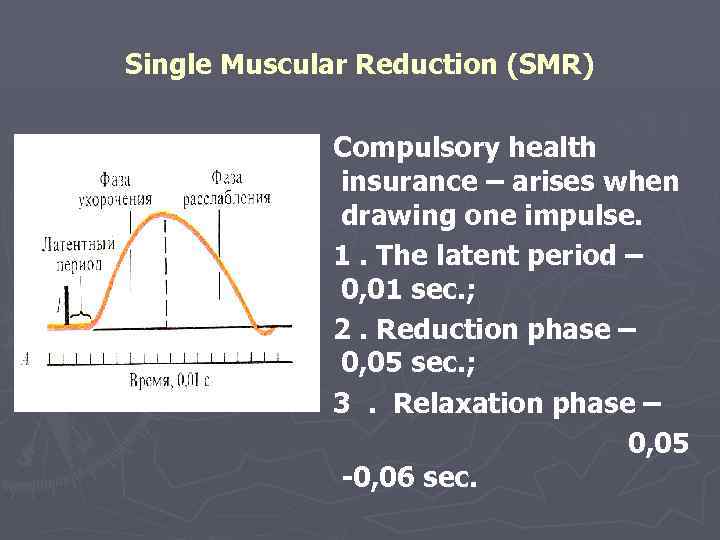
Single Muscular Reduction (SMR) Compulsory health insurance – arises when drawing one impulse. 1. The latent period – 0, 01 sec. ; 2. Reduction phase – 0, 05 sec. ; 3 . Relaxation phase – 0, 05 -0, 06 sec.
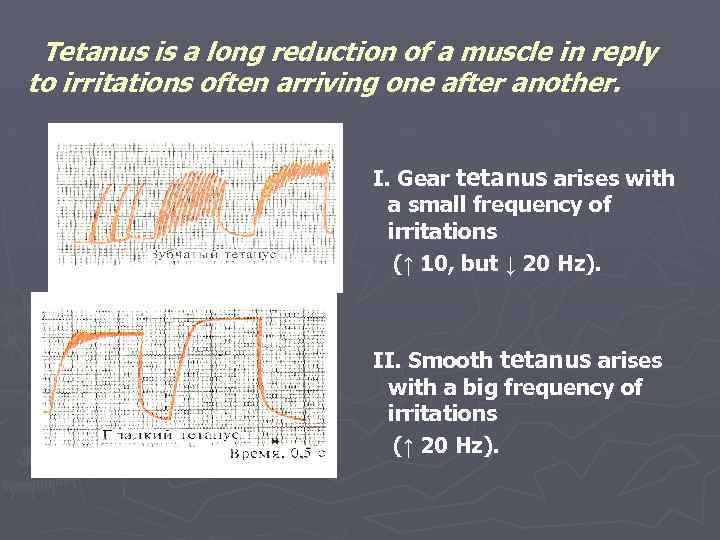
Tetanus is a long reduction of a muscle in reply to irritations often arriving one after another. I. Gear tetanus arises with a small frequency of irritations (↑ 10, but ↓ 20 Hz). II. Smooth tetanus arises with a big frequency of irritations (↑ 20 Hz).
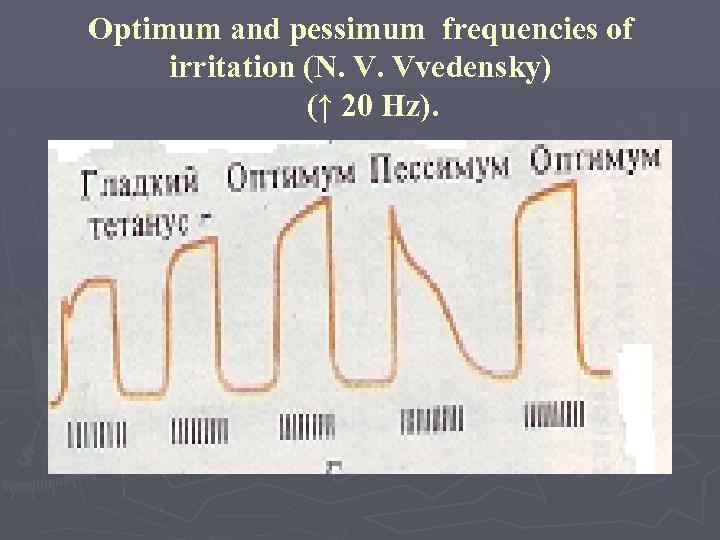
Optimum and pessimum frequencies of irritation (N. V. Vvedensky) (↑ 20 Hz).
The optimum is the maximum (optimum) frequency of irritation at which tetanus reaches the greatest height. Pessimum is a big frequency of irritation at which amplitude tetanus decreases.
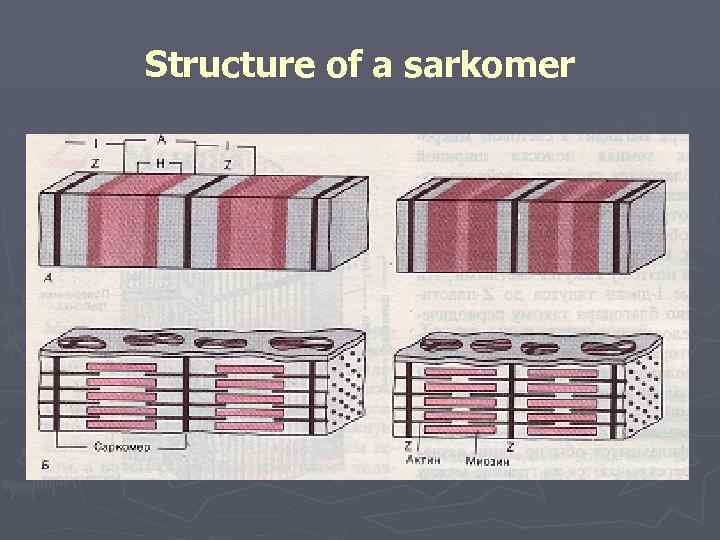
Structure of a sarkomer
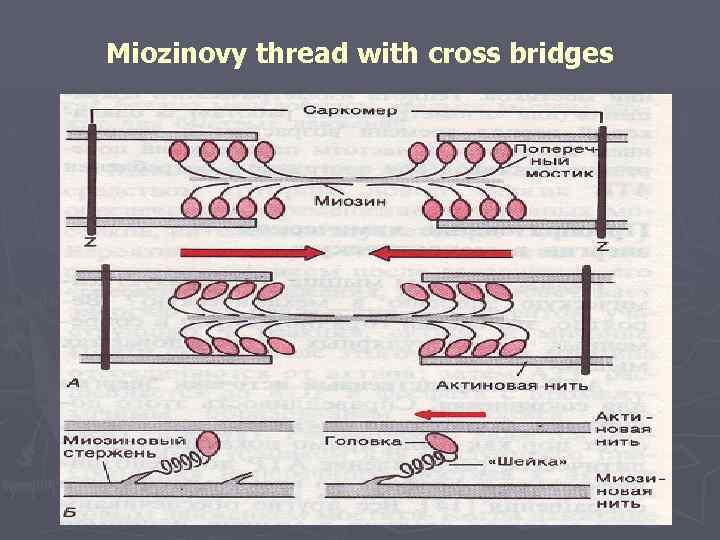
Miozinovy thread with cross bridges
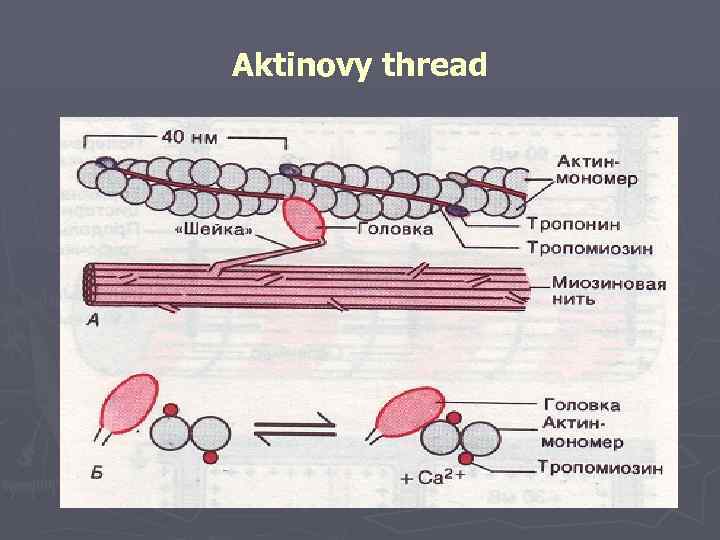
Aktinovy thread
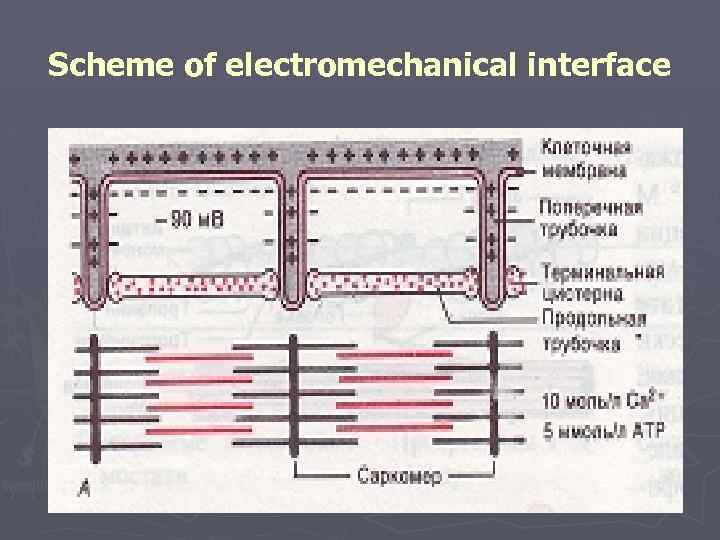
Scheme of electromechanical interface
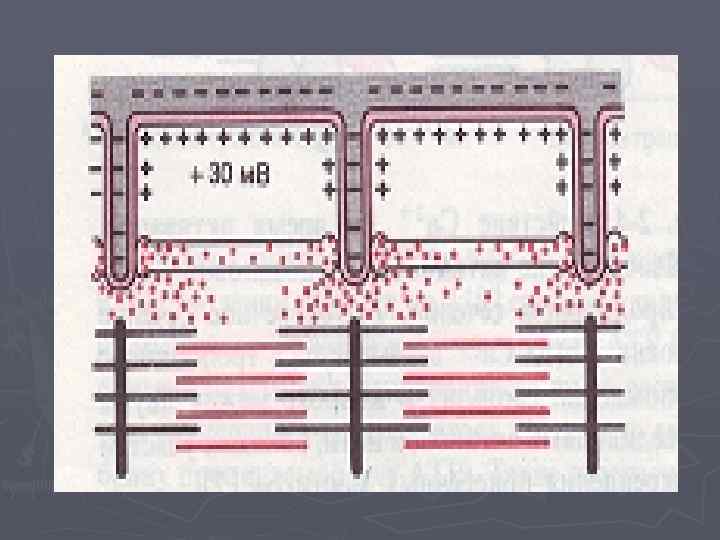
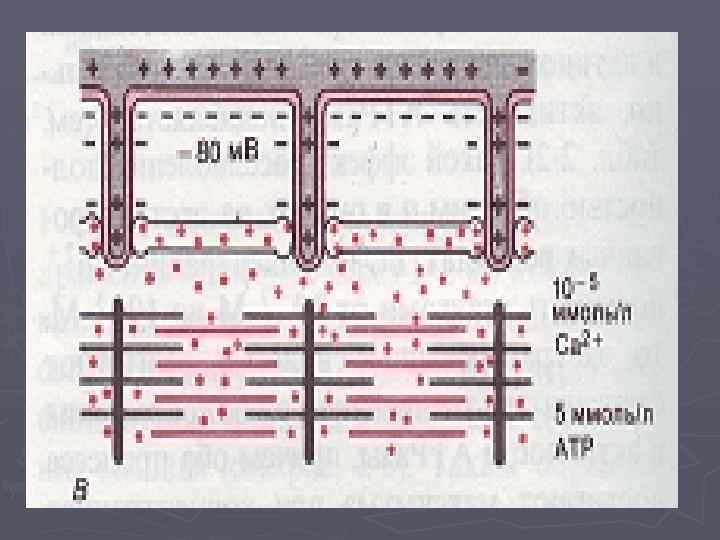
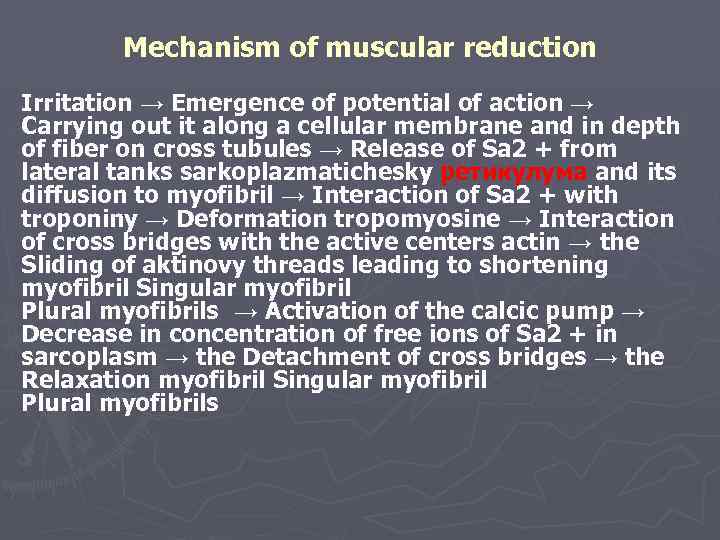
Mechanism of muscular reduction Irritation → Emergence of potential of action → Carrying out it along a cellular membrane and in depth of fiber on cross tubules → Release of Sa 2 + from lateral tanks sarkoplazmatichesky ретикулума and its diffusion to myofibril → Interaction of Sa 2 + with troponiny → Deformation tropomyosine → Interaction of cross bridges with the active centers actin → the Sliding of aktinovy threads leading to shortening myofibril Singular myofibril Plural myofibrils → Activation of the calcic pump → Decrease in concentration of free ions of Sa 2 + in sarcoplasm → the Detachment of cross bridges → the Relaxation myofibril Singular myofibril Plural myofibrils

The exhaustion is a temporary loss of operability of a cage, body or the whole organism caused work and disappearing after rest. There is a concept about, outdoor activities, (I. M. Setchenov).
Скачать презентацию Subject Physiological properties of muscles Lecture plan 1
2. Физ.Мышц.ppt