 Скачать презентацию Subgrid-Scale Transport in Cloud-Resolving Models Chin-Hoh Moeng NCAR
b97846216f837bb64d090bf1dc2b5486.ppt
- Количество слайдов: 34



Subgrid-Scale Transport in Cloud-Resolving Models Chin-Hoh Moeng NCAR Earth System Lab & CMMAP IPAM workshop (May 2010) NCAR & CMMAP are sponsored by the National Science Foundation
OUTLINE 1. SGS processes in climate models 2. Database (Giga-LES) and approach 3. A priori test of a two-part SGS scheme
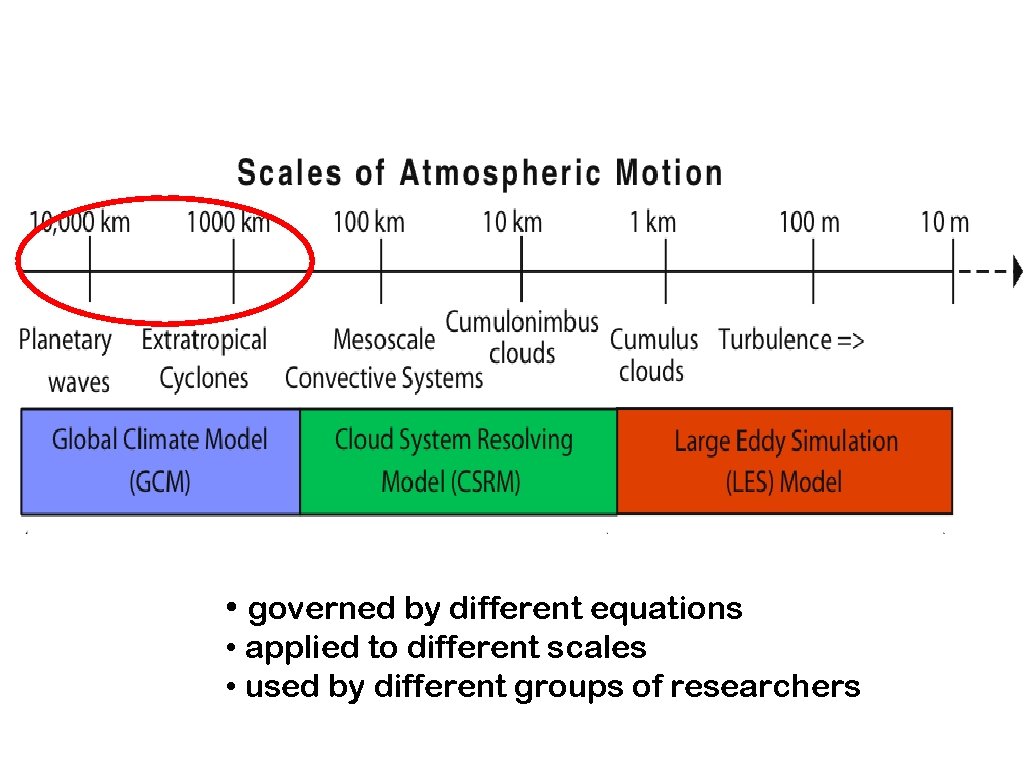
• governed by different equations • applied to different scales • used by different groups of researchers
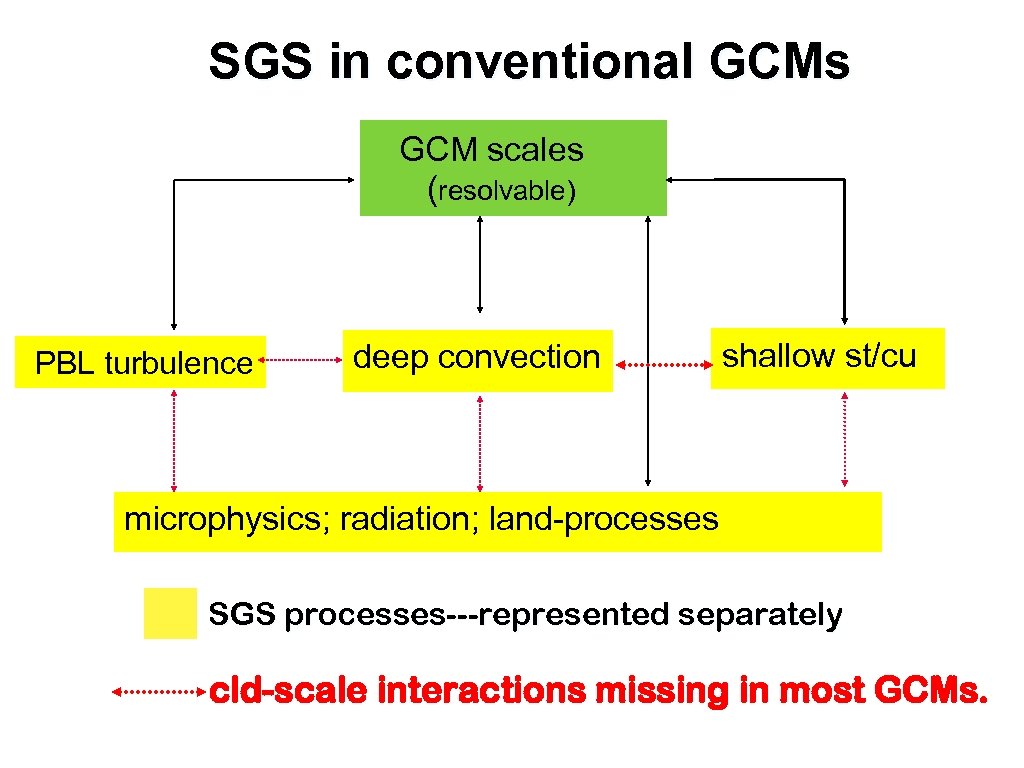
SGS in conventional GCMs GCM scales (resolvable) PBL turbulence deep convection shallow st/cu microphysics; radiation; land-processes SGS processes---represented separately cld-scale interactions missing in most GCMs.
However, cloud-scale interactions are many and crucial: • cloud/precip. • cloud dynamics • cloud amount • …. PBL turbulence land process microphysics mass transport radiation
As computer power grows, global models are using finer grid: Fine-grid NWP Global Cloud Resolving Model (GCRM) to explicitly calculate large cloud systems.
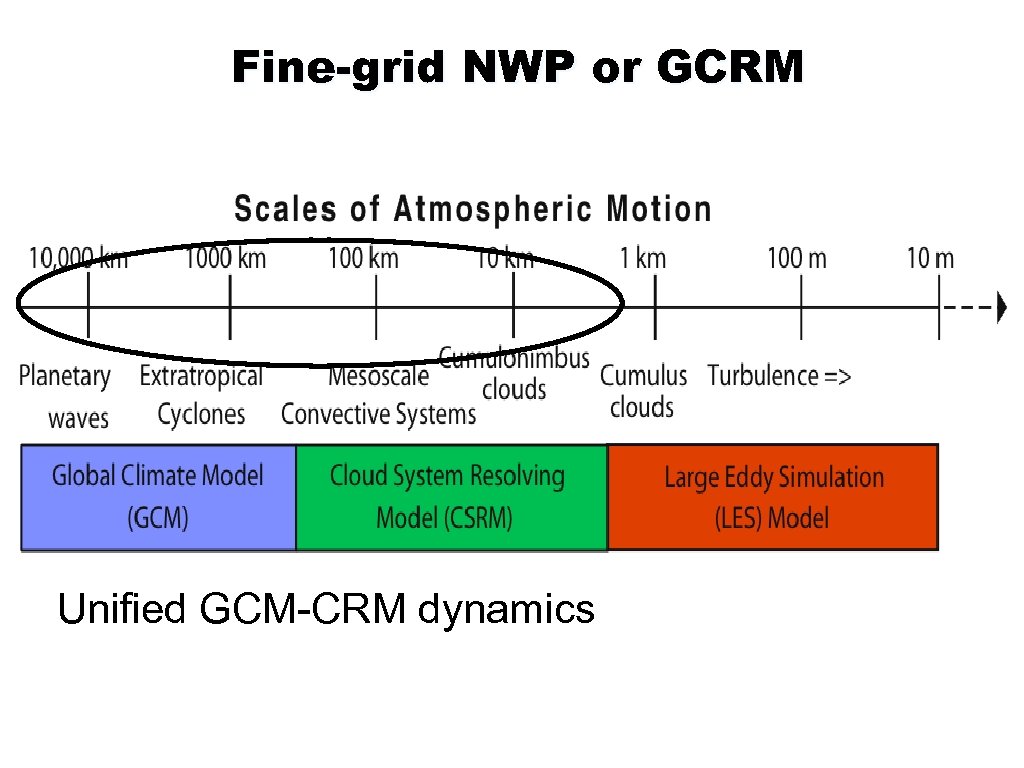
Fine-grid NWP or GCRM Unified GCM-CRM dynamics
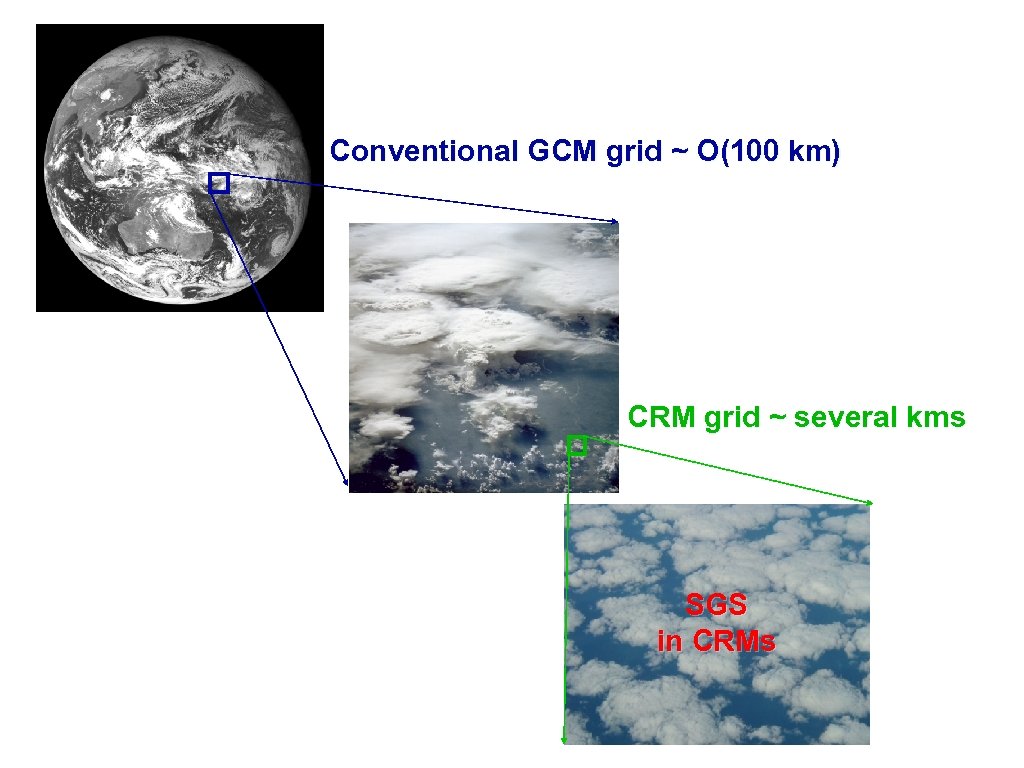
Conventional GCM grid ~ O(100 km) CRM grid ~ several kms SGS in CRMs
SGS processes in CRMs: • small and thin clouds (PBL stratocumulus and fair-weather cu) • • • transport by small conv. & turbulence cloud microphysics radiative transfer land processes …
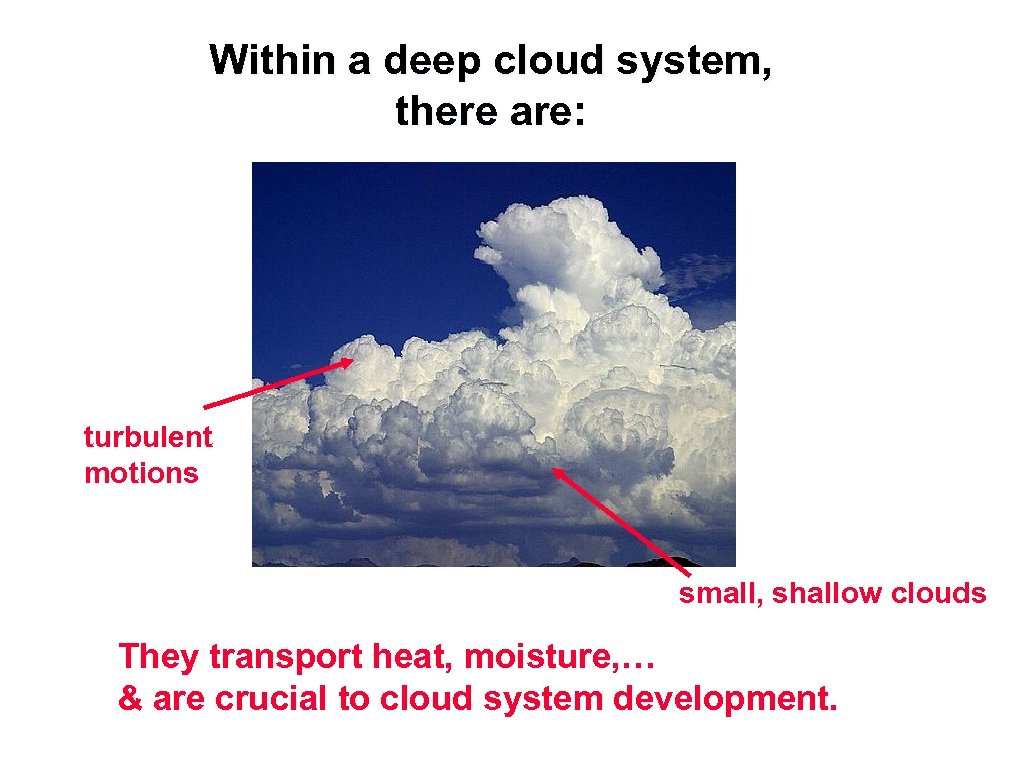
Within a deep cloud system, there are: turbulent motions small, shallow clouds They transport heat, moisture, … & are crucial to cloud system development.
Objective: To improve representation of SGS transport in CRMs.
OUTLINE 1. SGS processes in climate models 2. Database (Giga-LES) and approach 3. A priori test of a two-part SGS scheme
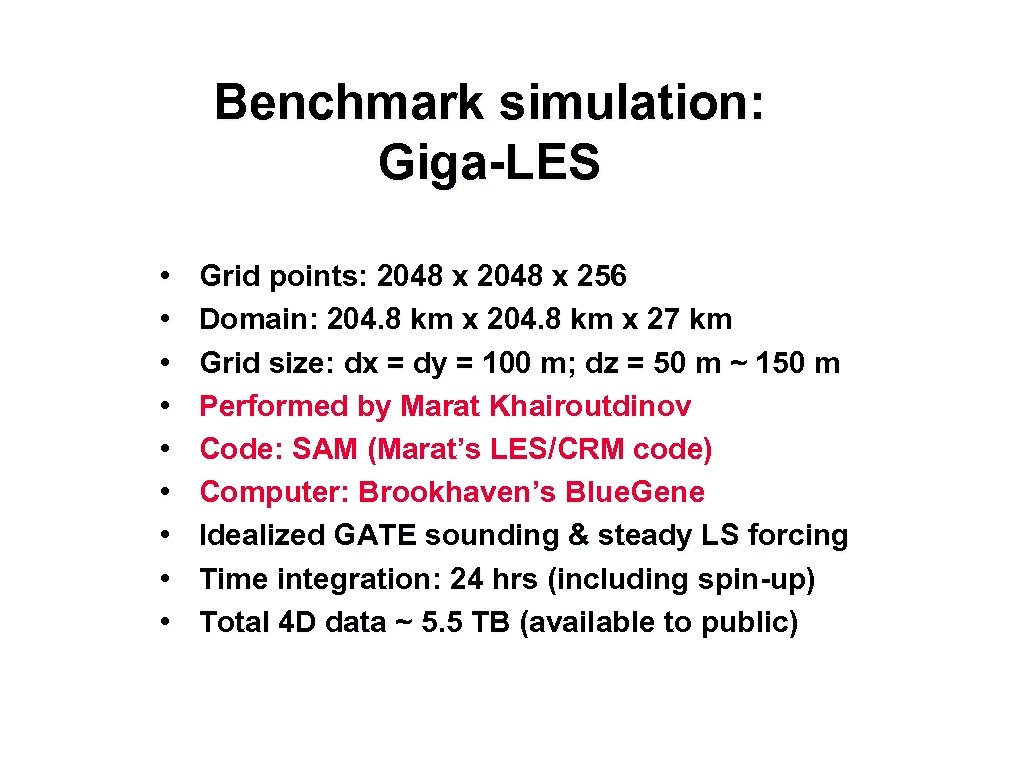
Benchmark simulation: Giga-LES • • • Grid points: 2048 x 256 Domain: 204. 8 km x 27 km Grid size: dx = dy = 100 m; dz = 50 m ~ 150 m Performed by Marat Khairoutdinov Code: SAM (Marat’s LES/CRM code) Computer: Brookhaven’s Blue. Gene Idealized GATE sounding & steady LS forcing Time integration: 24 hrs (including spin-up) Total 4 D data ~ 5. 5 TB (available to public)
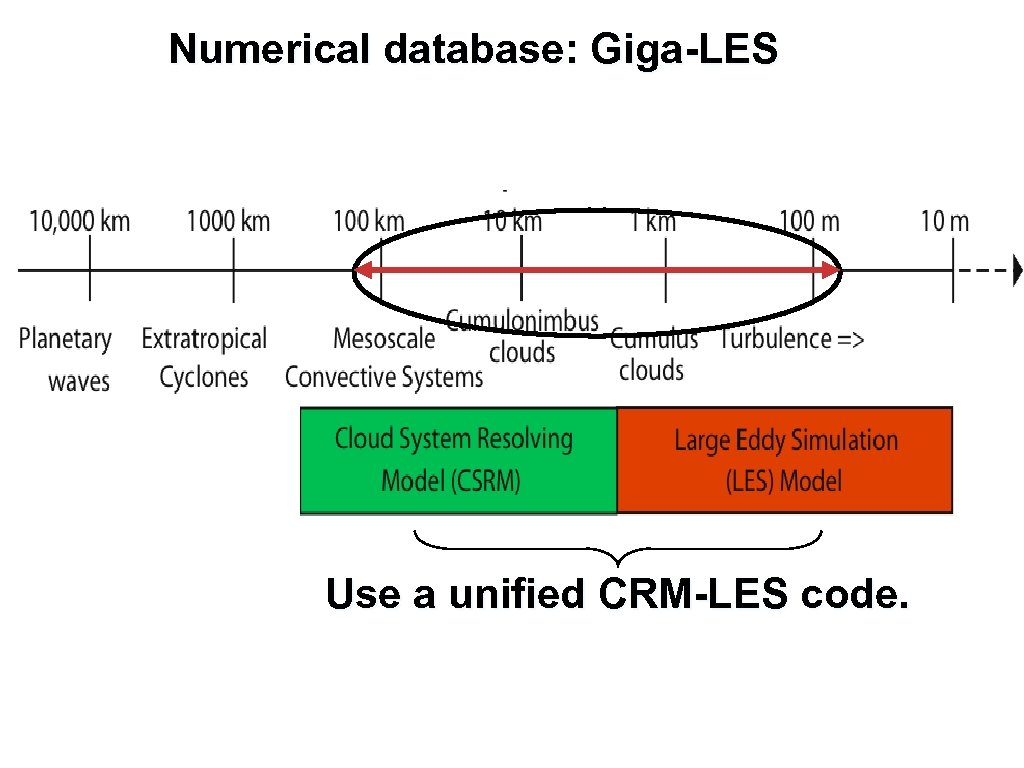
Numerical database: Giga-LES Use a unified CRM-LES code.
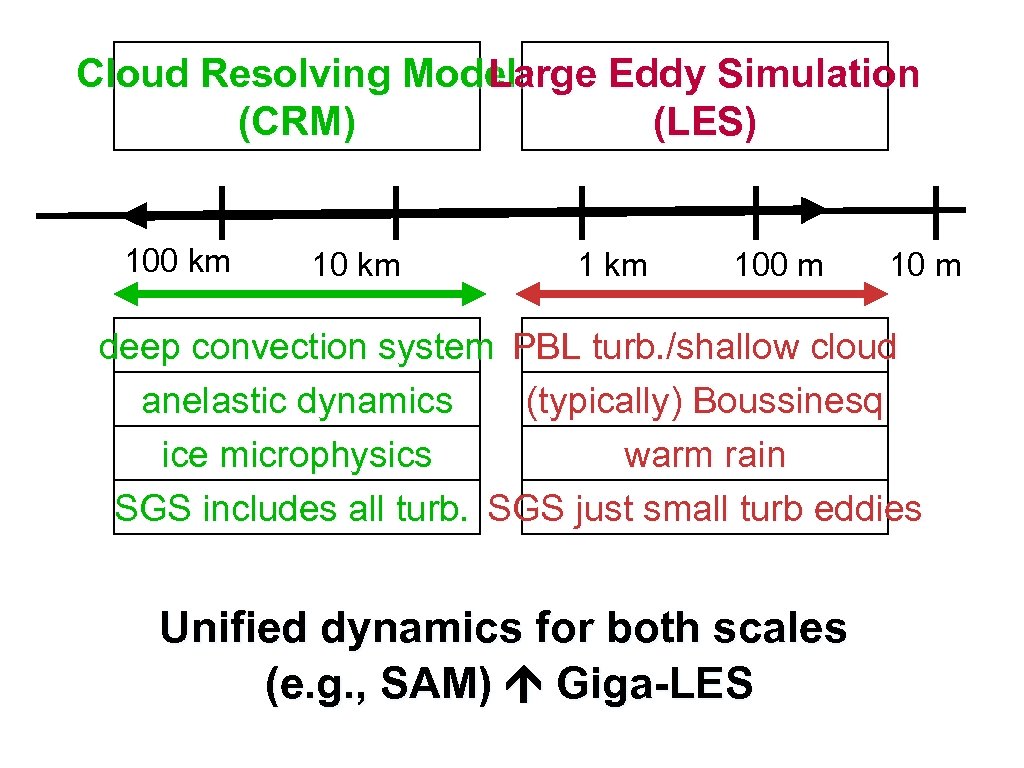
Cloud Resolving Model Large Eddy Simulation (CRM) (LES) 100 km 100 m 10 m deep convection system PBL turb. /shallow cloud anelastic dynamics (typically) Boussinesq ice microphysics warm rain SGS includes all turb. SGS just small turb eddies Unified dynamics for both scales (e. g. , SAM) Giga-LES
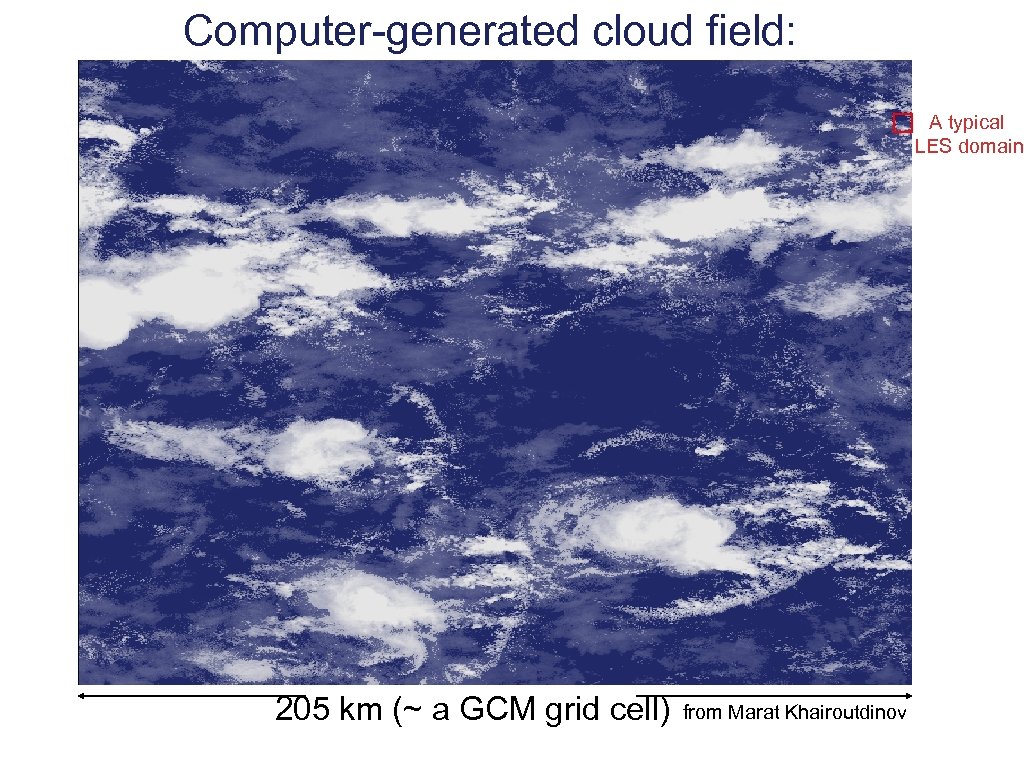
Computer-generated cloud field: A typical LES domain N 205 km (~ a GCM grid cell) from Marat Khairoutdinov
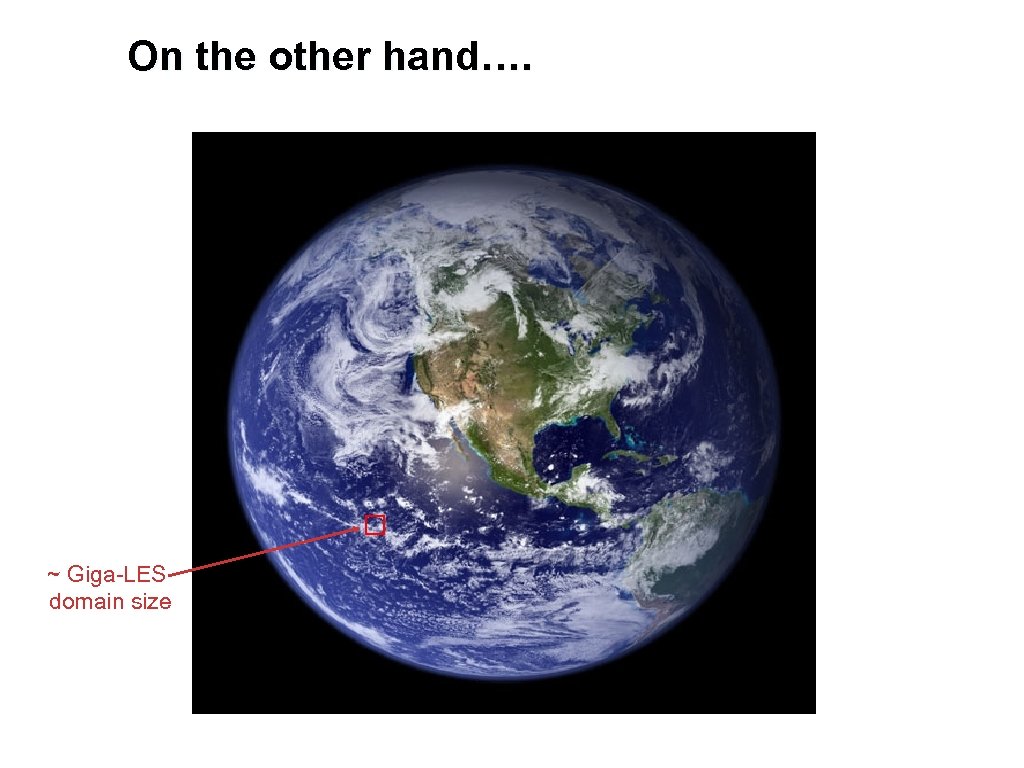
On the other hand…. ~ Giga-LES domain size
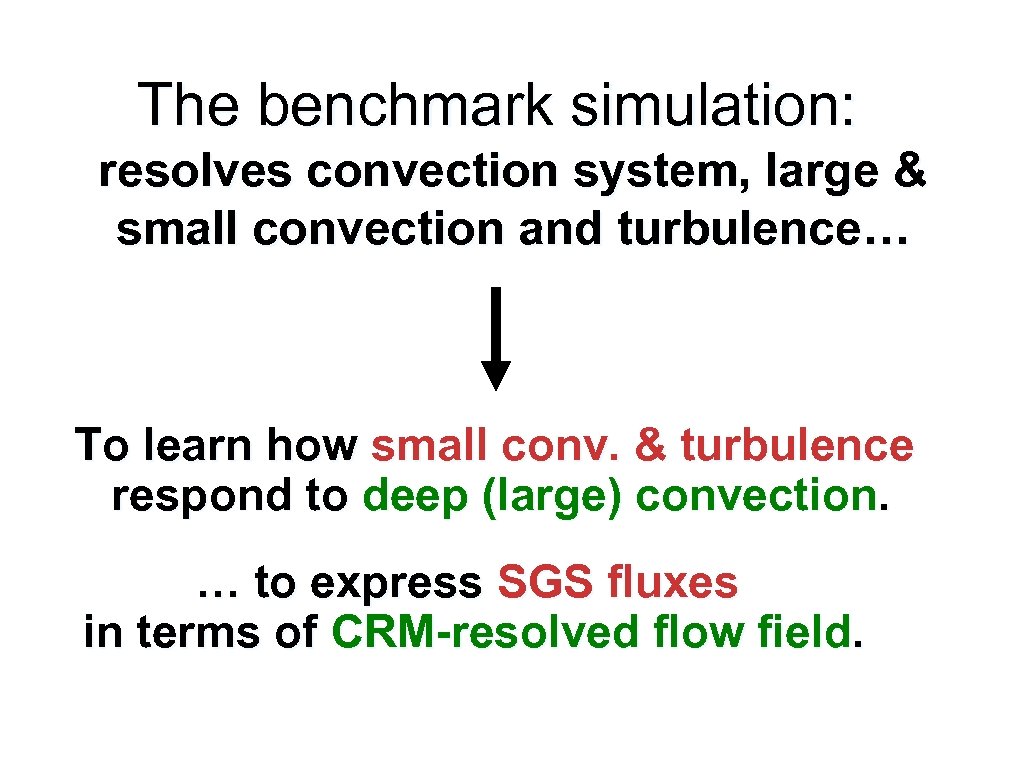
The benchmark simulation: resolves convection system, large & small convection and turbulence… To learn how small conv. & turbulence respond to deep (large) convection. … to express SGS fluxes in terms of CRM-resolved flow field.
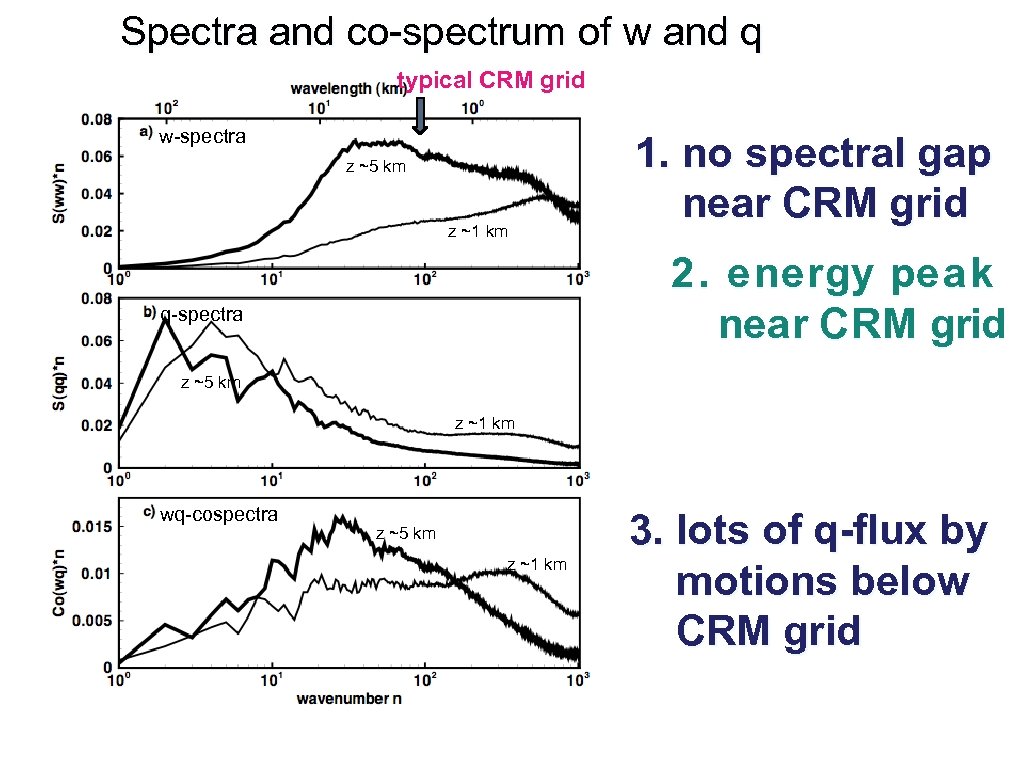
Spectra and co-spectrum of w and q typical CRM grid w-spectra z ~5 km z ~1 km 1. no spectral gap near CRM grid 2. energy peak near CRM grid q-spectra z ~5 km z ~1 km wq-cospectra z ~5 km z ~1 km 3. lots of q-flux by motions below CRM grid
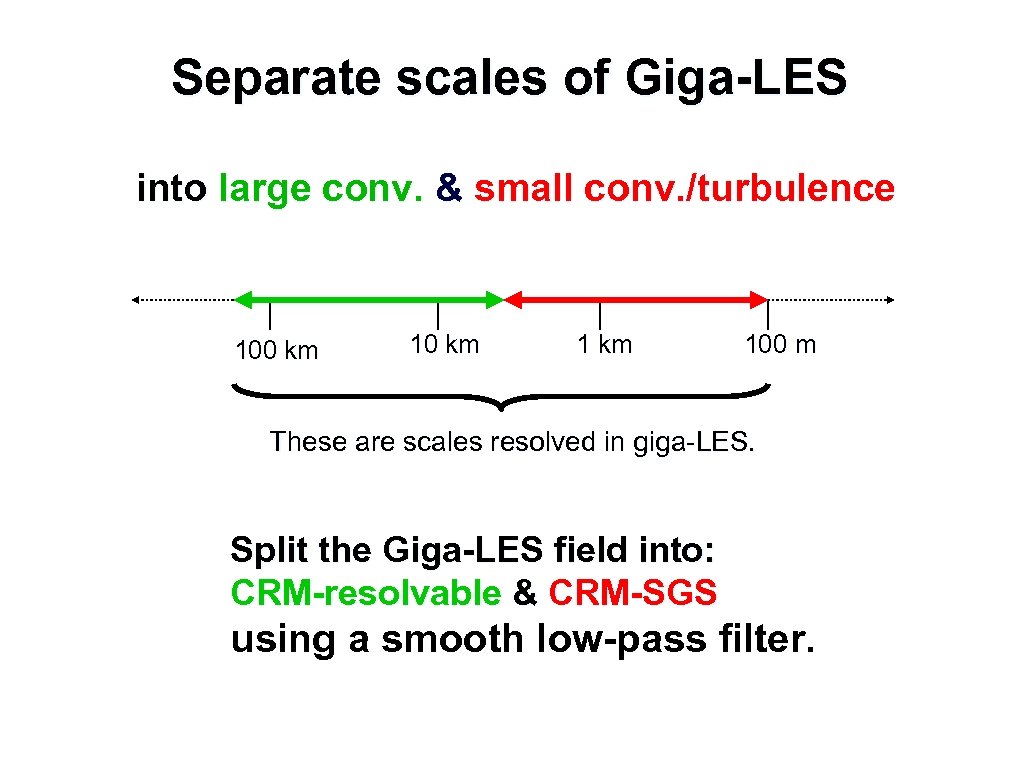
Separate scales of Giga-LES into large conv. & small conv. /turbulence 100 km 100 m These are scales resolved in giga-LES. Split the Giga-LES field into: CRM-resolvable & CRM-SGS using a smooth low-pass filter.
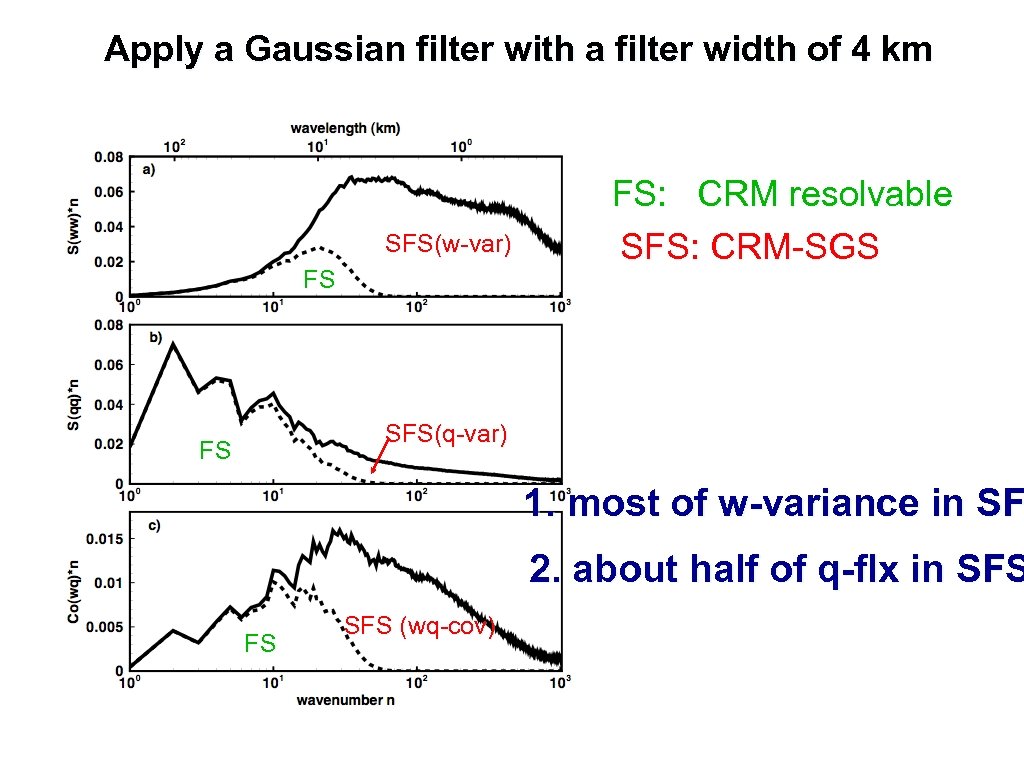
Apply a Gaussian filter with a filter width of 4 km SFS(w-var) FS FS: CRM resolvable SFS: CRM-SGS SFS(q-var) FS 1. most of w-variance in SF 2. about half of q-flx in SFS FS SFS (wq-cov)
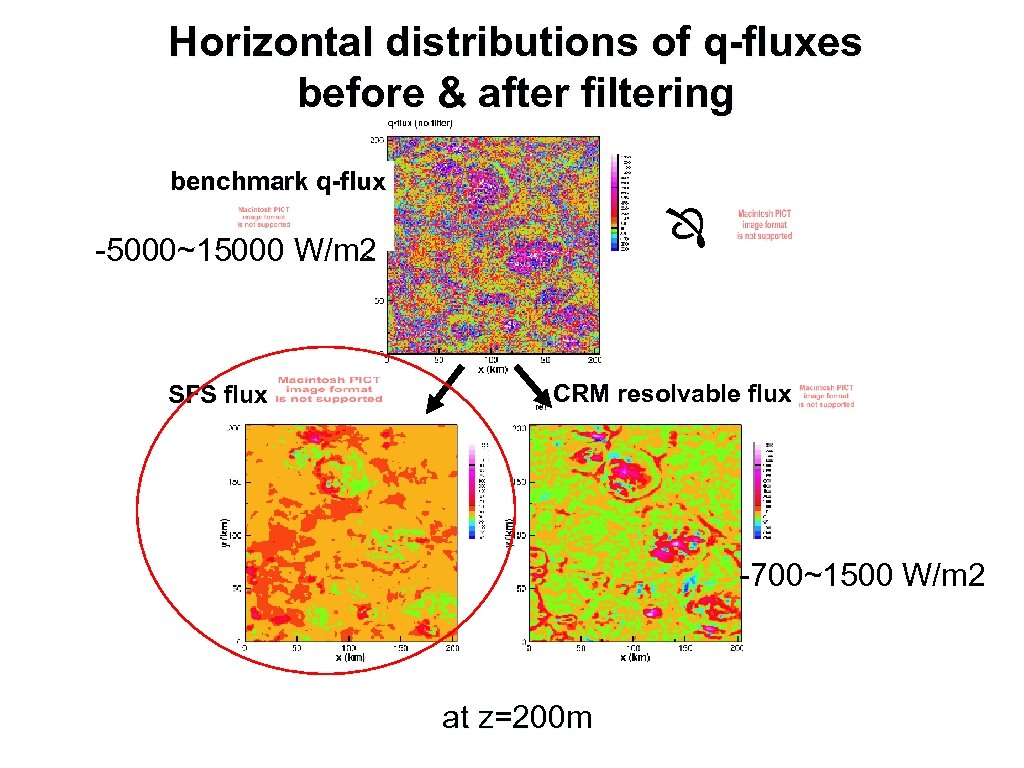
Horizontal distributions of q-fluxes before & after filtering benchmark q-flux -5000~15000 W/m 2 SFS flux CRM resolvable flux -700~1500 W/m 2 at z=200 m
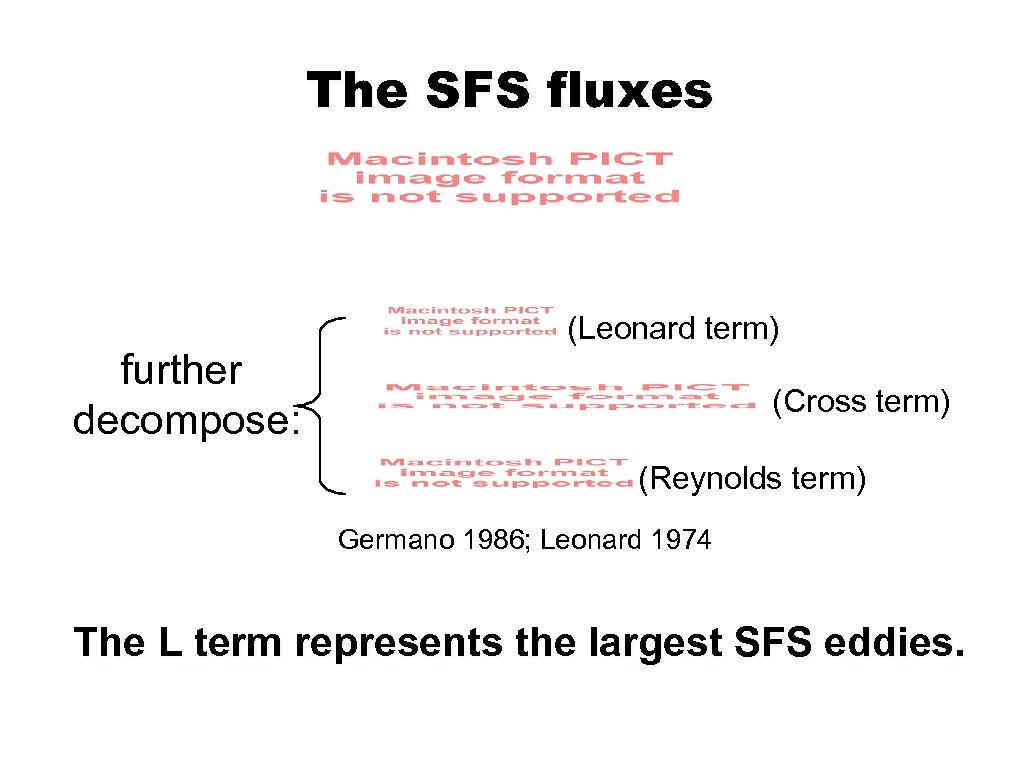
The SFS fluxes (Leonard term) further decompose: (Cross term) (Reynolds term) Germano 1986; Leonard 1974 The L term represents the largest SFS eddies.
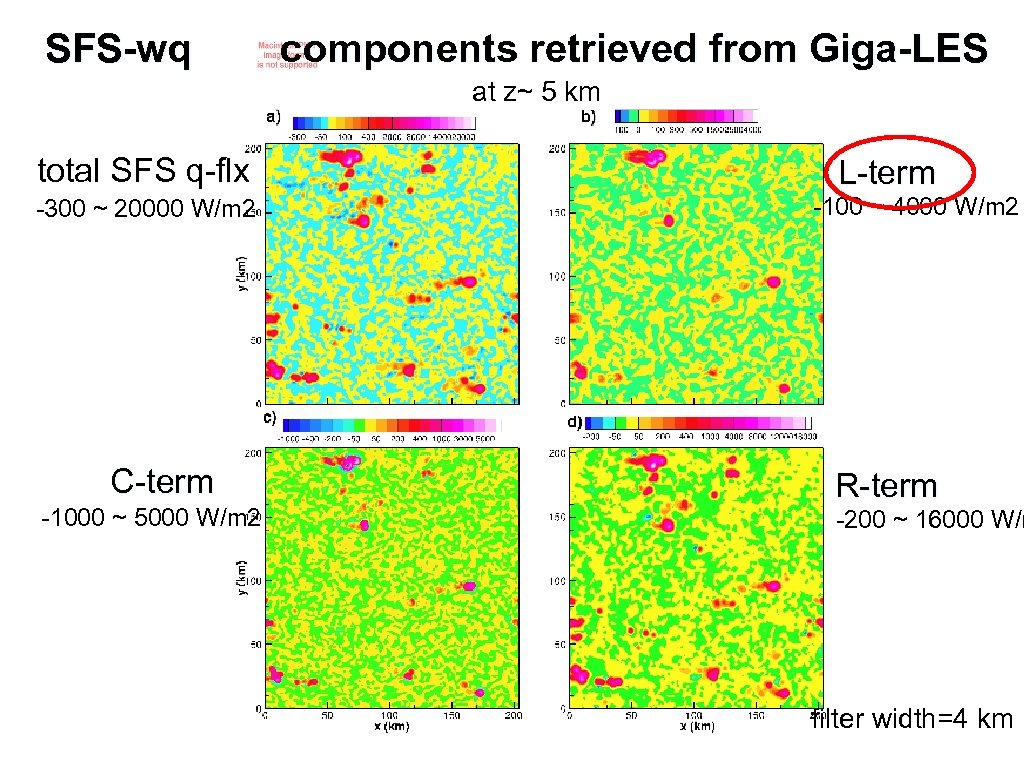
SFS-wq components retrieved from Giga-LES at z~ 5 km total SFS q-flx -300 ~ 20000 W/m 2 C-term -1000 ~ 5000 W/m 2 L-term -100 ~ 4000 W/m 2 R-term -200 ~ 16000 W/m filter width=4 km
Approximation for the L term use Taylor series: following Leonard (1974) and Clark et al (1979)
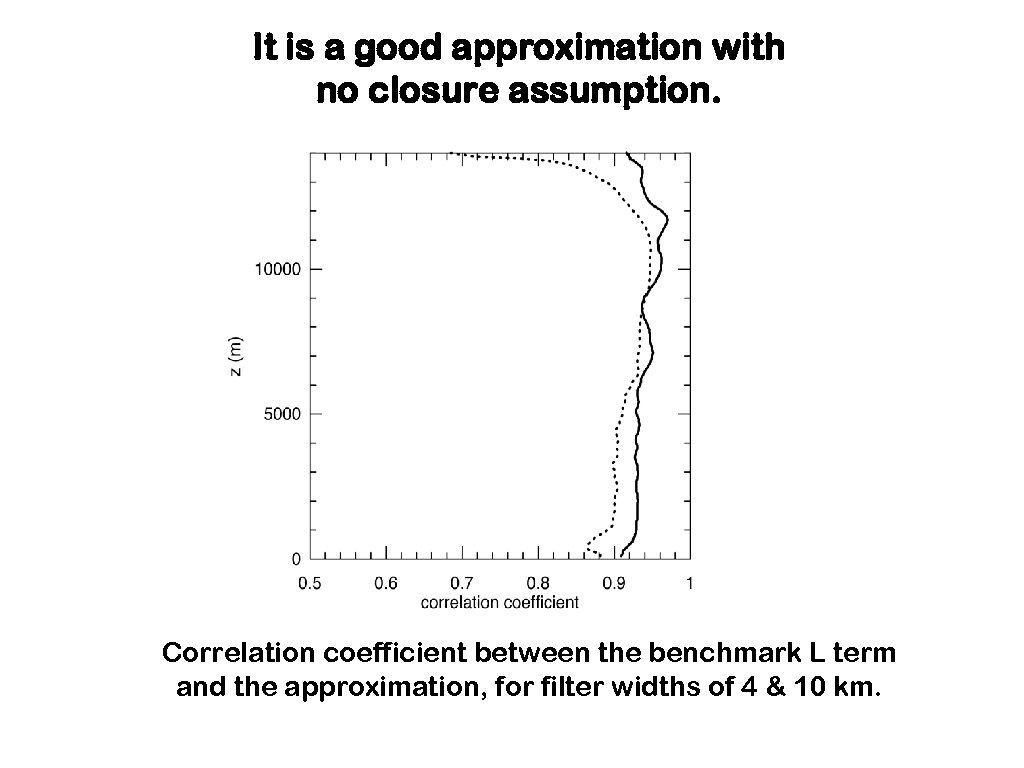
It is a good approximation with no closure assumption. Correlation coefficient between the benchmark L term and the approximation, for filter widths of 4 & 10 km.
The two-part scheme for SGS fluxes in CRMs The Giga-LES suggests that C ~ L. wher e are CRM resolvable variables.
First part is the commonly used Smag. -Deardorff SGS model needed for energy dissipation. Second part is the L+C term, for scale interaction; it is easy to implement in CRMs.
OUTLINE 1. SGS processes in climate models 2. Database (Giga-LES) and approach 3. A priori test of the two-part SGS scheme
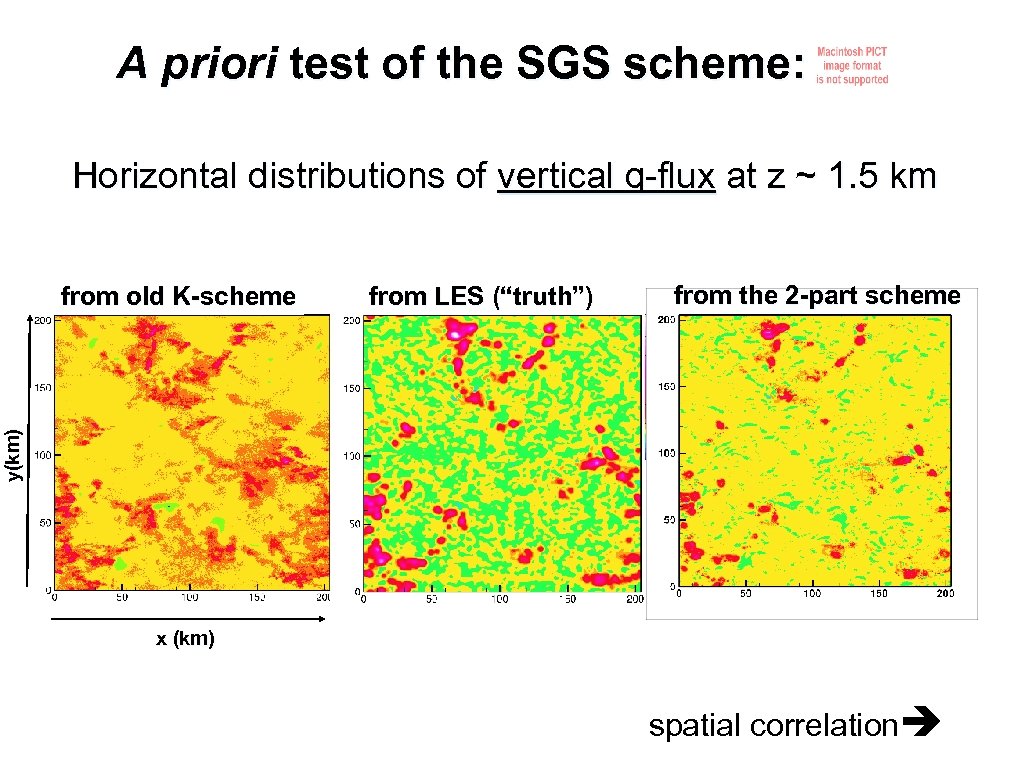
A priori test of the SGS scheme: Horizontal distributions of vertical q-flux at z ~ 1. 5 km from LES (“truth”) from the 2 -part scheme y(km) from old K-scheme x (km) spatial correlation
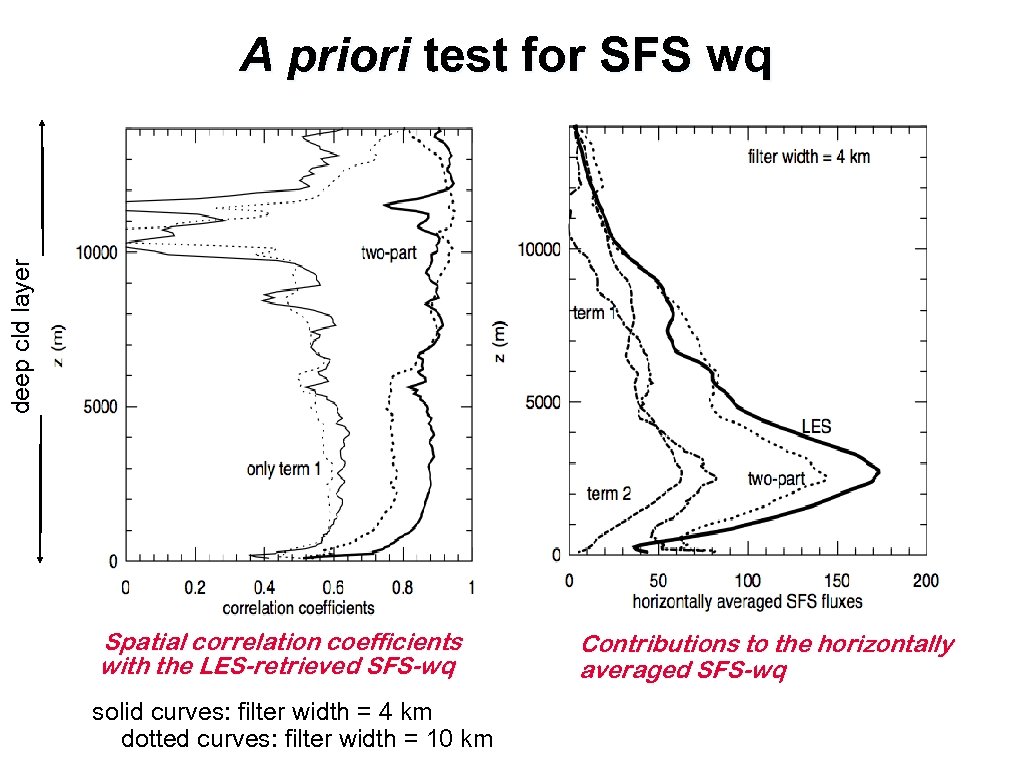
deep cld layer A priori test for SFS wq Spatial correlation coefficients with the LES-retrieved SFS-wq solid curves: filter width = 4 km dotted curves: filter width = 10 km Contributions to the horizontally averaged SFS-wq
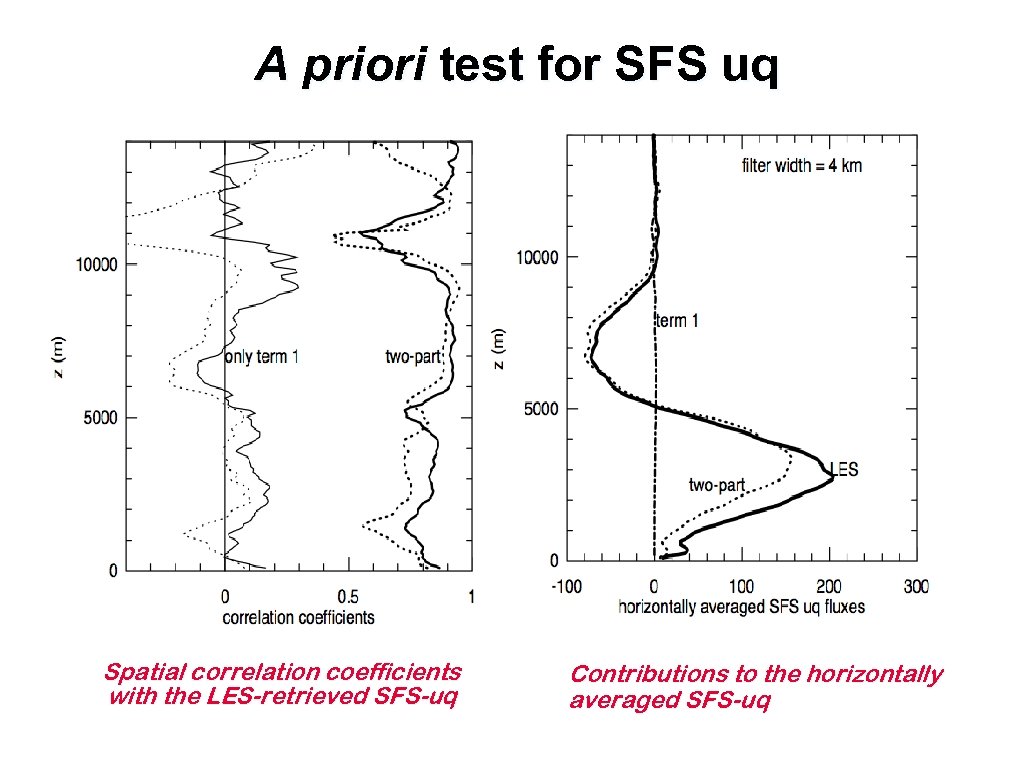
A priori test for SFS uq Spatial correlation coefficients with the LES-retrieved SFS-uq Contributions to the horizontally averaged SFS-uq
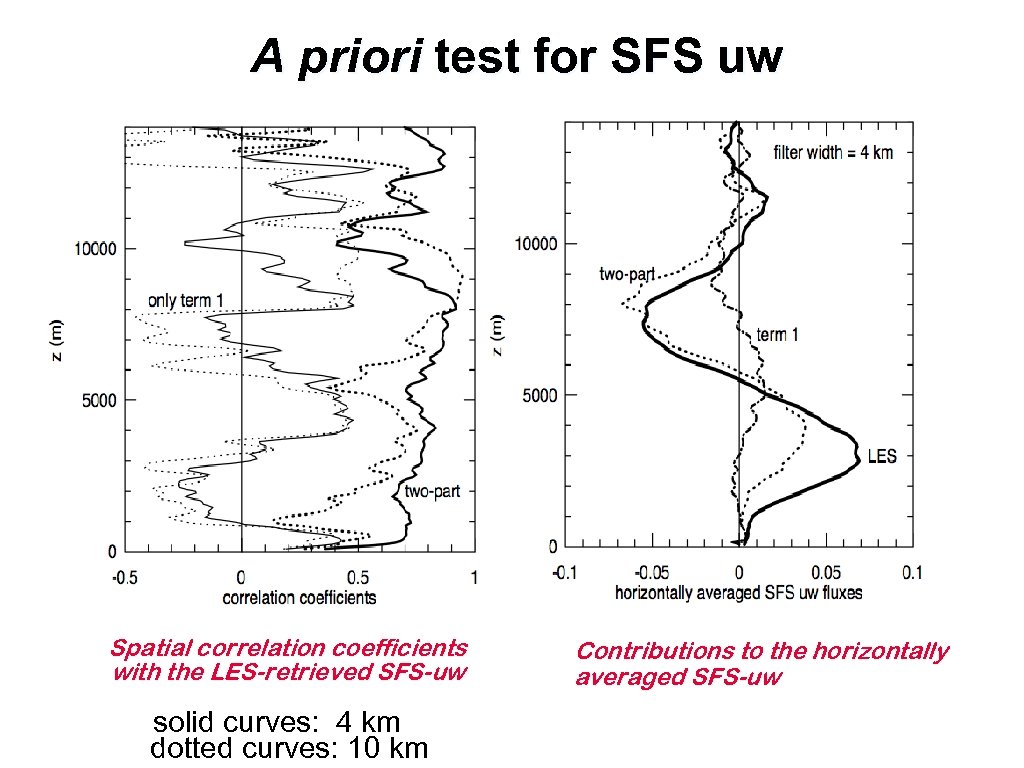
A priori test for SFS uw Spatial correlation coefficients with the LES-retrieved SFS-uw solid curves: 4 km dotted curves: 10 km Contributions to the horizontally averaged SFS-uw
SUMMARY • Giga-LES is useful benchmark to study SGS for CRMs. • No spectral gap exists between CRM-resolvable & SGS. • Most energy & transport occur near typical CRM grid, thus largest SGS eddies are important. • A prior test of the two-part SGS transport scheme shows promising results. Full test next… NCAR is sponsored by the National Science Foundation
Скачать презентацию Subgrid-Scale Transport in Cloud-Resolving Models Chin-Hoh Moeng NCAR
b97846216f837bb64d090bf1dc2b5486.ppt