 Скачать презентацию Sub-Regional Workshop on International Merchandise Trade Statistics Compilation
1846643581fd1046745b8b89442880b7.ppt
- Количество слайдов: 7



Sub-Regional Workshop on International Merchandise Trade Statistics Compilation and Export and Import Unit Value Indices 21 – 25 November 2016. Guam Reef & Olive Spa Resort, Tamuning, Guam VALUATION Presentation by Nilima Lal Economic Statisticians, Pacific Community Email: Nilima. L@spc. int
Statistical value of imports and exports Statistical value: a statistical value should be used for recording all goods covered in international merchandise trade statistics, whether sold, exchanged or provided without payment, following the specific rules defined below: – Customs valuation and statistical value • Single Administrative Document (SAD) contains a special entry for statistical value – Transaction value – WTO Agreement on Valuation – FOB-type and CIF-type values – Country practices Statistical value of exported and imported goods: to promote the comparability of IMTS, while taking into account various analytical needs and the commercial and data-reporting practices of the majority of countries, it is recommended that: • The statistical value of exported goods be a FOB-type value; • The statistical value of imported goods be a CIF-type value; – however, countries are encouraged to compile FOB-type value of imported goods as supplementary information – Countries that compile only CIF-type values for imported goods are encouraged to compile separate data for freight and insurance.
Compilation of FOB-type and CIF-type values Terms of delivery Customs administrations require FOB or CIF-type value to be placed on the customs declarations by traders, if not they calculate those values themselves based on documents submitted by traders using the contract of sale which contains the terms of delivery of goods and the price of the goods, and the invoice issued by the seller of the goods to the buyer. The price of the goods negotiated between traders are reflected in the invoice (also referred to as invoice price). Establishing the statistical value A variety of detail is given in the terms of delivery of goods. Statisticians should: • • carefully examine available data sources and information, including the terms of goods delivery, in order to derive the recommended FOB/CIF values establish a close cooperation with customs and other primary data collectors in order to provide guidance on the methodology regarding the statistical value and to ensure the availability of adequate data. Customs value, when established in compliance with the WTO Agreement on Customs Valuation should form the basis of the statistical value. Should values placed on goods by customs authorities not comply with statistical requirements, use values derived from non-customs sources or estimate values: • Important for exports Use of additional sources of information is always recommended.
Selected issues of valuation Some transactions present difficulties for the valuation of goods due to: – the complexity of the transaction or the peculiarity of the goods – transactions may not require goods valuation by the parties involved and are not accompanied by the movement of currency or credit. However, all categories of goods should be valued on the basis of the WTO Agreement on Customs Valuation. Special care should be taken of: – Banknotes and securities and coins not in circulation – Media, whether or not recorded – Electricity, gas, oil and water – Goods under financial lease that cross borders – Goods for processing with or without change of ownership – Returned goods – Goods bundled with services – Transactions without valuation Cooperation in valuation: appropriate valuation of goods is very important for the accuracy of IMTS. The agency responsible for the overall compilation of trade statistics and the agencies that collect data should cooperate to provide reliable valuation of goods in all cases, especially for problem categories and irrespective of whether their prices are available.
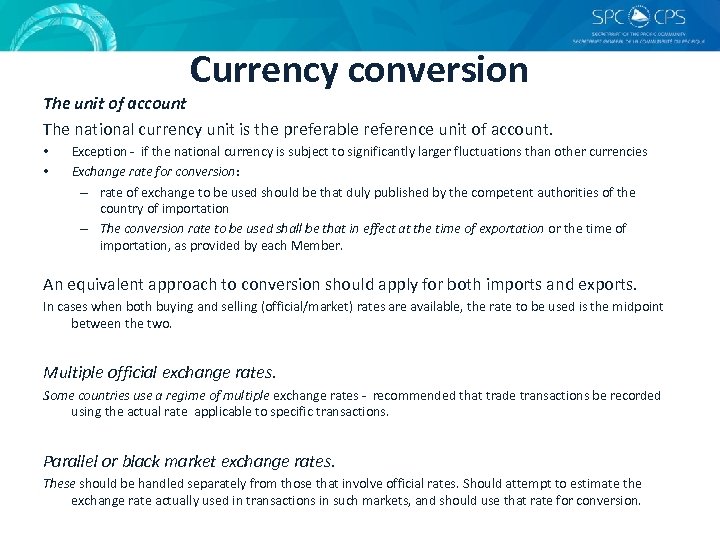
Currency conversion The unit of account The national currency unit is the preferable reference unit of account. • • Exception - if the national currency is subject to significantly larger fluctuations than other currencies Exchange rate for conversion: – rate of exchange to be used should be that duly published by the competent authorities of the country of importation – The conversion rate to be used shall be that in effect at the time of exportation or the time of importation, as provided by each Member. An equivalent approach to conversion should apply for both imports and exports. In cases when both buying and selling (official/market) rates are available, the rate to be used is the midpoint between the two. Multiple official exchange rates. Some countries use a regime of multiple exchange rates - recommended that trade transactions be recorded using the actual rate applicable to specific transactions. Parallel or black market exchange rates. These should be handled separately from those that involve official rates. Should attempt to estimate the exchange rate actually used in transactions in such markets, and should use that rate for conversion.
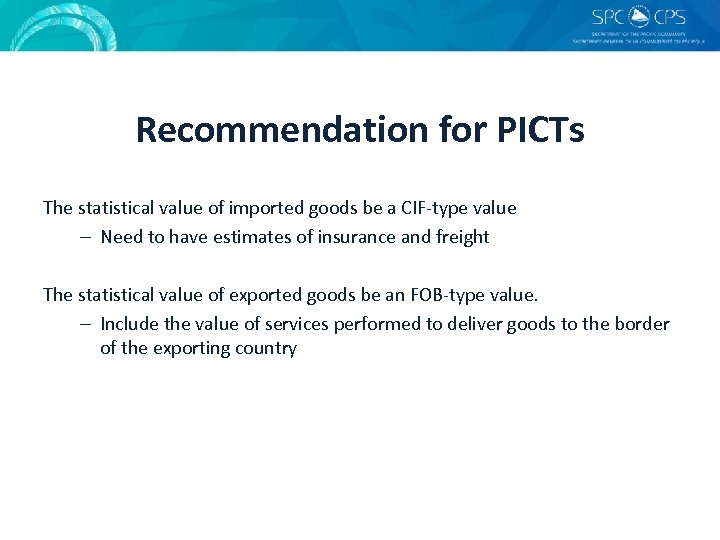
Recommendation for PICTs The statistical value of imported goods be a CIF-type value – Need to have estimates of insurance and freight The statistical value of exported goods be an FOB-type value. – Include the value of services performed to deliver goods to the border of the exporting country
 Скачать презентацию Sub-Regional Workshop on International Merchandise Trade Statistics Compilation
1846643581fd1046745b8b89442880b7.ppt