


 Скачать презентацию Stylistics Literature 1 I R Galperin Stylistics 2
18-04-2012_8_44_Lecture_1.ppt
- Количество слайдов: 22
 Stylistics Literature: 1) I. R. Galperin. Stylistics 2) И. В. Арнольд. Стилистика. Современный английский язык 3) Ю. М. Скребнев. Основы стилистики английского языка 4) V. A. Kukharenko. Seminars in style
 Lecture 1 THE SUBJECT MATTER OF STYLISTICS Items for discussion: Subject matter of stylistics and its connection with other disciplines l The problem of style l Stylistic classification of the English vocabulary l
 l The English vocabulary, its main layers, their aspects. l The standard English vocabulary. Neutral words l Literary vocabulary, its constituent parts. l Colloquial vocabulary, its constituent parts.
 l stylistic phonetics (phenomena of sound arrangement of both prose and verse, i. e. rhythm, rhyme, alliteration, etc); l stylistic morphology (stylistic potentialities of different grammatical categories and parts of speech); l stylistic lexicology (stylistic functions of words, expressive, emotive, evaluative potentialities of words and their stylistic reference, etc); l stylistic syntax (expressive potentialities of word order, different types of sentence structures and syntactical ties, etc).
 Stylistics deals with: ¡ the investigations of the inventory of special language media which secure the desirable effect of the utterance - stylistic devices (SD) and expressive means (EM) ¡ the investigation of certain types of text functional styles of language (FS)
 l The word STYLE (Latin STILUS, Greek STYLOS) meant a short stick sharp at one end and flat at the other used by the Romans for writing on wax tablets. l It is a set of characteristics distinguishing one author from another. l Style belongs to the plane of expression and not to the plane of content. l Style is specificity of sublanguage.
 l The notion of NORM refers to the literary language and implies conventionally accepted characteristics of what is evaluated. e. g. I haven’t ever done anything. I ain’t never done nothing. lass chicken
 The word-stock of the English language is divided into three main layers: lthe literary layer lthe neutral layer lthe colloquial layer
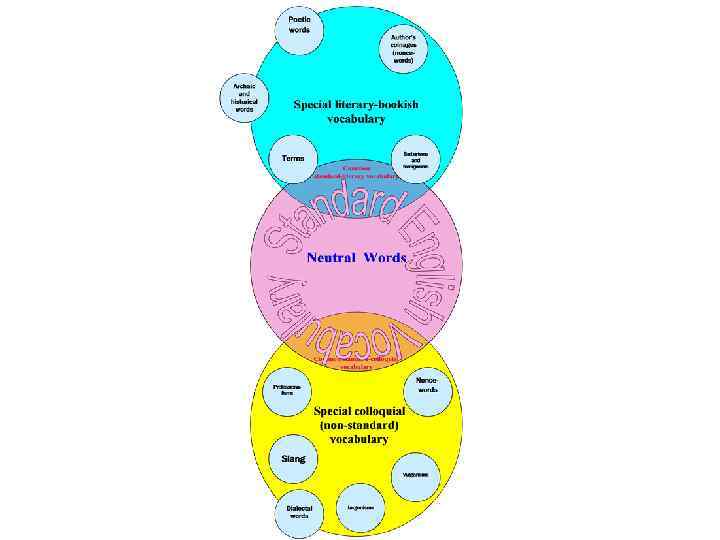
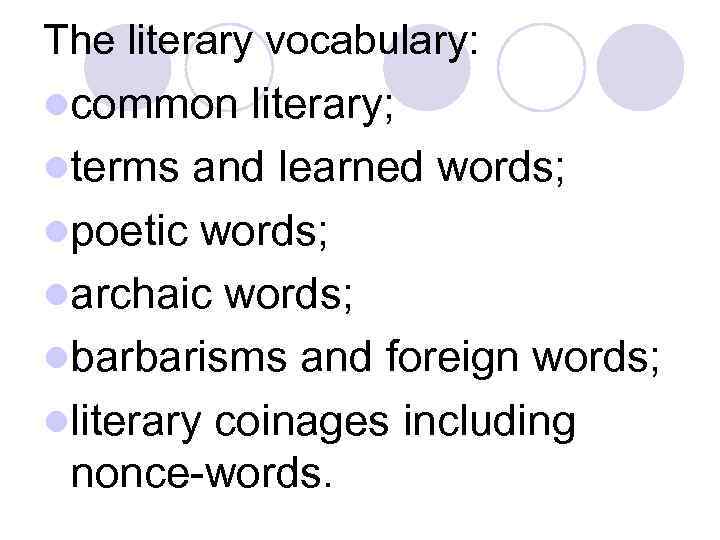 The literary vocabulary: lcommon literary; lterms and learned words; lpoetic words; larchaic words; lbarbarisms and foreign words; lliterary coinages including nonce-words.
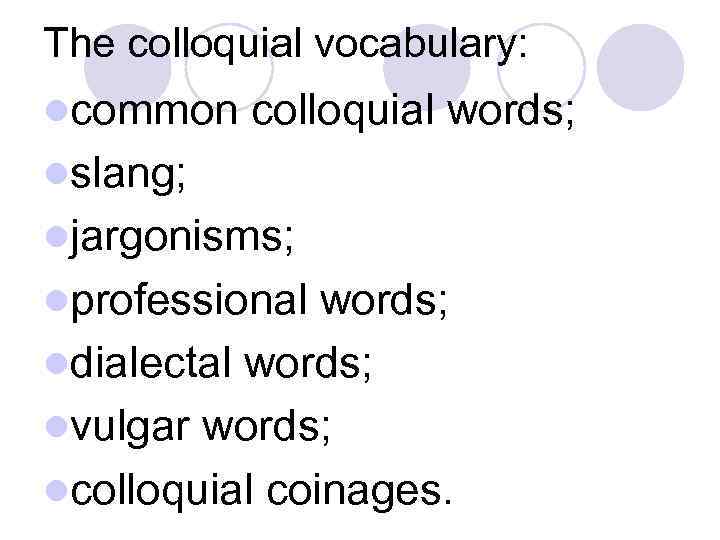 The colloquial vocabulary: lcommon colloquial words; lslang; ljargonisms; lprofessional words; ldialectal words; lvulgar words; lcolloquial coinages.
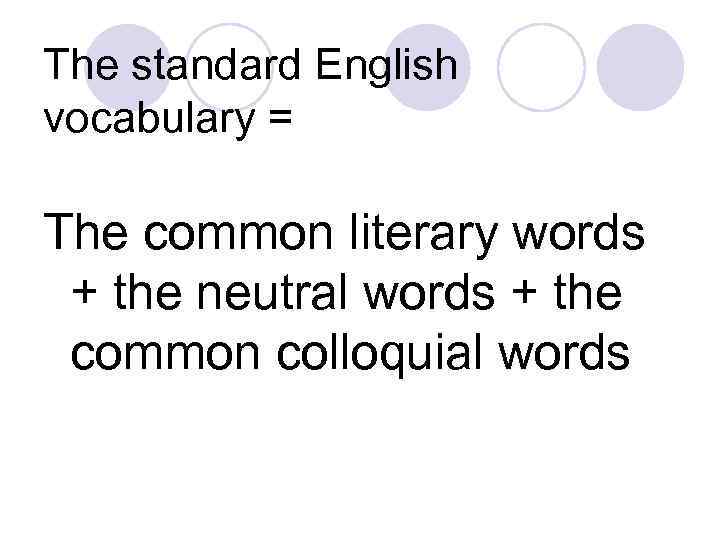 The standard English vocabulary = The common literary words + the neutral words + the common colloquial words
 Archaisms 1) Archaic words proper thou and its forms thee, thy and thine; -(e)th instead of -(e)s (he maketh); 2) Historisms Vassal, falconet 3) Poetic words Steed (horse), woe (sorrow)
 Barbarisms: lchic (=stylish); lbon mot (=a clever witty saying); len passant (= in passing); lad infinitum (= to infinity).
 Neologisms stylistic coinages: - tomatorama, bananarama (a sensational sale of bananas, tomatoes); - blends such as avigation (aviation+navigation), rockoon (rocket+balloon)
 Nonce-words: l "Let me say in the beginning that even if I wanted to avoid Texas I could not, for I am wived in Texas, and mother-inlawed, and uncled, and aunted, and cousined within an inch of my life. " (J. Steinbeck) l "sevenish" (around seven o'clock); l "morish" (a little more) (A. Christie).
 Neologisms coined by contractions and abbreviations: l TRUD (= time remaining until dive); l laser (= light amplification by stimulated emission of radiation); l Unesco (United Nations Education and Science Organization); l jeep (GP=General Purpose car).
 Slang: l to take stock in — 'to be interested in, attach importance, give credence to' l bread-basket — 'the stomach' l to do a flit — 'to quit one's flat or lodgings at night without paying the rent or board' l rot — 'nonsense!'
 Jargonisms: l grease = 'money'; loaf = 'head'; a tiger hunter = 'a gambler'; a lexer = 'a student preparing for a law course‘; l Matlo(w)—'a sailor' (from the French word 'matelot') l Man and wife—'a knife' (rhyming slang)
 Professionalisms: l tin-fish (=submarine); l block-buster (= a bomb especially designed to destroy blocks of big buildings); l piper (=a specialist who decorates pastry with the use of a cream-pipe); l a midder case (=a midwifery case); l outer (=a knockout blow).
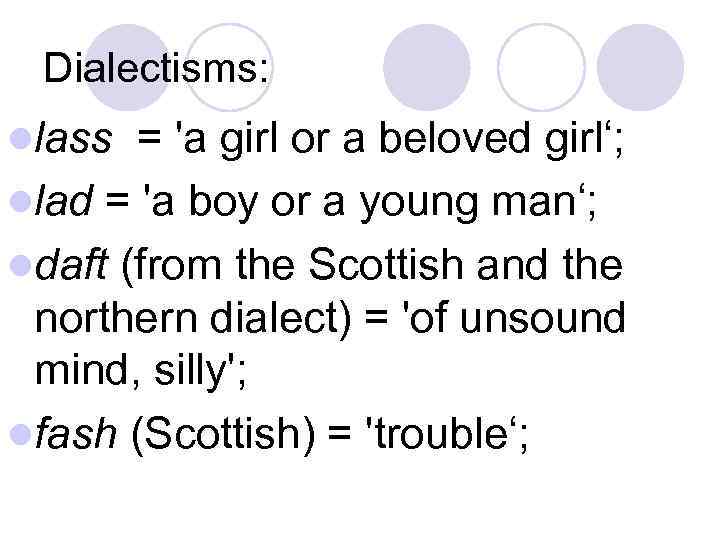 Dialectisms: llass = 'a girl or a beloved girl‘; llad = 'a boy or a young man‘; ldaft (from the Scottish and the northern dialect) = 'of unsound mind, silly'; lfash (Scottish) = 'trouble‘;
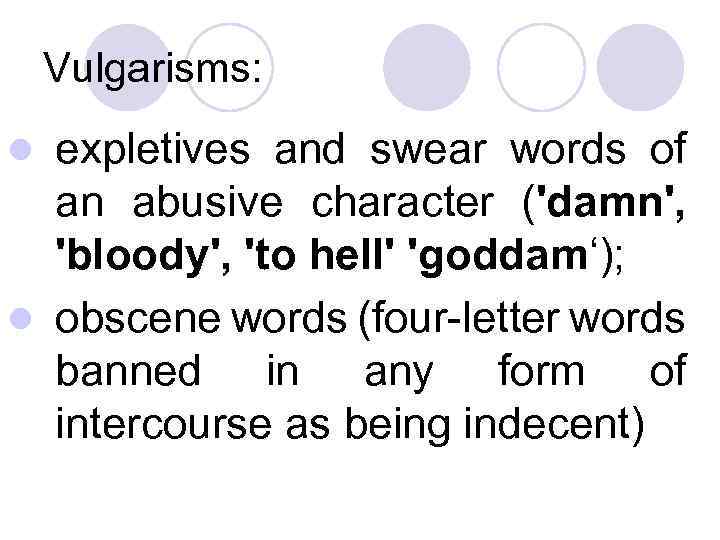 Vulgarisms: expletives and swear words of an abusive character ('damn', 'bloody', 'to hell' 'goddam‘); l obscene words (four-letter words banned in any form of intercourse as being indecent) l