


 Скачать презентацию Stylistic Stratification of English Words n n Depending
8_Stylistic_stratification.ppt
- Количество слайдов: 20
 Stylistic Stratification of English Words n n Depending o a situation we use 1) words of the formal style 2) words of the informal style. basic vocabulary units
 Stylistic component (or stylistic coloring) n n The word possesses this component when it is typical of some functional style Certain stylistic reference may suggest the character’s background: “Chief, you’re gonna force me inna roughin’ ya up a little bit. I don’t wanna do it, but that’s the way it looks, ” he said. “You owe us five bucks*. ”
 buck, n. Slang. a dollar. 1855 -1860, Amer. ; perhaps BUCK in sense «buckskin» ; deerskins were used by Indians and frontiersmen as a unit of exchange in transactions with merchants [Webster’s Encyclopedic Unabridged Dictionary of the English language. – NY: Random House, 1996. – P. 271. ]
 King Solomon’s Verse What is man, that Thou are mindful of him? And the son of man, that Thou visitest him? Thou madest him lower than the angels; To crown him with glory and worship. Thou makest him to have dominion of Thy hands; Thou hast put all things in subjection under his feet; All sheep and oxen; yea, and the beasts of the field; The fowls of the air, and the fishes of the sea; And whatsoever walketh through the paths of the seas.
 William Shakespeare, HAMLET, 1601 What piece of work is a man! How noble in reason! How infinite in faculty! In form and moving how express and admirable! In action how like an angel! In apprehension how like a god! The beauty of the world! The paragon of animals!
 Dr. L. A. Borrodaile, 1912 Man is metazone, tribloblastic, chordate, vertebrate, pentadactyle, mammalian, eutherian, primate…. The main outlines of each of his principal systems of organs may be traced back, like those of other mammals, to the fishes.
 The problem of vocabulary classification Some linguists deny the possibility of working out a systematic classification of the English vocabulary. Problems (Skrebnev): 1. The word stock of any natural language is highly heterogeneous; 2. Words cannot be analyzed as isolated units; 3. Polysemy and polyfunctionality of words (one word can be placed in several lexical classes). n Other scholars think that the word stock can be represented as a system in which different aspects of words may be singled out as interdependent. n
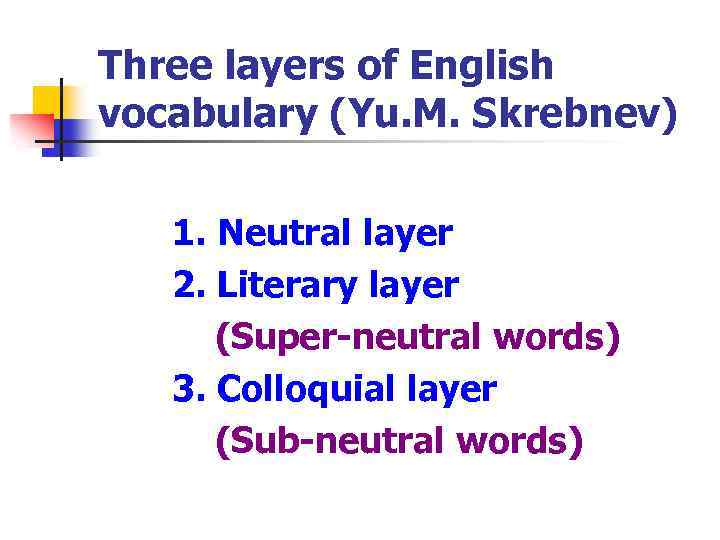 Three layers of English vocabulary (Yu. M. Skrebnev) 1. Neutral layer 2. Literary layer (Super-neutral words) 3. Colloquial layer (Sub-neutral words)
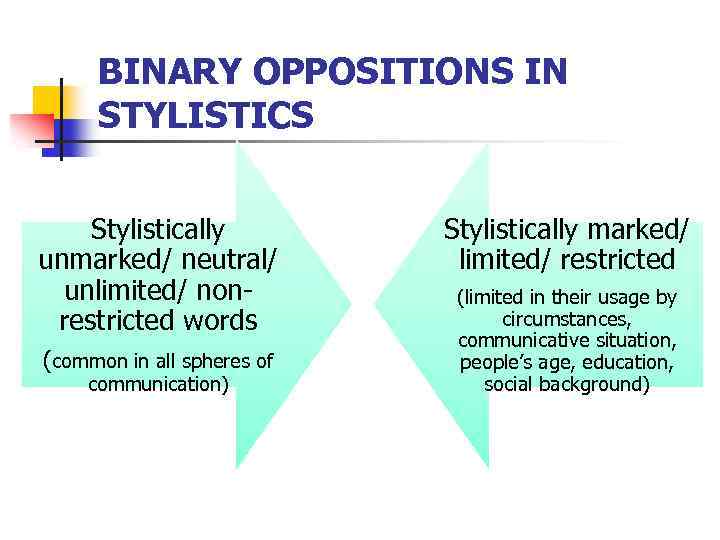 BINARY OPPOSITIONS IN STYLISTICS Stylistically unmarked/ neutral/ unlimited/ nonrestricted words (common in all spheres of communication) Stylistically marked/ limited/ restricted (limited in their usage by circumstances, communicative situation, people’s age, education, social background)
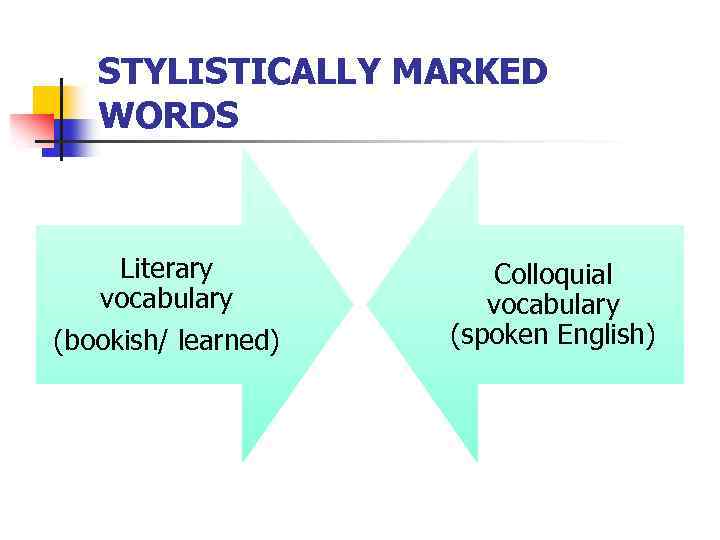 STYLISTICALLY MARKED WORDS Literary vocabulary (bookish/ learned) Colloquial vocabulary (spoken English)
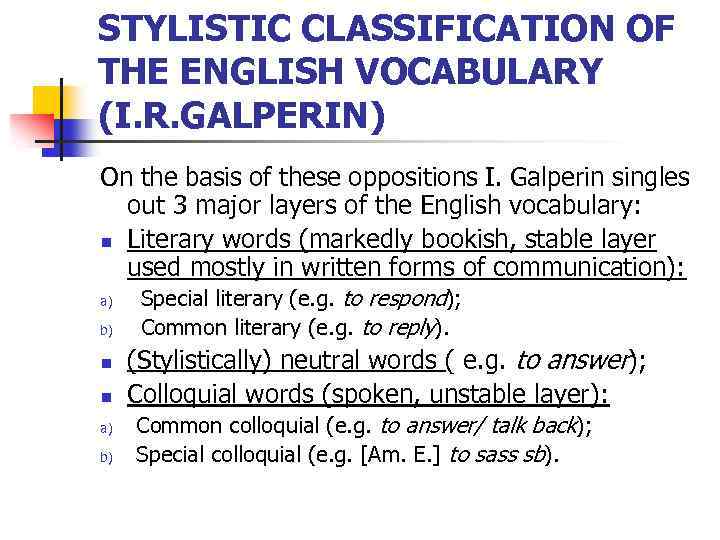 STYLISTIC CLASSIFICATION OF THE ENGLISH VOCABULARY (I. R. GALPERIN) On the basis of these oppositions I. Galperin singles out 3 major layers of the English vocabulary: n Literary words (markedly bookish, stable layer used mostly in written forms of communication): a) b) n n a) b) Special literary (e. g. to respond); Common literary (e. g. to reply). (Stylistically) neutral words ( e. g. to answer); Colloquial words (spoken, unstable layer): Common colloquial (e. g. to answer/ talk back); Special colloquial (e. g. [Am. E. ] to sass sb).
 Words of the informal style n n n 1. Colloquial words. a) literary (used in everyday conversational speech both by cultivated and uneducated people) kid (for “child”), pal, chum (for “friend”), hi, hello, zip (for “zip fastener”), exam, fridge, flu. b) familiar (used mostly by the young and the semieducated: doc (doctor), ta-ta (good-bye), shut up, beat it (go away). c) low colloquial words (obscene, vulgar, swear words used mostly in the speech of uncultivated people).
 I. Words of the informal style n n n 2. Slang words. metaphores rooted in a joke: nuts (for “heads”), mugs (for “faces”), flippers (ласты) (for “hands”), etc. is mainly used by the young and uneducated and helps the speakers dissociate themselves from others.
 Words of the informal style n n n 3. Dialect words. A dialect is a variety of a language which prevails in a district: Lancashire, Dorsetshire, Yorkshire, Norfolk dialects in Britain, Nothern, Midland Southern dialects in the USA. can be transferred into the common stock (or the basic vocabulary): girl, one, raid, glamour, car, tram. In works of fiction dialect words are used to render the speech of the characters, to create a realistic effect.
 II. Words of the formal style n n n 1. Learned words: a) literary or refined words, that often sound foreign: solitude (уединение), felicity (счастье), cordial (=hearty; сердечный). b) poetic words (poetic diction), which have a high-flown, archaic colouring: Alas!, realm [relm], wroth [rəuθ], morn (for “morning”), eve (for “evening”), welkin (небосвод). c) words that are used in scientific prose: comprise, compile, experimental. d) officialese: assist (for “help”), proceed (for “go on”), sufficient (for “enough”), inquire (for “ask”), approximately (for “about”).
 Words of the formal style n n n 2. Archaic and obsolete words which are partially or fully out of circulation and can be found in books only lexical archaisms: damsel (for “girl”), yon (там), foe (враг), aught (что-нибудь), chop-house (харчевня, трактир) grammatical archaisms: thou , thy, speaketh (for “you speak”) Obsolete words are words have completely fallen out of use, while archaisms are words which are rare in present usage. Historisms: words which denote objects and phenomena of the past, which no longer exist: goblet (кубок), lute (лютня), vizor (забрало), cataphract (кольчуга), childe (чайлд, молодой дворянин).
 Words of the formal style n n n 3. Professional terminology. for different sciences, arts and trades. Law: allegation, barrister, lawsuit, plaintiff are all technical terms of; phonetics: bilingual, interdental, descending stepping scale. monosemantic and have no synonyms.
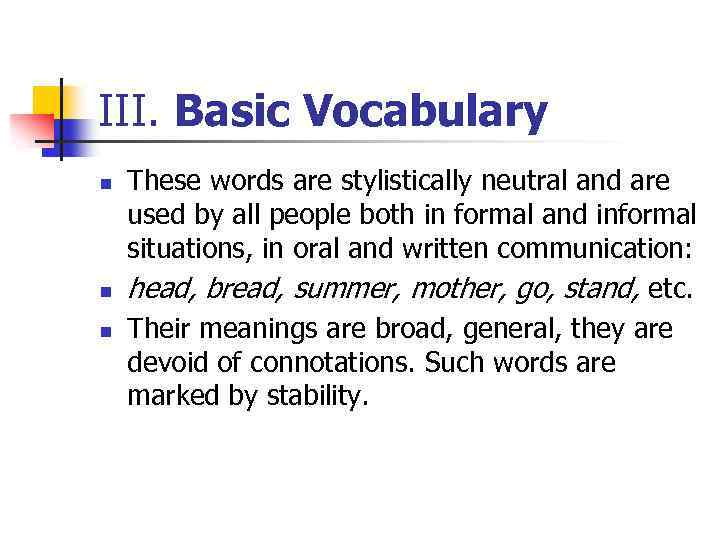 III. Basic Vocabulary n n n These words are stylistically neutral and are used by all people both in formal and informal situations, in oral and written communication: head, bread, summer, mother, go, stand, etc. Their meanings are broad, general, they are devoid of connotations. Such words are marked by stability.
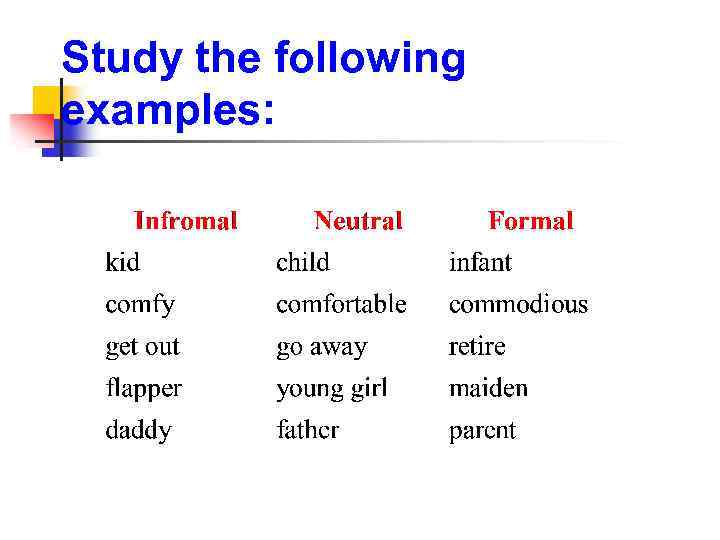 Study the following examples:
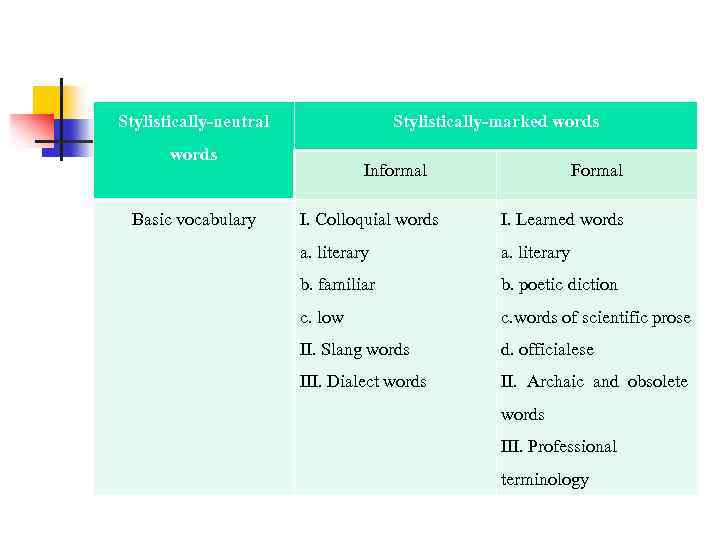 Stylistically-neutral Stylistically-marked words Basic vocabulary Informal Formal I. Colloquial words I. Learned words a. literary b. familiar b. poetic diction c. low c. words of scientific prose II. Slang words d. officialese III. Dialect words II. Archaic and obsolete words III. Professional terminology