


 Скачать презентацию Styles of Intrusion Detection Misuse intrusion detection
961d9d1bbb153acd575e01c3551193d6.ppt
- Количество слайдов: 32
 Styles of Intrusion Detection • Misuse intrusion detection – Try to detect things known to be bad • Anomaly intrusion detection – Try to detect deviations from normal behavior • Specification intrusion detection – Try to detect deviations from defined “good states” CS 236 Online Lecture 13 Page 1
 Misuse Detection • • Determine what actions are undesirable Watch for those to occur Signal an alert when they happen Often referred to as signature detection CS 236 Online Lecture 13 Page 2
 Level of Misuse Detection • Could look for specific attacks – E. g. , Syn attacks or IP spoofing • But that only detects already known attacks • Better to also look for known suspicious behavior – Like trying to become root – Or changing file permissions CS 236 Online Lecture 13 Page 3
 How Is Misuse Detected? • By examining logs – Only works after the fact • By monitoring system activities – Often hard to trap what you need to see • By scanning the state of the system – Can’t trap actions that don’t leave traces • By sniffing the network – For network intrusion detection systems CS 236 Online Lecture 13 Page 4
 Pluses and Minuses of Misuse Detection + Few false positives + Simple technology + Hard to fool • At least about things it knows about – Only detects known problems – Gradually becomes less useful if not updated – Sometimes signatures are hard to generate CS 236 Online Lecture 13 Page 5
 Misuse Detection and Commercial Systems • Essentially all commercial intrusion detection systems detect misuse – Primarily using signatures of attacks • Many of these systems are very similar – With only different details • Differentiated primarily by quality of their signature library – How large, how quickly updated CS 236 Online Lecture 13 Page 6
 Anomaly Detection • Misuse detection can only detect known problems • And many potential misuses can also be perfectly legitimate • Anomaly detection instead builds a model of valid behavior – And watches for deviations CS 236 Online Lecture 13 Page 7
 Methods of Anomaly Detection • Statistical models – User behavior – Program behavior – Overall system/network behavior • Expert systems • Pattern matching of various sorts • Misuse detection and anomaly detection sometimes blur together CS 236 Online Lecture 13 Page 8
 Pluses and Minuses of Anomaly Detection + Can detect previously unknown attacks – Hard to identify and diagnose nature of attacks – Unless careful, may be prone to many false positives – Depending on method, can be expensive and complex CS 236 Online Lecture 13 Page 9
 Anomaly Detection and Academic Systems • Most academic research on IDS in this area – More interesting problems – Greater promise for the future – Increasingly, misuse detection seems inadequate • But few really effective systems currently use it – Not entirely clear that will ever change – What if it doesn’t? CS 236 Online Lecture 13 Page 10
 Specification Detection • Define some set of states of the system as good • Detect when the system is in a different state • Signal a problem if it is CS 236 Online Lecture 13 Page 11
 How Does This Differ From Misuse and Anomaly Detection? • Misuse detection says that certain things are bad • Anomaly detection says deviations from statistically normal behavior are bad • Specification detection specifies exactly what is good and calls the rest bad • A relatively new approach CS 236 Online Lecture 13 Page 12
 Some Challenges • How much state do you have to look at? – Typically dealt with by limiting observation to state relevant to security • How do you specify a good state? CS 236 Online Lecture 13 Page 13
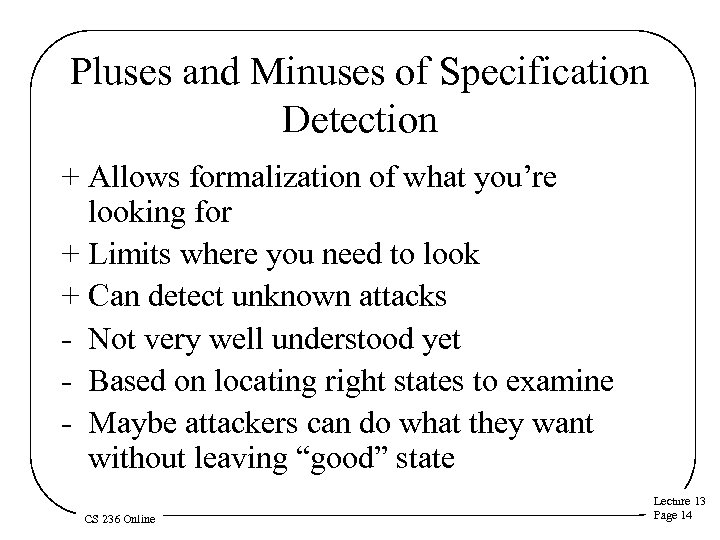 Pluses and Minuses of Specification Detection + Allows formalization of what you’re looking for + Limits where you need to look + Can detect unknown attacks Not very well understood yet Based on locating right states to examine Maybe attackers can do what they want without leaving “good” state CS 236 Online Lecture 13 Page 14
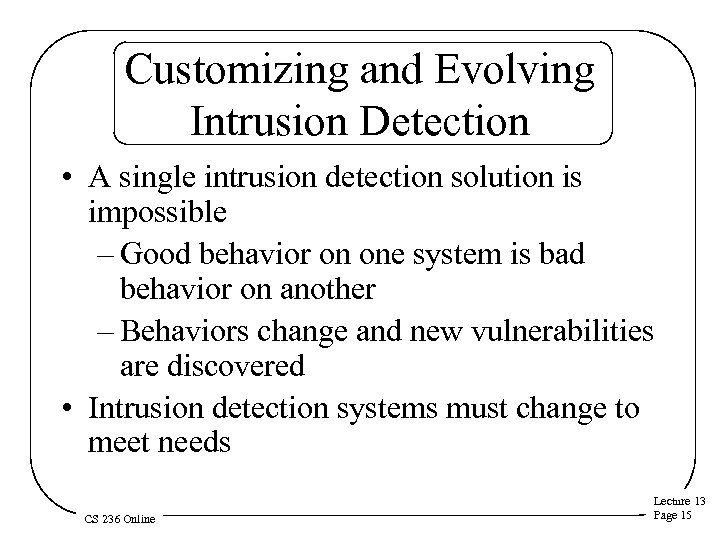 Customizing and Evolving Intrusion Detection • A single intrusion detection solution is impossible – Good behavior on one system is bad behavior on another – Behaviors change and new vulnerabilities are discovered • Intrusion detection systems must change to meet needs CS 236 Online Lecture 13 Page 15
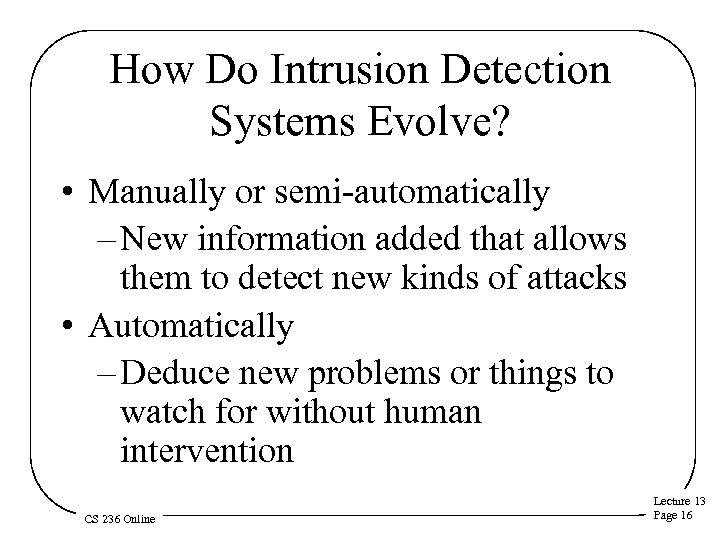 How Do Intrusion Detection Systems Evolve? • Manually or semi automatically – New information added that allows them to detect new kinds of attacks • Automatically – Deduce new problems or things to watch for without human intervention CS 236 Online Lecture 13 Page 16
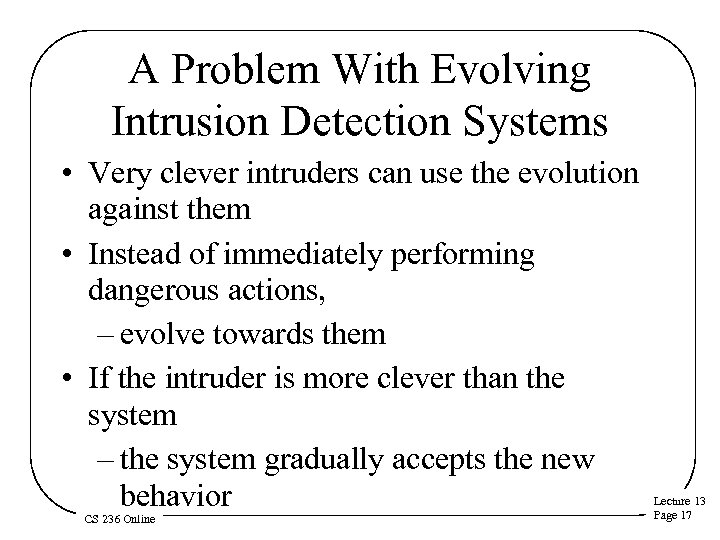 A Problem With Evolving Intrusion Detection Systems • Very clever intruders can use the evolution against them • Instead of immediately performing dangerous actions, – evolve towards them • If the intruder is more clever than the system – the system gradually accepts the new behavior CS 236 Online Lecture 13 Page 17
 Intrusion Detection Tuning • Generally, there’s a tradeoff between false positives and false negatives • You can tune the system to decrease one – Usually at cost of increasing the other • Choice depends on one’s situation CS 236 Online Lecture 13 Page 18
 Practicalities of Operation • Most commercial intrusion detection systems are add ons – They run as normal applications • They must make use of readily available information – Audit logged information – Sniffed packets – Output of systems calls they make • And performance is very important CS 236 Online Lecture 13 Page 19
 Practicalities of Audit Logs for IDS • Operating systems only log certain things • They don’t necessarily log what an intrusion detection system really needs • They produce large amounts of data – Expensive to process – Expensive to store • If attack was successful, logs may be corrupted CS 236 Online Lecture 13 Page 20
 What Does an IDS Do When It Detects an Attack? • Automated response – Shut down the “attacker” – Or more carefully protect the attacked service • Alarms – Notify a system administrator • Often via special console – Who investigates and takes action • Logging – Just keep record for later investigation CS 236 Online Lecture 13 Page 21
 Consequences of the Choices • Automated – Too many false positives and your network stops working – Is the automated response effective? • Alarm – Too many false positives and your administrator ignores them – Is the administrator able to determine what’s going on fast enough? CS 236 Online Lecture 13 Page 22
 Intrusion Prevention Systems • Essentially a buzzword for IDS that takes automatic action when intrusion is detected • Goal is to quickly take remedial actions to threats • Since IPSs are automated, false positives could be very, very bad • “Poor man’s” version is IDS controlling a firewall CS 236 Online Lecture 13 Page 23
 Sample Intrusion Detection Systems • • Snort Bro Real. Secure ISS Net. Ranger CS 236 Online Lecture 13 Page 24
 Snort • Network intrusion detection system • Public domain – Designed for Linux – But also runs on Win 32 • Designed for high extensibility – Allows easy plugins for detection – And rule based description of good & bad traffic CS 236 Online Lecture 13 Page 25
 Bro • Like Snort, public domain network based IDS • Developed at LBL • Includes more sophisticated non signature methods than Snort • More general and extensible than Snort • Maybe not as easy to use CS 236 Online Lecture 13 Page 26
 Real. Secure ISS • Commercial IDS from ISS • Very popular and widely deployed • Distributed client/server architecture – Incorporates network and host components • Other components report to server on dedicated machine CS 236 Online Lecture 13 Page 27
 Net. Ranger • Now bundled into Cisco products • For use in network environments – “Sensors” in promiscuous mode capture packets off the local network • Examines data flows – Raises alarm for suspicious flows • Using misuse detection techniques – Based on a signature database CS 236 Online Lecture 13 Page 28
 Is Intrusion Detection Useful? • 69% of CSI/FBI survey respondents (2008) use one – 54% use intrusion prevention • In 2003, Gartner Group analyst called IDS a failed technology – Predicted its death by 2005 – They’re not dead yet • Signature based IDS especially criticized CS 236 Online Lecture 13 Page 29
 Which Type of Intrusion Detection System Should I Use? • NIST report recommends using multiple IDSs – Preferably multiple types • E. g. , host and network • Each will detect different things – Using different data and techniques • Good defense in depth CS 236 Online Lecture 13 Page 30
 The Future of Intrusion Detection? • General concept has never quite lived up to its promise • Yet alternatives are clearly failing – We aren’t keeping the bad guys out • So research and development continues • And most serious people use them – Even if they are imperfect CS 236 Online Lecture 13 Page 31
 Conclusions • Intrusion detection systems are helpful enough that those who care about security should use them • They are not yet terribly sophisticated – Which implies they aren’t that effective • Much research continues to improve them • Not clear if they’ll ever achieve what the original inventors hoped for CS 236 Online Lecture 13 Page 32