


 Скачать презентацию Study on Copyright Limitations and Exceptions for Educational
18ebae443835a7fa39abed2b2a06940b.ppt
- Количество слайдов: 18
 Study on Copyright Limitations and Exceptions for Educational Activities Prof. Raquel Xalabarder Universitat Oberta de Catalunya – UOC WIPO. 14 December 2009
 International instruments n n n Art. 10. 2 BC: use by way of illustration in publications, broadcasts or …recordings for teaching Art. 15. 1(d) RC: use solely for the purposes of teaching // Art. 15. 2 RC: extend BC ones ‘Minor reservations’ (Brussels 1948) Art. 9. 2 BC: libraries, teaching, instruction, etc. Art. 10 WCT, Art. 16 WPPT digital contexts Art. 10. 1 BC: quotations (mandatory nature)
 International instruments Open: n All works and subject matter n All acts of exploitation (including translation) Neutral: n Technologically neutral: also online uses Flexible: n Educational purposes (instruction, making of compilations and recordings) n To the extent justified by the purpose n Compatible with fair practice n Remuneration: not required, but allowed
 National laws n Yet, exempted educational uses remain a matter for domestic laws … and domestic laws are not so generous! n 57 Countries covered 53 Acts located Europe, Caucasus, Central Asia, Israel, Canada, USA n n 27 EU members (+EEA) Art. 5. 3(a) EUCD Different legal traditions. Different economic, social, cultural background Different needs and sensitivities for education
 National laws n Educational uses: q Instruction / Teaching (lectures, exams, debates, etc) q Compilations for teaching / educational use q School events n Quotations works used for commenting, debating, analyzing, etc Private Copy/Use students’ copies? Fair Use/Dealing (Common law systems) Library uses q Loopholes among exempted uses: preservation, research… why not teaching purposes? q Online libraries “discriminated” n n n
 National laws: Instructional uses Heterogeneous solutions: n Purposes: education, teaching, instruction, lessons, examinations (… multiple technological contexts) n Exempted acts: photocopying, performance, reproduction, distribution, broadcast, making available online (intranet), translation, digitization? n n n Works covered: all kind of works or some works Benefiting institutions: public, non-profit, all levels? Scope: flexible (extent necessary, fair practice) or limited (as to amount, number of copies) n Remuneration: required, allowed, for free
 National laws: Common Law Systems n Specific teaching exceptions: q q q n Fair use/dealing remains fundamental q q q n Narrowly defined: scope and rights (reproduction, performance) A few cover online uses? USA (TEACH Act) Non-profit institutions Non-remunerated Canada (dropped bill: similar to TEACH Act + free use for teaching purposes of publicly available material on Internet) Teaching (USA) Research, private study, criticism (CA, UK, Ireland) … instruction and examination (Israel) Voluntary licensing schemes
 National laws: Sec. 110 USCA n Face to face and distance teaching (also online –TEACH Act): q q q n n Benefiting institutions: Nonprofit (f 2 f) / Accredited nonprofit (distance) Exempted acts / Works covered: q q n n n An integral part of a class session, directly related and of material assistance to the teaching Limited to students officially enrolled in the course Reasonably effective TPM to prevent retention after class session f 2 f: Performance (nondramatic literary or musical w. ), Display (any works) Distance: Performance (nondramatic literary or musical w. , reasonable and limited portions of other w. ), Display (a w. in amount as in live session) Provided that it is done by means of a lawfully acquired copy Excluded: works primarily for online instructional activities For free Fair use doctrine Voluntary licensing schemes developed
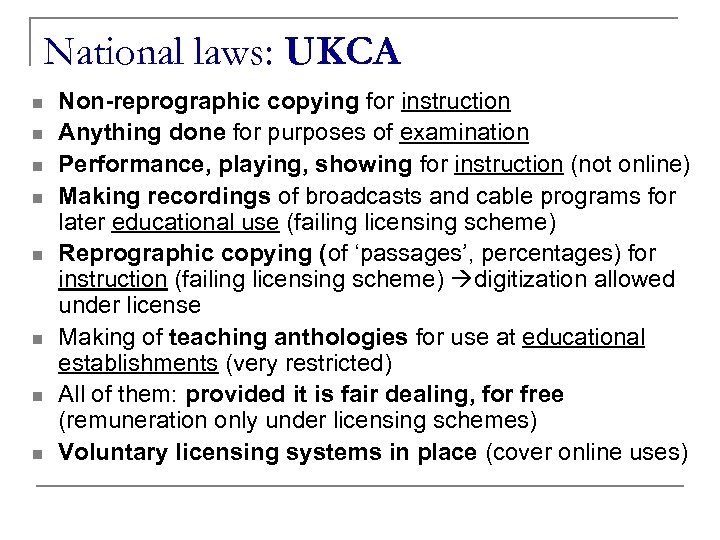 National laws: UKCA n n n n Non-reprographic copying for instruction Anything done for purposes of examination Performance, playing, showing for instruction (not online) Making recordings of broadcasts and cable programs for later educational use (failing licensing scheme) Reprographic copying (of ‘passages’, percentages) for instruction (failing licensing scheme) digitization allowed under license Making of teaching anthologies for use at educational establishments (very restricted) All of them: provided it is fair dealing, for free (remuneration only under licensing schemes) Voluntary licensing systems in place (cover online uses)
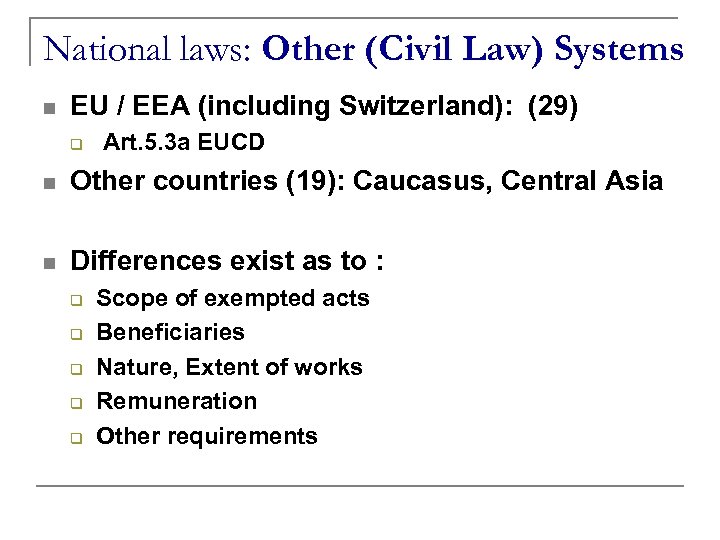 National laws: Other (Civil Law) Systems n EU / EEA (including Switzerland): (29) q Art. 5. 3 a EUCD n Other countries (19): Caucasus, Central Asia n Differences exist as to : q q q Scope of exempted acts Beneficiaries Nature, Extent of works Remuneration Other requirements
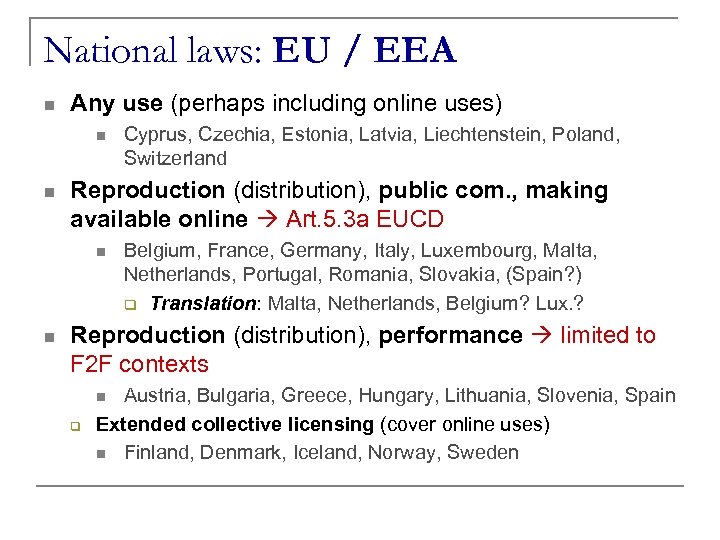 National laws: EU / EEA n Any use (perhaps including online uses) n n Reproduction (distribution), public com. , making available online Art. 5. 3 a EUCD n n Cyprus, Czechia, Estonia, Latvia, Liechtenstein, Poland, Switzerland Belgium, France, Germany, Italy, Luxembourg, Malta, Netherlands, Portugal, Romania, Slovakia, (Spain? ) q Translation: Malta, Netherlands, Belgium? Lux. ? Reproduction (distribution), performance limited to F 2 F contexts Austria, Bulgaria, Greece, Hungary, Lithuania, Slovenia, Spain Extended collective licensing (cover online uses) n Finland, Denmark, Iceland, Norway, Sweden n q
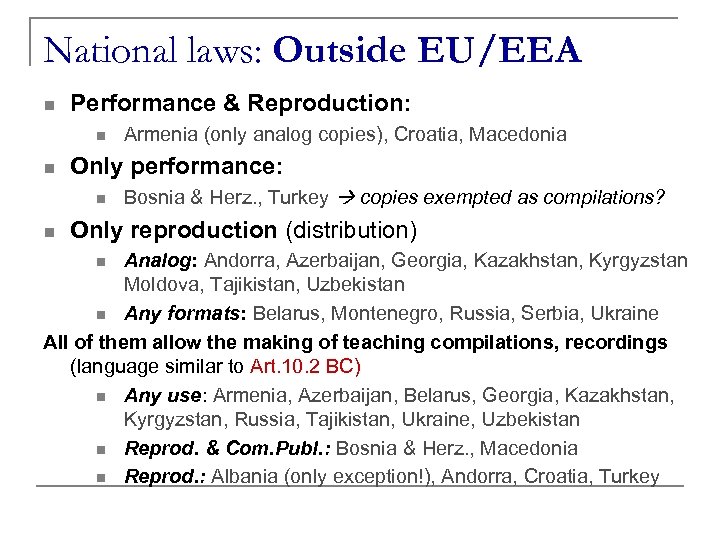 National laws: Outside EU/EEA n Performance & Reproduction: n n Only performance: n n Armenia (only analog copies), Croatia, Macedonia Bosnia & Herz. , Turkey copies exempted as compilations? Only reproduction (distribution) Analog: Andorra, Azerbaijan, Georgia, Kazakhstan, Kyrgyzstan Moldova, Tajikistan, Uzbekistan n Any formats: Belarus, Montenegro, Russia, Serbia, Ukraine All of them allow the making of teaching compilations, recordings (language similar to Art. 10. 2 BC) n Any use: Armenia, Azerbaijan, Belarus, Georgia, Kazakhstan, Kyrgyzstan, Russia, Tajikistan, Ukraine, Uzbekistan n Reprod. & Com. Publ. : Bosnia & Herz. , Macedonia n Reprod. : Albania (only exception!), Andorra, Croatia, Turkey n
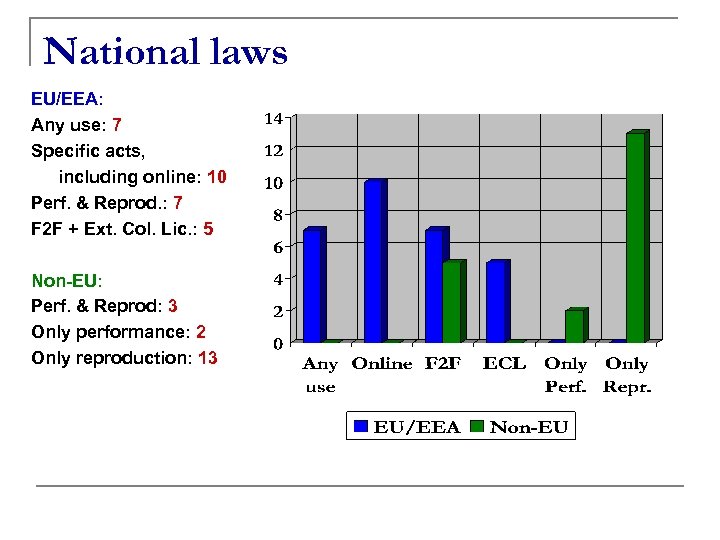 National laws EU/EEA: Any use: 7 Specific acts, including online: 10 Perf. & Reprod. : 7 F 2 F + Ext. Col. Lic. : 5 Non-EU: Perf. & Reprod: 3 Only performance: 2 Only reproduction: 13
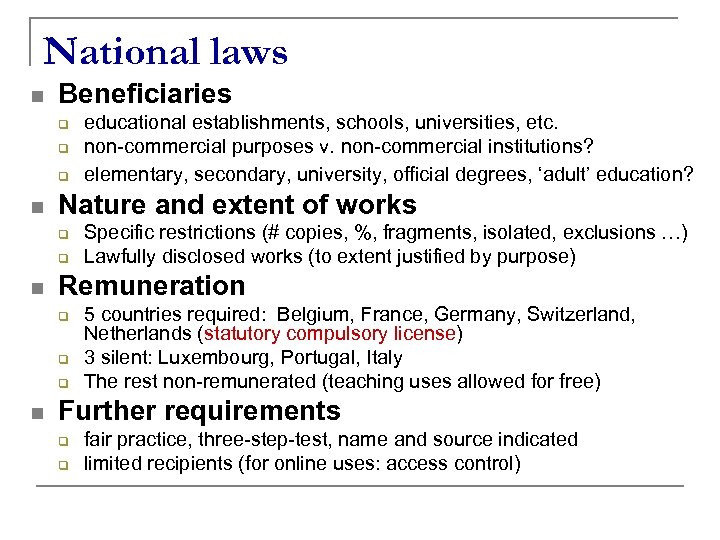 National laws n Beneficiaries q q q n Nature and extent of works q q n Specific restrictions (# copies, %, fragments, isolated, exclusions …) Lawfully disclosed works (to extent justified by purpose) Remuneration q q q n educational establishments, schools, universities, etc. non-commercial purposes v. non-commercial institutions? elementary, secondary, university, official degrees, ‘adult’ education? 5 countries required: Belgium, France, Germany, Switzerland, Netherlands (statutory compulsory license) 3 silent: Luxembourg, Portugal, Italy The rest non-remunerated (teaching uses allowed for free) Further requirements q q fair practice, three-step-test, name and source indicated limited recipients (for online uses: access control)
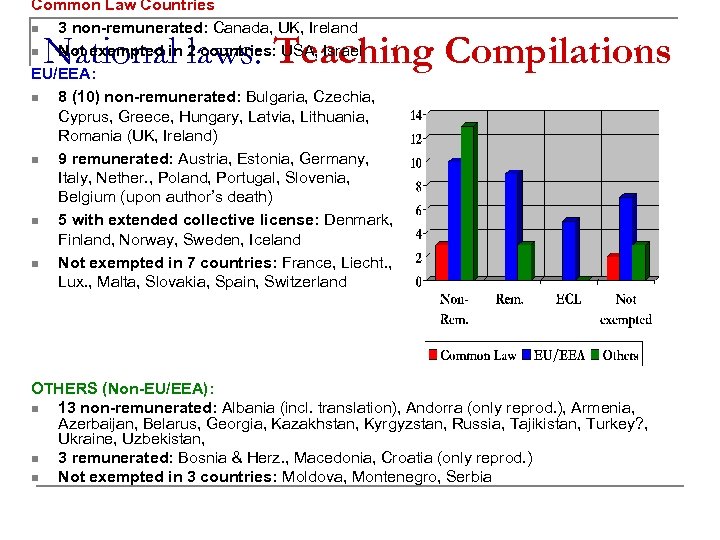 Common Law Countries n 3 non-remunerated: Canada, UK, Ireland n Not exempted in 2 countries: USA, Israel EU/EEA: n 8 (10) non-remunerated: Bulgaria, Czechia, Cyprus, Greece, Hungary, Latvia, Lithuania, Romania (UK, Ireland) n 9 remunerated: Austria, Estonia, Germany, Italy, Nether. , Poland, Portugal, Slovenia, Belgium (upon author’s death) n 5 with extended collective license: Denmark, Finland, Norway, Sweden, Iceland n Not exempted in 7 countries: France, Liecht. , Lux. , Malta, Slovakia, Spain, Switzerland National laws: Teaching Compilations OTHERS (Non-EU/EEA): n 13 non-remunerated: Albania (incl. translation), Andorra (only reprod. ), Armenia, Azerbaijan, Belarus, Georgia, Kazakhstan, Kyrgyzstan, Russia, Tajikistan, Turkey? , Ukraine, Uzbekistan, n 3 remunerated: Bosnia & Herz. , Macedonia, Croatia (only reprod. ) n Not exempted in 3 countries: Moldova, Montenegro, Serbia
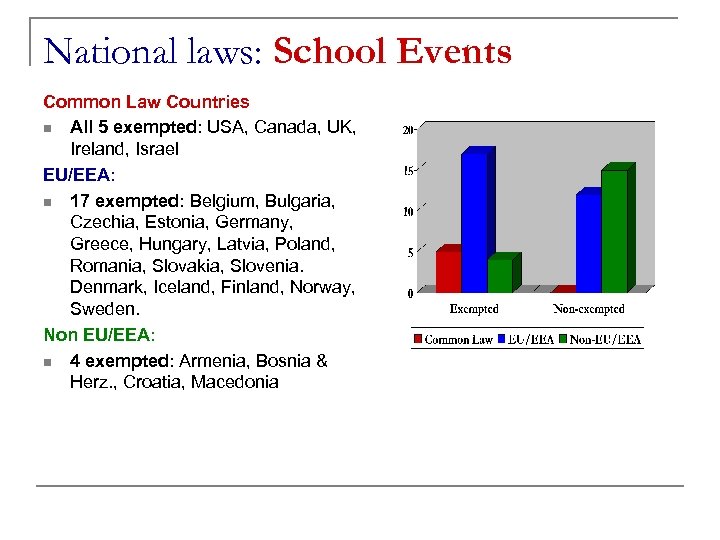 National laws: School Events Common Law Countries n All 5 exempted: USA, Canada, UK, Ireland, Israel EU/EEA: n 17 exempted: Belgium, Bulgaria, Czechia, Estonia, Germany, Greece, Hungary, Latvia, Poland, Romania, Slovakia, Slovenia. Denmark, Iceland, Finland, Norway, Sweden. Non EU/EEA: n 4 exempted: Armenia, Bosnia & Herz. , Croatia, Macedonia
 National laws: Voluntary Licensing For all non-exempted uses voluntary licensing n n n Collective licensing: q voluntary (USA), “stirred” by legislator (UK), extended (Nordic countries) q Practical difficulties: n CMO’s insufficient mandate of rights (ultimately voluntary) n Difficult to enforce (users not willing to accept them) Individual licensing - Practical difficulties: q identifying & locating owner q timely responses, exorbitant prices (fear of downstream uses, insensitive to needs of education) Unbalanced interests? q Denial of license (right to prohibit use of a work for teaching purposes) Should (to what extent) authors’ exclusive rights prevail over education? q DRMs and licensing terms further restricting educational uses? We must be vigilant on how these practices evolve and ensure teaching exceptions remain effective
 Conclusions n Fragmented, insufficient, non-uniform national solutions n Online teaching uses discriminated (not all national legislators are sensitive to needs of online education) Exceptions should be technology-neutral (under different conditions) n Voluntary licensing schemes (and DRMs) can hardly find the right “balance” between interests at stake n Education is a strong public interest Exceptions and limitations should be a matter of strict public policy (addressed by the law)