


 Скачать презентацию Study of jets in Heavy Ion collisions using
d6d2ab44c98dbc41f475dd8ac60977a5.ppt
- Количество слайдов: 29
 Study of jets in Heavy Ion collisions using the ATLAS detector Martin Spousta for the ATLAS collaboration PANIC 2008 Eilat, ISRAEL Martin Spousta Charles University in Prague
 Outline • Motivation • Cone and k. T jet reconstruction strategy • Jet reconstruction performance – jet energy and position resolution – fake-rate and efficiency • Jet properties – fragmentation function and j. T distribution – jet shapes • Di-jet correlations • Summary PANIC 2008 Eilat, ISRAEL Martin Spousta Charles University in Prague 2
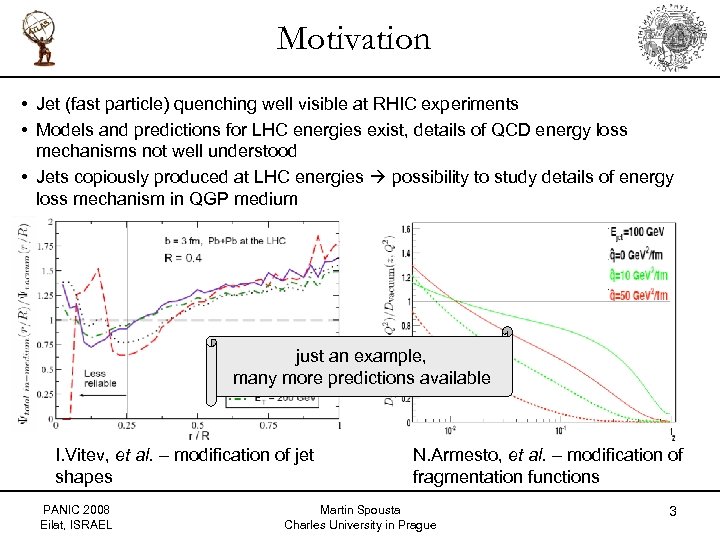 Motivation • Jet (fast particle) quenching well visible at RHIC experiments • Models and predictions for LHC energies exist, details of QCD energy loss mechanisms not well understood • Jets copiously produced at LHC energies possibility to study details of energy loss mechanism in QGP medium just an example, many more predictions available I. Vitev, et al. – modification of jet shapes PANIC 2008 Eilat, ISRAEL N. Armesto, et al. – modification of fragmentation functions Martin Spousta Charles University in Prague 3
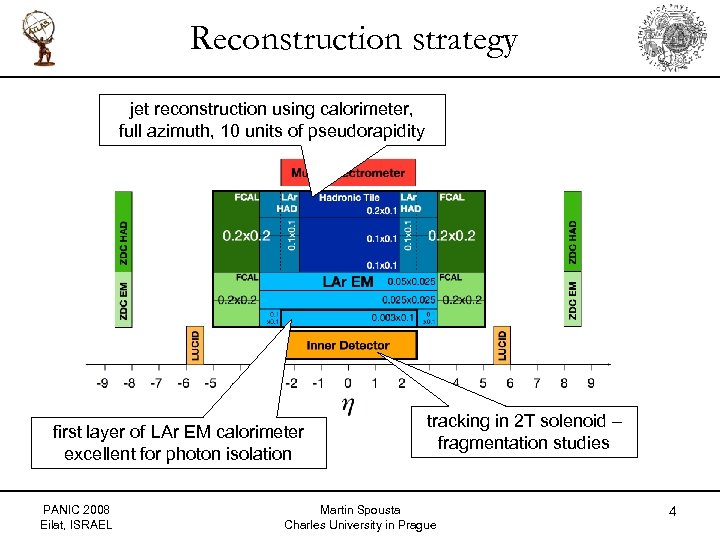 Reconstruction strategy jet reconstruction using calorimeter, full azimuth, 10 units of pseudorapidity first layer of LAr EM calorimeter excellent for photon isolation PANIC 2008 Eilat, ISRAEL tracking in 2 T solenoid – fragmentation studies Martin Spousta Charles University in Prague 4
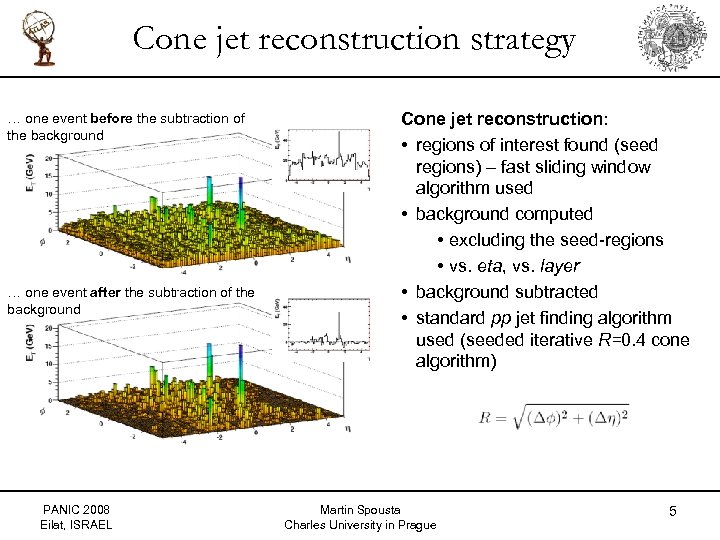 Cone jet reconstruction strategy … one event before the subtraction of the background … one event after the subtraction of the background PANIC 2008 Eilat, ISRAEL Cone jet reconstruction: • regions of interest found (seed regions) – fast sliding window algorithm used • background computed • excluding the seed-regions • vs. eta, vs. layer • background subtracted • standard pp jet finding algorithm used (seeded iterative R=0. 4 cone algorithm) Martin Spousta Charles University in Prague 5
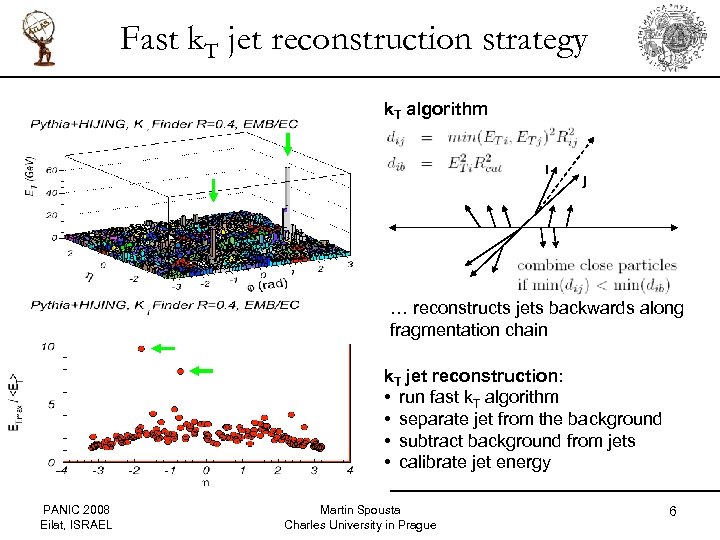 Fast k. T jet reconstruction strategy k. T algorithm i j … reconstructs jets backwards along fragmentation chain k. T jet reconstruction: • run fast k. T algorithm • separate jet from the background • subtract background from jets • calibrate jet energy PANIC 2008 Eilat, ISRAEL Martin Spousta Charles University in Prague 6
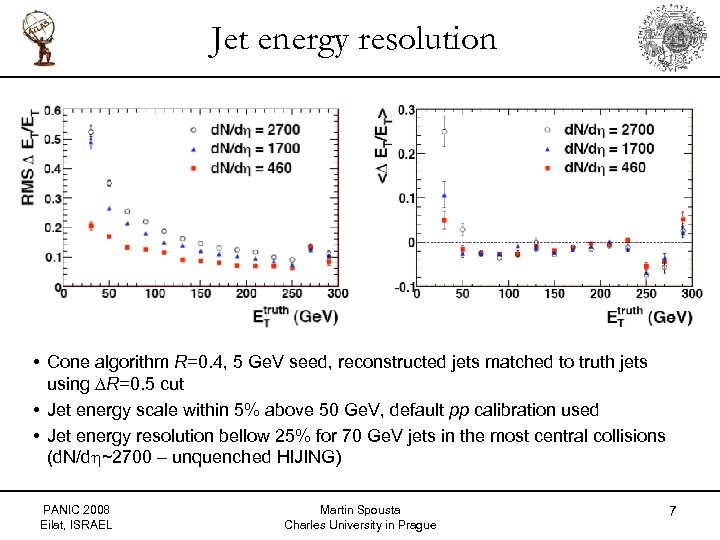 Jet energy resolution • Cone algorithm R=0. 4, 5 Ge. V seed, reconstructed jets matched to truth jets using DR=0. 5 cut • Jet energy scale within 5% above 50 Ge. V, default pp calibration used • Jet energy resolution bellow 25% for 70 Ge. V jets in the most central collisions (d. N/dh~2700 – unquenched HIJING) PANIC 2008 Eilat, ISRAEL Martin Spousta Charles University in Prague 7
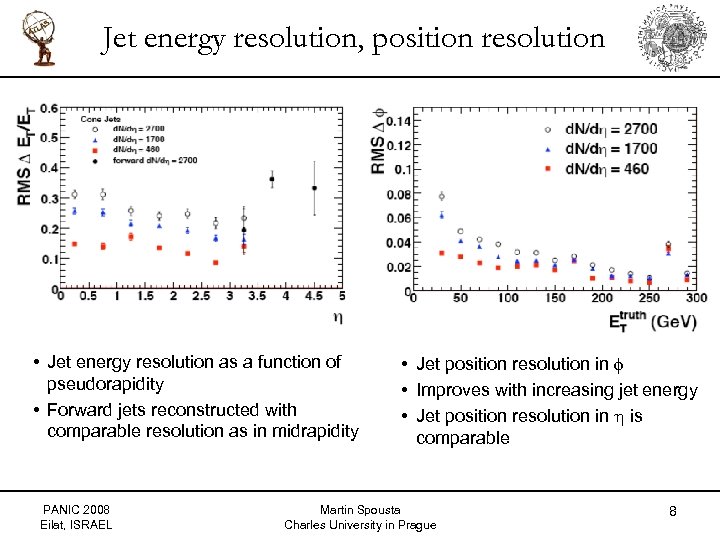 Jet energy resolution, position resolution • Jet energy resolution as a function of pseudorapidity • Forward jets reconstructed with comparable resolution as in midrapidity PANIC 2008 Eilat, ISRAEL • Jet position resolution in f • Improves with increasing jet energy • Jet position resolution in h is comparable Martin Spousta Charles University in Prague 8
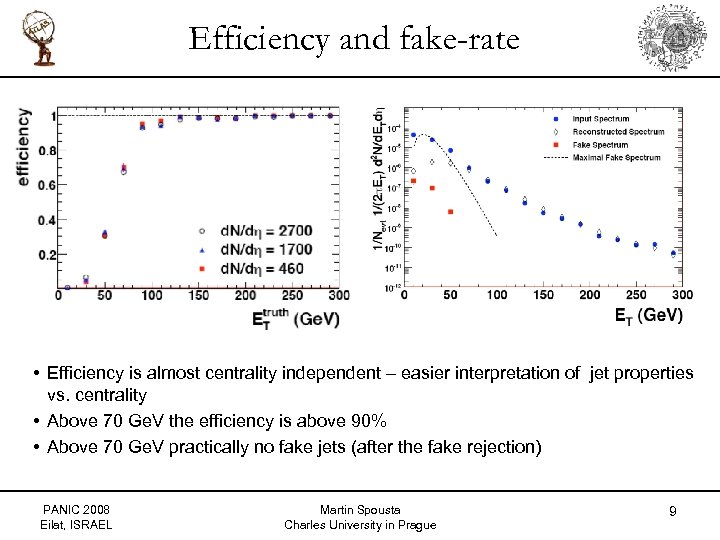 Efficiency and fake-rate • Efficiency is almost centrality independent – easier interpretation of jet properties vs. centrality • Above 70 Ge. V the efficiency is above 90% • Above 70 Ge. V practically no fake jets (after the fake rejection) PANIC 2008 Eilat, ISRAEL Martin Spousta Charles University in Prague 9
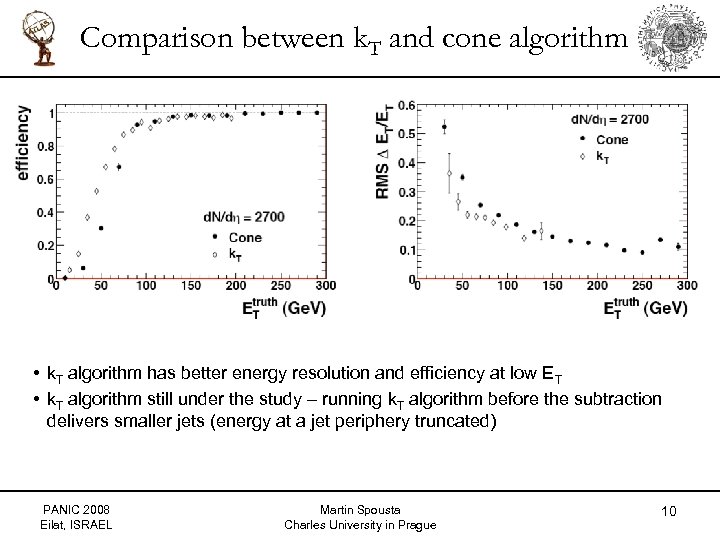 Comparison between k. T and cone algorithm • k. T algorithm has better energy resolution and efficiency at low ET • k. T algorithm still under the study – running k. T algorithm before the subtraction delivers smaller jets (energy at a jet periphery truncated) PANIC 2008 Eilat, ISRAEL Martin Spousta Charles University in Prague 10
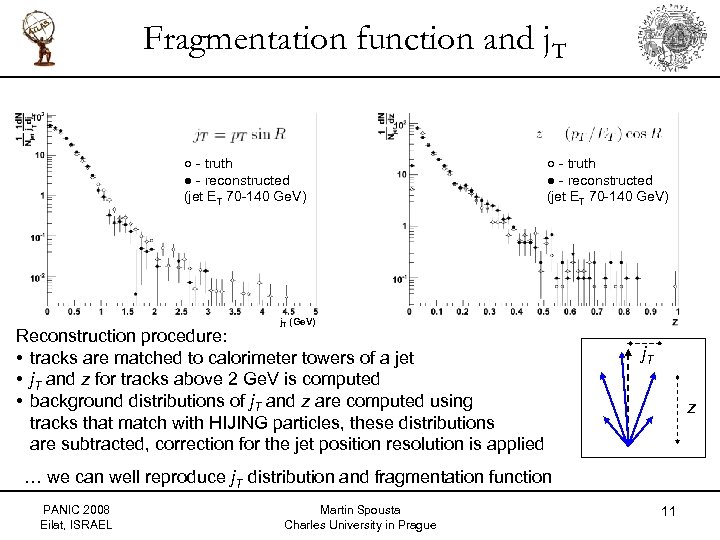 Fragmentation function and j. T ○ - truth ● - reconstructed (jet ET 70 -140 Ge. V) j. T (Ge. V) Reconstruction procedure: • tracks are matched to calorimeter towers of a jet • j. T and z for tracks above 2 Ge. V is computed • background distributions of j. T and z are computed using tracks that match with HIJING particles, these distributions are subtracted, correction for the jet position resolution is applied j. T z … we can well reproduce j. T distribution and fragmentation function PANIC 2008 Eilat, ISRAEL Martin Spousta Charles University in Prague 11
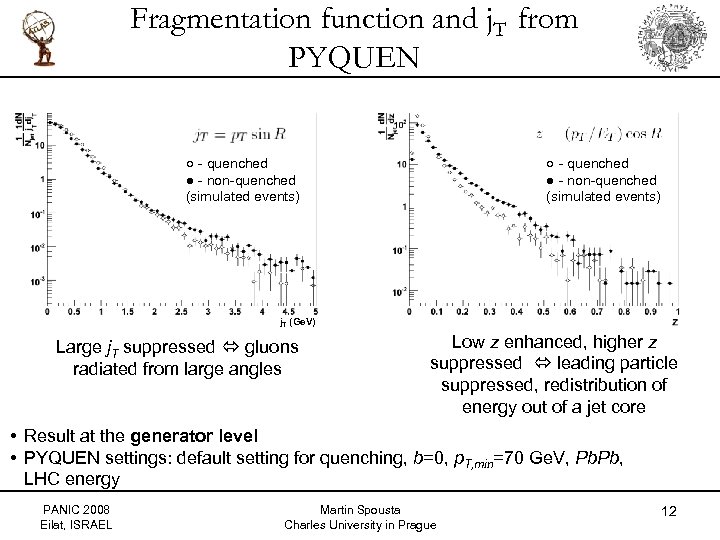 Fragmentation function and j. T from PYQUEN ○ - quenched ● - non-quenched (simulated events) j. T (Ge. V) Large j. T suppressed gluons radiated from large angles Low z enhanced, higher z suppressed leading particle suppressed, redistribution of energy out of a jet core • Result at the generator level • PYQUEN settings: default setting for quenching, b=0, p. T, min=70 Ge. V, Pb. Pb, LHC energy PANIC 2008 Eilat, ISRAEL Martin Spousta Charles University in Prague 12
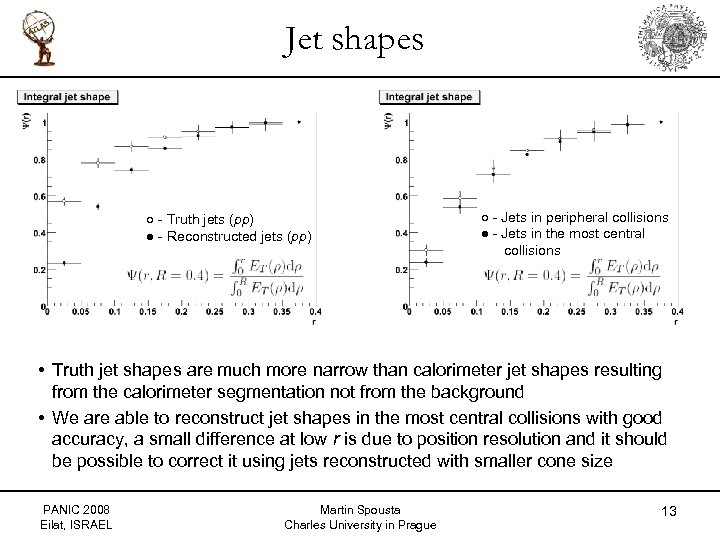 Jet shapes ○ - Truth jets (pp) ● - Reconstructed jets (pp) ○ - Jets in peripheral collisions ● - Jets in the most central collisions • Truth jet shapes are much more narrow than calorimeter jet shapes resulting from the calorimeter segmentation not from the background • We are able to reconstruct jet shapes in the most central collisions with good accuracy, a small difference at low r is due to position resolution and it should be possible to correct it using jets reconstructed with smaller cone size PANIC 2008 Eilat, ISRAEL Martin Spousta Charles University in Prague 13
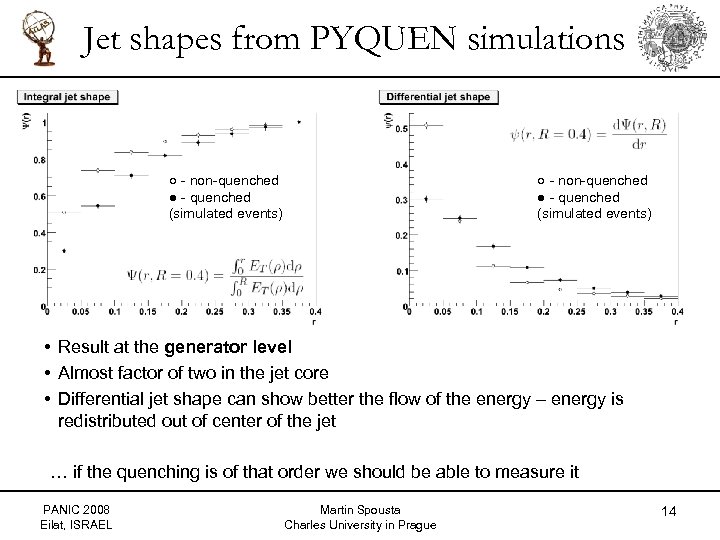 Jet shapes from PYQUEN simulations ○ - non-quenched ● - quenched (simulated events) • Result at the generator level • Almost factor of two in the jet core • Differential jet shape can show better the flow of the energy – energy is redistributed out of center of the jet … if the quenching is of that order we should be able to measure it PANIC 2008 Eilat, ISRAEL Martin Spousta Charles University in Prague 14
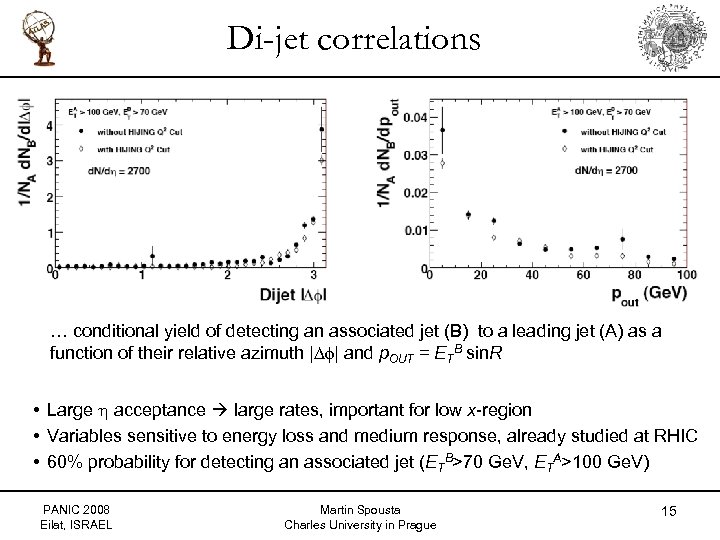 Di-jet correlations … conditional yield of detecting an associated jet (B) to a leading jet (A) as a function of their relative azimuth |Df| and p. OUT = ETB sin. R • Large h acceptance large rates, important for low x-region • Variables sensitive to energy loss and medium response, already studied at RHIC • 60% probability for detecting an associated jet (ETB>70 Ge. V, ETA>100 Ge. V) PANIC 2008 Eilat, ISRAEL Martin Spousta Charles University in Prague 15
 Summary • ATLAS heavy ion jet reconstruction studies extend over ET, eta and centrality • Two independent algorithms used for the reconstruction: iterative seeded cone and fast k. T algorithm • Reconstructed jets have good position, energy resolution and efficiency • Possibility to measure variables sensitive to different energy loss scenarios: – fragmentation function – j. T distribution – jet energy profiles – di-jet and g-jet correlations (not discussed due to time constraints) • ATLAS will make a significant impact on understanding of parton energy loss with the ability to reconstruct jets and their properties PANIC 2008 Eilat, ISRAEL Martin Spousta Charles University in Prague 16
 The ATLAS Heavy Ion Working Group Brookhaven National Laboratory, Upton, USA Charles University, Prague, Czech Republic Columbia University, New York, USA University of Geneva, Switzerland IHEP, Moscow, Russia IFJ PAN, Krakow, Poland Iowa State University, Ames, USA JINR, Dubna, Russia Me. PHI, Moscow, Russia Universidad Catolica de Chile, Santiago, Chile Santa Maria University, Valparaiso, Chile Stony Brook University (Chemistry) Stony Brook, USA Weizmann Institute, Rehovot, Israel PANIC 2008 Eilat, ISRAEL Martin Spousta Charles University in Prague 17
 Backup slides PANIC 2008 Eilat, ISRAEL Martin Spousta Charles University in Prague 18 Backup slides
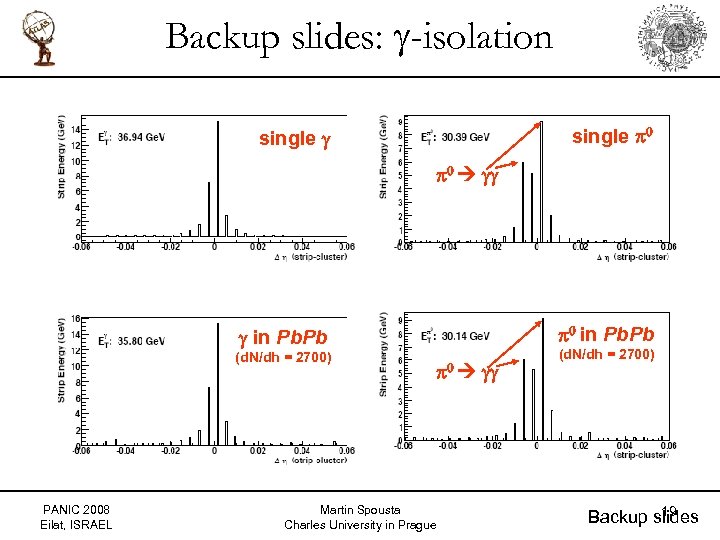 Backup slides: g-isolation single p 0 single g p 0 gg p 0 in Pb. Pb g in Pb. Pb (d. N/dh = 2700) PANIC 2008 Eilat, ISRAEL Martin Spousta Charles University in Prague p 0 gg (d. N/dh = 2700) 19 Backup slides
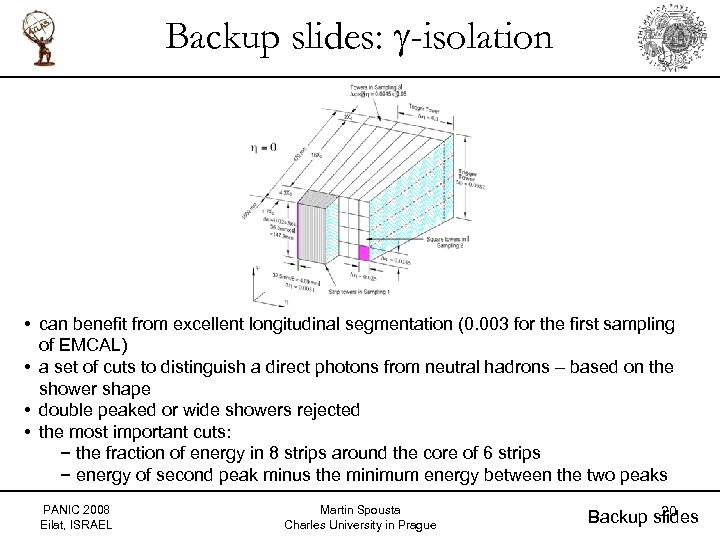 Backup slides: g-isolation • can benefit from excellent longitudinal segmentation (0. 003 for the first sampling of EMCAL) • a set of cuts to distinguish a direct photons from neutral hadrons – based on the shower shape • double peaked or wide showers rejected • the most important cuts: − the fraction of energy in 8 strips around the core of 6 strips − energy of second peak minus the minimum energy between the two peaks PANIC 2008 Eilat, ISRAEL Martin Spousta Charles University in Prague 20 Backup slides
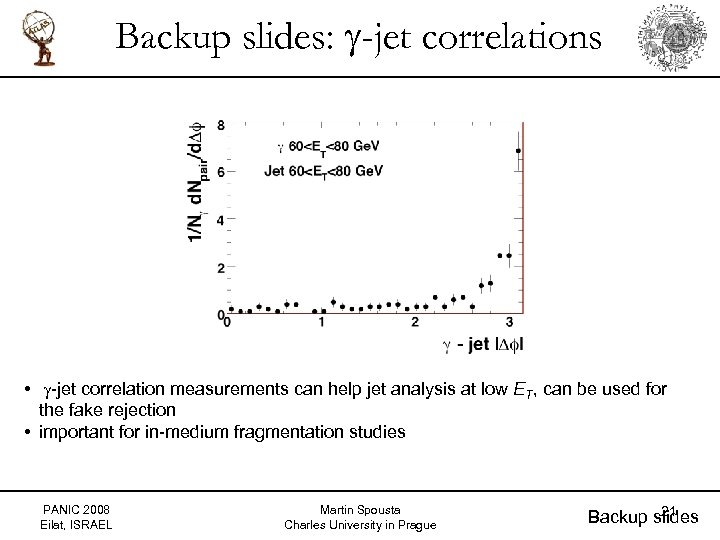 Backup slides: g-jet correlations • g-jet correlation measurements can help jet analysis at low ET, can be used for the fake rejection • important for in-medium fragmentation studies PANIC 2008 Eilat, ISRAEL Martin Spousta Charles University in Prague 21 Backup slides
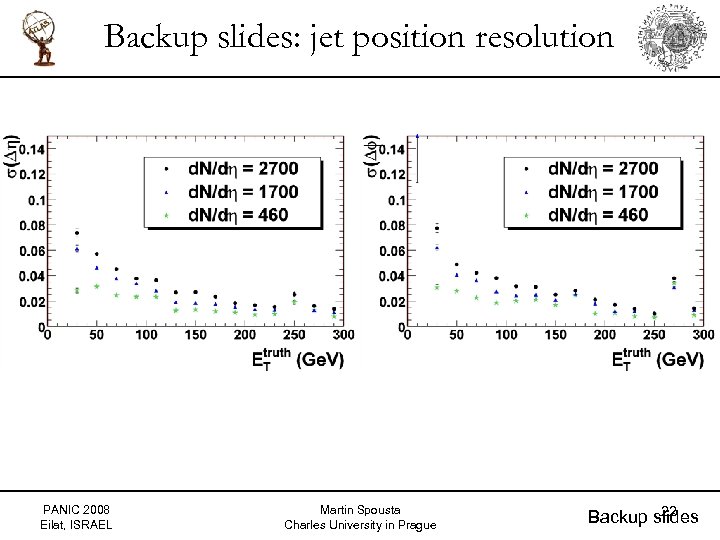 Backup slides: jet position resolution PANIC 2008 Eilat, ISRAEL Martin Spousta Charles University in Prague 22 Backup slides
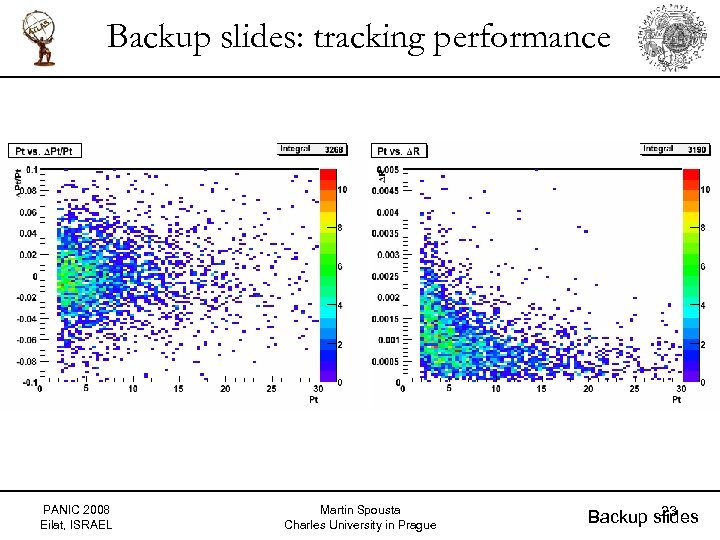 Backup slides: tracking performance PANIC 2008 Eilat, ISRAEL Martin Spousta Charles University in Prague 23 Backup slides
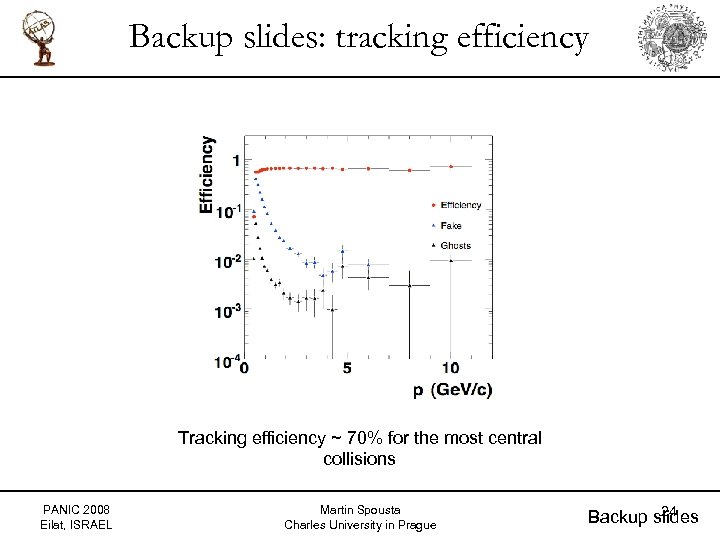 Backup slides: tracking efficiency Tracking efficiency ~ 70% for the most central collisions PANIC 2008 Eilat, ISRAEL Martin Spousta Charles University in Prague 24 Backup slides
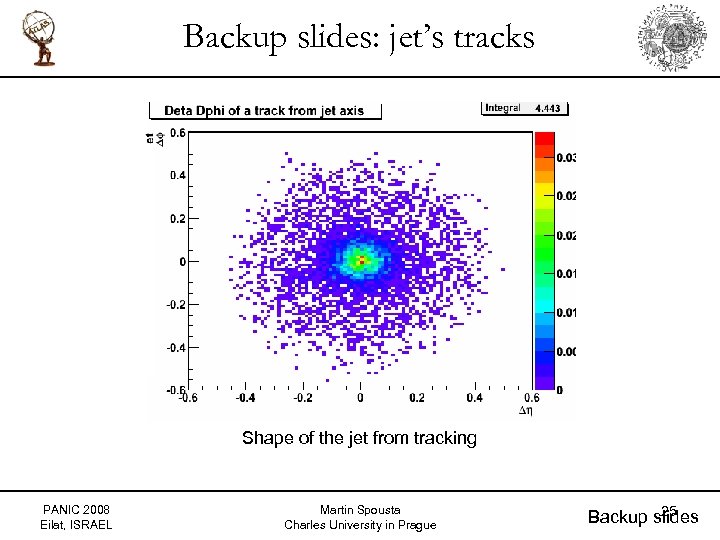 Backup slides: jet’s tracks Shape of the jet from tracking PANIC 2008 Eilat, ISRAEL Martin Spousta Charles University in Prague 25 Backup slides
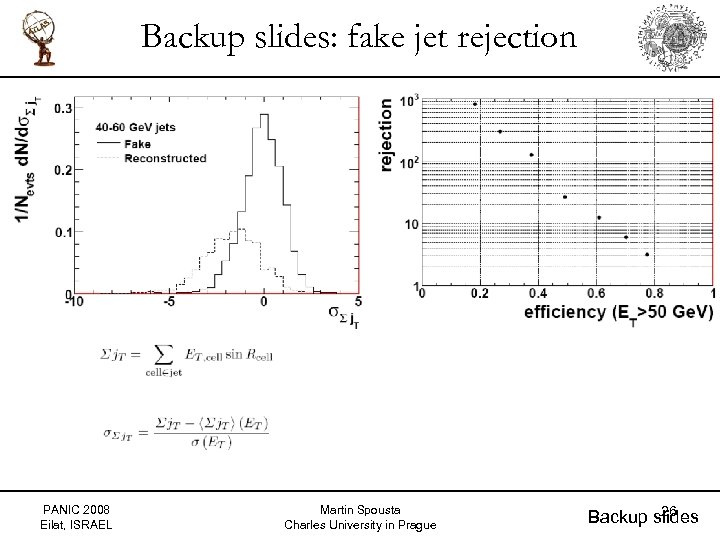 Backup slides: fake jet rejection PANIC 2008 Eilat, ISRAEL Martin Spousta Charles University in Prague 26 Backup slides
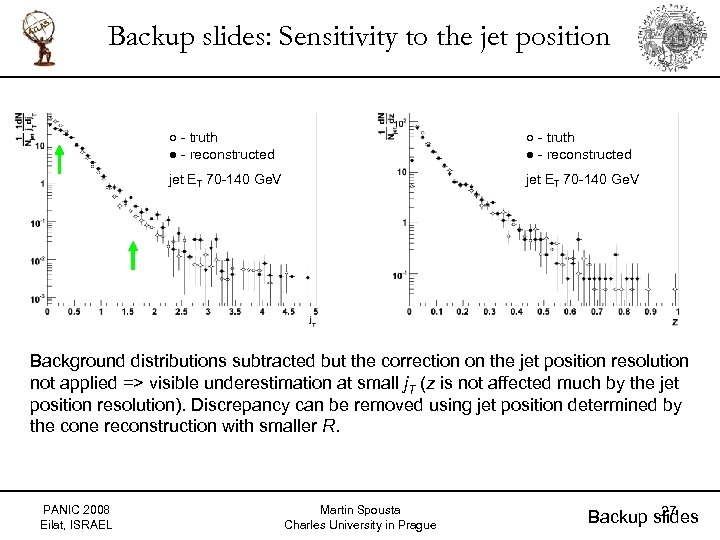 Backup slides: Sensitivity to the jet position ○ - truth ● - reconstructed jet ET 70 -140 Ge. V Background distributions subtracted but the correction on the jet position resolution not applied => visible underestimation at small j. T (z is not affected much by the jet position resolution). Discrepancy can be removed using jet position determined by the cone reconstruction with smaller R. PANIC 2008 Eilat, ISRAEL Martin Spousta Charles University in Prague 27 Backup slides
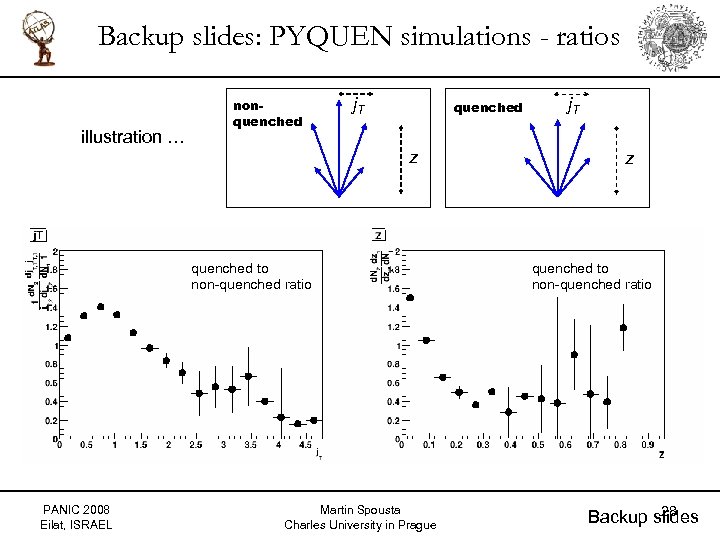 Backup slides: PYQUEN simulations - ratios illustration … nonquenched j. T quenched z quenched to non-quenched ratio PANIC 2008 Eilat, ISRAEL Martin Spousta Charles University in Prague j. T z quenched to non-quenched ratio 28 Backup slides
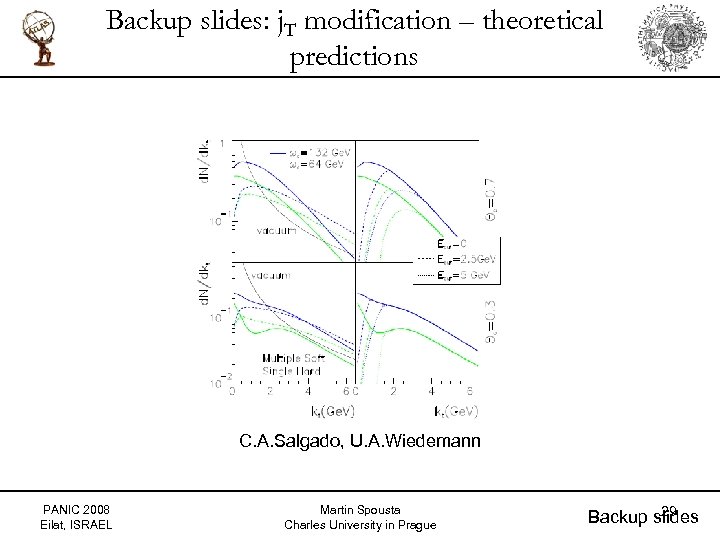 Backup slides: j. T modification – theoretical predictions C. A. Salgado, U. A. Wiedemann PANIC 2008 Eilat, ISRAEL Martin Spousta Charles University in Prague 29 Backup slides