


 Скачать презентацию Students will list and explain the 4 main
63d7ff251f6afa8863b18f5a3793cef5.ppt
- Количество слайдов: 120
 Students will list and explain the 4 main causes of WWI in their notebook.
 World War I
 OA #1 (behind Title Page) How can imperialism lead to conflict?
 1. Imperialism
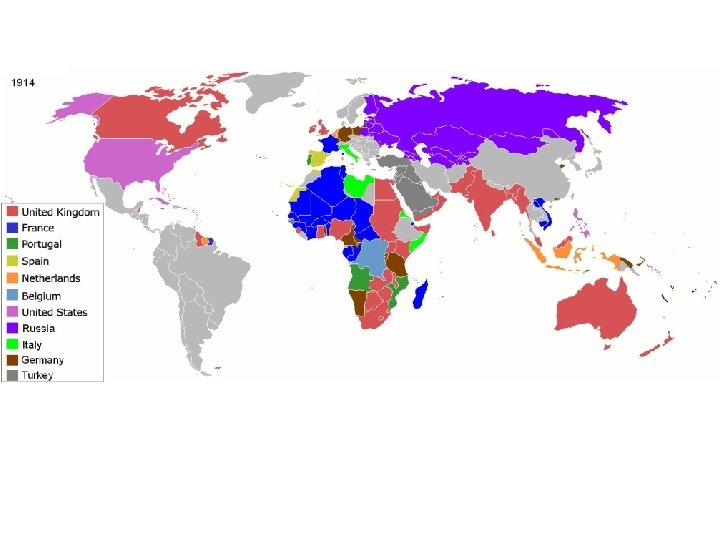
 1. Imperialism • Definition: When one country takes over another country to build an empire.
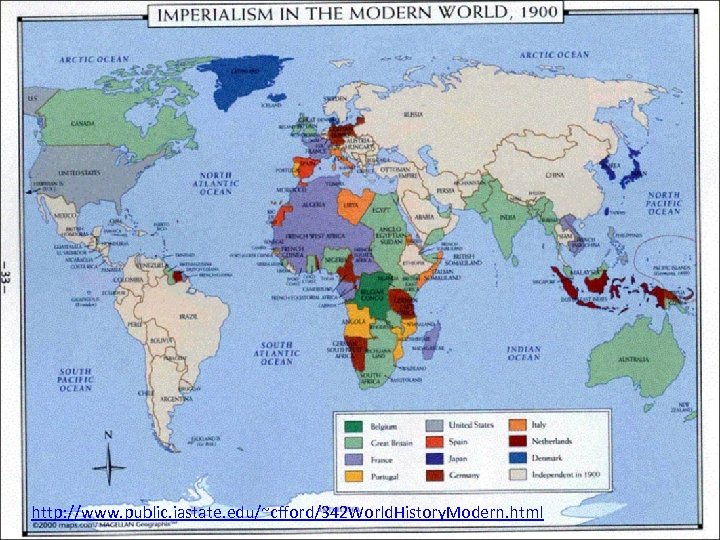 http: //www. public. iastate. edu/~cfford/342 World. History. Modern. html
 2. Militarism
 2. Militarism (Arms Race) Definition: Competition of creating the largest military
 Industrial Revolution • During the 1800’s the Industrial Revolution was happening in Europe. • With the invention of factories, weapons were less expensive to produce allowing countries to improve and buy them in mass quantities. • Countries were also experimenting with new weapons such as airplanes, tanks, chemical warfare.
 Nationalism
 Nationalism • Definition: Pride for your country.
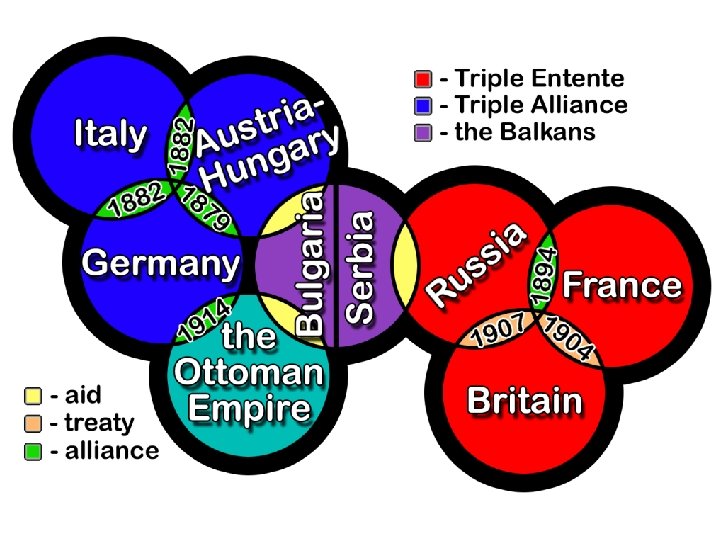
 4. Alliance System • An agreement between two or more countries to help each other. It can include military help, money or providing of weapons. • Late 1800’s many countries in Europe made various alliances, Triple Entente and The Triple Alliance
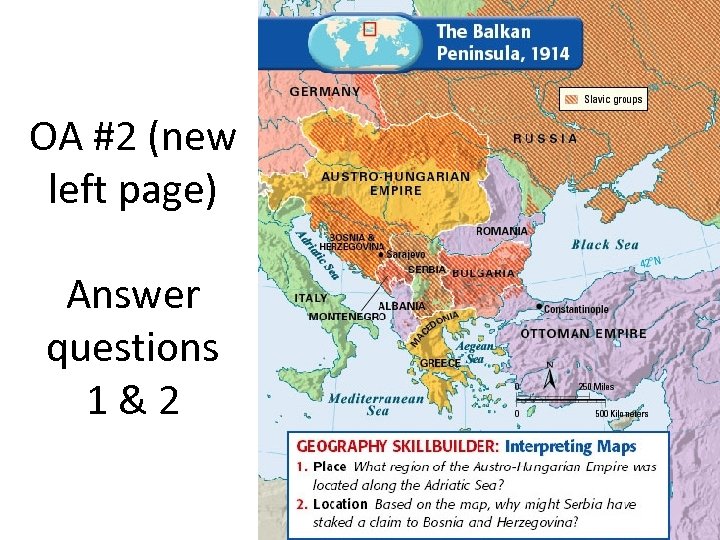 OA #2 (new left page) Answer questions 1&2
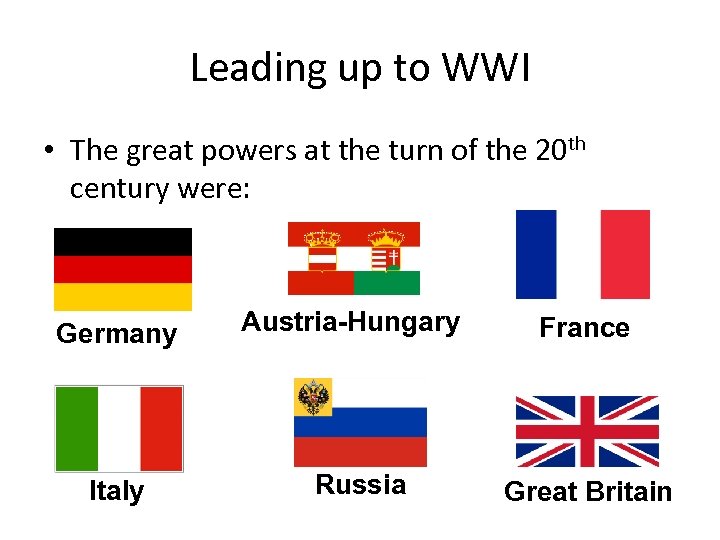 Leading up to WWI • The great powers at the turn of the 20 th century were: Germany Italy Austria-Hungary Russia France Great Britain
 Rivalry Increased Between European Power • Rivalry was motivated by: • Nationalism and Economic Competition
 What were t
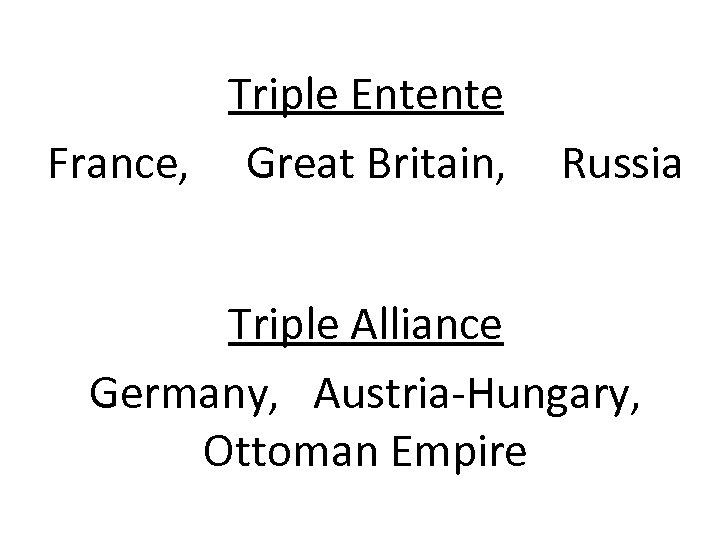 Triple Entente France, Great Britain, Russia Triple Alliance Germany, Austria-Hungary, Ottoman Empire
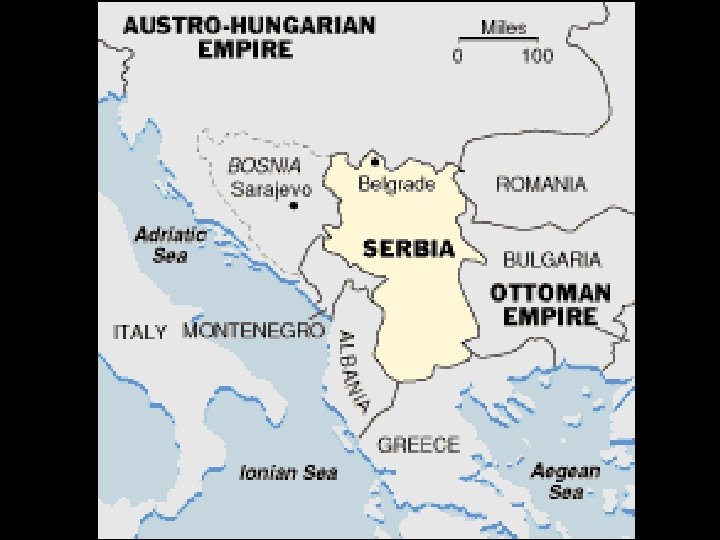
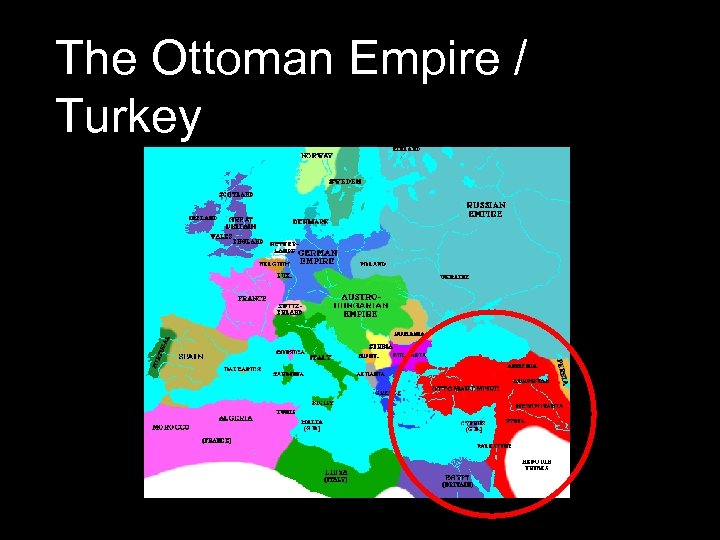
 Nationalism in the Balkans • Serbia resented Austria-Hungary’s control over Bosnia • Russia and Austria-Hungary want control over the people of the Balkan Peninsula • Many new nations have recently formed from the dying Ottoman Empire
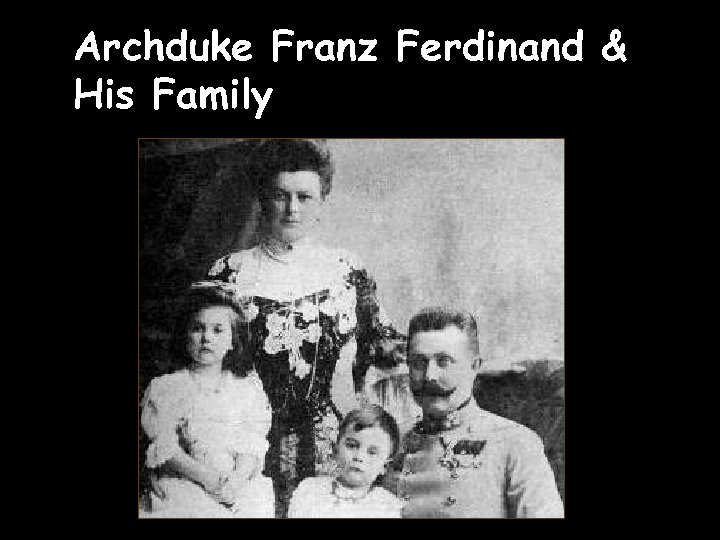 Archduke Franz Ferdinand & His Family
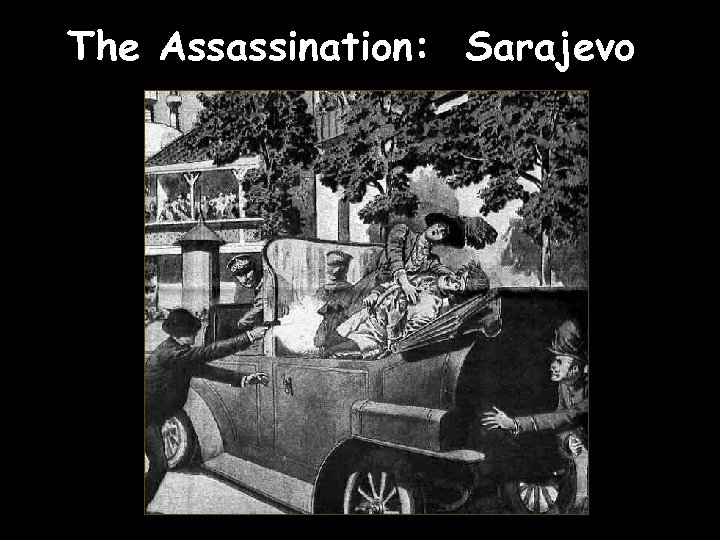 The Assassination: Sarajevo
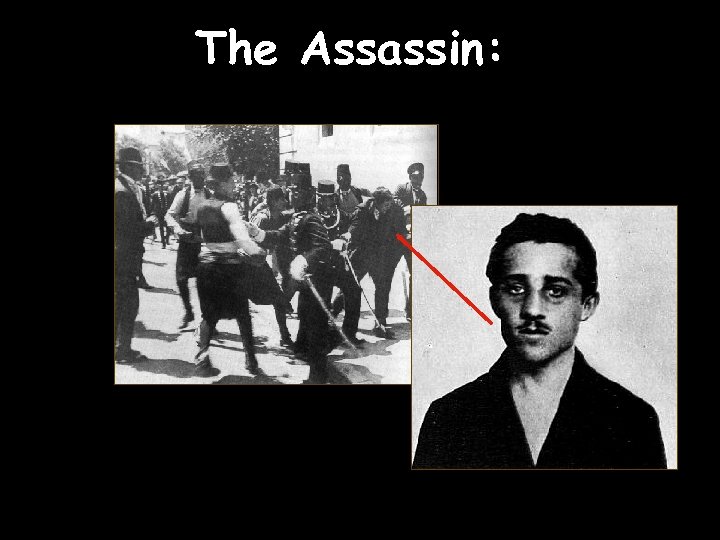 The Assassin: Gavrilo Princip
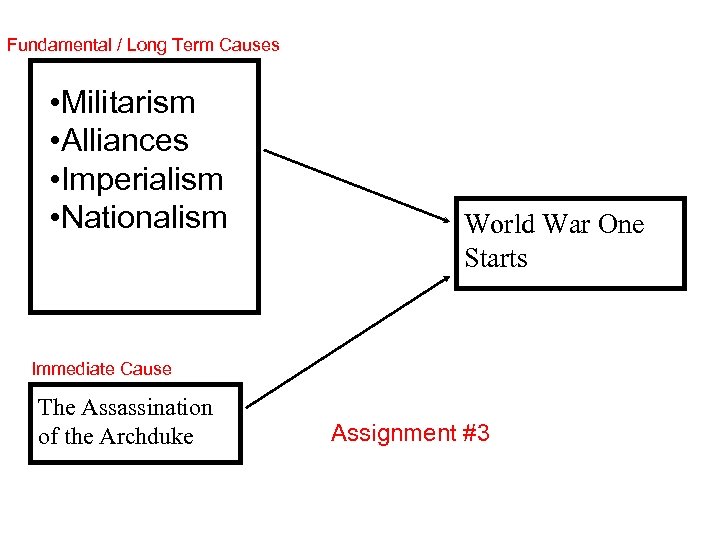 Fundamental / Long Term Causes • Militarism • Alliances • Imperialism • Nationalism World War One Starts Immediate Cause The Assassination of the Archduke Assignment #3
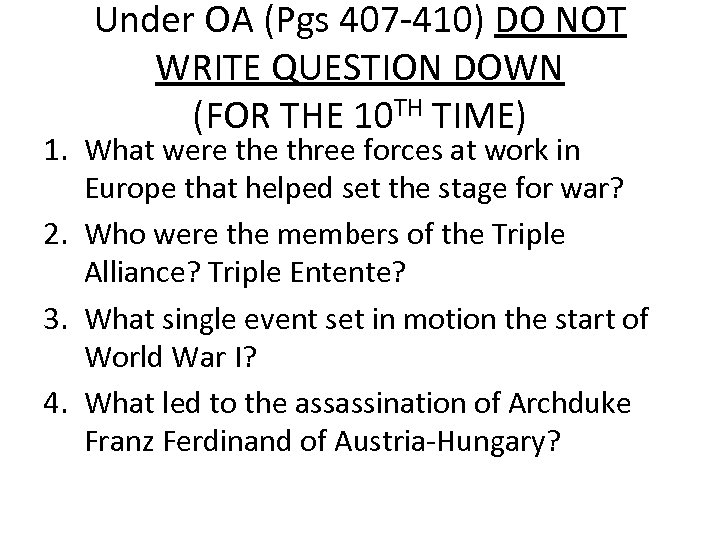 Under OA (Pgs 407 -410) DO NOT WRITE QUESTION DOWN (FOR THE 10 TH TIME) 1. What were three forces at work in Europe that helped set the stage for war? 2. Who were the members of the Triple Alliance? Triple Entente? 3. What single event set in motion the start of World War I? 4. What led to the assassination of Archduke Franz Ferdinand of Austria-Hungary?
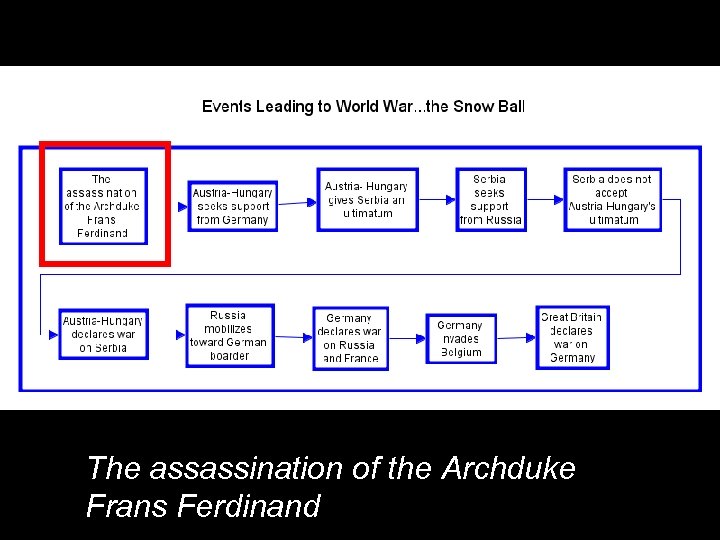 The assassination of the Archduke Frans Ferdinand
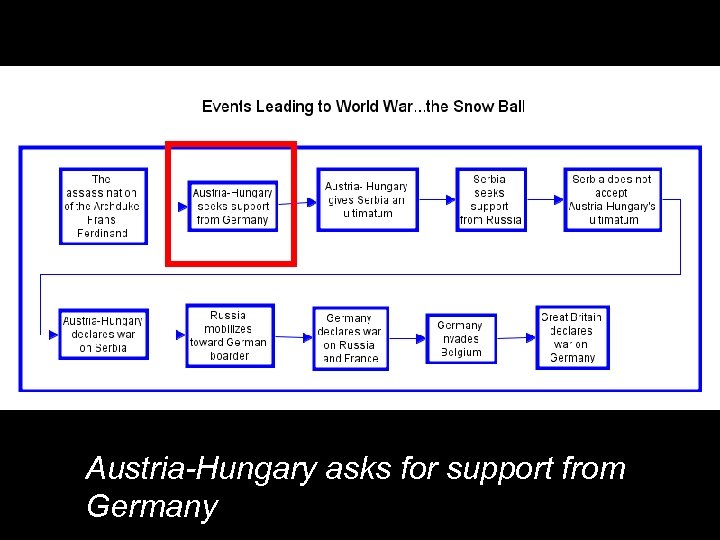 Austria-Hungary asks for support from Germany
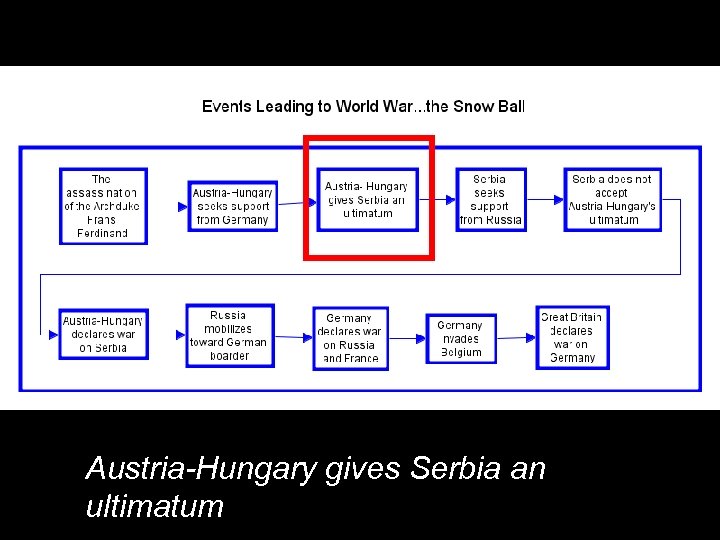 Austria-Hungary gives Serbia an ultimatum
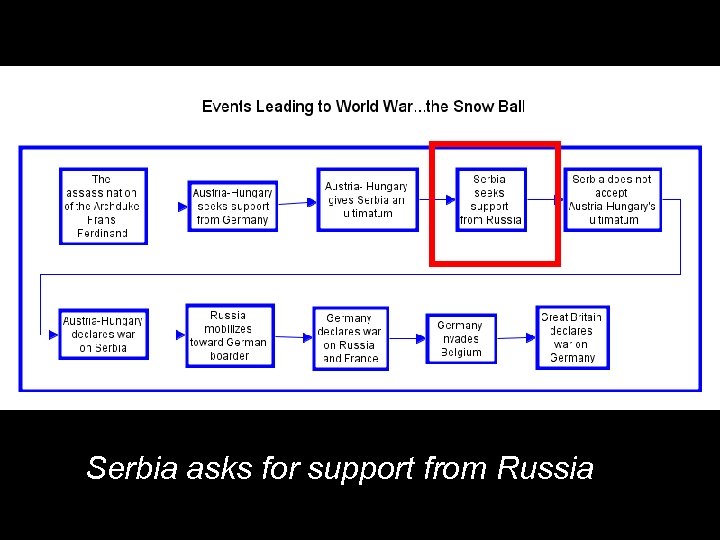 Serbia asks for support from Russia
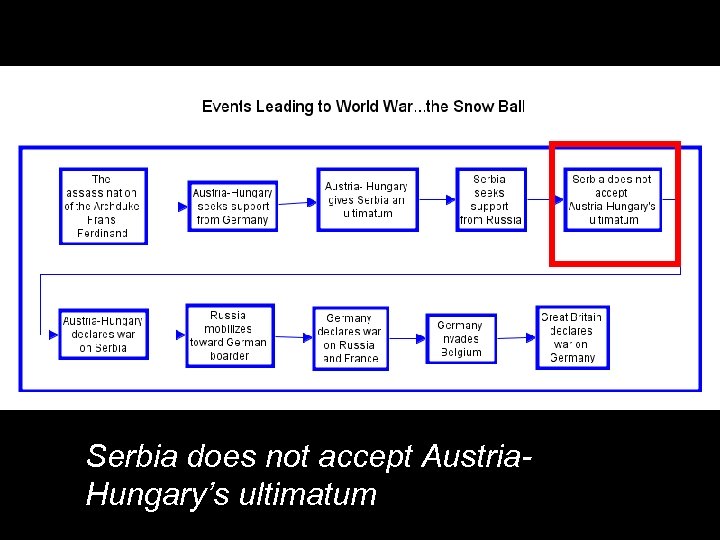 Serbia does not accept Austria. Hungary’s ultimatum
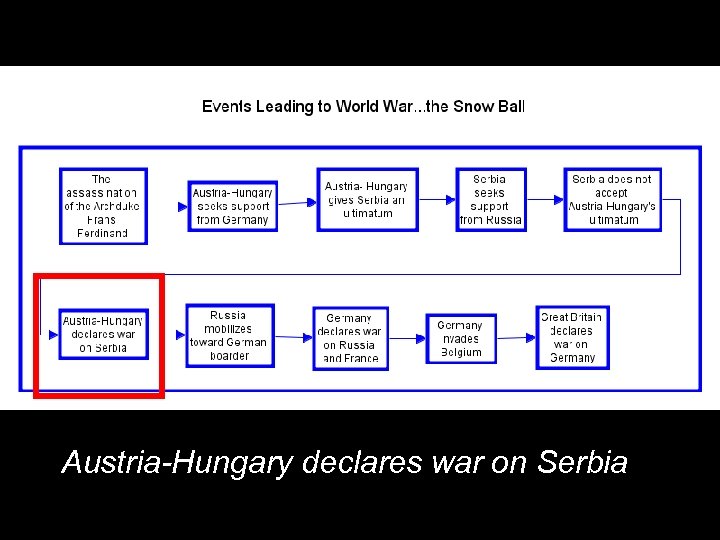 Austria-Hungary declares war on Serbia
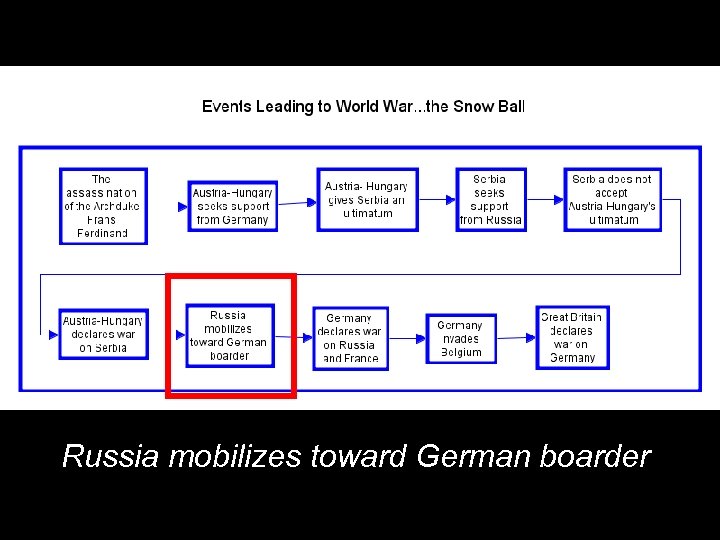 Russia mobilizes toward German boarder
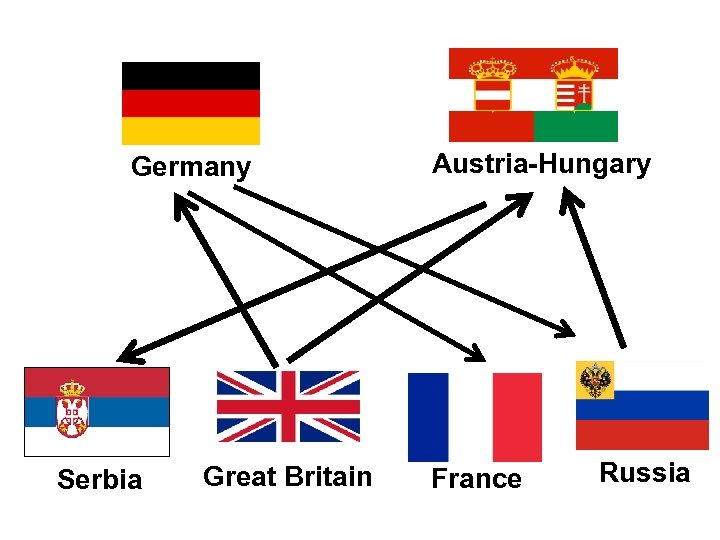
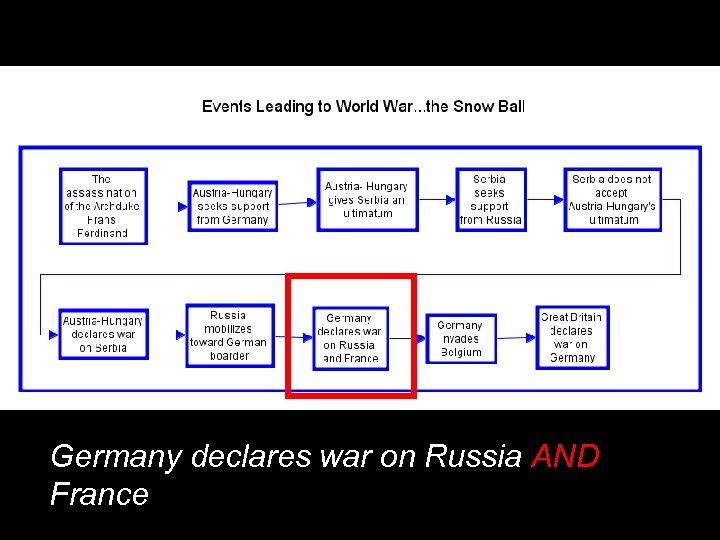 Germany declares war on Russia AND France
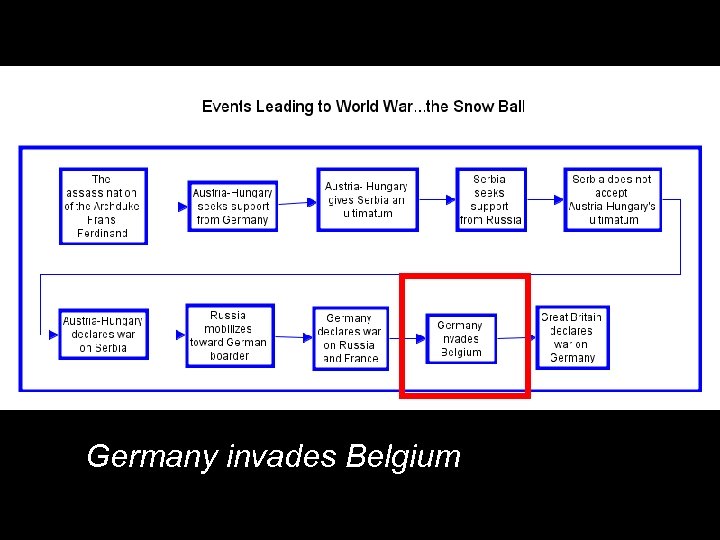 Germany invades Belgium
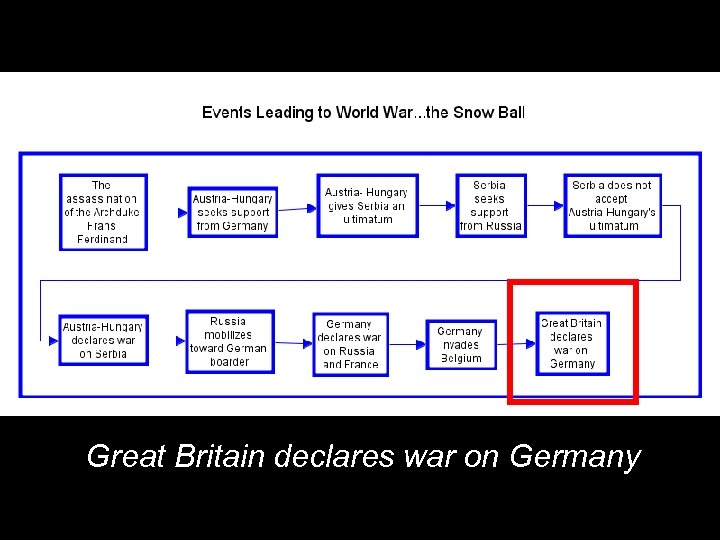 Great Britain declares war on Germany
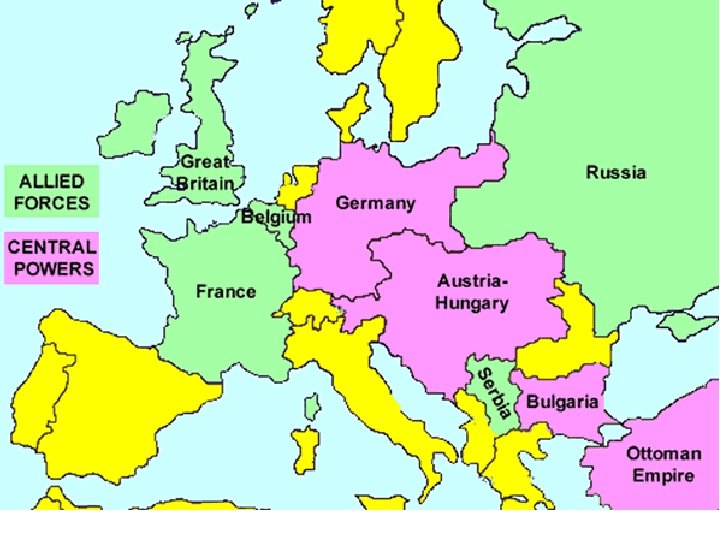
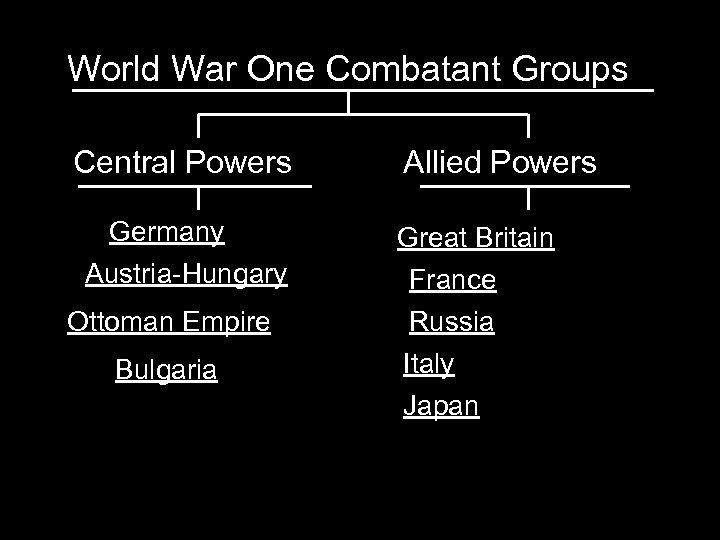 World War One Combatant Groups Central Powers Germany Austria-Hungary Ottoman Empire Bulgaria Allied Powers Great Britain France Russia Italy Japan
 Schlieffen Plan 1. Why would the allies have an advantage in fighting WWI over the Central Powers? – Explain by writing a paragraph. – Give two or more reasons.
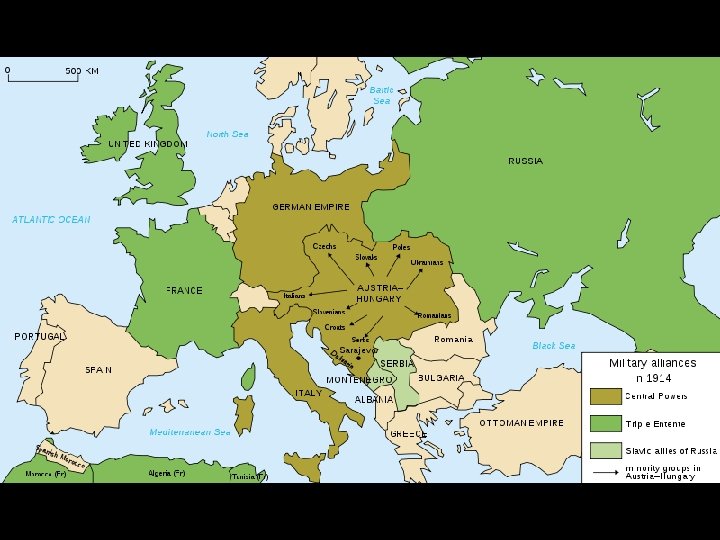
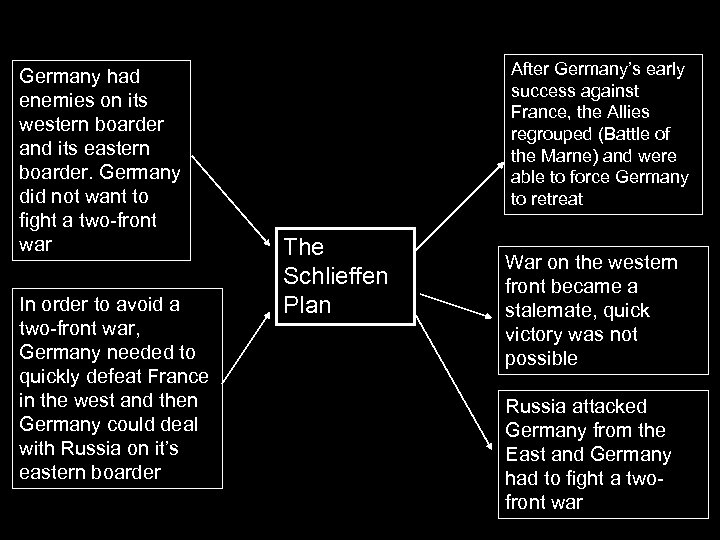 Germany had enemies on its western boarder and its eastern boarder. Germany did not want to fight a two-front war In order to avoid a two-front war, Germany needed to quickly defeat France in the west and then Germany could deal with Russia on it’s eastern boarder After Germany’s early success against France, the Allies regrouped (Battle of the Marne) and were able to force Germany to retreat The Schlieffen Plan War on the western front became a stalemate, quick victory was not possible Russia attacked Germany from the East and Germany had to fight a twofront war
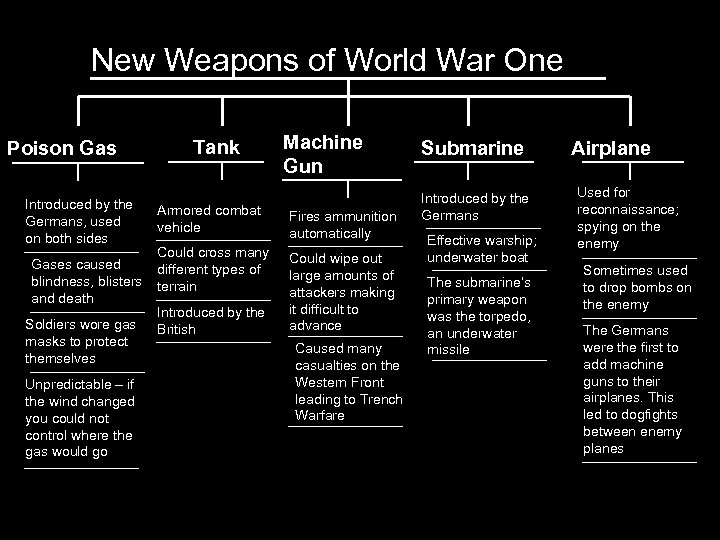 New Weapons of World War One Poison Gas Introduced by the Germans, used on both sides Gases caused blindness, blisters and death Soldiers wore gas masks to protect themselves Unpredictable – if the wind changed you could not control where the gas would go Tank Machine Gun Armored combat vehicle Fires ammunition automatically Could cross many different types of terrain Could wipe out large amounts of attackers making it difficult to advance Introduced by the British Caused many casualties on the Western Front leading to Trench Warfare Submarine Introduced by the Germans Effective warship; underwater boat The submarine’s primary weapon was the torpedo, an underwater missile Airplane Used for reconnaissance; spying on the enemy Sometimes used to drop bombs on the enemy The Germans were the first to add machine guns to their airplanes. This led to dogfights between enemy planes
 OA #4 (new left page) Out of the new technology used during WWI, which do you think was the most significant? Explain why.
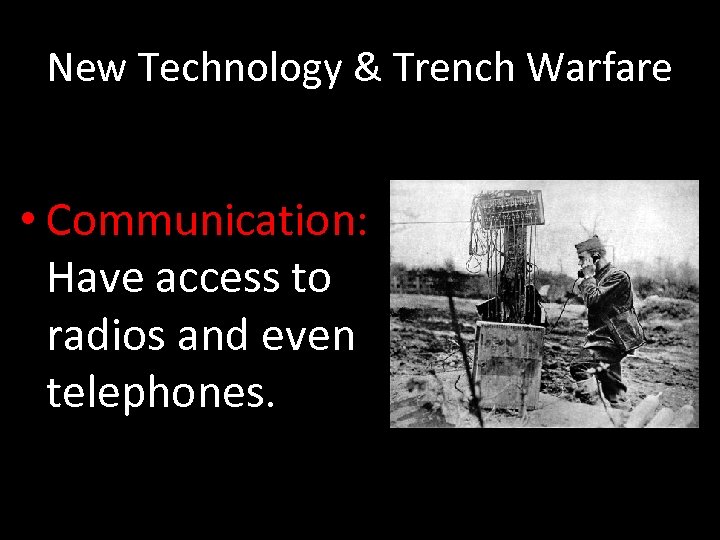 New Technology & Trench Warfare • Communication: Have access to radios and even telephones.
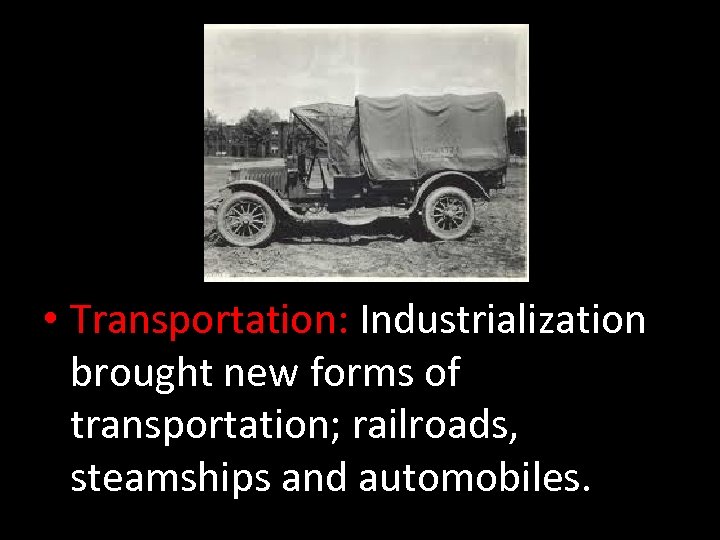 • Transportation: Industrialization brought new forms of transportation; railroads, steamships and automobiles.
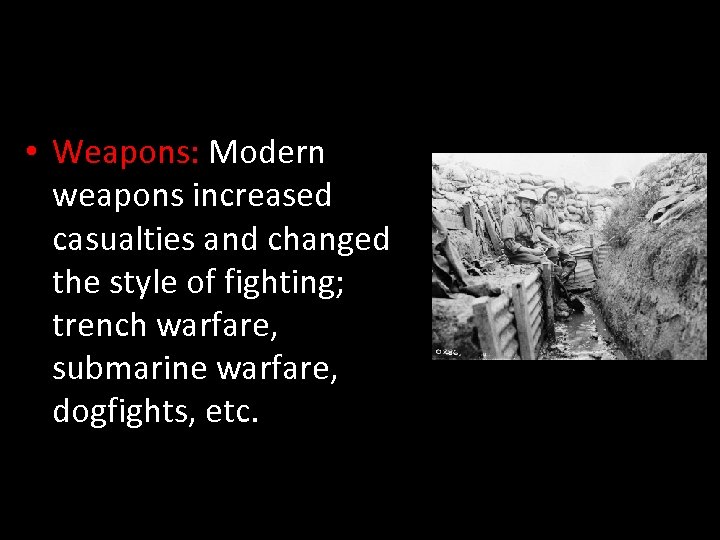 • Weapons: Modern weapons increased casualties and changed the style of fighting; trench warfare, submarine warfare, dogfights, etc.
 • On separate sheet of paper (#4), create a bubble map of “life in the trenches. ” –Must have at least 10 descriptive aspects
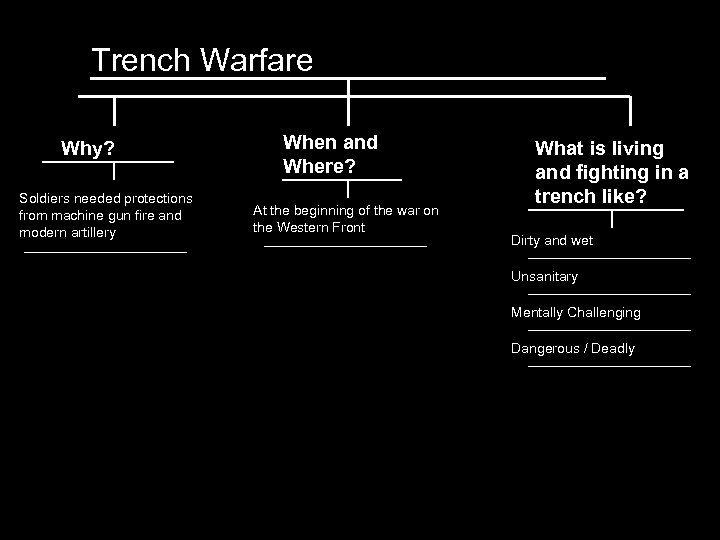 Trench Warfare Why? Soldiers needed protections from machine gun fire and modern artillery When and Where? At the beginning of the war on the Western Front What is living and fighting in a trench like? Dirty and wet Unsanitary Mentally Challenging Dangerous / Deadly
 Trench Warfare • Modern war was very different from the traditional “gentleman’s warfare. ” Modern – Weapons like the machine gun forced soldiers to find protection by digging trenches. • Morale of soldiers changed bad living conditions a lot of casualties • Can’t gain advantage in trench warfare – Led to stalemate
 OA #5 (new left page) In a couple sentences (2 -3 sentences), describe what trench warfare was like
 Germany Serbia Great Britain Austria-Hungary France Russia
 Who Declared War on Who? • • • AH Declares War on SER RUS Declares War on AH GER Declares War on RUS GER Declares War on FRA GB Declares War on GER and AH
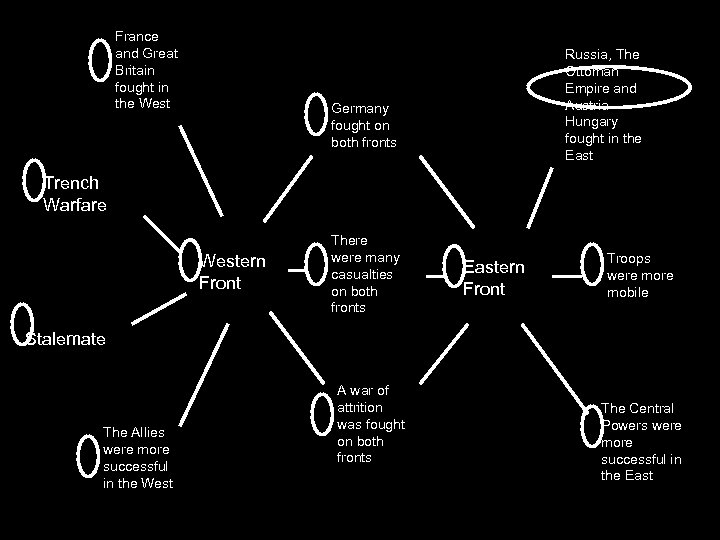
 Theatres of War • Although World War I was a world war, it was confined to only a few areas: –The Western Front –The Eastern Front –The War at Sea
 Western Front • Germans, Austria-Hungarians vs. French, British and later Americans • Germany develops the Schlieffen Plan • Battle of the Marne (1914 - German Defeat) • Trench Warfare on the Western Front
 Western Front: Battles • Battle of Verdun – – Ten months long French and German armies. Estimated 540, 000 French and 430, 000 German casualties Stalemate • Battle of Somme – – English and French vs Germany Six months of fighting Five miles of advancement for Allies 1 million men killed
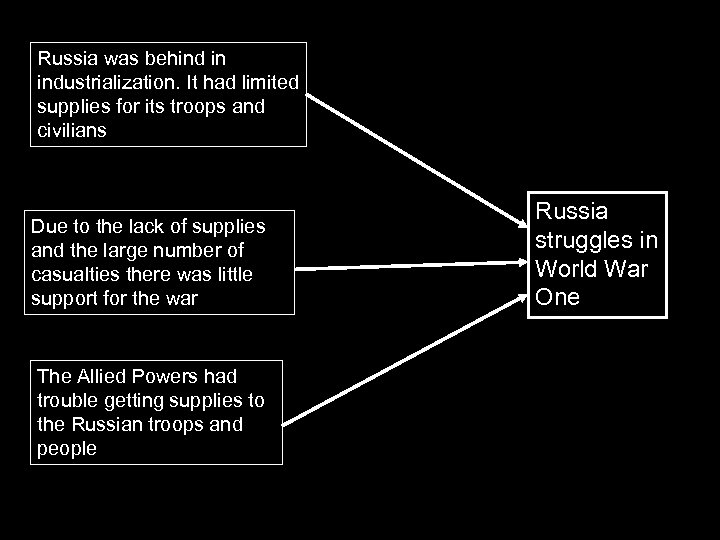
 Eastern Front • Russians and Serbs vs. Germans and Austria-Hungarians • War more mobile but still a stalemate • Russia’s disadvantages – Not Industrialized – Short on Supplies • Russia’s advantage – People
 Eastern Front: Battles • Battle of Tannenberg: – August 1914 - First major eastern battle. – Russia was badly defeated and pushed back. – Russia lost millions of men against Germany, undersupplied, under gunned
 OA #6 (under OA #5) Where was WWI primarily fought? Be specific.
 France and Great Britain fought in the West Russia, The Ottoman Empire and Austria. Hungary fought in the East Germany fought on both fronts Trench Warfare Western Front There were many casualties on both fronts Eastern Front Troops were mobile Stalemate The Allies were more successful in the West A war of attrition was fought on both fronts The Central Powers were more successful in the East
 Russia was behind in industrialization. It had limited supplies for its troops and civilians Due to the lack of supplies and the large number of casualties there was little support for the war The Allied Powers had trouble getting supplies to the Russian troops and people Russia struggles in World War One
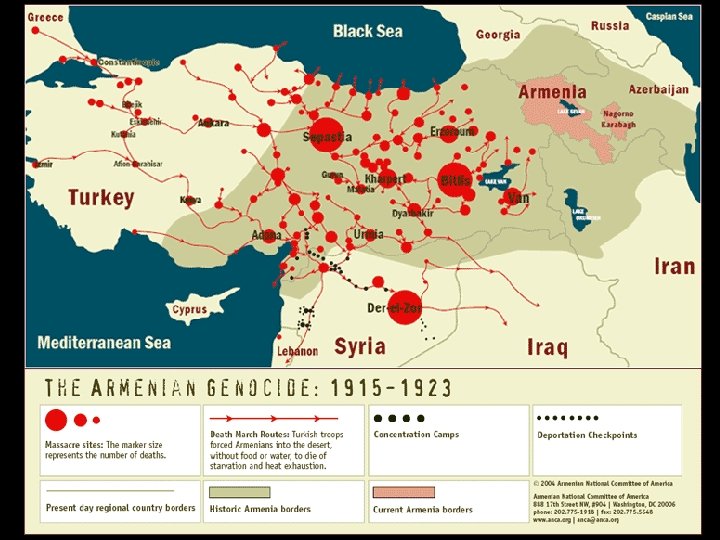
 The Ottoman Empire / Turkey
 Vocabulary – Armenian Genocide Textbook page 410 • genocide – the deliberate murder of a whole group or race of people • ethnic cleansing – the action of forcing people to leave an area or country because of their racial or national group • refugee – someone who has been forced to leave their country, especially during a war, or for political or religious reasons
 Vocabulary – Armenian Genocide Textbook page 410 • exterminate – to kill large numbers of people of a particular group so that they no longer exist • denial – when you refuse to admit or believe that something bad exists or has happened • civic responsibility – obligations as a good citizen, responsibilities of a good citizen.
 Genocide as defined by the United Nations in 1948 means any of the following acts committed with intent to destroy, in whole or in part, a national, ethnic, racial or religious group, including: • killing members of the group • causing serious bodily or mental harm to members of the group • deliberately inflicting on the group conditions of life calculated to bring about its physical destruction in a whole or in part • imposing measures intended to prevent births within the group • forcibly transferring children from the group to another group
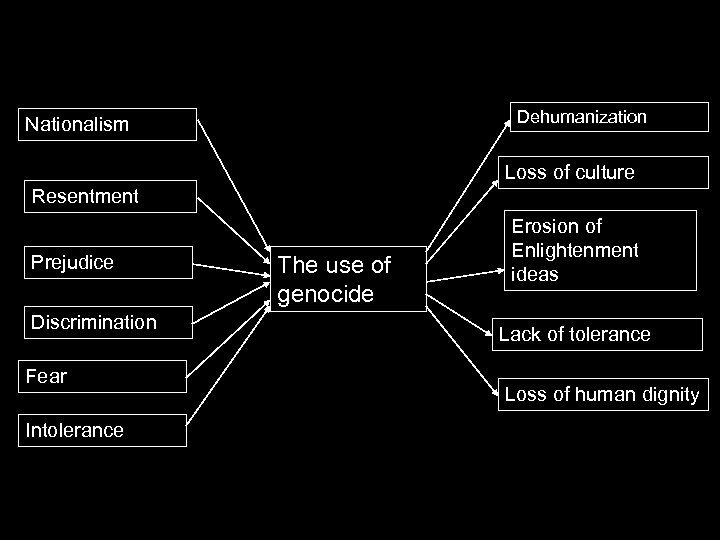 Dehumanization Nationalism Loss of culture Resentment Prejudice Discrimination Fear Intolerance The use of genocide Erosion of Enlightenment ideas Lack of tolerance Loss of human dignity
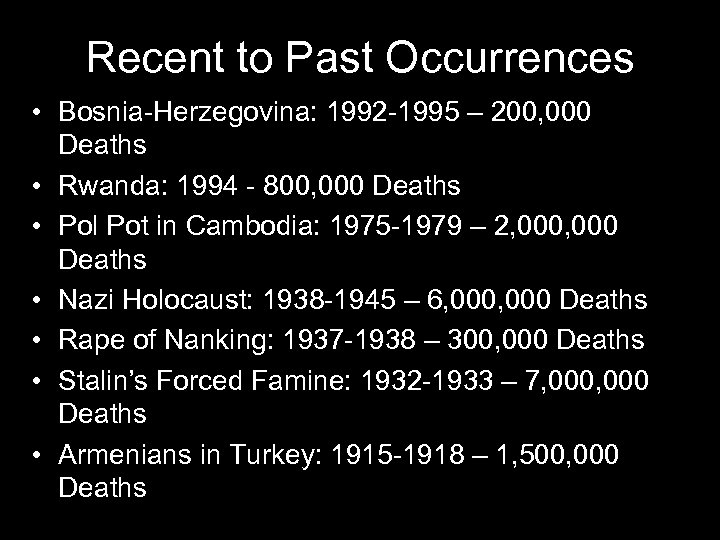 Recent to Past Occurrences • Bosnia-Herzegovina: 1992 -1995 – 200, 000 Deaths • Rwanda: 1994 - 800, 000 Deaths • Pol Pot in Cambodia: 1975 -1979 – 2, 000 Deaths • Nazi Holocaust: 1938 -1945 – 6, 000 Deaths • Rape of Nanking: 1937 -1938 – 300, 000 Deaths • Stalin’s Forced Famine: 1932 -1933 – 7, 000 Deaths • Armenians in Turkey: 1915 -1918 – 1, 500, 000 Deaths
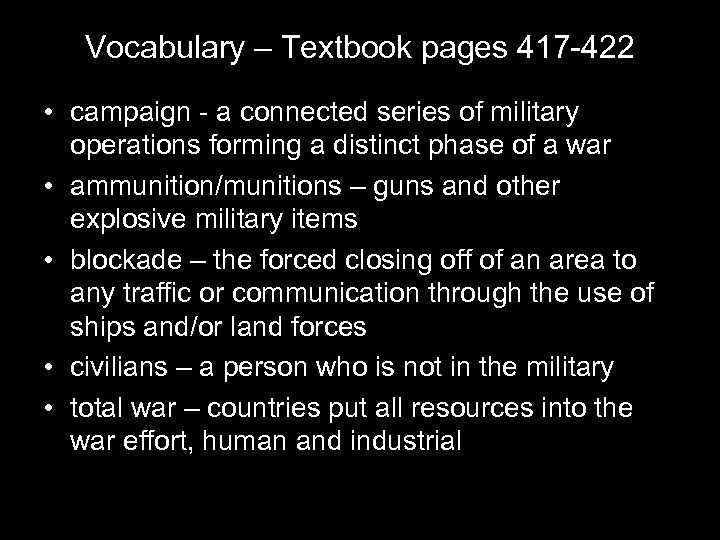 Vocabulary – Textbook pages 417 -422 • campaign - a connected series of military operations forming a distinct phase of a war • ammunition/munitions – guns and other explosive military items • blockade – the forced closing off of an area to any traffic or communication through the use of ships and/or land forces • civilians – a person who is not in the military • total war – countries put all resources into the war effort, human and industrial
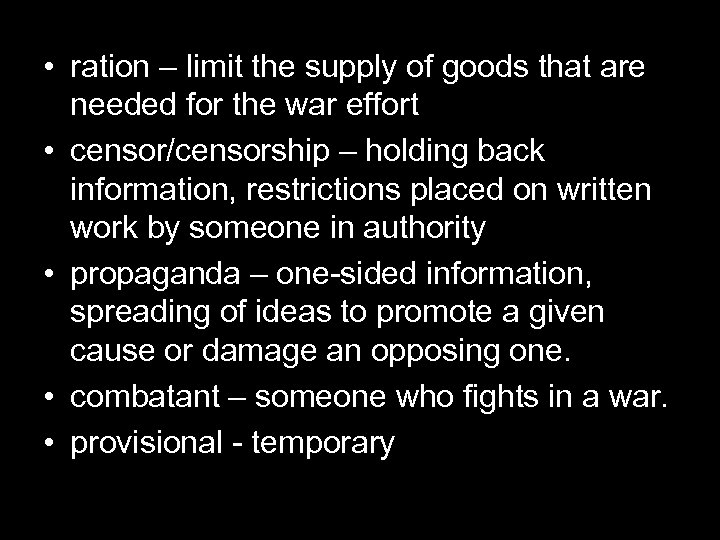 • ration – limit the supply of goods that are needed for the war effort • censor/censorship – holding back information, restrictions placed on written work by someone in authority • propaganda – one-sided information, spreading of ideas to promote a given cause or damage an opposing one. • combatant – someone who fights in a war. • provisional - temporary
 • strategy – a plan of action to achieve a goal • truce/armistice/cease-fire – temporary ending / an agreement to stop fighting. • disillusionment – when you realize what you thought was good or true really isn’t. Loss of idealism. • legacy – anything handed down from the past.
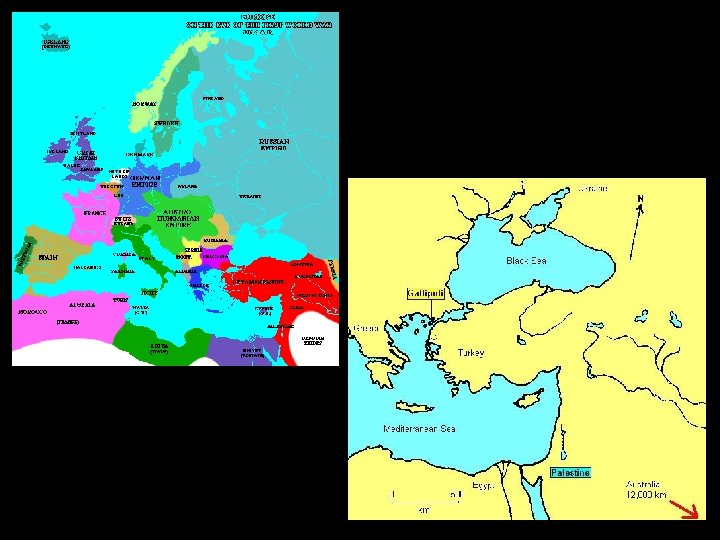
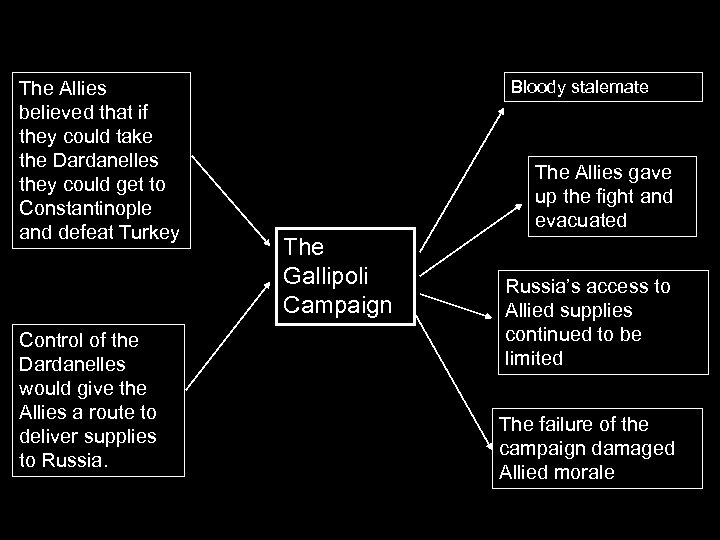 The Allies believed that if they could take the Dardanelles they could get to Constantinople and defeat Turkey Control of the Dardanelles would give the Allies a route to deliver supplies to Russia. Bloody stalemate The Allies gave up the fight and evacuated The Gallipoli Campaign Russia’s access to Allied supplies continued to be limited The failure of the campaign damaged Allied morale
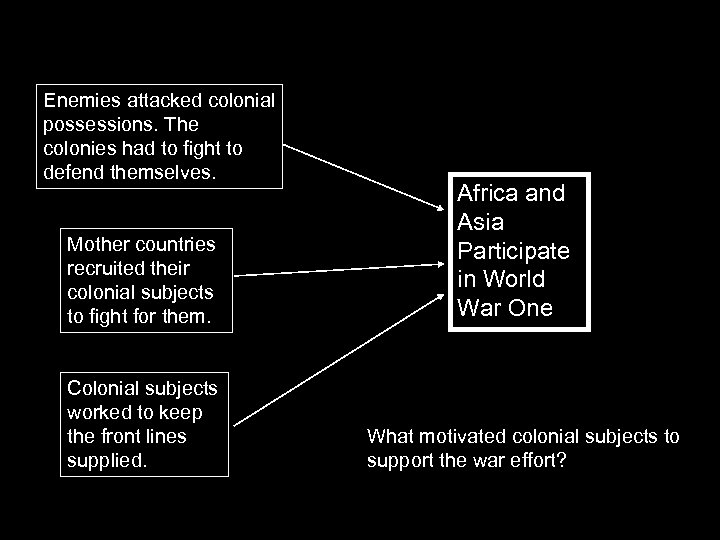 Enemies attacked colonial possessions. The colonies had to fight to defend themselves. Mother countries recruited their colonial subjects to fight for them. Colonial subjects worked to keep the front lines supplied. Africa and Asia Participate in World War One What motivated colonial subjects to support the war effort?
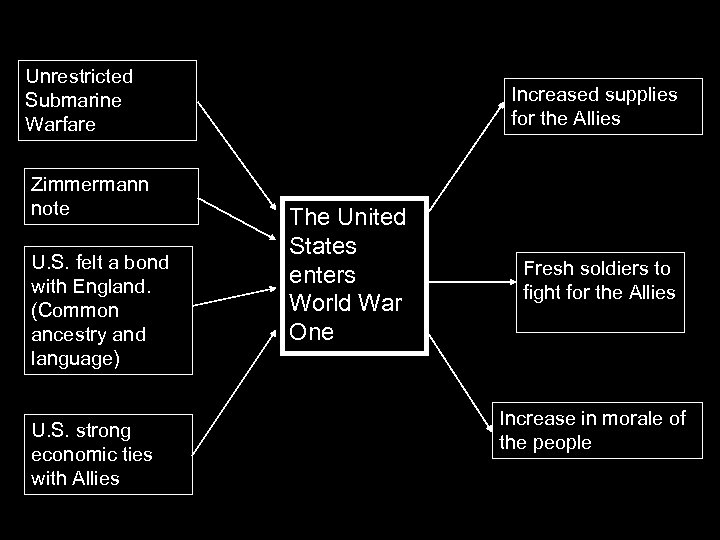 Unrestricted Submarine Warfare Zimmermann note U. S. felt a bond with England. (Common ancestry and language) U. S. strong economic ties with Allies Increased supplies for the Allies The United States enters World War One Fresh soldiers to fight for the Allies Increase in morale of the people
 OA #7 (new left page) What do you think was Russia’s biggest disadvantage in WWI? Why?
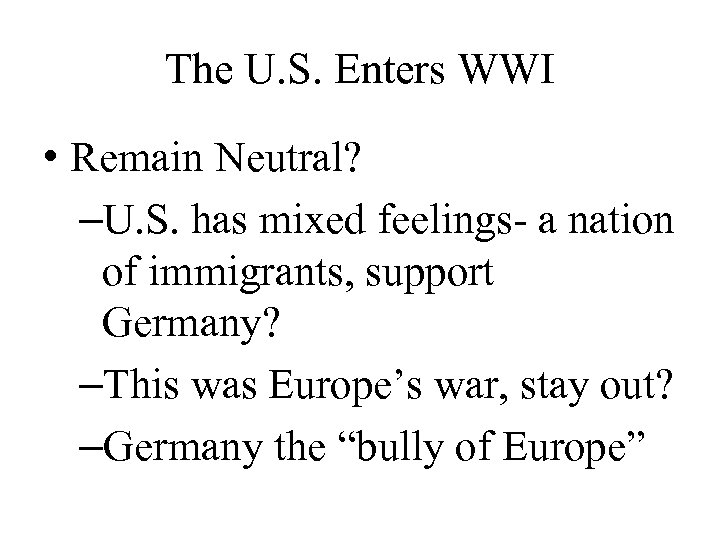 The U. S. Enters WWI • Remain Neutral? –U. S. has mixed feelings- a nation of immigrants, support Germany? –This was Europe’s war, stay out? –Germany the “bully of Europe”
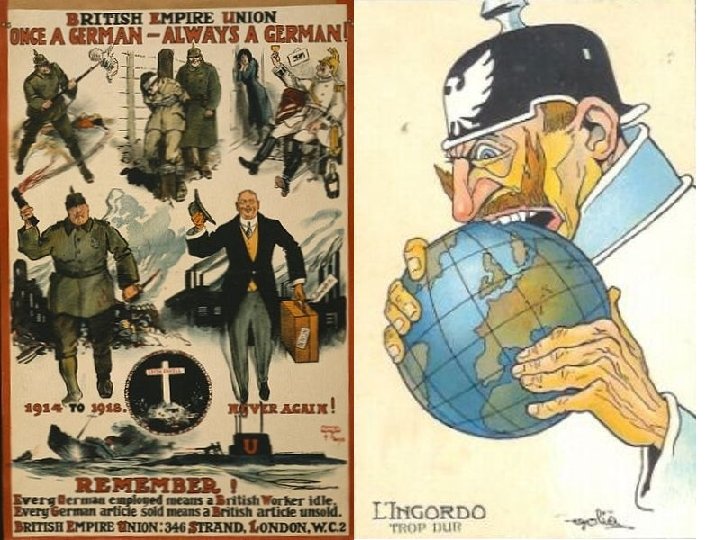
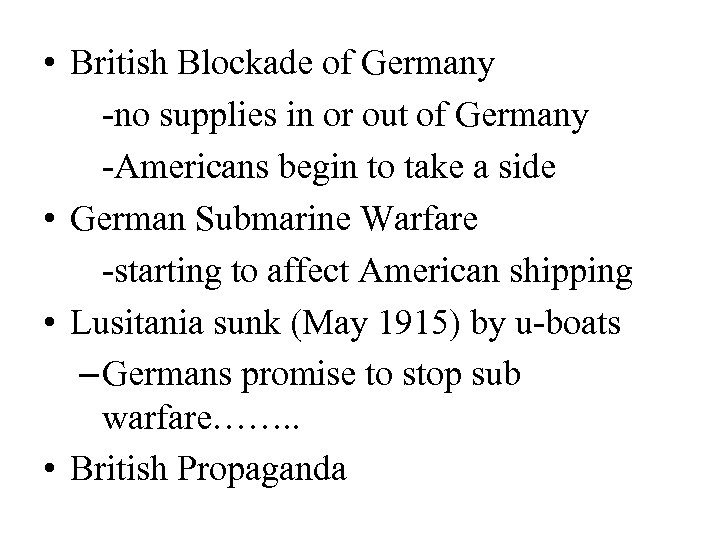 • British Blockade of Germany -no supplies in or out of Germany -Americans begin to take a side • German Submarine Warfare -starting to affect American shipping • Lusitania sunk (May 1915) by u-boats – Germans promise to stop sub warfare……. . • British Propaganda
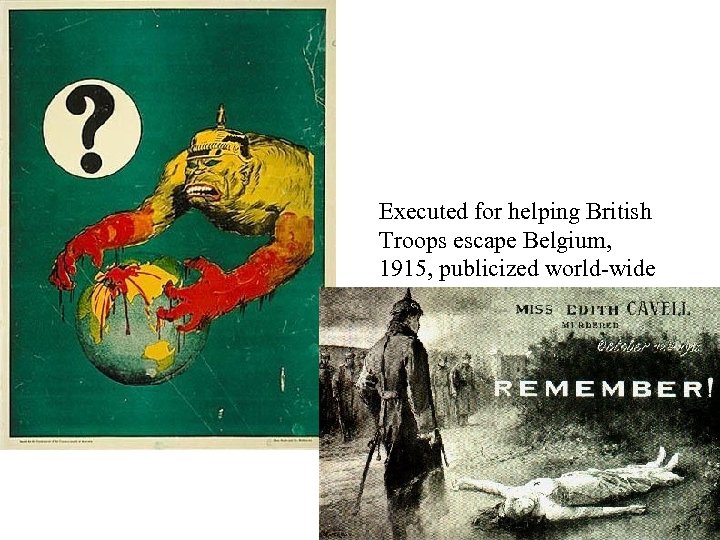 Executed for helping British Troops escape Belgium, 1915, publicized world-wide
 • The Zimmerman Note (Jan 1917): -Germany sends message to Mexico: “ We are resuming sub warfare, Help us beat the U. S. and we’ll give you back the American west. ” -America reacts…. • Congress Declares War on Germany (April 1917)…why Germany and not UK? • The Russian Revolution 1917: severely weakens Russia – Russia has to make peace treaty with Central powers – w/draws from combat& the Allies begin to struggle

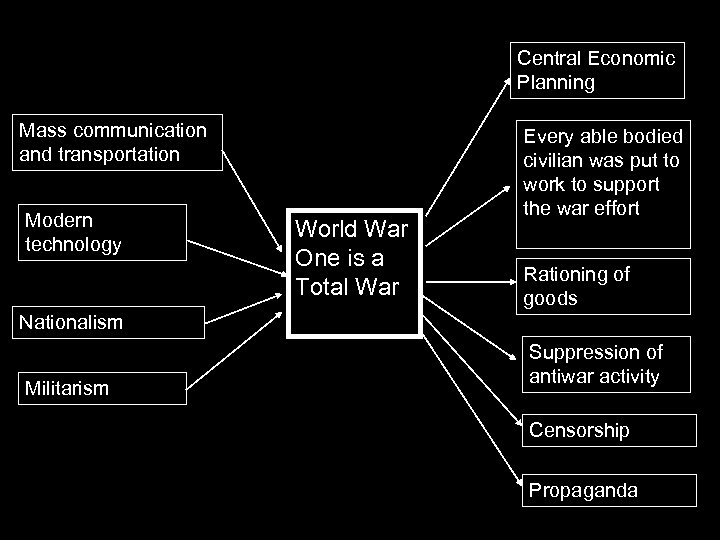 Central Economic Planning Mass communication and transportation Modern technology World War One is a Total War Every able bodied civilian was put to work to support the war effort Rationing of goods Nationalism Militarism Suppression of antiwar activity Censorship Propaganda
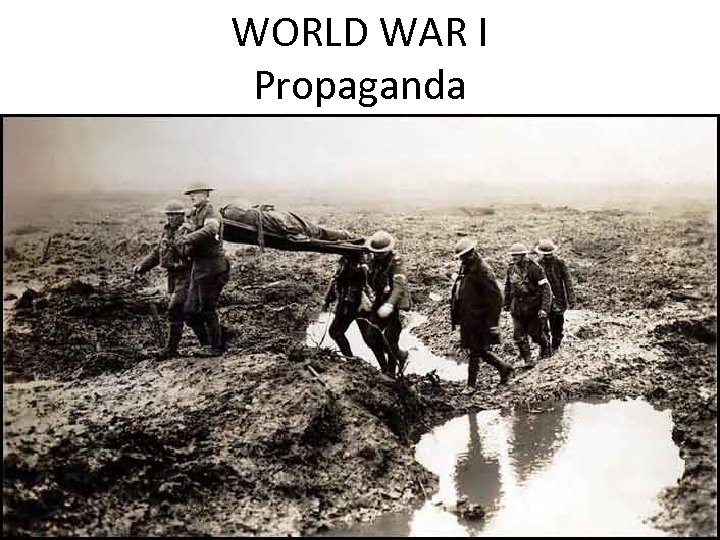 WORLD WAR I Propaganda
 Propaganda (definition) • Information, ideas, or rumors deliberately spread widely to help or harm a person, group, movement, institution, nation, etc.
 Introduction Popular support for World War I was garnered by imagery used in newspapers and posters. This phenomena is known as propaganda. Propaganda posters played a major role in World War I.
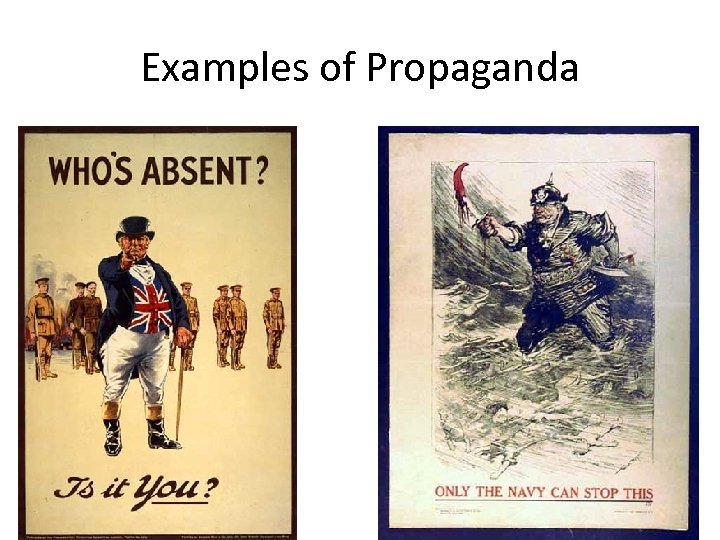 Examples of Propaganda
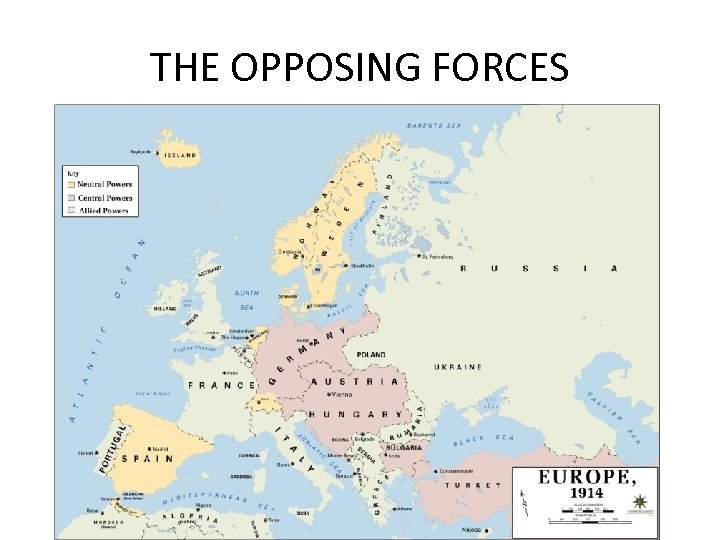 THE OPPOSING FORCES
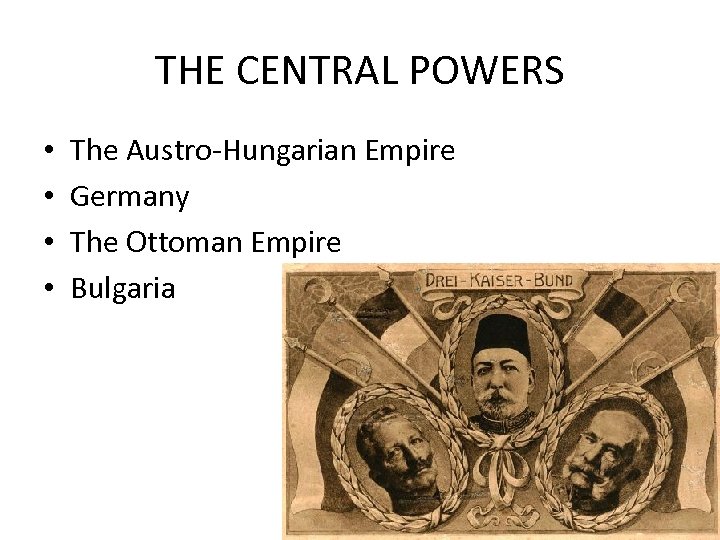 THE CENTRAL POWERS • • The Austro-Hungarian Empire Germany The Ottoman Empire Bulgaria
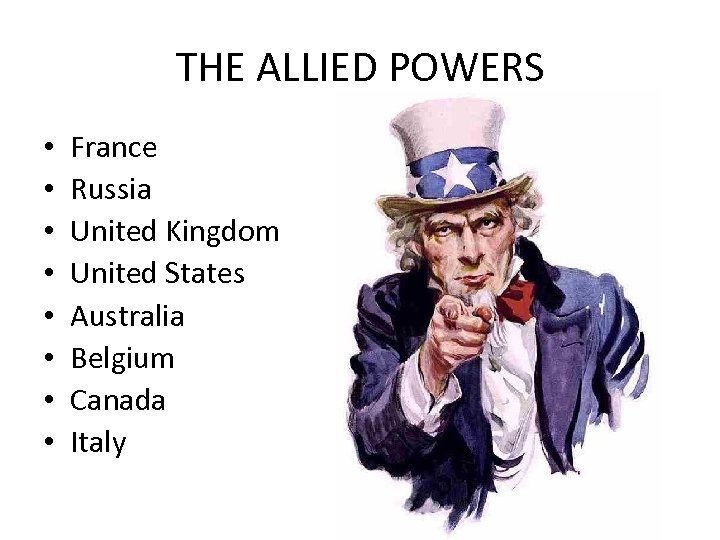 THE ALLIED POWERS • • France Russia United Kingdom United States Australia Belgium Canada Italy
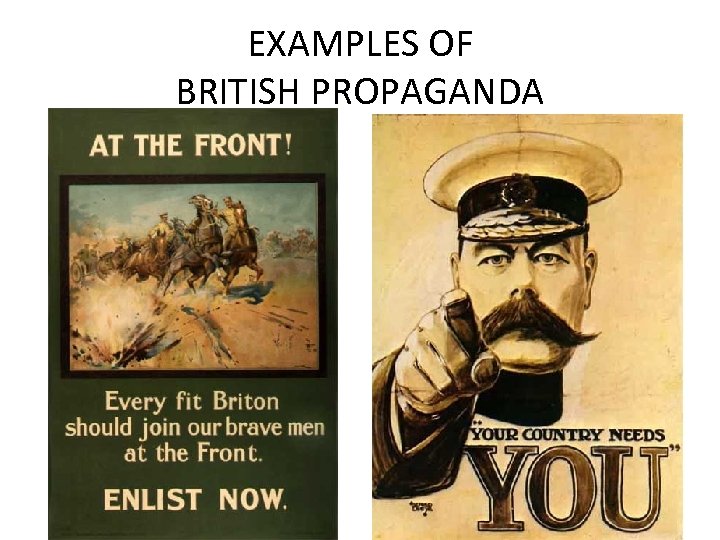 EXAMPLES OF BRITISH PROPAGANDA
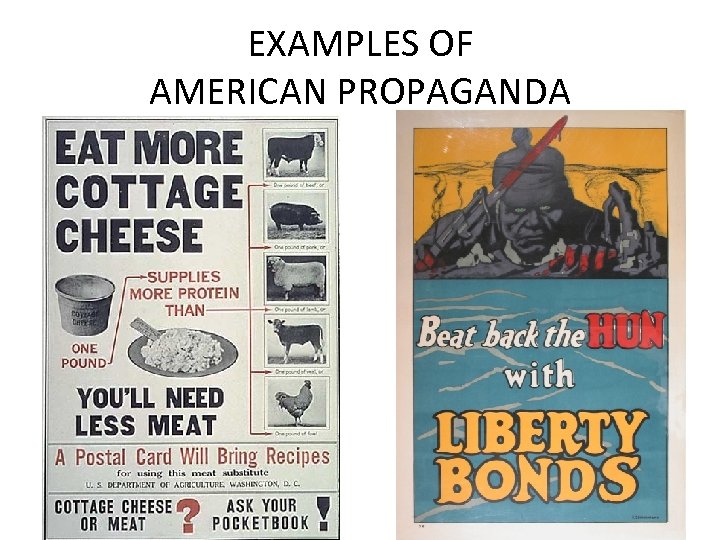 EXAMPLES OF AMERICAN PROPAGANDA
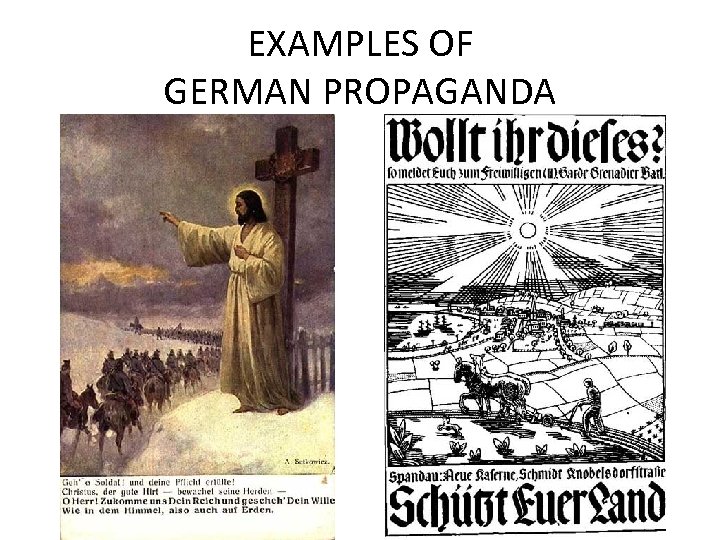 EXAMPLES OF GERMAN PROPAGANDA
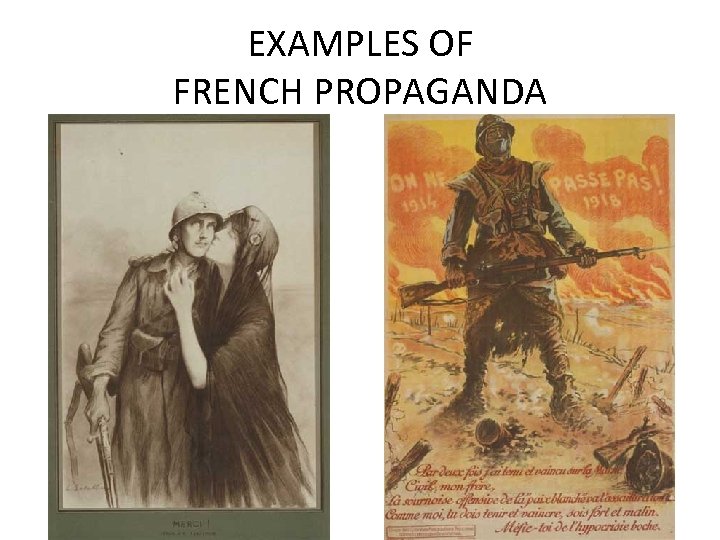 EXAMPLES OF FRENCH PROPAGANDA
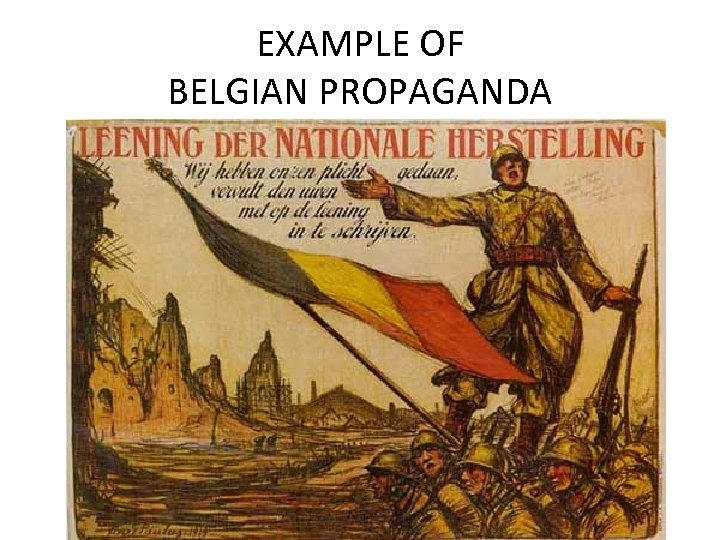 EXAMPLE OF BELGIAN PROPAGANDA
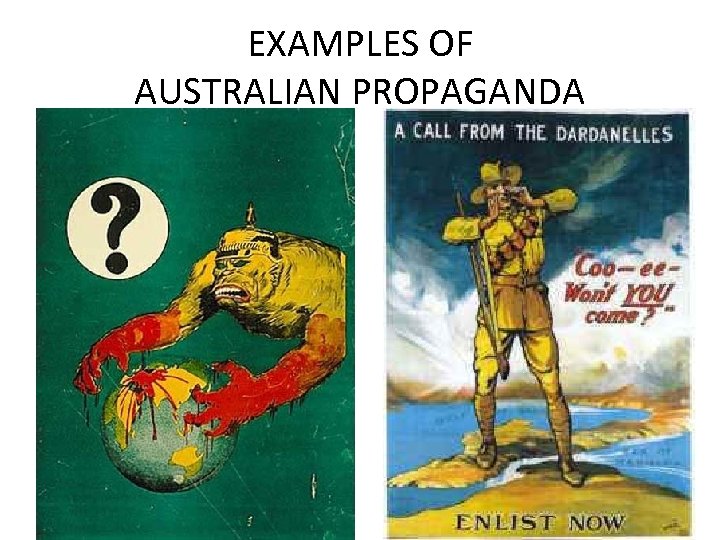 EXAMPLES OF AUSTRALIAN PROPAGANDA
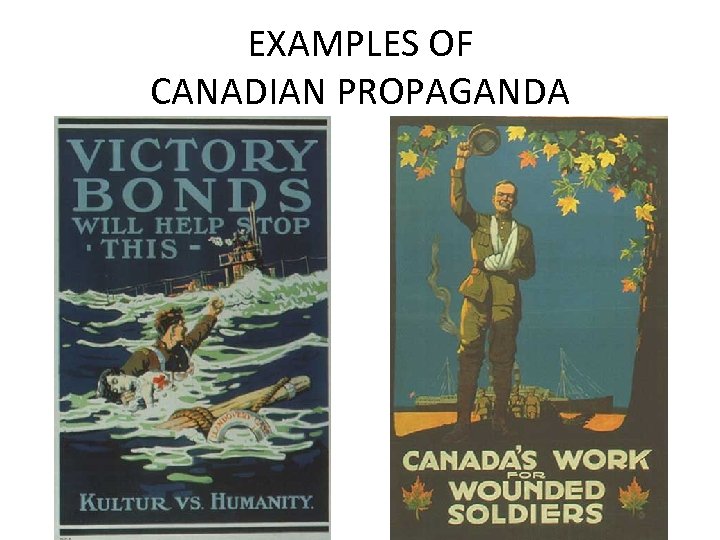 EXAMPLES OF CANADIAN PROPAGANDA
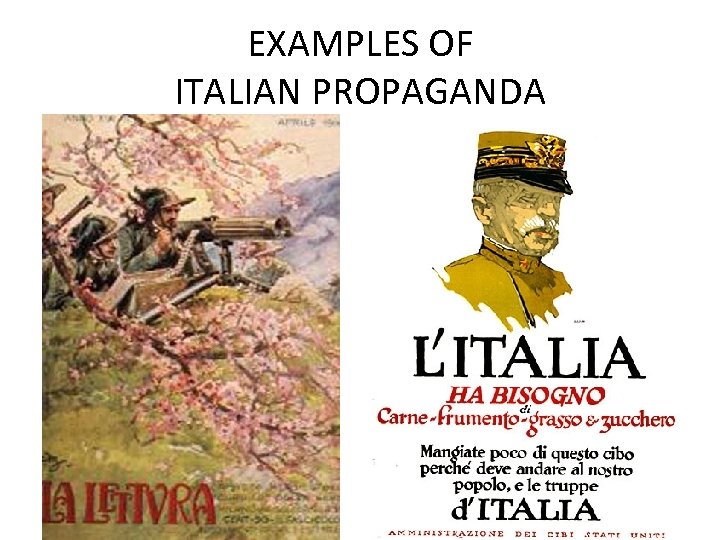 EXAMPLES OF ITALIAN PROPAGANDA
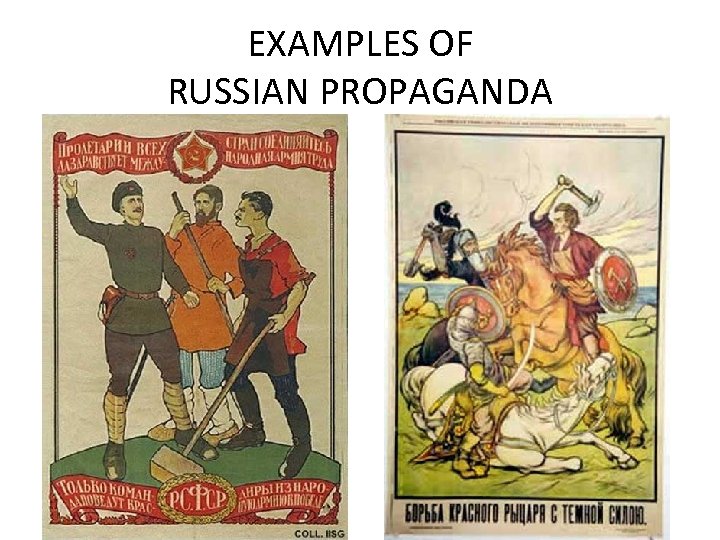 EXAMPLES OF RUSSIAN PROPAGANDA
 GOALS OF PROPAGANDA POSTERS • Recruitment of soldiers: Posters aimed at recruitment attempted to get men to join the army and fight for their country. • Conservation of goods: These posters encouraged people at home to conserve goods so that they could be used by soldiers in the war. • Purchasing of war bonds: These posters advocated the purchase of war bonds, which would help the government fund the war. • Support for the war at home: These posters encouraged people not in the army to become involved in the war at home by joining organizations or working in industries related to the war effort.
 TOOLS (METHODS) USED IN PROPAGANDA POSTERS • Catchy phrases: Posters often used catchy phrases or slogans in order to stick in the memory of the people who saw them. • Appeals to patriotism: Displaying symbols of the country was a strategy used in propaganda posters, and could include anything from flags to symbols such as eagles. • Demonization of the enemy: Another strategy involved a direct attack on the enemy. In these posters the enemy is portrayed as a demonic figure that is often doing things that no moral human being would do. • Half-Truths/Half-Lies: These posters used inaccurate information in an attempt to persuade viewers.
 TOOLS(METHODS) cont. • Caricatures: These posters portray the enemy in a ridiculous fashion and make them appear as if they are not human. • Appeals to emotion: These posters attempt to create an emotional response in the viewer, who will then be compelled to act. • Name Calling: These posters resort to insults or name calling directed at the enemy.
 OA #8 (new left page) What are forms of propaganda that we see today?
 End of WWI • When Russia left the war, Germany didn’t have to fight a 2 -front war. – March, 1918 - Germany tries one last push against France, but were to weak to complete the attack on France. – May, 1918 - France, with the new supply of American troops, was able to counterattack Germany.
 –Germany was now facing shortages, soldiers revolting, and a revolutionary movement, which eventually forced the Kaiser to step down. –Germany and France signed an armistice and WWI ended on 11/11/1918 at 11 am. • World War I ends
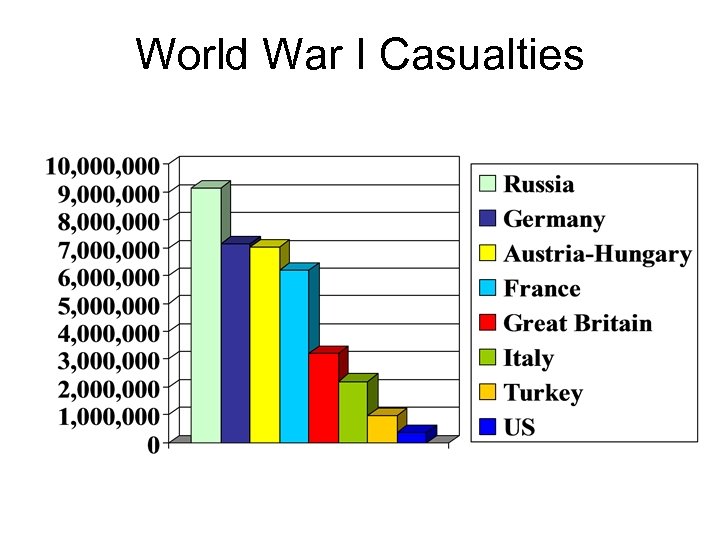 World War I Casualties
 Lost Generation • Individuals who survived WWI, but became disillusioned and disheartened by the horrors they experienced. • The Lost Generation expressed their feelings in their art and literature of the time. • The "Lost Generation" defines a sense of moral loss or aimlessness apparent in literary figures during the 1920 s. • World War I seemed to have destroyed the idea that if you acted virtuously, good things would happen. • Many good, young men went to war and died, or returned home either physically or mentally wounded (for most, both), and their faith in the moral guideposts that had earlier given them hope, were no longer valid. . . they were "Lost. "
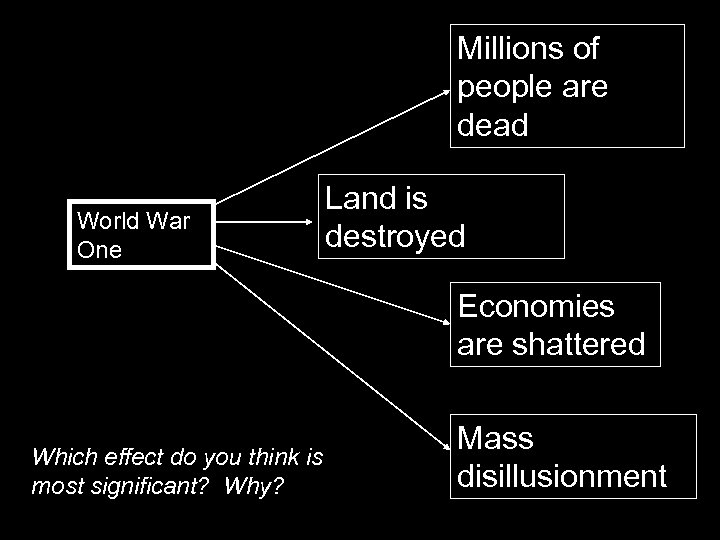 Millions of people are dead World War One Land is destroyed Economies are shattered Which effect do you think is most significant? Why? Mass disillusionment
 OA #9 (new left page) Which major effect of WWI do you think was the most significant? Explain.
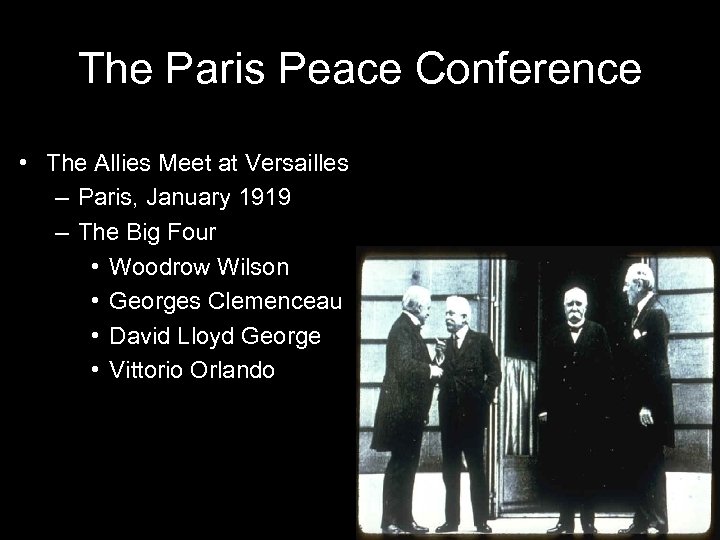 The Paris Peace Conference • The Allies Meet at Versailles – Paris, January 1919 – The Big Four • Woodrow Wilson • Georges Clemenceau • David Lloyd George • Vittorio Orlando
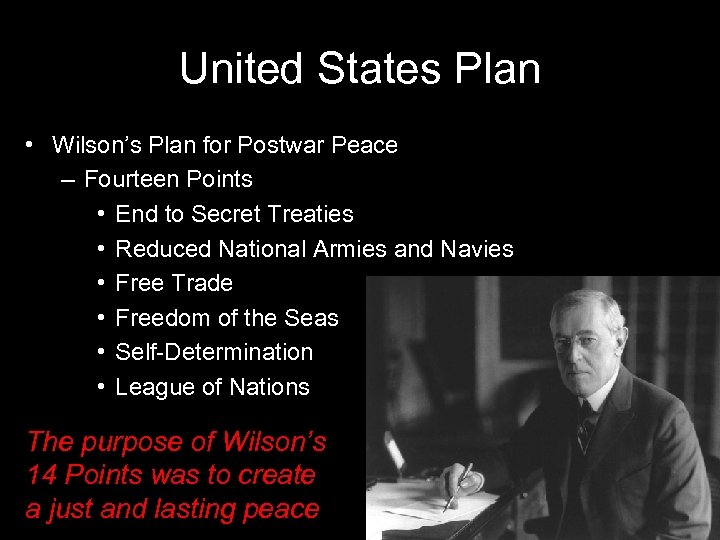 United States Plan • Wilson’s Plan for Postwar Peace – Fourteen Points • End to Secret Treaties • Reduced National Armies and Navies • Free Trade • Freedom of the Seas • Self-Determination • League of Nations The purpose of Wilson’s 14 Points was to create a just and lasting peace
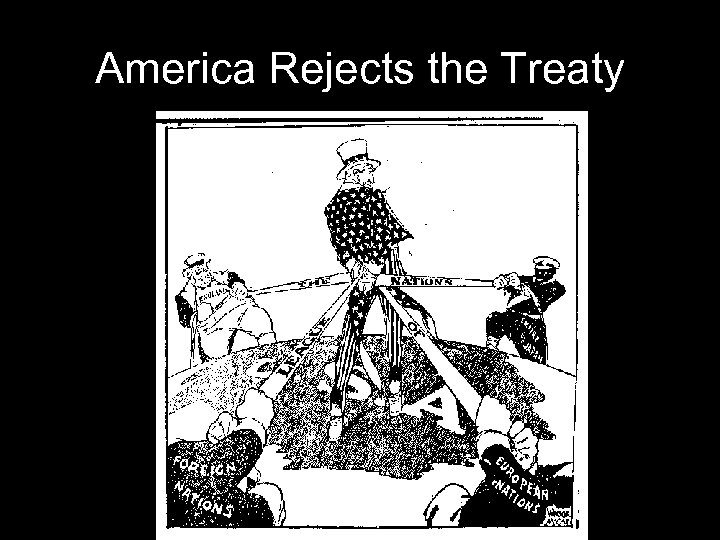 America Rejects the Treaty
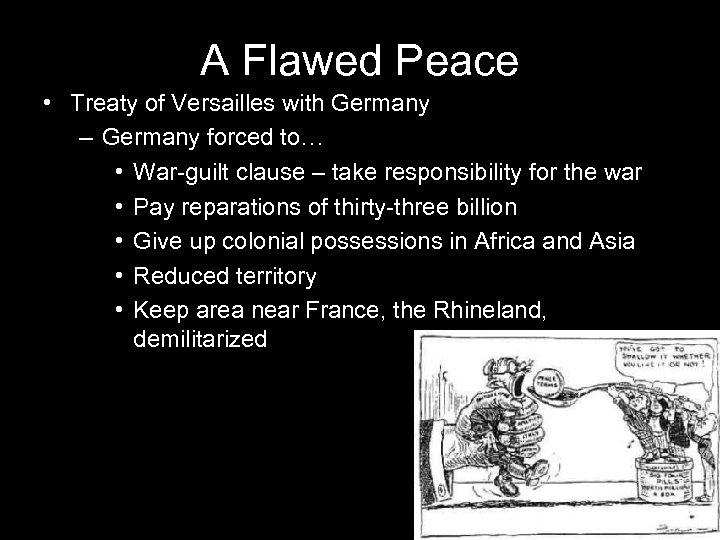 A Flawed Peace • Treaty of Versailles with Germany – Germany forced to… • War-guilt clause – take responsibility for the war • Pay reparations of thirty-three billion • Give up colonial possessions in Africa and Asia • Reduced territory • Keep area near France, the Rhineland, demilitarized
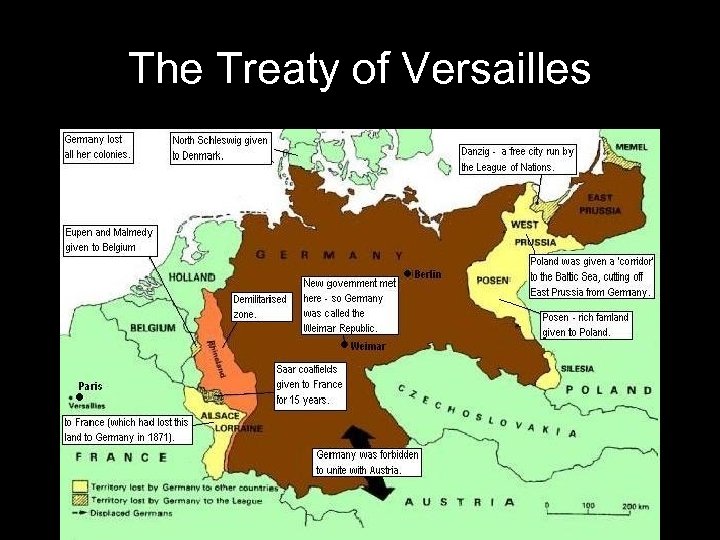 The Treaty of Versailles
 Territorial Changes • New Nations – Poland – Austria – Hungary – Czechoslovakia – Yugoslavia – Finland – Estonia – Latvia – Lithuania
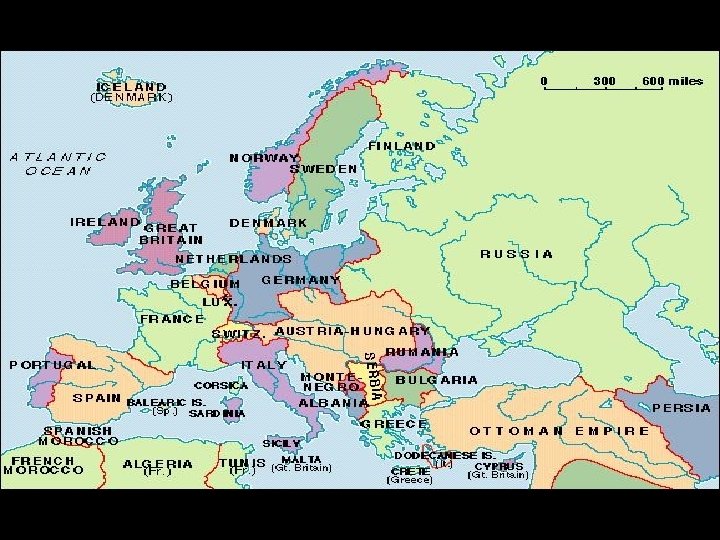
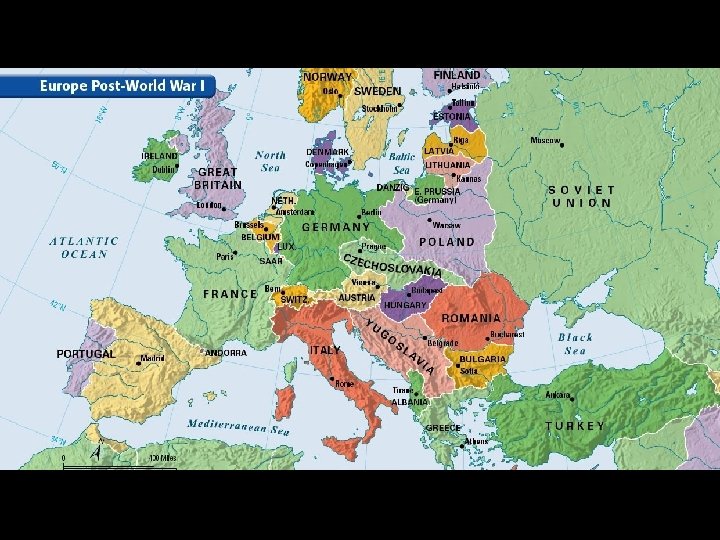
 Territorial Changes • New Nations – Poland – Austria – Hungary – Czechoslovakia – Yugoslavia
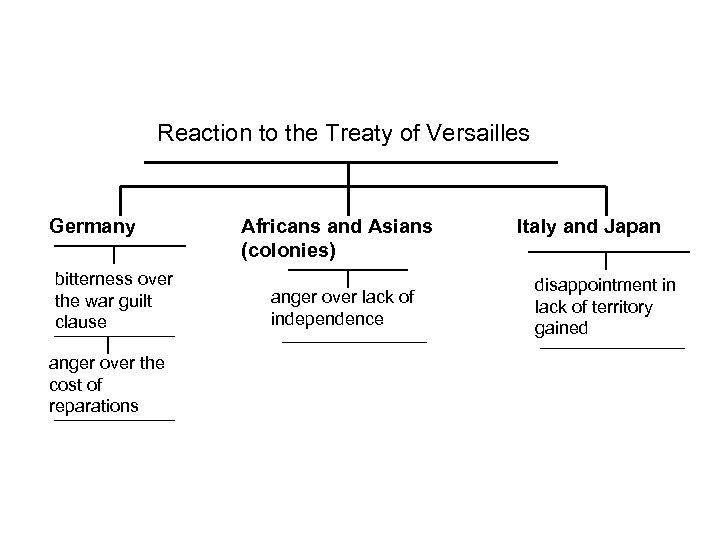 Reaction to the Treaty of Versailles Germany bitterness over the war guilt clause anger over the cost of reparations Africans and Asians (colonies) anger over lack of independence Italy and Japan disappointment in lack of territory gained
 Legacy • The treaty did little to create lasting peace and balance of power in Europe. • The United States refused to sign this treaty and created its own treaties with the Central Powers. The United States began a policy of isolationism. • Germany was left bitter and full of hate.
 A Flawed Peace • The Legacy of the War – U. S. refuses to sign the Treaty – 8. 5 million soldiers dead – The war cost 338 billion – Many Germans are shocked by the armistice and the terms of the treaty. – Desperate economic conditions in Germany help Hitler rise to power.
 Review Demands of Allies at the conference: What were French goals and demands at the treaty? Weaken Germany, prevent any future invasion of France Reduce military Reparations Naval blockades What were British goals and demands? Reparations Prevent France from becoming too powerful Maintain trading relationship with Germany Maintain balance of power What were American goals? 14 points Disentangle the country from European affairs Reduce Military End secret alliances