 Скачать презентацию Students Game to Learn about Green Supply Chains
775a6061f0117cfa5b2342afb4538d9a.ppt
- Количество слайдов: 40



Students Game to Learn about Green Supply Chains J. A. Isaacs and J. Laird**, Northeastern University, Boston MA ** Metaversal Studios, Boston MA 12 th Annual Green Chemistry and Engineering Conference June 24 – 26, Washington, DC Northeastern University
Interdisciplinary Development Team Faculty: Donna Qualters, Beverly Dolinsky, Tom Cullinane, Jim Benneyan, Ann Mc. Donald, and Jay Laird Graduate research assistants: Kala Wilcox and Amin Torabkhani Undergraduate research assistants: Seth Sivak, Mark Sivak, Gabe Connolly, Cara Tontodonato, John Schwartz, Chris Cerrato, Robert Gable and Jimmy Mullen Northeastern University
Motivation ◦ Growing interest in sustainable development ◦ Interdisciplinary nature of sustainability ◦ Engineering curriculum offered little on concepts of sustainability ◦ Prospect of “millennial students” in today’s classrooms Northeastern University
The Millennial Student ◦ Born after 1980 ◦ “Wanted and watched child” ◦ Highly influenced by technology “…They keep punching keys ◦ Gamers until they find the solution…” Wanket & Orevicz, 2005 For more information see presentation by Richard Sweeney @ NJIT http: //library 1. njit. edu/staff-folders/sweeney/ Northeastern University
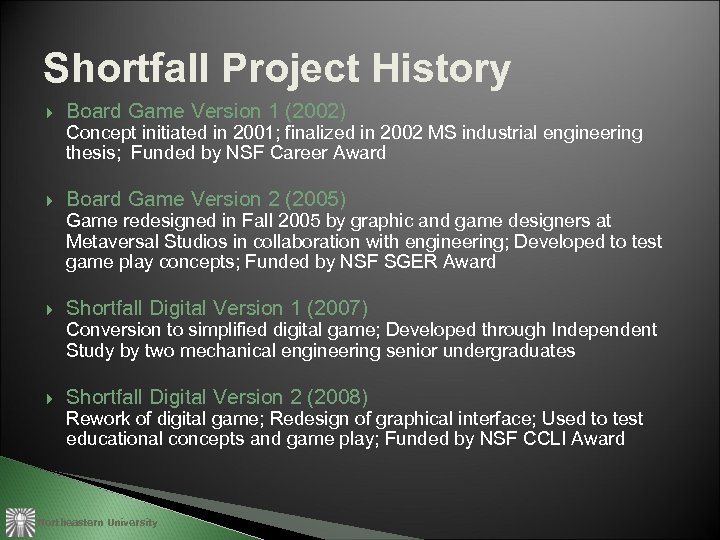
Shortfall Project History Board Game Version 1 (2002) Concept initiated in 2001; finalized in 2002 MS industrial engineering thesis; Funded by NSF Career Award Board Game Version 2 (2005) Game redesigned in Fall 2005 by graphic and game designers at Metaversal Studios in collaboration with engineering; Developed to test game play concepts; Funded by NSF SGER Award Shortfall Digital Version 1 (2007) Conversion to simplified digital game; Developed through Independent Study by two mechanical engineering senior undergraduates Shortfall Digital Version 2 (2008) Rework of digital game; Redesign of graphical interface; Used to test educational concepts and game play; Funded by NSF CCLI Award Northeastern University
A Game Called Shortfall… ◦ …encourages students to consider environmentally benign strategies in every day business planning ◦ …uses US automotive industry as a framework due to extent of industry impact ◦ …provides context to learn about: new technologies resource allocation managerial skills team-work Northeastern University
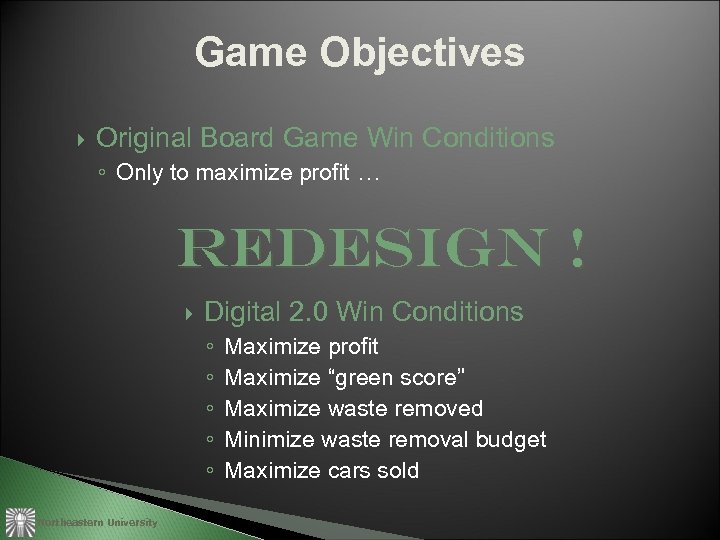
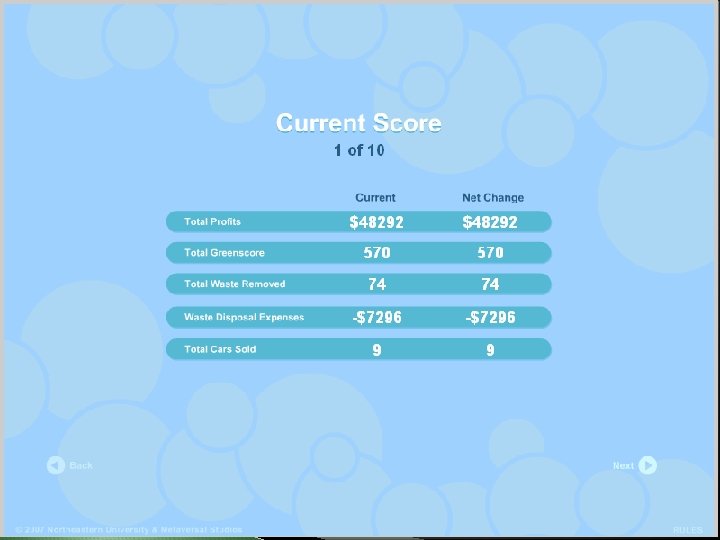
Game Objectives Original Board Game Win Conditions ◦ Only to maximize profit … Redesign ! Digital 2. 0 Win Conditions ◦ ◦ ◦ Northeastern University Maximize profit Maximize “green score” Maximize waste removed Minimize waste removal budget Maximize cars sold
Students Will… Determine strategy based on economic tradeoffs with technologies, regulations and market through: ◦ Selection of technologies with environmentally-friendly options in Production (materials, parts or automobiles) Storage (inventory or waste) Waste management ◦ Consideration of current events Environmental policies and legislation (national & international) Names of historically or currently relevant regulations Repercussions of these regulations on business decisions Other unexpected events that affect business climate Repercussions of natural disasters or work stoppages on planning ◦ Awareness of complex supply chain as system Northeastern University
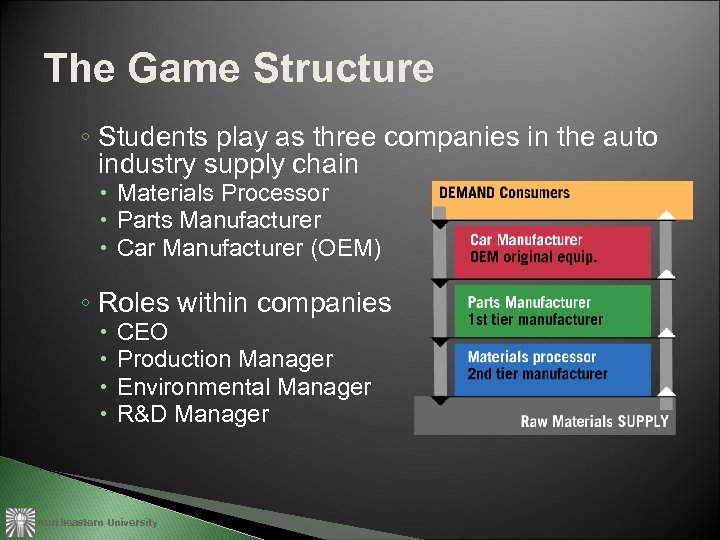
The Game Structure ◦ Students play as three companies in the auto industry supply chain Materials Processor Parts Manufacturer Car Manufacturer (OEM) ◦ Roles within companies CEO Production Manager Environmental Manager R&D Manager Northeastern University
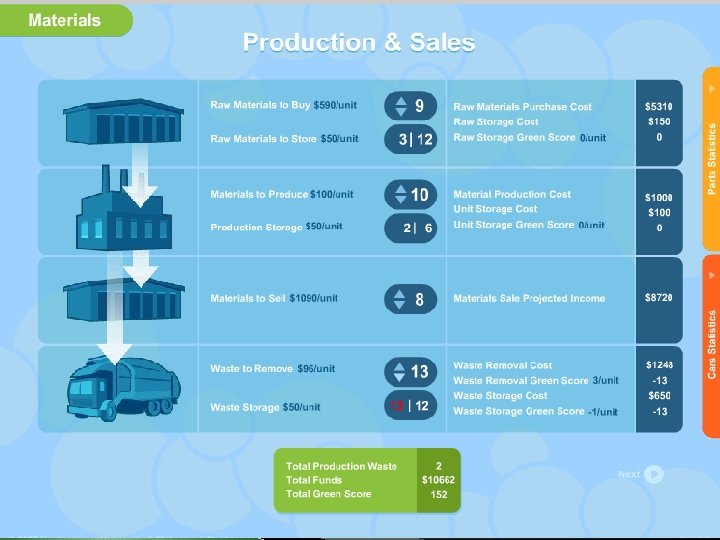
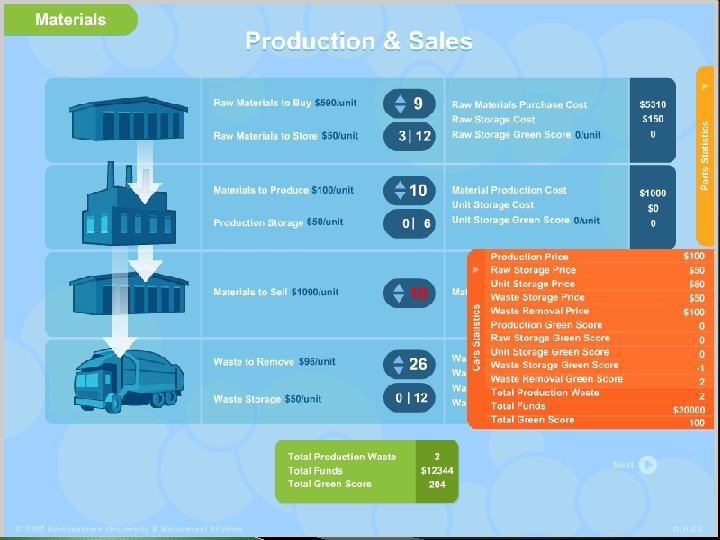
The Rules ◦ Game is played in series of rounds ◦ Each round as a fiscal quarter ◦ At the beginning of each round: Budgets allocated to managers Managers decide on how to spend funds ◦ Companies then interact with each other in the supply chain Northeastern University
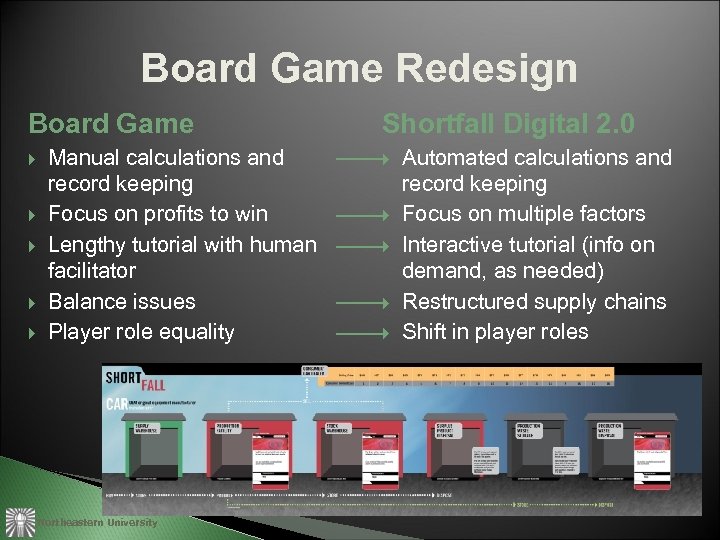
Board Game Redesign Board Game Manual calculations and record keeping Focus on profits to win Lengthy tutorial with human facilitator Balance issues Player role equality Northeastern University Shortfall Digital 2. 0 Automated calculations and record keeping Focus on multiple factors Interactive tutorial (info on demand, as needed) Restructured supply chains Shift in player roles
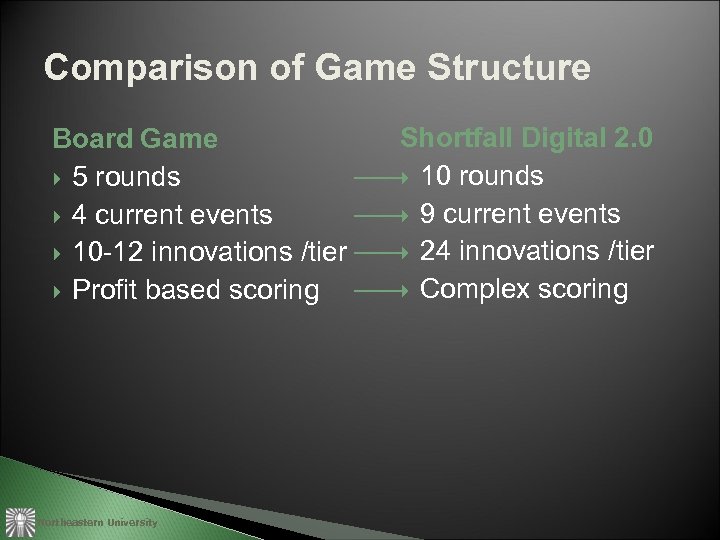
Comparison of Game Structure Board Game 5 rounds 4 current events 10 -12 innovations /tier Profit based scoring Northeastern University Shortfall Digital 2. 0 10 rounds 9 current events 24 innovations /tier Complex scoring
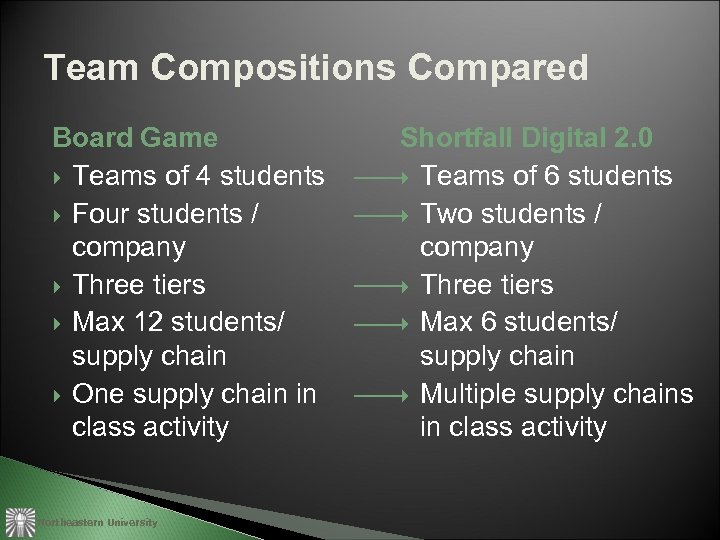
Team Compositions Compared Board Game Teams of 4 students Four students / company Three tiers Max 12 students/ supply chain One supply chain in class activity Northeastern University Shortfall Digital 2. 0 Teams of 6 students Two students / company Three tiers Max 6 students/ supply chain Multiple supply chains in class activity
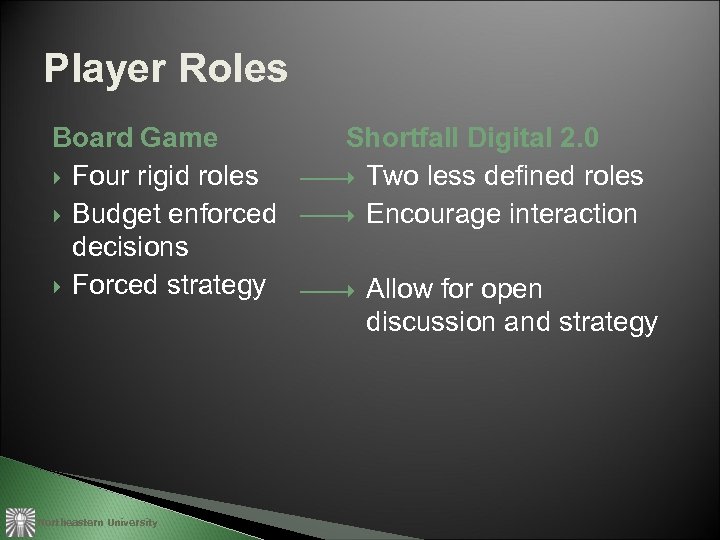
Player Roles Board Game Four rigid roles Budget enforced decisions Forced strategy Northeastern University Shortfall Digital 2. 0 Two less defined roles Encourage interaction Allow for open discussion and strategy
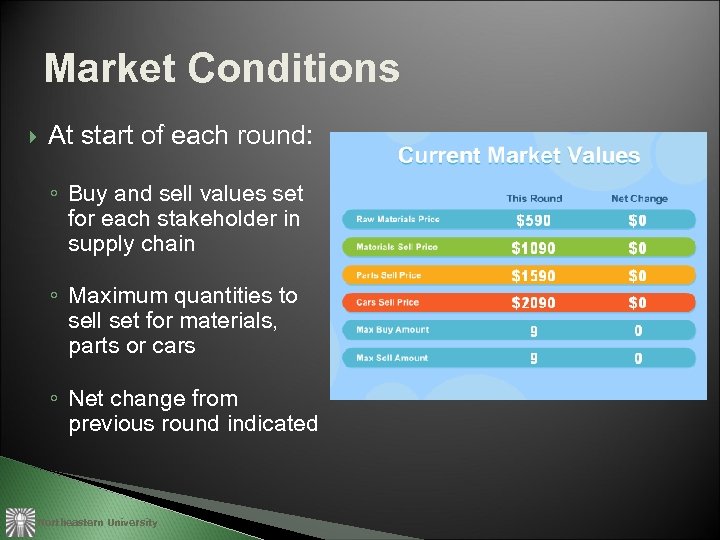
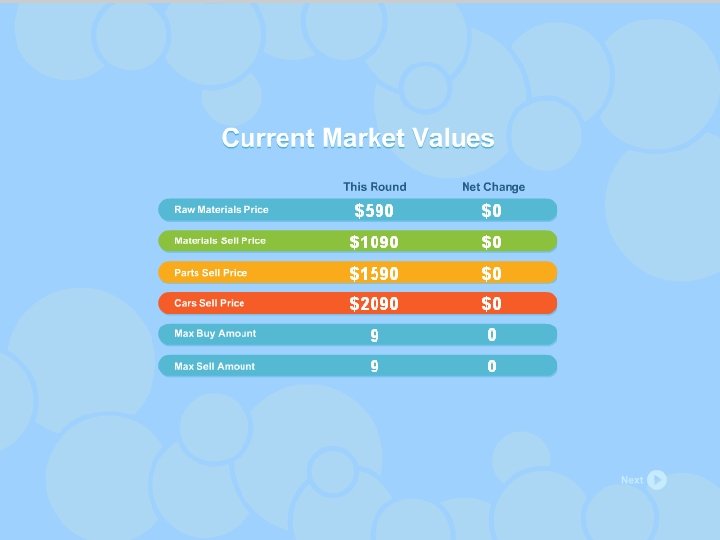
Market Conditions At start of each round: ◦ Buy and sell values set for each stakeholder in supply chain ◦ Maximum quantities to sell set for materials, parts or cars ◦ Net change from previous round indicated Northeastern University
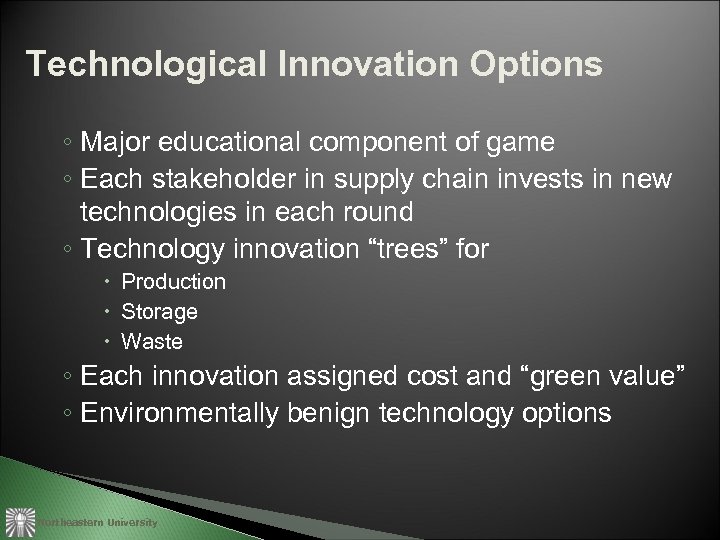
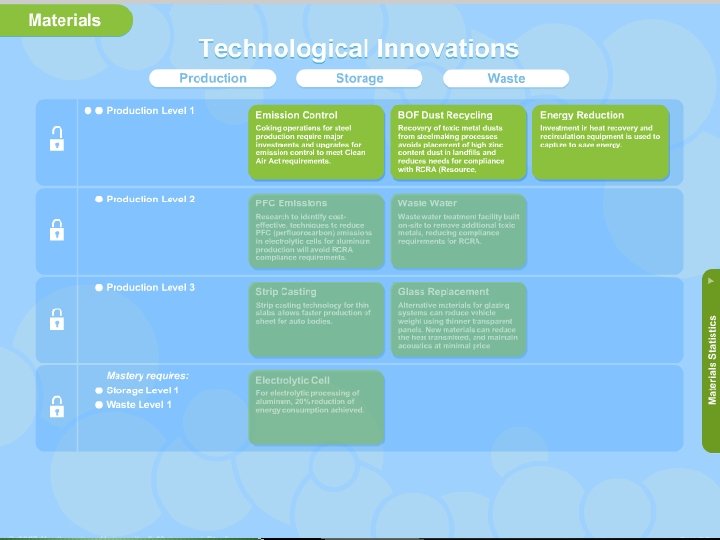
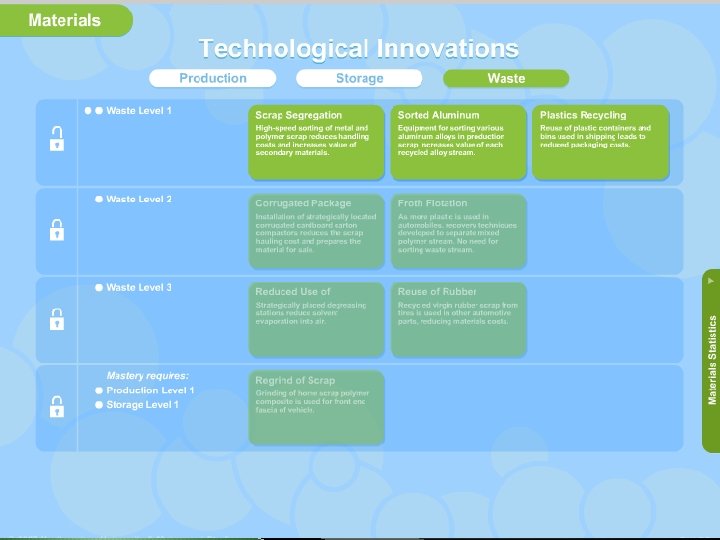
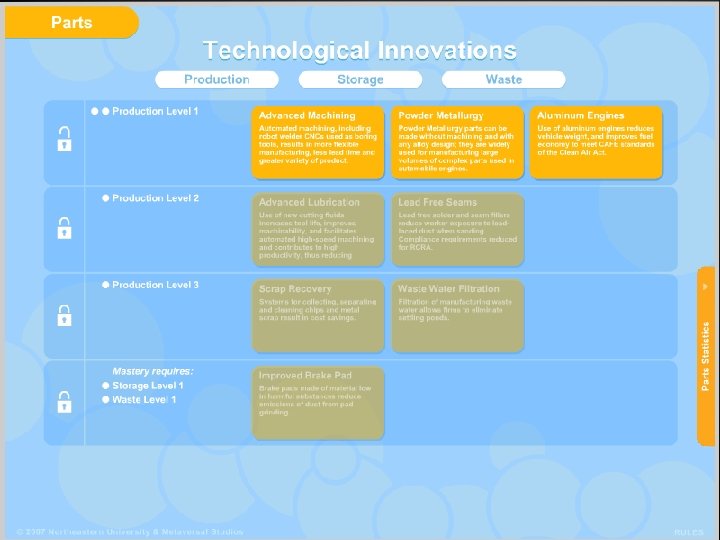
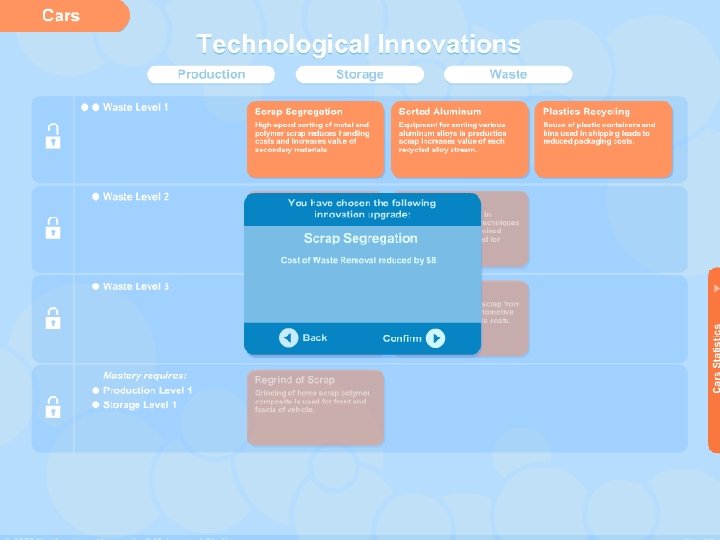
Technological Innovation Options ◦ Major educational component of game ◦ Each stakeholder in supply chain invests in new technologies in each round ◦ Technology innovation “trees” for Production Storage Waste ◦ Each innovation assigned cost and “green value” ◦ Environmentally benign technology options Northeastern University
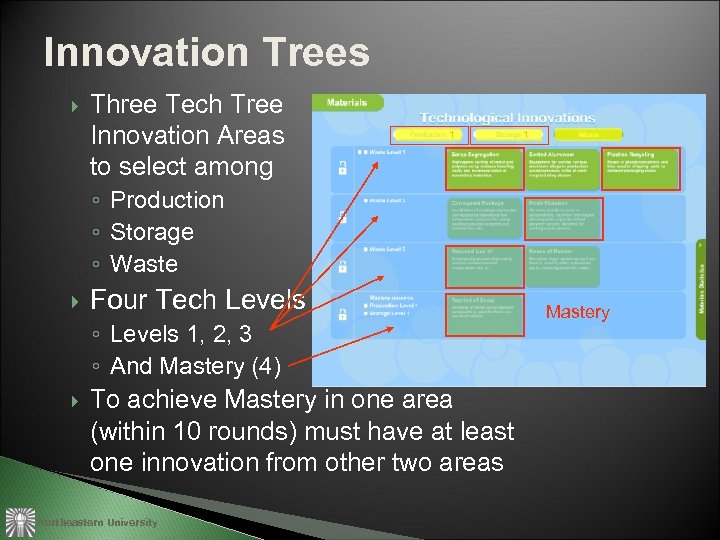
Innovation Trees Three Tech Tree Innovation Areas to select among 1 1 ◦ Production ◦ Storage ◦ Waste Four Tech Levels ◦ Levels 1, 2, 3 ◦ And Mastery (4) To achieve Mastery in one area (within 10 rounds) must have at least one innovation from other two areas Northeastern University Mastery
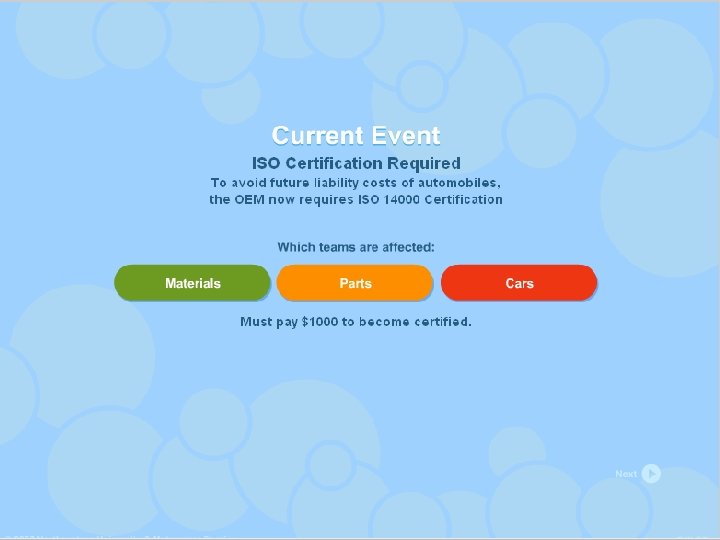
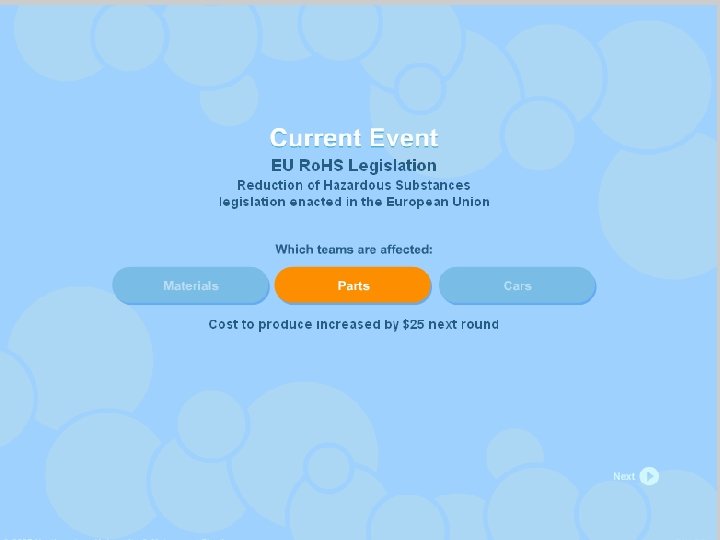
Current Events Occur Each Round… Increased Cost of Financing Waste Storage Unit Leakage Increased Gas Prices ISO Certification Required Recycling Incentives Public Rewards Green Rail Strike Aluminum Shortage Steel Price Hike Patent Royalties Machinist Strike European Ro. HS Legislation Tier Emission Regulation UAW Contract Dispute Each randomly occurring event has different ramification on game play Northeastern University
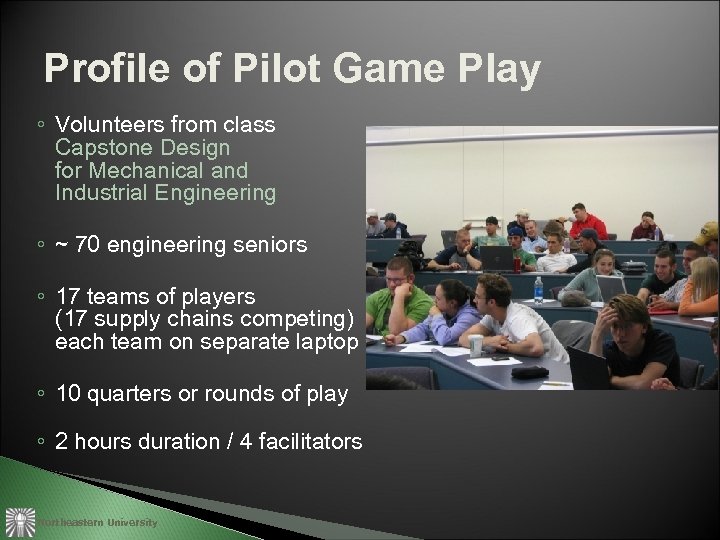
Profile of Pilot Game Play ◦ Volunteers from class Capstone Design for Mechanical and Industrial Engineering ◦ ~ 70 engineering seniors ◦ 17 teams of players (17 supply chains competing) each team on separate laptop ◦ 10 quarters or rounds of play ◦ 2 hours duration / 4 facilitators Northeastern University
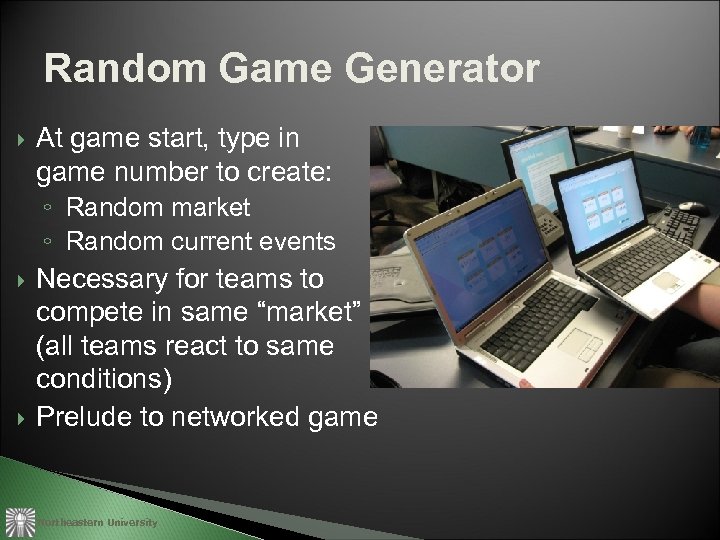
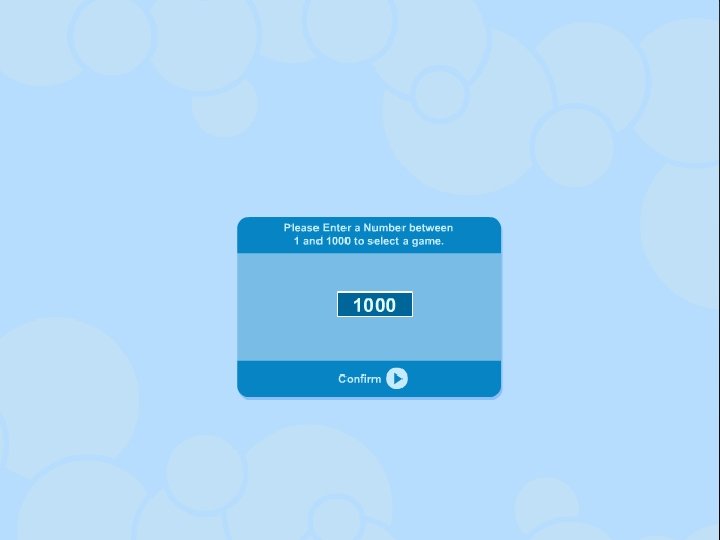
Random Game Generator At game start, type in game number to create: ◦ Random market ◦ Random current events Necessary for teams to compete in same “market” (all teams react to same conditions) Prelude to networked game Northeastern University
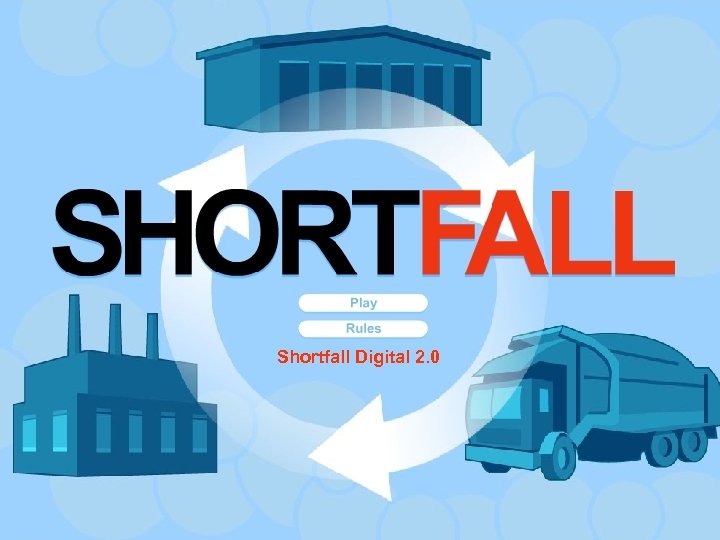
Shortfall Digital 2. 0 Northeastern University
Northeastern University
Northeastern University
Northeastern University
Northeastern University
Northeastern University
Northeastern University
Northeastern University
Northeastern University
Northeastern University
Northeastern University
Northeastern University
Revised Game Goals (again!) Maximize profit Minimize environmental impact Maximize social responsibility Design Shortfall Online (name of next revision) to be played across the internet or locally in a classroom Northeastern University
Goals for Shortfall Online Adapt various features in existing digital game Increase learning on technological innovations and tradeoffs among profitability and environmental ramifications of decisions Enhance graphics, sound, program optimization, animation, usability… Track and record players’ decisions for further statistical analysis and learning assessments Northeastern University
Adapt Various Features 1. 2. 3. 4. 5. 6. 7. 8. Revert back to independent suppliers Adapt scoring and win conditions Add measures of “know-how” Expand Innovation Trees Expand Current Events Revise price negotiation Consider role of regulator Address assessment issues Northeastern University
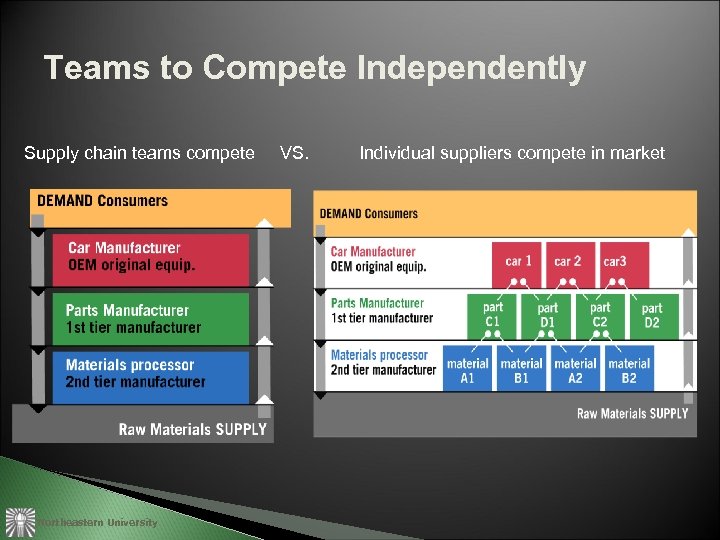
Teams to Compete Independently Supply chain teams compete Northeastern University VS. Individual suppliers compete in market
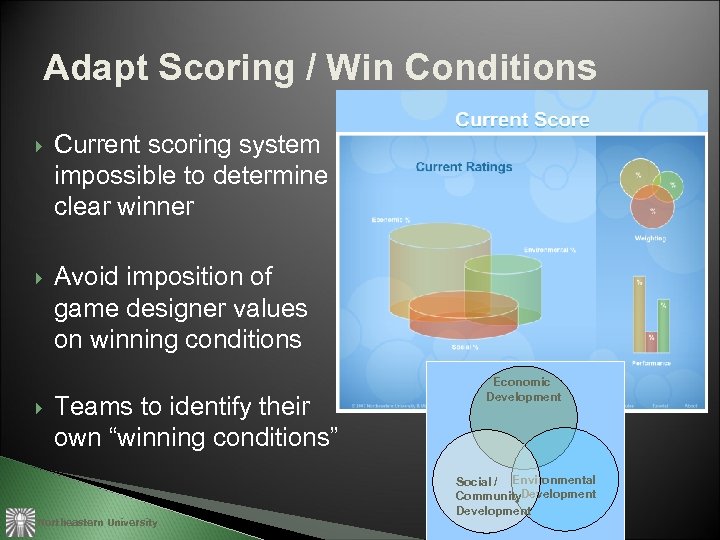
Adapt Scoring / Win Conditions Current scoring system impossible to determine clear winner Avoid imposition of game designer values on winning conditions Teams to identify their own “winning conditions” Northeastern University Economic Development Social / Environmental Community. Development
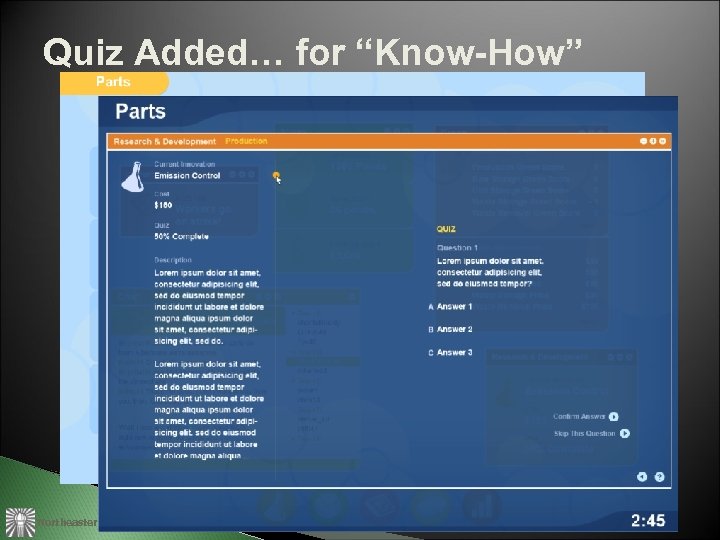
Quiz Added… for “Know-How” Northeastern University
Shortfall Online: The Future Multi-player networked environment designed for cooperation and competitive play, virtually across classes or institutions Computer controlled companies could be added in each tier of supply chain Computer as moderator, and as virtual advisor to each student for quick orientation and help as needed during play Inclusion of scenario mapping and charting tools as well as opportunities to learn more on specific topics through additional text and graphics More complex current event chains that are managed in response to player choices rather than entirely randomized Track play progress and financials, allowing for a more nuanced scoring system Flexible time span for game to encourage replay across an entire course, not just one class session Northeastern University
Acknowledgements ◦ Original game development funded by a CAREER grant from NSF DMI-9734054 ◦ Subsequent funding by NSF DMI-0537056 and recently NSF CCLI-0717750 ◦ Acknowledgements to Faculty: Donna Qualters, Tom Cullinane, Jim Benneyan, Ann Mc. Donald, and Jay Laird Graduate research assistants: Kala Wilcox and Amin Torabkhani Undergraduate research assistants: Seth Sivak, Mark Sivak, Gabe Connolly, Cara Tontodonato, John Schwartz, Chris Cerrato, Robert Gable and Jimmy Mullen Northeastern University www. coe. neu. edu/shortfall Shortfall@coe. neu. edu
Скачать презентацию Students Game to Learn about Green Supply Chains
775a6061f0117cfa5b2342afb4538d9a.ppt