


 Скачать презентацию Student Investment Management Consumer Staples Sector Presentation Panchanathan
e4ba5540173c1597a817434c60bd397d.ppt
- Количество слайдов: 40
 Student Investment Management Consumer Staples Sector Presentation Panchanathan Arthaballe C. Nishanker Damodara
 Presentation Agenda Sector Size and Composition Business Analysis Economic Analysis Valuation Analysis Financial Analysis Portfolio Recommendation
 Consumer Staples: Brief Overview A category of industries comprised of those companies which sell the most common consumer products, such as food, beverages, house wares, clothing, tobacco and prescription drugs. (Investorwords. com) Sector’s products are viewed as basic needs, so demand is inelastic and relatively constant. At what point can you not afford to buy toilet paper?
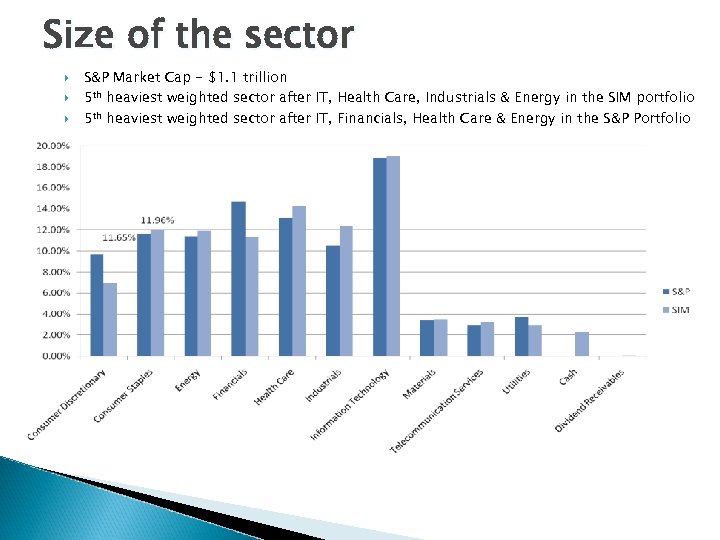 Size of the sector S&P Market Cap - $1. 1 trillion 5 th heaviest weighted sector after IT, Health Care, Industrials & Energy in the SIM portfolio 5 th heaviest weighted sector after IT, Financials, Health Care & Energy in the S&P Portfolio
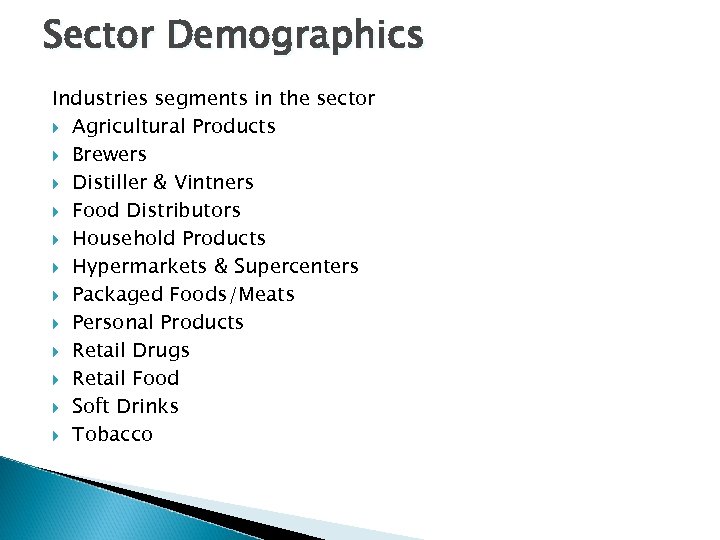 Sector Demographics Industries segments in the sector Agricultural Products Brewers Distiller & Vintners Food Distributors Household Products Hypermarkets & Supercenters Packaged Foods/Meats Personal Products Retail Drugs Retail Food Soft Drinks Tobacco
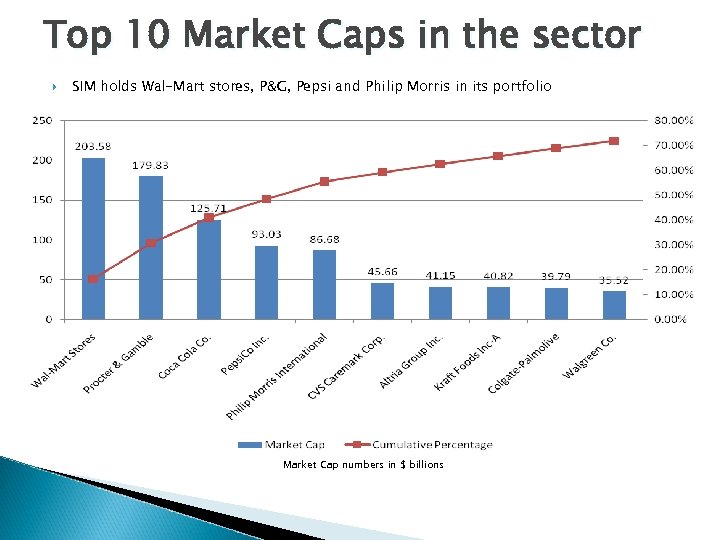 Top 10 Market Caps in the sector SIM holds Wal-Mart stores, P&G, Pepsi and Philip Morris in its portfolio Market Cap numbers in $ billions
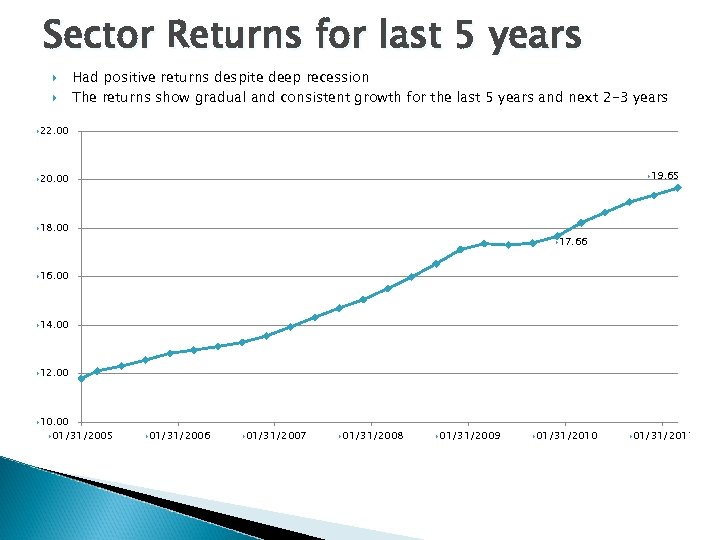 Sector Returns for last 5 years Had positive returns despite deep recession The returns show gradual and consistent growth for the last 5 years and next 2 -3 years 22. 00 19. 65 20. 00 18. 00 17. 66 16. 00 14. 00 12. 00 10. 00 01/31/2005 01/31/2006 01/31/2007 01/31/2008 01/31/2009 01/31/2010 01/31/2011
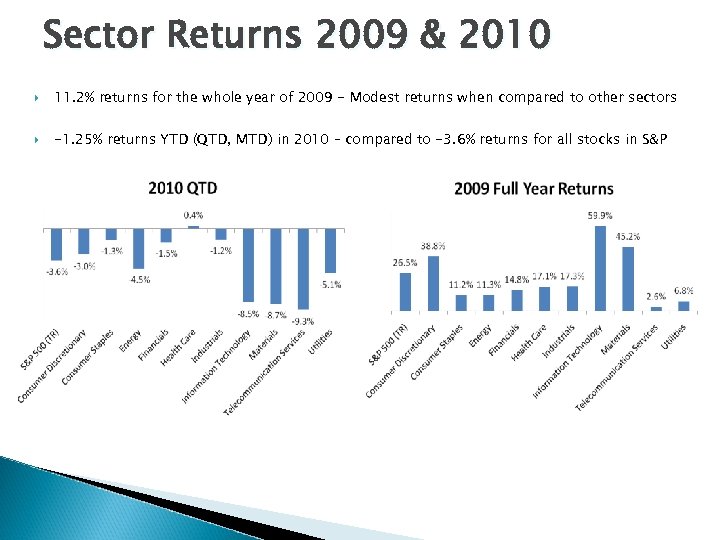 Sector Returns 2009 & 2010 11. 2% returns for the whole year of 2009 - Modest returns when compared to other sectors -1. 25% returns YTD (QTD, MTD) in 2010 – compared to -3. 6% returns for all stocks in S&P
 Business Analysis
 Sector Characteristics Non-cyclical ◦ Inelastic demand of products makes sector a defensive play. ◦ Underperforms broader market during economic expansions. ◦ Outperforms broader market in times of economic contraction. Competitive Pricing ◦ Pricing usually drives market share. ◦ Price usually supersedes branding as most important consumer consideration.
 Sector Characteristics (cont’d) High Barriers to entry ◦ Large initial capital outlays require EOS. ◦ New entrants face discounting barriers from established companies. Substitution ◦ Undifferentiated, borderline-commodity products ensure customers are ready and willing to substitute.
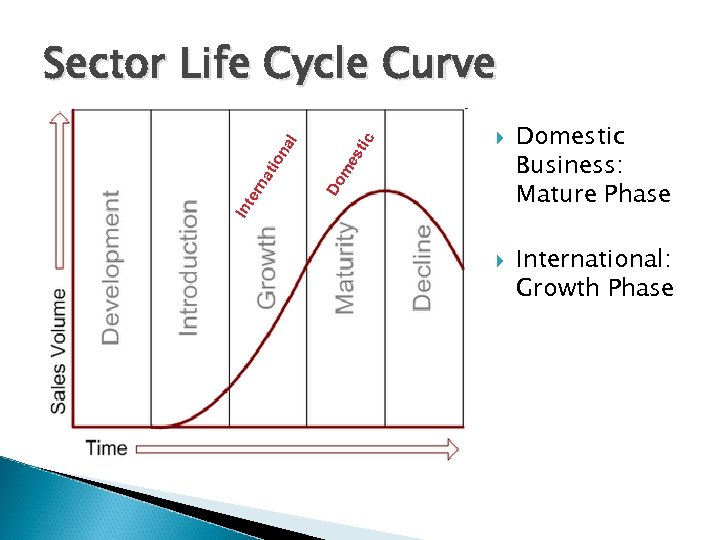 s ti Do me Int er na ti o na l c Sector Life Cycle Curve Domestic Business: Mature Phase International: Growth Phase
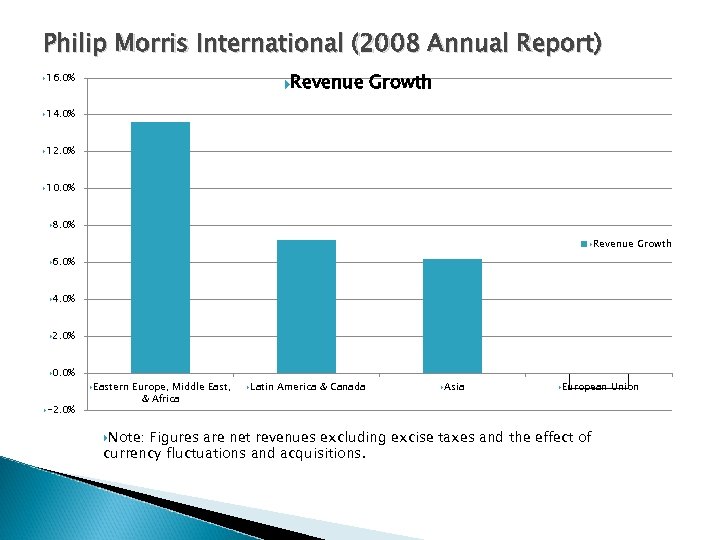 Philip Morris International (2008 Annual Report) Revenue 16. 0% Growth 14. 0% 12. 0% 10. 0% 8. 0% Revenue Growth 6. 0% 4. 0% 2. 0% 0. 0% -2. 0% Eastern Europe, Middle East, & Africa Note: Latin America & Canada Asia European Figures are net revenues excluding excise taxes and the effect of currency fluctuations and acquisitions. Union
 Drivers of Growth Emerging markets ◦ “The World Bank estimates that the global middle class is likely to grow from 430 million in 2000 to 1. 15 billion in 2030. The bank defines the middle class as earners making between $10 and $20 a day -- adjusted for local prices -- which is roughly the range of average incomes between Brazil ($10) and Italy ($20). ” Brand differentiation ◦ Hefty Brand Trash Bags vs Giant Eagle Trash Bags Product customization ◦ P&G in the Philippines
 Areas of Concern Supplier-Retailer Relations ◦ Margin Compression: the Walmart Effect ◦ Global Consolidation in Retail Space: Walmart Carrefour Target Excess Capacity ◦ High fixed costs ◦ Under utilization = worsening margins
 Economic Analysis
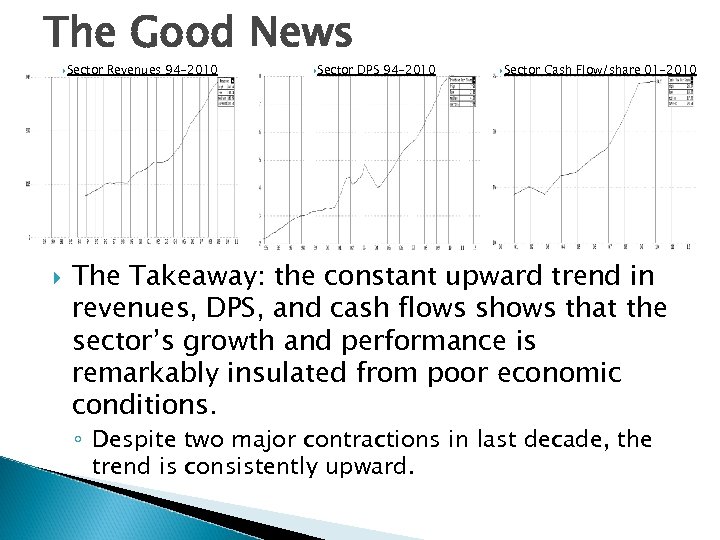 The Good News Sector Revenues 94 -2010 Sector DPS 94 -2010 Sector Cash Flow/share 01 -2010 The Takeaway: the constant upward trend in revenues, DPS, and cash flows shows that the sector’s growth and performance is remarkably insulated from poor economic conditions. ◦ Despite two major contractions in last decade, the trend is consistently upward.
 Economic Factors to Consider Macroeconomics over Microeconomics ◦ ◦ Unemployment rates GDP growth Commodity prices: inputs and energy Interest Rates Exchange rate fluctuation. ◦ “Foreign exchange reduced P&G’s fiscal 2009 sales by about four percentage points, or approximately $4 billion, and profit by more than $1 billion. ” (2009 Annual Report) ◦ Currency fluctuations can help or hurt the sector.
 Financial Analysis
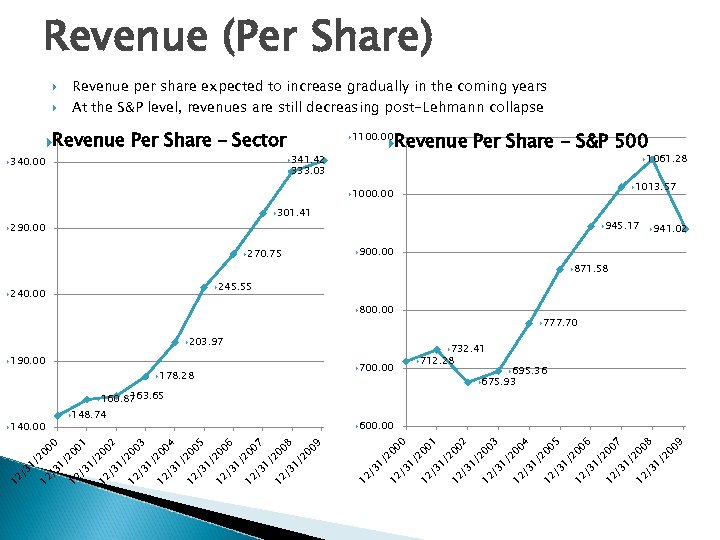 Revenue (Per Share) Revenue per share expected to increase gradually in the coming years At the S&P level, revenues are still decreasing post-Lehmann collapse Per Share – Sector Revenue 1100. 00 341. 42 Per Share - S&P 500 1061. 28 333. 03 1013. 57 1000. 00 301. 41 290. 00 945. 17 900. 00 270. 75 871. 58 245. 55 240. 00 800. 00 777. 70 203. 97 732. 41 190. 00 712. 28 700. 00 178. 28 695. 36 675. 93 163. 65 160. 87 148. 74 9 00 8 31 /2 00 /2 1 31 1 2/ /2 00 7 6 31 2/ 1 1 2/ 31 /2 00 5 00 4 1 2/ 31 /2 00 3 /2 31 2/ 1 1 2/ 31 /2 00 1 1 2/ 31 /2 00 0 31 /2 2/ 1 31 2/ 1 /2 00 9 00 /2 31 2/ 1 1 2/ 31 /2 00 8 7 00 /2 6 1 2/ 31 00 5 1 2/ 31 /2 00 4 /2 00 31 1 2/ /2 31 2/ 1 1 2/ 31 /2 00 3 2 600. 00 00 1 /2 00 31 1 2/ /2 31 2/ 31 /2 00 0 140. 00 1 941. 02 2/ 340. 00 Revenue
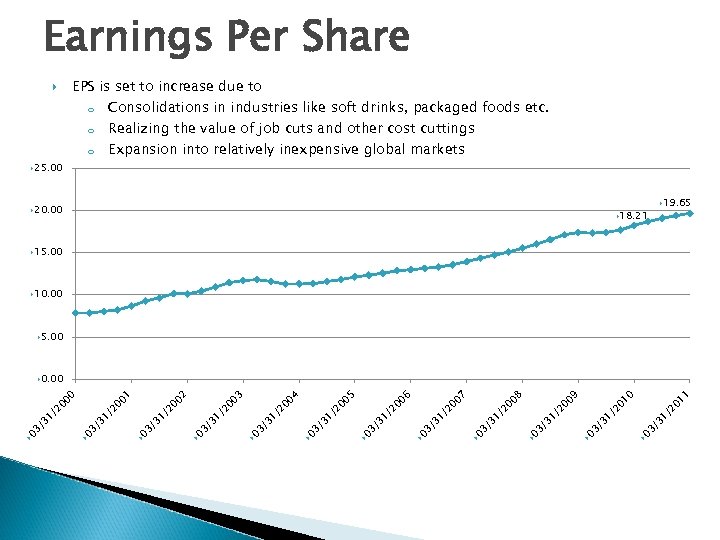 Earnings Per Share 25. 00 EPS is set to increase due to o Consolidations in industries like soft drinks, packaged foods etc. o Realizing the value of job cuts and other cost cuttings o Expansion into relatively inexpensive global markets 20. 00 19. 65 18. 21 15. 00 10. 00 5. 00 1 0 3/ 31 /2 01 0 0 3/ 31 /2 01 9 0 3/ 31 /2 00 0 3/ 31 /2 /2 31 3/ 0 00 8 7 00 6 0 3/ 31 /2 00 5 0 3/ 31 /2 00 4 0 3/ 31 /2 00 3 0 3/ 31 /2 00 /2 31 3/ 0 /2 3/ 31 0 0 3/ 31 /2 00 00 1 0 0. 00
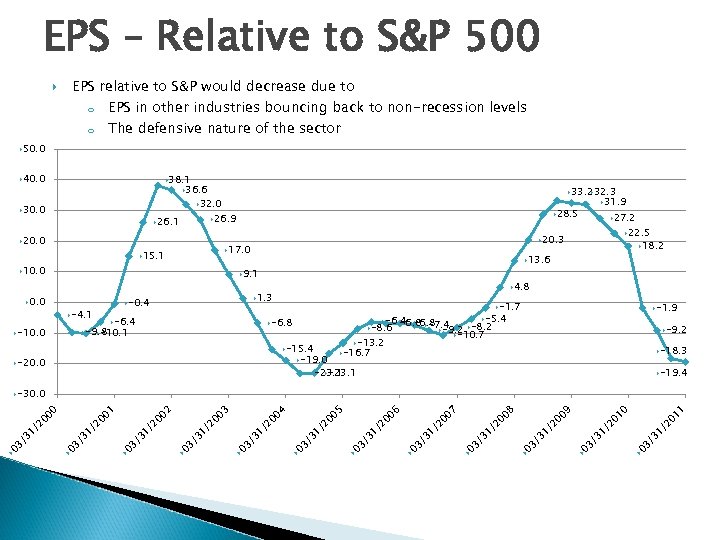 EPS – Relative to S&P 500 EPS relative to S&P would decrease due to o EPS in other industries bouncing back to non-recession levels o The defensive nature of the sector 50. 0 40. 0 38. 1 36. 6 33. 2 32. 3 31. 9 32. 0 30. 0 20. 0 -6. 4 -9. 8 -10. 1 -10. 0 18. 2 4. 8 1. 3 -0. 4 22. 5 13. 6 9. 1 -4. 1 27. 2 20. 3 17. 0 15. 1 10. 0 28. 5 26. 9 26. 1 -6. 4 -6. 8 -7. 4 -8. 6 -9. 2 -8. 2 -10. 7 -6. 8 -1. 9 -9. 2 -13. 2 -15. 4 -18. 3 -16. 7 -19. 0 -20. 0 -1. 7 -5. 4 -23. 1 -19. 4 1 0 01 /2 31 3/ 0 0 3/ 31 /2 00 0 3/ 31 /2 /2 3/ 31 0 01 9 8 00 7 0 3/ 31 /2 00 6 0 3/ 31 /2 00 5 0 3/ 31 /2 00 4 0 3/ 31 /2 00 3 0 3/ 31 /2 00 2 0 3/ 31 /2 00 1 00 /2 31 3/ 0 0 3/ 31 /2 00 0 -30. 0
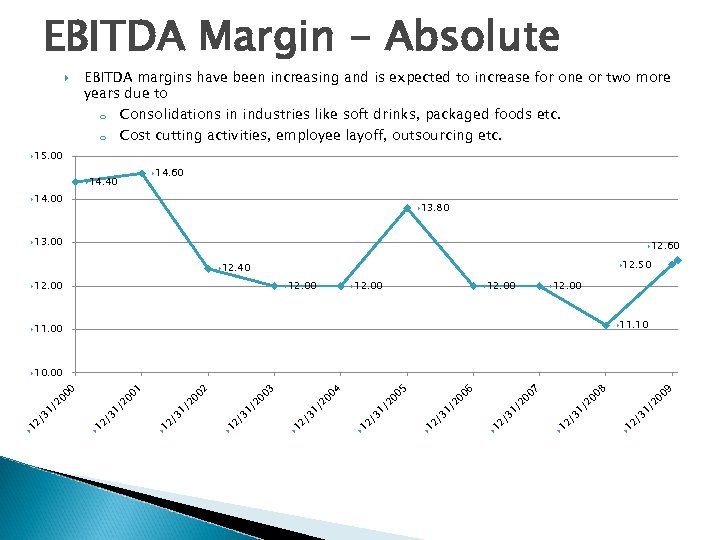 EBITDA Margin - Absolute EBITDA margins have been increasing and is expected to increase for one or two more years due to o Consolidations in industries like soft drinks, packaged foods etc. o Cost cutting activities, employee layoff, outsourcing etc. 15. 00 14. 60 14. 40 14. 00 13. 80 13. 00 12. 60 12. 50 12. 40 12. 00 11. 10 11. 00 9 1 2/ 31 /2 00 8 1 2/ 31 /2 00 7 1 2/ 31 /2 00 6 1 2/ 31 /2 00 5 1 2/ 31 /2 00 4 1 2/ 31 /2 00 3 1 2/ 31 /2 00 1 2/ 31 /2 /2 0 31 2/ 1 1 2/ 31 /2 00 0 01 10. 00
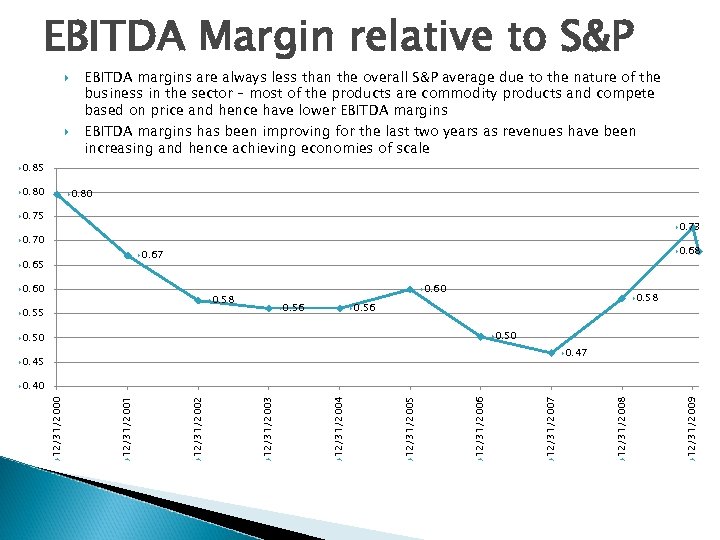 EBITDA Margin relative to S&P EBITDA margins are always less than the overall S&P average due to the nature of the business in the sector – most of the products are commodity products and compete based on price and hence have lower EBITDA margins has been improving for the last two years as revenues have been increasing and hence achieving economies of scale 0. 85 0. 80 0. 75 0. 73 0. 70 0. 68 0. 67 0. 65 0. 60 0. 58 0. 55 0. 56 0. 58 0. 56 0. 50 0. 47 0. 45 12/31/2009 12/31/2008 12/31/2007 12/31/2006 12/31/2005 12/31/2004 12/31/2003 12/31/2002 12/31/2001 12/31/2000 0. 40
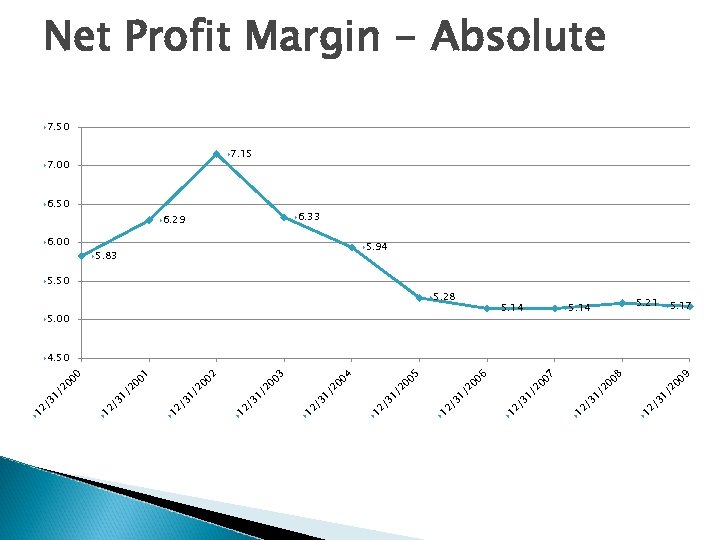 Net Profit Margin - Absolute 7. 50 7. 15 7. 00 6. 50 6. 33 6. 29 6. 00 5. 94 5. 83 5. 50 5. 28 5. 14 5. 00 5. 21 5. 14 5. 17 9 8 /2 31 2/ 1 1 2/ 31 /2 00 00 7 1 2/ 31 /2 00 6 1 2/ 31 /2 00 5 1 2/ 31 /2 00 4 1 2/ 31 /2 00 3 1 2/ 31 /2 00 1 2/ 31 /2 /2 31 2/ 1 1 2/ 31 /2 00 00 0 1 4. 50
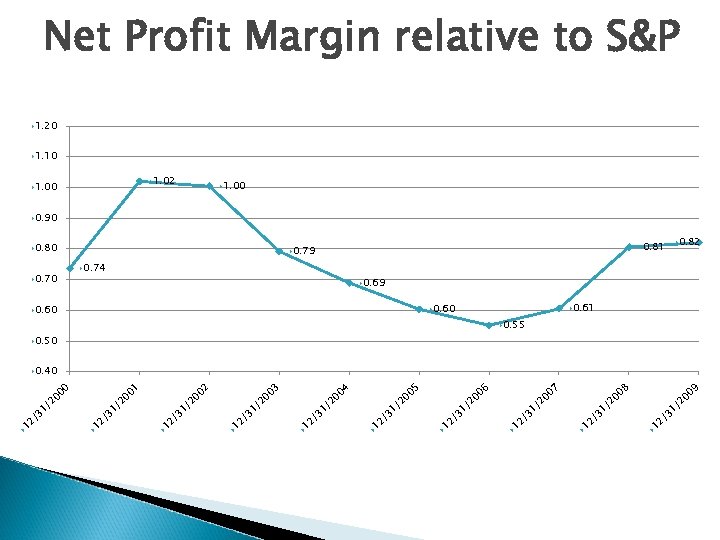 Net Profit Margin relative to S&P 1. 20 1. 10 1. 02 1. 00 0. 90 0. 80 0. 70 0. 82 0. 81 0. 79 0. 74 0. 69 0. 61 0. 60 0. 55 0. 50 9 8 /2 31 2/ 1 1 2/ 31 /2 00 00 7 1 2/ 31 /2 00 6 1 2/ 31 /2 00 5 1 2/ 31 /2 00 4 1 2/ 31 /2 00 3 1 2/ 31 /2 00 2 1 2/ 31 /2 00 1 00 /2 31 2/ 1 1 2/ 31 /2 00 0 0. 40
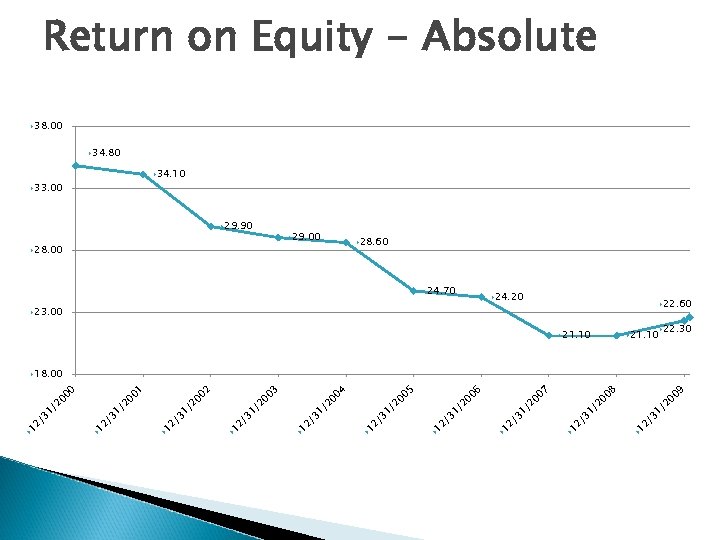 Return on Equity - Absolute 38. 00 34. 80 34. 10 33. 00 29. 90 29. 00 28. 60 24. 70 24. 20 23. 00 22. 60 21. 10 22. 30 9 /2 31 2/ 1 00 8 00 7 1 2/ 31 /2 00 6 1 2/ 31 /2 00 5 00 /2 31 2/ 1 1 2/ 31 /2 0 00 4 03 2 1 2/ 31 /2 00 1 00 /2 31 2/ 1 1 2/ 31 /2 00 0 18. 00
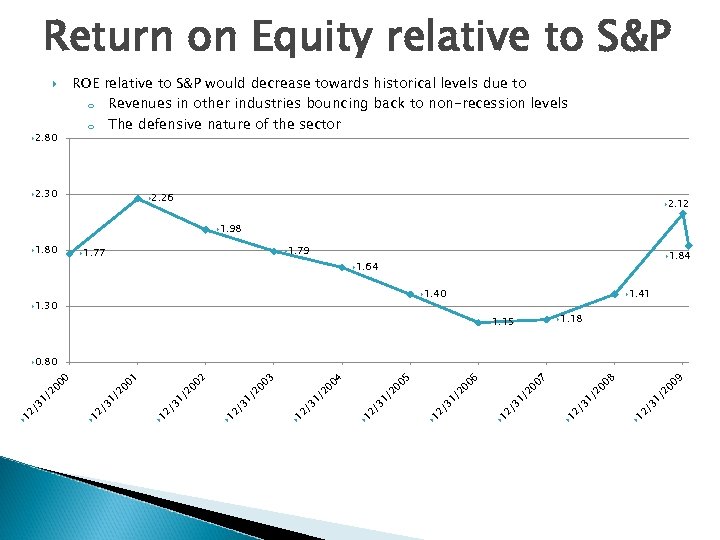 Return on Equity relative to S&P 2. 80 ROE relative to S&P would decrease towards historical levels due to o Revenues in other industries bouncing back to non-recession levels o The defensive nature of the sector 2. 30 2. 26 2. 12 1. 98 1. 80 1. 79 1. 77 1. 84 1. 64 1. 41 1. 40 1. 30 1. 18 1. 15 9 1 2/ 31 /2 00 1 2/ 31 /2 /2 31 2/ 1 00 8 7 00 6 1 2/ 31 /2 00 5 1 2/ 31 /2 00 4 /2 31 2/ 1 /2 0 1 2/ 31 /2 31 2/ 1 00 03 2 00 1 00 /2 31 2/ 1 1 2/ 31 /2 00 0 0. 80
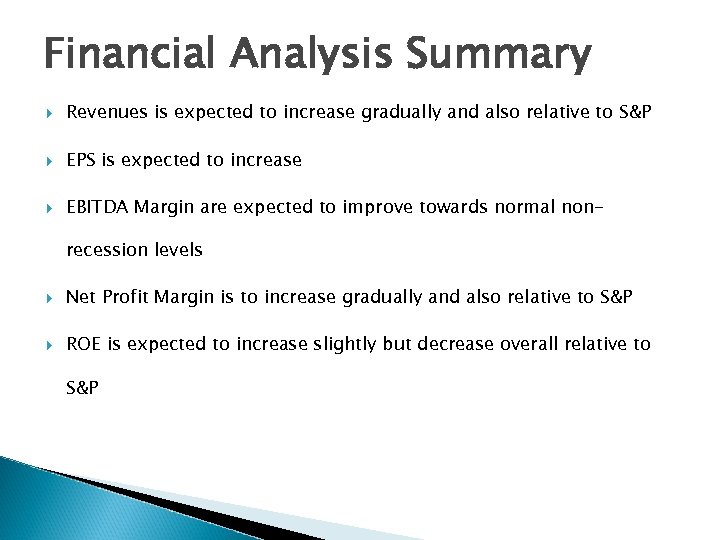 Financial Analysis Summary Revenues is expected to increase gradually and also relative to S&P EPS is expected to increase EBITDA Margin are expected to improve towards normal nonrecession levels Net Profit Margin is to increase gradually and also relative to S&P ROE is expected to increase slightly but decrease overall relative to S&P
 Valuation Analysis
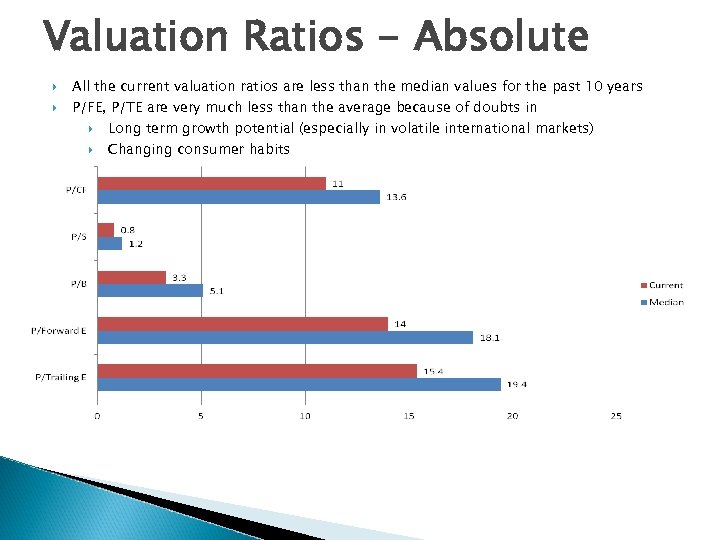 Valuation Ratios - Absolute All the current valuation ratios are less than the median values for the past 10 years P/FE, P/TE are very much less than the average because of doubts in Long term growth potential (especially in volatile international markets) Changing consumer habits
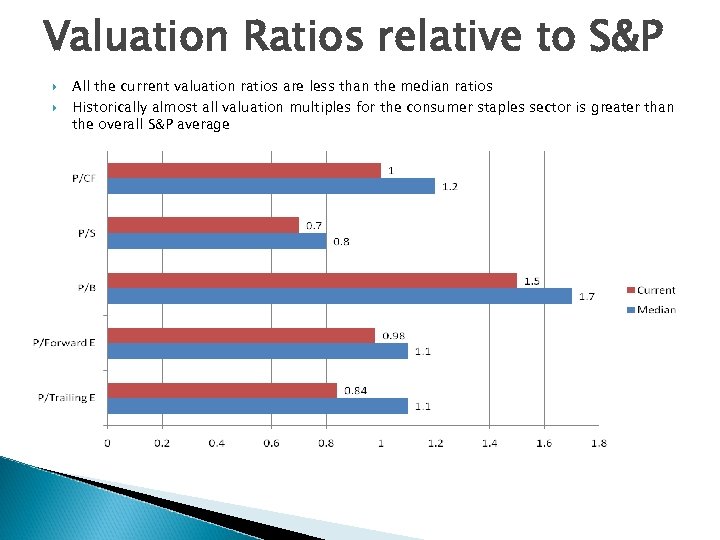 Valuation Ratios relative to S&P All the current valuation ratios are less than the median ratios Historically almost all valuation multiples for the consumer staples sector is greater than the overall S&P average
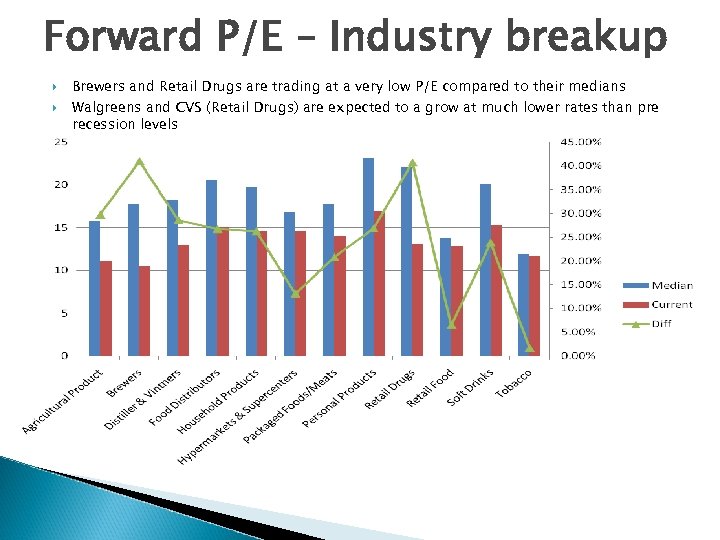 Forward P/E – Industry breakup Brewers and Retail Drugs are trading at a very low P/E compared to their medians Walgreens and CVS (Retail Drugs) are expected to a grow at much lower rates than pre recession levels
 P/E – Trend over last 10 years
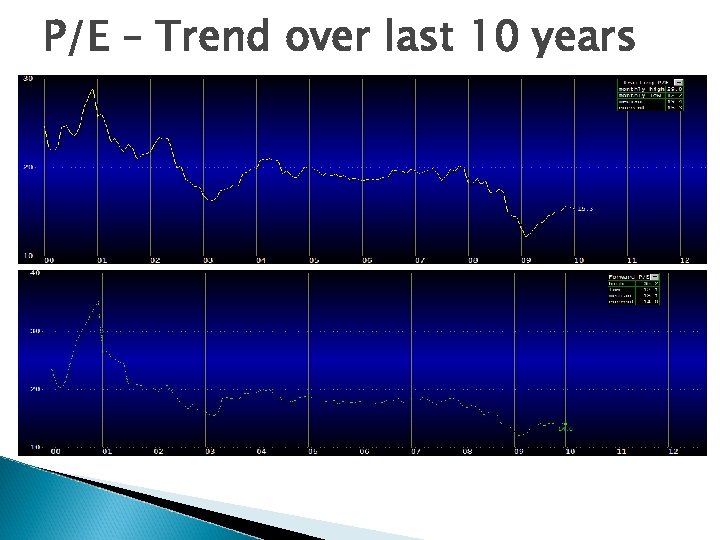
 Valuation Analysis Summary All current valuation ratios are lower than the historical median The valuation ratios have been expanding from the start of 2009 The ratios are expected to expand as doubts about economic recovery in various markets, consumer habits etc. , are cleared over a period of time Certain industries like Retail drugs, breweries are not expected to have pre-recession growth levels and hence valuation ratios are expected to be well below (contraction) the median for these cases
 Portfolio Recommendation
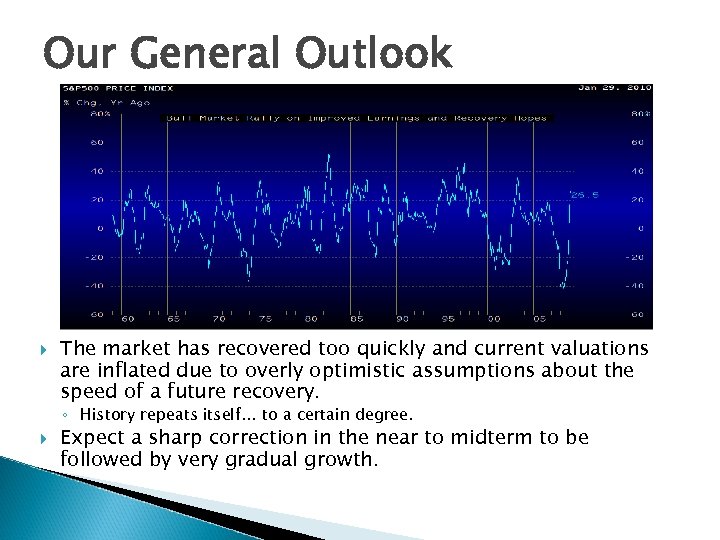 Our General Outlook The market has recovered too quickly and current valuations are inflated due to overly optimistic assumptions about the speed of a future recovery. ◦ History repeats itself… to a certain degree. Expect a sharp correction in the near to midterm to be followed by very gradual growth.
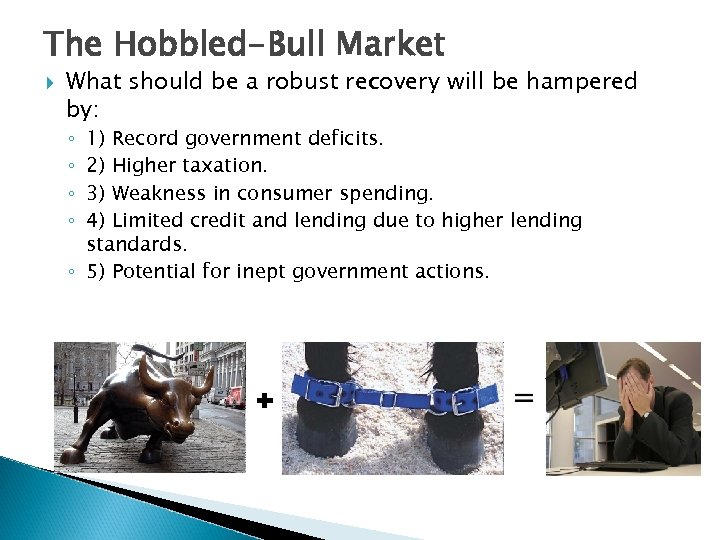 The Hobbled-Bull Market What should be a robust recovery will be hampered by: 1) Record government deficits. 2) Higher taxation. 3) Weakness in consumer spending. 4) Limited credit and lending due to higher lending standards. ◦ 5) Potential for inept government actions. ◦ ◦
 Recommendation Increase weight of Consumer Staples sector by 30 basis points to 12. 26%. The current weight of the sector is 11. 96% compared to S&P’s 11. 65%. Provides a defense against a market pullback. Still in a position to benefit from the emerging markets growth story. Market direction is currently uncertain and until it becomes more clear, it will be best to remain defensive. ◦ Signs of direction: Unemployment figures. Consumer spending and confidence data GDP growth Energy prices Interest rates and FOMC minutes
 Q&A?
Q&A?