


 Скачать презентацию Structuring for Student Success and Retention at Cuesta
5cc516cacc1041725df3f66c23dc0ac2.ppt
- Количество слайдов: 49
 Structuring for Student Success and Retention at Cuesta College – An Integrated Approach February 5, 2008 Campus Presentation
 Student Success and Retention Strategic Plan Mission n To provide direction and make recommendations to Cuesta College in its efforts to promote and enhance student retention and success n The pursuit of this Student Success and Retention sub-committee mission supports goal # 5 of the 2007 -2008 San Luis Obispo County Community College District Goals n Goal #5: Align institutional effectiveness outcomes with the new state accountability measures and incorporate a focus of student retention and achievement
 Retention Strategies n n Organize Student Success & Retention sub -committee as a strategic initiative with direct report to Enrollment Management Develop a steering committee as a subgroup Cross-functional team including faculty and staff Develop retention model
 Structure for Comprehensive Student Success and Retention Model n n n n Obtain institutional support for campus-wide initiative Establish structure to oversee the initiative Collect relevant data n Assess key variables n Student factors, institutional factors, potential interventions Develop campus plan and criteria to: n Identify goals for success/retention model n Identify strategies Implement retention model Evaluate outcomes Review and revise
 General Guidelines n n n n Student focused initiatives Total campus involvement Measurements Systemic support Continuous improvement Right people on board Quality educational experiences Intrusive efforts to promote persistence to goal completion
 Student Success and Retention Work Group n We envision campus-wide participation Faculty n Staff n Administrators n
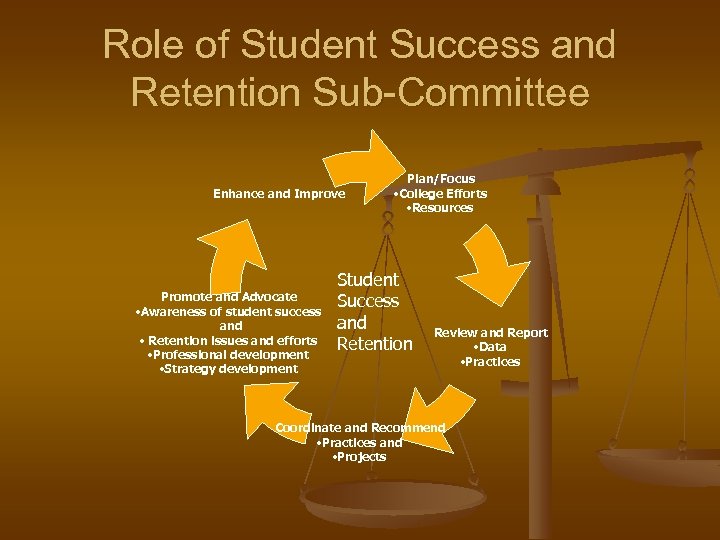 Role of Student Success and Retention Sub-Committee Enhance and Improve Promote and Advocate • Awareness of student success and • Retention issues and efforts • Professional development • Strategy development Plan/Focus • College Efforts • Resources Student Success and Retention Review and Report • Data • Practices Coordinate and Recommend • Practices and • Projects
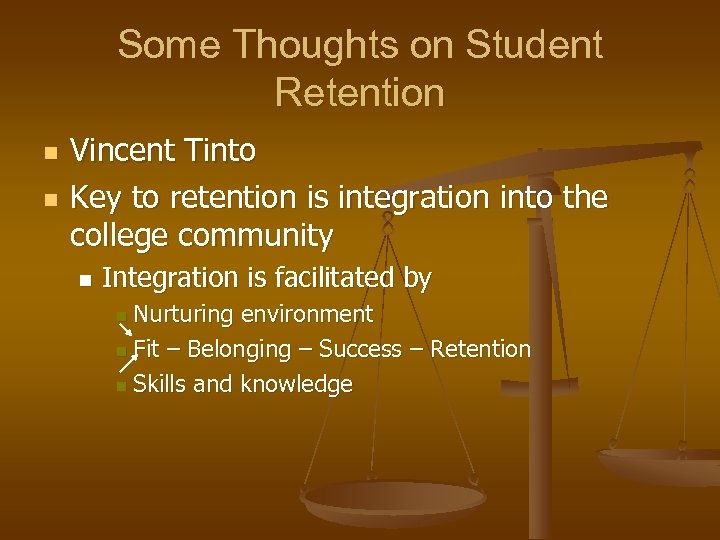 Some Thoughts on Student Retention n n Vincent Tinto Key to retention is integration into the college community n Integration is facilitated by Nurturing environment n Fit – Belonging – Success – Retention n Skills and knowledge n
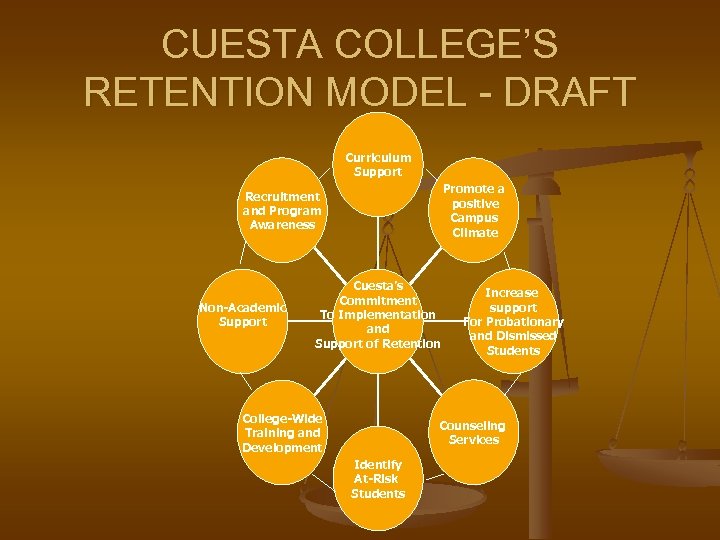 CUESTA COLLEGE’S RETENTION MODEL - DRAFT Curriculum Support Promote a positive Campus Climate Recruitment and Program Awareness Non-Academic Support Cuesta’s Commitment To Implementation and Support of Retention College-Wide Training and Development Increase support For Probationary and Dismissed Students Counseling Services Identify At-Risk Students
 Goal #1 Identifying At-Risk Students Objectives n Identify at-risk students at point of admissions, via assessment scores and prior transcripts (college and HS) n Identify special student populations requiring services, such as: ESL, VATEA, Cal. WORKS, EOPS, other n Improve student and staff awareness of campus and community support services n “Mandatory” assessment and counseling, especially with low placement scores n Create a student profile of multiple dismissal students
 Goal # 2 Improve Student Academic Advisement Process Objectives n To adequately provide counselor coverage that address year round service n To ensure that a counselor liaison is assigned to each instructional cluster/division, to each instructional site, cluster, division n To provide a comprehensive outreach and recruitment to all prospective students n To evaluate and, if needed, improve existing orientations (in person and online) n To expand orientations aimed at special population students n To create multiple methods to promote course; certificate; degree and transfer programs n To monitor the quality of student counseling processes and learning outcomes n To create methods to identify at-risk students as soon as possible n To establish a referral process for at-risk students to counselors and learning staff in advance of registration n n To require probationary and dismissed students to utilize appropriate support services and/or attend workshops To ensure that students are clearly informed as to where resources and services (support, instructional and community) are available to support educational goal achievement To consider ways in which interested faculty and services can become more involved in the student advisement process, and establish a means for them to communicate with each other To evaluate “pilot” counseling projects being initiated in Nursing and English as a Second Language learners To create ways to evaluate educational goal achievement and/or career placement
 Goal #3 Increase Support for Probationary and Dismissed Students Objectives n Have a referral team of counselors for students entering with at-risk grades from another institution (college or high school), or those with low assessment scores n Include a 4 -week personal follow-up for newly readmitted students n Send notification to reinstated students whom are also on Early Alert n Send “invite” letter to students whom were dismissed the previous semester but never re-enrolled at Cuesta n Consider implementing mandatory SEP policy for all multiple dismissal students n Consider having all readmit students enroll in Academic Skills 25 course n Assign a counselor to all students who need remediation. The counselor will assist students with academic planning and navigation of the college. n n n n Create a readmission task force, with emphasis on ensuring strong advising and encouraging students to declare a goal/major during their first year in college Enhance advising through use of a “road map” – a structure of guided sequential steps. A guide for students showing “what next” Encourage faculty to utilize the Early Alert system for students at high risk of failure Via e-mail, or readmit workshops, advertise Academic Skills workshops Offer professional development for faculty who teach gatekeeper courses During registration process, disseminate brochures on student support services and available resources Track student data and use the findings to strengthen the curriculum, the support system, and staff development
 Goal # 4 Improve and Promote a Positive Campus Climate and Sense of Connection for Students Objectives n To organize on-campus social and community events in order to encourage out-of-class interaction among students and between students, faculty, and staff. n To provide increased opportunities for first-generation students to meet faculty and other students n To review the results of the Noel-Levitz to analyze how students are feeling about their campus experience n To continue engineering facilities in which the layout promotes opportunities for faculty, students, and staff to interact n To provide access to technology for all students, but specially for those who do not have the technological resources at home n To ensure that with the advances of technology students still have the opportunity to engage in face-to-face interactions with faculty and staff n To make sure that availability of faculty office hours are well posted n To survey students to learn about what they see as important for creating a positive campus climate n To stimulate a campus-wide conversation about what we could do to improve campus climate (as individuals, departments, divisions, and programs) n To honor and celebrate students accomplishments n To bring students skills more visible (e. g. campus website, displays, etc. ) n To recommend to include “Positive Campus Climate” as part of the College’s mission and values
 Goal #5 Curriculum Support Objectives n n n n Identify success by course by student demographics Access prerequisite validity and quality of articulation with intra and inter-disciplinary meetings among faculty (paid by Matric? ) Provide early and frequent assessment in each course in order to flag at risk-students. Support the use of Early Alert and, more importantly, pre-registration identification of at-risk students Link at-risk students to academic support services Provide ongoing opportunities for faculty professional development in the areas of pedagogy, cultural sensitivity, learning theory, learning styles, etc. To evaluate student course offerings and scheduling of those courses Development of appropriate “bridge” courses after identification of poorly matriculated course sequences (e. g. , between ESL 6 and English 100) Integrate academic support modules into other “academic” courses
 Goal # 6 Improve Student Recruitment and Awareness of Cuesta College and Its Programs Objectives n Analyze the effectiveness of informational brochures, promotional materials including the Cuesta website n Use a centralized “common” look of internal and external marketing/communication tools n Analyze and make revisions to current outreach activities with local high schools, community and out of county prospective students n Update the Outreach Calendar and improve utilization in an effort to create a “master calendar” of outreach/recruitment to achieve collaboration among Cuesta programs/services who conduct outreach n Analyze Cuesta Admission process and the level of ease of our online application and other admission documentation. Improve access for non-English speakers by evaluating materials, processes and available bilingual staff. Focus on evening and off-site locations n Develop an outreach/recruitment database using “Banner” so that on going and timely electronic communication occurs among families/prospective students and Cuesta College n Introduce academic skills during orientations, assessment letters and recruitment activities, in an effort to address foundations in learning n Review and communicate to college personnel involved in recruiting and outreach minimum program entrance requirements n Evaluate the access by non-exempt and exempt credit and non-credit students in terms of application, assessment, orientation and counseling/advising matriculation components n Review outreach activities such as College Night, campus tours, “open houses” and other oncampus recruitment activities
 Goal # 7 Non-Academic Support Objectives n To enhance, promote, and utilize student career and career choice planning services n To encourage faculty participation in student out of class activities and orientation n To provide improved student services’ leadership training n To encourage a review of course material costs n To increase faculty awareness of support services n To increase access to financial advice for students n To promote and increase on-campus student employment opportunities n To develop alternatives for students with family support issues n n n n To develop a division, and campuswide coordinated effort of college support service activities To promote student accessibility to all students with qualified disabilities To develop a student mentoring program with participation of campus staff To work closely with Marketing and Communication to encourage campus and community understanding of student support services To improve current accessibility of student services by evaluating hours and locations To create a level of services that supports the ever changing student demographics at Cuesta To intensify efforts to increase the diversity of college staff
 Goal # 8 College-Wide Training and Development Objectives n n n n To provide training sessions for all Cuesta Faculty and Staff on retention strategies To provide training sessions for faculty and staff on effective advising tools and supporting/mentoring of at-risk students To establish a pilot mentoring program targeted to at-risk students To assist faculty in the development of strategies to improve student success To promote increased collaboration among all sectors of the campus community in regards to retention initiatives. To support faculty in the development of student mentoring initiatives (i. e. , students mentoring students, faculty mentoring students, etc) To offer seminars and workshops for faculty on the incorporation of retention strategies to course design
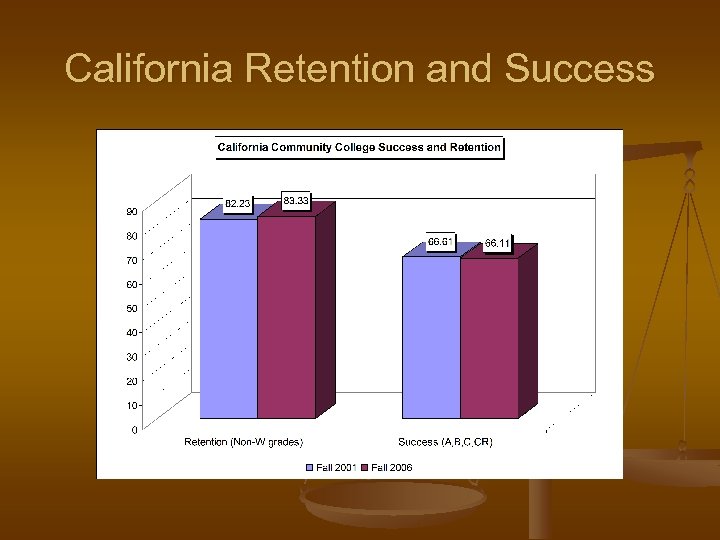 California Retention and Success
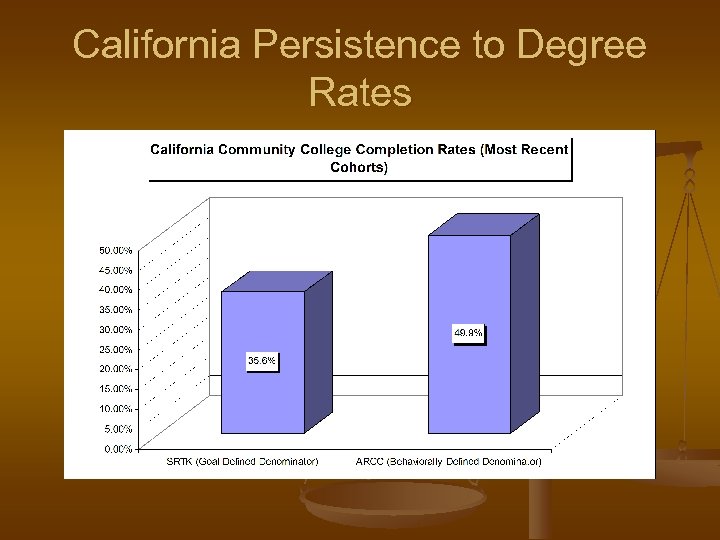 California Persistence to Degree Rates
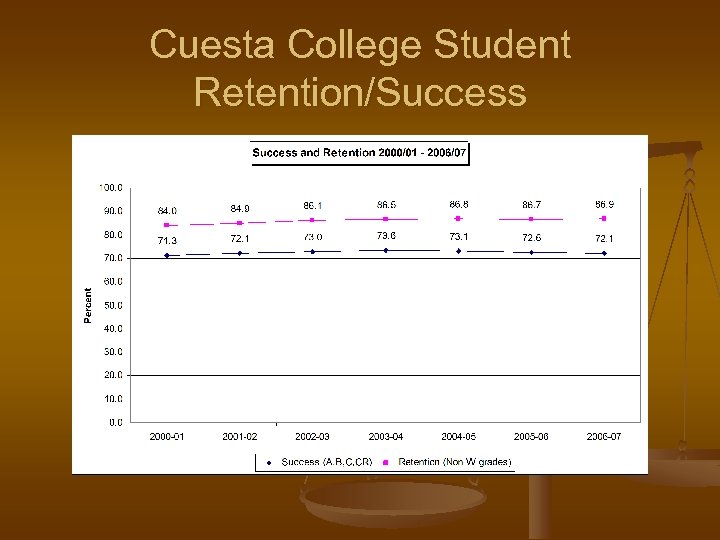 Cuesta College Student Retention/Success
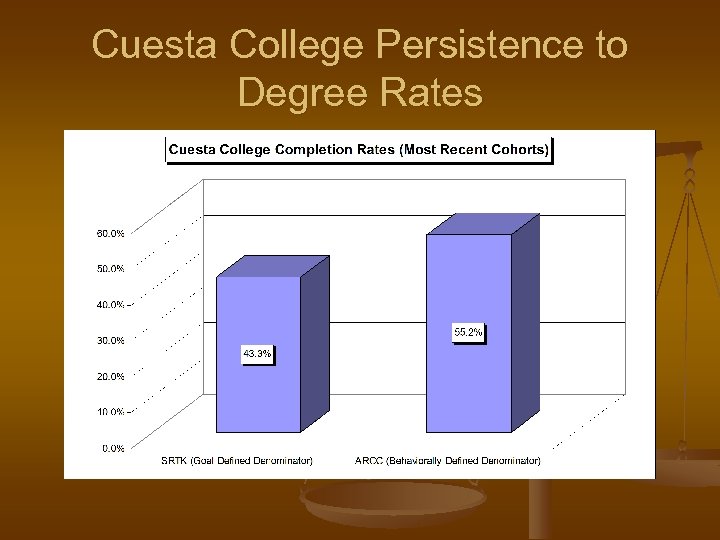 Cuesta College Persistence to Degree Rates
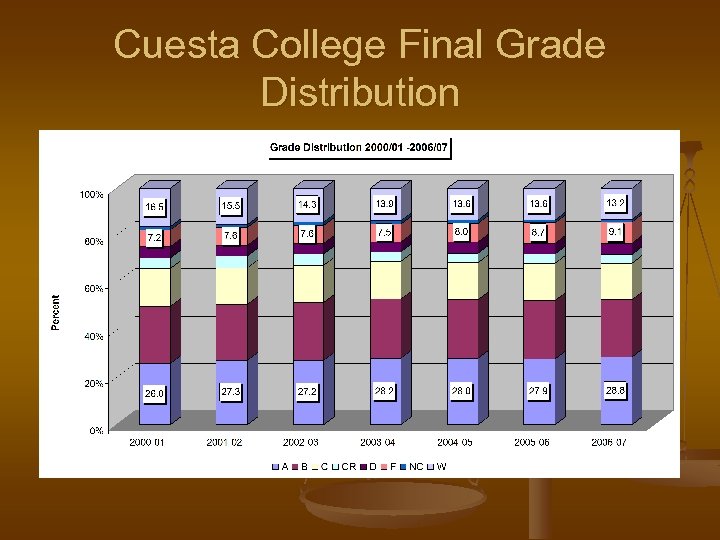 Cuesta College Final Grade Distribution
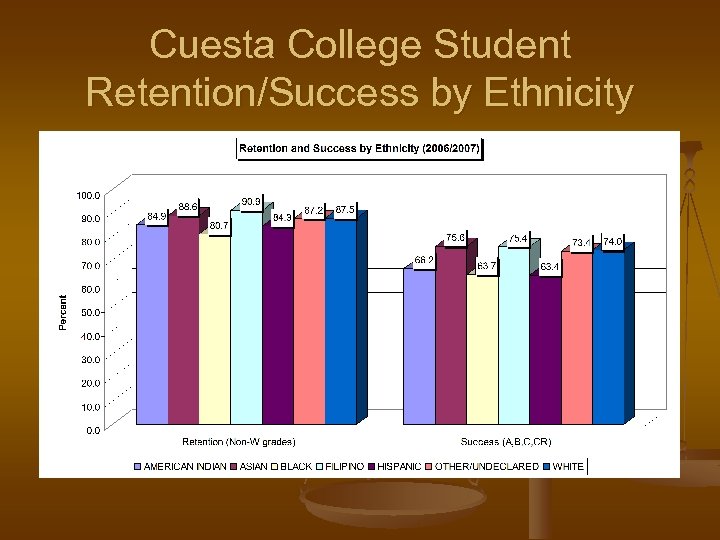 Cuesta College Student Retention/Success by Ethnicity
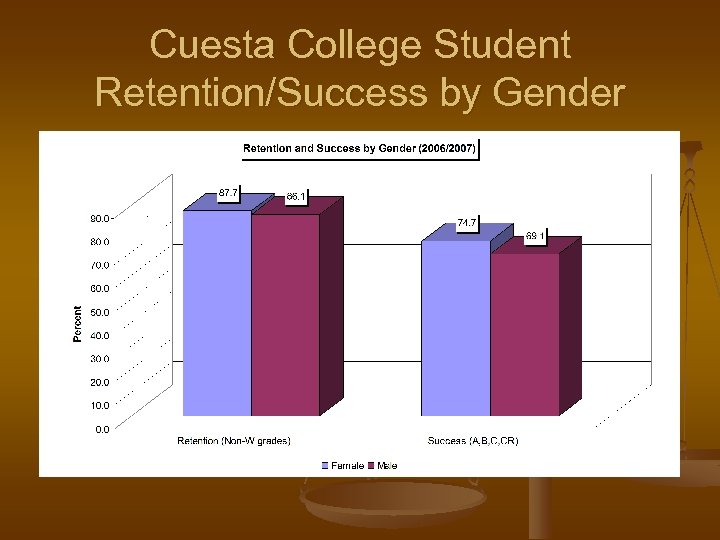 Cuesta College Student Retention/Success by Gender
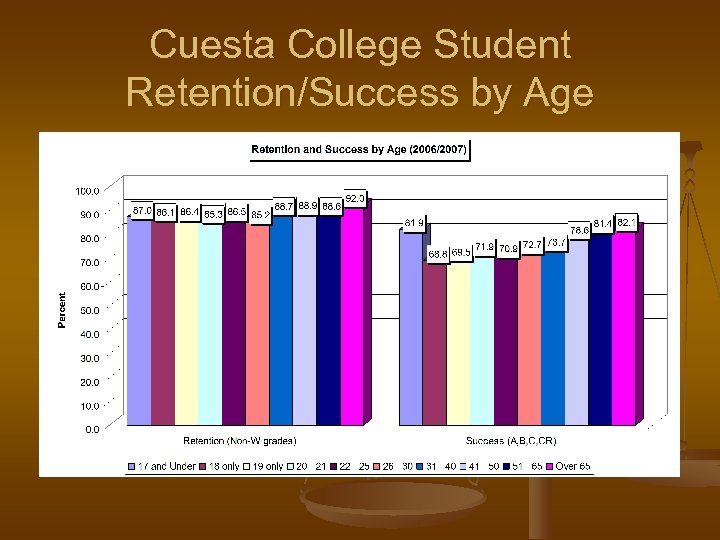 Cuesta College Student Retention/Success by Age
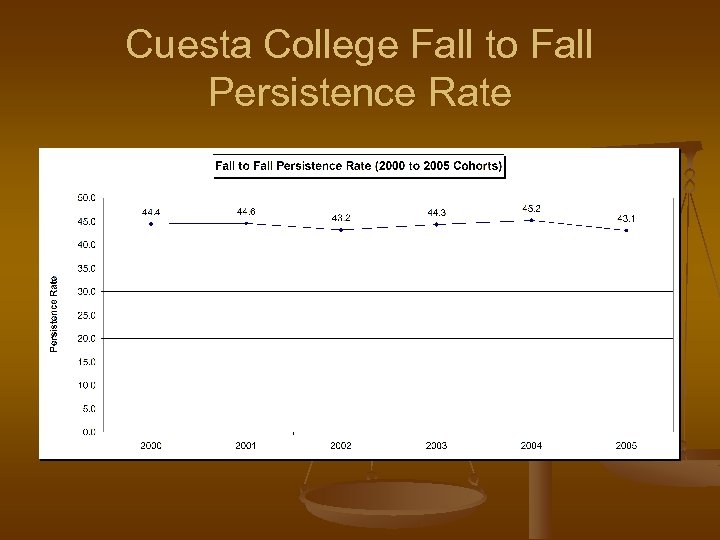 Cuesta College Fall to Fall Persistence Rate
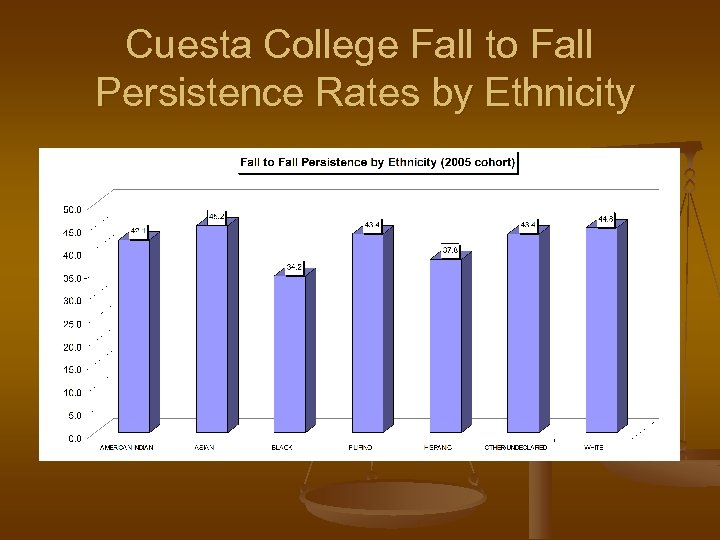 Cuesta College Fall to Fall Persistence Rates by Ethnicity
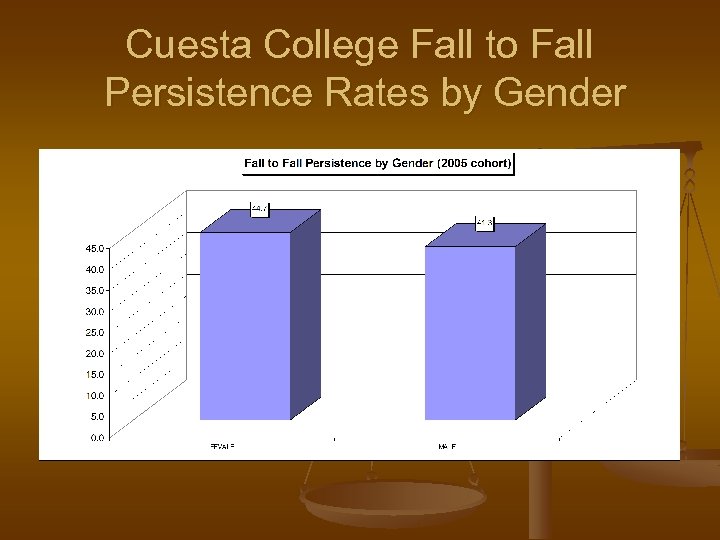 Cuesta College Fall to Fall Persistence Rates by Gender
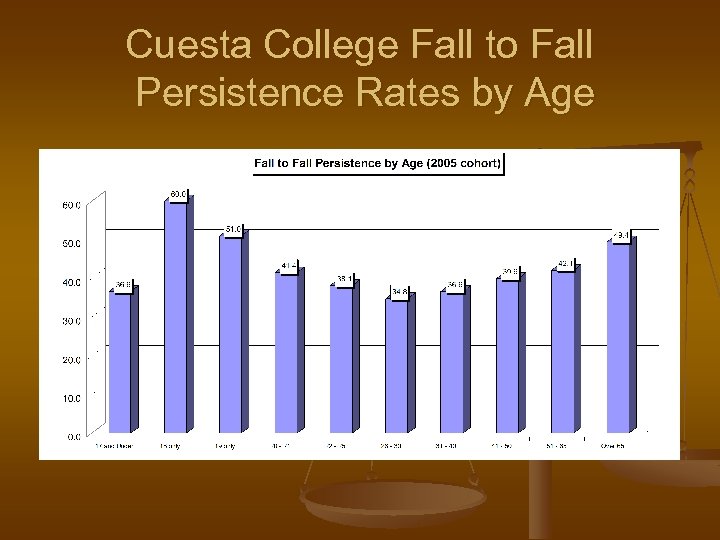 Cuesta College Fall to Fall Persistence Rates by Age
 Student Retention Data n n Institutional Profile of “Persisters” and Leavers Academic Factors n n n n High school GPA Cumulative prior college GPA Units attempted Educational goal Placement scores Major Enroll status
 Student Retention Data n Demographic Factors n n n n Traditional/non-traditional – need data… First generation college – need data… Ethnicity – Anglos and Asians Gender - females Age - curvilinear relationship Socioeconomic status – need data… Cuesta needs to construct its own model, but until we can collect SES, first generation status, HS GPA, etc. as well as the affective measures of engagement, any model we create will be misspecified…
 Student Retention Data n Affective Factors n n n n n Achievement motivation Engagement Academic self-concept Emotional intelligence Social support Goal clarity and realism Learning and study skills/habits Social and academic integration Social support Satisfaction
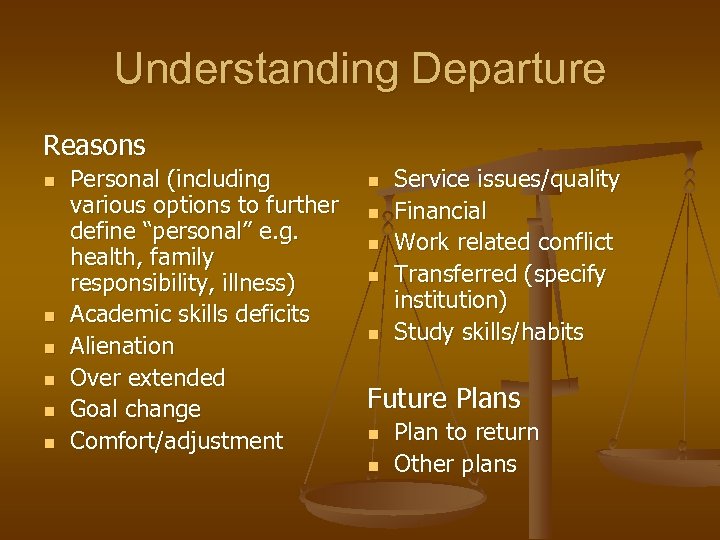 Understanding Departure Reasons n n n Personal (including various options to further define “personal” e. g. health, family responsibility, illness) Academic skills deficits Alienation Over extended Goal change Comfort/adjustment n n n Service issues/quality Financial Work related conflict Transferred (specify institution) Study skills/habits Future Plans n n Plan to return Other plans
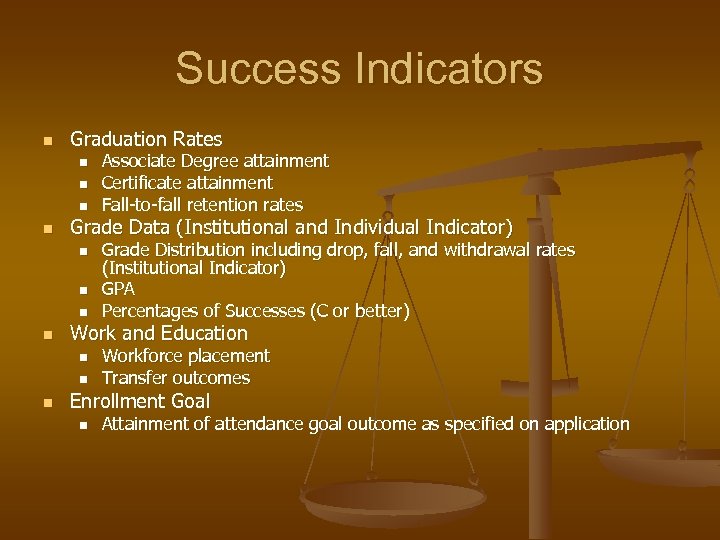 Success Indicators n Graduation Rates n n Grade Data (Institutional and Individual Indicator) n n Grade Distribution including drop, fall, and withdrawal rates (Institutional Indicator) GPA Percentages of Successes (C or better) Work and Education n Associate Degree attainment Certificate attainment Fall-to-fall retention rates Workforce placement Transfer outcomes Enrollment Goal n Attainment of attendance goal outcome as specified on application
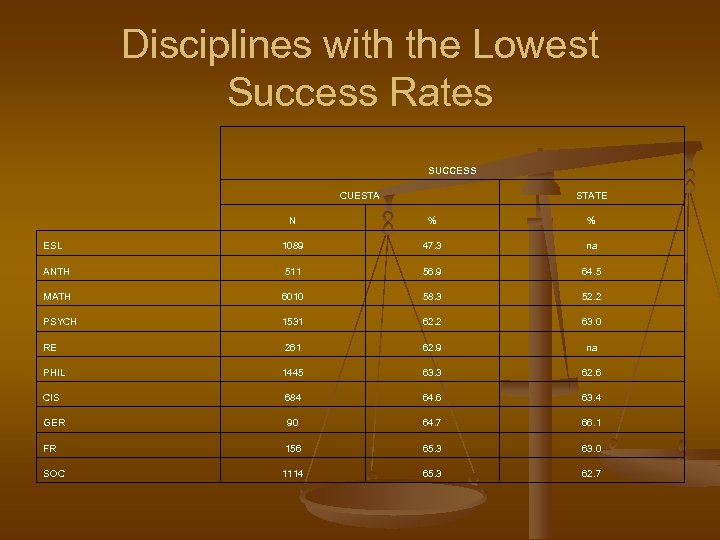 Disciplines with the Lowest Success Rates SUCCESS CUESTA STATE N % % ESL 1089 47. 3 na ANTH 511 56. 9 64. 5 MATH 6010 58. 3 52. 2 PSYCH 1531 62. 2 63. 0 RE 261 62. 9 na PHIL 1445 63. 3 62. 6 CIS 684 64. 6 63. 4 GER 90 64. 7 66. 1 FR 156 65. 3 63. 0 SOC 1114 65. 3 62. 7
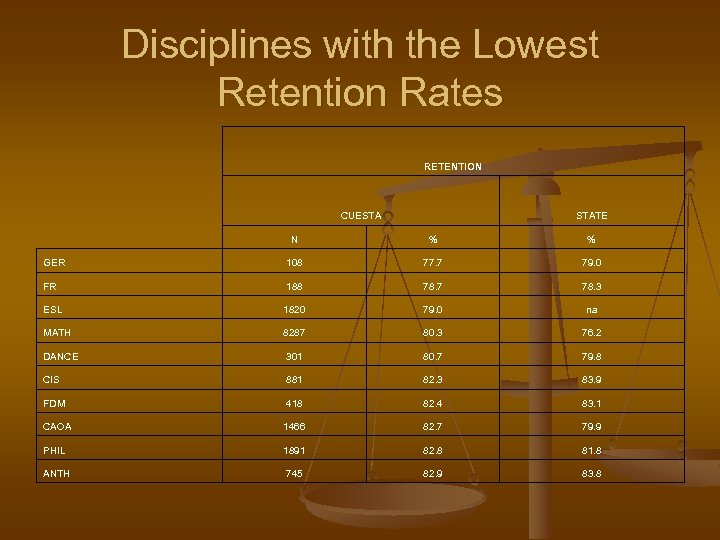 Disciplines with the Lowest Retention Rates RETENTION CUESTA STATE N % % GER 108 77. 7 79. 0 FR 188 78. 7 78. 3 ESL 1820 79. 0 na MATH 8287 80. 3 76. 2 DANCE 301 80. 7 79. 8 CIS 881 82. 3 83. 9 FDM 418 82. 4 83. 1 CAOA 1466 82. 7 79. 9 PHIL 1891 82. 8 81. 8 ANTH 745 82. 9 83. 8
 Data to Support Initiative n n n Correlation of results to course success Trend analyses Grade analysis At-risk courses Placement at time of entry
 Some Thoughts on Student Retention n Simple but complex! n If we can STUDENT LIFE AND LEARNING (goal) to meet STUDENT NEEDS AND EXPECTATIONS, IMPROVED STUDENT SUCCESS and RETENTION (outcome) will follow!
 Some Thoughts on Student Retention n Noel-Levitz n n Comprehensive campus-wide systematic effort rather than disparate initiatives Set of strategies that combine to enhance the quality of student life, learning and satisfaction Focus on high impact, high value-added strategies Although attrition is typically greatest during the first year, institutional efforts should extend beyond that
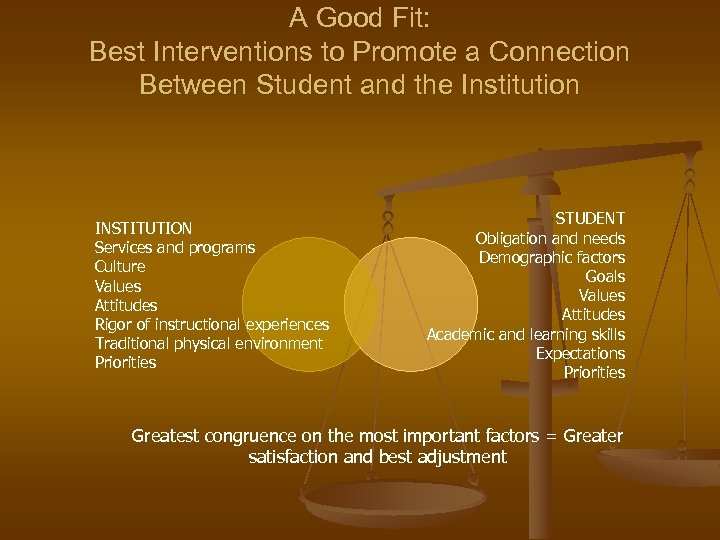 A Good Fit: Best Interventions to Promote a Connection Between Student and the Institution INSTITUTION Services and programs Culture Values Attitudes Rigor of instructional experiences Traditional physical environment Priorities STUDENT Obligation and needs Demographic factors Goals Values Attitudes Academic and learning skills Expectations Priorities Greatest congruence on the most important factors = Greater satisfaction and best adjustment
 Strategies for Success n Focus should be on the major areas that impact the students experiences Instructional program n Institutional policies and procedures n Institutional culture n Services and supports n
 Instructional Program n n n n Relevant programs for career and educational goals Concerned involved faculty Culture focused on student learning High quality course content Appropriate use of technology Delivery options Academic support system Options for development of under-prepared students
 Policies and Structure n n n n Early Alert Require placement testing for all non-exempt students Expand refine course placement Remedial coursework Orientation Learning communities Standard of academic progress Mandatory advising for at-risk students
 Institutional Culture n n n Service excellence Engagement (academic, social, psychological) Culture of caring Fostering connection (integration) Student centered philosophy Option and flexibility
 Services and Support n n n Intrusive academic advising Supplemental instruction Tutoring Comprehensive learning assistance centers Career decision making and goal setting Employment services n n n Financial Aid Affective assessment and intervention (institutional and individual levels) Counseling services Life skills training Learning Skills instruction (time management, study and testing skills, note taking, decision-making, etc. )
 Strategies n Practices having greatest impact on retention Academic advising (intrusive targeted) n Learning support services (tutoring, labs, required developmental coursework) n Assessment (including mandatory course placement) n
 Cuesta Implementation Objectives n n Pre-planning, implementation, review Gather your input n n Follow-up First layer of implementation: Probation/dismissal students n Students with low assessment scores n
 Getting Your Input Today n n n List 2 best practices you employ for student success and retention List 2 questions or concerns regarding student success and retention at Cuesta Interest sheet for goals 1 -8 on the Cuesta Student Success and Retention Model
 Thank you! Student Success and Retention Sub-Committee: Teri Sherman- Chair Sandee Mc. Laughlin Cande Munoz Patrick Schwab Ryan Cartnal Jane Morgan Glenda Moscoso