


 Скачать презентацию Structure Propulsion Lunar Transportation System GISS Apprentices Design
7895be1ed1020492c8d63f1fe95f202b.ppt
- Количество слайдов: 1
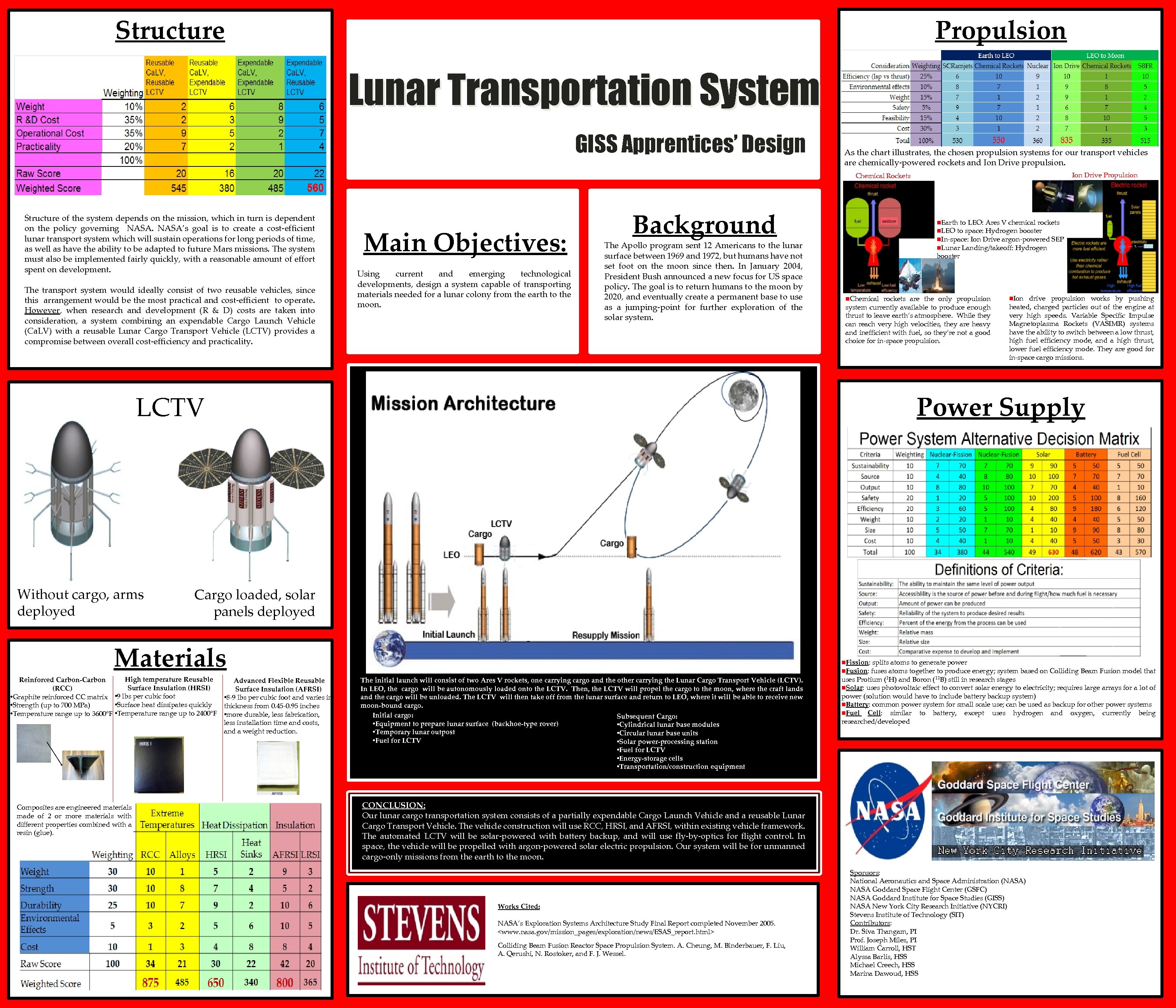 Structure Propulsion Lunar Transportation System GISS Apprentices’ Design As the chart illustrates, the chosen propulsion systems for our transport vehicles are chemically-powered rockets and Ion Drive propulsion. Ion Drive Propulsion Chemical Rockets Structure of the system depends on the mission, which in turn is dependent on the policy governing NASA’s goal is to create a cost-efficient lunar transport system which will sustain operations for long periods of time, as well as have the ability to be adapted to future Mars missions. The system must also be implemented fairly quickly, with a reasonable amount of effort spent on development. The transport system would ideally consist of two reusable vehicles, since this arrangement would be the most practical and cost-efficient to operate. However, when research and development (R & D) costs are taken into consideration, a system combining an expendable Cargo Launch Vehicle (Ca. LV) with a reusable Lunar Cargo Transport Vehicle (LCTV) provides a compromise between overall cost-efficiency and practicality. Main Objectives: Using current and emerging technological developments, design a system capable of transporting materials needed for a lunar colony from the earth to the moon. Background The Apollo program sent 12 Americans to the lunar surface between 1969 and 1972, but humans have not set foot on the moon since then. In January 2004, President Bush announced a new focus for US space policy. The goal is to return humans to the moon by 2020, and eventually create a permanent base to use as a jumping-point for further exploration of the solar system. Chemical rockets are the only propulsion system currently available to produce enough thrust to leave earth’s atmosphere. While they can reach very high velocities, they are heavy and inefficient with fuel, so they’re not a good choice for in-space propulsion. Ion drive propulsion works by pushing heated, charged particles out of the engine at very high speeds. Variable Specific Impulse Magnetoplasma Rockets (VASIMR) systems have the ability to switch between a low thrust, high fuel efficiency mode, and a high thrust, lower fuel efficiency mode. They are good for in-space cargo missions. Cargo loaded, solar panels deployed Materials High temperature Reusable Reinforced Carbon-Carbon Advanced Flexible Reusable Surface Insulation (HRSI) (RCC) Surface Insulation (AFRSI) • Graphite reinforced CC matrix • 9 lbs per cubic foot • 8 -9 lbs per cubic foot and varies in • Surface heat dissipates quickly • Strength (up to 700 MPa) thickness from 0. 45 -0. 95 inches • Temperature range up to 3600°F • Temperature range up to 2400°F • more durable, less fabrication, less installation time and costs, and a weight reduction. Composites are engineered materials made of 2 or more materials with different properties combined with a resin (glue). booster Power Supply LCTV Without cargo, arms deployed Earth to LEO: Ares V chemical rockets LEO to space: Hydrogen booster In-space: Ion Drive argon-powered SEP Lunar Landing/takeoff: Hydrogen The initial launch will consist of two Ares V rockets, one carrying cargo and the other carrying the Lunar Cargo Transport Vehicle (LCTV). In LEO, the cargo will be autonomously loaded onto the LCTV. Then, the LCTV will propel the cargo to the moon, where the craft lands and the cargo will be unloaded. The LCTV will then take off from the lunar surface and return to LEO, where it will be able to receive new moon-bound cargo. Initial cargo: Subsequent Cargo: • Equipment to prepare lunar surface (backhoe-type rover) • Cylindrical lunar base modules • Temporary lunar outpost • Circular lunar base units • Fuel for LCTV • Solar power-processing station • Fuel for LCTV • Energy-storage cells • Transportation/construction equipment Fission: splits atoms to generate power Fusion: fuses atoms together to produce energy; system based on Colliding Beam Fusion model that uses Protium (1 H) and Boron (11 B) still in research stages Solar: uses photovoltaic effect to convert solar energy to electricity; requires large arrays for a lot of power (solution would have to include battery backup system) Battery: common power system for small scale use; can be used as backup for other power systems Fuel Cell: similar to battery, except uses hydrogen and oxygen, currently being researched/developed CONCLUSION: Our lunar cargo transportation system consists of a partially expendable Cargo Launch Vehicle and a reusable Lunar Cargo Transport Vehicle. The vehicle construction will use RCC, HRSI, and AFRSI, within existing vehicle framework. The automated LCTV will be solar-powered with battery backup, and will use fly-by-optics for flight control. In space, the vehicle will be propelled with argon-powered solar electric propulsion. Our system will be for unmanned cargo-only missions from the earth to the moon. Works Cited: NASA’s Exploration Systems Architecture Study Final Report completed November 2005.