


 Скачать презентацию Structure of the hog industry Many small
334b22390cfdff9e1d485c03304c31ee.ppt
- Количество слайдов: 18
 Structure of the hog industry • Many, small operations used to raise hogs from start to finish • Hogs were raised where near large supplies of corn. • Hog farmers typically fed corn and other farm by-products from their own operation as an inexpensive feed • Hogs were sold at local markets for a negotiated price
 Structure has changed dramatically • Rapid transition to large specialized operations • Most hogs are raised in buildings, with specialized, environmentally modified facilities. • Allows closer watch of animals for nutritional needs and disease prevention • Confinement production allows year-round production
 Hogs are produced in 3 types of specialized enterprises • Farrow-to-finish operations – raise hogs from birth to slaughter weight, about 110 -125 KG (4. 5 -6 months) • Feeder pig producers – raise pigs from birth to 4 -28 KG, then generally sell them for finishing. • Feeder pig finishers – buy feeder pigs and grow them to slaughter weight.
 Change to more specialized operations • Farrow-to-finish operations were the main type of hog farm in the 1980 s • Operations have been more specialized, dividing each stage of production • Most hogs produced under production or marketing contracts
 Economies of size drove the change • Larger operations can spread fixed costs over more animals • Low-cost operations can survive periods of low prices easier than high-cost • Contract production allowed farms to specialize and reduce risk • Increased capital requirements
 Contracting has changed the industry • Contract production is an arrangement between a pig owner (the contractor) and a producer (the grower) • Producer cares for the pig in the producer's facilities. • The producer is paid a fee for the service provided. • An integrator may have contracts with many growers to produce hogs. • Farmers can also be contractors
 Contracting has changed the industry (continued) • Decision making is divided between farmer and contractor • Day-to-day management is key to returns to farmers • Financial management, acquiring other inputs, allocation of time and management • Farmers don’t have a role in other production practices (such as raising feed) and marketing role is limited
 Why would farmers use contracts? • • • Reduce risk of price swings Stabilize cash flow Share production costs Assure access to market Access to expert advice Expand scale of operation
 Why would farmers use contracts? • Reduce input risk – Assure access to product – Control quality and quantity • Diversify operations • Ease inventory management problems • Establish product identity
 Contracting allowed the application of technology in new ways • Technology applied to each production stage – Automated feeding and watering system reduced costs – Increase pigs per litter and weight per hog – Management systems became more specialized – Advantage of economies of size • Location of farms moved to non-traditional areas, led by North Carolina. Other growth areas--Oklahoma, Missouri, and Utah.
 Large operations means more manure • More animals, more manure in one location • With higher fertilizer costs, there is a new interest in using manure in the Corn Belt state • Hog finishing facilities are directly tied to location of cropland (where the feed is located and where the manure can be spread)
 Two types of contracts • Market contracts-- setting price before delivery • Production contracts-- agreement to produce a particular product for a known outlet for a fee • Production contracts used more in livestock • 68 billion or 36 percent of ag production
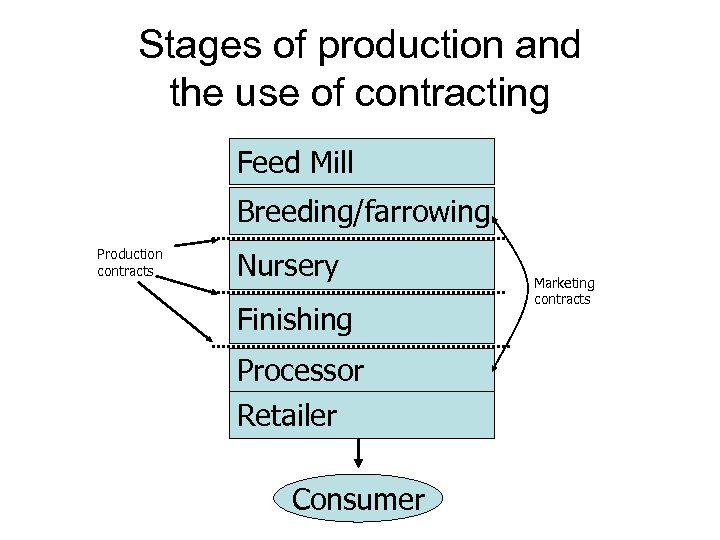 Stages of production and the use of contracting Feed Mill Breeding/farrowing Production contracts Nursery Finishing Processor Retailer Consumer Marketing contracts
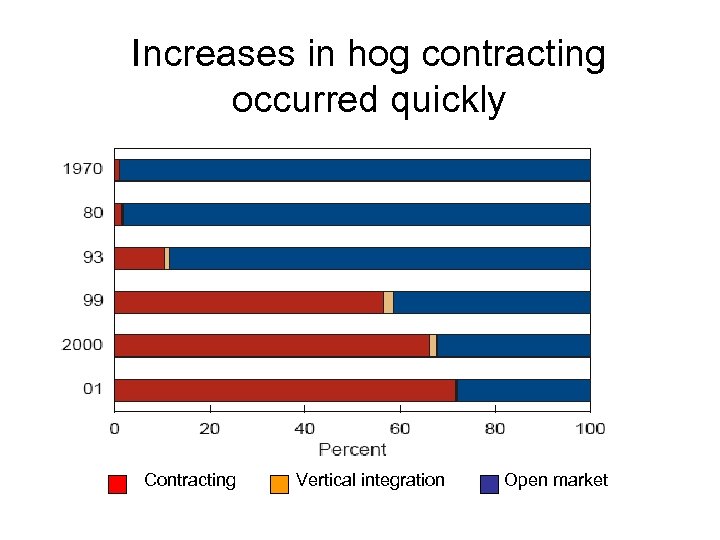 Increases in hog contracting occurred quickly Contracting Vertical integration Open market
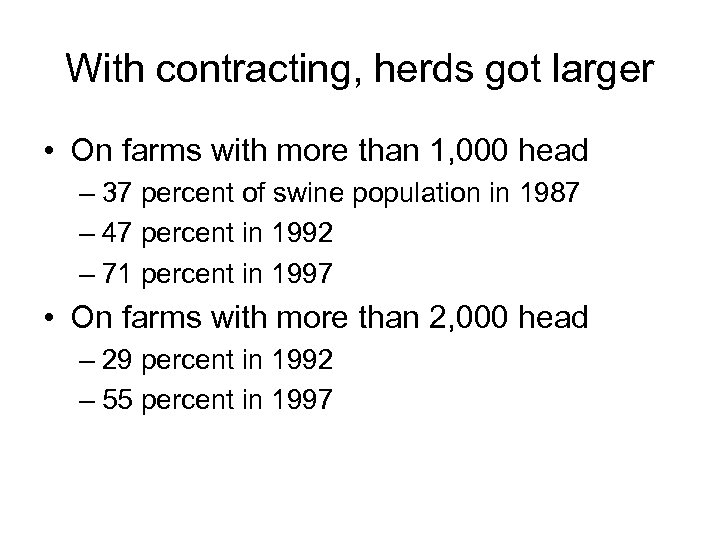 With contracting, herds got larger • On farms with more than 1, 000 head – 37 percent of swine population in 1987 – 47 percent in 1992 – 71 percent in 1997 • On farms with more than 2, 000 head – 29 percent in 1992 – 55 percent in 1997
 Why were contracts so popular? • Application of new technology • More closely coordinated stages of production to meet demand • Allowed American to have preferred food year round • Contracting assures a given supply and quality at stable prices and better manages risk
 Contracting changes production • Is agriculture going thru stages? – Autonomous, small, wholly owned and operated, self and local markets – Rent or lease resources, cash market – Multiple cooperative agreements, including marketing contracts – Consolidated, highly integrated, complex organization
 Contracting changes the market • Prices not visible • Fewer buyers • Eliminate stages of transfer (markets) • Market risk is exchanged for contract risk