


 Скачать презентацию Structure of a Regular Patent Regular Utility Patents
e238147d5f714af881db27d7122ba34a.ppt
- Количество слайдов: 83
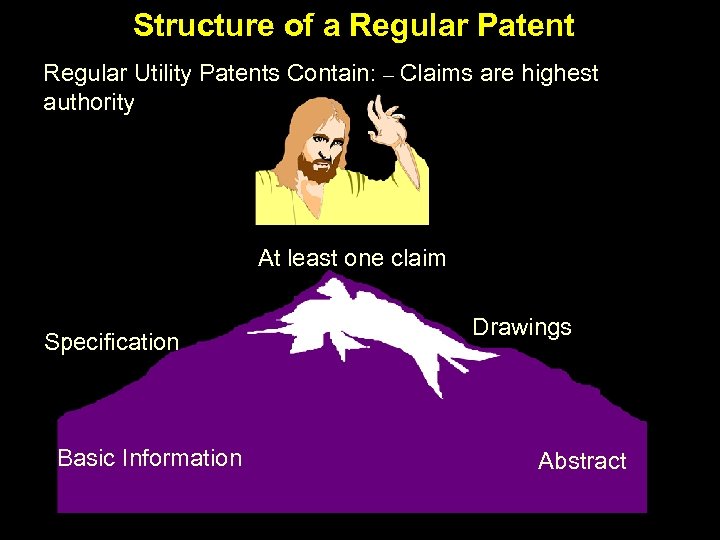 Structure of a Regular Patent Regular Utility Patents Contain: – Claims are highest authority At least one claim Specification Basic Information Drawings Abstract
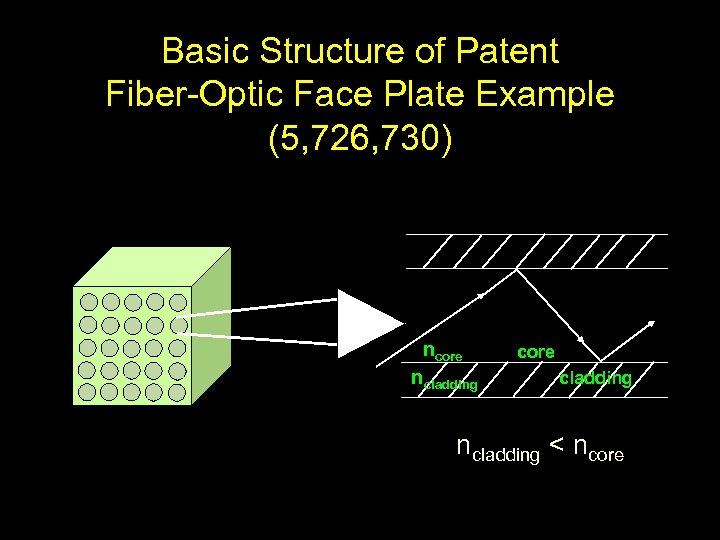 Basic Structure of Patent Fiber-Optic Face Plate Example (5, 726, 730) ncore ncladding core cladding ncladding < ncore
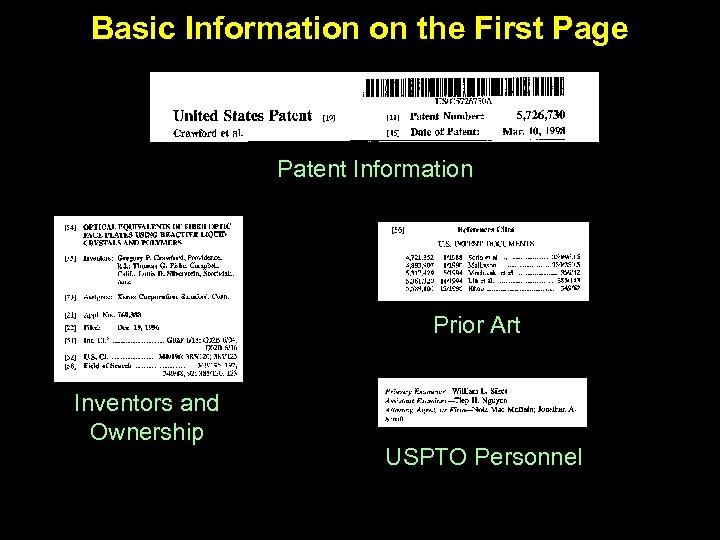 Basic Information on the First Page Patent Information Prior Art Inventors and Ownership USPTO Personnel
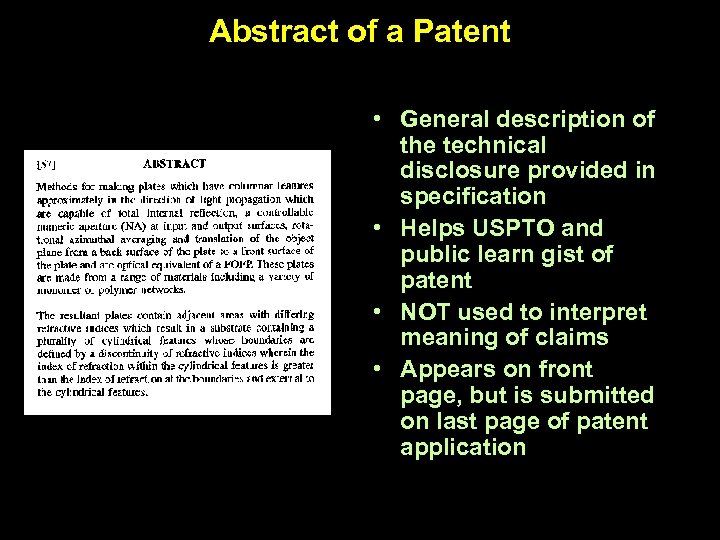 Abstract of a Patent • General description of the technical disclosure provided in specification • Helps USPTO and public learn gist of patent • NOT used to interpret meaning of claims • Appears on front page, but is submitted on last page of patent application
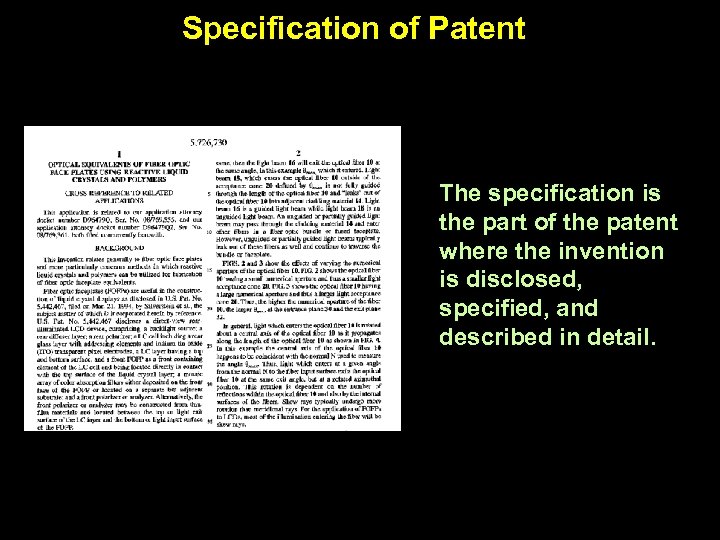 Specification of Patent The specification is the part of the patent where the invention is disclosed, specified, and described in detail.
 Specification of Patent The specification must meet three requirements • • • Must describe the claimed invention (description requirement) The description of the invention must be in clear and concise terms (exact) to enable any person skilled in the art to make and use the invention. It must provide the best mode contemplated by the inventor of carrying out the invention at the time the patent application is written. This may be in the form of examples (e. g. materials used) This section discloses background art, drawing descriptions, examples, and a summary.
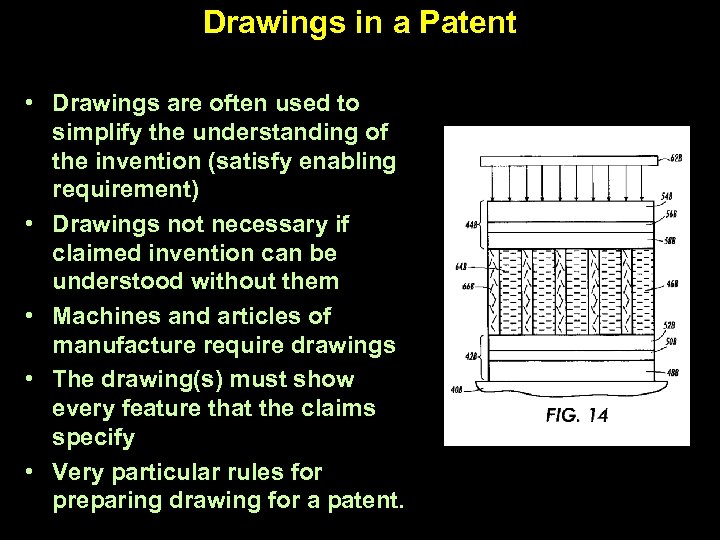 Drawings in a Patent • Drawings are often used to simplify the understanding of the invention (satisfy enabling requirement) • Drawings not necessary if claimed invention can be understood without them • Machines and articles of manufacture require drawings • The drawing(s) must show every feature that the claims specify • Very particular rules for preparing drawing for a patent.
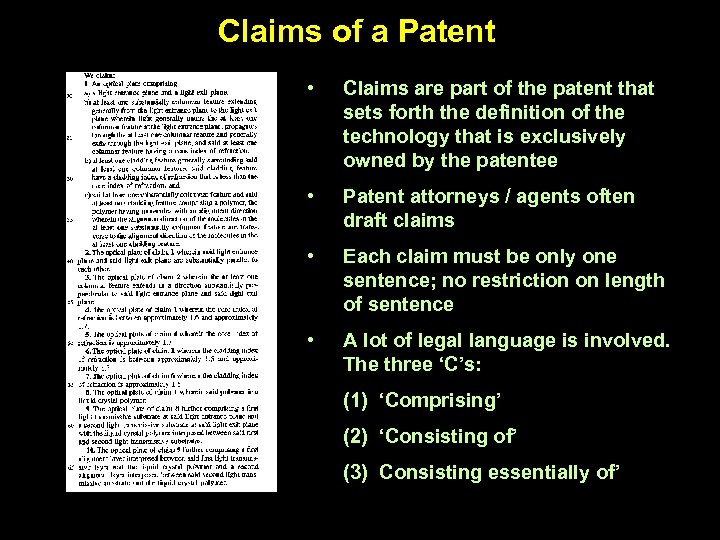 Claims of a Patent • Claims are part of the patent that sets forth the definition of the technology that is exclusively owned by the patentee • Patent attorneys / agents often draft claims • Each claim must be only one sentence; no restriction on length of sentence • A lot of legal language is involved. The three ‘C’s: (1) ‘Comprising’ (2) ‘Consisting of’ (3) Consisting essentially of’
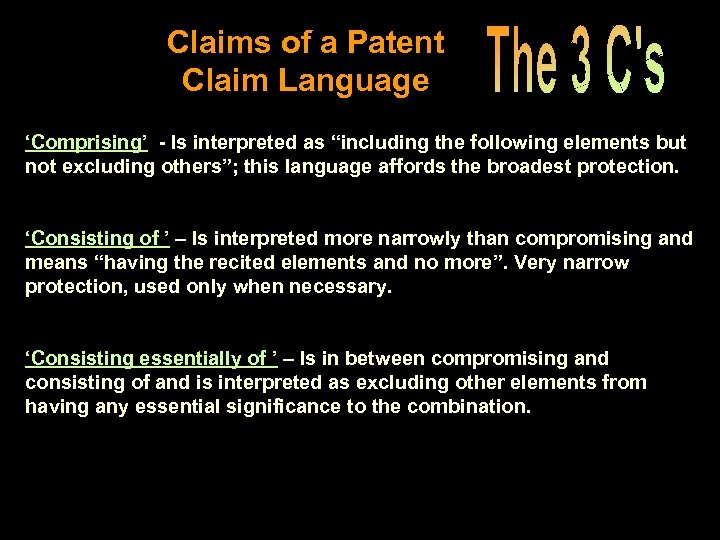 Claims of a Patent Claim Language ‘Comprising’ - Is interpreted as “including the following elements but not excluding others”; this language affords the broadest protection. ‘Consisting of ’ – Is interpreted more narrowly than compromising and means “having the recited elements and no more”. Very narrow protection, used only when necessary. ‘Consisting essentially of ’ – Is in between compromising and consisting of and is interpreted as excluding other elements from having any essential significance to the combination.
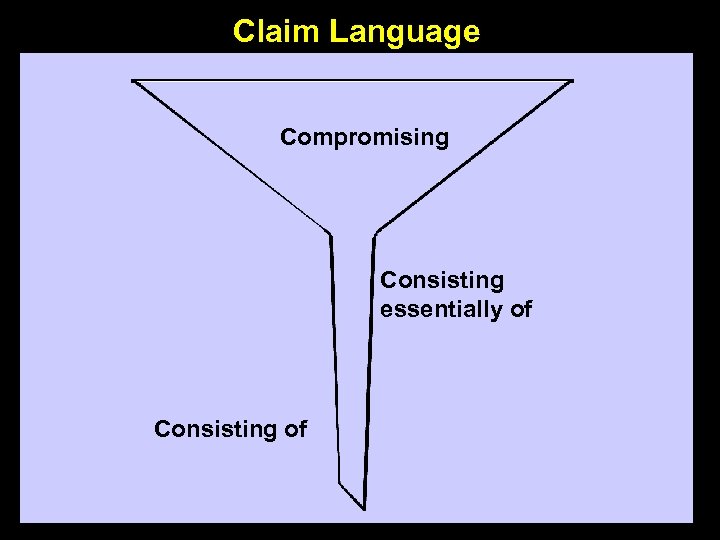 Claim Language Compromising Consisting essentially of Consisting of
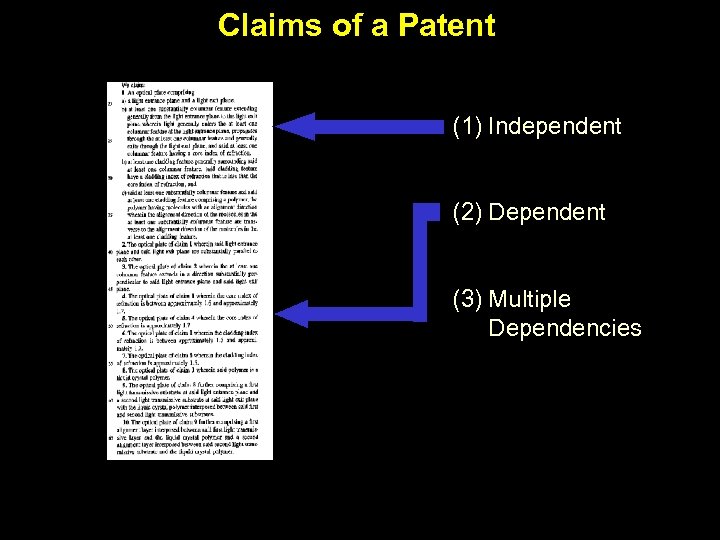 Claims of a Patent (1) Independent (2) Dependent (3) Multiple Dependencies
 Claims of a Patent • An independent claim stands alone and includes its necessary limitation. Broadly defines invention. • A dependent claim refers to another claim and includes all the limitations of the parent claim, plus the new limitations of the dependant claim. Dependant claims provide scope to the invention and relies on only one claim. • A multiple dependant claim incorporates the limitation of more than one claim (rarely used in US patent law).
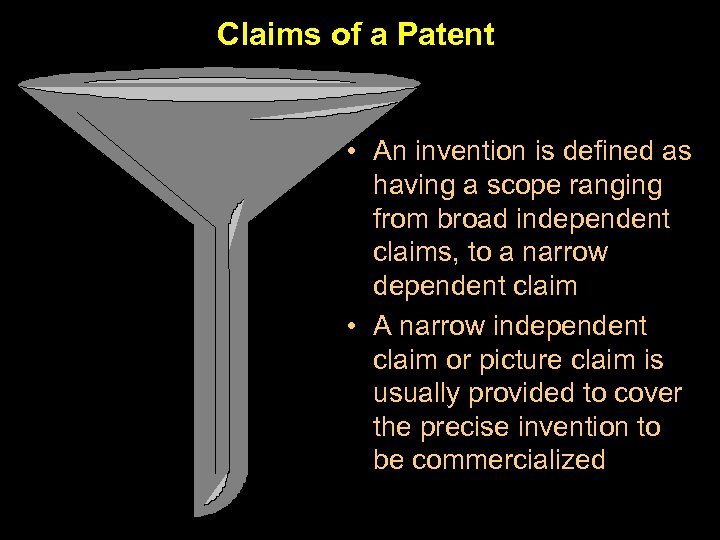 Claims of a Patent • An invention is defined as having a scope ranging from broad independent claims, to a narrow dependent claim • A narrow independent claim or picture claim is usually provided to cover the precise invention to be commercialized
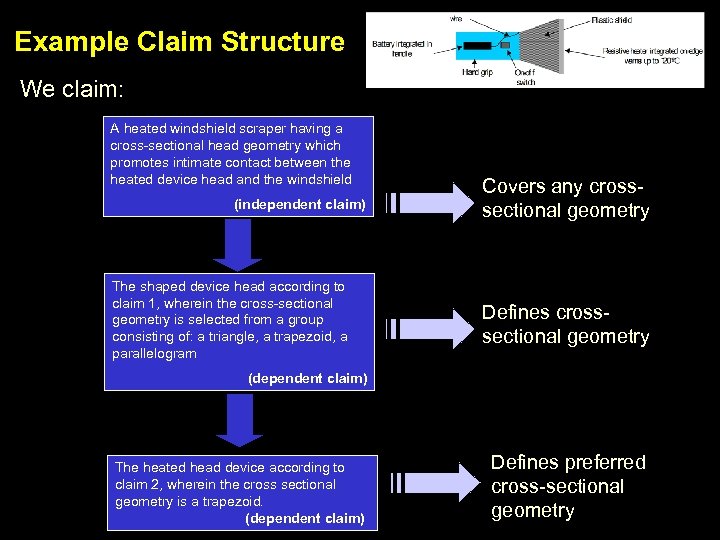 Example Claim Structure We claim: A heated windshield scraper having a cross-sectional head geometry which promotes intimate contact between the heated device head and the windshield (independent claim) The shaped device head according to claim 1, wherein the cross-sectional geometry is selected from a group consisting of: a triangle, a trapezoid, a parallelogram Covers any crosssectional geometry Defines crosssectional geometry (dependent claim) The heated head device according to claim 2, wherein the cross sectional geometry is a trapezoid. (dependent claim) Defines preferred cross-sectional geometry
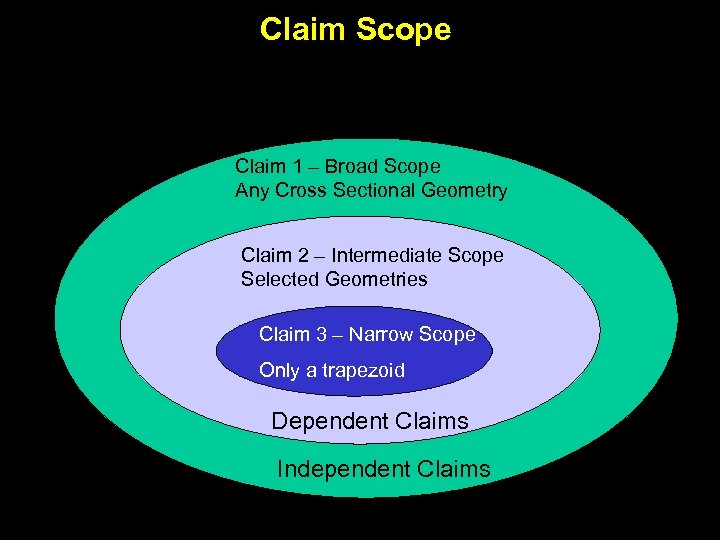 Claim Scope Claim 1 – Broad Scope Any Cross Sectional Geometry Claim 2 – Intermediate Scope Selected Geometries Claim 3 – Narrow Scope Only a trapezoid Dependent Claims Independent Claims
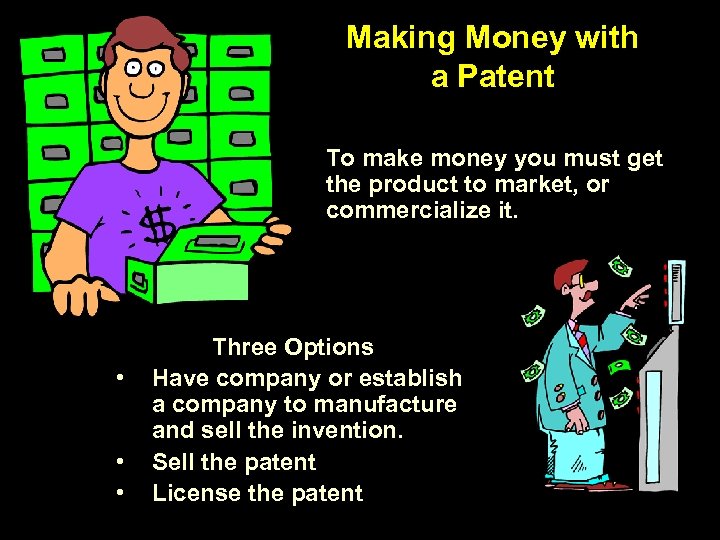 Making Money with a Patent To make money you must get the product to market, or commercialize it. • • • Three Options Have company or establish a company to manufacture and sell the invention. Sell the patent License the patent
 Manufacturing and Selling Inventions • Large corporations have infrastructure to do this, but for startups, or an individual inventor, wanting to start a business around a patent is risky. • If successful, the inventor has a higher likelihood of making more money by manufacturing and selling the product than he/she does otherwise. • Need to assess the novel features of the patent, making sure you will not infringe others, especially if you are a small company.
 Selling the Patent • Transfers the patent rights to a third party for an agreed upon sum of money (I. e. transfer of ownership) • Quickest way to make money • Within a company, employees assign the right of the patent to the company in exchange for salary • For an individual inventor, it is usually hard to get your food in the door at big companies if you are not known.
 Licensing a Patent • Main vehicle for technology transfer • A patent license is a contractual grant of permission to use a patented technology for a defined time, context, market line, or territory, in exchange for a royalty. • Basically an agreement that the licensor will not sue the licensee for patent infringement.
 Licensing a Patent • Usually involves an up-front fee and often an incremental royalty payment to the patent owner. • Instead of money, the royalty could be paid in equity • Typical royalty rates range from 0. 25% to 10% of the selling price.
 Exclusive / Non-Exclusive Licenses Exclusive – the patent owner (licensor) will not grant patent rights to anyone else Nonexclusive – the patent owner (licensor) grants patent rights to more than one entity to use the patented technology.
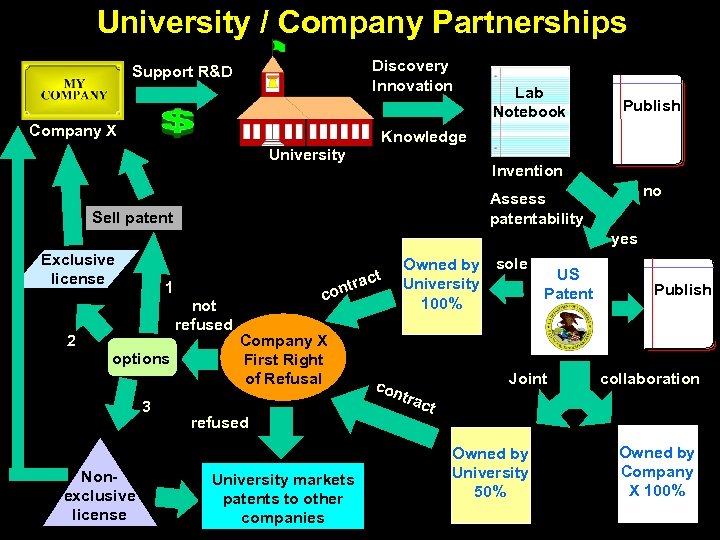 University / Company Partnerships Discovery Innovation Support R&D Company X Lab Notebook Publish Knowledge University Invention no Assess patentability Sell patent yes Exclusive license 1 not refused 2 options 3 Nonexclusive license Owned by sole University 100% t trac con Company X First Right of Refusal refused University markets patents to other companies con US Patent trac Joint Publish collaboration t Owned by University 50% Owned by Company X 100%
 Infringement of your Patent • If company X is practicing your patent, what will happen Absolutely nothing. • The PTO plays no role in infringement. The owner assumes the full burden to stop it. Options? • Ask infringer to stop and pay compensation for past infringement. • Ask infringer to pay compensation for past infringement and a royalty for future activity. Ask infringer to purchase patent. • If you are a manufacturer, and the infringer has patent of interest to you – exchange / cross license the patent. • Sue infringer in court.
 Infringement: Federal Circuit • Patent infringement suits are expensive ($millions) • and time consuming (1 -10 years) • Litigation favors wealthy / large companies.
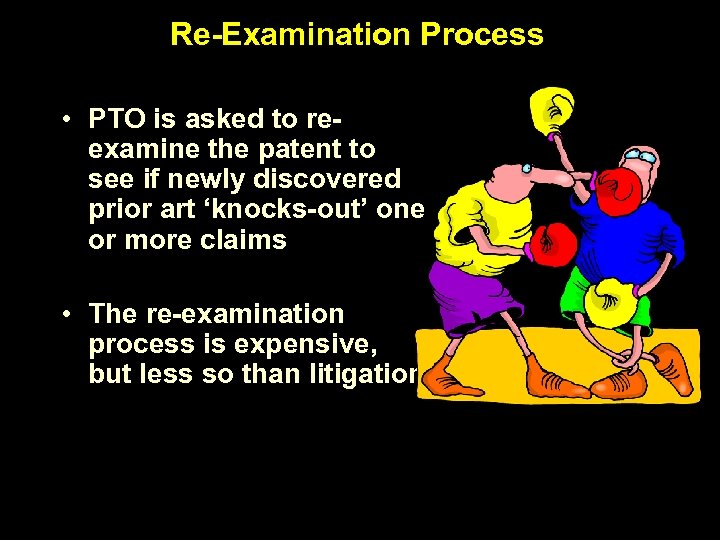 Re-Examination Process • PTO is asked to reexamine the patent to see if newly discovered prior art ‘knocks-out’ one or more claims • The re-examination process is expensive, but less so than litigation.
 Jury Trials • Juries love patent holders and award very large damages in patent infringement cases • Usually award more than a judge would
 Arbitration • Option, instead of a lawsuit • Both parties agree on an arbitrator • Arbitrator is usually a patent attorney or retired judge
 How Patent Rights are Forfeited PTO retroactively declares patents invalid: -Relevant prior art that wasn’t discovered -Public use or sale of invention prior to date of patent application -Misuse of the patent by its owner -Fraud on the PTO committed by inventor, failure to disclose relevant facts about invention or prior art
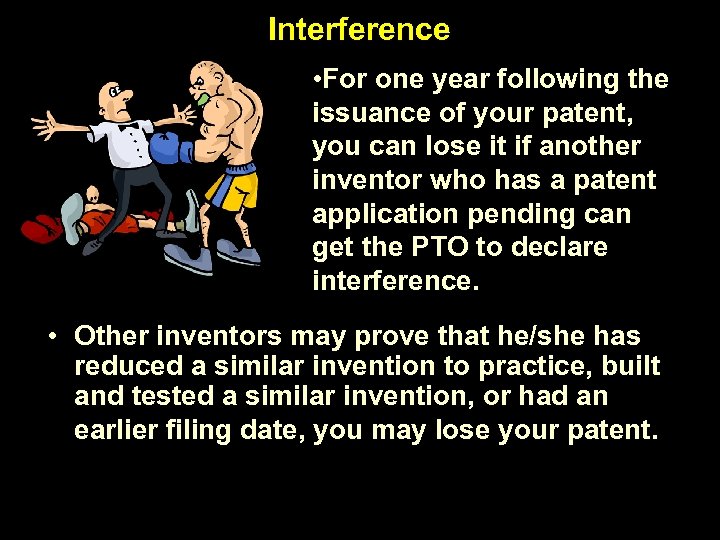 Interference • For one year following the issuance of your patent, you can lose it if another inventor who has a patent application pending can get the PTO to declare interference. • Other inventors may prove that he/she has reduced a similar invention to practice, built and tested a similar invention, or had an earlier filing date, you may lose your patent.
 Patent Litigation Financing • You can obtain insurance on your patent in case it goes to litigation. – Bolton / RGV Insurance Brokers – Lloyds of London
 Trade Secret NO CLEARCUT DEFINITION Information that has commercial value and that has been scrupulously kept confidential will be considered a trade secret-the owner of the information will be entitled to court action against those who have stolen or divulge it in violation of a duty of trust or a written non-disclosure agreement.
 Trade Secret A trade secret may consist of any formula, pattern, physical device, idea, process, compilation of information or other information or both: • Provides the owner of the information a competitive advantage in the market place. • Is treated in a way that can reasonably be expected to prevent the public and competitors from learning about it, absent improper acquisition of theft. Examples of Trade Secrets: Customer List, marketing information, chemical formulas, cosmetic formula, food formulas, magic tricks, manufacturing process. These all have one thing in common-they can make money for their owners if kept secret from competitors.
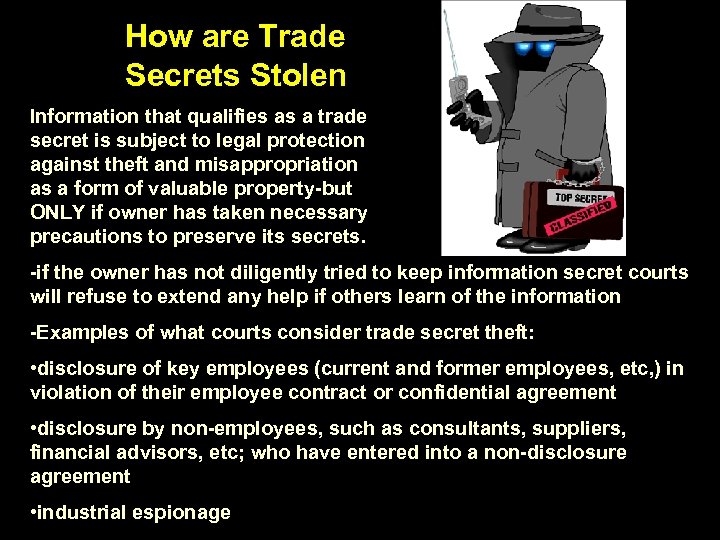 How are Trade Secrets Stolen Information that qualifies as a trade secret is subject to legal protection against theft and misappropriation as a form of valuable property-but ONLY if owner has taken necessary precautions to preserve its secrets. -if the owner has not diligently tried to keep information secret courts will refuse to extend any help if others learn of the information -Examples of what courts consider trade secret theft: • disclosure of key employees (current and former employees, etc, ) in violation of their employee contract or confidential agreement • disclosure by non-employees, such as consultants, suppliers, financial advisors, etc; who have entered into a non-disclosure agreement • industrial espionage
 Can Trade Secrets be Sold ? -Just like any other property, such as goods, accounts, receivables, and intellectual property, patents, copyrights, trademarks, trade secrets may be sold. -most of the time, trade secret sales occur as part of a sale of the entire business unit owning the trade secret.
 How is Trade Secret Protection Enforced ? -If court finds that a trade secret violation or theft has occurred, it may issue an order (injunction) requiring those wrongfully in possession of refrain from using it or disclosing it to others. -The court can also award trade secret owner money damages to compensate losses suffered as a result of theft. -For willful and deliberate theft, the court may also award punitive damages. -If they violate federal and state criminal anti-theft laws, the court may subject the thief to a criminal prosecution.
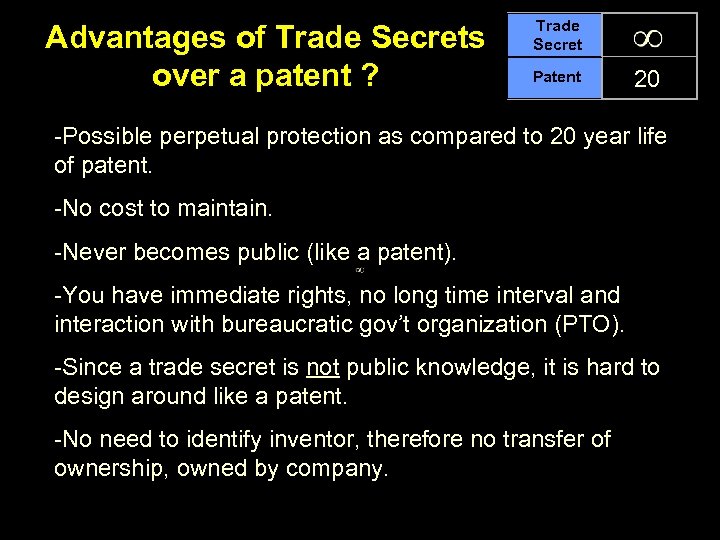 Advantages of Trade Secrets over a patent ? Trade Secret Patent 20 -Possible perpetual protection as compared to 20 year life of patent. -No cost to maintain. -Never becomes public (like a patent). -You have immediate rights, no long time interval and interaction with bureaucratic gov’t organization (PTO). -Since a trade secret is not public knowledge, it is hard to design around like a patent. -No need to identify inventor, therefore no transfer of ownership, owned by company.
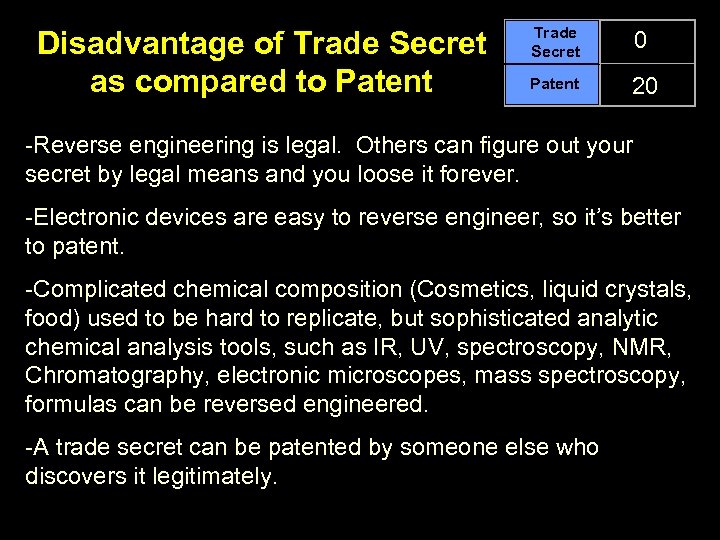 Disadvantage of Trade Secret as compared to Patent Trade Secret 0 Patent 20 -Reverse engineering is legal. Others can figure out your secret by legal means and you loose it forever. -Electronic devices are easy to reverse engineer, so it’s better to patent. -Complicated chemical composition (Cosmetics, liquid crystals, food) used to be hard to replicate, but sophisticated analytic chemical analysis tools, such as IR, UV, spectroscopy, NMR, Chromatography, electronic microscopes, mass spectroscopy, formulas can be reversed engineered. -A trade secret can be patented by someone else who discovers it legitimately.
 Acquiring and Maintaining Trade Secrets -No government or bureaucratic paper work involved -Take reasonable precautions to keep it secret and out of the public domain. -Keep well documented notes and descriptive documents on file. -IP attorney can be involved (not necessary) to prepare documentation.
 Unfair Competition -Unfair competition practices exist when one company represents its goods (packaging, marketing, etc. ) in such a way that it causes confusion with a goods and services offered by another company. -Covers advertising, symbols packaging, slogans, business names, and titles. -Court can issue injection to stop a business engaged in unfair competition practices and ward compensation is the form of money to the injured business.
 What is a C pyright? -A copyright gives the owner of a creative work the right to keep others from using the work without the owners permission. -Understand difference between idea and expression of idea. -Copyright applies to an expression, not the underlying ideas and facts underlying the expression. E. g. songs, novel, and computer games.
 Definition of Creative Work -Creative work, or work of authorship must satisfy three criteria to be protected by copyright law: 1. Must be original-author created it rather than copied it. 2. Must be fixed in a tangible (concrete) medium. (paper, tape, audio, video, computer disk. 3. It must have at least some creativity-produced by human intellect, (No rule of thumb here with how much is enough).
 How is a C pyright Created? -A creative work is protected by copyright once the work assumes tangible form. -Do not need to use or register with the US copyright office to obtain protection.
 Enforcing a Copyright Enhancing your success of a copyright -Place or published work. e. g. If your work is identified by then those who violate your work do it deliberatelyeasier to recover damages in court. -Register works with US copyright office-Only costs $20, and a timely registration (with 3 months of creation, creates a legal presumption that copyright is valid.
 Who owns a Copyright? -Copyrights are owned by writers, poets, musicians, composers, artists, software designers, photographers, movie producers, all called authors Except: • Work made by hire, you are an employee of a company or a consultant or contract worker for a company. As a condition of employment, you probably is away your rights to the company. • The author sells the copyright.
 Can a Copyright be transferred? A copyright is composed of general subrights: 1. reproduce the work 2. display or perform the work 3. distribute the work 4. prepare derivative works When the owner of the copyright wished to exploit the work commercially, the owner typically transfers one or more of these rights to the publisher.
 How Long Does Copyright Protection Last? Copyright Extension Act 1998: • Life of Author plus 70 years. • After copyright expires, the work goes in the public domain and becomes available for anyone to use.
 Copyright Infringement -The owner has the right to file a lawsuit in Federal court asking the federal court to: 1. issue order to prevent further violations. 2. award money damages. 3. award attorney fees in some cases. -Common legal defenses. 1. too much time has elapsed (the statue of limitations). 2. fair use defense (e. g. education research, scholarship, criticism, journalism. 3. infringement was innocent (infringer didn’t know). 4. work was independently created not copied. 5. owner authorized use.
 Copyright Protection Abroad Berne Convention -Under this treaty, all member countries must afford copyright protection to authors who are nationals of member countries.
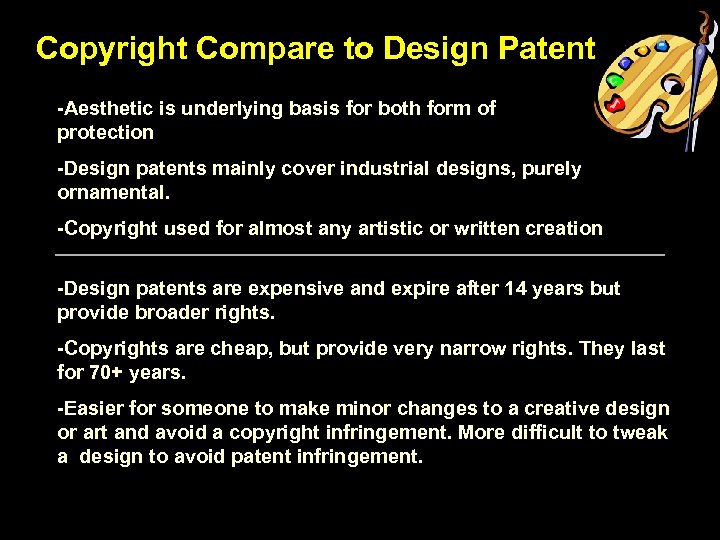 Copyright Compare to Design Patent -Aesthetic is underlying basis for both form of protection -Design patents mainly cover industrial designs, purely ornamental. -Copyright used for almost any artistic or written creation -Design patents are expensive and expire after 14 years but provide broader rights. -Copyrights are cheap, but provide very narrow rights. They last for 70+ years. -Easier for someone to make minor changes to a creative design or art and avoid a copyright infringement. More difficult to tweak a design to avoid patent infringement.
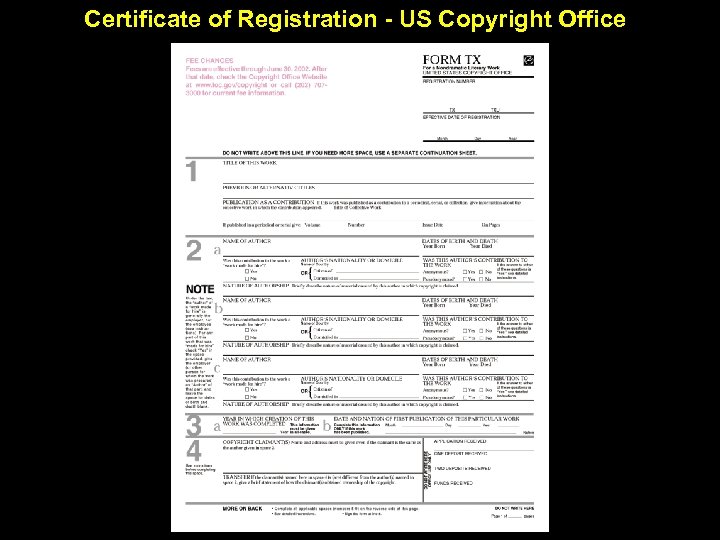 Certificate of Registration - US Copyright Office
 ™ Trademark Law Trademark law consists of legal rules that govern how business may: • Identify their products or services in the marketplace to prevent consumer confusion • Protect the means they have chosen to identify their products or services against use by competitors.
 ™ What are Trademarks? • A trademark is a distinctive word, phrase, logo, graphic, or symbol that is used to identify the source of a product or service and to distinguish a manufacturer’s product from anyone else. • In the trademark context, ‘distinctive’ means unique enough to reasonably serve as an identifier of a product in the market place. • A trademark can be more than a brand name or logo, it can include other non-functional but distinctive aspects of a product or service that tends to promote and distinguish it in the market, such as shops, letters, numbers, sounds, smells, or color. • Examples: Ford cars, IBM Computers, Microsoft Software.
 Examples of Trademarks ™
 Service Marks • A service mark is essentially a trademark, except that it promotes a service. ACLU
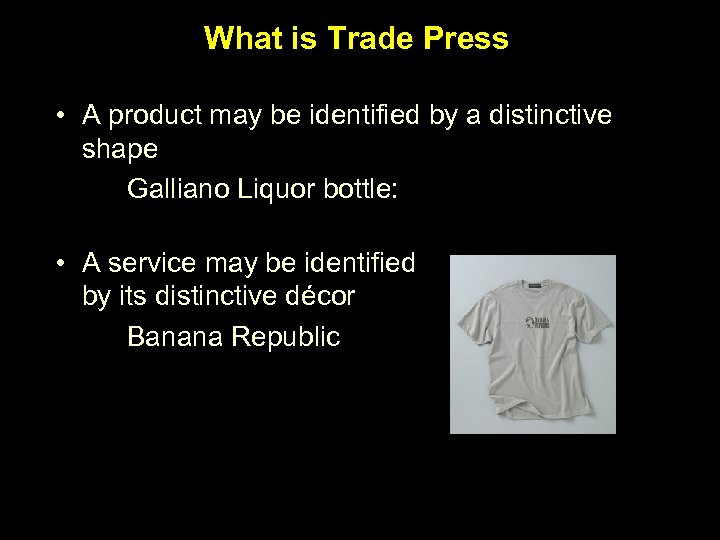 What is Trade Press • A product may be identified by a distinctive shape Galliano Liquor bottle: • A service may be identified by its distinctive décor Banana Republic
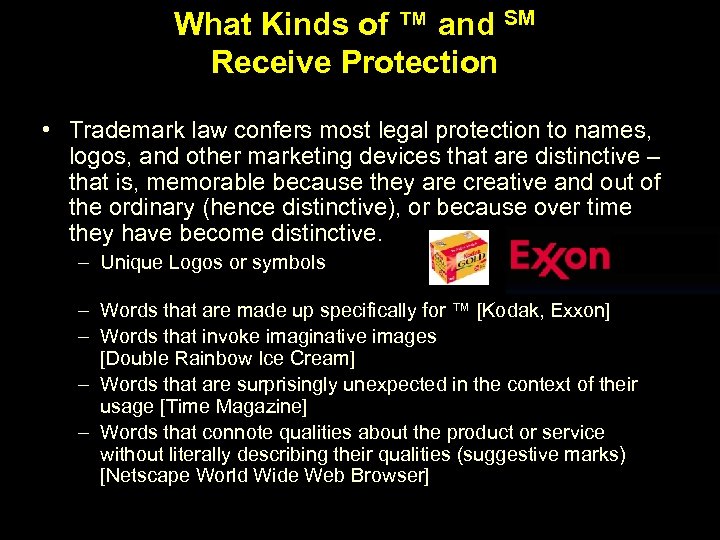 What Kinds of ™ and SM Receive Protection • Trademark law confers most legal protection to names, logos, and other marketing devices that are distinctive – that is, memorable because they are creative and out of the ordinary (hence distinctive), or because over time they have become distinctive. – Unique Logos or symbols – Words that are made up specifically for ™ [Kodak, Exxon] – Words that invoke imaginative images [Double Rainbow Ice Cream] – Words that are surprisingly unexpected in the context of their usage [Time Magazine] – Words that connote qualities about the product or service without literally describing their qualities (suggestive marks) [Netscape World Wide Web Browser]
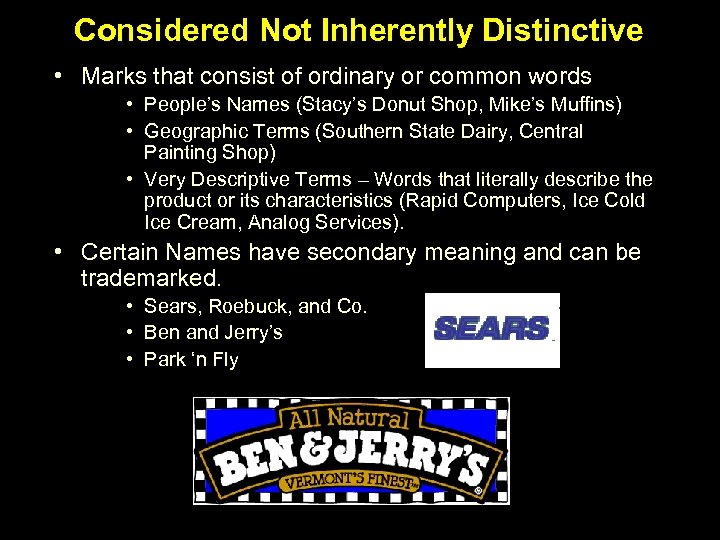 Considered Not Inherently Distinctive • Marks that consist of ordinary or common words • People’s Names (Stacy’s Donut Shop, Mike’s Muffins) • Geographic Terms (Southern State Dairy, Central Painting Shop) • Very Descriptive Terms – Words that literally describe the product or its characteristics (Rapid Computers, Ice Cold Ice Cream, Analog Services). • Certain Names have secondary meaning and can be trademarked. • Sears, Roebuck, and Co. • Ben and Jerry’s • Park ‘n Fly
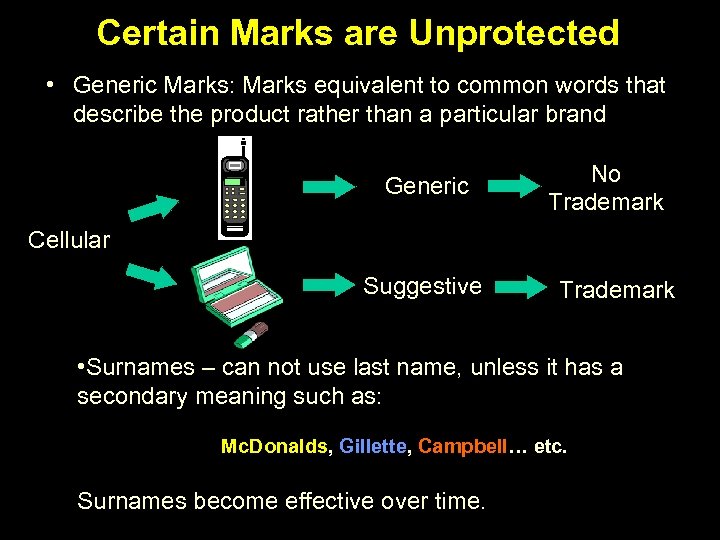 Certain Marks are Unprotected • Generic Marks: Marks equivalent to common words that describe the product rather than a particular brand Generic No Trademark Cellular Suggestive Trademark • Surnames – can not use last name, unless it has a secondary meaning such as: Mc. Donalds, Gillette, Campbell… etc. Surnames become effective over time.
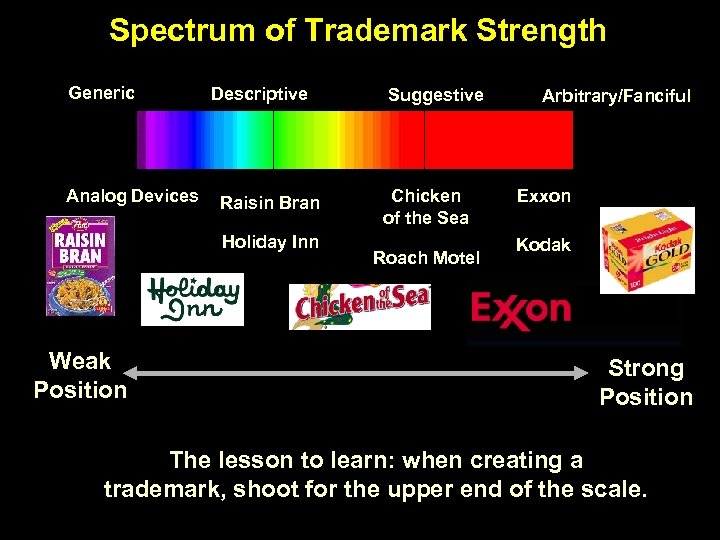 Spectrum of Trademark Strength Generic Analog Devices Descriptive Raisin Bran Holiday Inn Weak Position Suggestive Chicken of the Sea Roach Motel Arbitrary/Fanciful Exxon Kodak Strong Position The lesson to learn: when creating a trademark, shoot for the upper end of the scale.
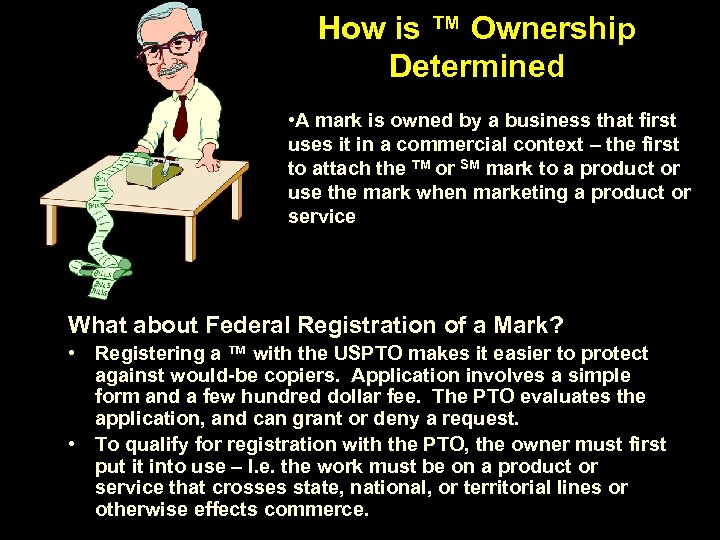 How is ™ Ownership Determined • A mark is owned by a business that first uses it in a commercial context – the first to attach the TM or SM mark to a product or use the mark when marketing a product or service What about Federal Registration of a Mark? • Registering a ™ with the USPTO makes it easier to protect against would-be copiers. Application involves a simple form and a few hundred dollar fee. The PTO evaluates the application, and can grant or deny a request. • To qualify for registration with the PTO, the owner must first put it into use – I. e. the work must be on a product or service that crosses state, national, or territorial lines or otherwise effects commerce.
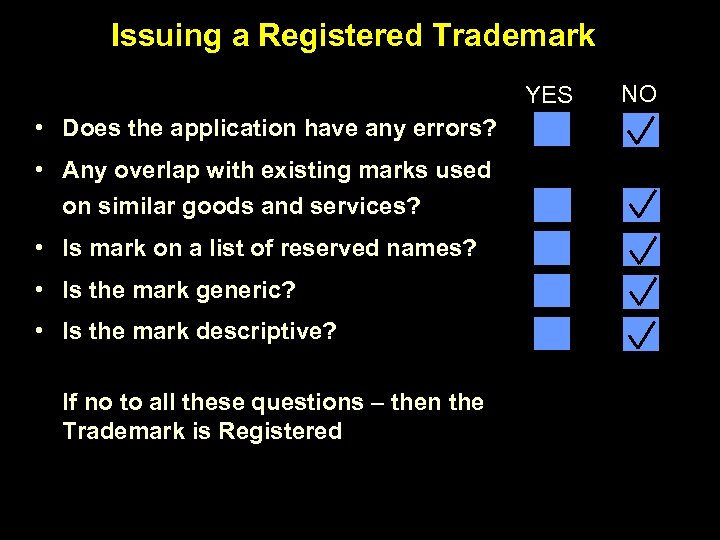 Issuing a Registered Trademark YES • Does the application have any errors? • Any overlap with existing marks used on similar goods and services? • Is mark on a list of reserved names? • Is the mark generic? • Is the mark descriptive? If no to all these questions – then the Trademark is Registered NO
 Notice to Public • Put TM or SM next to your mark to let the world know that you are claiming ownership. • No legal necessity for using it, but the use of TM and SM is an act to confer ownership • ® only if registered with the USPTO.
 Enforcing Ownership of Trademarks • Whether or not your trademark is federally registered, its owner may go to court to prevent someone else from using it or a confusingly similar mark. • Courts consider: – Is the trademark being used on competing goods or services? – Will consumers be confused by the dual use mark? – Is it in the same part of the country?
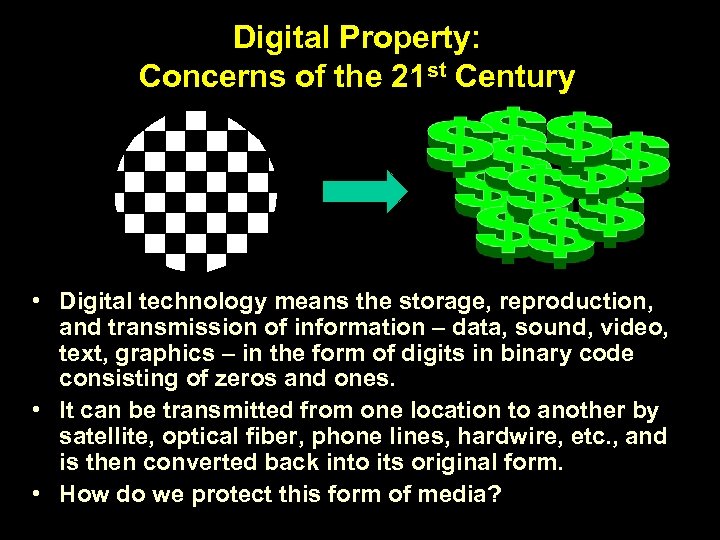 Digital Property: Concerns of the 21 st Century • Digital technology means the storage, reproduction, and transmission of information – data, sound, video, text, graphics – in the form of digits in binary code consisting of zeros and ones. • It can be transmitted from one location to another by satellite, optical fiber, phone lines, hardwire, etc. , and is then converted back into its original form. • How do we protect this form of media?
 New Media in the Digital Economy • Stuff that really didn’t exist ~ 10 years ago • • • CD-ROMs DVDs Websites (www. cnn. com) Electronic magazines Digital photographs Digital film • Fascinating Stuff, but can be really confusing in terms of IP.
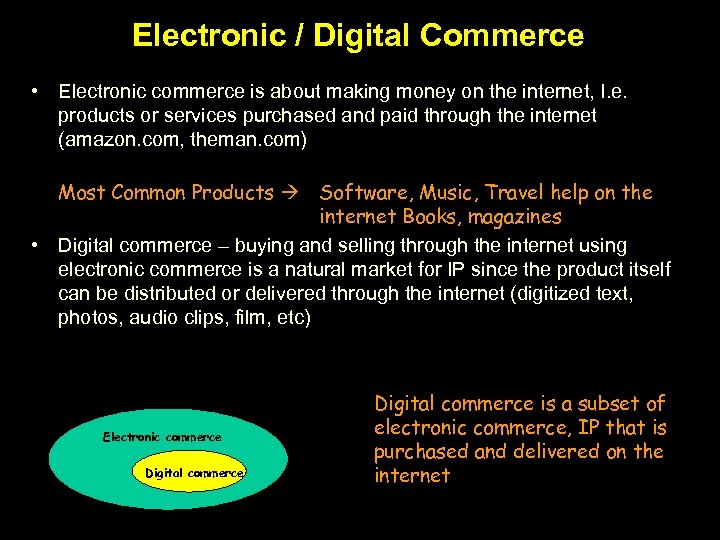 Electronic / Digital Commerce • Electronic commerce is about making money on the internet, I. e. products or services purchased and paid through the internet (amazon. com, theman. com) Most Common Products Software, Music, Travel help on the internet Books, magazines • Digital commerce – buying and selling through the internet using electronic commerce is a natural market for IP since the product itself can be distributed or delivered through the internet (digitized text, photos, audio clips, film, etc) Electronic commerce Digital commerce is a subset of electronic commerce, IP that is purchased and delivered on the internet
 Final Thoughts on IP • Like death and taxes, you will not be able to avoid IP in your life, especially now in the new millennium where digital and electronic commerce is so prevalent • Even if the legal profession is not in your future plans, you will need a firm understanding of IP since many of you will be entrepreneurs or work for high tech information companies. • You don’t have to like it, but you will need to deal with it. • If, to you, IP seems very FUZZY, it is, and will get more confusing during the growth of the information age.
 Let’s Play ARE THESE PATENTABLE?
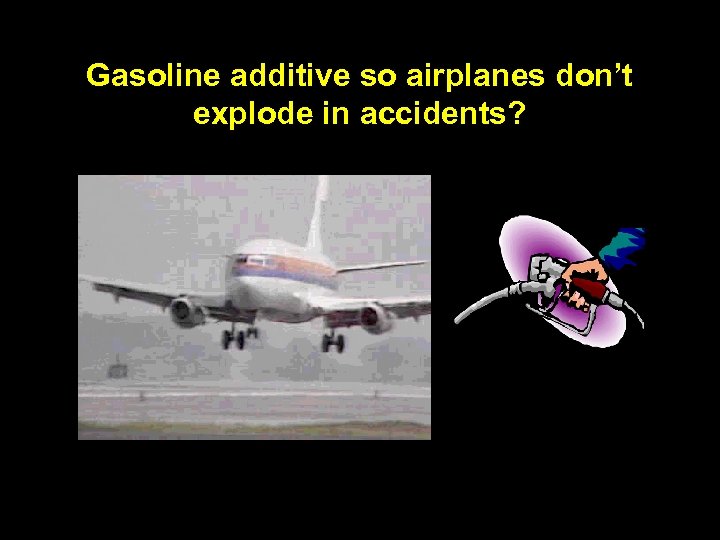 Gasoline additive so airplanes don’t explode in accidents?
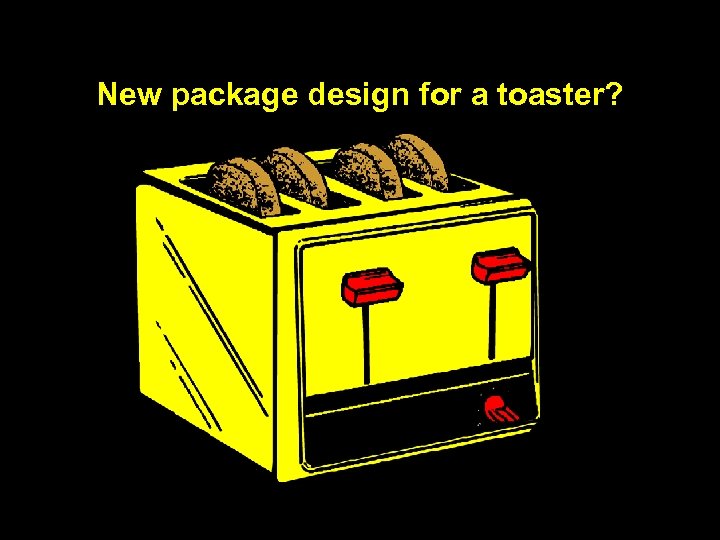 New package design for a toaster?
 A cure-all drug for AIDS and cancer?
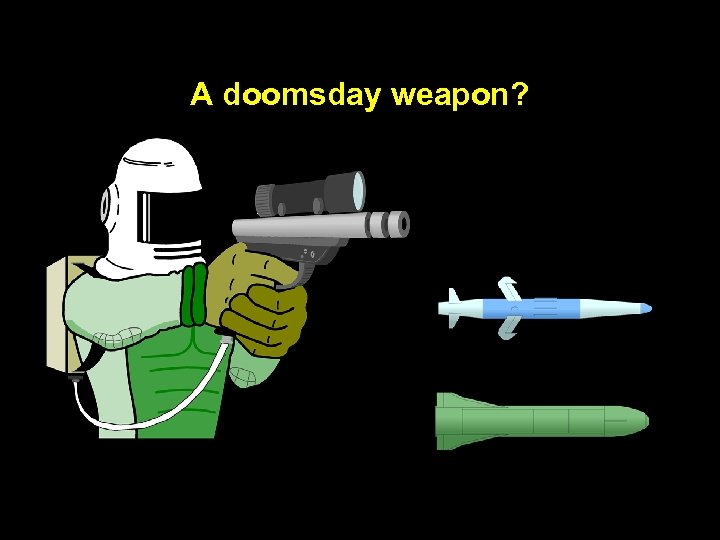 A doomsday weapon?
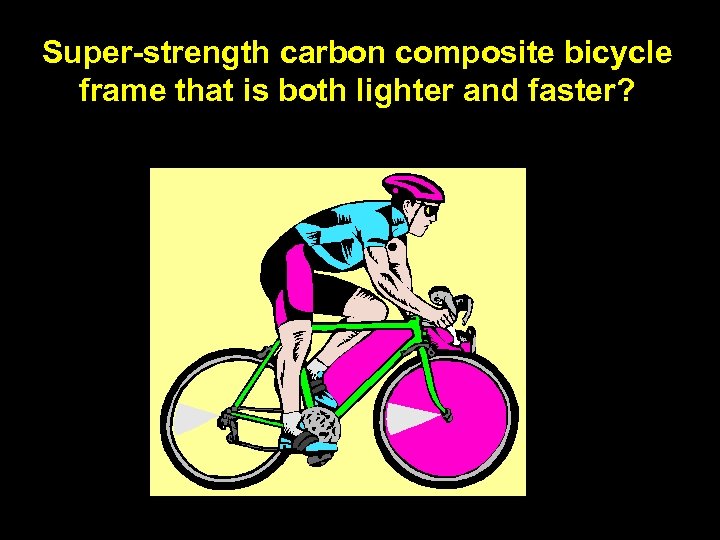 Super-strength carbon composite bicycle frame that is both lighter and faster?
 A new computer program?
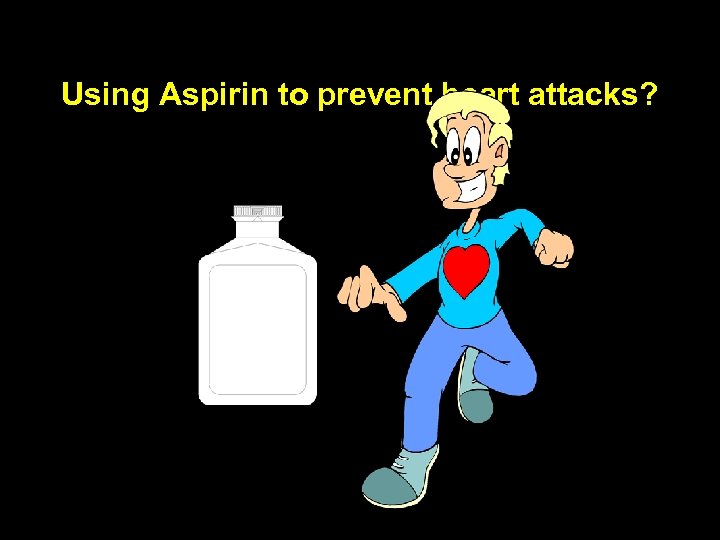 Using Aspirin to prevent heart attacks?
 An energy machine with greater than 100% efficiency?
 A shower head that turns off if the water temperature exceeds a set range of values?
 A universal key electronic device that allows you to open any automatic garage door?
 A way to prevent car accidents by sensor technology?
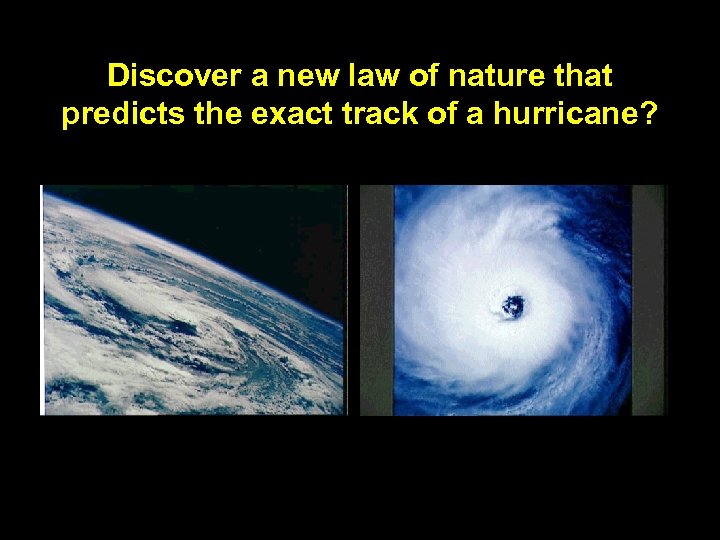 Discover a new law of nature that predicts the exact track of a hurricane?
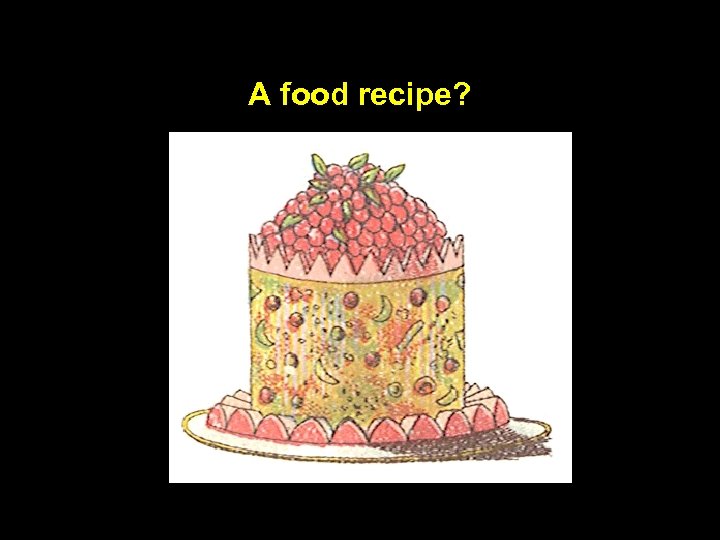 A food recipe?
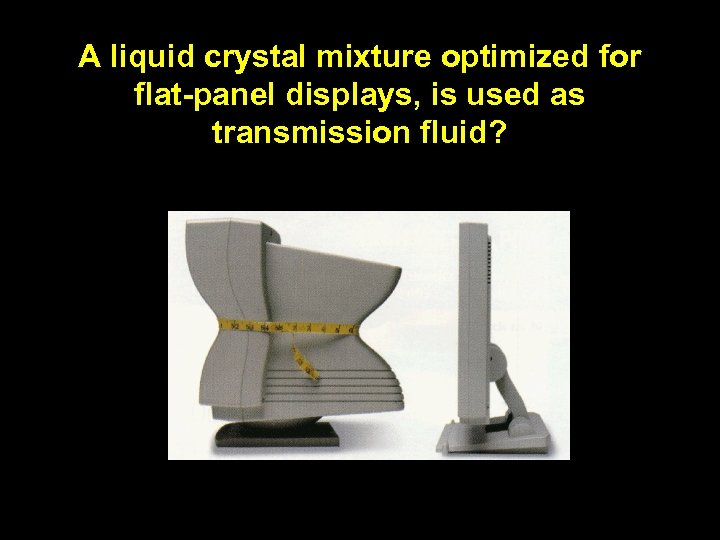 A liquid crystal mixture optimized for flat-panel displays, is used as transmission fluid?