


 Скачать презентацию STRUCTURE OF A LESSON Anna N Kondakova
Structure of a Lesson SS.pptx
- Количество слайдов: 30
 STRUCTURE OF A LESSON Anna N. Kondakova
 Aims of today’s session: Look at different lesson components Share ideas to start lessons effectively Discuss inductive and deductive teaching Explain rationales behind different types of practice activities • Self-study: Look at how different types of lessons are organized • •
 Finish these metaphors for lessons: v A good lesson is like a film because. . . v A good lesson is like a football match because. . . v A good lesson is like a meal because. . . v A good lesson is like a symphony because. . .
 • Every effective lesson plan should build toward the achievement of the objective and connect to long-term instructional goals • “I do, we do, you do” approach • Five Step Lesson Plan
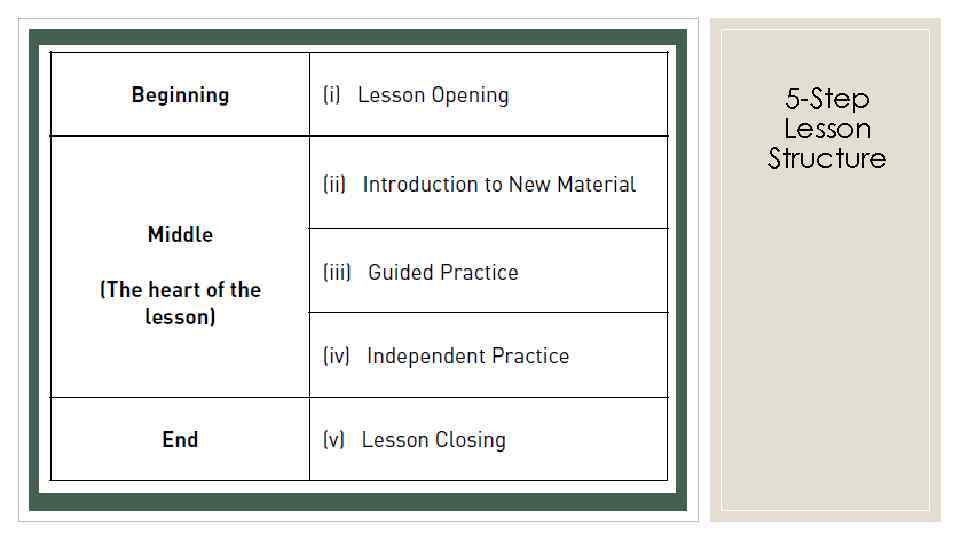 5 -Step Lesson Structure
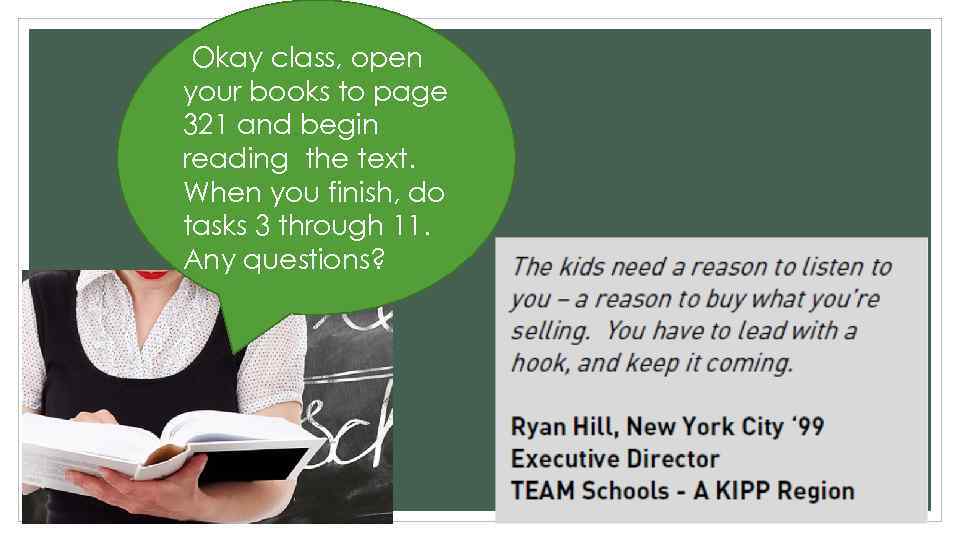 Okay class, open your books to page 321 and begin reading the text. When you finish, do tasks 3 through 11. Any questions?
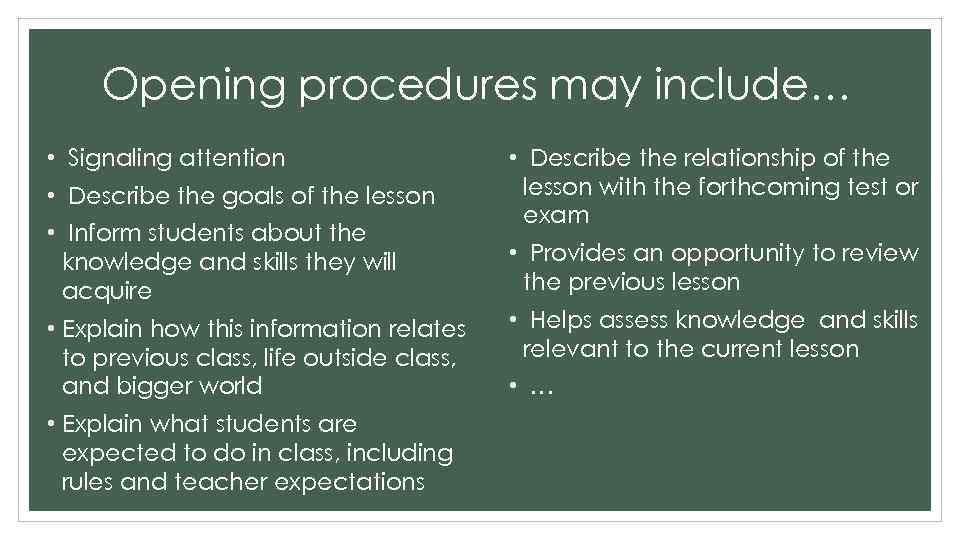 Opening procedures may include… • Signaling attention • Describe the goals of the lesson • Inform students about the knowledge and skills they will acquire • Explain how this information relates to previous class, life outside class, and bigger world • Explain what students are expected to do in class, including rules and teacher expectations • Describe the relationship of the lesson with the forthcoming test or exam • Provides an opportunity to review the previous lesson • Helps assess knowledge and skills relevant to the current lesson • …
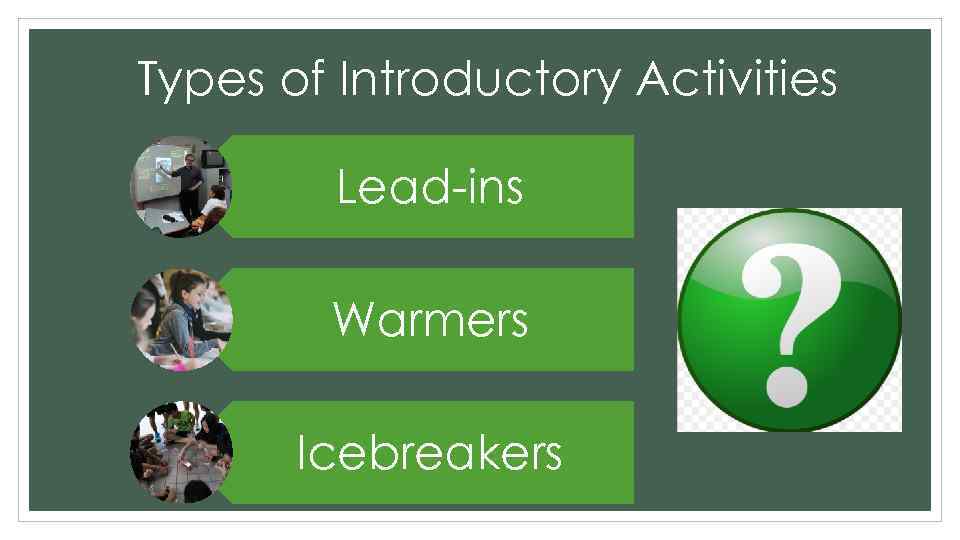 Types of Introductory Activities Lead-ins Warmers Icebreakers
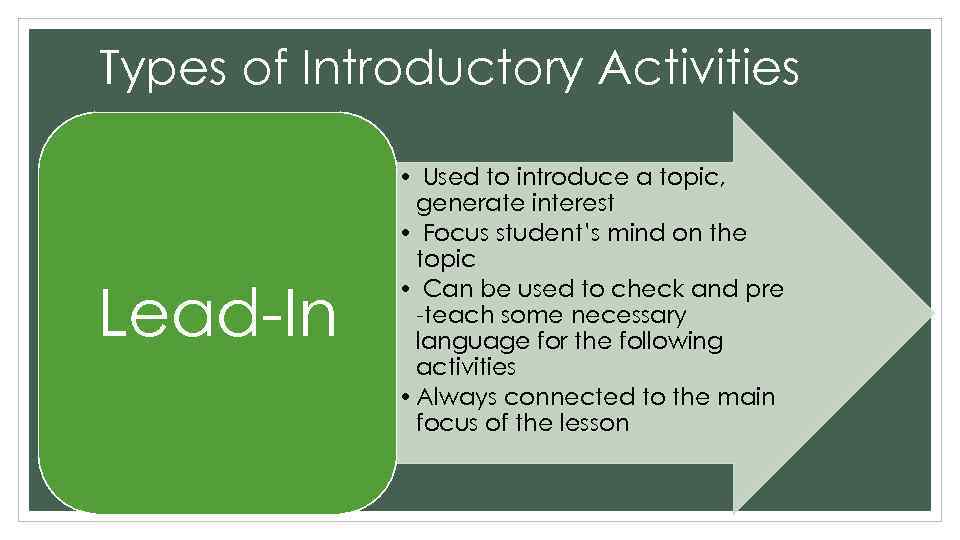 Types of Introductory Activities Lead-In • Used to introduce a topic, generate interest • Focus student’s mind on the topic • Can be used to check and pre -teach some necessary language for the following activities • Always connected to the main focus of the lesson
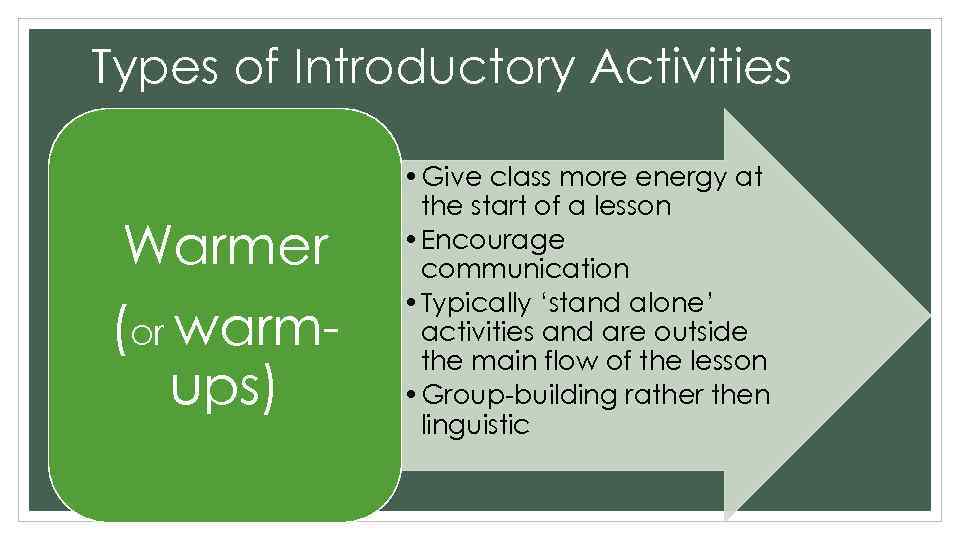 Types of Introductory Activities Warmer (or warmups) • Give class more energy at the start of a lesson • Encourage communication • Typically ‘stand alone’ activities and are outside the main flow of the lesson • Group-building rather then linguistic
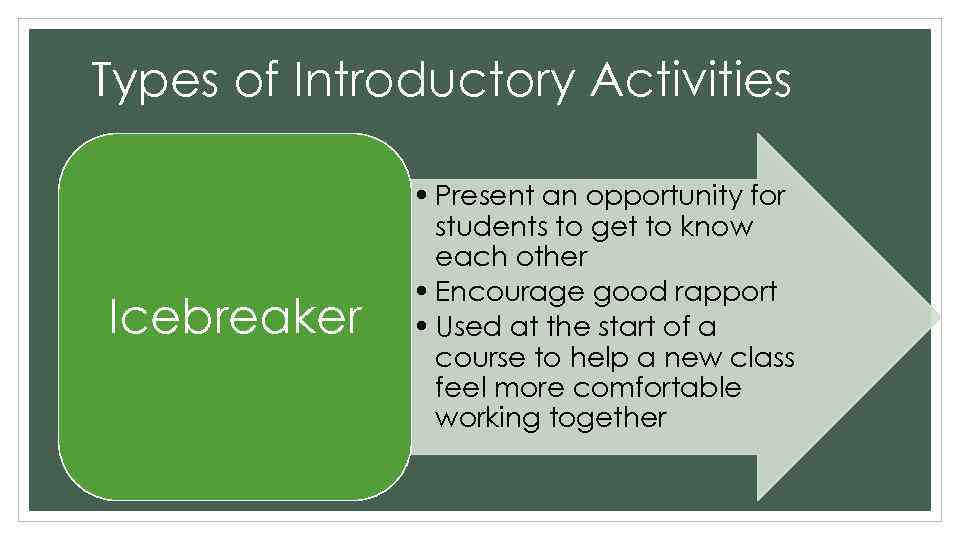 Types of Introductory Activities Icebreaker • Present an opportunity for students to get to know each other • Encourage good rapport • Used at the start of a course to help a new class feel more comfortable working together
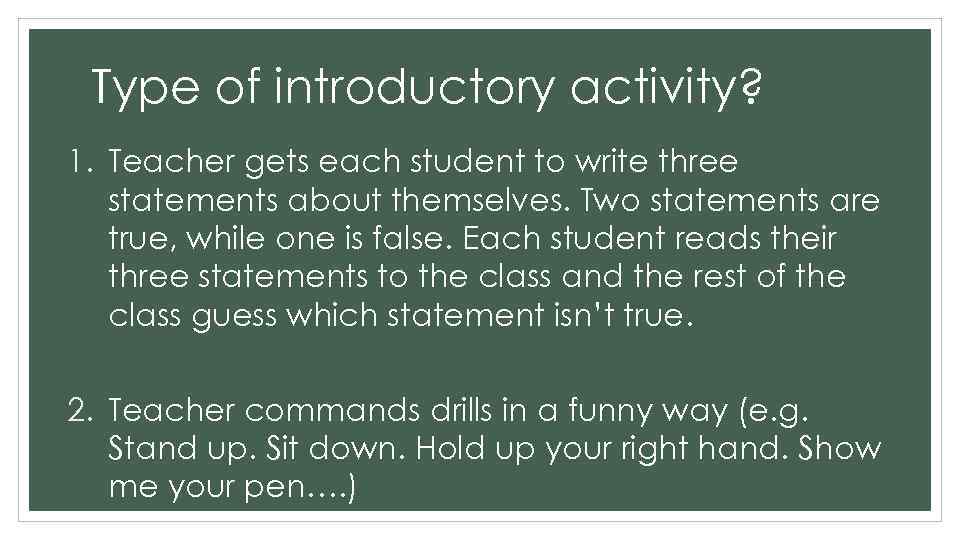 Type of introductory activity? 1. Teacher gets each student to write three statements about themselves. Two statements are true, while one is false. Each student reads their three statements to the class and the rest of the class guess which statement isn’t true. 2. Teacher commands drills in a funny way (e. g. Stand up. Sit down. Hold up your right hand. Show me your pen…. )
 3. Teacher puts a quote on the wall. The quote reads: “All you need is love. But a little chocolate now and then “doesn't hurt. ” Charles M. Schulz”. T asks the students how they feel about the quote (Do you agree or disagree with this statement? ) 4. Teacher writes a long word on the board (e. g. CONSTITUTION) and asks students to provide words using the letters of the word on the board.
 5. Each student divides the sheet into four squares. For each square, each person will describe themselves in the form of drawings. They could be asked to draw “favorite hobbies, ” “favorite place on earth for vacation, ” “if you were an animal, which one would you be? ” and “what are the most important things in your life? ” When everyone is finished drawing, T gathers them together to share the drawings as a group.
 6. The learners are going to read a text about computers in the lesson. The teacher asks them to change their seating and sit down in an order based on how much they use a computer. This requires them to move around and talk to each other. 7. Teacher gives out several strips with sentence parts from a text. Students have to put the sentences in the correct order individually, in pairs or small groups. After students assemble the scrambled sentences in order and there is a class consensus on the correct order, T ask students what they think the reading will be about.
 8. Teacher gives each learner a sheet with a series of 'Find someone who…' statements, e. g. 'Find someone who has a cat'. Learners circulate around the class and complete the statements with names. 9. Teacher puts a picture of a family on the board. She begins by stating, “What do you see, ” then asks a more specific question, such as “What problems do you see in this picture? ” “Why is this boy sad? ”
 THREE TEACHERS’ LESSON STARTS • What strategies of lesson opening do they use? • What works well? • What would you do differently?
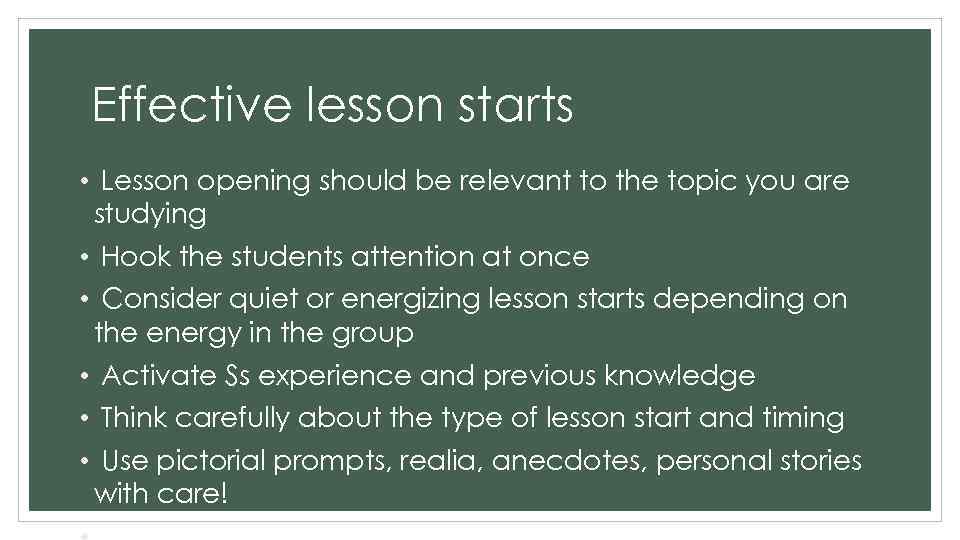 Effective lesson starts • Lesson opening should be relevant to the topic you are studying • Hook the students attention at once • Consider quiet or energizing lesson starts depending on the energy in the group • Activate Ss experience and previous knowledge • Think carefully about the type of lesson start and timing • Use pictorial prompts, realia, anecdotes, personal stories with care!
 INSTRUCTION
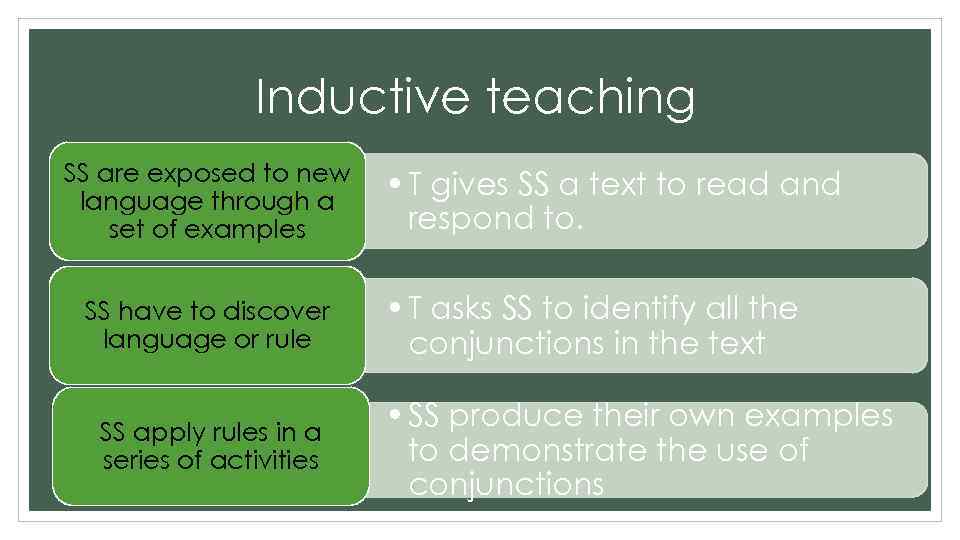 Inductive teaching SS are exposed to new language through a set of examples SS have to discover language or rule SS apply rules in a series of activities • T gives SS a text to read and respond to. • T asks SS to identify all the conjunctions in the text • SS produce their own examples to demonstrate the use of conjunctions
 Advantages of inductive teaching • • It is student-centered It is authentic It stimulates learner autonomy The action of discovery helps learners retain more information • It fosters communication in class • It responds better to SS needs and encourages use of various learning strategies and styles
 Any disadvantages? • Can require more class-time • SS may need to be introduced into such kind of teaching • May not be appropriate for all SS and especially administration
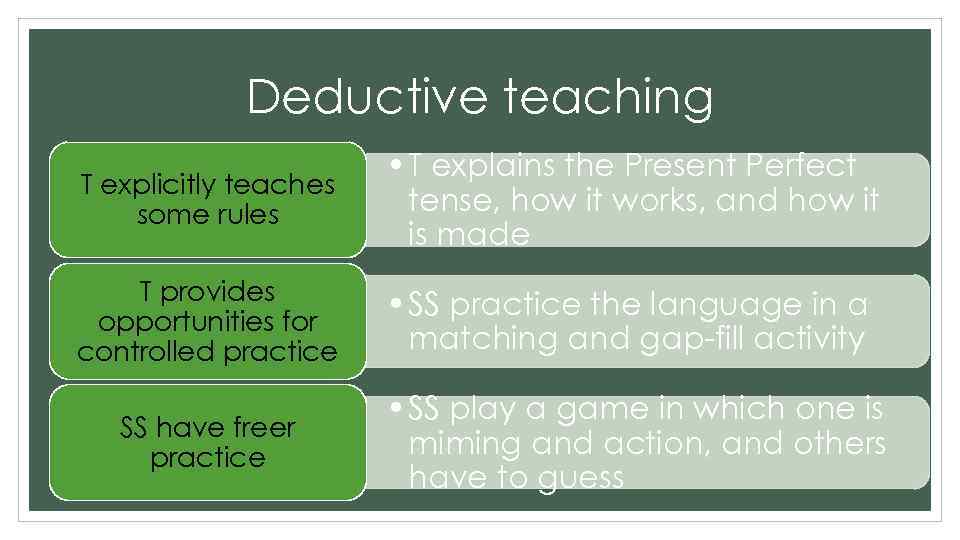 Deductive teaching T explicitly teaches some rules • T explains the Present Perfect tense, how it works, and how it is made T provides opportunities for controlled practice • SS practice the language in a matching and gap-fill activity SS have freer practice • SS play a game in which one is miming and action, and others have to guess
 Advantages of deductive teaching • It can meet student expectations • It is more ‘teacher-friendly’ (T controls the input) • A more efficient use of time • Complies with many coursebooks and syllabuses
 Any disadvantages? • It is teacher-centered • It does not provide room for learner autonomy • It can be boring
 Video • Watch two teachers presenting instruction to their learners. • Say which is an example of inductive and deductive teaching. • Watch Teacher 3 – what kind of approach is used?
 Types of lessons • • • Reading skills lessons Listening skills lessons Writing skills lessons Speaking skills lessons Grammar lessons
 Making reading communicative https: //www. teachingenglish. org. uk/article/makingreading-communicative A framework for planning a listening skills lesson at http: //www. teachingenglish. org. uk/comment/18920 Planning a writing lesson https: //www. teachingenglish. org. uk/article/planning -a-writing-lesson
 Planning a grammar lesson http: //www. teachingenglish. org. uk/article/planning -a-grammar-lesson Improving Adult English Language Learners' Speaking Skills http: //www. cal. org/caela/esl_resources/digests/Sp eak. html Stages of a speaking lesson https: //www. professorjackrichards. com/stagesspeaking-lesson/
 THANK YOU!