 Скачать презентацию Structure Governance Systems Baku Azerbaidjan November 10 —
968dd03e4ebf5a6d4bcb9e3b50280117.ppt
- Количество слайдов: 20



Structure, Governance, Systems Baku, Azerbaidjan, November 10 - 11, 2004 By: Pierre Giguère
Models of Institutional Structures Various models are found around the world. Two majors trends can be outlined. q The Atomized network model: Ø networks in which the units have relatively weak links and only share resources to a small extent Ø the accent is on the individual units, limiting integration to: representation, lobbying and public relations Ø When resources are shared, this is often bilateral without involvement of the Central.
q Atomized Networks Ø Agreements are made on short term basis Ø Each member may opt out at any time Ø Rules for affiliation and disaffiliation are lightly defined Ø Attention drawn towards the primary institution much more than on the Network Individualism and weak solidarity
Models of Institutional Structures (cont. ) q The federated network model Ø many components highly interrelated & equipped with apex organizations providing significant integration Ø sharing of resources is raised to a high level of partnership Ø the supervision of base units is highly integrated & thus, facilitated Delegation of Powers & Solidarity
Federated Networks v Decision making by all; decision taken become Mandatory for all v Delegation of power to the Central Entity v Clear division of power between the Central and the entities v Rules of Affiliation and disaffiliation are clear and stringent
What is preferable ? Why ? Research & Analyses have shown superiority of federated model: • economies of scale, • better control of complex procedures and markets; sharing of specialized HR • faster response to change, • improved business flexibility to markets, • control/investment in new technologies, • access to a variety of sources of capital and financing, • up-to-date expertise, • risk reduction through distribution • conquest of new markets • leaner internal structure for business.
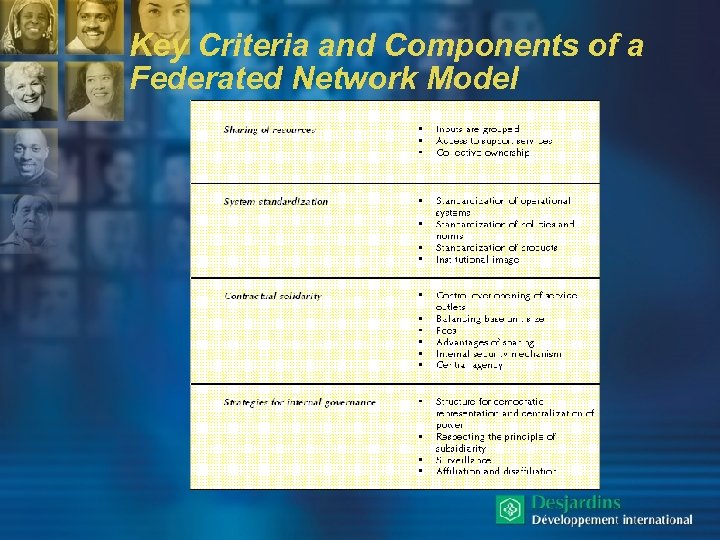
Key Criteria and Components of a Federated Network Model
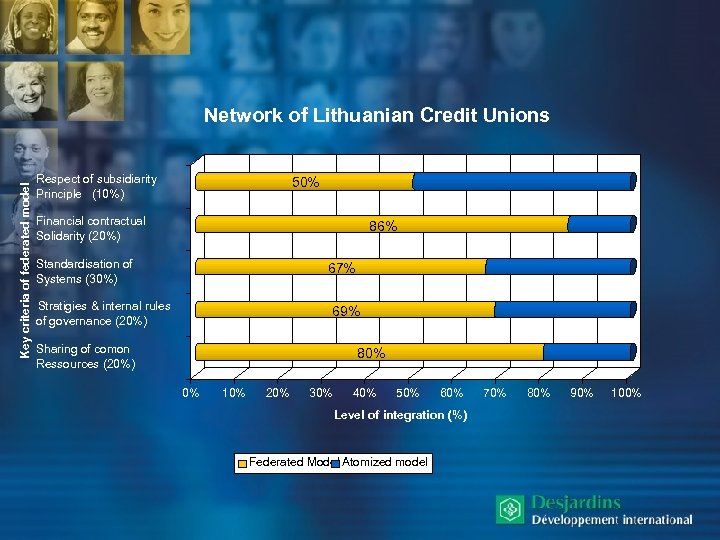
Key criteria of federated model Network of Lithuanian Credit Unions Respect of subsidiarity Principle (10%) 50% Financial contractual Solidarity (20%) 86% Standardisation of Systems (30%) 67% Stratigies & internal rules of governance (20%) 69% Sharing of comon Ressources (20%) 80% 0% 10% 20% 30% 40% 50% 60% Level of integration (%) Federated Model Atomized model 70% 80% 90% 100%
Why FI Coops in many countries are little federated ? v v v v Historical reasons Scandals, fraud, corruption Inadequate legal framework Asymetric membership Markets not competitive Members not demanding Weak leaders • At level of the authorities • At level of Coop Sector
SUPERVISON: Which approach to choose ? Gvt must exert its roles and authority : • define norms ; monitoring and quality control ; sanctions & penalties, up to loosing right to operate If one contemplates Auxiliary Model : CONDITIONS v Coops must be bound within a federation, with a good level of cohesion in their organisation v Being member of a group, they share identical quality norms, standards, systems; share cost of supervision, of corrective measures, ultimately, share cost of a Security Fund; this forces discipline from Peer Pressure. v Independence of the function
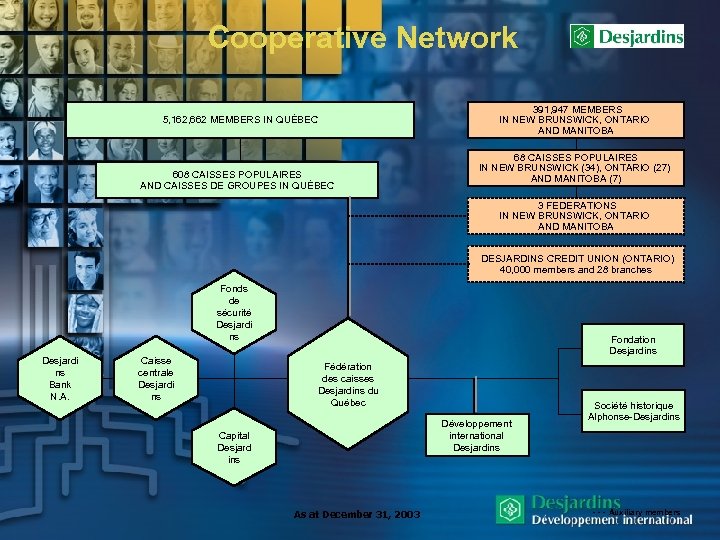
Cooperative Network 5, 162, 662 MEMBERS IN QUÉBEC 608 CAISSES POPULAIRES AND CAISSES DE GROUPES IN QUÉBEC 391, 947 MEMBERS IN NEW BRUNSWICK, ONTARIO AND MANITOBA 68 CAISSES POPULAIRES IN NEW BRUNSWICK (34), ONTARIO (27) AND MANITOBA (7) 3 FEDERATIONS IN NEW BRUNSWICK, ONTARIO AND MANITOBA DESJARDINS CREDIT UNION (ONTARIO) 40, 000 members and 28 branches Fonds de sécurité Desjardi ns Bank N. A. Caisse centrale Desjardi ns Fondation Desjardins Fédération des caisses Desjardins du Québec Développement international Desjardins Capital Desjard ins As at December 31, 2003 Société historique Alphonse-Desjardins - - - Auxiliary members
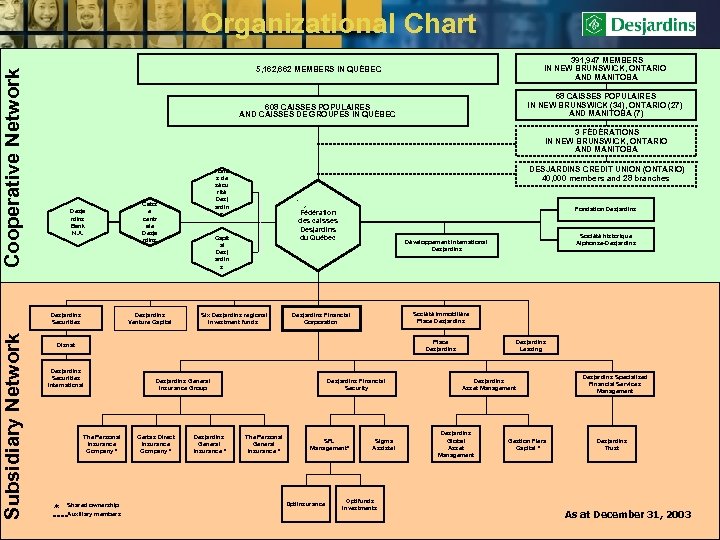
Organizational Chart Cooperative Network 68 CAISSES POPULAIRES IN NEW BRUNSWICK (34), ONTARIO (27) AND MANITOBA (7) 608 CAISSES POPULAIRES AND CAISSES DE GROUPES IN QUÉBEC 3 FÉDÉRATIONS IN NEW BRUNSWICK, ONTARIO AND MANITOBA Desja rdins Bank N. A. Desjardins Securities Subsidiary Network 391, 947 MEMBERS IN NEW BRUNSWICK, ONTARIO AND MANITOBA 5, 162, 662 MEMBERS IN QUÉBEC Caiss e centr ale Desja rdins Desjardins Venture Capital DESJARDINS CREDIT UNION (ONTARIO) 40, 000 members and 28 branches Fond s de sécu rité Desj ardin s Fondation Desjardins Fédération des caisses Desjardins du Québec Capit al Desj ardin s Six Desjardins regional investment funds Société immobilière Place Desjardins Financial Corporation Place Desjardins Disnat Desjardins Securities International The Personal Insurance Company * * Shared ownership Auxiliary members Desjardins General Insurance Group Certas Direct Insurance Company * Desjardins General Insurance * Desjardins Financial Security The Personal General Insurance * SFL Management* 0 ptiinsurance Société historique Alphonse-Desjardins Développement international Desjardins Sigma Assistel Optifunds Investments Desjardins Leasing Desjardins Asset Management Desjardins Global Asset Management Gestion Fiera Capital * Desjardins Specialized Financial Services Management Desjardins Trust As at December 31, 2003
Role of the Federation (Desjardins) v Ascertain that the Group carries out its Mission « …creating value for its ownersusers » v Guide, plan and coordinate all the Group operations v Strategic planning process; network’s Business Plan v Strategic communication policy v Systems definition, maintenance, upgrade and operation v Identify & manage main RISKS v Oversee and control: Internal Control & Supervision
Role of the Federation (Desjardins) v define & harmonize the Group’s rules and practices v marketing of trademark at national level v internal reporting system & integrity of control systems v a well applied follow up process after the Inspection report v Technical Assistance Unit which may help correct soft spot and detected weaknesses v transparency, benchmarking (strata)
Support services offered by the federation - Compensation Liquid funds mgement & matching Hum. resource mgt Training personnel and management Introducing new products Approving major loans Opening a service outlet Purchase of software, hardware - External audit Borrowing Investing Advertising & Promotion Modifying a policy Modifying /introducing a work tool Introducing a new system Modifying a standard
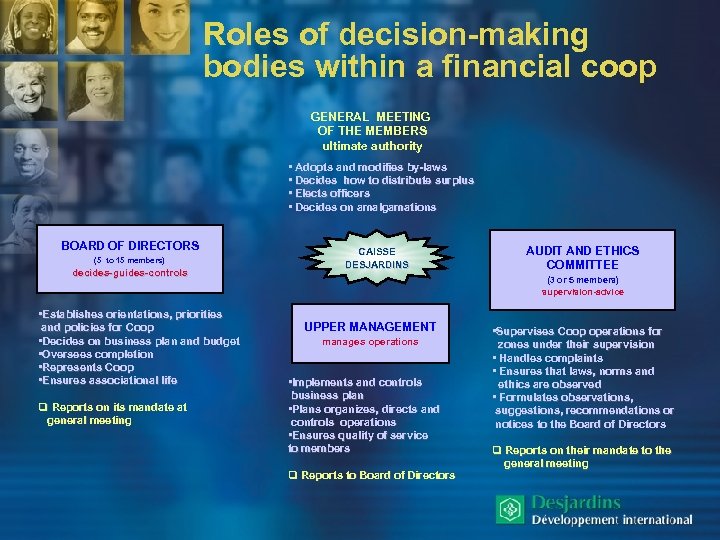
Roles of decision-making bodies within a financial coop GENERAL MEETING OF THE MEMBERS ultimate authority • Adopts and modifies by-laws • Decides how to distribute surplus • Elects officers • Decides on amalgamations BOARD OF DIRECTORS (5 to 15 members) decides-guides-controls • Establishes orientations, priorities and policies for Coop • Decides on business plan and budget • Oversees completion • Represents Coop • Ensures associational life q Reports on its mandate at general meeting CAISSE DESJARDINS AUDIT AND ETHICS COMMITTEE (3 or 5 members) supervision-advice UPPER MANAGEMENT manages operations • Implements and controls business plan • Plans organizes, directs and controls operations controls • Ensures quality of service to members q Reports to Board of Directors • Supervises Coop operations for zones under their supervision • Handles complaints • Ensures that laws, norms and ethics are observed • Formulates observations, suggestions, recommendations or notices to the Board of Directors q Reports on their mandate to the general meeting
7 key responsibilities for Board of Directors at Desjardins 1. 2. 3. 4. Ensure Coop mission & values are respected Strategic choices: Strategic planning; Strategic planning organizational structure; establish policies structure and ensure their application Performance management: Adopt annual business plan and budget; monitor its business plan and budget performance Monitor upper management: Set duties for and hire Director General; then monitor for and hire Director General performance by setting objectives, measuring achievement and setting salary
7 key responsibilities for Board of Directors at Desjardins 5. Relationship with members & community • Ensure member satisfaction • Encourage active associational life • Ensure commitment to community • Report to members on mandate. 6. Risk management: • Identify main risks and abatement strategies • 7. Ensure follow-up for Audit and Ethics and Surveillance Committees Internal operations • Set up process to assess board operations and self assessment procedure for board members
Key Management Systems (Desjardins) a. The Cooperative Identity: participation rate; products served by subsidiaries of the Group; patronage refund paid/ turnover b. Sales management: fidelity ratios; market share growth / product; business volume / member c. Financial results: gross margin; net margin; loan losses; RH costs; IT costs d. Risk management: credit risk & coverage ratio; NPA; loan concentration; interest rate risk; liquidity risk; capital risk; image risk e. Members satisfaction: customers satisfaction survey f. Performance of resources: productivity ratios per employee; % of automated transactions; profitabilty / product/ service / member

www. did. qc. ca
Скачать презентацию Structure Governance Systems Baku Azerbaidjan November 10 —
968dd03e4ebf5a6d4bcb9e3b50280117.ppt