 Скачать презентацию STRUCTURE DIPOLE MOMENTS POLARIZABILITIES AND MOLECULAR SPIN ORBIT
b3e9d78222ca883ad271a396f478b7b9.ppt
- Количество слайдов: 15



STRUCTURE, DIPOLE MOMENTS, POLARIZABILITIES, AND MOLECULAR SPIN ORBIT OF STRONG DIPOLAR ALKALI DIATOMICS Mireille Aymar, Olivier Dulieu Laboratoire Aimé Cotton, CNRS and Université d’Orsay, France Ph. D’s: Johannes Deiglmayr (U. Freiburg/ LAC Orsay), Andreas Gerdes (U. Hannover/ LAC Orsay), Sihem Azizi (U. Tlemcen) until 2005 Coll. with F. Spiegelman (Lab. de Physique et Chimie Quantiques , Toulouse) Other members of the group: N. Bouloufa, A. Crubellier, R. Osseni, M. Raoult COMOL HPRN-CT-2002 -00290 Interferences and Quantum Aplications International Symposium on Molecular Spectroscopy 62 nd Meeting - Columbus- June 18 -22, 2007 French-German University
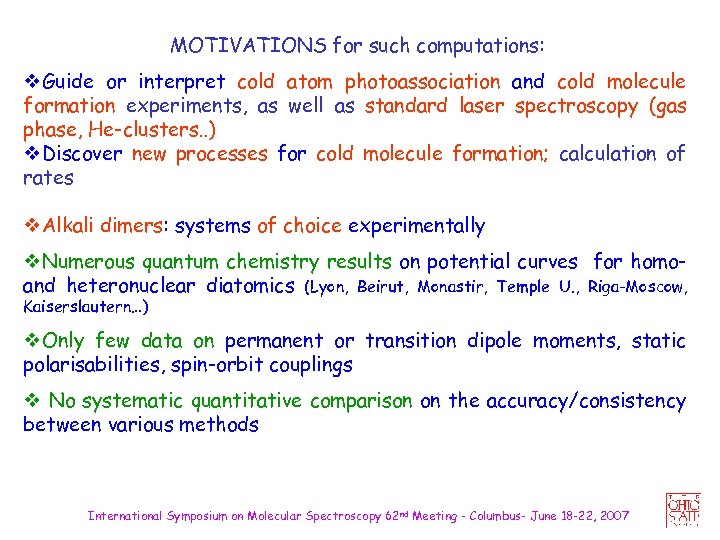
MOTIVATIONS for such computations: v. Guide or interpret cold atom photoassociation and cold molecule formation experiments, as well as standard laser spectroscopy (gas phase, He-clusters. . ) v. Discover new processes for cold molecule formation; calculation of rates v. Alkali dimers: systems of choice experimentally v. Numerous quantum chemistry results on potential curves for homoand heteronuclear diatomics (Lyon, Beirut, Monastir, Temple U. , Riga-Moscow, Kaiserslautern…) v. Only few data on permanent or transition dipole moments, static polarisabilities, spin-orbit couplings v No systematic quantitative comparison on the accuracy/consistency between various methods International Symposium on Molecular Spectroscopy 62 nd Meeting - Columbus- June 18 -22, 2007
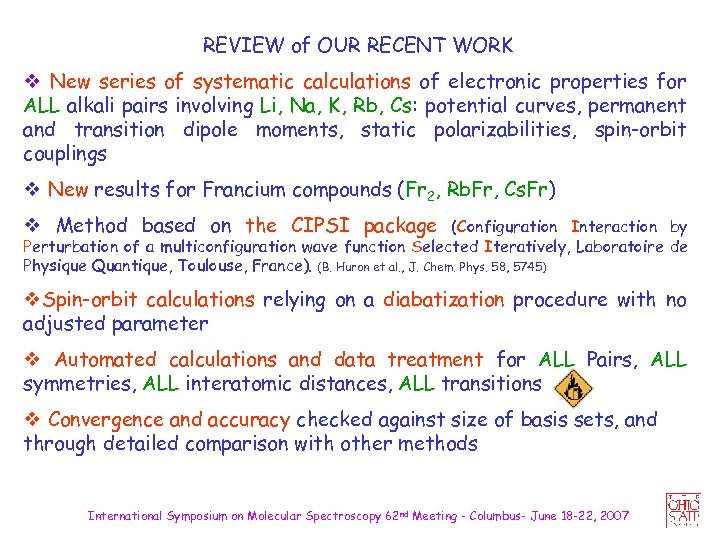
REVIEW of OUR RECENT WORK v New series of systematic calculations of electronic properties for ALL alkali pairs involving Li, Na, K, Rb, Cs: potential curves, permanent and transition dipole moments, static polarizabilities, spin-orbit couplings v New results for Francium compounds (Fr 2, Rb. Fr, Cs. Fr) v Method based on the CIPSI package (Configuration Interaction by Perturbation of a multiconfiguration wave function Selected Iteratively, Laboratoire de Physique Quantique, Toulouse, France). (B. Huron et al. , J. Chem. Phys. 58, 5745) v. Spin-orbit calculations relying on a diabatization procedure with no adjusted parameter v Automated calculations and data treatment for ALL Pairs, ALL symmetries, ALL interatomic distances, ALL transitions v Convergence and accuracy checked against size of basis sets, and through detailed comparison with other methods International Symposium on Molecular Spectroscopy 62 nd Meeting - Columbus- June 18 -22, 2007
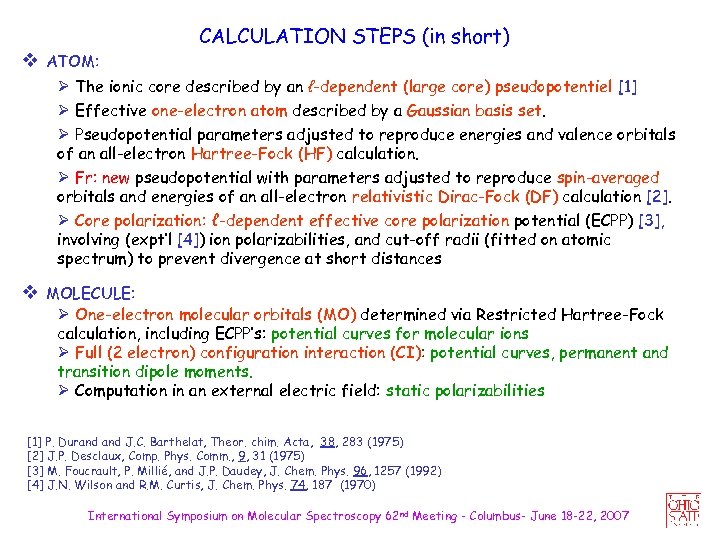
v ATOM: CALCULATION STEPS (in short) Ø The ionic core described by an ℓ-dependent (large core) pseudopotentiel [1] Ø Effective one-electron atom described by a Gaussian basis set. Ø Pseudopotential parameters adjusted to reproduce energies and valence orbitals of an all-electron Hartree-Fock (HF) calculation. Ø Fr: new pseudopotential with parameters adjusted to reproduce spin-averaged orbitals and energies of an all-electron relativistic Dirac-Fock (DF) calculation [2]. Ø Core polarization: ℓ-dependent effective core polarization potential (ECPP) [3], involving (expt’l [4]) ion polarizabilities, and cut-off radii (fitted on atomic spectrum) to prevent divergence at short distances v MOLECULE: Ø One-electron molecular orbitals (MO) determined via Restricted Hartree-Fock calculation, including ECPP’s: potential curves for molecular ions Ø Full (2 electron) configuration interaction (CI): potential curves, permanent and transition dipole moments. Ø Computation in an external electric field: static polarizabilities [1] P. Durand J. C. Barthelat, Theor. chim. Acta, 38, 283 (1975) [2] J. P. Desclaux, Comp. Phys. Comm. , 9, 31 (1975) [3] M. Foucrault, P. Millié, and J. P. Daudey, J. Chem. Phys. 96, 1257 (1992) [4] J. N. Wilson and R. M. Curtis, J. Chem. Phys. 74, 187 (1970) International Symposium on Molecular Spectroscopy 62 nd Meeting - Columbus- June 18 -22, 2007
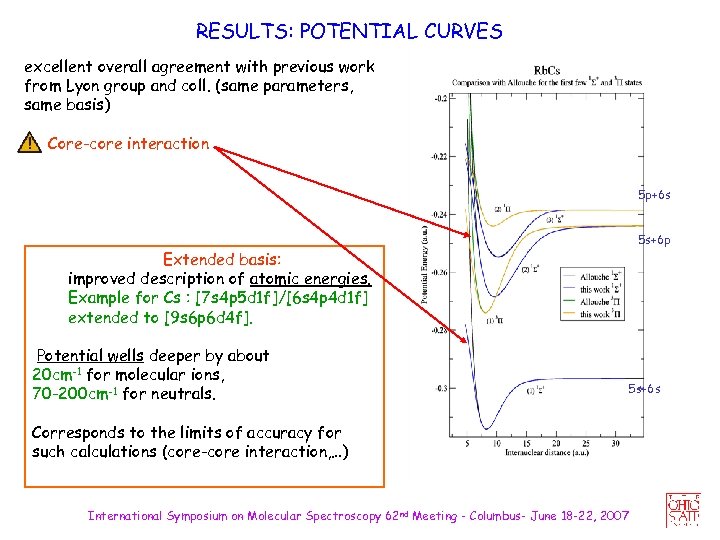
RESULTS: POTENTIAL CURVES excellent overall agreement with previous work from Lyon group and coll. (same parameters, same basis) Core-core interaction 5 p+6 s 5 s+6 p Extended basis: improved description of atomic energies. Example for Cs : [7 s 4 p 5 d 1 f]/[6 s 4 p 4 d 1 f] extended to [9 s 6 p 6 d 4 f]. Potential wells deeper by about 20 cm-1 for molecular ions, 70 -200 cm-1 for neutrals. 5 s+6 s Corresponds to the limits of accuracy for such calculations (core-core interaction, …) International Symposium on Molecular Spectroscopy 62 nd Meeting - Columbus- June 18 -22, 2007
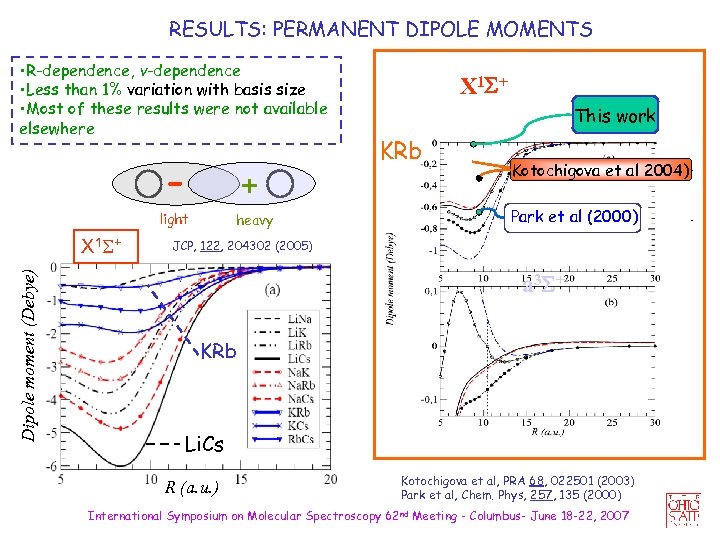
RESULTS: PERMANENT DIPOLE MOMENTS • R-dependence, v-dependence • Less than 1% variation with basis size • Most of these results were not available elsewhere - + light Dipole moment (Debye) X 1 S+ heavy X 1 S + This work KRb Kotochigova et al 2004) Park et al (2000) JCP, 122, 204302 (2005) a 3 S+ KRb Li. Cs R (a. u. ) Kotochigova et al, PRA 68, 022501 (2003) Park et al, Chem. Phys, 257, 135 (2000) International Symposium on Molecular Spectroscopy 62 nd Meeting - Columbus- June 18 -22, 2007
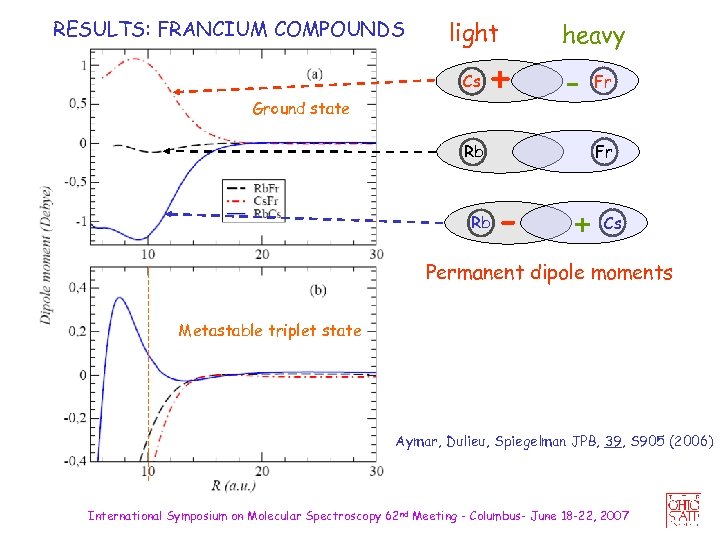
RESULTS: FRANCIUM COMPOUNDS light Cs Ground state + heavy - Fr Rb Rb Fr - + Cs Permanent dipole moments Metastable triplet state Aymar, Dulieu, Spiegelman JPB, 39, S 905 (2006) International Symposium on Molecular Spectroscopy 62 nd Meeting - Columbus- June 18 -22, 2007
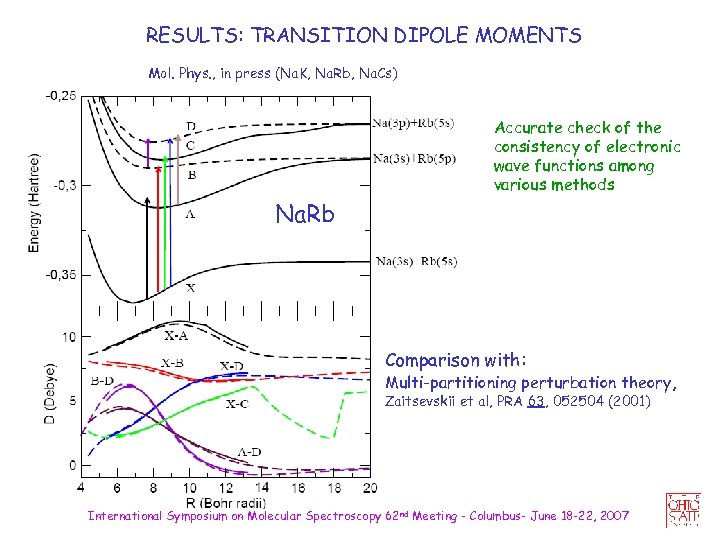
RESULTS: TRANSITION DIPOLE MOMENTS Mol. Phys. , in press (Na. K, Na. Rb, Na. Cs) Accurate check of the consistency of electronic wave functions among various methods Na. Rb Comparison with: Multi-partitioning perturbation theory, Zaitsevskii et al, PRA 63, 052504 (2001) International Symposium on Molecular Spectroscopy 62 nd Meeting - Columbus- June 18 -22, 2007
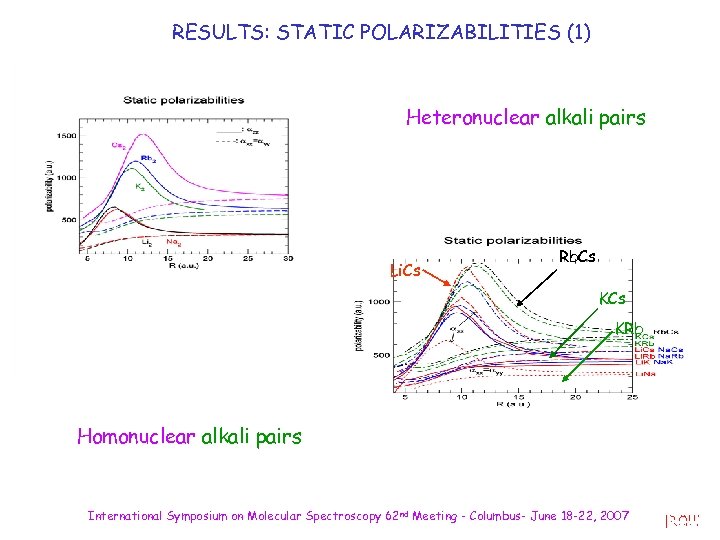
RESULTS: STATIC POLARIZABILITIES (1) Heteronuclear alkali pairs Li. Cs Rb. Cs KRb Homonuclear alkali pairs International Symposium on Molecular Spectroscopy 62 nd Meeting - Columbus- June 18 -22, 2007
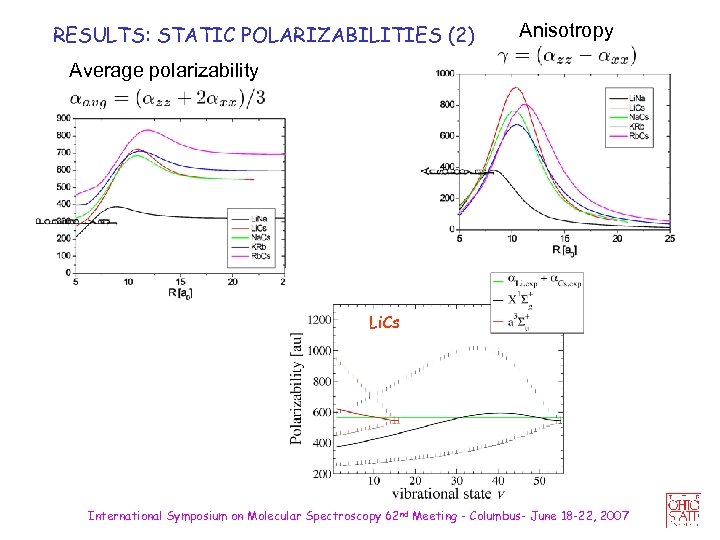
RESULTS: STATIC POLARIZABILITIES (2) Anisotropy Average polarizability Li. Cs International Symposium on Molecular Spectroscopy 62 nd Meeting - Columbus- June 18 -22, 2007
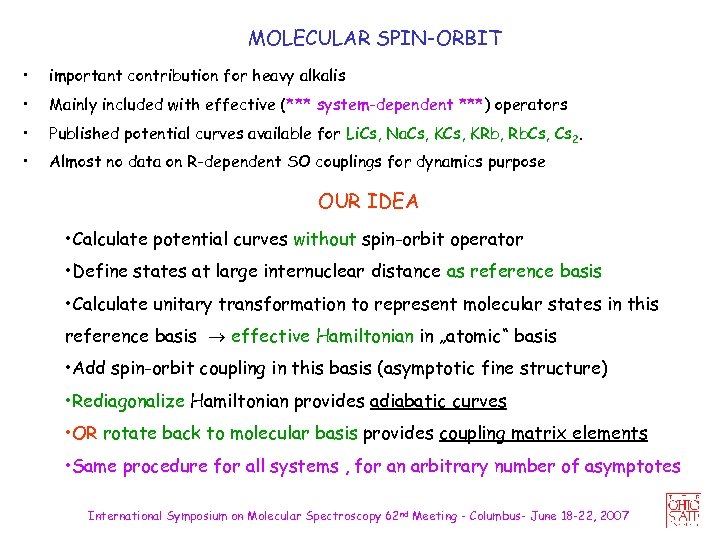
MOLECULAR SPIN-ORBIT • important contribution for heavy alkalis • Mainly included with effective (*** system-dependent ***) operators • Published potential curves available for Li. Cs, Na. Cs, KRb, Rb. Cs, Cs 2. • Almost no data on R-dependent SO couplings for dynamics purpose OUR IDEA • Calculate potential curves without spin-orbit operator • Define states at large internuclear distance as reference basis • Calculate unitary transformation to represent molecular states in this reference basis effective Hamiltonian in „atomic“ basis • Add spin-orbit coupling in this basis (asymptotic fine structure) • Rediagonalize Hamiltonian provides adiabatic curves • OR rotate back to molecular basis provides coupling matrix elements • Same procedure for all systems , for an arbitrary number of asymptotes International Symposium on Molecular Spectroscopy 62 nd Meeting - Columbus- June 18 -22, 2007
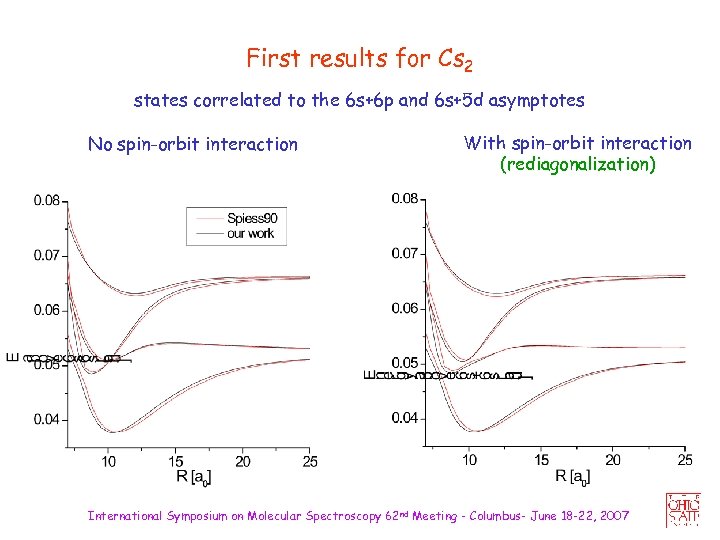
First results for Cs 2 states correlated to the 6 s+6 p and 6 s+5 d asymptotes No spin-orbit interaction With spin-orbit interaction (rediagonalization) International Symposium on Molecular Spectroscopy 62 nd Meeting - Columbus- June 18 -22, 2007
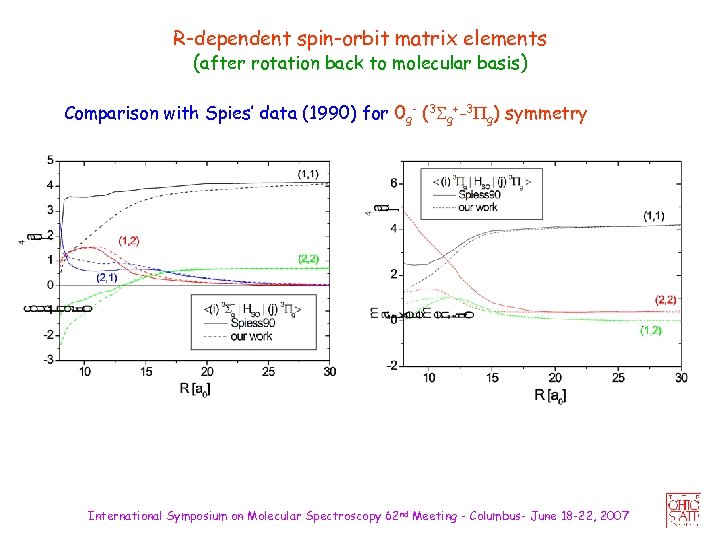
R-dependent spin-orbit matrix elements (after rotation back to molecular basis) Comparison with Spies’ data (1990) for 0 g- (3 Sg+-3 Pg) symmetry International Symposium on Molecular Spectroscopy 62 nd Meeting - Columbus- June 18 -22, 2007
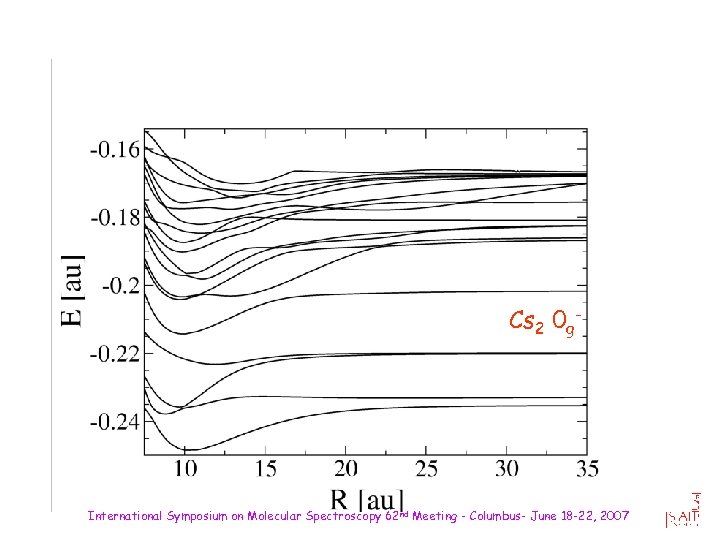
Cs 2 0 g- International Symposium on Molecular Spectroscopy 62 nd Meeting - Columbus- June 18 -22, 2007
Today’s published results from our group: Na. K, Na. Rb, Na. Cs: M. Aymar and O. Dulieu, submitted to Molecular Physics (2007) Rb 2: J. Lozeille et al (Orsay+ Pise + Storrs) Eur. Phys. J. D 39, 261 (2006); V. Horvatic et al (Orsay+ Zagreb), Phys. Rev. A, 75, 032512 (2007). KRb: Beuc et al (Zagreb+Orsay), J. Phys. B, 39, S 1191 (2006) Fr 2, Rb. Fr, Cs. Fr: Aymar, Dulieu, Spiegelman J. Phys. B, 39, S 905 (2006) All other systems in preparation (including alkali hydrides) Perspectives of this work: • Spin-orbit couplings for all alkali pairs (Li. Rb, Li. Cs, Rb 2, …). • Mixed alkali/alkaline-earth ions… and neutrals… • Triatomic alkali ions… and neutrals… • Dynamics… atom/molecule photoassociation… • …and hopefully interaction with experimentalists… • There « could be » possibilities for Ph. D/postdoc positions… International Symposium on Molecular Spectroscopy 62 nd Meeting - Columbus- June 18 -22, 2007
Скачать презентацию STRUCTURE DIPOLE MOMENTS POLARIZABILITIES AND MOLECULAR SPIN ORBIT
b3e9d78222ca883ad271a396f478b7b9.ppt