


 Скачать презентацию Structural Instrumentation and Monitoring Navigation Lock and Dam
521127f28e67d2abad1f476274bf865f.ppt
- Количество слайдов: 53
 Structural Instrumentation and Monitoring Navigation Lock and Dam Inspection and Emergency Repairs Workshop 19 April 2006 Bruce Barker Information Technology Laboratory, ERDC US Army Corps of Engineers®
 Why Instrument Civil Works Structures • As directed by COE regulations and guidance - EM 1110 -2 -4300, Engineering and Design - Instrumentation for Concrete Structures - ER 1110 -2 -103 Strong Motion Earthquake Monitoring • Ensure life-cycle performance of critical • • structures Support preventive and predictive maintenance programs for key components Establish nominal conditions and loads Provide real-time information or alerts in extreme events or conditions Replace lost manpower with “automation” US Army Corps of Engineers®
 Then Why Don’t We? • The need for instrumentation is seldom • • • recognized…until there is a problem $$$ - Both from an installation and maintenance standpoint Lack of maintenance programs for systems can result in poor long-term reliability Difficult to retrofit existing infrastructure Bad experiences with data management – over sampling, and lack of automated analysis Lack of awareness of new technologies that can minimize the above US Army Corps of Engineers®
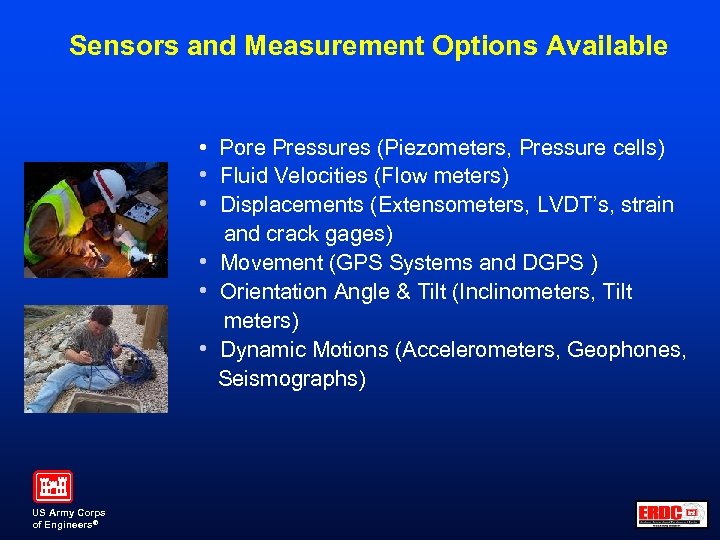 Sensors and Measurement Options Available • Pore Pressures (Piezometers, Pressure cells) • Fluid Velocities (Flow meters) • Displacements (Extensometers, LVDT’s, strain and crack gages) • Movement (GPS Systems and DGPS ) • Orientation Angle & Tilt (Inclinometers, Tilt meters) • Dynamic Motions (Accelerometers, Geophones, Seismographs) US Army Corps of Engineers®
 Examples of Structural Instrumentation Projects US Army Corps of Engineers®
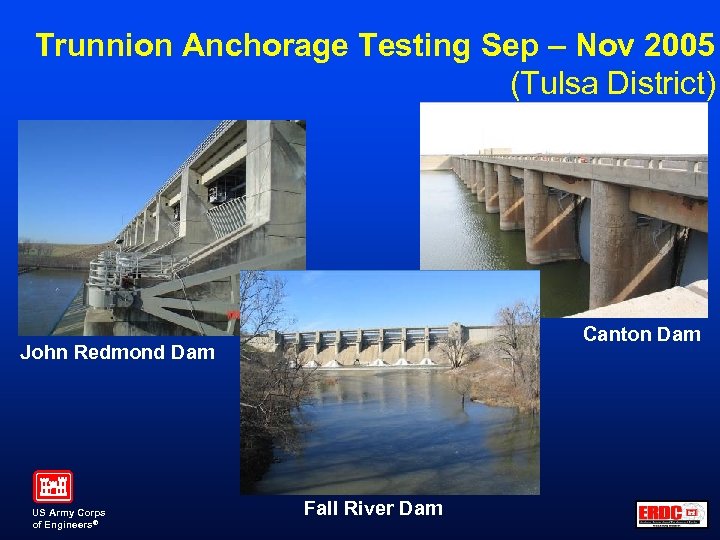 Trunnion Anchorage Testing Sep – Nov 2005 (Tulsa District) Canton Dam John Redmond Dam US Army Corps of Engineers® Fall River Dam
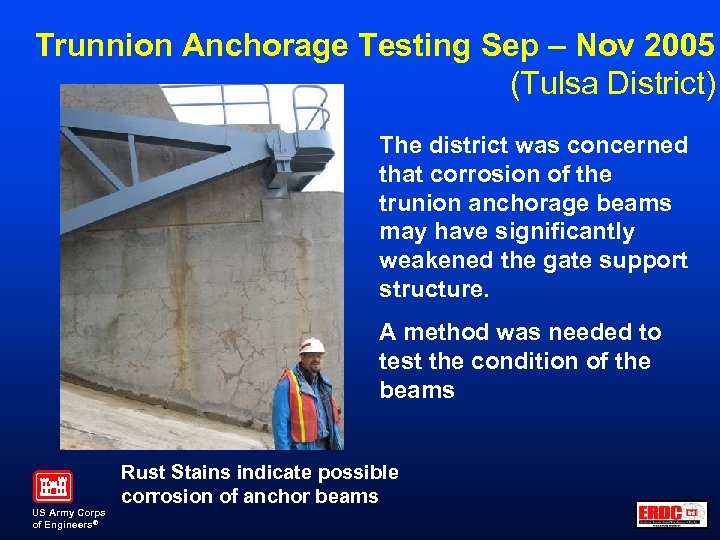 Trunnion Anchorage Testing Sep – Nov 2005 (Tulsa District) The district was concerned that corrosion of the trunion anchorage beams may have significantly weakened the gate support structure. A method was needed to test the condition of the beams US Army Corps of Engineers® Rust Stains indicate possible corrosion of anchor beams
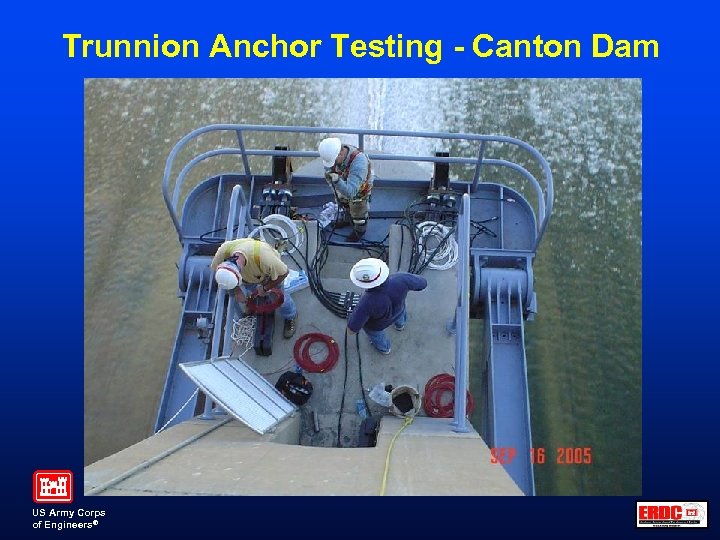 Trunnion Anchor Testing - Canton Dam US Army Corps of Engineers®
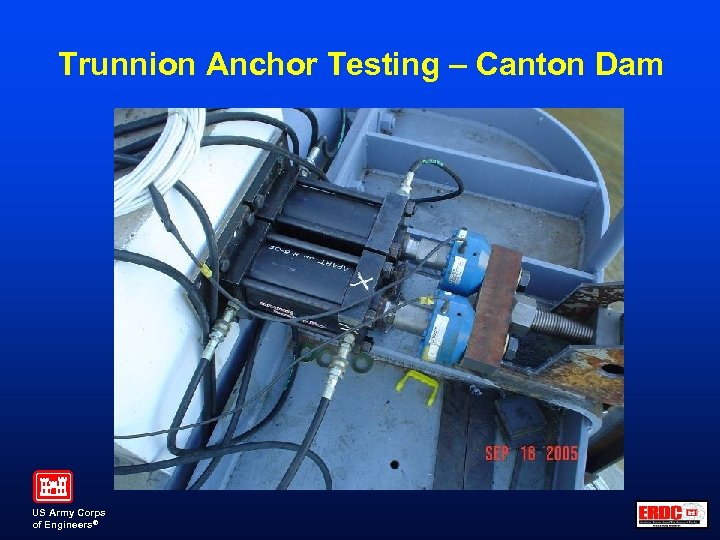 Trunnion Anchor Testing – Canton Dam US Army Corps of Engineers®
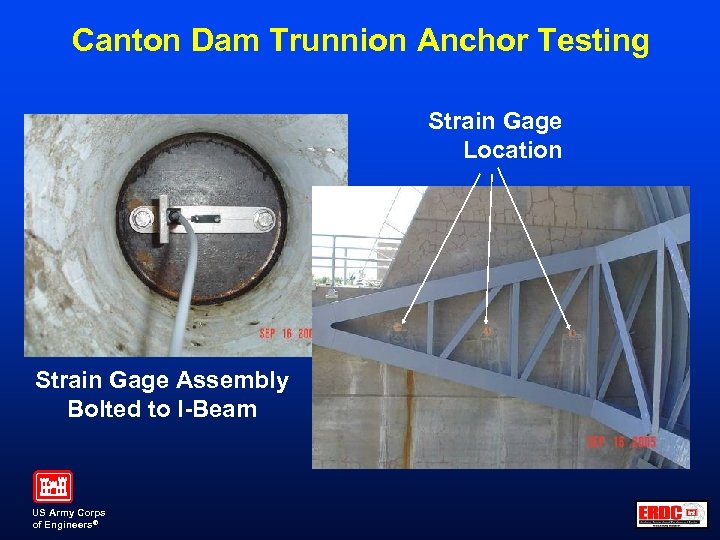 Canton Dam Trunnion Anchor Testing Strain Gage Location Strain Gage Assembly Bolted to I-Beam US Army Corps of Engineers®
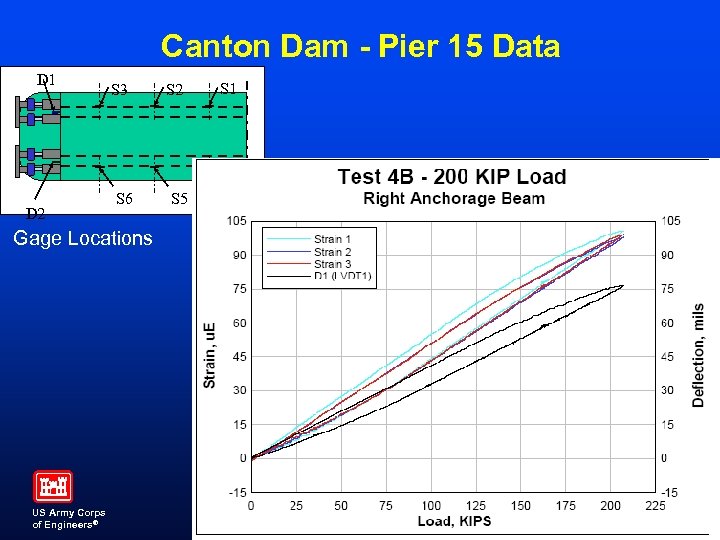 Canton Dam - Pier 15 Data D 1 D 2 S 3 S 6 Gage Locations US Army Corps of Engineers® S 2 S 5 S 1 S 4
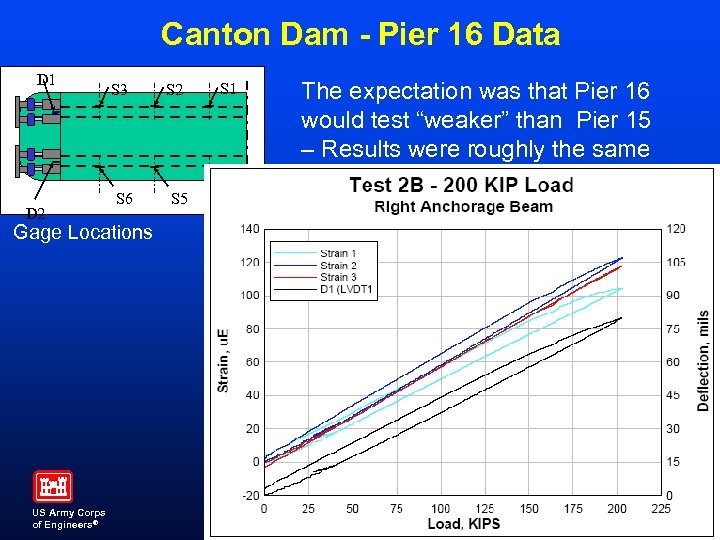 Canton Dam - Pier 16 Data D 1 D 2 S 3 S 6 Gage Locations US Army Corps of Engineers® S 2 S 5 S 1 S 4 The expectation was that Pier 16 would test “weaker” than Pier 15 – Results were roughly the same
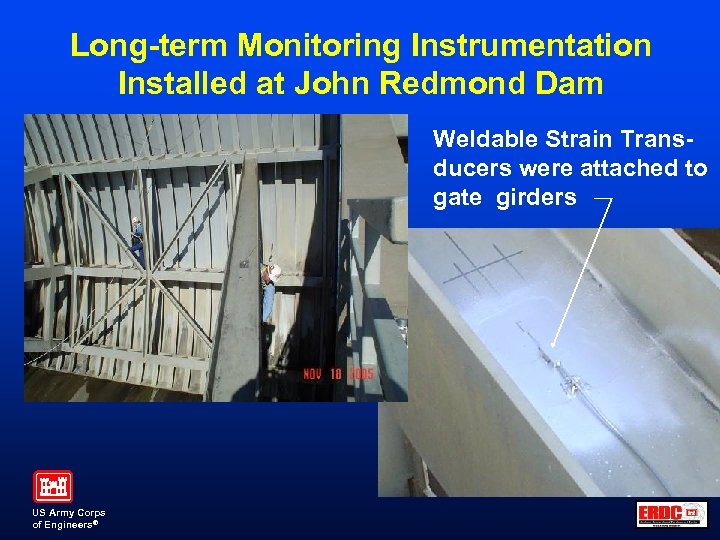 Long-term Monitoring Instrumentation Installed at John Redmond Dam Weldable Strain Transducers were attached to gate girders US Army Corps of Engineers®
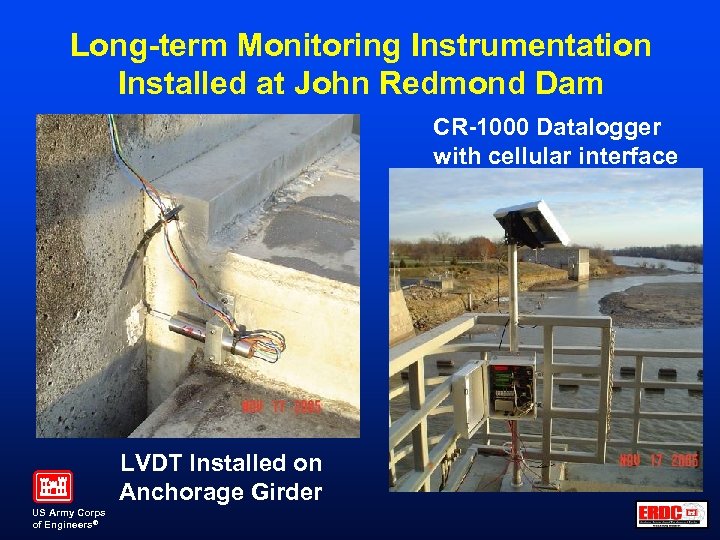 Long-term Monitoring Instrumentation Installed at John Redmond Dam CR-1000 Datalogger with cellular interface LVDT Installed on Anchorage Girder US Army Corps of Engineers®
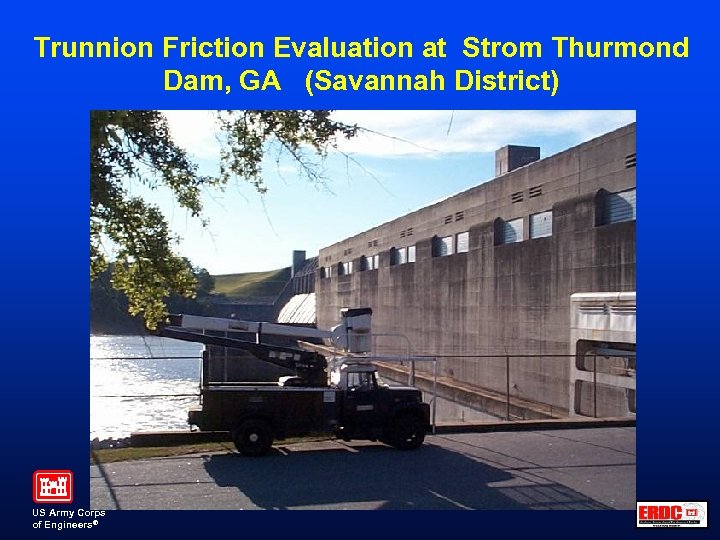 Trunnion Friction Evaluation at Strom Thurmond Dam, GA (Savannah District) US Army Corps of Engineers®
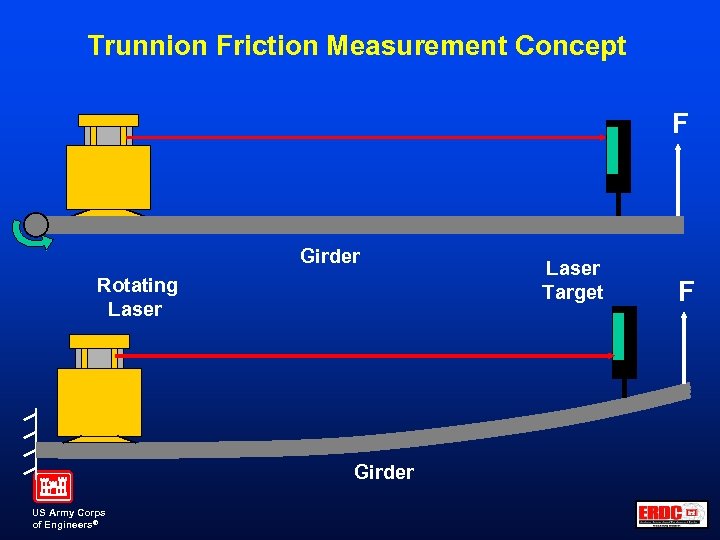 Trunnion Friction Measurement Concept F Girder Rotating Laser Girder US Army Corps of Engineers® Laser Target F
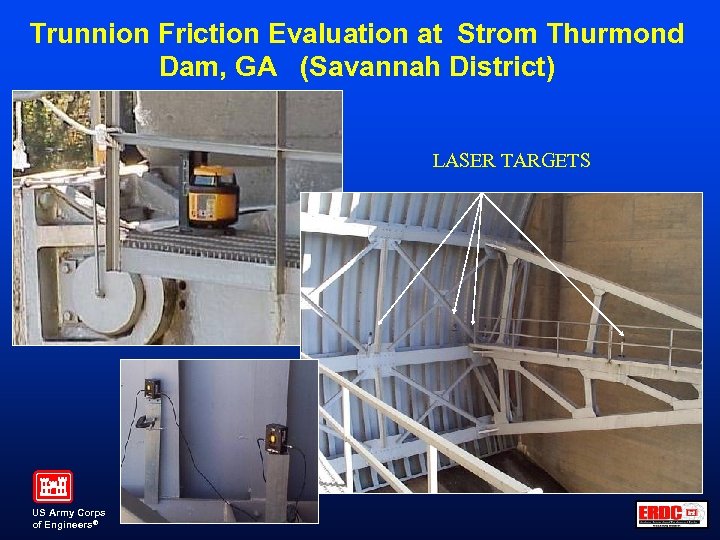 Trunnion Friction Evaluation at Strom Thurmond Dam, GA (Savannah District) LASER TARGETS US Army Corps of Engineers®
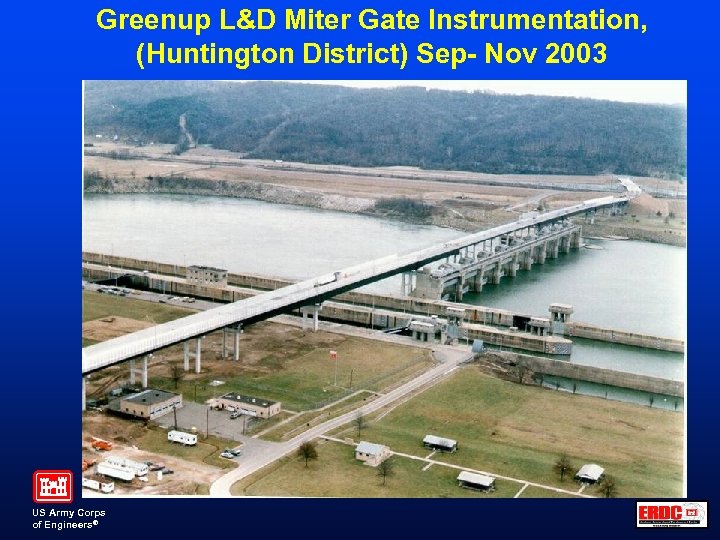 Greenup L&D Miter Gate Instrumentation, (Huntington District) Sep- Nov 2003 US Army Corps of Engineers®
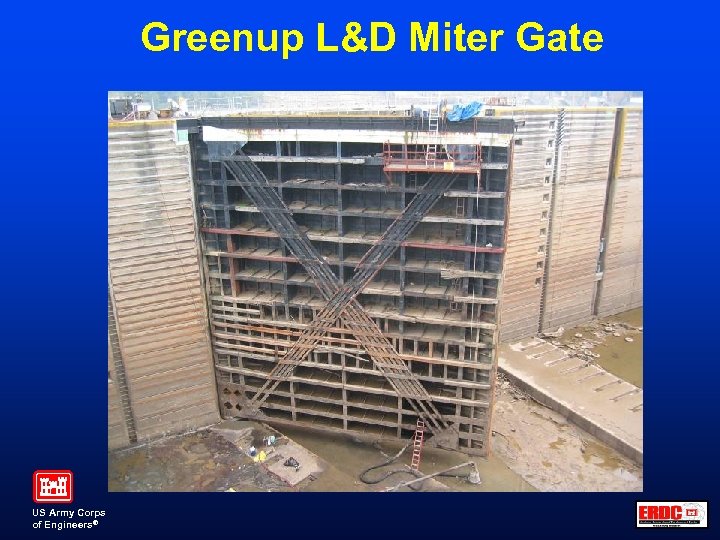 Greenup L&D Miter Gate US Army Corps of Engineers®
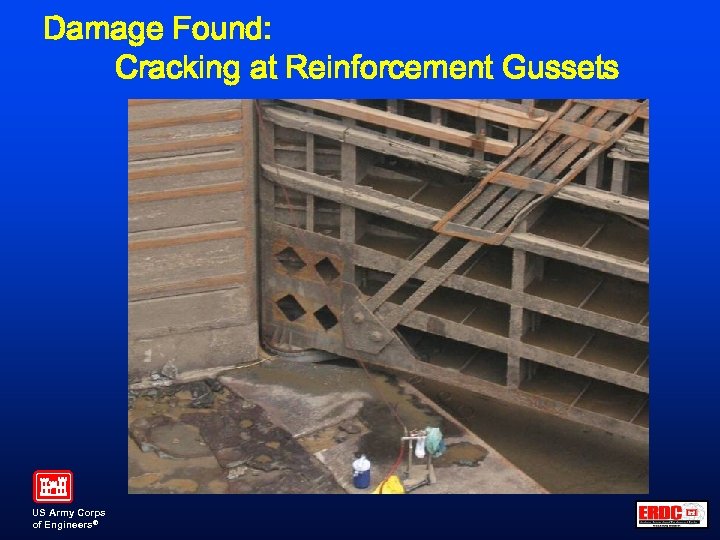 Damage Found: Cracking at Reinforcement Gussets US Army Corps of Engineers®
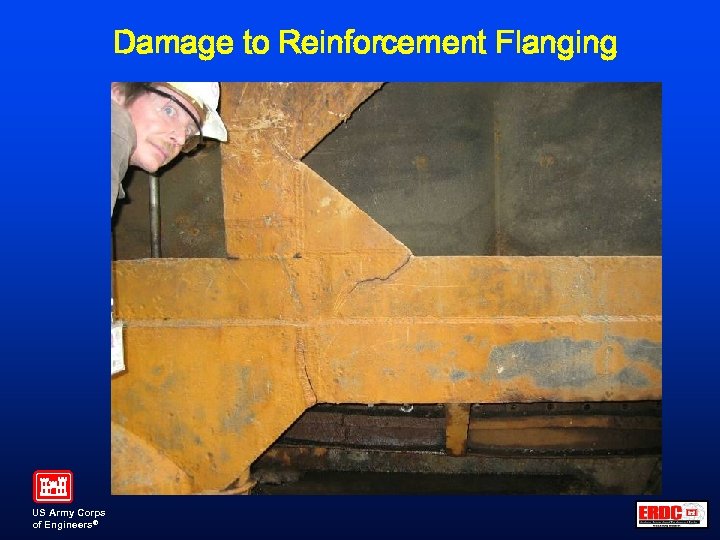 Damage to Reinforcement Flanging US Army Corps of Engineers®
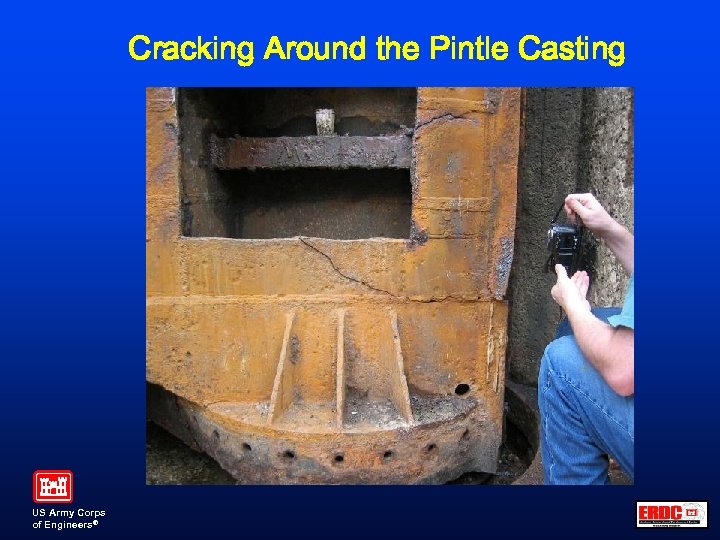 Cracking Around the Pintle Casting US Army Corps of Engineers®
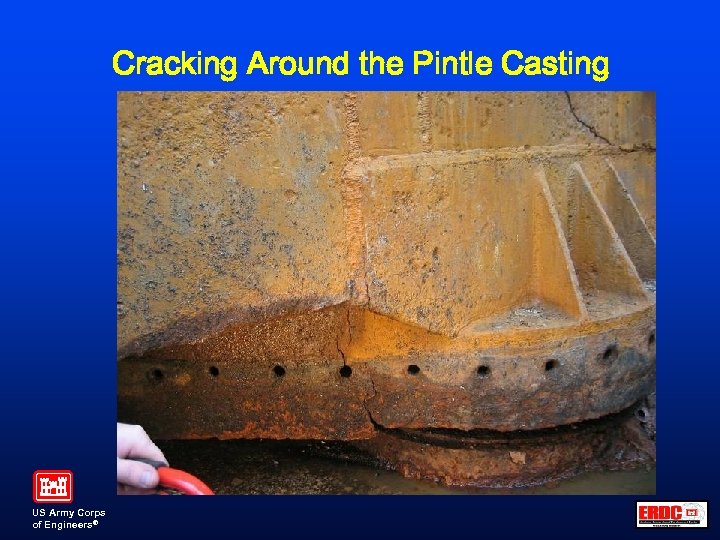 Cracking Around the Pintle Casting US Army Corps of Engineers®
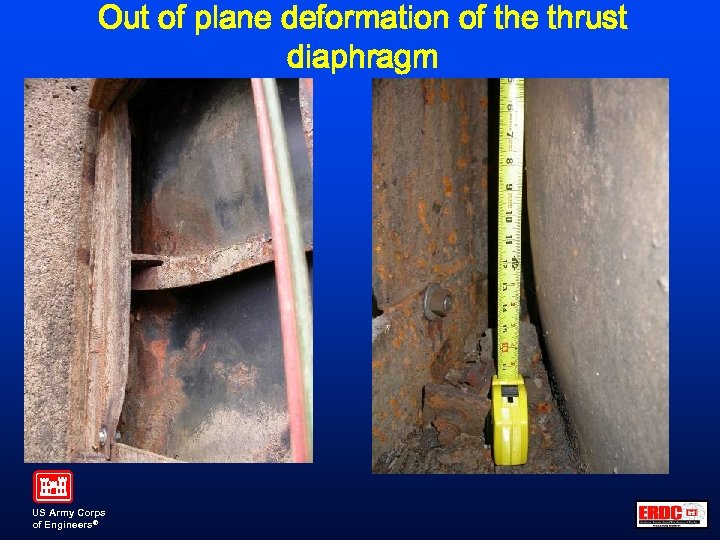 Out of plane deformation of the thrust diaphragm US Army Corps of Engineers®
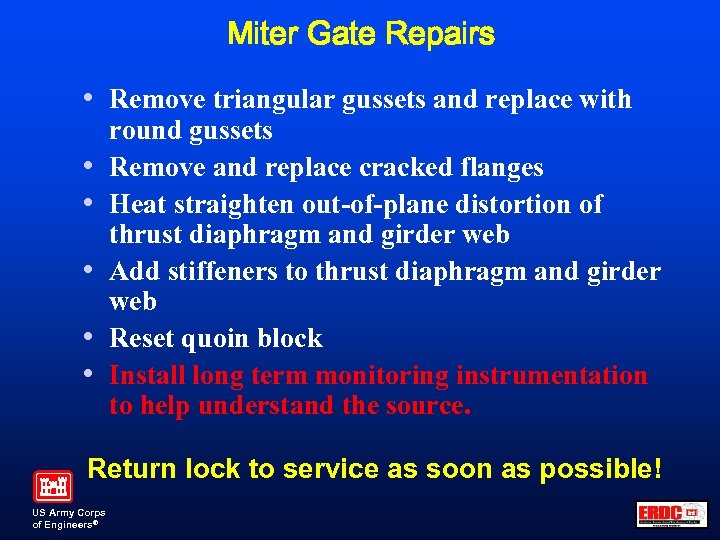 Miter Gate Repairs • Remove triangular gussets and replace with • • • round gussets Remove and replace cracked flanges Heat straighten out-of-plane distortion of thrust diaphragm and girder web Add stiffeners to thrust diaphragm and girder web Reset quoin block Install long term monitoring instrumentation to help understand the source. Return lock to service as soon as possible! US Army Corps of Engineers®
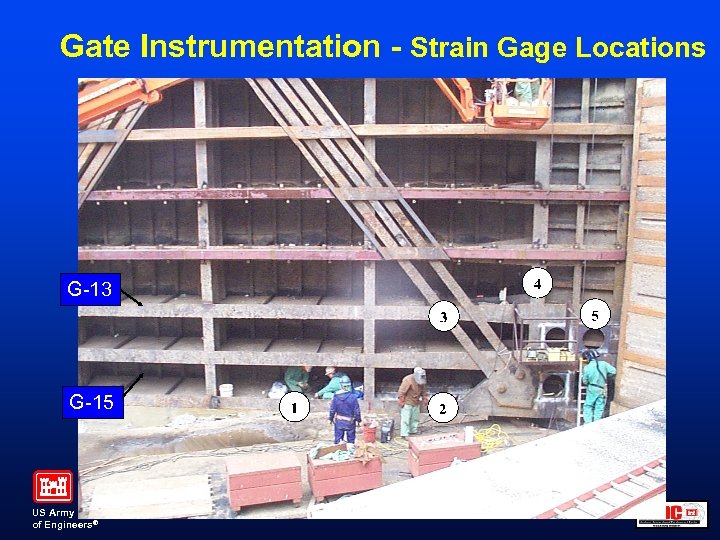 Gate Instrumentation - Strain Gage Locations G-13 G-15 US Army Corps of Engineers®
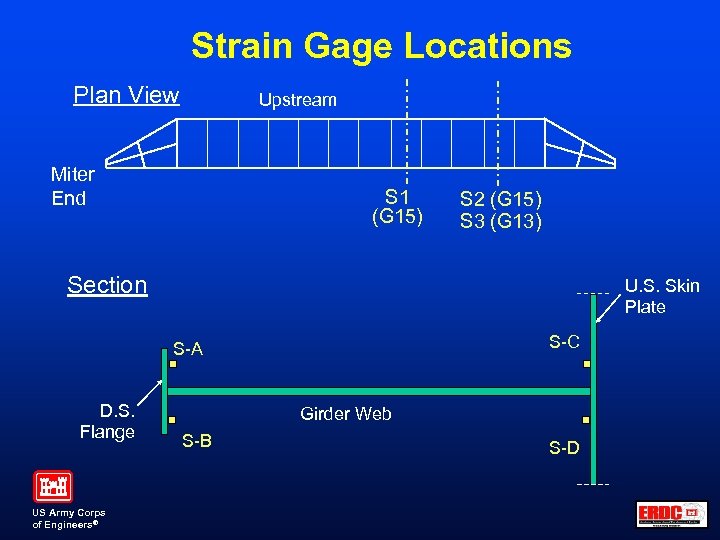 Strain Gage Locations Plan View Upstream Miter End S 1 (G 15) S 2 (G 15) S 3 (G 13) Section U. S. Skin Plate S-C S-A D. S. Flange US Army Corps of Engineers® Girder Web S-B S-D
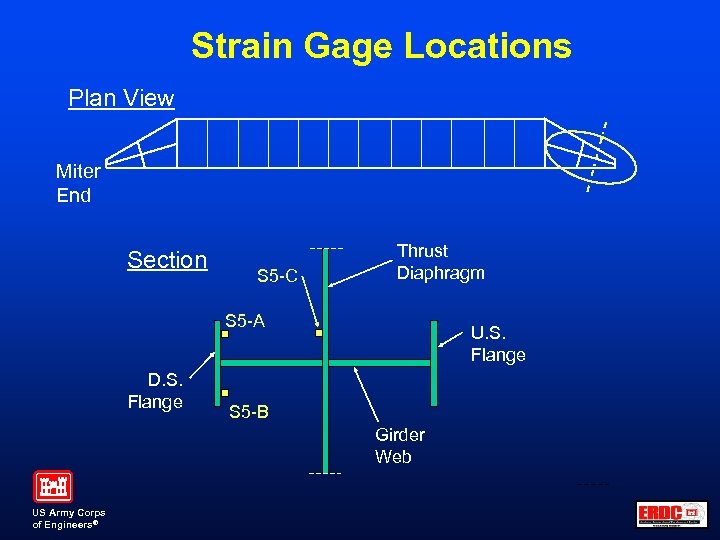 Strain Gage Locations Plan View Miter End Section S 5 -C Thrust Diaphragm S 5 -A D. S. Flange U. S. Flange S 5 -B Girder Web US Army Corps of Engineers®
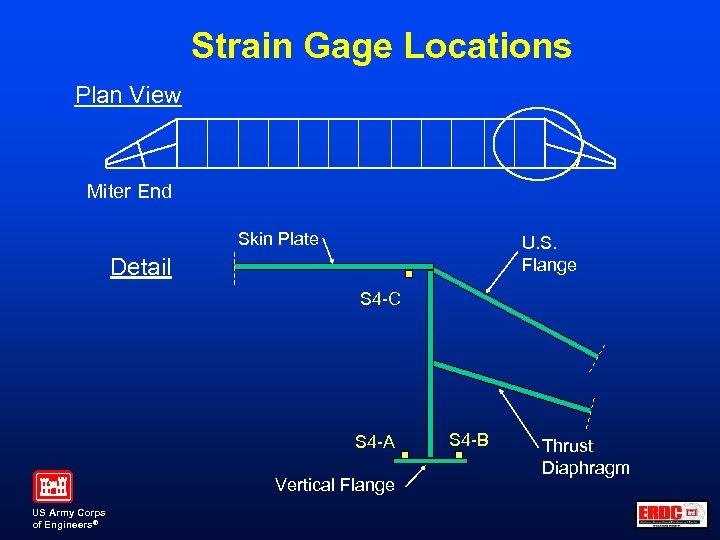 Strain Gage Locations Plan View Miter End Skin Plate U. S. Flange Detail S 4 -C S 4 -A Vertical Flange US Army Corps of Engineers® S 4 -B Thrust Diaphragm
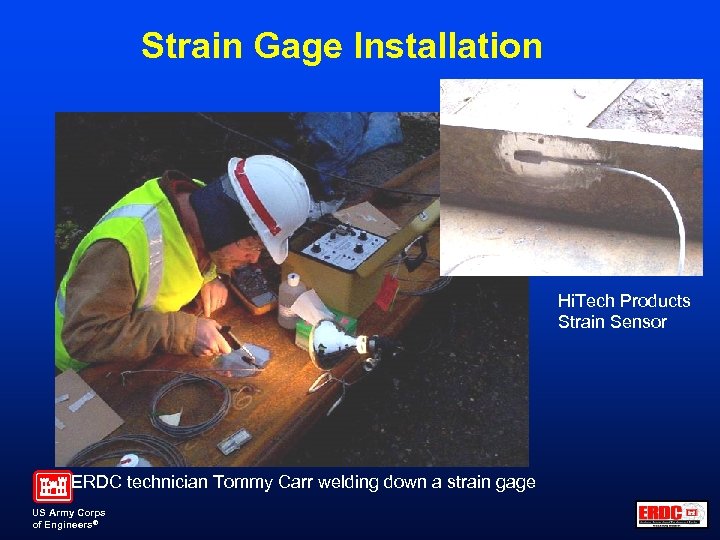 Strain Gage Installation Hi. Tech Products Strain Sensor ERDC technician Tommy Carr welding down a strain gage US Army Corps of Engineers®
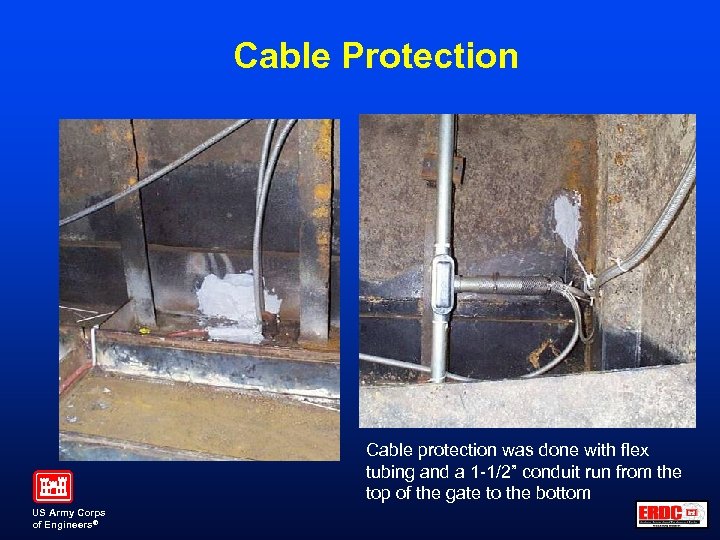 Cable Protection Cable protection was done with flex tubing and a 1 -1/2” conduit run from the top of the gate to the bottom US Army Corps of Engineers®
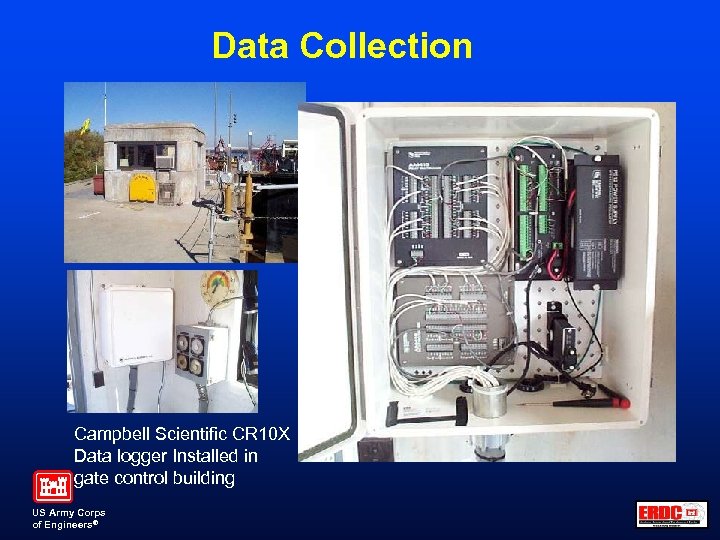 Data Collection Campbell Scientific CR 10 X Data logger Installed in gate control building US Army Corps of Engineers®
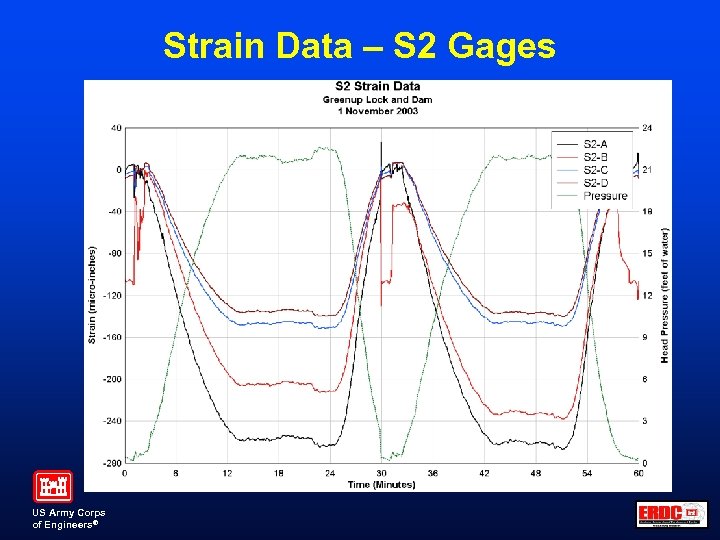 Strain Data – S 2 Gages US Army Corps of Engineers®
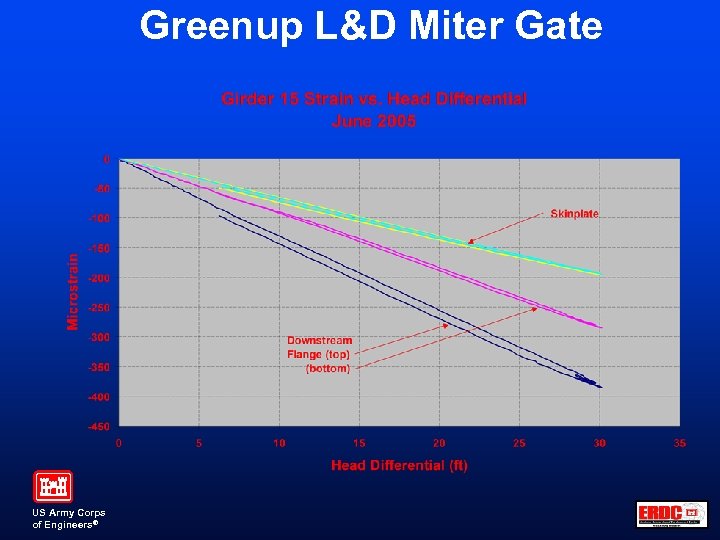 Greenup L&D Miter Gate US Army Corps of Engineers®
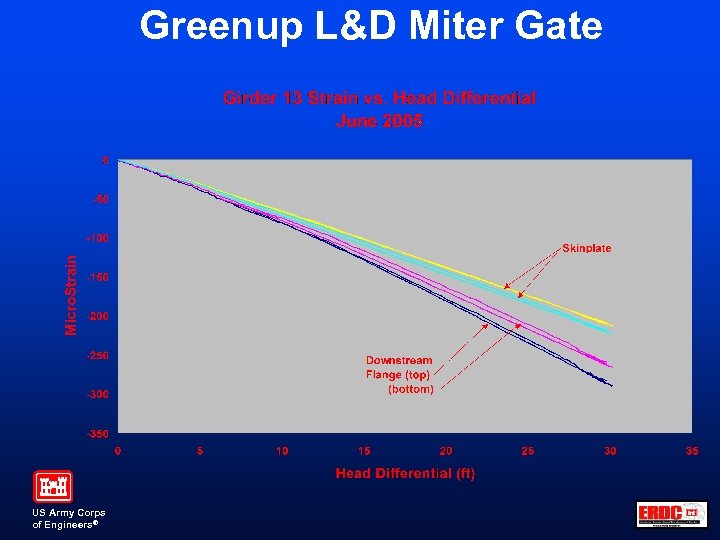 Greenup L&D Miter Gate US Army Corps of Engineers®
 Example of a Geotechnical Instrumentation Project US Army Corps of Engineers®
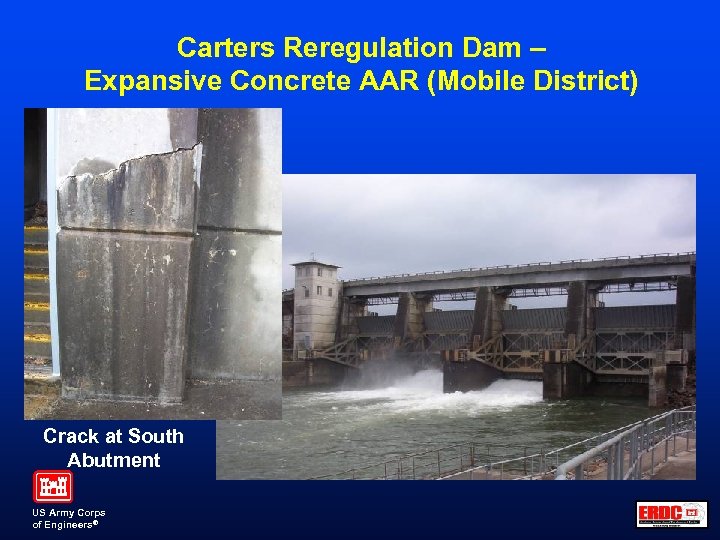 Carters Reregulation Dam – Expansive Concrete AAR (Mobile District) Crack at South Abutment US Army Corps of Engineers®
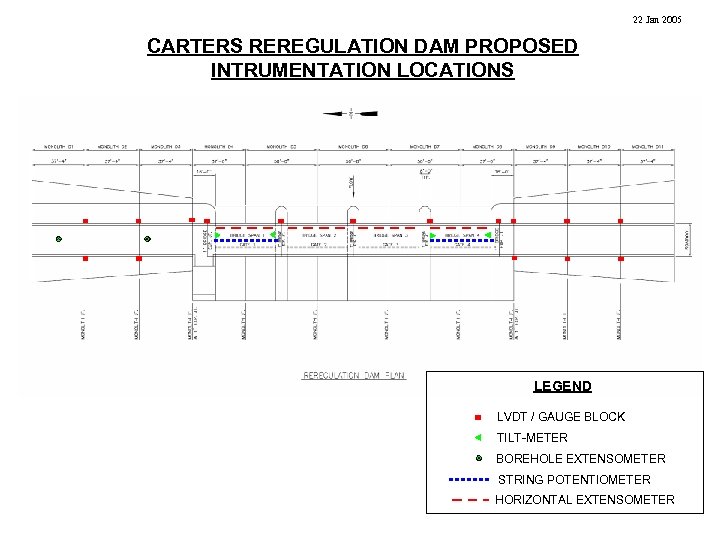 22 Jan 2005 CARTERS REREGULATION DAM PROPOSED INTRUMENTATION LOCATIONS LEGEND LVDT / GAUGE BLOCK TILT-METER BOREHOLE EXTENSOMETER STRING POTENTIOMETER HORIZONTAL EXTENSOMETER US Army Corps of Engineers®
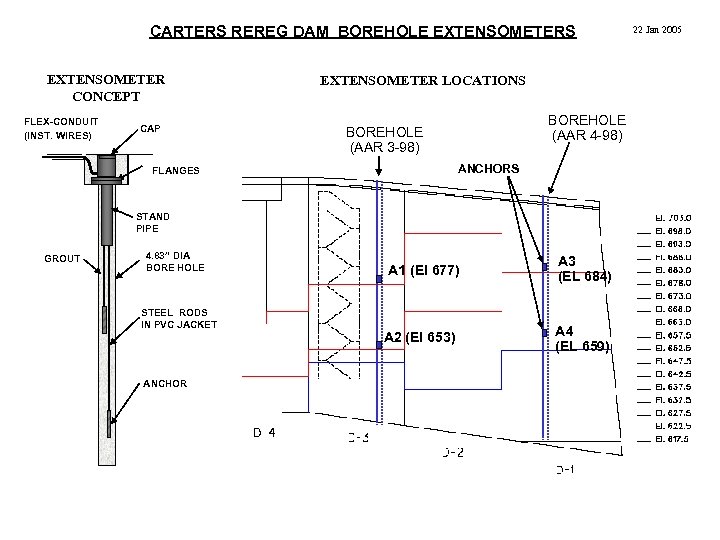 CARTERS REREG DAM BOREHOLE EXTENSOMETERS EXTENSOMETER CONCEPT FLEX-CONDUIT (INST. WIRES) CAP EXTENSOMETER LOCATIONS BOREHOLE (AAR 4 -98) BOREHOLE (AAR 3 -98) ANCHORS FLANGES STAND PIPE GROUT 4. 83” DIA BORE HOLE STEEL RODS IN PVC JACKET ANCHOR US Army Corps of Engineers® A 1 (El 677) A 2 (El 653) A 3 (EL 684) A 4 (EL 659) 22 Jan 2005
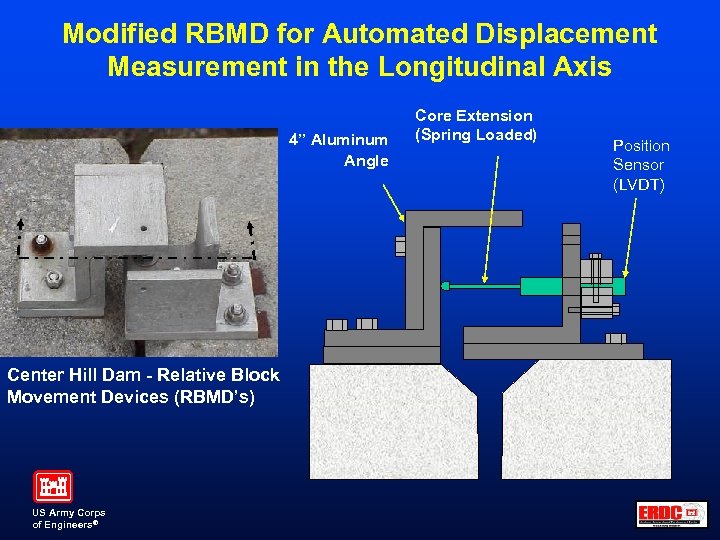 Modified RBMD for Automated Displacement Measurement in the Longitudinal Axis 4” Aluminum Angle Center Hill Dam - Relative Block Movement Devices (RBMD’s) US Army Corps of Engineers® Core Extension (Spring Loaded) Position Sensor (LVDT)
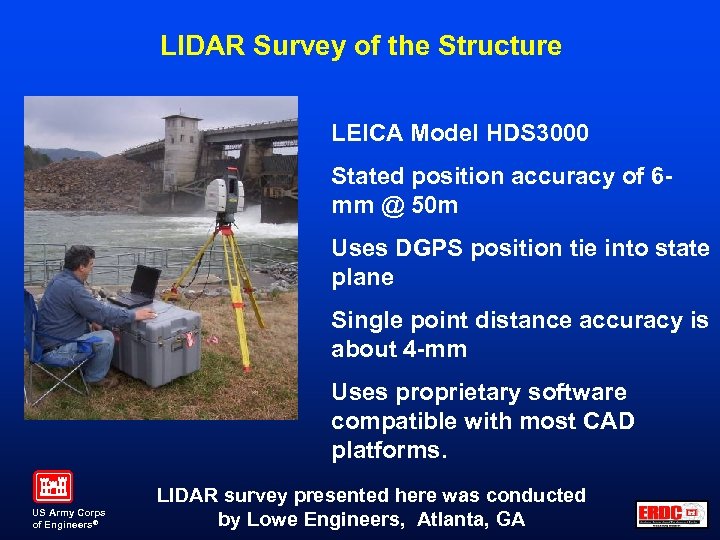 LIDAR Survey of the Structure LEICA Model HDS 3000 Stated position accuracy of 6 mm @ 50 m Uses DGPS position tie into state plane Single point distance accuracy is about 4 -mm Uses proprietary software compatible with most CAD platforms. US Army Corps of Engineers® LIDAR survey presented here was conducted by Lowe Engineers, Atlanta, GA
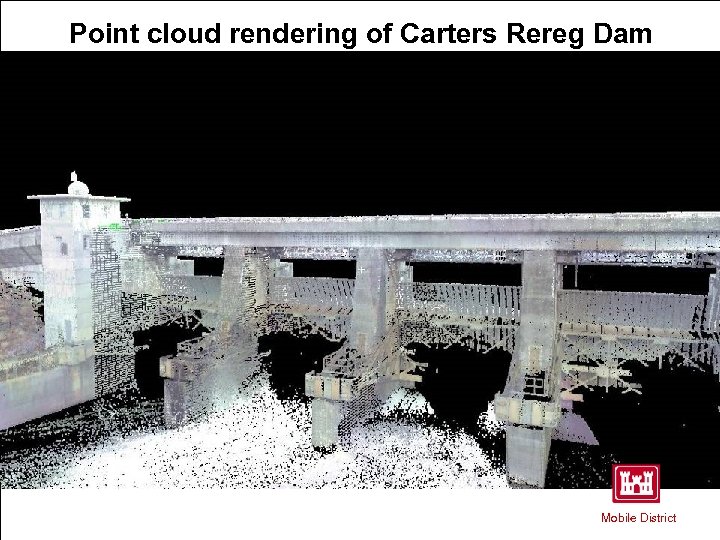 Cyclone Software (oblique Carters Rereg Dam Point cloud rendering ofview) US Army Corps of Engineers® Mobile District
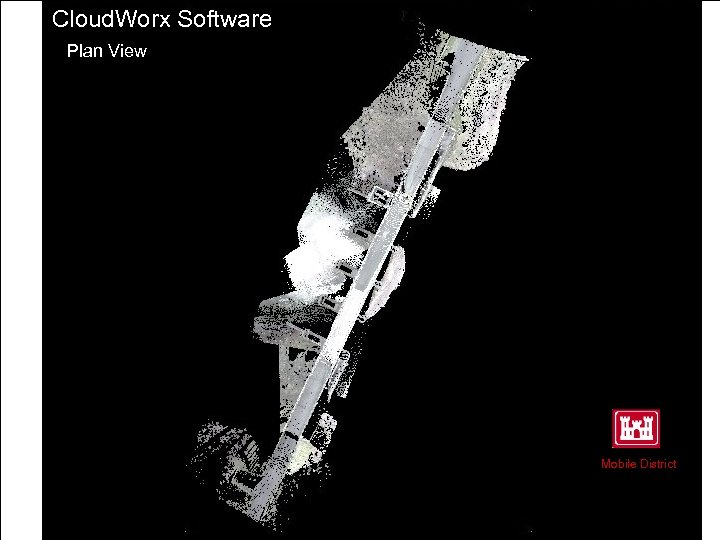 Cloud. Worx Software Plan View Mobile District US Army Corps of Engineers®
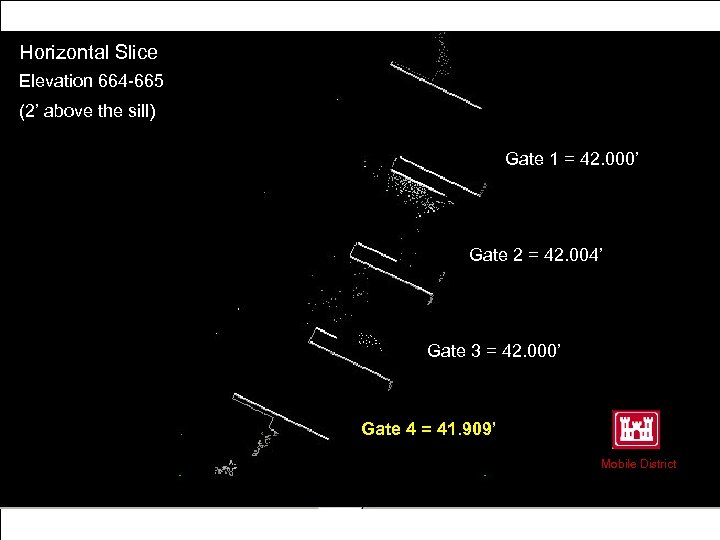 Horizontal Slice Elevation 664 -665 (2’ above the sill) Gate 1 = 42. 000’ Gate 2 = 42. 004’ Gate 3 = 42. 000’ Gate 4 = 41. 909’ Mobile District US Army Corps of Engineers®
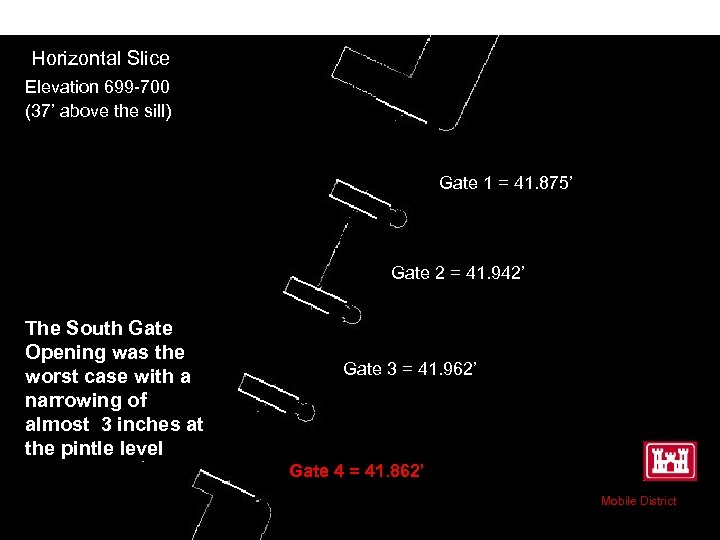 Horizontal Slice Elevation 699 -700 (37’ above the sill) Gate 1 = 41. 875’ Gate 2 = 41. 942’ The South Gate Opening was the worst case with a narrowing of almost 3 inches at the pintle level Gate 3 = 41. 962’ Gate 4 = 41. 862’ US Army Corps of Engineers® Mobile District
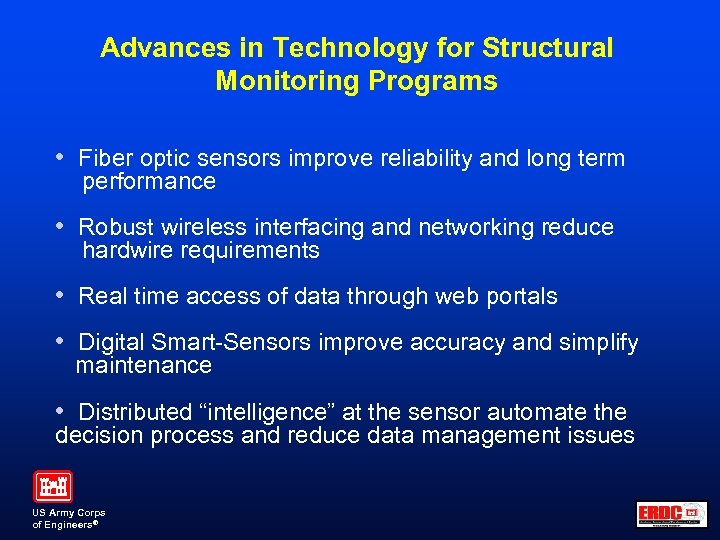 Advances in Technology for Structural Monitoring Programs • Fiber optic sensors improve reliability and long term performance • Robust wireless interfacing and networking reduce hardwire requirements • Real time access of data through web portals • Digital Smart-Sensors improve accuracy and simplify maintenance • Distributed “intelligence” at the sensor automate the decision process and reduce data management issues US Army Corps of Engineers®
 The future in Long-term Monitoring Instrumentation Internet Protocol IPv 6 will offer enormous potential for remote sensing applications, allowing roughly 100 IP addresses for every person on the planet. Tiny. OS has been developed to enable very small, low power, low cost, network linked sensor platforms. US Army Corps of Engineers®
 The Future of Real-time Monitoring Garo K. Kiremidjian, Founder/CEO “Sensametrics, Inc. is developing technology for comprehensive and costeffective solutions for structural monitoring of civil assets – bridges, large facilities, new construction, dams, levee walls and buildings - aimed at identifying the onset, development, location, and severity of structural vulnerability and damage. Sensametrics’ technology concept is based on a wireless network of devices, or sensing units, for capturing damage/vulnerability information and a decision support software environment for information presentation and analysis. ” US Army Corps of Engineers®
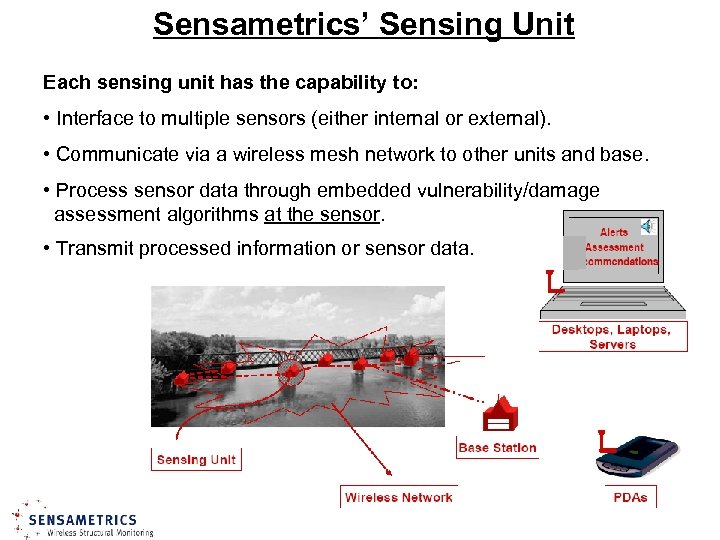 Sensametrics’ Sensing Unit Each sensing unit has the capability to: • Interface to multiple sensors (either internal or external). • Communicate via a wireless mesh network to other units and base. • Process sensor data through embedded vulnerability/damage assessment algorithms at the sensor. • Transmit processed information or sensor data. US Army Corps of Engineers®
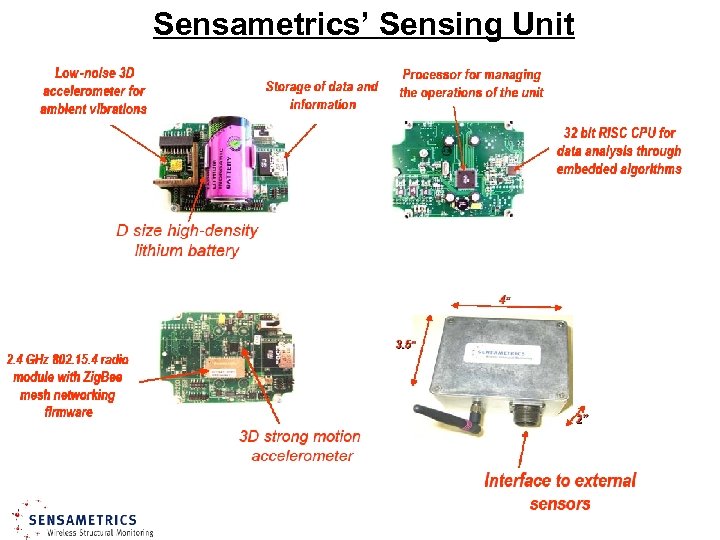 Sensametrics’ Sensing Unit US Army Corps of Engineers®
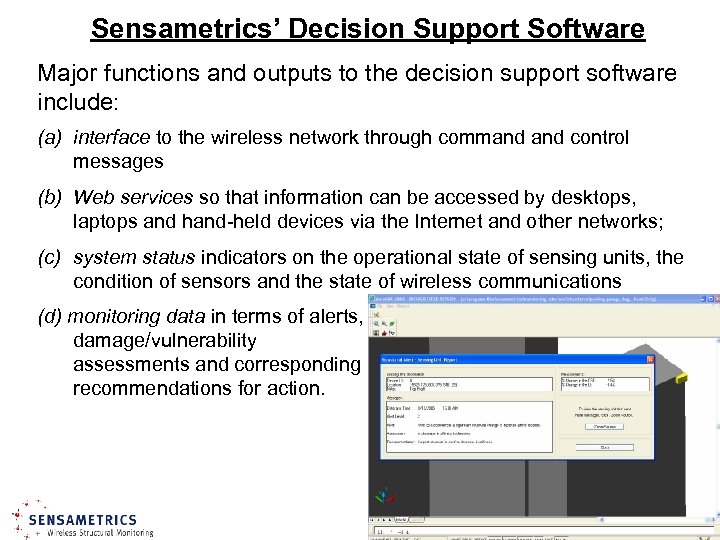 Sensametrics’ Decision Support Software Major functions and outputs to the decision support software include: (a) interface to the wireless network through command control messages (b) Web services so that information can be accessed by desktops, laptops and hand-held devices via the Internet and other networks; (c) system status indicators on the operational state of sensing units, the condition of sensors and the state of wireless communications (d) monitoring data in terms of alerts, damage/vulnerability assessments and corresponding recommendations for action. US Army Corps of Engineers®
 Summary and Conclusions Permanent installation of sensors and monitoring systems can minimize performance questions. Maintenance and upgrades to the monitoring systems must be factored into O&M budgets. Manpower restrictions will force more reliance on technology to “monitor” structural conditions. Emerging technology will make this possible and more cost effective. US Army Corps of Engineers®
 QUESTIONS? US Army Corps of Engineers®