


 Скачать презентацию Structural Funds looking towards 2014 20 Context-
a047486426b6ed34dbc347e05e25abd3.ppt
- Количество слайдов: 39

 Structural Funds – looking towards 2014/20 • Context- an era of rapid and volatile change in healthcare • What the ‘EU’ is doing about healthcare • e. Health and Integration – changing the way healthcare is delivered • Structural Funds - Cohesion Policy and Europe 2020 guidelines • Conclusions
 EU Cohesion Policy – investing in growth and jobs - Structural Funds are a pooled and shared resource – we are all stakeholders The European Regional Development Funds (ERDF) strengthening economic, social and territorial cohesion by correcting inbalances between regions The European Social Funds (ESF) the EU’s main financial instrument for investing in people • Cohesion Policy structure and process – doing better by improving performance requirements and strengthening conditionalities: • Tackling weaknesses in national policies, institutional frameworks • Stronger adherence to agreed milestones • Promoting integration e. g. multi-fund programmes • Results based strategic programming
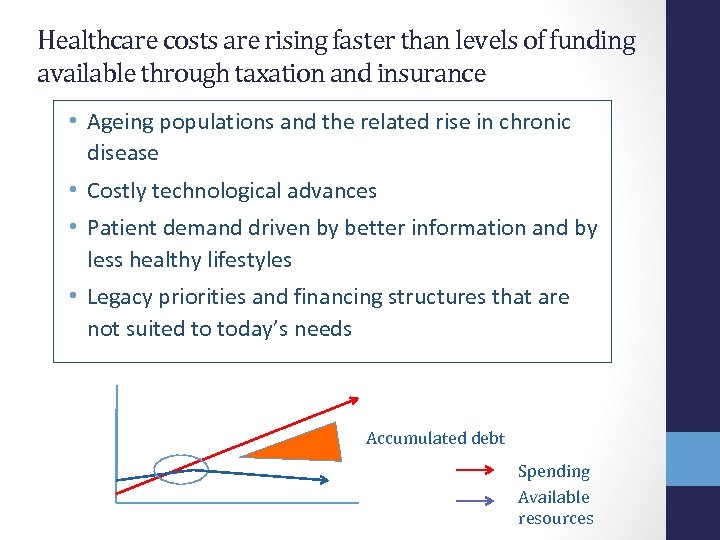 Healthcare costs are rising faster than levels of funding available through taxation and insurance • Ageing populations and the related rise in chronic disease • Costly technological advances • Patient demand driven by better information and by less healthy lifestyles • Legacy priorities and financing structures that are not suited to today’s needs Accumulated debt Spending Available resources
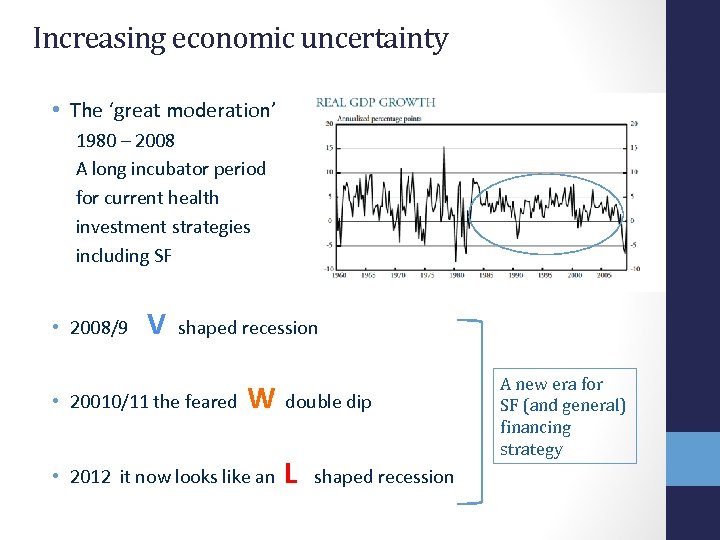 Increasing economic uncertainty • The ‘great moderation’ 1980 – 2008 A long incubator period for current health investment strategies including SF • 2008/9 V shaped recession • 20010/11 the feared W double dip • 2012 it now looks like an L shaped recession A new era for SF (and general) financing strategy
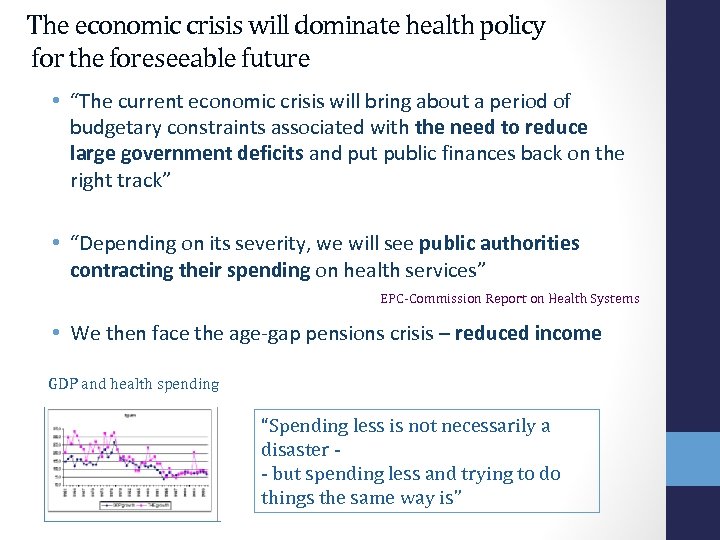 The economic crisis will dominate health policy for the foreseeable future • “The current economic crisis will bring about a period of budgetary constraints associated with the need to reduce large government deficits and put public finances back on the right track” • “Depending on its severity, we will see public authorities contracting their spending on health services” EPC-Commission Report on Health Systems • We then face the age-gap pensions crisis – reduced income GDP and health spending “Spending less is not necessarily a disaster - but spending less and trying to do things the same way is”
 Europe is tending to repeat patterns of investment in healthcare from the 80’s and 90’s The hospital-centred model has benefited from GDP stability and growth, easy credit and ring-fenced SF – it looks increasingly unsustainable • High fixed costs, inflexible capital & business models that are often based on expectation of growing income • Infrastructure is depreciating faster than it can be replaced • Access to capital is difficult and getting harder – there seems no plan B Rising government debt PPP based debt Service squeeze Increasing hospital deficits 5% to 10% of total patient numbers treated • 40% to 75% of total healthcare costs • Evidence strongly suggests the need for a more devolved, accessible and pluralistic system e. Health is a critical factor in changing healthcare, but --Hospital DNA is remarkably good at replication.
 We need a new ‘business model’ for healthcare otherwise we will continue to medicalise ageing and chronic illness by default. e. Health – further, faster, deeper - supported by bold political leadership to help create the tipping point for change.
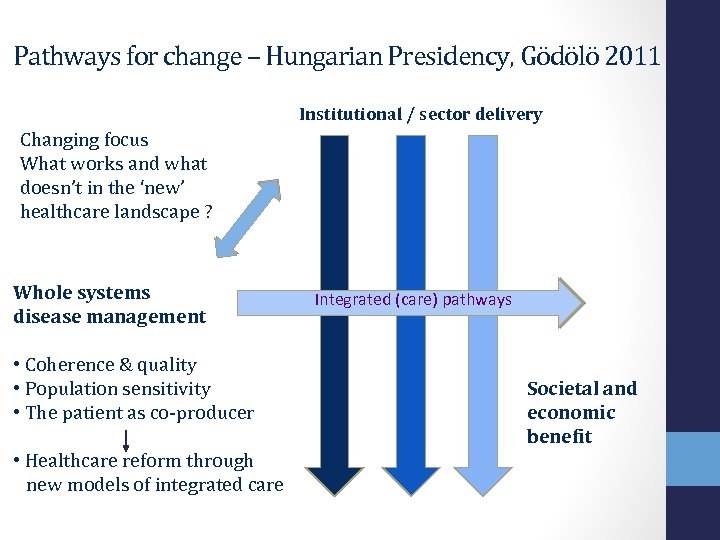 Pathways for change – Hungarian Presidency, Gödölö 2011 Institutional / sector delivery Changing focus What works and what doesn’t in the ‘new’ healthcare landscape ? Whole systems disease management • Coherence & quality • Population sensitivity • The patient as co-producer • Healthcare reform through new models of integrated care Integrated (care) pathways Societal and economic benefit
 New models of care A clear EU Council policy lead “Consider innovative approaches and models of care responding to challenges and develop future long-term health sector strategies with the aim of moving away from hospital centered systems towards integrated care systems, enhancing equitable access to high quality care and reducing inequalities” EU Council 6 th June 2011
 EU Council - The High level Reflection Process • At its meeting on 6 June 2011 the Council adopted conclusions "Towards modern, responsive and sustainable health systems”. As discussed at: • the Working Party on Public Health at Senior Level on 18 March 2011 • informal meeting of Ministers of health held in Gödölö on 4 -5 April 2011. • To achieve the objective expressed above, the Council invited Member States and the Commission to initiate a reflection process under the auspices of the Working Party on Public Health at Senior Level aiming to identify effective ways of investing in health, so as to pursue modern, responsive and sustainable health systems”. This decision also changes the boundary lines on subsidiarity in the health sector
 EU Council High Level Reflection Process Two SF related sub-groups – a two year programme 1. “Enhancing the adequate representation of health in the framework of the Europe 2020 Strategy and in the process of the European Semester” – led by DG Sanco 1. “Defining success factors for the effective use of Structural Funds for health investments” - led by Hungary • “Very early progress should be made on key deliverables” • “Identifying “common sense success factors”, which should be present in advance as to guarantee effective investments from the Structural Funds in the health sector”
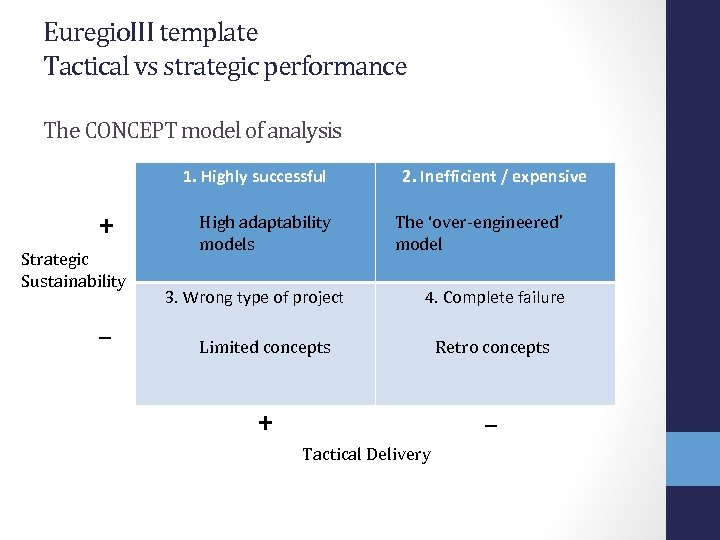 Euregio. III template Tactical vs strategic performance The CONCEPT model of analysis 1. Highly successful + Strategic Sustainability _ High adaptability models 3. Wrong type of project 2. Inefficient / expensive The ‘over-engineered’ model 4. Complete failure Limited concepts Retro concepts + _ Tactical Delivery
 Structural Fund processes – illustrative Euregio III evidence from past and current programmes • A predisposition to mono-focus stand-alone projects • limitations of the process - including expertise • A tendency towards ‘opportunistic’ emphasis on headlined elements of policy and guidance • Ticking the process boxes • Tactical benefit is often at the expense of sustainable strategic value – sometimes justified by circumstance • Problems of concept development and planning and implementation through weak stakeholder engagement and commitment • Notable lack of relevant technical rigour e. g. lifecycle economics
 Further key issues • “Strategic mimicry – strategy often loosely coupled with the problem and mainly focused on the elaboration of attractive project ideas often without an adequate or reliable evidence base” • “Lack of strategic integrative coordination” – masterplanning • Return on Investment (ROI) - A ‘free goods’ culture – SF projects tend to compare badly with the ‘business sector’ • Over-ambition with regard to project expectation and delivery, including planning and implementation timetables • Political ownership, leadership and continuity – and knowledge
 Delivering Strategic success OECD, EU and USAID (etc) success criteria In order to succeed strategically, five success criteria need to be satisfied. The project’s intended effect should achieve: • • • Relevance - the effect should be achieved in time Effectiveness - there should be measurable beneficial effect Impact - the project should deliver affordable optimal value Efficiency - the project should generate (benchmarked) cost value Sustainability - the positive effects should be sustained, and • There should be no adverse effects • These would seem to represent a useful set of “common sense success factors” – under discussion • Euregio III - very few SF case studies met all five criteria
 The high level reflection process provides a new window of opportunity to shape the future of healthcare in Europe Applying SF to strike a balance between investments that offer societal benefit and those that relieve severe economic pressures is a difficult challenge e. Health must deliver realisable added value that contributes to the twin aims of social cohesion and economic growth
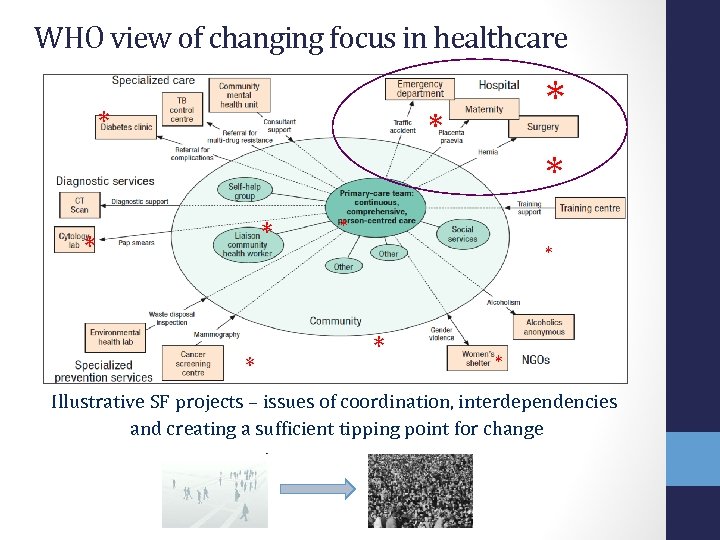 WHO view of changing focus in healthcare * * * Illustrative SF projects – issues of coordination, interdependencies and creating a sufficient tipping point for change
 e. Health – delivering the promise
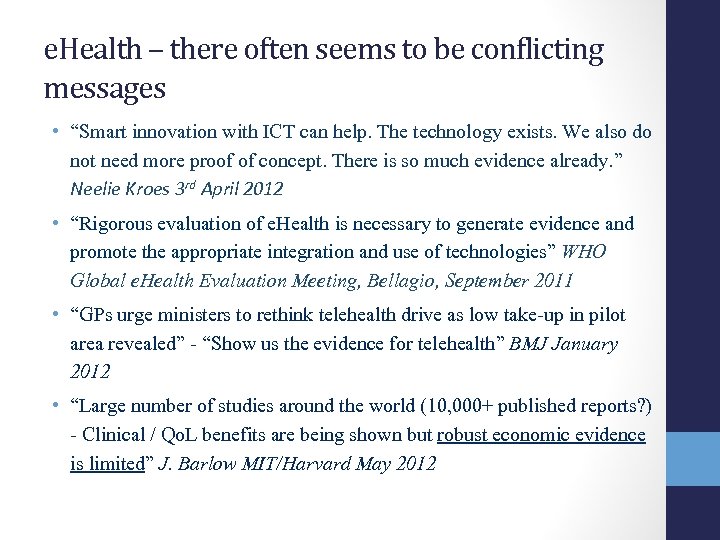 e. Health – there often seems to be conflicting messages • “Smart innovation with ICT can help. The technology exists. We also do not need more proof of concept. There is so much evidence already. ” Neelie Kroes 3 rd April 2012 • “Rigorous evaluation of e. Health is necessary to generate evidence and promote the appropriate integration and use of technologies” WHO Global e. Health Evaluation Meeting, Bellagio, September 2011 • “GPs urge ministers to rethink telehealth drive as low take-up in pilot area revealed” - “Show us the evidence for telehealth” BMJ January 2012 • “Large number of studies around the world (10, 000+ published reports? ) - Clinical / Qo. L benefits are being shown but robust economic evidence is limited” J. Barlow MIT/Harvard May 2012
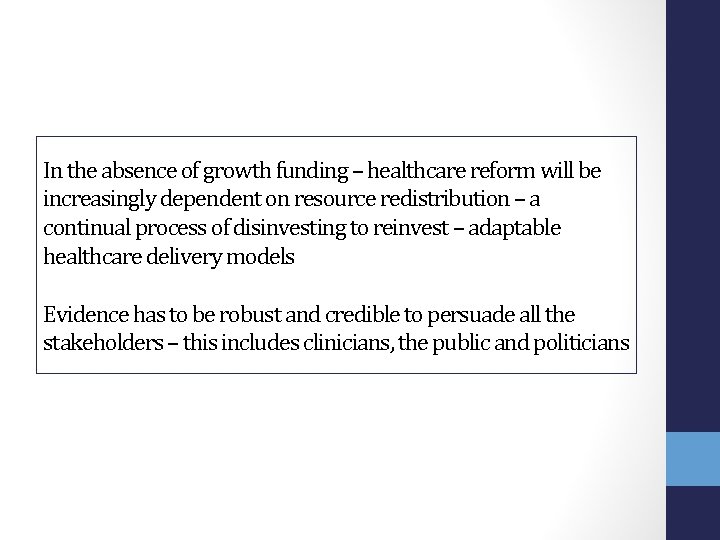 In the absence of growth funding – healthcare reform will be increasingly dependent on resource redistribution – a continual process of disinvesting to reinvest – adaptable healthcare delivery models Evidence has to be robust and credible to persuade all the stakeholders – this includes clinicians, the public and politicians
 Achieving measurable return on investment major weakness of capital projects – are there similar lessons for e. Health? • EU Cohesion Policy - “Enhancing access to ICT • that there should measurable targets for outcome of intervention in e. Health” • e. Health is about making the workforce more effective and efficient and helping patients to help themselves • de-facto – this leads to predicting, planning, financing and measuring on the basis of workforce led changes in performance outcomes and levels of patient engagement • Euregio III • Prior and sustained engagement of all stakeholders • Prior and sustained commitment to change A
 Norrbotten County
 Will e. Health (“ever”) fully deliver on the promises? The four mantras in healthcare today • Prevention of ill health is a good thing • Subsidiarity - getting (and keeping) people out of hospital - is also a good thing to do • Integration - across ‘silos’ - will improve (and reform) healthcare efficiency and effectiveness • Patient-centred care is the obvious way to improve quality
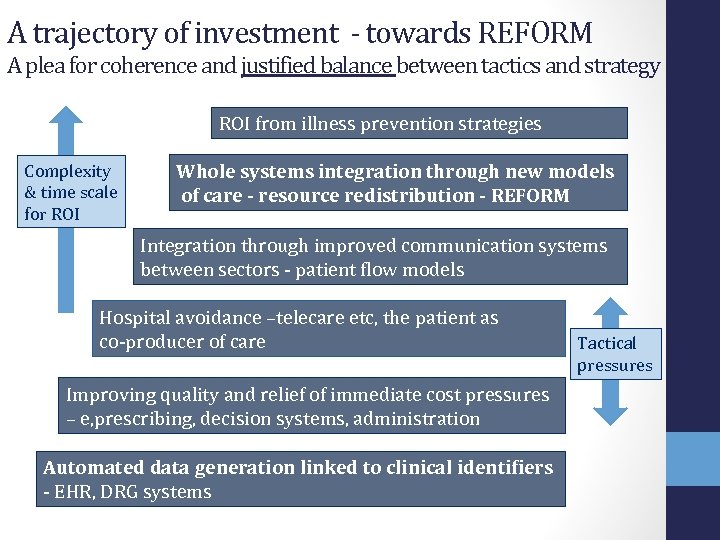 A trajectory of investment - towards REFORM A plea for coherence and justified balance between tactics and strategy ROI from illness prevention strategies Complexity & time scale for ROI Whole systems integration through new models of care - resource redistribution - REFORM Integration through improved communication systems between sectors - patient flow models Hospital avoidance –telecare etc, the patient as co-producer of care Improving quality and relief of immediate cost pressures – e, prescribing, decision systems, administration Automated data generation linked to clinical identifiers - EHR, DRG systems Tactical pressures
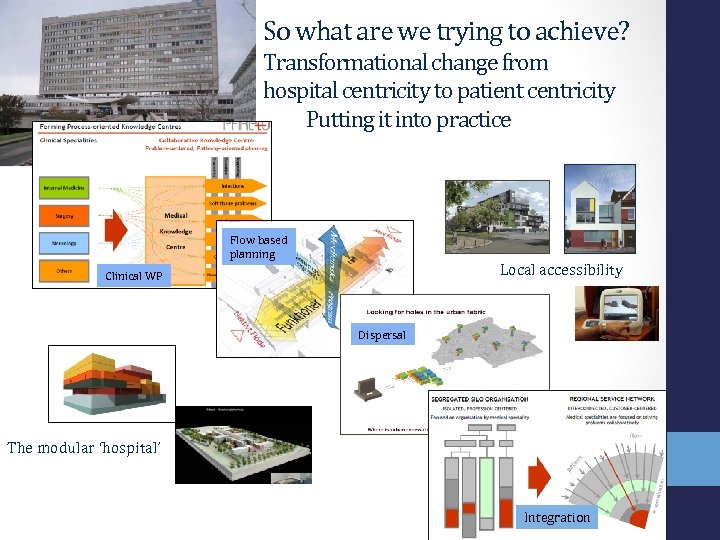 So what are we trying to achieve? Transformational change from hospital centricity to patient centricity Putting it into practice Flow based planning Local accessibility Clinical WP Dispersal The modular ‘hospital’ Integration
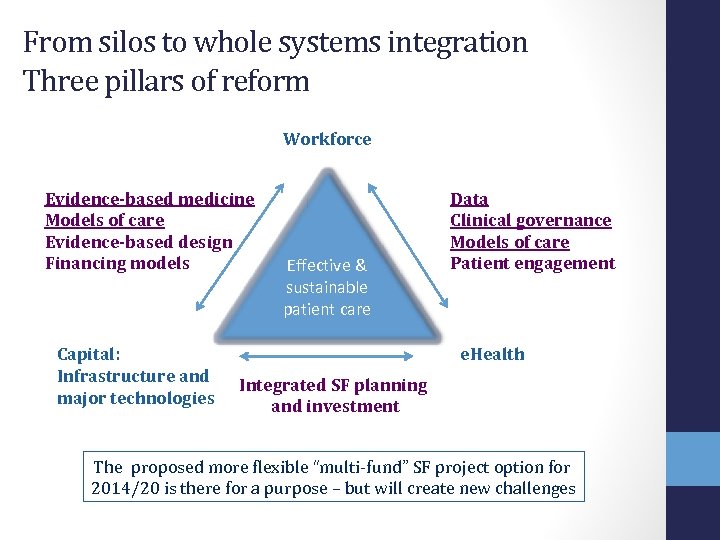 From silos to whole systems integration Three pillars of reform Workforce Evidence-based medicine Models of care Evidence-based design Financing models Capital: Infrastructure and major technologies Effective & sustainable patient care Data Clinical governance Models of care Patient engagement e. Health Integrated SF planning and investment The proposed more flexible “multi-fund” SF project option for 2014/20 is there for a purpose – but will create new challenges
 Towards integration Shared values need to transcend sectoral interests & We must start talking a common language we can all understand
 Conclusions – e. Health as a critical factor in ‘future health’ • We appear to have an unaffordable and unsustainable model of healthcare that will begin to have an adverse impact on society and the economy unless corrective action is taken – new strategies • We had money to spend but failed to join up the dots, often because of partisan interests, tactical pressures and active inertia • There is a clear EU Council policy lead, reflective of the economic climate - integration and reform. Proposed SF conditionality & process shifts are aimed at promoting and strengthening these objectives • Health reform aimed at the twin targets of social cohesion and the economy will remain central to the forthcoming SF programme cycle – but we need to provide better impact evidence - results.
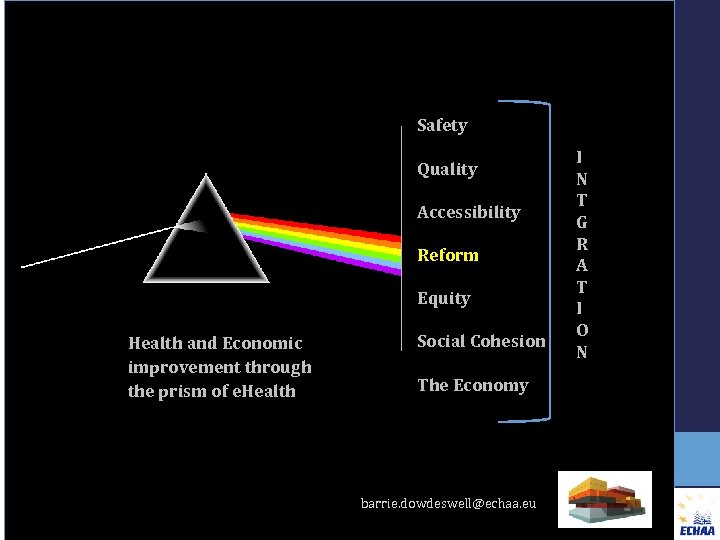 Safety Quality Accessibility Reform Equity Health and Economic improvement through the prism of e. Health Social Cohesion The Economy barrie. dowdeswell@echaa. eu I N T G R A T I O N
 Annexes • Cohesion Policy • Europe 2020 • Fitting it together – how provisions and guidelines fit into overarching health strategy • Other funding options
 EU Structural Funds – annexes for later reading Cohesion policy guidelines & Europe 2020 - HEALTH (per se) is not a thematic or flagship priority but is featured in specific contributing terms: Cohesion Policy refers to: • "The existence of a national or regional strategy for health ensuring access to quality health services and economic sustainability: • contains coordinated measures to improve access to quality health services; • contains measures to stimulate efficiency in the health sector, including deployment of effective innovative: technologies, service delivery models and infrastructure; • contains a monitoring and review system. ”
 There is more • “A Member State or region has adopted a framework outlining available budgetary resources for health care“ • Annex IV notes under Enhancing access to ICT “that there should measurable targets for outcome of intervention in e. Health” • Under Promoting employment, active and healthy ageing is mentioned as a priority - as contributing to sustaining and improving the scale and scope of the employment pool We might reasonably conclude that health has sufficient reference points within the Cohesion Policy to ensure access to SF. But health will be in direct and vigorous competition from more obvious economy related priorities which may also be flagship initiatives – and then there are the conditionalities.
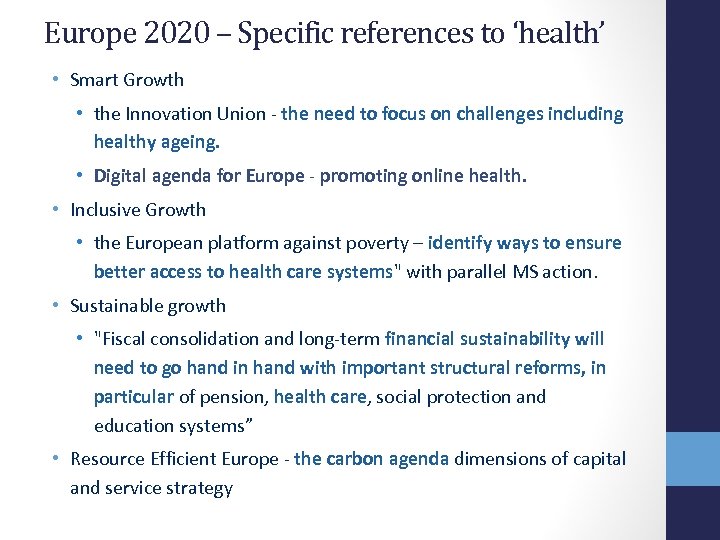 Europe 2020 – Specific references to ‘health’ • Smart Growth • the Innovation Union - the need to focus on challenges including healthy ageing. • Digital agenda for Europe - promoting online health. • Inclusive Growth • the European platform against poverty – identify ways to ensure better access to health care systems" with parallel MS action. • Sustainable growth • "Fiscal consolidation and long-term financial sustainability will need to go hand in hand with important structural reforms, in particular of pension, health care, social protection and education systems” • Resource Efficient Europe - the carbon agenda dimensions of capital and service strategy
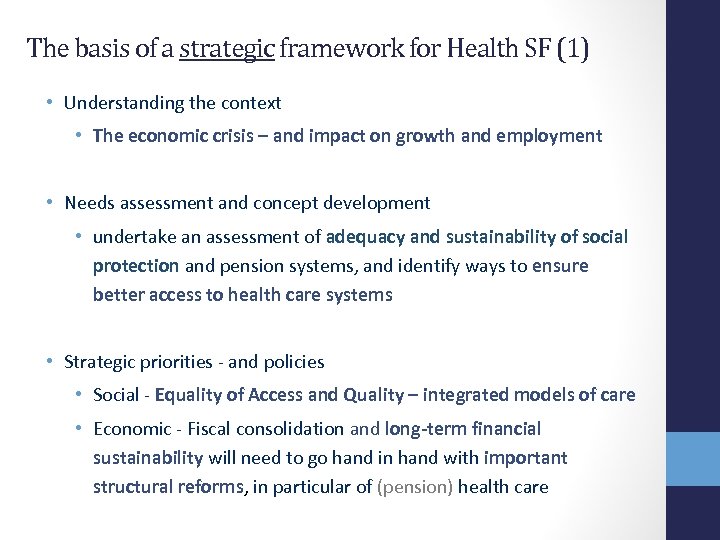 The basis of a strategic framework for Health SF (1) • Understanding the context • The economic crisis – and impact on growth and employment • Needs assessment and concept development • undertake an assessment of adequacy and sustainability of social protection and pension systems, and identify ways to ensure better access to health care systems • Strategic priorities - and policies • Social - Equality of Access and Quality – integrated models of care • Economic - Fiscal consolidation and long-term financial sustainability will need to go hand in hand with important structural reforms, in particular of (pension) health care
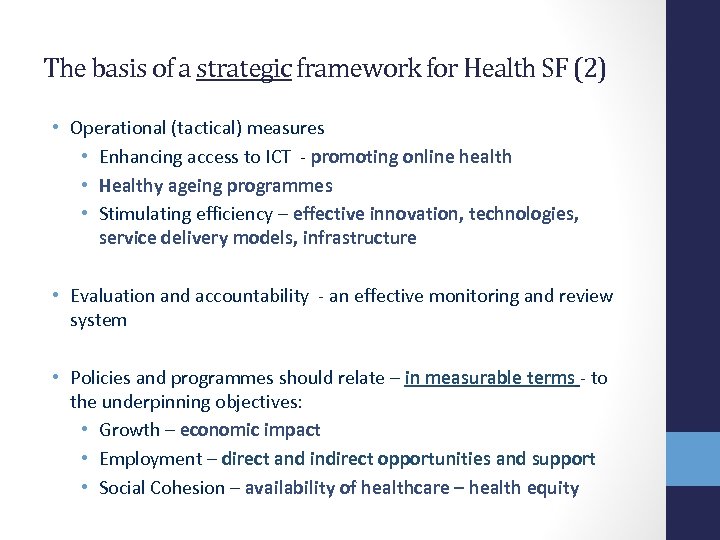 The basis of a strategic framework for Health SF (2) • Operational (tactical) measures • Enhancing access to ICT - promoting online health • Healthy ageing programmes • Stimulating efficiency – effective innovation, technologies, service delivery models, infrastructure • Evaluation and accountability - an effective monitoring and review system • Policies and programmes should relate – in measurable terms - to the underpinning objectives: • Growth – economic impact • Employment – direct and indirect opportunities and support • Social Cohesion – availability of healthcare – health equity
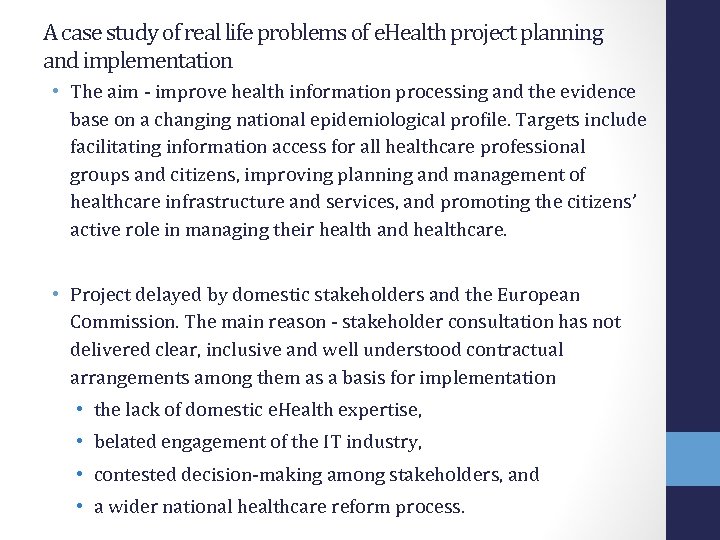 A case study of real life problems of e. Health project planning and implementation • The aim - improve health information processing and the evidence base on a changing national epidemiological profile. Targets include facilitating information access for all healthcare professional groups and citizens, improving planning and management of healthcare infrastructure and services, and promoting the citizens’ active role in managing their health and healthcare. • Project delayed by domestic stakeholders and the European Commission. The main reason - stakeholder consultation has not delivered clear, inclusive and well understood contractual arrangements among them as a basis for implementation • the lack of domestic e. Health expertise, • belated engagement of the IT industry, • contested decision-making among stakeholders, and • a wider national healthcare reform process.
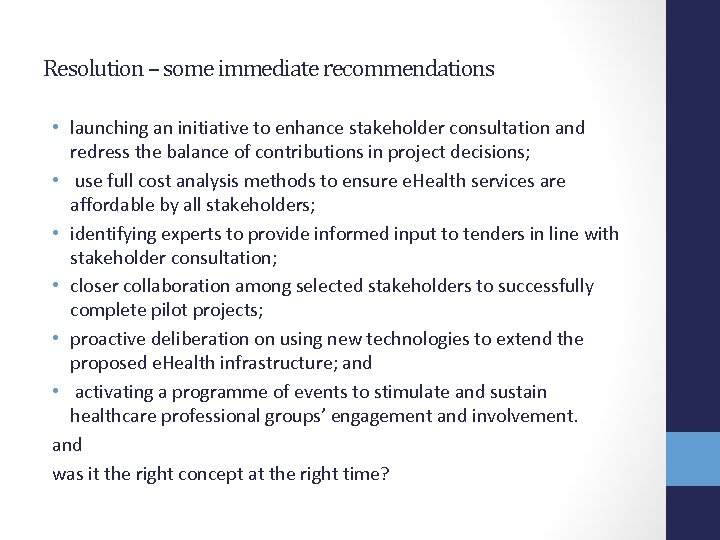 Resolution – some immediate recommendations • launching an initiative to enhance stakeholder consultation and redress the balance of contributions in project decisions; • use full cost analysis methods to ensure e. Health services are affordable by all stakeholders; • identifying experts to provide informed input to tenders in line with stakeholder consultation; • closer collaboration among selected stakeholders to successfully complete pilot projects; • proactive deliberation on using new technologies to extend the proposed e. Health infrastructure; and • activating a programme of events to stimulate and sustain healthcare professional groups’ engagement and involvement. and was it the right concept at the right time?
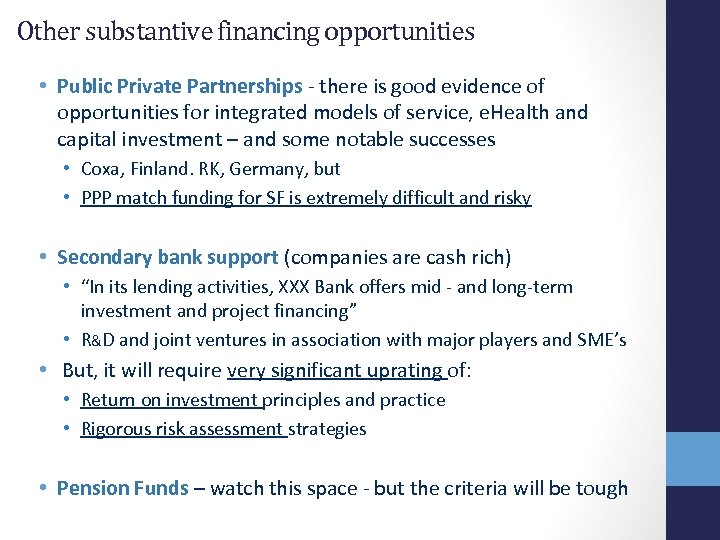 Other substantive financing opportunities • Public Private Partnerships - there is good evidence of opportunities for integrated models of service, e. Health and capital investment – and some notable successes • Coxa, Finland. RK, Germany, but • PPP match funding for SF is extremely difficult and risky • Secondary bank support (companies are cash rich) • “In its lending activities, XXX Bank offers mid - and long-term investment and project financing” • R&D and joint ventures in association with major players and SME’s • But, it will require very significant uprating of: • Return on investment principles and practice • Rigorous risk assessment strategies • Pension Funds – watch this space - but the criteria will be tough