 Скачать презентацию Strong foundations Early childhood care and education Global
73e3ceff14eacf0e23f12af350cdae13.ppt
- Количество слайдов: 41



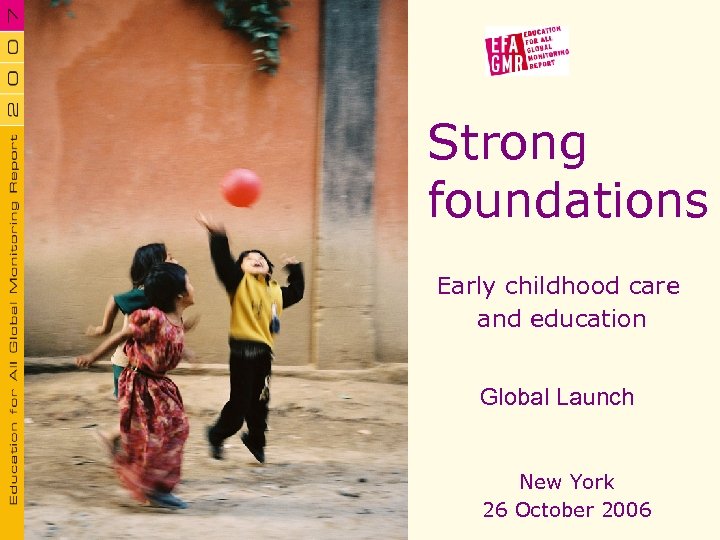
Strong foundations Early childhood care and education Global Launch New York 26 October 2006
About the Report Evidence and analysis for policy and action § Prepared by an independent team based at UNESCO Paris § Funded by nine bilateral donors, advised by an editorial board § Charts progress toward the six EFA goals § Assesses aid to education § Highlights effective policies and practices to accelerate progress § Draws attention to emerging challenges § Four reports since 2002: § § Overall trends Gender Quality Literacy 2
Education for All Dakar Goals and Millennium Development Goals EFA Goals MDGs 1. Expand improve comprehensive early childhood care and education 1. Eradicate extreme poverty and hunger 2. Universal primary education by 2015 3. Learning and life skills programmes for youth and adults 4. 50% increase in adult literacy rates by 2015 5. Gender parity by 2005 and gender equality by 2015 6. Improving quality of education 2. Achieve universal primary education 3. Promote gender equality and empower women 4. Reduce child mortality, and other health goals No country in need should be denied international assistance 3
Presentation roadmap § Education for All Overview § The Primary Education, Quality, Gender and Literacy Goals § Early Childhood Care and Education § International Aid for Education § Agenda for the Future 4
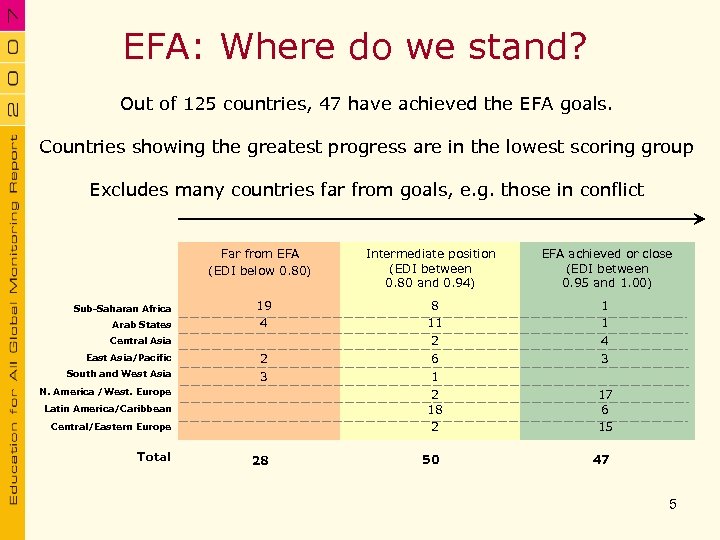
EFA: Where do we stand? Out of 125 countries, 47 have achieved the EFA goals. Countries showing the greatest progress are in the lowest scoring group Excludes many countries far from goals, e. g. those in conflict Far from EFA (EDI below 0. 80) Sub-Saharan Africa Arab States 19 4 Central Asia East Asia/Pacific South and West Asia 2 3 N. America /West. Europe Latin America/Caribbean Central/Eastern Europe Total 28 Intermediate position (EDI between 0. 80 and 0. 94) EFA achieved or close (EDI between 0. 95 and 1. 00) 8 11 2 6 1 2 18 2 1 1 4 17 6 15 50 47 3 5
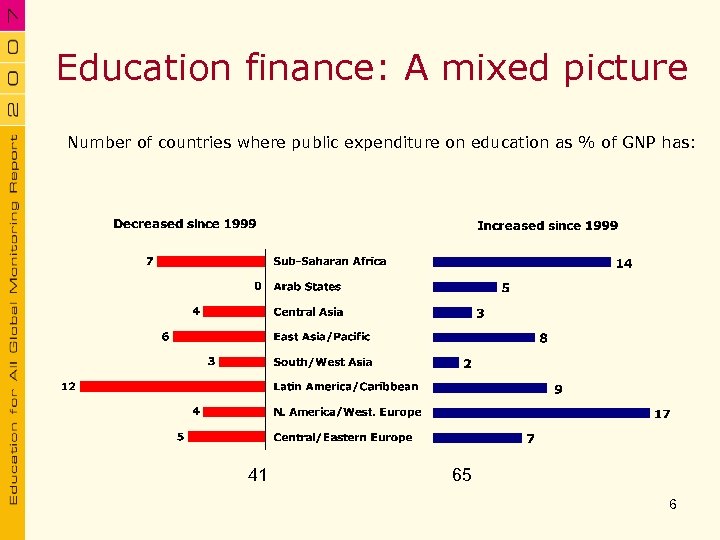
Education finance: A mixed picture Number of countries where public expenditure on education as % of GNP has: 41 65 6
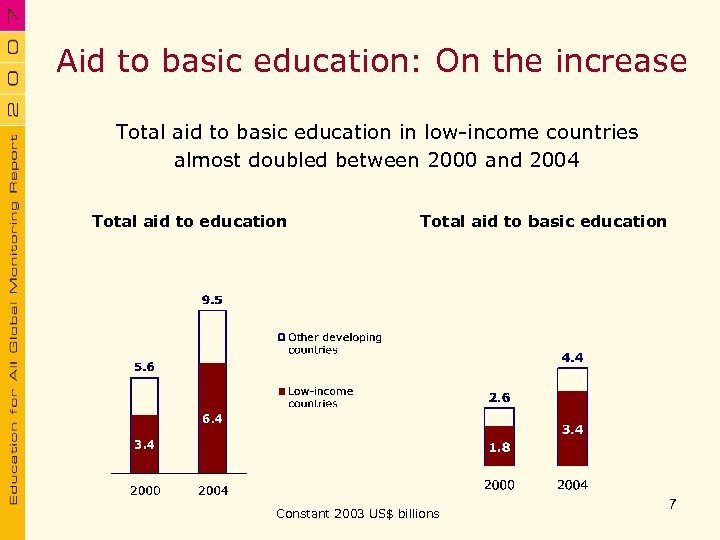
Aid to basic education: On the increase Total aid to basic education in low-income countries almost doubled between 2000 and 2004 Total aid to education Total aid to basic education Constant 2003 US$ billions 7
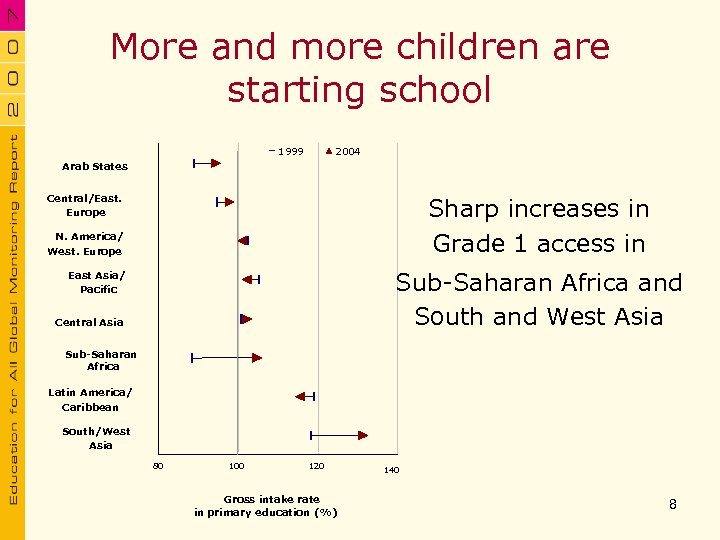
More and more children are starting school 1999 2004 Arab States Central/East. Europe Sharp increases in Grade 1 access in N. America/ West. Europe Sub-Saharan Africa and South and West Asia East Asia/ Pacific Central Asia Sub-Saharan Africa Latin America/ Caribbean South/West Asia 80 100 120 Gross intake rate in primary education (%) 140 8
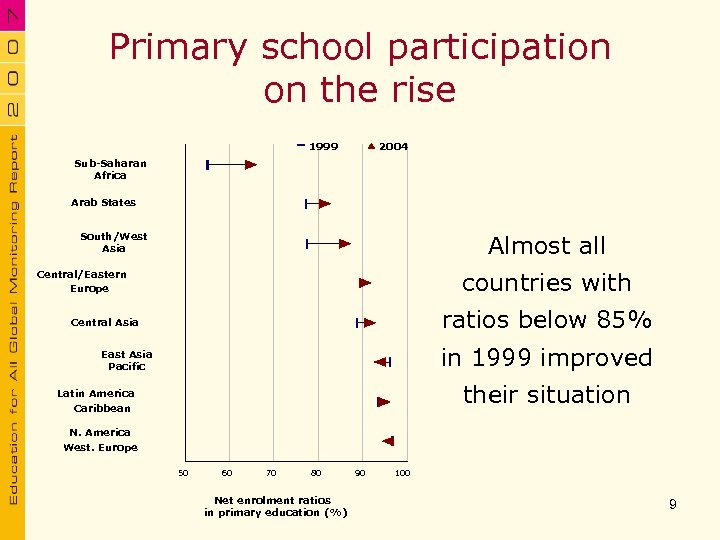
Primary school participation on the rise 1999 2004 Sub-Saharan Africa Arab States Almost all South/West Asia countries with Central/Eastern Europe ratios below 85% Central Asia in 1999 improved East Asia Pacific their situation Latin America Caribbean N. America West. Europe 50 60 70 80 Net enrolment ratios in primary education (%) 90 100 9
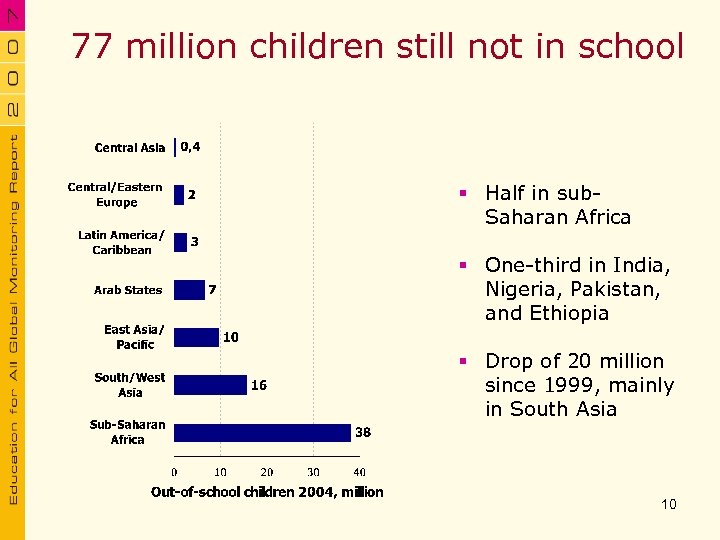
77 million children still not in school § Half in sub. Saharan Africa § One-third in India, Nigeria, Pakistan, and Ethiopia § Drop of 20 million since 1999, mainly in South Asia 10
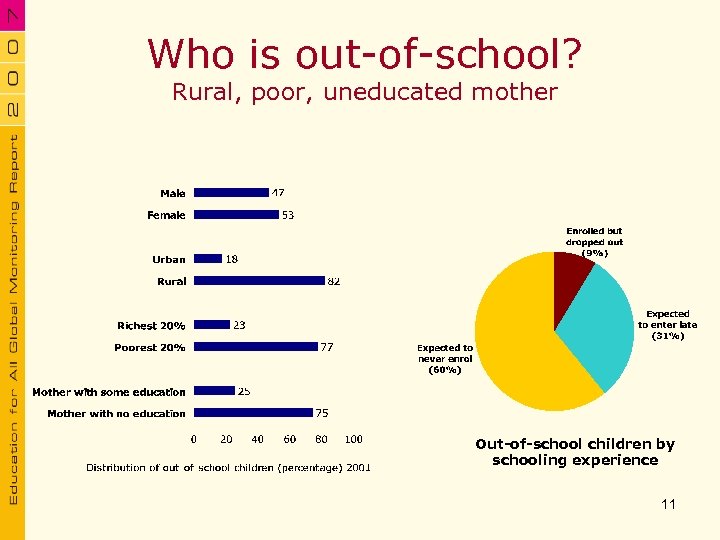
Who is out-of-school? Rural, poor, uneducated mother Out-of-school children by schooling experience 11
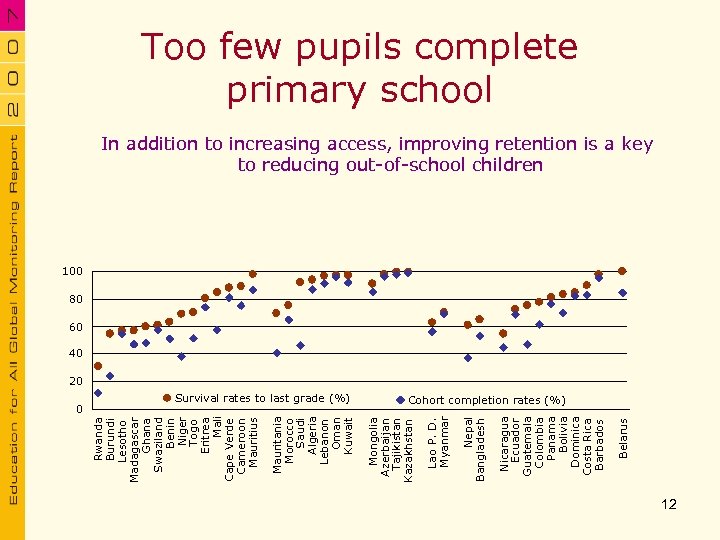
Belarus Nicaragua Ecuador Guatemala Colombia Panama Bolivia Dominica Costa Rica Barbados Nepal Bangladesh Lao P. D. Myanmar Survival rates to last grade (%) Mongolia Azerbaijan Tajikistan Kazakhstan Mauritania Morocco Saudi Algeria Lebanon Oman Kuwait 0 Rwanda Burundi Lesotho Madagascar Ghana Swaziland Benin Niger Togo Eritrea Mali Cape Verde Cameroon Mauritius Too few pupils complete primary school In addition to increasing access, improving retention is a key to reducing out-of-school children 100 80 60 40 20 Cohort completion rates (%) 12
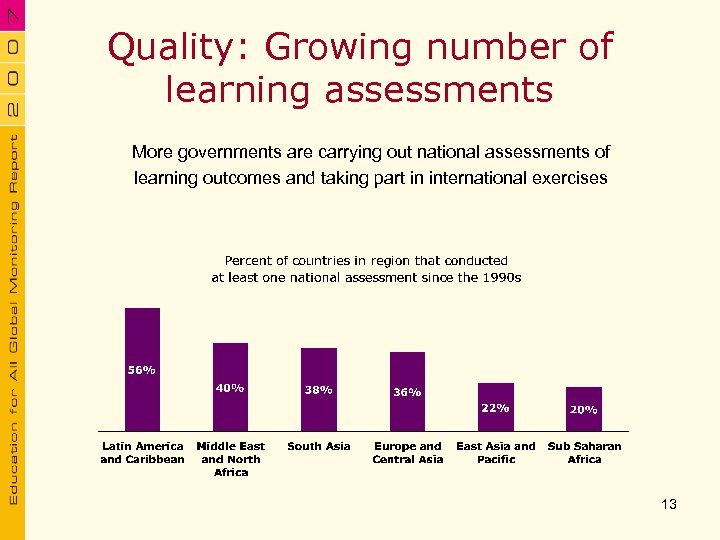
Quality: Growing number of learning assessments More governments are carrying out national assessments of learning outcomes and taking part in international exercises 13
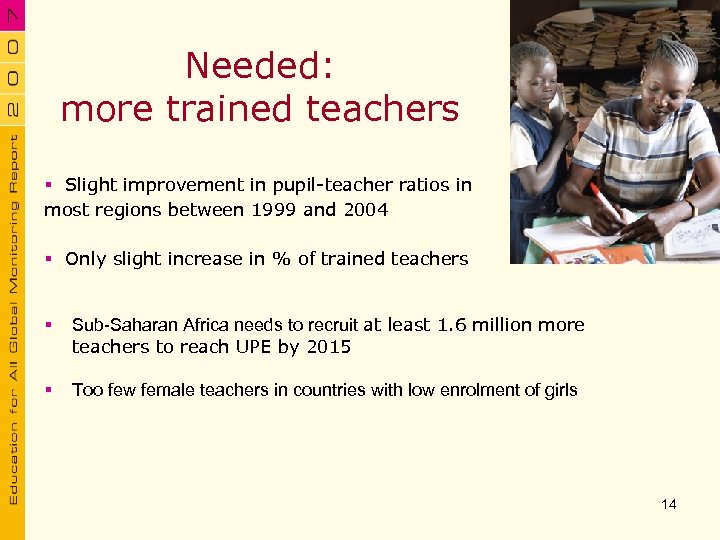
Needed: more trained teachers § Slight improvement in pupil-teacher ratios in most regions between 1999 and 2004 § Only slight increase in % of trained teachers § Sub-Saharan Africa needs to recruit at least 1. 6 million more teachers to reach UPE by 2015 § Too few female teachers in countries with low enrolment of girls 14
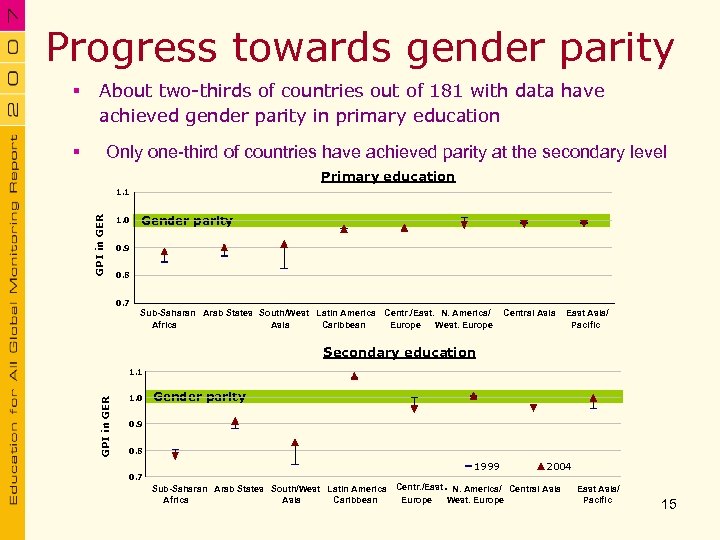
Progress towards gender parity § About two-thirds of countries out of 181 with data have achieved gender parity in primary education § Only one-third of countries have achieved parity at the secondary level Primary education GPI in GER 1. 1 1. 0 Gender parity 0. 9 0. 8 0. 7 Sub-Saharan Arab States South/West Latin America Centr. /East. N. America/ Africa Asia Caribbean Europe West. Europe Central Asia East Asia/ Pacific Secondary education GPI in GER 1. 1 1. 0 Gender parity 0. 9 0. 8 0. 7 1999 . 2004 Sub-Saharan Arab States South/West Latin America Centr. /East N. America/ Central Asia Africa Asia Caribbean Europe West. Europe East Asia/ Pacific 15
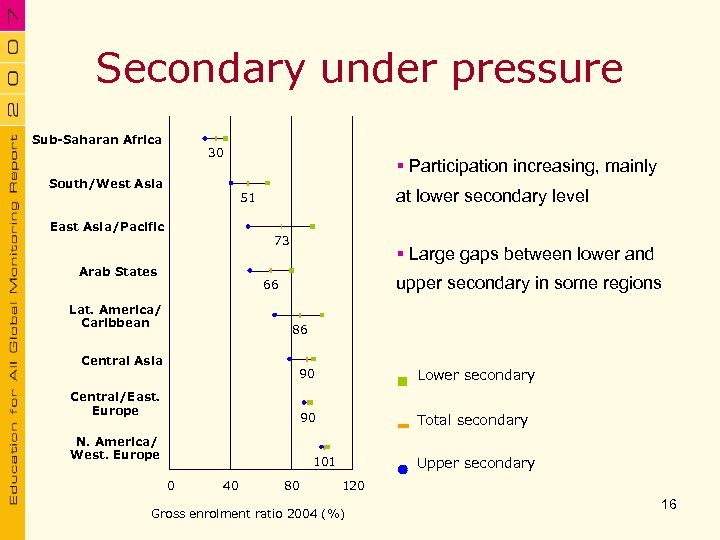
Secondary under pressure Sub-Saharan Africa 30 § Participation increasing, mainly South/West Asia at lower secondary level 51 East Asia/Pacific 73 Arab States § Large gaps between lower and upper secondary in some regions 66 Lat. America/ Caribbean 86 Central Asia 90 Lower secondary 90 Total secondary Central/East. Europe N. America/ West. Europe 101 0 40 80 Upper secondary 120 Gross enrolment ratio 2004 (%) 16
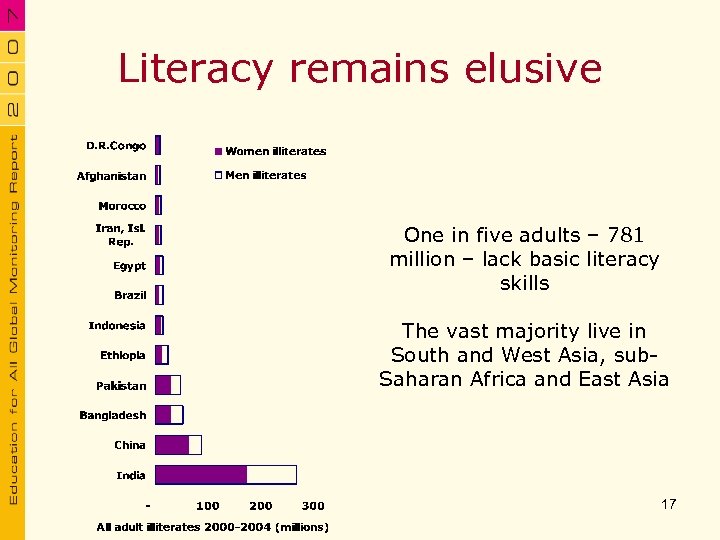
Literacy remains elusive One in five adults – 781 million – lack basic literacy skills The vast majority live in South and West Asia, sub. Saharan Africa and East Asia 17
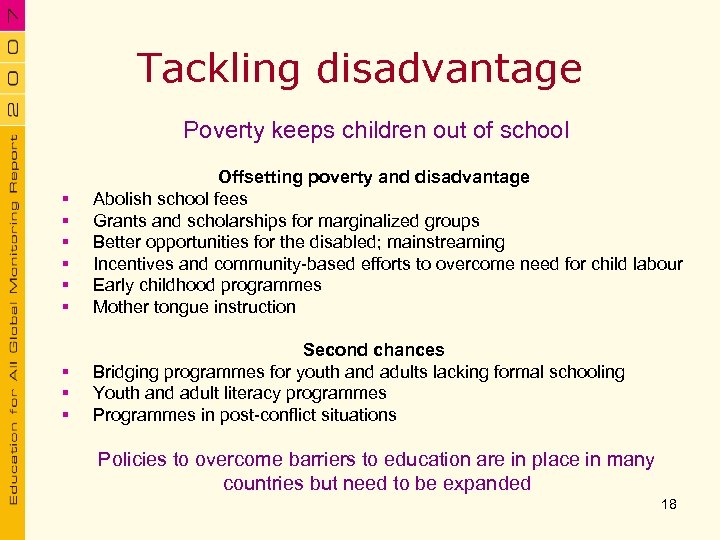
Tackling disadvantage Poverty keeps children out of school § § § Offsetting poverty and disadvantage Abolish school fees Grants and scholarships for marginalized groups Better opportunities for the disabled; mainstreaming Incentives and community-based efforts to overcome need for child labour Early childhood programmes Mother tongue instruction § § § Second chances Bridging programmes for youth and adults lacking formal schooling Youth and adult literacy programmes Programmes in post-conflict situations Policies to overcome barriers to education are in place in many countries but need to be expanded 18
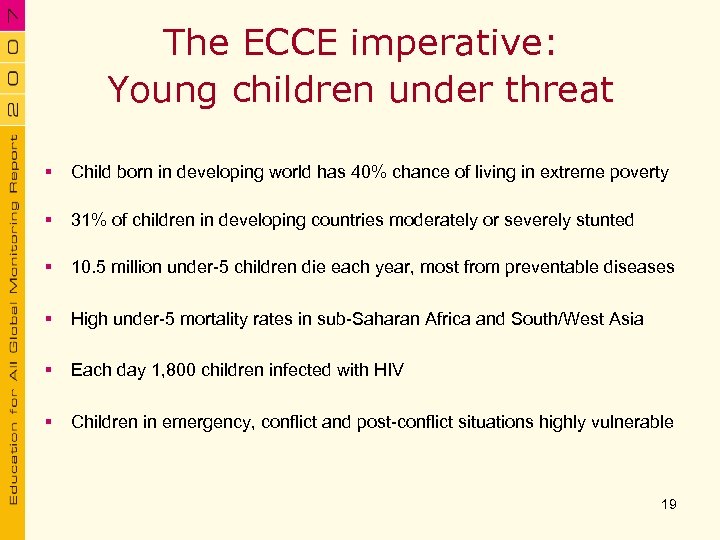
The ECCE imperative: Young children under threat § Child born in developing world has 40% chance of living in extreme poverty § 31% of children in developing countries moderately or severely stunted § 10. 5 million under-5 children die each year, most from preventable diseases § High under-5 mortality rates in sub-Saharan Africa and South/West Asia § Each day 1, 800 children infected with HIV § Children in emergency, conflict and post-conflict situations highly vulnerable 19
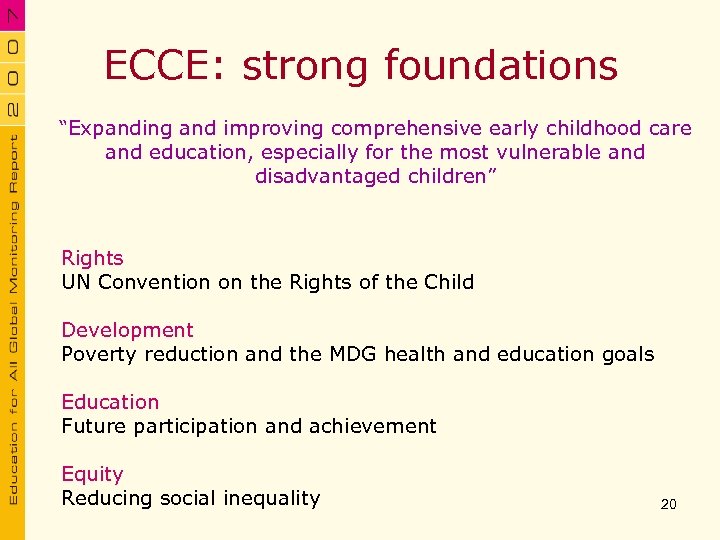
ECCE: strong foundations “Expanding and improving comprehensive early childhood care and education, especially for the most vulnerable and disadvantaged children” Rights UN Convention on the Rights of the Child Development Poverty reduction and the MDG health and education goals Education Future participation and achievement Equity Reducing social inequality 20
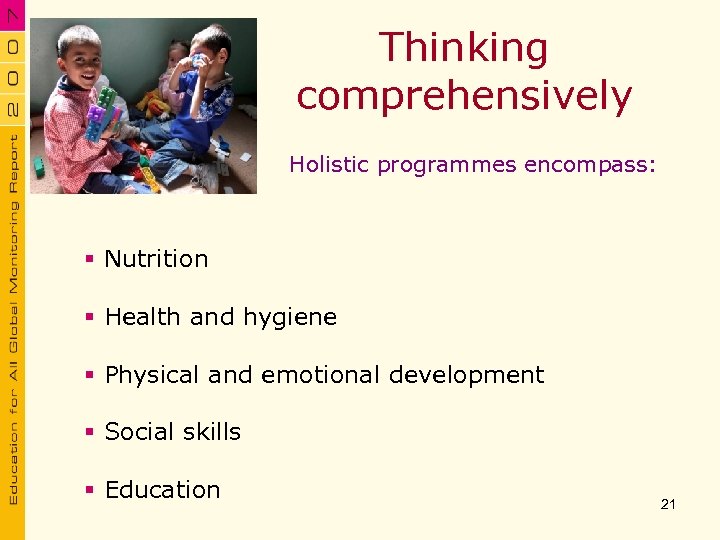
Thinking comprehensively Nutrition Holistic programmes encompass: § Nutrition § Health and hygiene § Physical and emotional development § Social skills § Education 21
Early childhood, nutrition and education Nutrition and Education Reinforce Each Other § Iron, nutrition, deworming and psycho-social stimulation impact on learning § Combining nutrition and education has larger and longer-lasting impact Early Childhood Participation Improves Later Education § Access to primary school § Retention in primary school § Lower repetition § Better language development § Higher achievement 22
Acting early pays off ‘It is a rare public policy initiative that promotes fairness and social justice and at the same time promotes productivity in the economy and in society at large. Investing in disadvantaged young children is such a policy. ’ James Heckman, Nobel economics prizewinner § Most rigorous studies on benefits come from developed countries § U. S. High/Scope Perry study of low-income African-American children § higher IQ at age 5 § enhanced success at school § higher earning at age 40 § High returns to programmes in India, Egypt, Colombia, Bolivia § Returns greatest for poorest and most disadvantaged children 23
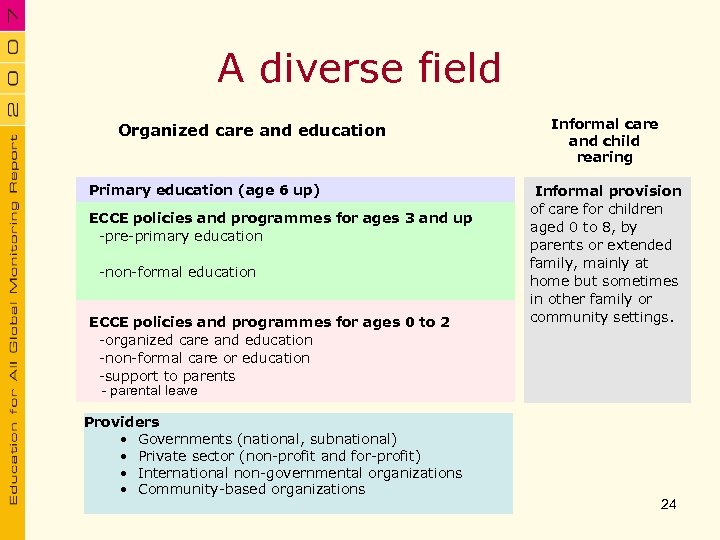
A diverse field Organized care and education Primary education (age 6 up) ECCE policies and programmes for ages 3 and up -pre-primary education -non-formal education ECCE policies and programmes for ages 0 to 2 -organized care and education -non-formal care or education -support to parents - parental leave Providers • Governments (national, subnational) • Private sector (non-profit and for-profit) • International non-governmental organizations • Community-based organizations Informal care and child rearing Informal provision of care for children aged 0 to 8, by parents or extended family, mainly at home but sometimes in other family or community settings. 24
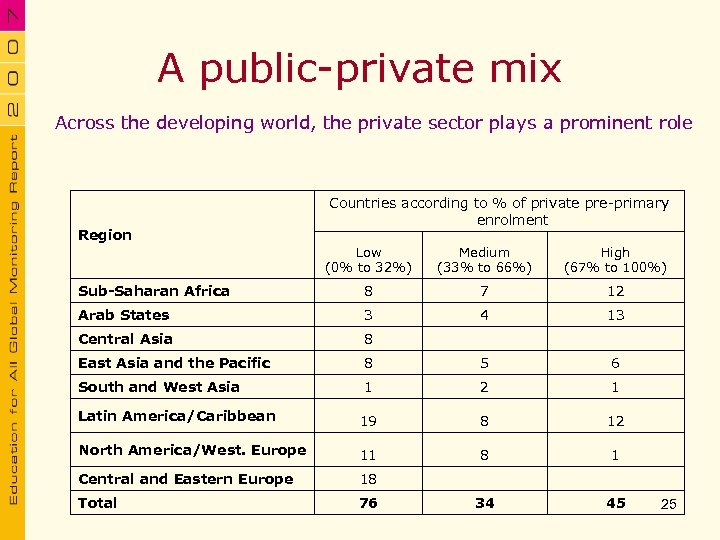
A public-private mix Across the developing world, the private sector plays a prominent role Region Countries according to % of private pre-primary enrolment Low (0% to 32%) Medium (33% to 66%) High (67% to 100%) Sub-Saharan Africa 8 7 12 Arab States 3 4 13 Central Asia 8 East Asia and the Pacific 8 5 6 South and West Asia 1 2 1 Latin America/Caribbean 19 8 12 North America/West. Europe 11 8 1 Central and Eastern Europe 18 Total 76 34 45 25
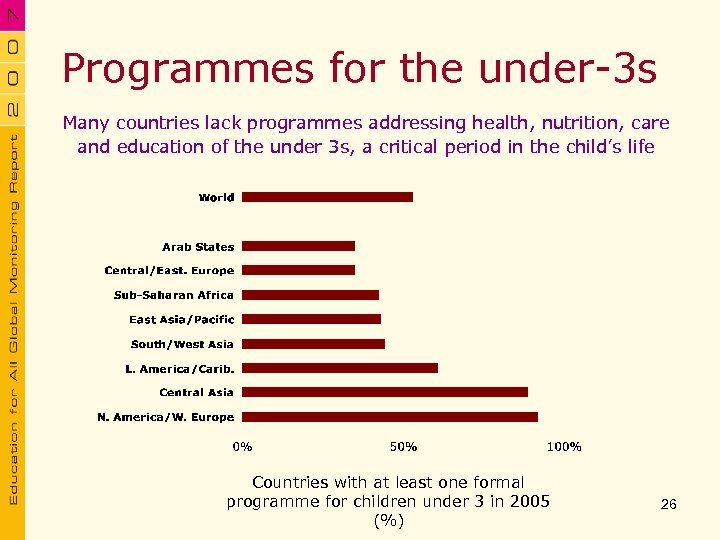
Programmes for the under-3 s Many countries lack programmes addressing health, nutrition, care and education of the under 3 s, a critical period in the child’s life Countries with at least one formal programme for children under 3 in 2005 (%) 26
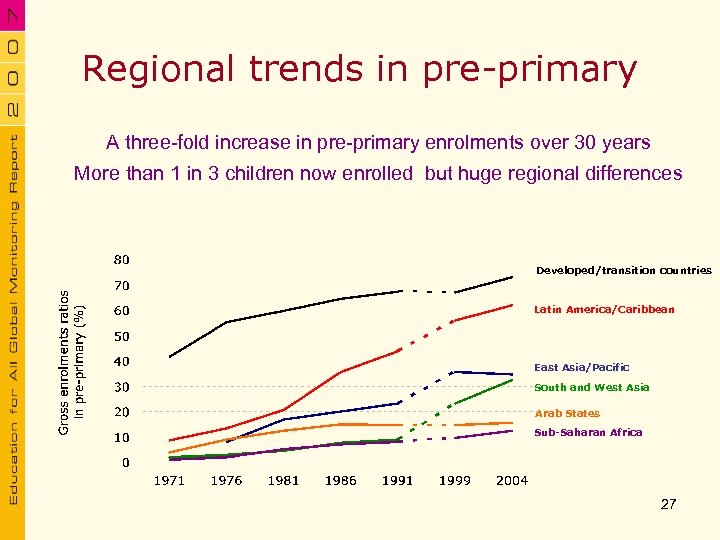
Regional trends in pre-primary A three-fold increase in pre-primary enrolments over 30 years More than 1 in 3 children now enrolled but huge regional differences Developed/transition countries Latin America/Caribbean East Asia/Pacific South and West Asia Arab States Sub-Saharan Africa 27
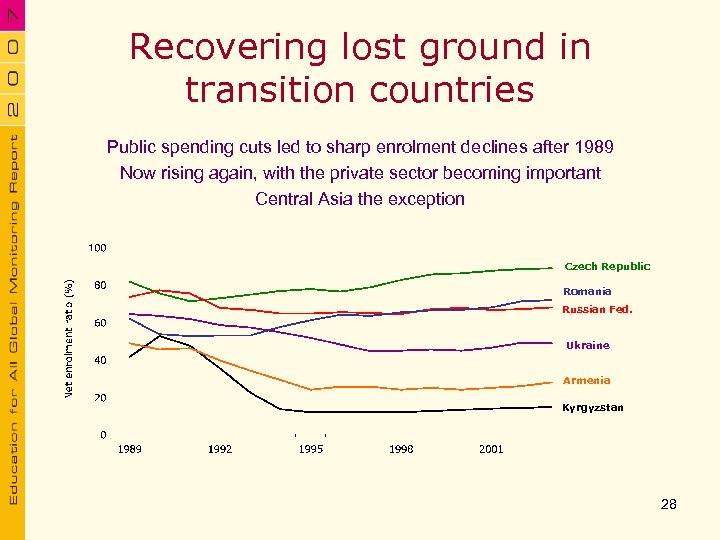
Recovering lost ground in transition countries Public spending cuts led to sharp enrolment declines after 1989 Now rising again, with the private sector becoming important Central Asia the exception Czech Republic Romania Russian Fed. Ukraine Armenia Kyrgyzstan 28
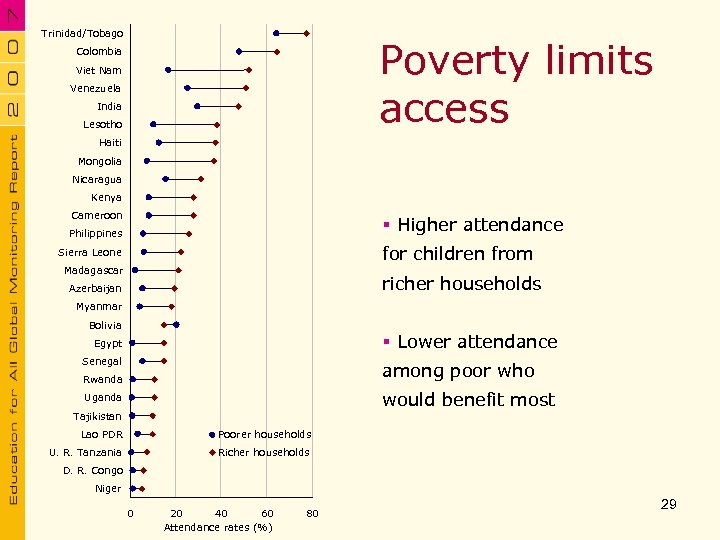
Trinidad/Tobago Poverty limits access Colombia Viet Nam Venezuela India Lesotho Haiti Mongolia Nicaragua Kenya Cameroon § Higher attendance Philippines for children from Sierra Leone Madagascar richer households Azerbaijan Myanmar Bolivia § Lower attendance Egypt Senegal among poor who Rwanda would benefit most Uganda Tajikistan Lao PDR Poorer households U. R. Tanzania Richer households D. R. Congo Niger 0 20 40 60 Attendance rates (%) 80 29
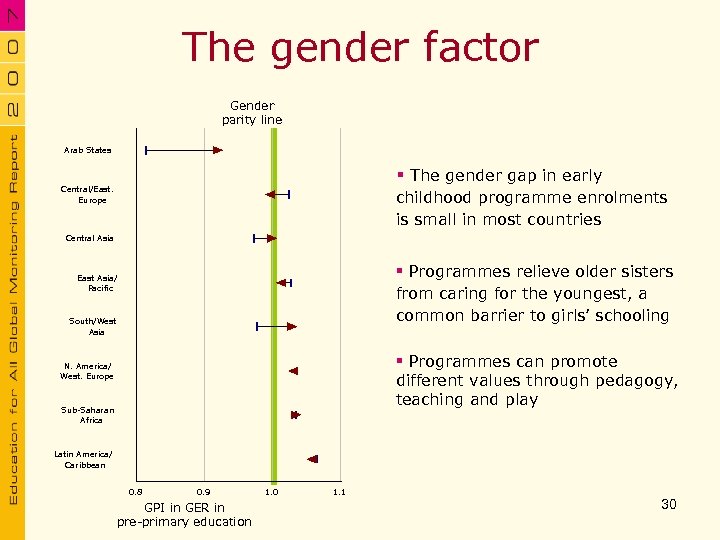
The gender factor Gender parity line Arab States § The gender gap in early Central/East. Europe childhood programme enrolments is small in most countries Central Asia § Programmes relieve older sisters from caring for the youngest, a common barrier to girls’ schooling East Asia/ Pacific South/West Asia § Programmes can promote different values through pedagogy, teaching and play N. America/ West. Europe Sub-Saharan Africa Latin America/ Caribbean 0. 8 0. 9 GPI in GER in pre-primary education 1. 0 1. 1 30
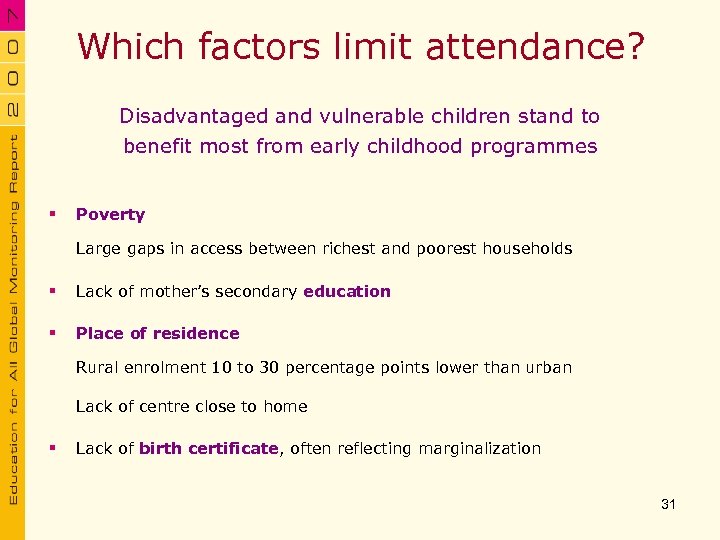
Which factors limit attendance? Disadvantaged and vulnerable children stand to benefit most from early childhood programmes § Poverty Large gaps in access between richest and poorest households § Lack of mother’s secondary education § Place of residence Rural enrolment 10 to 30 percentage points lower than urban Lack of centre close to home § Lack of birth certificate, often reflecting marginalization 31
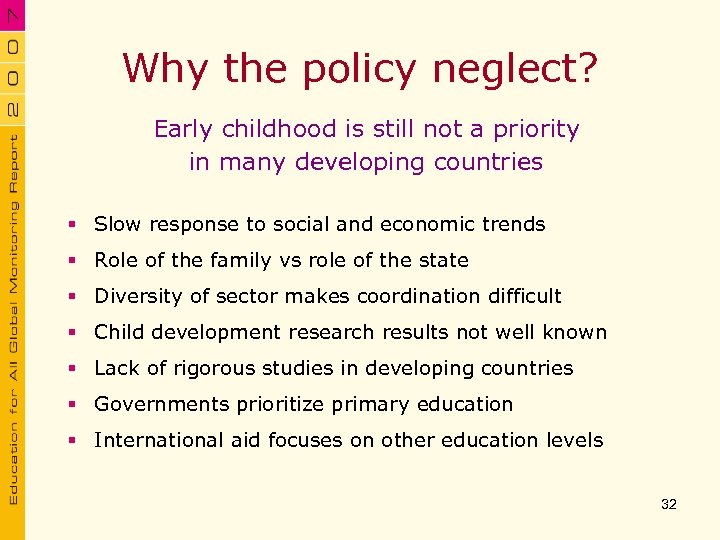
Why the policy neglect? Early childhood is still not a priority in many developing countries § Slow response to social and economic trends § Role of the family vs role of the state § Diversity of sector makes coordination difficult § Child development research results not well known § Lack of rigorous studies in developing countries § Governments prioritize primary education § International aid focuses on other education levels 32
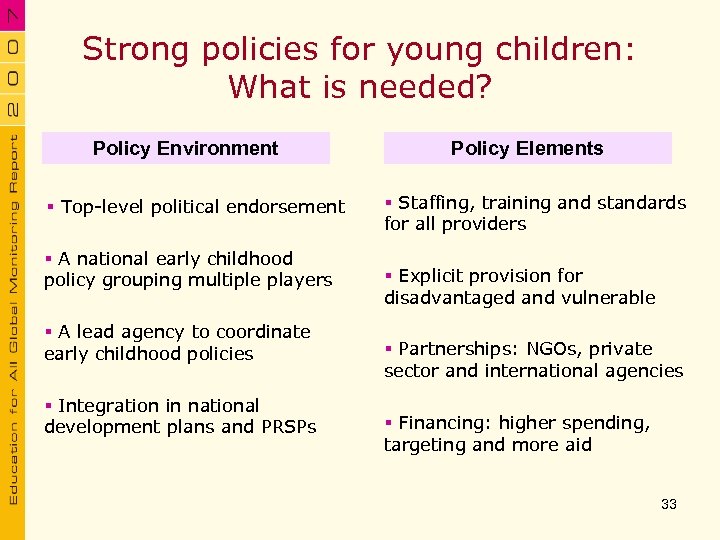
Strong policies for young children: What is needed? Policy Environment § Top-level political endorsement § A national early childhood policy grouping multiple players § A lead agency to coordinate early childhood policies § Integration in national development plans and PRSPs Policy Elements § Staffing, training and standards for all providers § Explicit provision for disadvantaged and vulnerable § Partnerships: NGOs, private sector and international agencies § Financing: higher spending, targeting and more aid 33
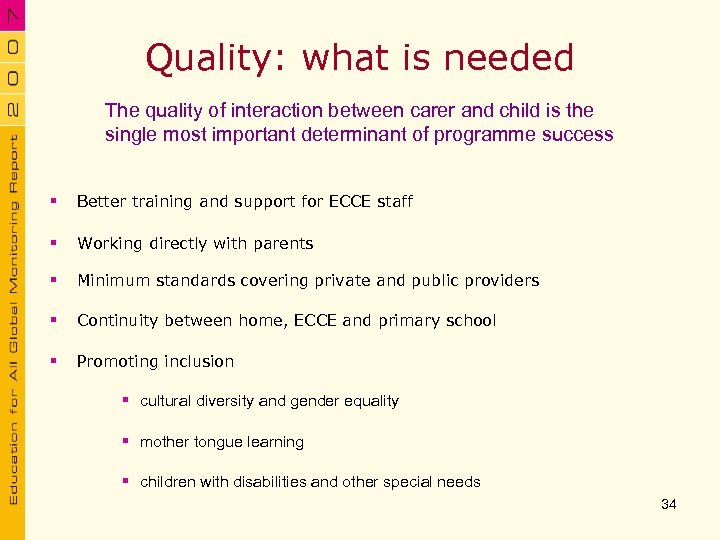
Quality: what is needed The quality of interaction between carer and child is the single most important determinant of programme success § Better training and support for ECCE staff § Working directly with parents § Minimum standards covering private and public providers § Continuity between home, ECCE and primary school § Promoting inclusion § cultural diversity and gender equality § mother tongue learning § children with disabilities and other special needs 34
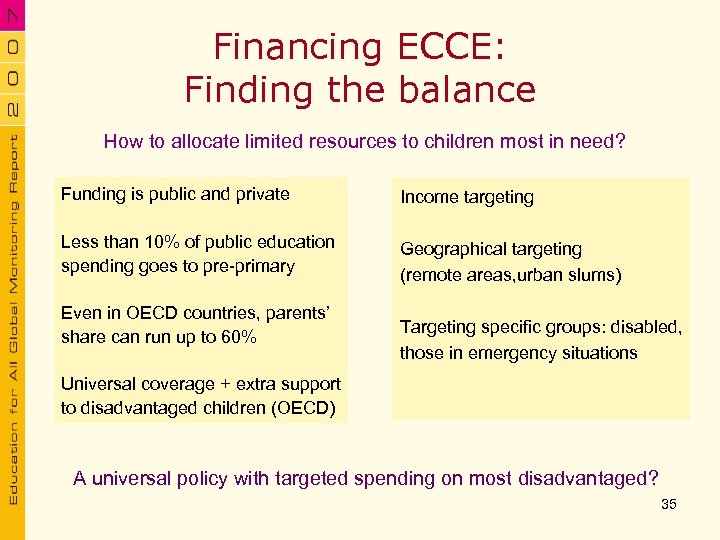
Financing ECCE: Finding the balance How to allocate limited resources to children most in need? Funding is public and private Income targeting Less than 10% of public education spending goes to pre-primary Geographical targeting (remote areas, urban slums) Even in OECD countries, parents’ share can run up to 60% Targeting specific groups: disabled, those in emergency situations Universal coverage + extra support to disadvantaged children (OECD) A universal policy with targeted spending on most disadvantaged? 35
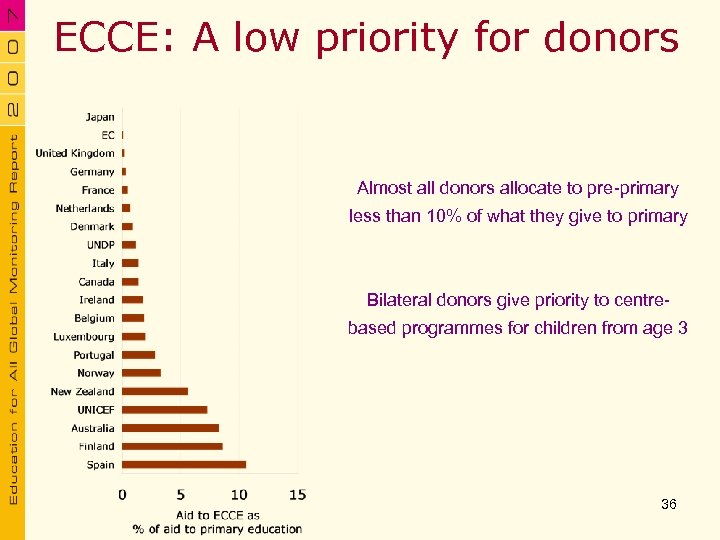
ECCE: A low priority for donors Almost all donors allocate to pre-primary less than 10% of what they give to primary Bilateral donors give priority to centrebased programmes for children from age 3 36
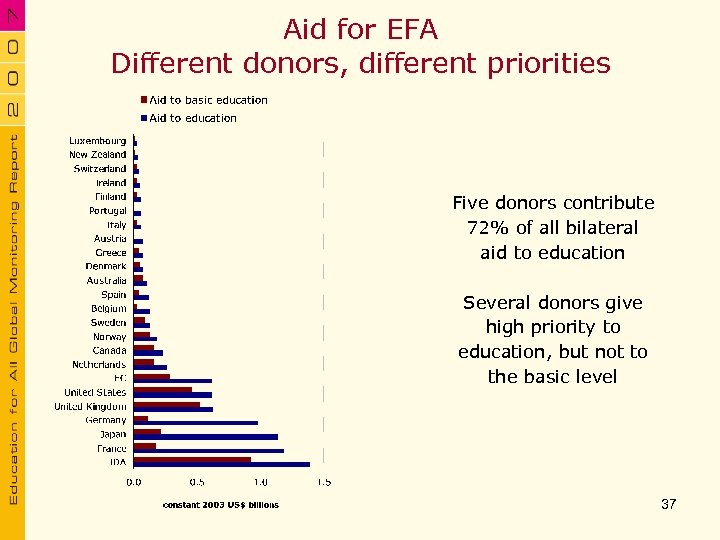
Aid for EFA Different donors, different priorities Five donors contribute 72% of all bilateral aid to education Several donors give high priority to education, but not to the basic level 37
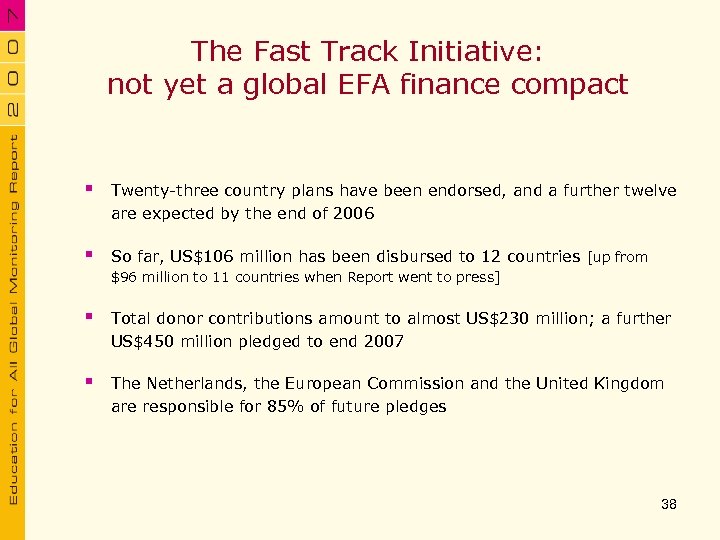
The Fast Track Initiative: not yet a global EFA finance compact § Twenty-three country plans have been endorsed, and a further twelve are expected by the end of 2006 § So far, US$106 million has been disbursed to 12 countries [up from $96 million to 11 countries when Report went to press] § Total donor contributions amount to almost US$230 million; a further US$450 million pledged to end 2007 § The Netherlands, the European Commission and the United Kingdom are responsible for 85% of future pledges 38
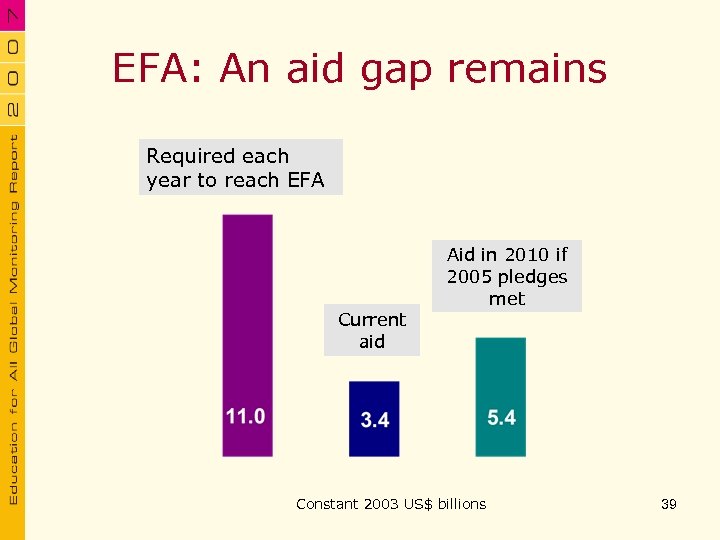
EFA: An aid gap remains Required each year to reach EFA Current aid Aid in 2010 if 2005 pledges met Constant 2003 US$ billions 39
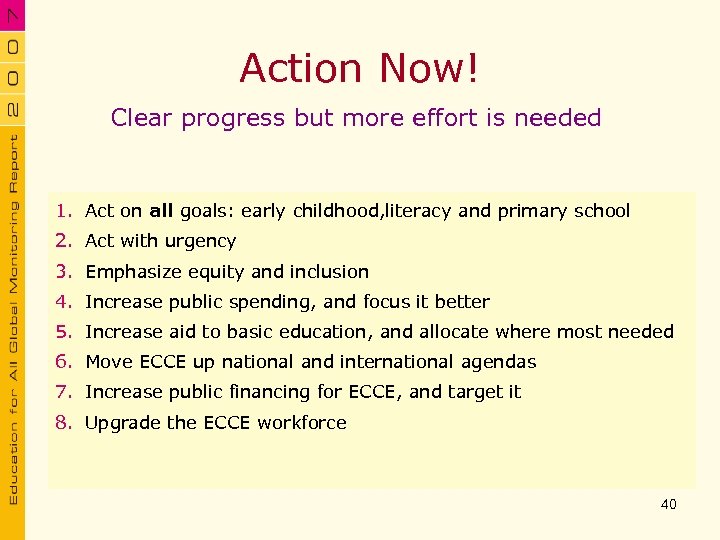
Action Now! Clear progress but more effort is needed 1. Act on all goals: early childhood, literacy and primary school 2. Act with urgency 3. Emphasize equity and inclusion 4. Increase public spending, and focus it better 5. Increase aid to basic education, and allocate where most needed 6. Move ECCE up national and international agendas 7. Increase public financing for ECCE, and target it 8. Upgrade the ECCE workforce 40
Contact Information EFA Global Monitoring Report Team c/o UNESCO 7, place de Fontenoy 75352 Paris 07 France efareport@unesco. org www. efareport. unesco. org 41
Скачать презентацию Strong foundations Early childhood care and education Global
73e3ceff14eacf0e23f12af350cdae13.ppt