


 Скачать презентацию Strictly Private and Confidential Investment Funds Conference Qatar
4d0a5041eebb7fdda3643b1622e34611.ppt
- Количество слайдов: 6
 Strictly Private and Confidential Investment Funds Conference Qatar, 27 November 2007 Islamic Funds – Landscape and Evolution Geert Bossuyt Managing Director, Head of Middle East Structuring, Global Markets, Deutsche Bank AG
 Islamic liquidity is huge and growing n Moody's suggests that there are currently 250 Islamic mutual funds operating with USD 300 bn of assets, and 300 Islamic financial institutions holding more than USD 250 bn of assets around the world. Another USD 200 bn of assets are estimated to be held in the Islamic "windows" - or subsets - of conventional banks, such as Western investment banks n The Dubai International Financial Centre (DIFC) estimates the current market for Islamic financial products at USD 260 bn worldwide and forecasts it to grow 12 -15% annually. It estimates current market penetration at 20% of the Arab population, though predicts that number to rise drastically to 50 -60% of total savings held within the next decade n Standard & Poor’s (S&P) estimates Islamic banking assets to comprise roughly 20% of total in Gulf. S&P also estimates that the current size of global Sharia-compliant assets is USD 400 billion, which would be roughly equivalent to 18½% of OIC broad money and roughly 10% of their GDP, and that the potential market for Islamic financial services to be around USD 4 trillion n Mc Kinsey made an analysis (2 years ago) that only about 20% of Muslim population within GCC has at least one Shari’a compliant product. 80% of interviewed Muslim intends to buy Shari’a compliant products if offered at same economic conditions as conventional financial product n The trend? : Conventional investors can buy Islamic products, Islamic investors cannot buy conventional products n Our prediction? : Think about a package of chips in the US. 2
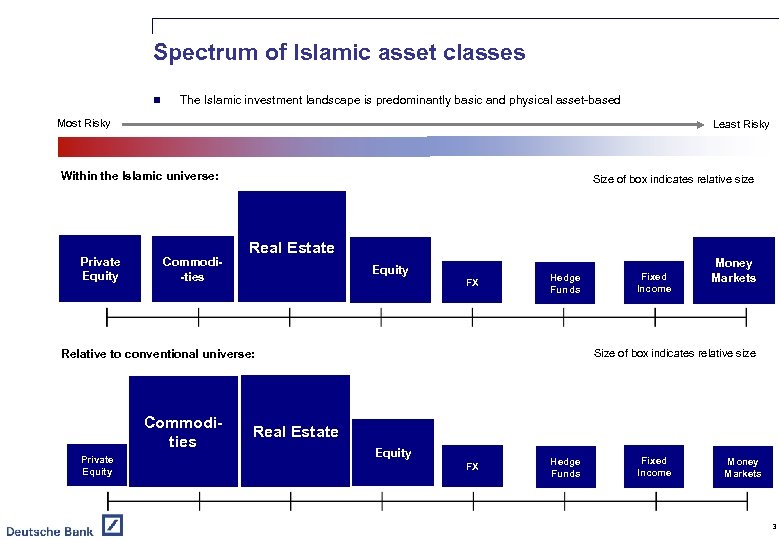 Spectrum of Islamic asset classes n The Islamic investment landscape is predominantly basic and physical asset-based Most Risky Least Risky Within the Islamic universe: Private Equity Commodi-ties Size of box indicates relative size Real Estate Equity FX Hedge Funds Relative to conventional universe: Commodities Private Equity Fixed Income Money Markets Size of box indicates relative size Real Estate Equity FX Hedge Funds Fixed Income Money Markets 3
 Inherent limitations within the industry n Relative to the conventional world, the Islamic fund industry is underdeveloped This is with respect to: Ø Size per fund/liquidity/cost Ø Level of sophistication in the investment process, i. e. the market is still largely dominated by vanilla products Ø Investment spectrum, i. e. menu of choices n Riskier asset classes are relatively overdeveloped; Liquid, low-risk investment solutions are virtually inexistent vis-à-vis potential size of demand n Lack of open architecture n The lack of alternative becomes even more critical given the poor state of the Islamic capital markets allowing the local banks to be the gatekeepers → Potential for diversification within each asset class is very limited compared to conventional counterparts → Efficiency in Islamic asset management is very hard to achieve, given the current tools available → Islamic funds cannot fully accommodate Islamic liquidity 4
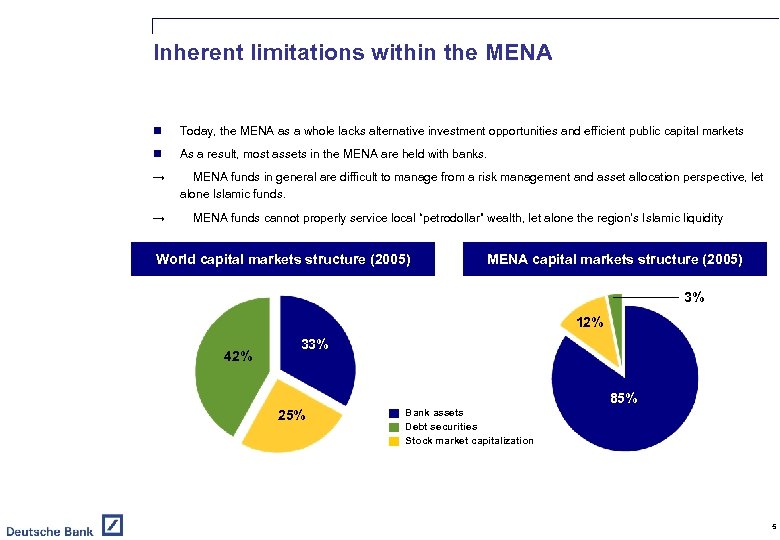 Inherent limitations within the MENA n Today, the MENA as a whole lacks alternative investment opportunities and efficient public capital markets n As a result, most assets in the MENA are held with banks. → MENA funds in general are difficult to manage from a risk management and asset allocation perspective, let alone Islamic funds. → MENA funds cannot properly service local “petrodollar” wealth, let alone the region’s Islamic liquidity World capital markets structure (2005) MENA capital markets structure (2005) 3% 12% 42% 33% 85% 25% Bank assets Debt securities Stock market capitalization 5
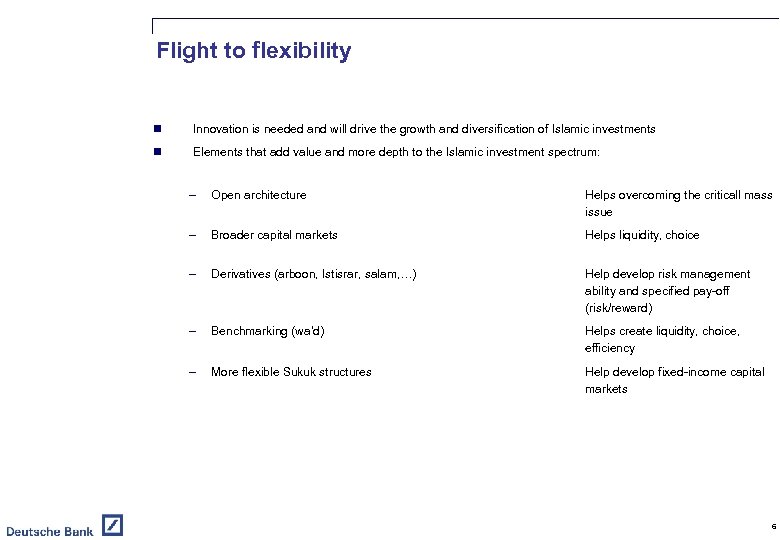 Flight to flexibility n Innovation is needed and will drive the growth and diversification of Islamic investments n Elements that add value and more depth to the Islamic investment spectrum: – Open architecture Helps overcoming the criticall mass issue – Broader capital markets Helps liquidity, choice – Derivatives (arboon, Istisrar, salam, …) Help develop risk management ability and specified pay-off (risk/reward) – Benchmarking (wa’d) Helps create liquidity, choice, efficiency – More flexible Sukuk structures Help develop fixed-income capital markets 6