


Stress Made by: Grozdova Oksana Afg-110
B. A. Bogoroditsky defined stress as an increase of energy, accompanied by an increase of expiratory and articulatory activity.
D. Jones de fined stress as the degree of force, which is accompanied by a strong force of exhalation and gives an impression of loudness.
H. Sweet also stated that stress is connected with the force of breath.
A. C. Gimson admits that a more prominent syllable is accompanied by pitch changes in the voice, quality and quantity of the accented sounds.
Types of Word Stress 1)dynamic, or force stress 2)musical, or tonic 3)quantitative 4)qualitative
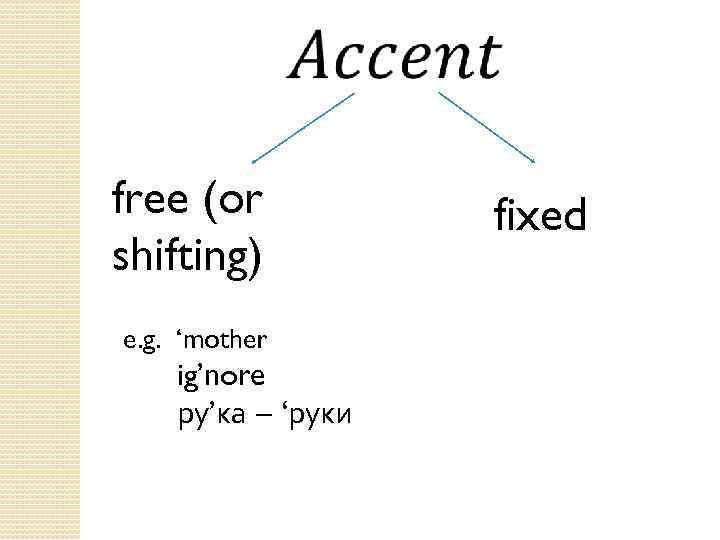
free (or shifting) e. g. ‘mother ig’nore ру’ка – ‘руки fixed
Degrees of the word-stress British phoneticians: 1)primary 2)secondary 3)weak
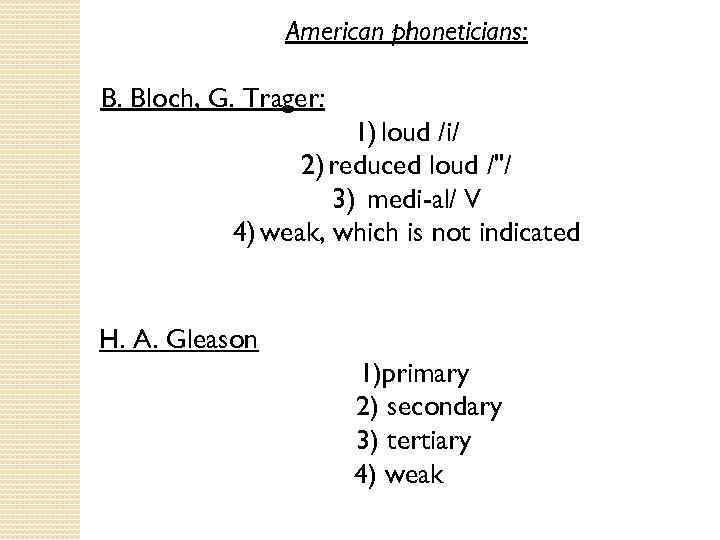
American phoneticians: B. Bloch, G. Trager: 1) loud /i/ 2) reduced loud /"/ 3) medi al/ V 4) weak, which is not indicated H. A. Gleason 1)primary 2) secondary 3) tertiary 4) weak
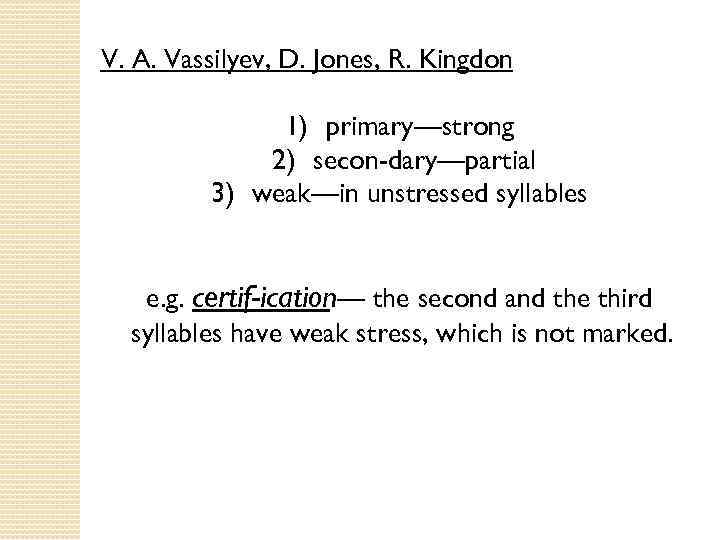
V. A. Vassilyev, D. Jones, R. Kingdon 1) primary—strong 2) secon dary—partial 3) weak—in unstressed syllables e. g. certif ication— the second and the third syllables have weak stress, which is not marked.
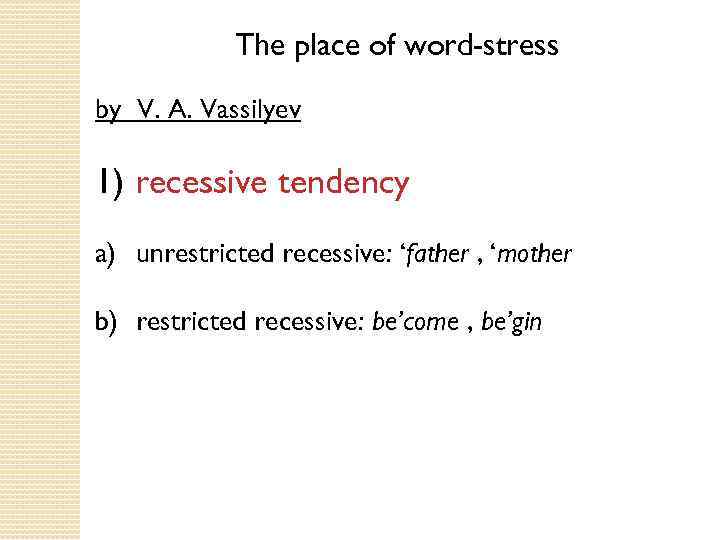
The place of word-stress by V. A. Vassilyev 1) recessive tendency a) unrestricted recessive: ‘father , ‘mother b) restricted recessive: be’come , be’gin
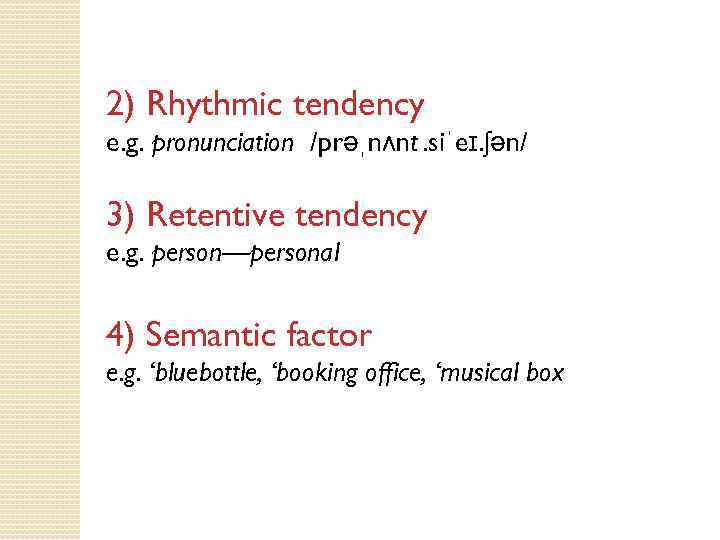
2) Rhythmic tendency e. g. pronunciation /prəˌnʌnt . siˈeɪ. ʃən/ 3) Retentive tendency e. g. person—personal 4) Semantic factor e. g. ‘bluebottle, ‘booking office, ‘musical box
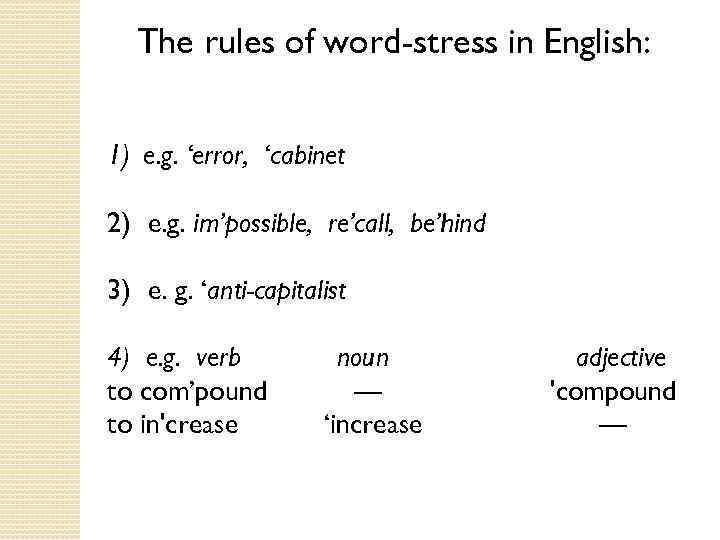
The rules of word-stress in English: 1) e. g. ‘error, ‘cabinet 2) e. g. im’possible, re’call, be’hind 3) e. g. ‘anti-capitalist 4) e. g. verb to com’pound to in'crease noun — ‘increase adjective 'compound —
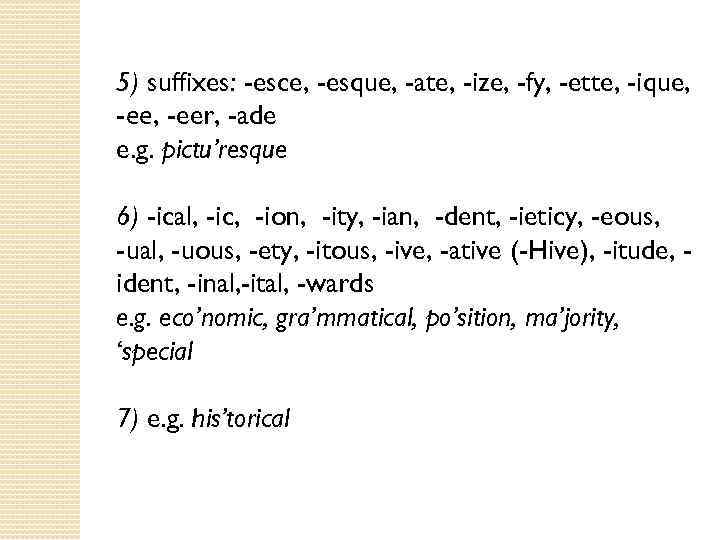
5) suffixes: -esce, -esque, -ate, -ize, -fy, -ette, -ique, -ее, -eer, -ade e. g. pictu’resque 6) -ical, -ic, -ion, -ity, -ian, -dent, -ieticy, -eous, -ual, -uous, -ety, -itous, -ive, -ative (-Hive), -itude, ident, -inal, -ital, -wards e. g. eco’nomic, gra’mmatical, po’sition, ma’jority, ‘special 7) e. g. his’torical
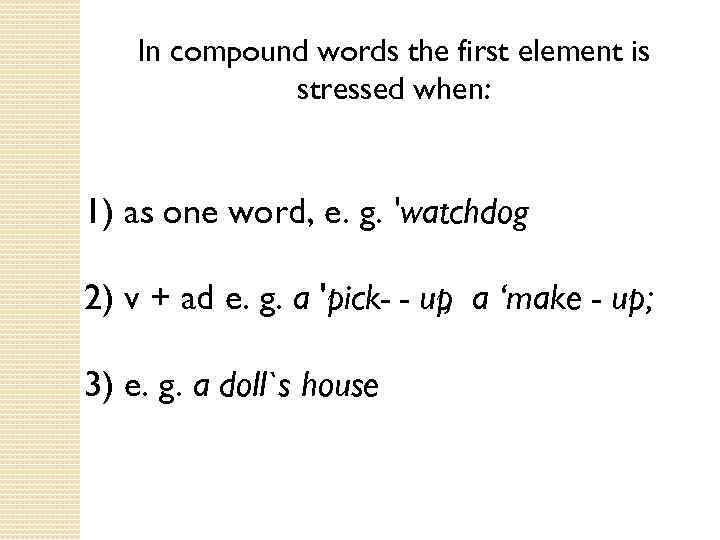
In compound words the first element is stressed when: 1) as one word, e. g. 'watchdog 2) v + ad e. g. a 'pick - up a ‘make - up; , 3) e. g. a doll`s house
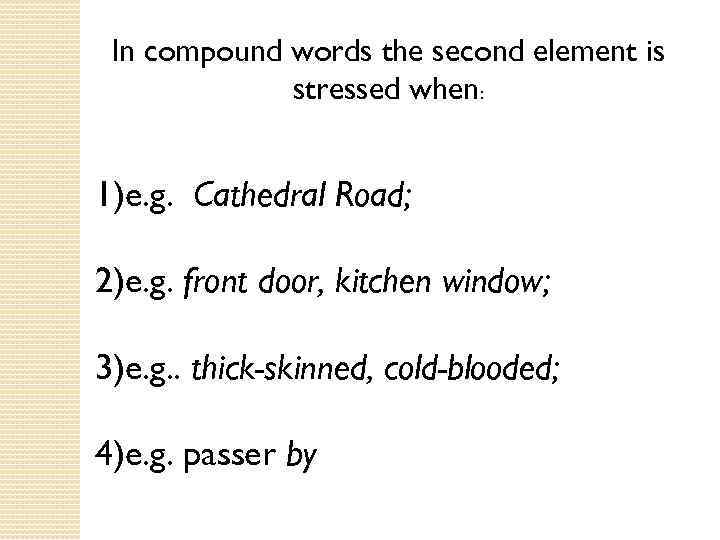
In compound words the second element is stressed when: 1)e. g. Cathedral Road; 2)e. g. front door, kitchen window; 3)e. g. . thick-skinned, cold-blooded; 4)e. g. passer by
Two equal stresses are observed: 1) in composite verbs e. g to give up 2) in numerals from 13 to 19, e. g. sixteen
Thank you for attention
