Скачать презентацию Strengthening social and emotional health Readiness to change
b8909dcf460b7bb7b07746c94ad8638b.ppt
- Количество слайдов: 43

 Strengthening social and emotional health Readiness to change: Implications for improving quality in early care and education Shira M. Peterson, Ph. D. Children’s Institute Rochester, NY © 2009 CHILDREN’S INSTITUTE INC. , 274 N. GOODMAN STREET, SUITE D 103, ROCHESTER, NY 14607 | ALL RIGHTS RESERVED
 Defining the Problem v Need for high-quality care v Challenges for ECE workforce – Financial resources – Psychological well-being – Academic skills – Professional identity – Childrearing beliefs v Existing PD approaches are one-size-fits-all © 2009 CHILDREN’S INSTITUTE INC. , 274 N. GOODMAN STREET, SUITE D 103, ROCHESTER, NY 14607 | ALL RIGHTS RESERVED
 Mentor Observations of ECE Readiness “Absolutely did not want to change” “Change was just too much effort or energy” “Very open to [thinking] about what’s needed in her room” “People who say, ‘Oh, I’m so glad you’re here. . . I need to do this or that or the other. ’” © 2009 CHILDREN’S INSTITUTE INC. , 274 N. GOODMAN STREET, SUITE D 103, ROCHESTER, NY 14607 | ALL RIGHTS RESERVED
 The Change Process v Most systems resist change v Change takes time (3 -5 yrs) v To be sustained, change must be determined self- v Only about 20% of the population are “ready to change” v Programs that are mismatched to stage can actually make outcomes worse (Deci & Ryan, 1985; Loucks-Horsley et al. , 2003; Prochaska & Velicer, 1997) © 2009 CHILDREN’S INSTITUTE INC. , 274 N. GOODMAN STREET, SUITE D 103, ROCHESTER, NY 14607 | ALL RIGHTS RESERVED
 The Transtheoretical Model (TTM) (Prochaska & Diclemente, 1983) v An NIH recommended practice for behavior change programs (Ory, Jordan, & Bazzarre, 2002) v Large evidence base (e. g. , Noar, Benac, & Harris, 2007; Velicer et al. , 1999; 2006) v Wide range of applications v Smoking cessation v Exercise adoption v Stress management v Organizational change v Physician practice v Foster care/adoption © 2009 CHILDREN’S INSTITUTE INC. , 274 N. GOODMAN STREET, SUITE D 103, ROCHESTER, NY 14607 | ALL RIGHTS RESERVED
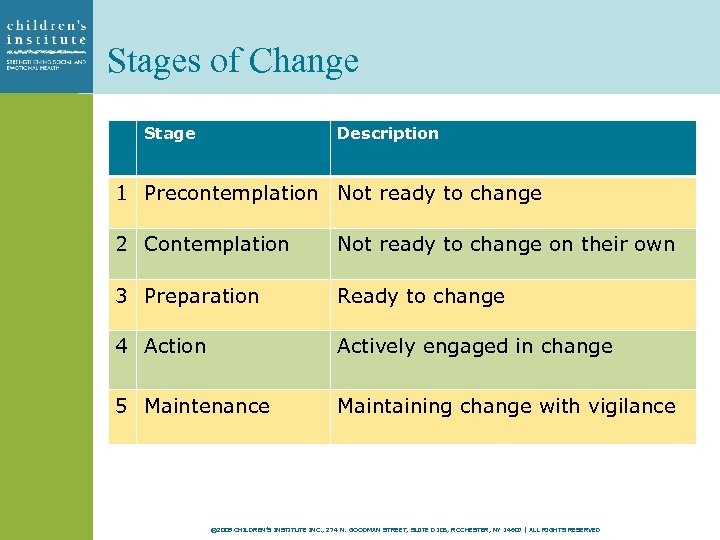 Stages of Change Stage Description 1 Precontemplation Not ready to change 2 Contemplation Not ready to change on their own 3 Preparation Ready to change 4 Action Actively engaged in change 5 Maintenance Maintaining change with vigilance © 2009 CHILDREN’S INSTITUTE INC. , 274 N. GOODMAN STREET, SUITE D 103, ROCHESTER, NY 14607 | ALL RIGHTS RESERVED
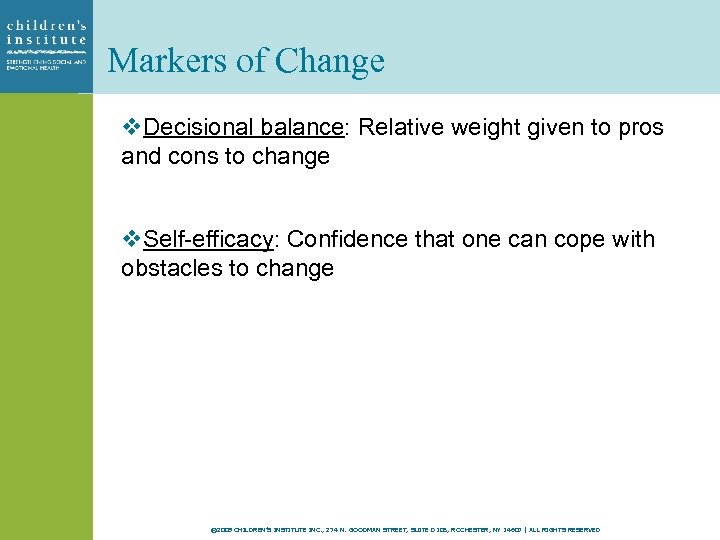 Markers of Change v. Decisional balance: Relative weight given to pros and cons to change v. Self-efficacy: Confidence that one can cope with obstacles to change © 2009 CHILDREN’S INSTITUTE INC. , 274 N. GOODMAN STREET, SUITE D 103, ROCHESTER, NY 14607 | ALL RIGHTS RESERVED
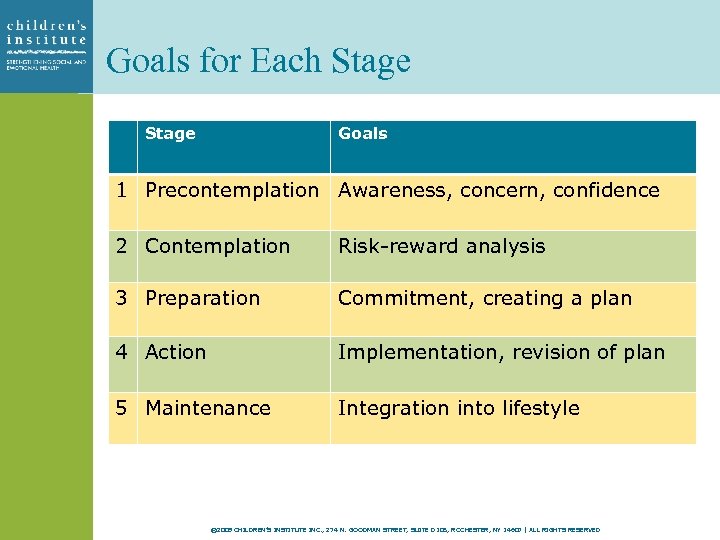 Goals for Each Stage Goals 1 Precontemplation Awareness, concern, confidence 2 Contemplation Risk-reward analysis 3 Preparation Commitment, creating a plan 4 Action Implementation, revision of plan 5 Maintenance Integration into lifestyle © 2009 CHILDREN’S INSTITUTE INC. , 274 N. GOODMAN STREET, SUITE D 103, ROCHESTER, NY 14607 | ALL RIGHTS RESERVED
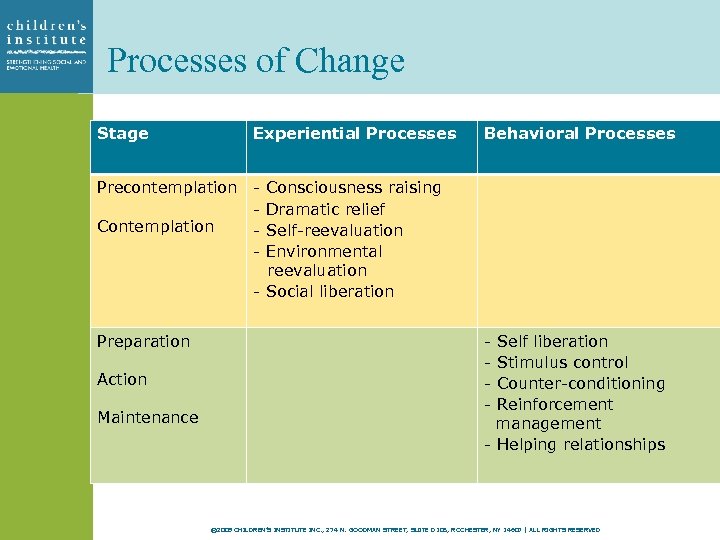 Processes of Change Stage Experiential Processes Precontemplation - Contemplation Preparation Action Maintenance Behavioral Processes Consciousness raising Dramatic relief Self-reevaluation Environmental reevaluation - Social liberation - Self liberation Stimulus control Counter-conditioning Reinforcement management - Helping relationships © 2009 CHILDREN’S INSTITUTE INC. , 274 N. GOODMAN STREET, SUITE D 103, ROCHESTER, NY 14607 | ALL RIGHTS RESERVED
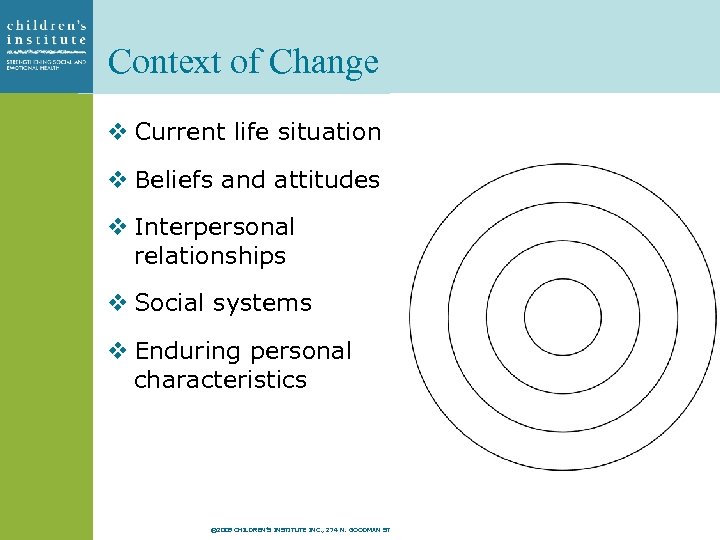 Context of Change v Current life situation v Beliefs and attitudes v Interpersonal relationships v Social systems v Enduring personal characteristics © 2009 CHILDREN’S INSTITUTE INC. , 274 N. GOODMAN STREET, SUITE D 103, ROCHESTER, NY 14607 | ALL RIGHTS RESERVED
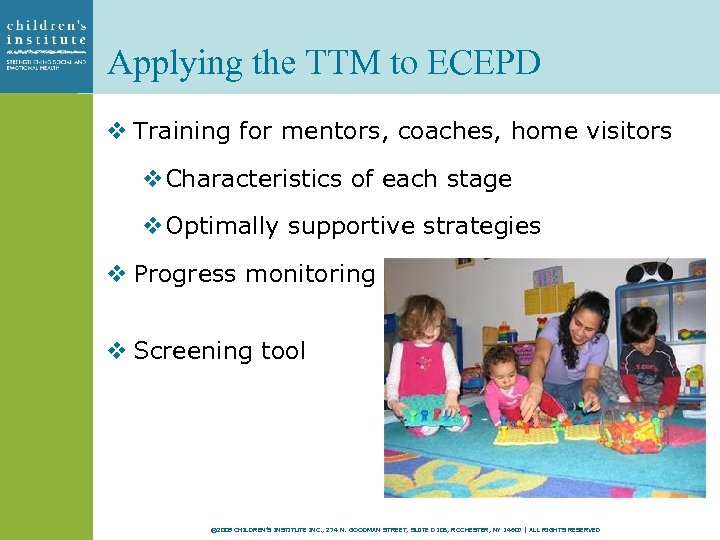 Applying the TTM to ECEPD v Training for mentors, coaches, home visitors v. Characteristics of each stage v. Optimally supportive strategies v Progress monitoring v Screening tool © 2009 CHILDREN’S INSTITUTE INC. , 274 N. GOODMAN STREET, SUITE D 103, ROCHESTER, NY 14607 | ALL RIGHTS RESERVED
 The Stage of Change Scale v Used with ECEs enrolled in professional development programs v. Early Educator Mentoring System v. Partners in Family Child Care v Two parallel versions v. Caregiver/provider survey v. Mentor/home visitor survey © 2009 CHILDREN’S INSTITUTE INC. , 274 N. GOODMAN STREET, SUITE D 103, ROCHESTER, NY 14607 | ALL RIGHTS RESERVED
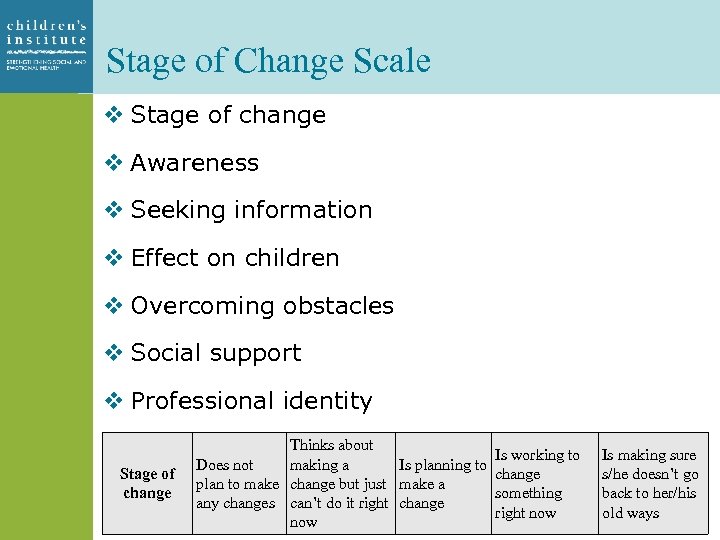 Stage of Change Scale v Stage of change v Awareness v Seeking information v Effect on children v Overcoming obstacles v Social support v Professional identity Stage of change Thinks about making a Does not Is planning to plan to make change but just make a any changes can’t do it right change now Is working to change something right now © 2009 CHILDREN’S INSTITUTE INC. , 274 N. GOODMAN STREET, SUITE D 103, ROCHESTER, NY 14607 | ALL RIGHTS RESERVED Is making sure s/he doesn’t go back to her/his old ways
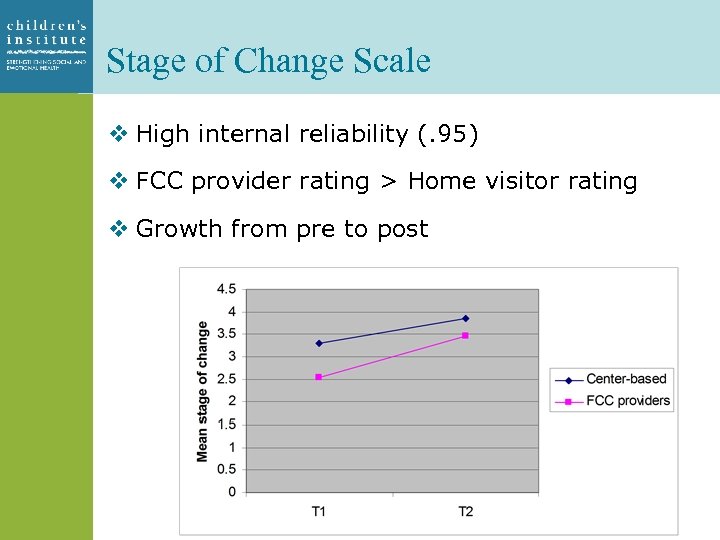 Stage of Change Scale v High internal reliability (. 95) v FCC provider rating > Home visitor rating v Growth from pre to post © 2009 CHILDREN’S INSTITUTE INC. , 274 N. GOODMAN STREET, SUITE D 103, ROCHESTER, NY 14607 | ALL RIGHTS RESERVED
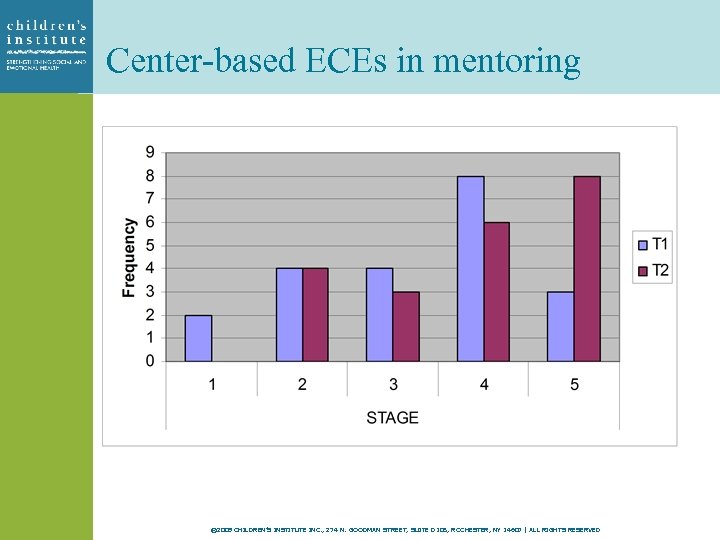 Center-based ECEs in mentoring © 2009 CHILDREN’S INSTITUTE INC. , 274 N. GOODMAN STREET, SUITE D 103, ROCHESTER, NY 14607 | ALL RIGHTS RESERVED
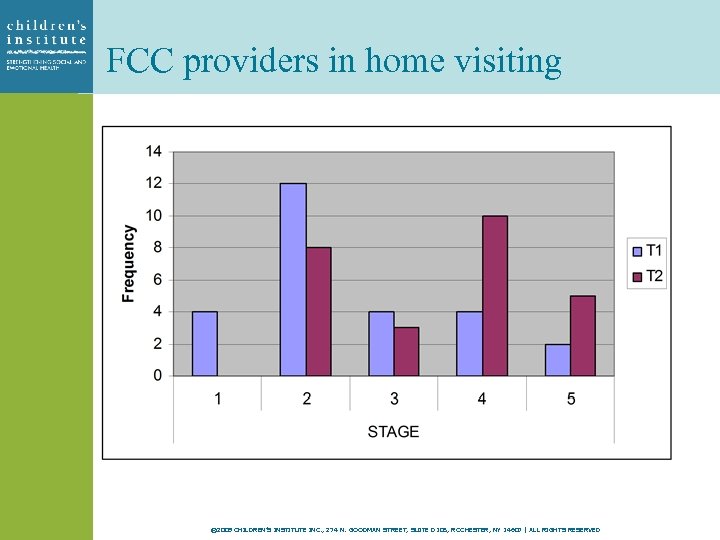 FCC providers in home visiting © 2009 CHILDREN’S INSTITUTE INC. , 274 N. GOODMAN STREET, SUITE D 103, ROCHESTER, NY 14607 | ALL RIGHTS RESERVED
 Predictive validity v Moderate correlation with caregiving skills (. 39) in center-based sample (N=21) v Further research is planned to develop the measure and assess its validity © 2009 CHILDREN’S INSTITUTE INC. , 274 N. GOODMAN STREET, SUITE D 103, ROCHESTER, NY 14607 | ALL RIGHTS RESERVED
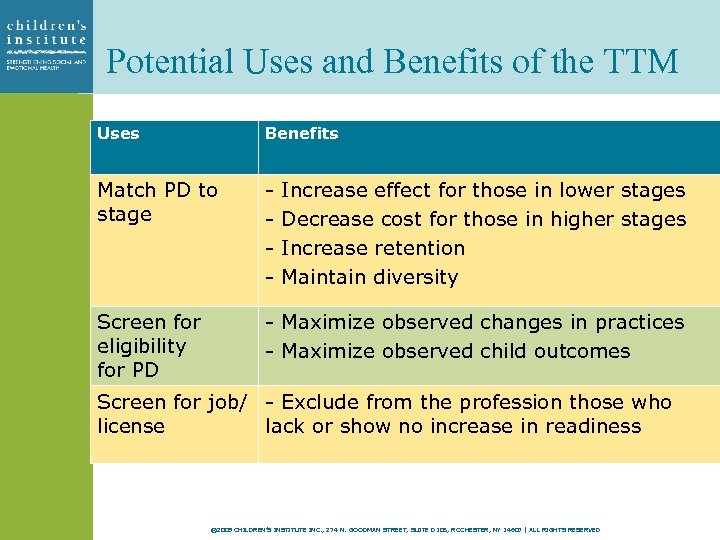 Potential Uses and Benefits of the TTM Uses Benefits Match PD to stage - Screen for eligibility for PD - Maximize observed changes in practices - Maximize observed child outcomes Increase effect for those in lower stages Decrease cost for those in higher stages Increase retention Maintain diversity Screen for job/ - Exclude from the profession those who license lack or show no increase in readiness © 2009 CHILDREN’S INSTITUTE INC. , 274 N. GOODMAN STREET, SUITE D 103, ROCHESTER, NY 14607 | ALL RIGHTS RESERVED
 Strengthening social and emotional health Contact: Shira M. Peterson, Ph. D. Children’s Institute speterson@childrensinstitute. net (585) 295 -1000 ext. 233 www. childrensinstitute. net © 2009 CHILDREN’S INSTITUTE INC. , 274 N. GOODMAN STREET, SUITE D 103, ROCHESTER, NY 14607 | ALL RIGHTS RESERVED

 Assessing and Measuring Readiness for Change: Potential Applications to Quality Initiatives for Home-Based Child Care October 30, 2009 Presentation at the 2009 CCPRC Annual Meeting Diane Paulsell
 Overview of the Presentation § Characteristics of home-based caregivers § Initiatives to support quality in home-based care § Potential applications of readiness-to-change concepts that could strengthen quality initiatives for home-based child care 23
 Characteristics of Home-Based Caregivers § Includes regulated and exempt caregivers; most are relatives. § Ages vary—most caregivers in mid-40 s. § Most caregivers have low incomes. § Family, friend, and neighbor caregivers tend to share same race/ethnicity and home language as parents and children. § Family child care providers are more likely to have a high school degree. 24
 Motivations and Challenges Faced by Home-Based Caregivers § Motivation for family, friend, and neighbor caregivers: help the family or keep child care within the family § Motivation for family child care providers: earn income; stay home with own children § Challenges of home-based caregivers: – Social isolation – Work-related stress and physical exhaustion – Conflicts with parents—childrearing styles, scheduling, payment, lack of respect for professional status 25
 Initiatives to Support Quality in Home-Based Care: Goals § Recent national scan identified 90 recent or ongoing initiatives in all 50 states § Primary goals of initiatives: – – Quality improvement (72) Support for licensing or registration (9) Support for obtaining accreditation (5) Certificate program or college credit or CDA (4) 26
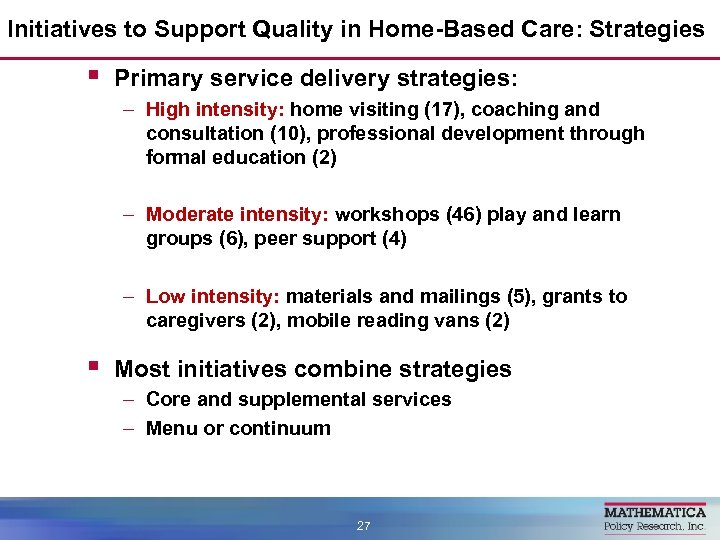 Initiatives to Support Quality in Home-Based Care: Strategies § Primary service delivery strategies: – High intensity: home visiting (17), coaching and consultation (10), professional development through formal education (2) – Moderate intensity: workshops (46) play and learn groups (6), peer support (4) – Low intensity: materials and mailings (5), grants to caregivers (2), mobile reading vans (2) § Most initiatives combine strategies – Core and supplemental services – Menu or continuum 27
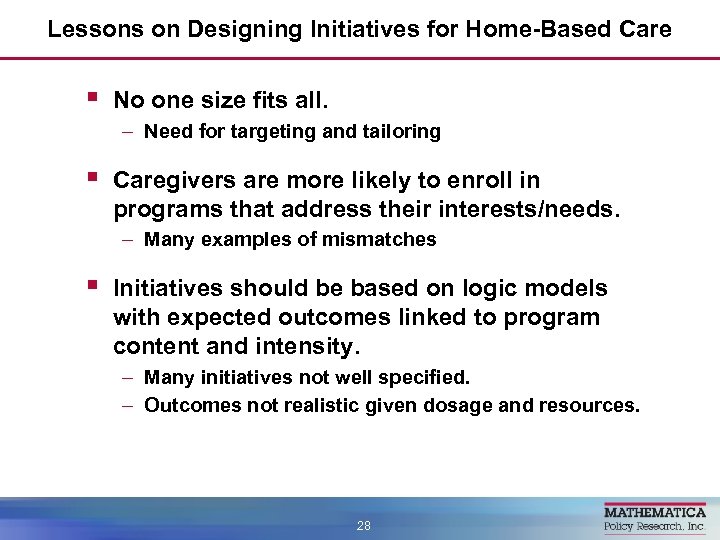 Lessons on Designing Initiatives for Home-Based Care § No one size fits all. – Need for targeting and tailoring § Caregivers are more likely to enroll in programs that address their interests/needs. – Many examples of mismatches § Initiatives should be based on logic models with expected outcomes linked to program content and intensity. – Many initiatives not well specified. – Outcomes not realistic given dosage and resources. 28
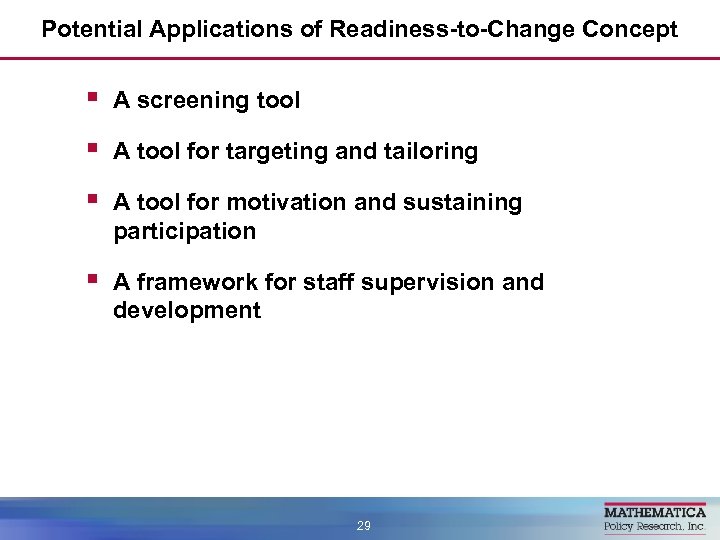 Potential Applications of Readiness-to-Change Concept § A screening tool § A tool for targeting and tailoring § A tool for motivation and sustaining participation § A framework for staff supervision and development 29
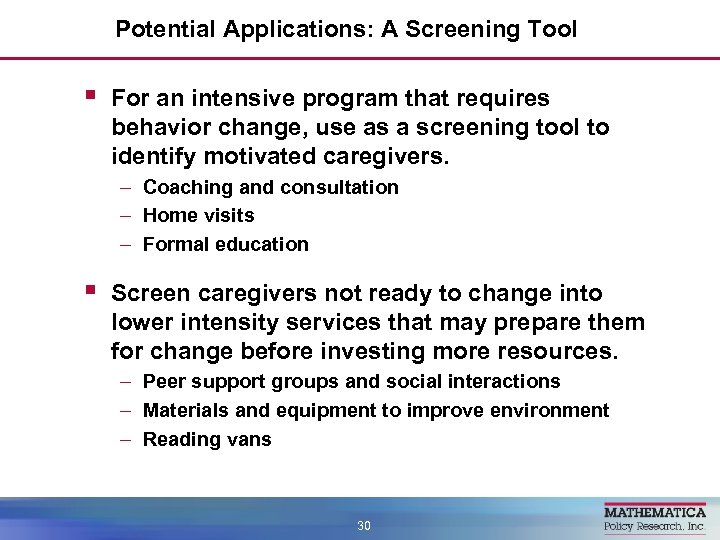 Potential Applications: A Screening Tool § For an intensive program that requires behavior change, use as a screening tool to identify motivated caregivers. – Coaching and consultation – Home visits – Formal education § Screen caregivers not ready to change into lower intensity services that may prepare them for change before investing more resources. – Peer support groups and social interactions – Materials and equipment to improve environment – Reading vans 30
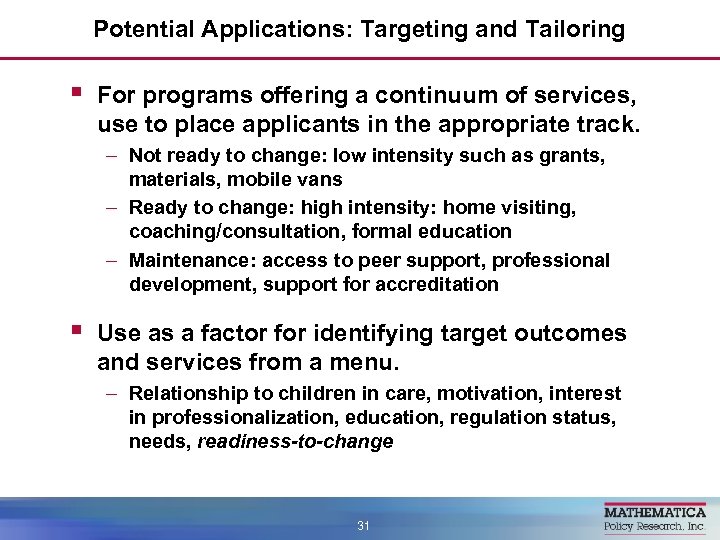 Potential Applications: Targeting and Tailoring § For programs offering a continuum of services, use to place applicants in the appropriate track. – Not ready to change: low intensity such as grants, materials, mobile vans – Ready to change: high intensity: home visiting, coaching/consultation, formal education – Maintenance: access to peer support, professional development, support for accreditation § Use as a factor for identifying target outcomes and services from a menu. – Relationship to children in care, motivation, interest in professionalization, education, regulation status, needs, readiness-to-change 31
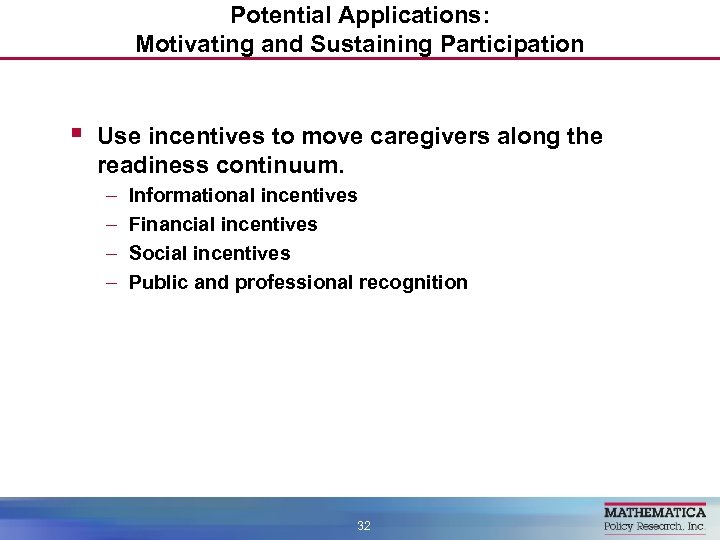 Potential Applications: Motivating and Sustaining Participation § Use incentives to move caregivers along the readiness continuum. – – Informational incentives Financial incentives Social incentives Public and professional recognition 32
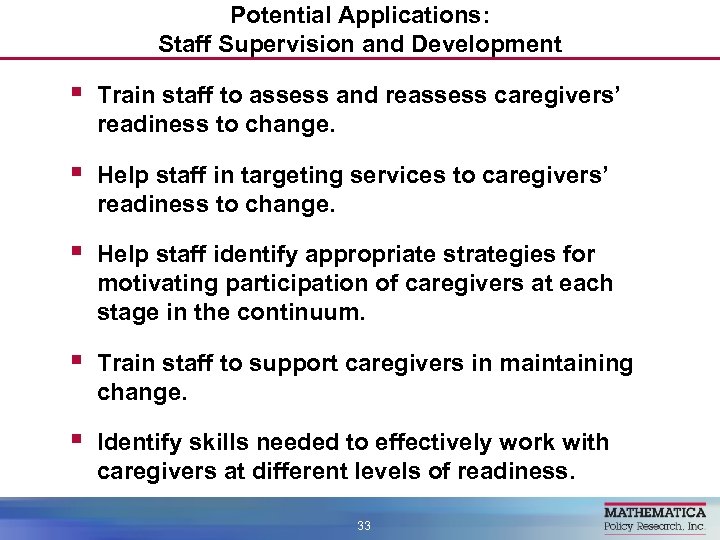 Potential Applications: Staff Supervision and Development § Train staff to assess and reassess caregivers’ readiness to change. § Help staff in targeting services to caregivers’ readiness to change. § Help staff identify appropriate strategies for motivating participation of caregivers at each stage in the continuum. § Train staff to support caregivers in maintaining change. § Identify skills needed to effectively work with caregivers at different levels of readiness. 33

 Discussion of Shira Peterson’s Readiness to Change Paper Perspective: Center-based caregivers October 30, 2009 Carolyn Layzer Abt Associates Inc.
 How might Stages of Change influence our… • Expectations for rates of change – Designing study to measure process and outcomes—need to factor in more time – Cost • Expectations for kinds of change – Not all learners will progress in same areas along same timeline – Does the type of intervention or p. d. also operate with/against readiness to change? – Supervision, support • Expectations for Consequences & Rewards – QRS and other rating issues
 Design Considerations (studies of p. d. ) • Include Stages of Change in process model – Whole group/large group training just one of several strategies to be employed in training and development – Role of coaches/mentors—includes survey & assessment • Include process documentation in design and budget – Extra mentoring/coaching, longer time, more nuanced coaching – Group training still important (see “Social Support” row!) but not as sole mode of transmitting information… • Client briefing—how can we help funders (make role of Stages of Change visible)?
 Expectations for Kinds of Change • Progress • Type of intervention/p. d. – Curriculum-focused intervention, school-readiness focus [usually CO area] – vs. IS area – concept development; scaffolding & effective differentiation of instruction / intentional guidance; language development – vs. ES area – climate, sensitivity, student roles • Supervision and support – Coaching model – need different levels of support at different stages (frequency of visits, structure of feedback), and need different content –this seems to be a good fit for center-based…
 Consequences / Rewards • Including Stages of Change in outcomes • Including growth in readiness to change in assessment of efficacy of intervention or p. d. • Including growth in readiness to change in formula for QRS or other rating system • Developing ways of communicating about process and appropriate expectations
 Concerns / Questions • Does it make a difference what the focus of the p. d. is? • Once we know the teacher’s (initial) stage, how to safeguard against determinism? • Training of mentors/coaches