 Скачать презентацию Streamroller Automatic Synthesis of Prescribed Throughput Accelerator Pipelines
605c47164694c61ab7e79ee4ff14fd0b.ppt
- Количество слайдов: 18



Streamroller: Automatic Synthesis of Prescribed Throughput Accelerator Pipelines Manjunath Kudlur, Kevin Fan, Scott Mahlke Advanced Computer Architecture Lab University of Michigan 1 University of Michigan Electrical Engineering and Computer Science
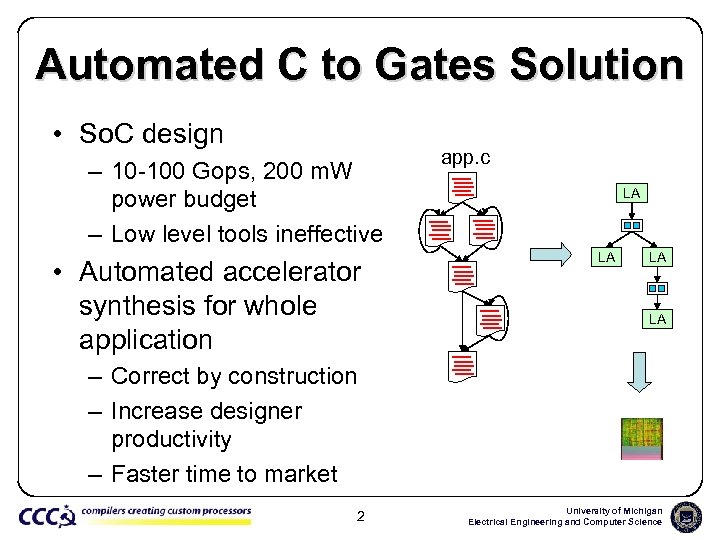
Automated C to Gates Solution • So. C design – 10 -100 Gops, 200 m. W power budget – Low level tools ineffective • Automated accelerator synthesis for whole application app. c LA LA – Correct by construction – Increase designer productivity – Faster time to market 2 University of Michigan Electrical Engineering and Computer Science
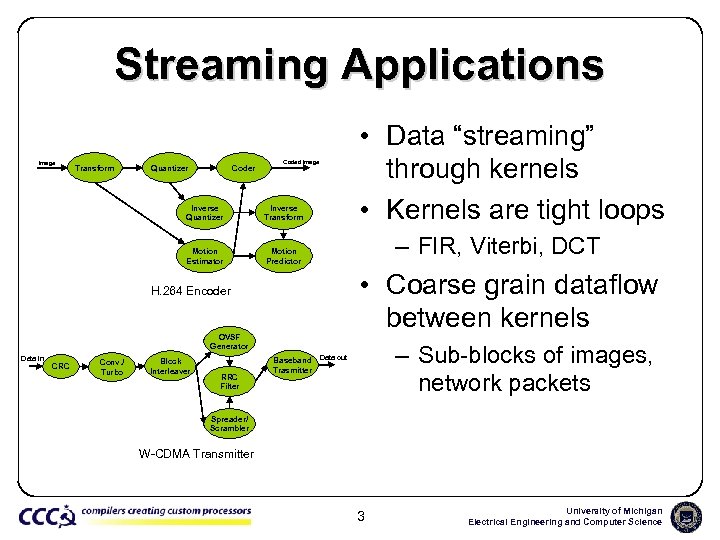
Streaming Applications Image Transform Quantizer Coder • Data “streaming” through kernels • Kernels are tight loops Coded Image Inverse Quantizer Inverse Transform Motion Estimator Motion Predictor – FIR, Viterbi, DCT • Coarse grain dataflow between kernels H. 264 Encoder OVSF Generator Data in CRC Conv. / Turbo Block Interleaver RRC Filter Baseband Trasmitter – Sub-blocks of images, network packets Data out Spreader/ Scrambler W-CDMA Transmitter 3 University of Michigan Electrical Engineering and Computer Science
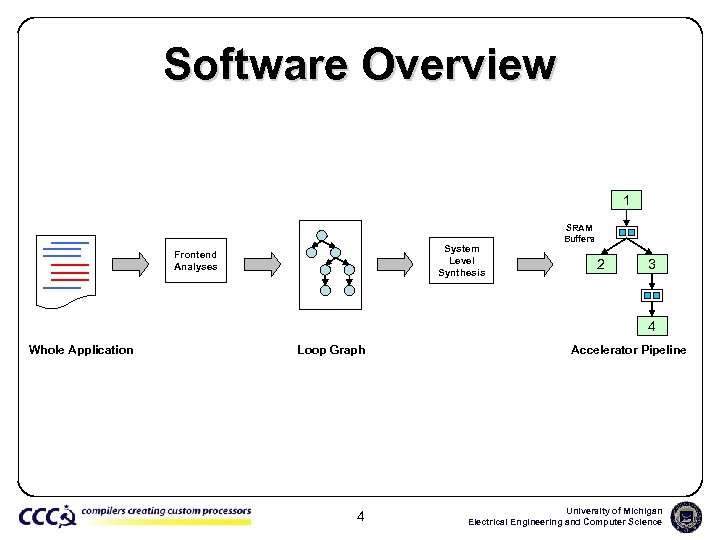
Software Overview 1 System Level Synthesis Frontend Analyses SRAM Buffers 2 3 4 Whole Application Loop Graph 4 Accelerator Pipeline University of Michigan Electrical Engineering and Computer Science
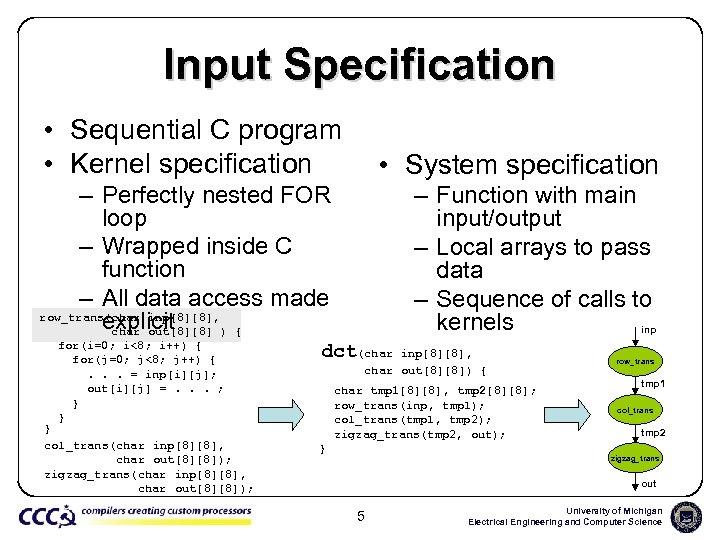
Input Specification • Sequential C program • Kernel specification • System specification – Perfectly nested FOR loop – Wrapped inside C function – All data access made row_trans(char inp[8][8], explicit char out[8][8] ) { for(i=0; i<8; i++) { for(j=0; j<8; j++) {. . . = inp[i][j]; out[i][j] =. . . ; } } } col_trans(char inp[8][8], char out[8][8]); zigzag_trans(char inp[8][8], char out[8][8]); – Function with main input/output – Local arrays to pass data – Sequence of calls to kernels inp dct(char inp[8][8], char out[8][8]) { char tmp 1[8][8], tmp 2[8][8]; row_trans(inp, tmp 1); col_trans(tmp 1, tmp 2); zigzag_trans(tmp 2, out); } row_trans tmp 1 col_trans tmp 2 zigzag_trans out 5 University of Michigan Electrical Engineering and Computer Science
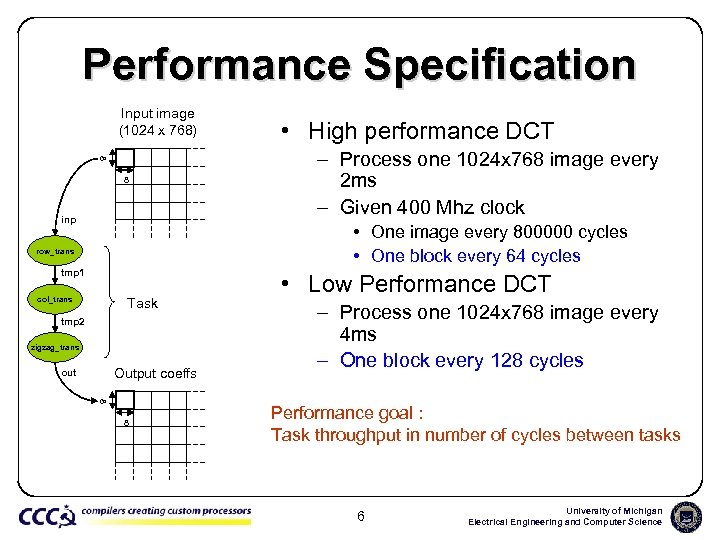
Performance Specification Input image (1024 x 768) 8 8 inp • High performance DCT – Process one 1024 x 768 image every 2 ms – Given 400 Mhz clock • One image every 800000 cycles • One block every 64 cycles row_trans tmp 1 col_trans Task tmp 2 zigzag_trans Output coeffs out 8 8 • Low Performance DCT – Process one 1024 x 768 image every 4 ms – One block every 128 cycles Performance goal : Task throughput in number of cycles between tasks 6 University of Michigan Electrical Engineering and Computer Science
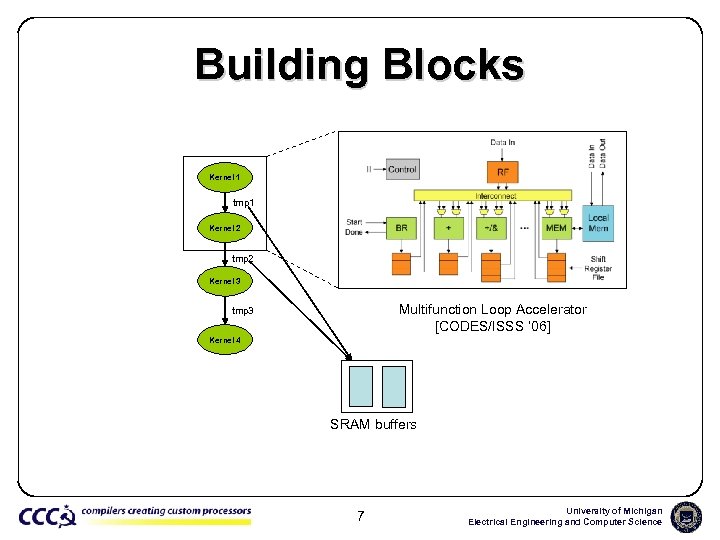
Building Blocks Kernel 1 tmp 1 Kernel 2 tmp 2 Kernel 3 Multifunction Loop Accelerator [CODES/ISSS ’ 06] tmp 3 Kernel 4 SRAM buffers 7 University of Michigan Electrical Engineering and Computer Science
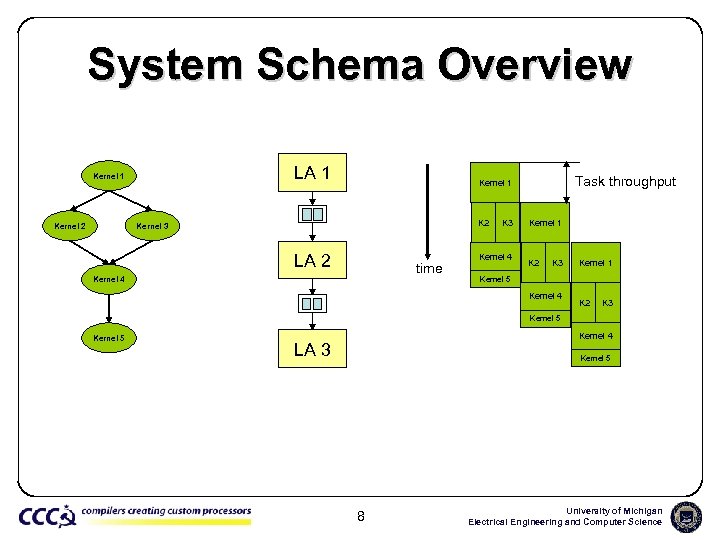
System Schema Overview LA 1 Kernel 2 Task throughput Kernel 1 K 2 Kernel 3 LA 2 time Kernel 4 K 3 Kernel 4 Kernel 1 K 2 K 3 Kernel 1 Kernel 5 Kernel 4 K 2 K 3 Kernel 5 Kernel 4 LA 3 Kernel 5 8 University of Michigan Electrical Engineering and Computer Science
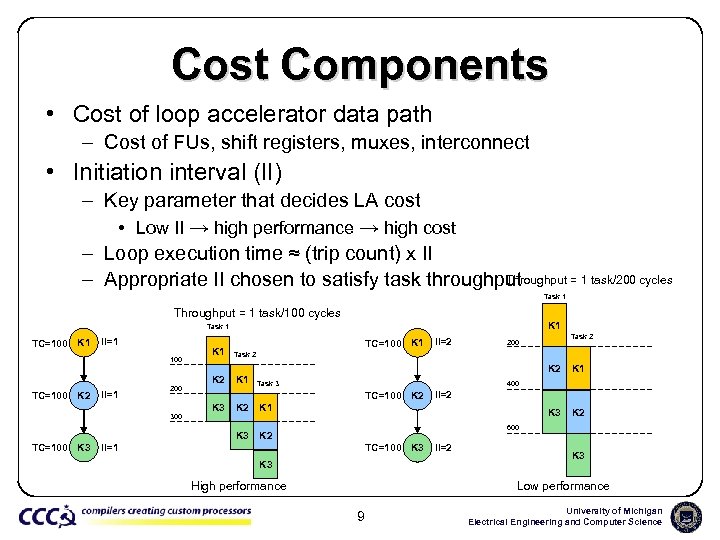
Cost Components • Cost of loop accelerator data path – Cost of FUs, shift registers, muxes, interconnect • Initiation interval (II) – Key parameter that decides LA cost • Low II → high performance → high cost – Loop execution time ≈ (trip count) x II Throughput = 1 task/200 cycles – Appropriate II chosen to satisfy task throughput Task 1 Throughput = 1 task/100 cycles K 1 Task 1 TC=100 K 1 II=1 TC=100 K 2 II=1 200 300 TC=100 K 3 K 1 K 2 K 1 Task 3 K 2 II=2 K 1 K 2 Task 2 200 Task 2 K 3 100 K 1 K 2 K 1 K 3 K 2 400 TC=100 K 2 II=2 600 II=1 TC=100 K 3 High performance K 3 II=2 K 3 Low performance 9 University of Michigan Electrical Engineering and Computer Science
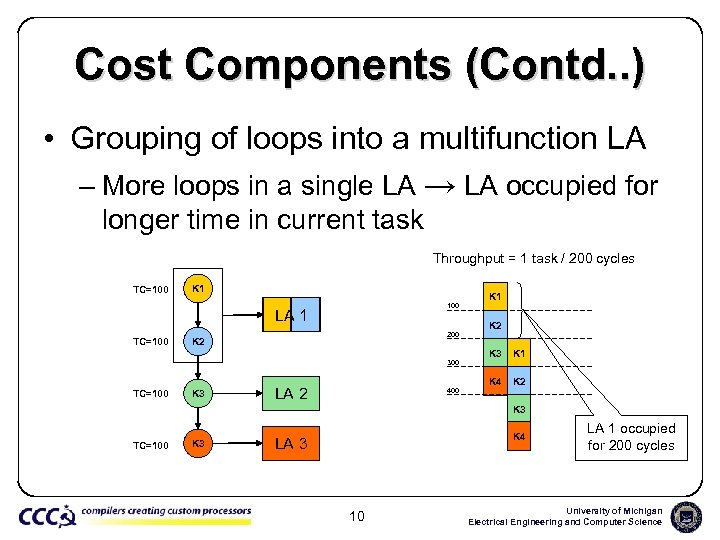
Cost Components (Contd. . ) • Grouping of loops into a multifunction LA – More loops in a single LA → LA occupied for longer time in current task Throughput = 1 task / 200 cycles TC=100 K 1 100 LA 1 TC=100 200 K 2 300 TC=100 K 3 LA 2 400 K 1 K 2 K 3 K 1 K 4 K 2 K 3 TC=100 K 3 K 4 LA 3 10 LA 1 occupied for 200 cycles University of Michigan Electrical Engineering and Computer Science
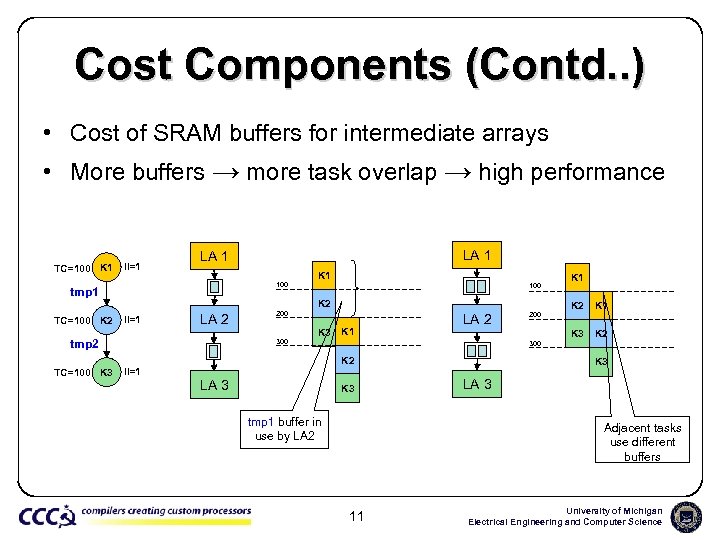
Cost Components (Contd. . ) • Cost of SRAM buffers for intermediate arrays • More buffers → more task overlap → high performance TC=100 K 1 II=1 100 tmp 1 TC=100 LA 1 K 2 II=1 LA 2 tmp 2 200 300 K 1 100 K 2 K 3 K 1 LA 2 300 K 2 TC=100 K 3 II=1 LA 3 200 K 3 tmp 1 buffer in use by LA 2 K 1 K 3 K 2 K 3 LA 3 Adjacent tasks use different buffers 11 University of Michigan Electrical Engineering and Computer Science
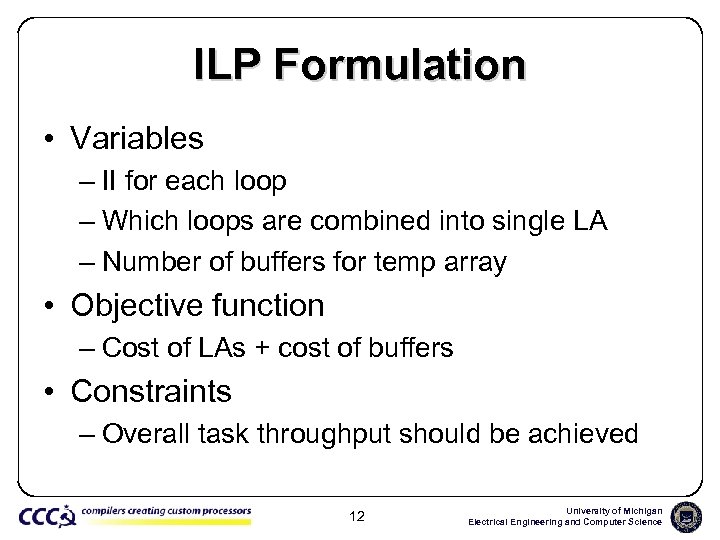
ILP Formulation • Variables – II for each loop – Which loops are combined into single LA – Number of buffers for temp array • Objective function – Cost of LAs + cost of buffers • Constraints – Overall task throughput should be achieved 12 University of Michigan Electrical Engineering and Computer Science
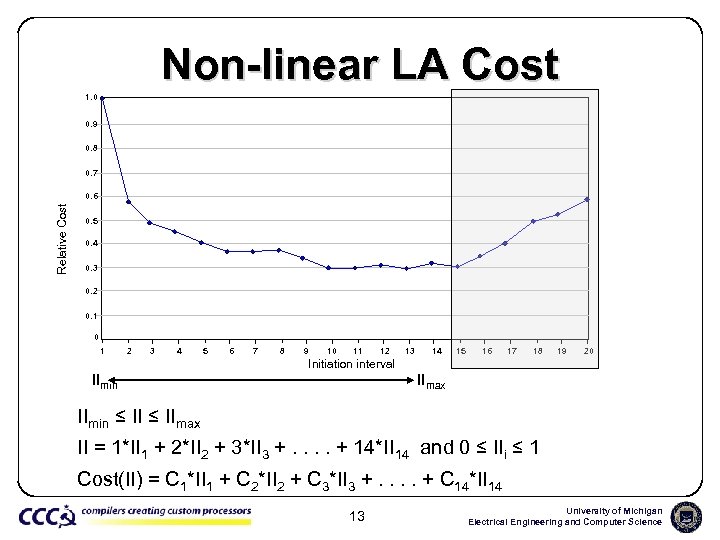
Non-linear LA Cost 1. 0 0. 9 0. 8 0. 7 Relative Cost 0. 6 0. 5 0. 4 0. 3 0. 2 0. 1 0 1 2 3 4 IImin 5 6 7 8 9 10 11 12 Initiation interval 13 14 15 16 17 18 19 20 IImax IImin ≤ IImax II = 1*II 1 + 2*II 2 + 3*II 3 +. . + 14*II 14 and 0 ≤ IIi ≤ 1 Cost(II) = C 1*II 1 + C 2*II 2 + C 3*II 3 +. . + C 14*II 14 13 University of Michigan Electrical Engineering and Computer Science
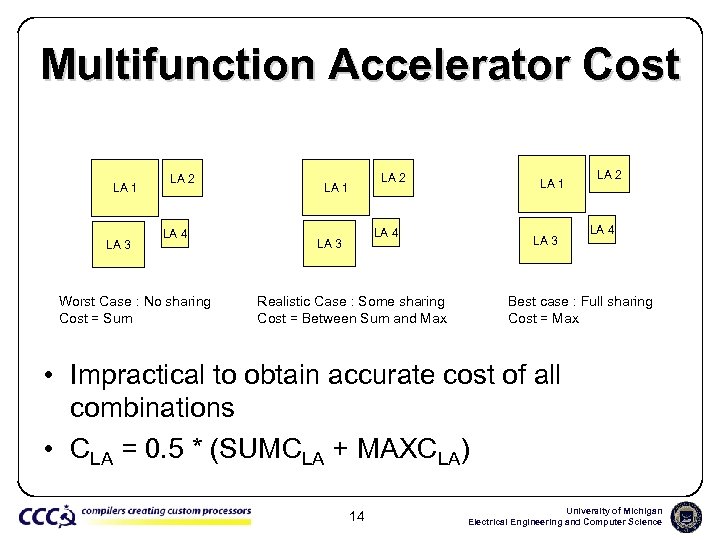
Multifunction Accelerator Cost LA 1 LA 3 LA 2 LA 4 Worst Case : No sharing Cost = Sum LA 2 LA 1 LA 4 LA 3 Realistic Case : Some sharing Cost = Between Sum and Max LA 1 LA 3 LA 2 LA 4 Best case : Full sharing Cost = Max • Impractical to obtain accurate cost of all combinations • CLA = 0. 5 * (SUMCLA + MAXCLA) 14 University of Michigan Electrical Engineering and Computer Science
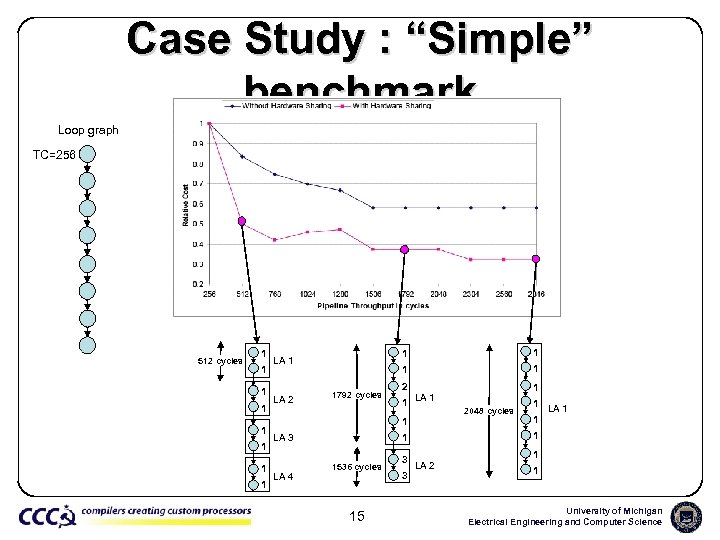
Case Study : “Simple” benchmark Loop graph TC=256 512 cycles 1 1 1 1 1 LA 2 1792 cycles 1 1 LA 1 1 2 1 1 LA 1 2048 cycles 1 1 1 LA 3 LA 4 1536 cycles 15 1 LA 1 1 3 3 1 LA 2 1 University of Michigan Electrical Engineering and Computer Science
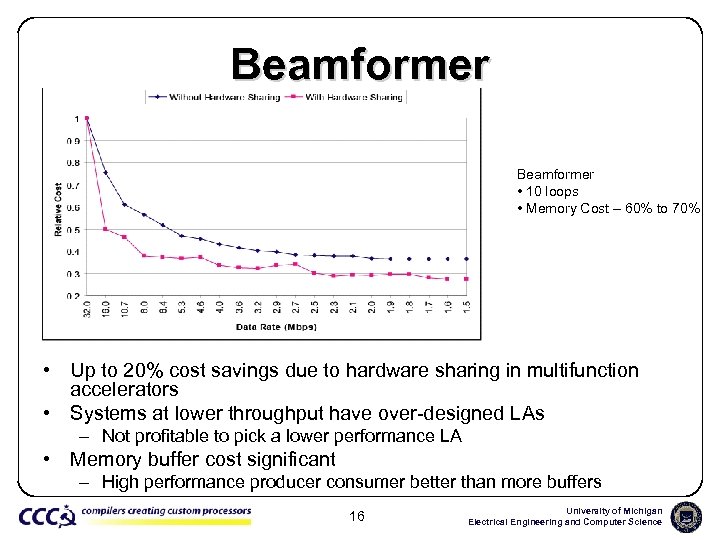
Beamformer • 10 loops • Memory Cost – 60% to 70% • Up to 20% cost savings due to hardware sharing in multifunction accelerators • Systems at lower throughput have over-designed LAs – Not profitable to pick a lower performance LA • Memory buffer cost significant – High performance producer consumer better than more buffers 16 University of Michigan Electrical Engineering and Computer Science
Conclusions • Automated design realistic for system of loops • Designers can move up the abstraction hierarchy • Observations – Macro level hardware sharing can achieve significant cost savings – Memory cost is significant – need to simultaneously optimize for datapath and memory cost 17 University of Michigan Electrical Engineering and Computer Science
18 University of Michigan Electrical Engineering and Computer Science
Скачать презентацию Streamroller Automatic Synthesis of Prescribed Throughput Accelerator Pipelines
605c47164694c61ab7e79ee4ff14fd0b.ppt