


 Скачать презентацию Streamline states working together to increase their
e0649e6f14877508731d570548fb85c0.ppt
- Количество слайдов: 21
 Streamline – states working together to increase their sovereignty Scott Peterson Streamlined Sales Tax Governing Board
 What states do to get the tax collected Ø Since the sales tax was first enacted in the 1930’s states have done the following to enforce its collection: Ø Create the use tax Ø Audit, audit Ø Define and redefine “doing business” to get at out-of-state retailers Ø Go to court Ø Work together to make it simpler to collect
 The courts: a solution or not -QuillØ 1992 Supreme Court decision in Quill Corp. v. North Dakota Ø Requiring collection of tax by out-ofstate retailers with no physical presence in a state would be burden on interstate commerce and would therefore violate Commerce Clause of U. S. Constitution
 What retailer’s say makes the system complex ØState AND local tax administration in some states ØConflicting rules on who has the right to tax a transaction ØToo many tax rates within each state and locality ØState and locals tax different items ØToo many definitions for the same product ØPunish the retailer when a buyer lies or fails to provide proof of an exempt sale
 Remote sales: What is at stake? Ø Compliance with sales tax laws by multistate businesses is too complex Ø Local merchants suffer from lack of level playing field Ø Significant losses of revenue expected due to growth in electronic commerce and inability of states to administer use tax with consumers
 Uncollected use tax from remote sales Ø State and local governments failed to collect $6. 9 billion in sales tax in 2009 just from electronic commerce Ø By 2012 the projected loss for state and local governments is $23. 3 billion, including $11. 4 billion from remote commerce, $6. 8 billion from business-toconsumer catalog sales, and $5 billion from businessto-business catalog sales Ø Wyoming’s share: $61. 7 million Ø Source: "State and Local Government Sales Tax Revenue Losses from Electronic Commerce, ” April 2009 Univ. of Tennessee
 “E-retail puts together back-to-back doubledigit growth quarters” Ø “The U. S. Commerce Department reported that e-commerce sales grew 14. 3% in the first quarter, following the fourth’s quarter 14. 6% gain. ” Ø “E-commerce grew 14. 3% compared to the first quarter of 2009, after adjusting for seasonal variations, total retail sales grew only 6. 3%. ” Ø “Counting retail sales of all types, the web accounted for 4. 0% of total sales in the first quarter of 2010 versus 3. 7% a year earlier. ” Ø Online consumers have spent $21. 95 billion so far this holiday season, an 11. 5% increase over the same period last year, according to com. Score Inc Ø Source: Internet Retailer’s Daily News Service (May 18 and December 15, 2010)
 Goals of the Streamlined Effort: Ø Create a simpler system for administering the various state and local sales taxes Ø Make processes uniform if they cannot be made simple Ø Balance the interests of a state’s sovereignty with the interests of simplicity and uniformity Ø Leverage the use of technology to ease the retailer’s tax collection Ø Balance simplicity with state sovereignty
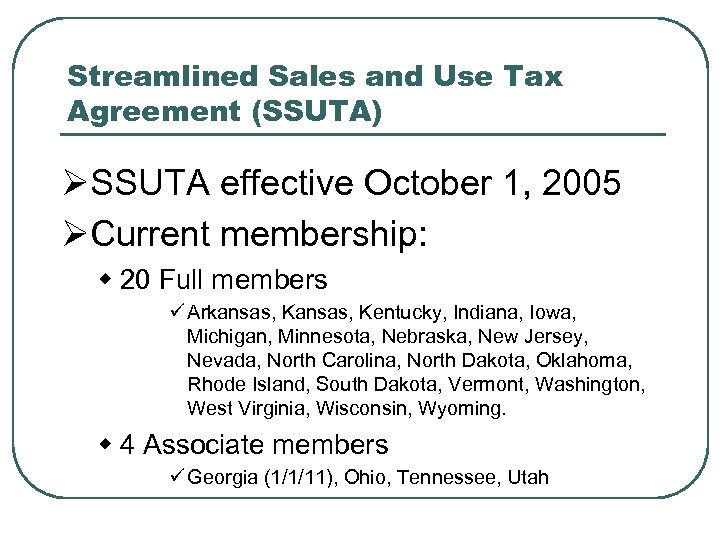 Streamlined Sales and Use Tax Agreement (SSUTA) ØSSUTA effective October 1, 2005 ØCurrent membership: w 20 Full members ü Arkansas, Kentucky, Indiana, Iowa, Michigan, Minnesota, Nebraska, New Jersey, Nevada, North Carolina, North Dakota, Oklahoma, Rhode Island, South Dakota, Vermont, Washington, West Virginia, Wisconsin, Wyoming. w 4 Associate members ü Georgia (1/1/11), Ohio, Tennessee, Utah
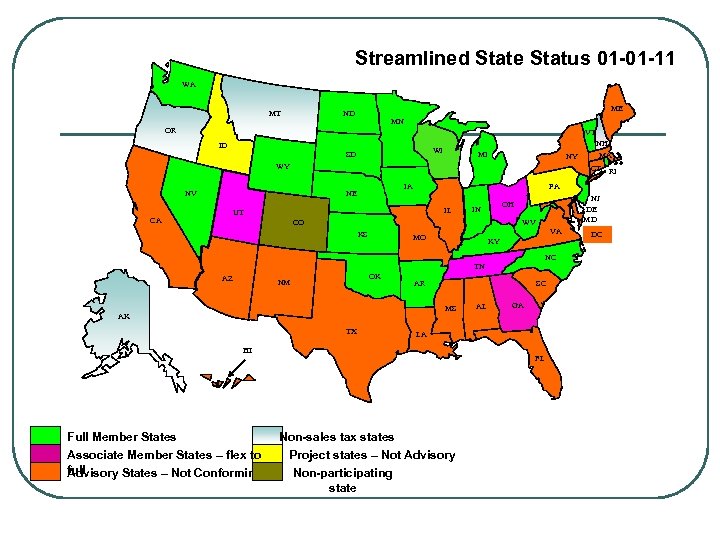 Streamlined State Status 01 -01 -11 WA MT ME ND MN OR VT ID WI SD MI NY WY CT RI PA IA NE NV IL UT CA NJ DE MD OH IN WV CO KS VA MO KY NC TN AZ OK NM AR SC MS AK TX AL GA LA HI Full Member States Associate Member States – flex to full Advisory States – Not Conforming NH MA FL Non-sales tax states Project states – Not Advisory Non-participating state DC
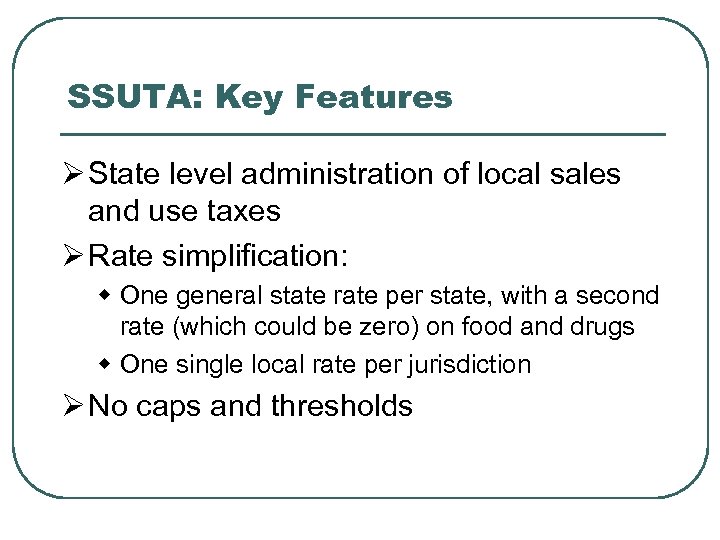 SSUTA: Key Features Ø State level administration of local sales and use taxes Ø Rate simplification: w One general state rate per state, with a second rate (which could be zero) on food and drugs w One single local rate per jurisdiction Ø No caps and thresholds
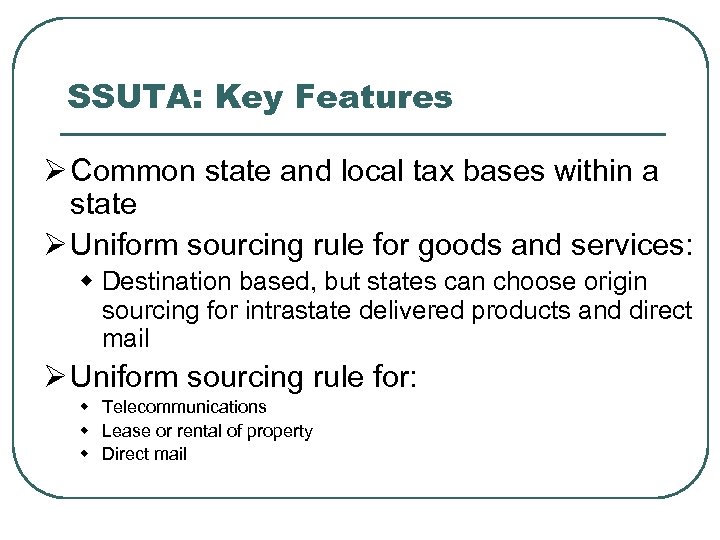 SSUTA: Key Features Ø Common state and local tax bases within a state Ø Uniform sourcing rule for goods and services: w Destination based, but states can choose origin sourcing for intrastate delivered products and direct mail Ø Uniform sourcing rule for: w Telecommunications w Lease or rental of property w Direct mail
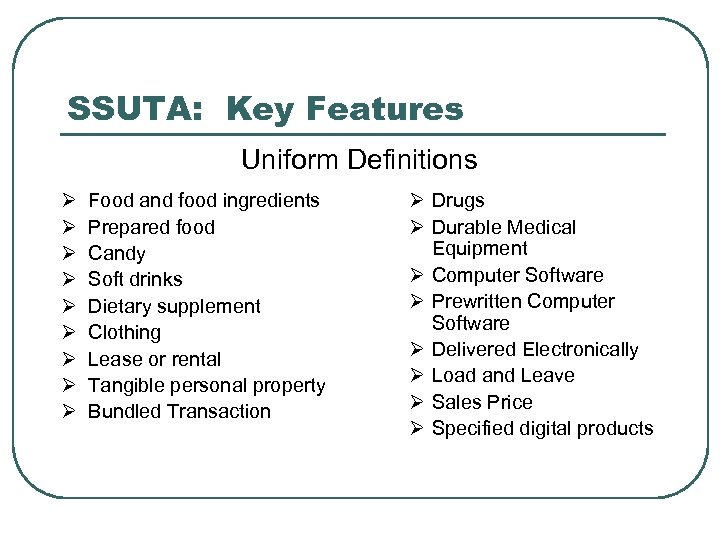 SSUTA: Key Features Uniform Definitions Ø Ø Ø Ø Ø Food and food ingredients Prepared food Candy Soft drinks Dietary supplement Clothing Lease or rental Tangible personal property Bundled Transaction Ø Drugs Ø Durable Medical Equipment Ø Computer Software Ø Prewritten Computer Software Ø Delivered Electronically Ø Load and Leave Ø Sales Price Ø Specified digital products
 SSUTA: Key Features Ø Uniform treatment of bank holidays Ø Uniform rules for sales tax holidays: w limited to defined products and within administrative guidelines Ø Uniform drop shipment rule Ø Uniform rule for bad debt credits
 SSUTA: Key Features Ø Simplified electronic tax return Ø Uniform exemption certificate and simplified exemption processing Ø Uniform rounding Ø A one-stop national registration system
 State Liability Protection Obligations States must provide: Ø Database matching tax rates to local jurisdictions Ø Database of boundary information for local jurisdictions Ø Taxability matrix that identifies whether defined products are exempt or taxable under the state’s laws
 Taxability matrix Ø A state database that tells sellers what is and what is not taxable Ø A list of uniformly defined products and services, but will eventually include more Ø Sellers are not liable for errors in how something is taxed if they follow what is in the taxability matrix
 State sponsored technology: “Certified Service Provider” (CSP) Ø CSP is a third party that provides “cradle to grave” tax service including liability determination, return filing and tax remittance Ø Six CSPs have contracts with Governing Board: w w w Accurate Tax Avalara Exactor Fed-Tax ADP Taxware Speedtax Ø Businesses who volunteer to collect tax in state may use CSP’s at no cost – states pay CSP for services to volunteer sellers Ø As of 12/01/10 there were 197 companies using a CSP
 CSP - Responsibilities & Liabilities Ø Integrate with seller’s order processing system Ø Tax liability determination Ø Tax rate determination Ø Electronic funds transfers Ø System performance & security
 Central Registration System Ø As of December 1, 2010 there were 1, 369 companies registered on the central registration system Ø As of September 30, 2010 those companies had collected $684. 6 million in sales tax for the Streamline states Ø Wyoming has collected $6. 7 million
 Streamlined Sales Tax Questions: Scott. Peterson@sstgb. org 615 -460 -9330 www. streamlinedsalestax. org