


 Скачать презентацию Stratford Chefs School Nutrition Course Week 9
ce7f7ac468098796acd2426f48cc8a53.ppt
- Количество слайдов: 27
 Stratford Chefs School Nutrition Course – Week 9
 Today’s Topics • Carbohydrates
 Key Concepts • Misinformation issues • Key points for interpreting Nutrition in the News & 10 red flags • 5 Ws • Label review • Labeling exceptions • “Anatomy” of the Label • Nutrient claims – Nutrient content claims – Diet related health claims
 Grocery Store Trip • What did you notice about placement of products? • What product tended to be cheaper – no name or brand name? • Was it possible to feed a family of 3 for a week on $100?
 Grocery Shopping Tips • • • • • Clean out the fridge before shopping and do a basic inventory of existing food. Make meal plans and a grocery list based on the plans. Create a grocery master list. The list should contain food items commonly purchased. The master list can be arranged in several formats (i. e. based on a specific stores Layout, by food groups, or by meals). Remember to stay disciplined while grocery shopping. Follow the list and do not buy on impulse. Do not shop hungry. Studies indicate impulse buying occurs if a person is hungry. Shop alone. “Helpers” will only add to the grocery cart. Produce, bakery, and meat department staff are great reference sources. Be sure to check out their “day old” items.
 • • • • • • Look at higher and lower shelves for bargains or alternative items because the most expensive brands are at eye level. Buy in season fresh fruits and vegetables. They will be less expensive and are better quality. Check store entrances, newspapers, and flyers for coupons. Only use coupons for items normally purchased. Check comparable brands to be sure get the best buy. Buy meat in family packages and freeze in smaller “meal” size packages. Avoid trips to the “corner store. ” Due to volume discounts, larger stores are generally cheaper than smaller ones. Department stores like Wal-Mart can be considerably cheaper for paper products, laundry detergent, and soft drinks. Do one bulk-shopping trip a month for staple foods. Stock up on sale products on the list (i. e. canned fruit and veggies, frozen juice, and pasta products). Shop for bread products at bakery outlets.
 Marking of High Fiber • Total of 10 marks • 1 mark for stating how many food guide servings are needed each day • 1 mark for stating the AI for total fibre • 3 marks for having three meals with 3 -4 food groups • 1 mark for stating how many food guide serving each food choice is • 1 mark for using the correct number of food guide servings that are required • 1 mark for stating how many grams of fibre each food choice provides • 2 marks for developing a menu that provides enough fibre that is equal to or greater than their AI
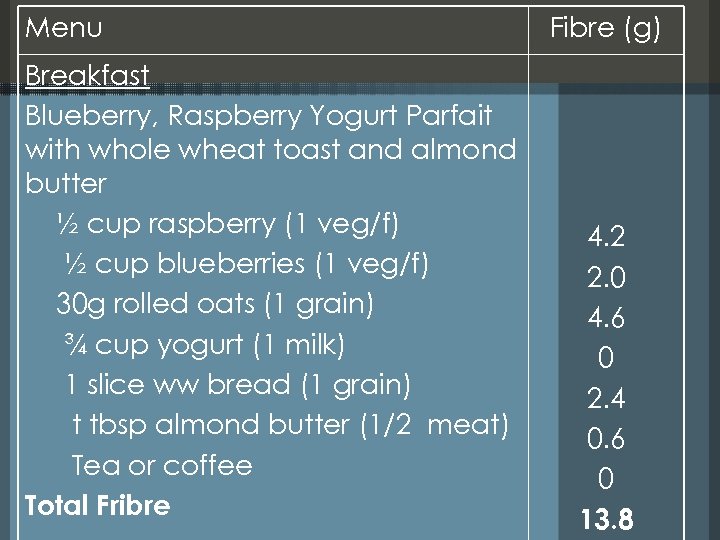 Menu Breakfast Blueberry, Raspberry Yogurt Parfait with whole wheat toast and almond butter ½ cup raspberry (1 veg/f) ½ cup blueberries (1 veg/f) 30 g rolled oats (1 grain) ¾ cup yogurt (1 milk) 1 slice ww bread (1 grain) t tbsp almond butter (1/2 meat) Tea or coffee Total Fribre Fibre (g) 4. 2 2. 0 4. 6 0 2. 4 0. 6 0 13. 8
 Calculating Fibre http: //www. nestle-family. com/eat-right -live-well/tools/fc/english/fibrecalculator. aspx
 Video! http: //www. youtube. com/watch? v =C 9 WAwby. Pf 0 c&noredirect=1
 Carbohydrates • CHO • Often end in “ose” – Glucose, fructose, sucrose, maltose, galactose • Roles in the body – Primary source of energy • Brain and nervous system need glucose – Energy storage – glycogen – Digestive tract health (fibre) – Satiety
 Types of Carbohydrate • Sugars – Also known as simple CHO – Single sugar units absorbed directly into blood stream • Starches – Also known as complex CHO • Larger CHO molecules • Must be broken down before absorption • Fibre – CHO you can’t digest
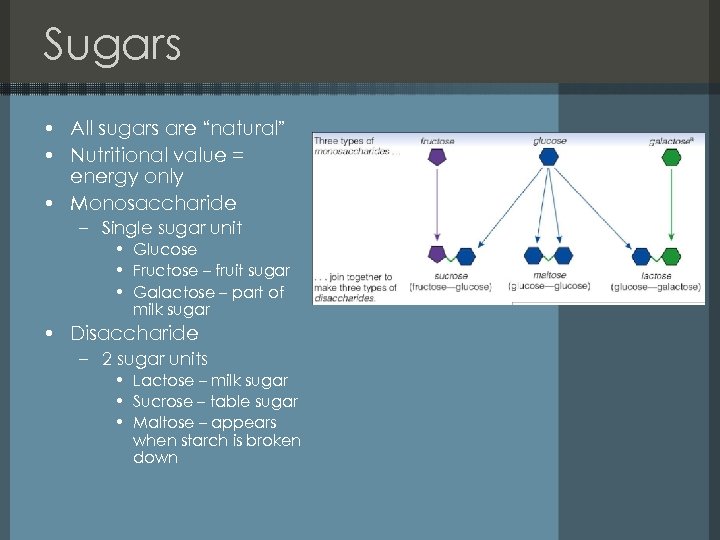 Sugars • All sugars are “natural” • Nutritional value = energy only • Monosaccharide – Single sugar unit • Glucose • Fructose – fruit sugar • Galactose – part of milk sugar • Disaccharide – 2 sugar units • Lactose – milk sugar • Sucrose – table sugar • Maltose – appears when starch is broken down
 What Makes Sugars? • Lactose-glucose and galactose • Sucrose-glucose and fructose • Maltose-glucose and glucose
 Refined Sugars • Refined sugars are sugars that are extracted from plants, processed and used as a sweetener. • Sucrose comes from plants such as sugar cane or sugar beets. • Other refined sugars include corn and maple syrup, honey, molasses and brown sugar.
 Processed Sugar • Plants make glucose and sucrose through photosynthesis – Can turn these into other sources of food energy • Other sugars, starches, proteins and fats • Sugar cane – Grows in tropical countries & southern US • Sugar beet – Grows in North America (Alberta) and Europe • Glucose syrups – Produced from wheat and corn – Cheaper • Molasses - usually cane – Molasses from sugar beet unpalatable – Byproduct from processing – Blackstrap – 3 rd boiling of sugar syrup • Source of calcium, magnesium and iron
 Processed Sugar • Raw sugars – Yellow to brown sugars – From clarified cane-juice boiled down to solid with minimal processing • Brown sugars – Late stages of sugar refining with significant molasses-content – Or coating white refined sugar with a cane molasses syrup
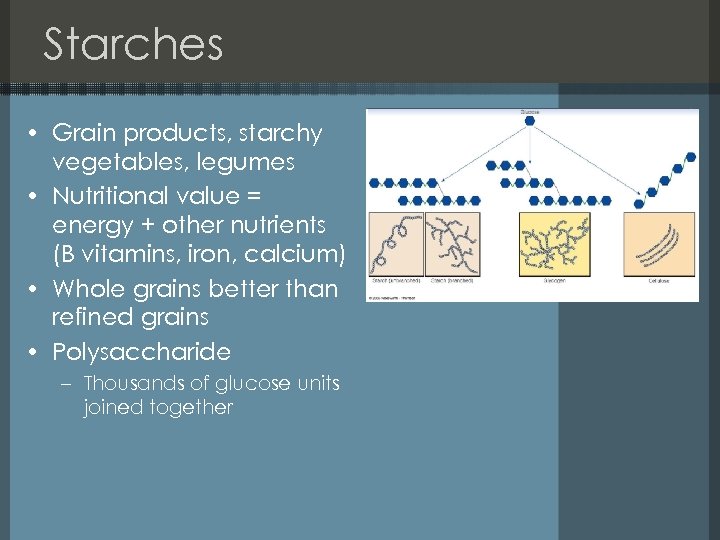 Starches • Grain products, starchy vegetables, legumes • Nutritional value = energy + other nutrients (B vitamins, iron, calcium) • Whole grains better than refined grains • Polysaccharide – Thousands of glucose units joined together
 • Most carbohydrates occurs as starches in foods, Grains and certain vegetables are major contributors. Other sources include corn, tapioca, flour, cereals, popcorn, pasta, rice, potatoes and crackers. • Fruit and dark coloured vegetables contain little or no starch.
 Fibre • CHO you can’t digest • Can be fermented by the digestive tract • Soluble fibre – Helps lower blood cholesterol and control blood sugar – Oat bran, psyllium, fruit, legumes • Insoluble fibre – Helps with bowel regulation – Wheat bran, vegetables, fruit, legumes
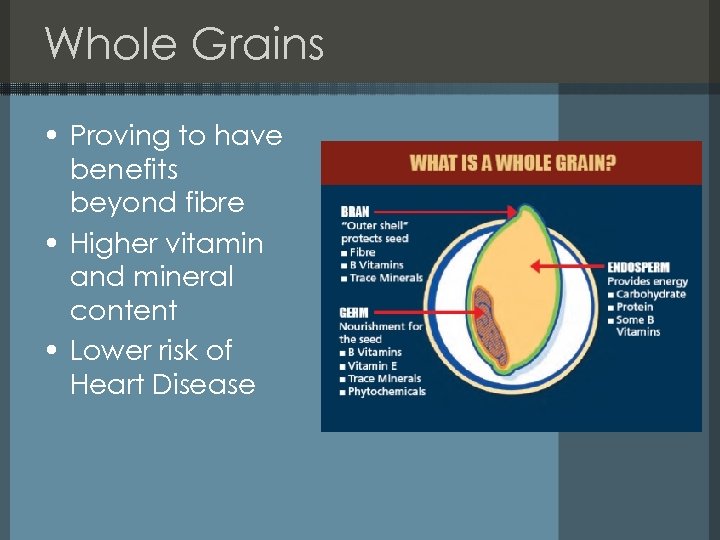 Whole Grains • Proving to have benefits beyond fibre • Higher vitamin and mineral content • Lower risk of Heart Disease
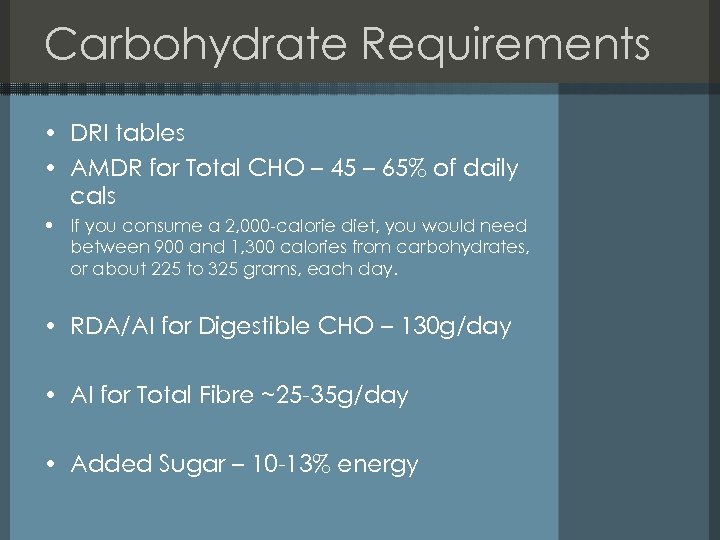 Carbohydrate Requirements • DRI tables • AMDR for Total CHO – 45 – 65% of daily cals • If you consume a 2, 000 -calorie diet, you would need between 900 and 1, 300 calories from carbohydrates, or about 225 to 325 grams, each day. • RDA/AI for Digestible CHO – 130 g/day • AI for Total Fibre ~25 -35 g/day • Added Sugar – 10 -13% energy
 • The DRI requirement for CHO are based on the average minimum amount of glucose that is utilized by the brain. Evidence was insufficient to set a Tolerable Upper Intake. • The amount of CHO for optimal health is unknown however data suggests that more slowly absorbed starches that are less processed offer health advantages. • However added sugar is set at 25% of total calories or less because trends show that people with diets at or above this level have poor intakes of essential nutrients.
 • Added sugar is defined as the sugar that is added to foods during processing, they do not occur naturally. • Non diet soft drinks are the leading source of added sugar. Followed by sugars and sweets, sweetened grains, fruit aids, sweetened dairy products, and breakfast cereals. • Long term effects of diets low in glucose: increased production of keto acids (Ketones are substances that are produced when fat cells break down. They can make the blood too acidic), bone mineral loss, hypercholesterolemia (the presence of excess cholesterol in the blood), increase risk of urolithiasis (a condition that is characterized by the formation or presence of calculi in the urinary tract) and impaired development and function of the central nervous system.
 Carbohydrate Content of Foods • CHO rich foods almost exclusively plants – Milk only animal food with significant CHO • Main sources – – – Grain products Starchy vegetables Fruit Legumes Milk
 Carbohydrates in Cooking • Sugars – Food for yeast in bread-making – Produces tenderness, smooth crumb texture – Crispness – Browning • Starches – Thickening • Fibre – Pectin for gelling – Guar gum for thickening and binding
 • BREAK!