



 Strategy Хисамутдинова Р. М. , гр. 31 -1
 Developing a successful strategy is a vital part of the planning process for all business organisations. Analysing where a business stands in relation to its markets and competition enables it to identify potential opportunities for growth and potential threats. It is then possible to set strategic objectives and to predict the human and financial resources needed to achieve them.
 Strategy is the direction and scope of an organisation over the long-term: which achieves advantage for the organisation through its configuration of resources within a challenging environment, to meet the needs of markets and to fulfil stakeholder expectations
 Strategy is about: Where is the business trying to get to in the long-term (direction) Which markets should a business compete in and what kind of activities are involved in such markets? (markets; scope) How can the business perform better than the competition in those markets? (advantage)? What resources (skills, assets, finance, relationships, technical competence, facilities) are required in order to be able to compete? (resources)? What external, environmental factors affect the businesses' ability to compete? (environment)? What are the values and expectations of those who have power in and around the business? (stakeholders)
 Strategy at Different Levels of a Business Strategies exist at several levels in any organisation - ranging from the overall business (or group of businesses) through to individuals working in it. Corporate Strategy - is concerned with the overall purpose and scope of the business to meet stakeholder expectations. This is a crucial level since it is heavily influenced by investors in the business and acts to guide strategic decision-making throughout the business. Corporate strategy is often stated explicitly in a "mission statement". Business Unit Strategy - is concerned more with how a business competes successfully in a particular market. It concerns strategic decisions about choice of products, meeting needs of customers, gaining advantage over competitors, exploiting or creating new opportunities etc. Operational Strategy - is concerned with how each part of the business is organised to deliver the corporate and business-unit level strategic direction. Operational strategy therefore focuses on issues of resources, processes, people etc.
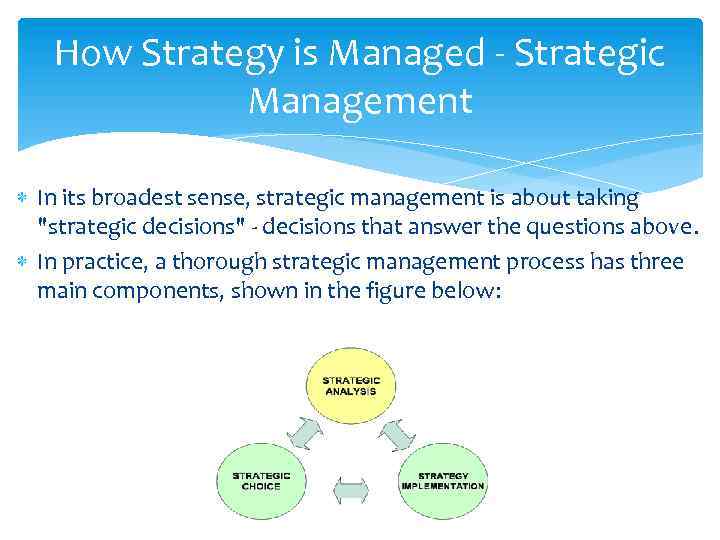 How Strategy is Managed - Strategic Management In its broadest sense, strategic management is about taking "strategic decisions" - decisions that answer the questions above. In practice, a thorough strategic management process has three main components, shown in the figure below:
 Strategic Analysis This is all about the analysing the strength of businesses' position and understanding the important external factors that may influence that position. The process of Strategic Analysis can be assisted by a number of tools, including: PEST Analysis - a technique for understanding the "environment" in which a business operates Scenario Planning - a technique that builds various plausible views of possible futures for a business Five Forces Analysis - a technique for identifying the forces which affect the level of competition in an industry Market Segmentation - a technique which seeks to identify similarities and differences between groups of customers or users Directional Policy Matrix - a technique which summarises the competitive strength of a businesses operations in specific markets Competitor Analysis - a wide range of techniques and analysis that seeks to summarise a businesses' overall competitive position Critical Success Factor Analysis - a technique to identify those areas in which a business must outperform the competition in order to succeed SWOT Analysis - a useful summary technique for summarising the key issues arising from an assessment of a businesses "internal" position and "external" environmental influences.
 SWOT - analysis All business organisations need to have a framework to help them to analyse their current position and then to use that information to help them to prepare for the future. There are many different ways that they can do this. Probably the best known is what's called the SWOT analysis. This very neatly divides the problem into four areas. It's normally represented as a square divided into four parts. At the top you have the S for strengths and the W for weaknesses. And then on the bottom line you have the О for opportunities and then T for threats. The idea is that if you analyse a business using these four criteria, then you should have the basic information to allow you to map out what the best strategy might be. Under strengths, you would put the things that it does well, and then under weaknesses, the things that it doesn't do quite so well. That leaves two spaces: one for opportunities that the company is in a position to exploit, and one for threats - the dangers that it will be exposed to in its markets in the future.
 Strategic Choice This process involves understanding the nature of stakeholder expectations (the "ground rules"), identifying strategic options, and then evaluating and selecting strategic options.
 Strategy Implementation Often the hardest part. When a strategy has been analysed and selected, the task is then to translate it into organisational action.
 Tactics need to know what to do when there is what to do. The strategist must know what to do when you have nothing to do. The best strategy - always be the strongest "Long-term perspective" - is a bad counselor in current affairs. In the long run we are all dead.