 Скачать презентацию STRATEGY OF PL Private Lable 1 STRATEGY
639dd7e02f1ef0330ba432c2b8a29ff6.ppt
- Количество слайдов: 10



STRATEGY OF PL (Private Lable)
1. STRATEGY TARGETS: increase of the profitability; Ø increase of loyalty to brand “Project”. Ø 2
2. The CONCEPT of PRIVATE LABLE : PL means the production (own and subcontracting ) brands. 3
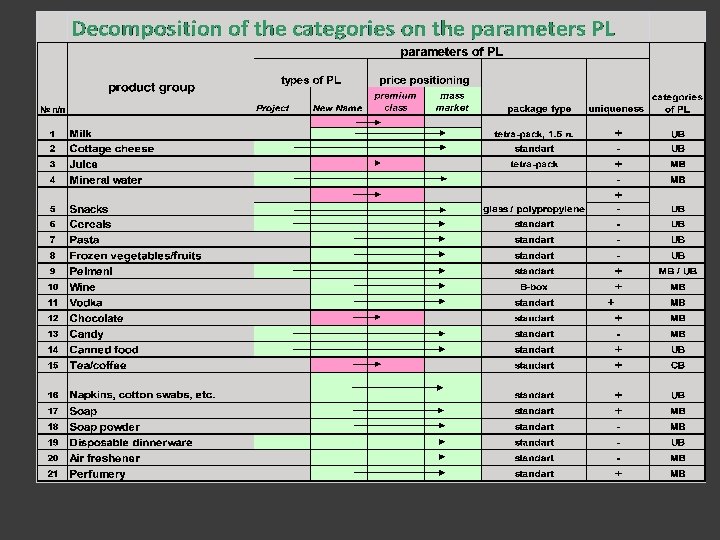
3. TYPES and CATEGORIES of PL: Types of PL “Project” - the production of goods under its own logo Ø “New Name” – the production of goods under a specially designed logo. Ø 4
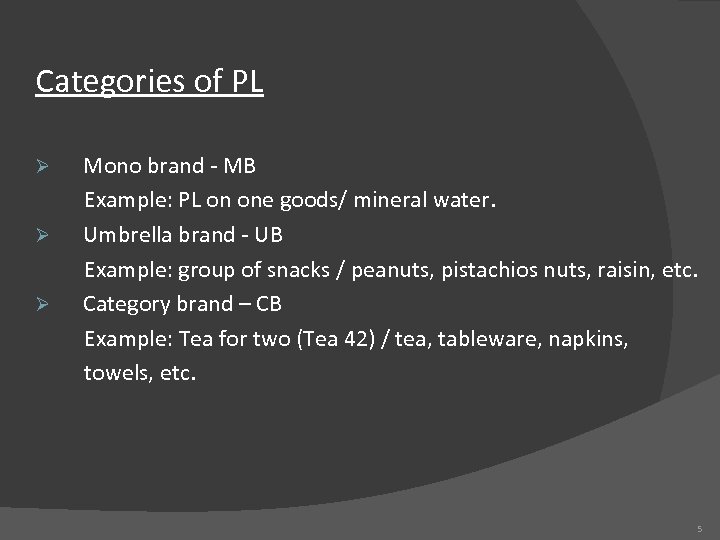
Categories of PL Ø Ø Ø Mono brand - MB Example: PL on one goods/ mineral water. Umbrella brand - UB Example: group of snacks / peanuts, pistachios nuts, raisin, etc. Category brand – CB Example: Tea for two (Tea 42) / tea, tableware, napkins, towels, etc. 5
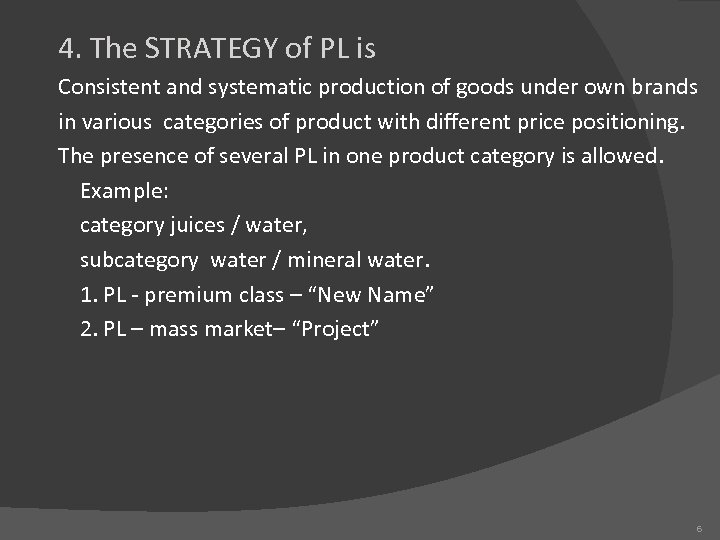
4. The STRATEGY of PL is Consistent and systematic production of goods under own brands in various categories of product with different price positioning. The presence of several PL in one product category is allowed. Example: category juices / water, subcategory water / mineral water. 1. PL - premium class – “New Name” 2. PL – mass market– “Project” 6
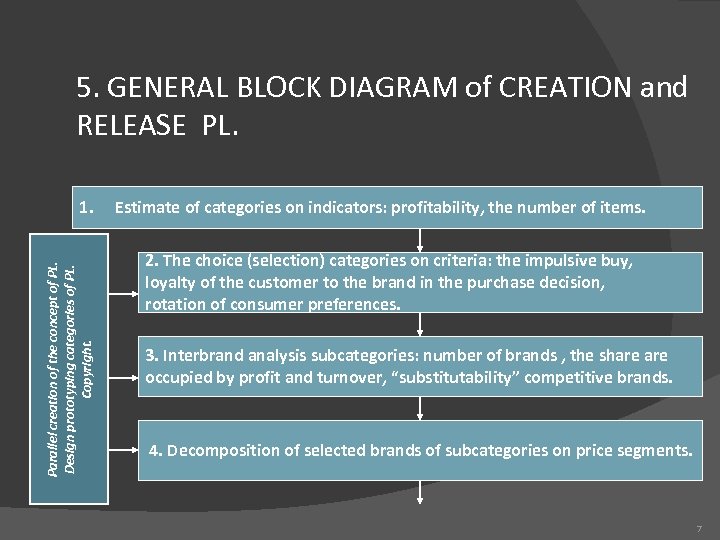
5. GENERAL BLOCK DIAGRAM of CREATION and RELEASE PL. Parallel creation of the concept of PL. Design prototyping categories of PL. Copyright. 1. Estimate of categories on indicators: profitability, the number of items. 2. The choice (selection) categories on criteria: the impulsive buy, loyalty of the customer to the brand in the purchase decision, rotation of consumer preferences. 3. Interbrand analysis subcategories: number of brands , the share occupied by profit and turnover, “substitutability” competitive brands. 4. Decomposition of selected brands of subcategories on price segments. 7
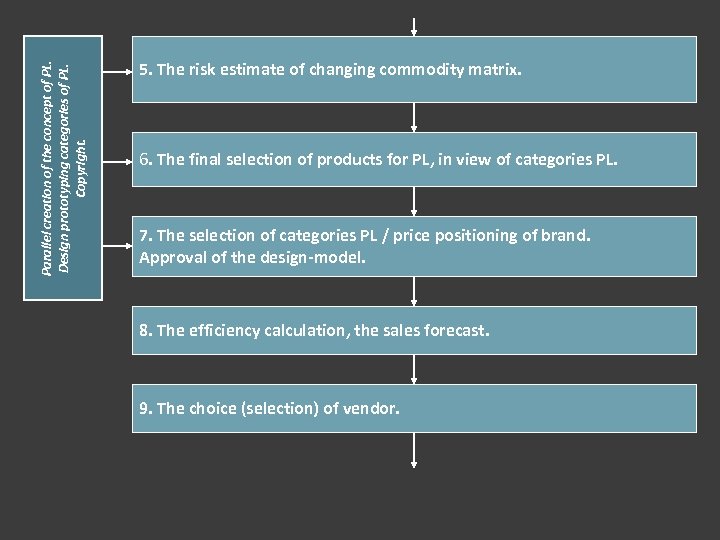
Parallel creation of the concept of PL. Design prototyping categories of PL. Copyright. 5. The risk estimate of changing commodity matrix. 6. The final selection of products for PL, in view of categories PL. 7. The selection of categories PL / price positioning of brand. Approval of the design-model. 8. The efficiency calculation, the sales forecast. 9. The choice (selection) of vendor.
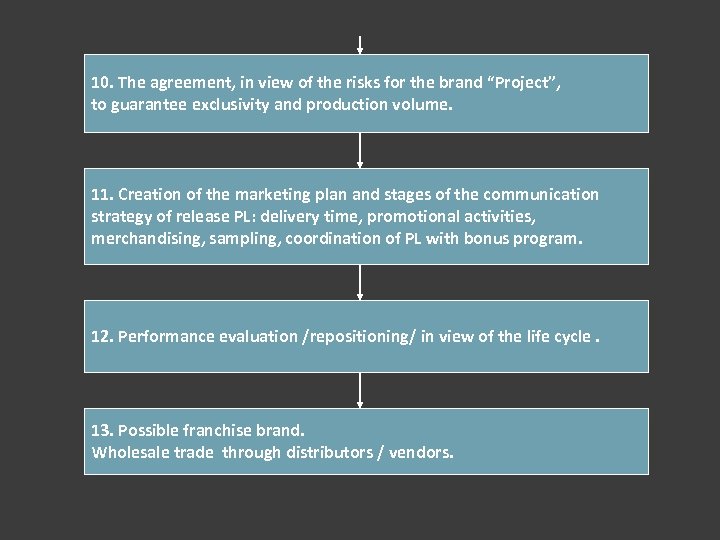
10. The agreement, in view of the risks for the brand “Project”, to guarantee exclusivity and production volume. 11. Creation of the marketing plan and stages of the communication strategy of release PL: delivery time, promotional activities, merchandising, sampling, coordination of PL with bonus program. 12. Performance evaluation /repositioning/ in view of the life cycle. 13. Possible franchise brand. Wholesale trade through distributors / vendors.
Скачать презентацию STRATEGY OF PL Private Lable 1 STRATEGY
639dd7e02f1ef0330ba432c2b8a29ff6.ppt