


 Скачать презентацию STRATEGY OF FUTURE 1 Opposition Modern-Postmodern in Mankind s
Strategy of future.ppt
- Количество слайдов: 27
 STRATEGY OF FUTURE 1. Opposition “Modern-Postmodern” in Mankind’s Cultural and Civilized Development. 2. Global Problems of Today as Negative Consequences of Modern Culture. 3. Phenomenon of Globalization in Modern Civilized Development.
 Literature Basic: Globalization and Social Changes / Johannes Dragsbaek Schmidt and Jacques Hersh. – London: Routage, 2000. -303 p. Jean-Francois Lyotard / S. Malpas. – New-York: Publication Yaer, 2002. -P. 15 -32. Knowledge Societies: Information Technology for Sustainable Development. – Oxford : Oxford University Press, 1998. -323 p. Modernity and Postmodern Culture / J. Mc. Guigan. – N. -Y. : Open University Press, 1999. -189 p. Toward Genuine Global Governance. Critical Reactions to “Our Global Neighborhood”/ Errol E. Harris, J. A. Yunker. – Praeger: Westport, 1999. -211 p. Supplementary: Globalization and National Identities; Crisis or Opportunity? / P. Kennedy. – New-York : Palgrave, 2001. -125 p. Media Culture: Cultural Studies, Identity, and Politics between the Modern and the Postmodern/ D. Kellner. -L. : Routledge, 1995. - 352 p. The Challenge of the 21 th Century: Managing Technology and Ourselves in a Shrinking World / A. Linstone, I. I. Mitroff. - Albany: State University of New York Press, 1994. -406 p. Primary sources: A. Toffler. Creating a new civilization: the politics of the Third Wave / A Toffler. – Atlanta: Turner Pub. ; Kansas City, Mo. -112 p. A. J. Toynbee. Civilization on Trial / A. J. Toynbee. – Oxford University Press; First Edition , 1948. 263 p. M. Castells. The Internet Galaxy / M. Castells. – U. K. : Oxford University Press, 2001. -292 p. J. -F. Lyotard. The Postmodern Condition: A Report on Knowledge / J. -F. Lyotard. – Munneapolis: University of Minnesota Press, 1984. -110 p.
 STRATEGY AND TACTICS “Strategy” means an overall perspective plan of specific actions; “Tactics” denotes immediate concrete actions with the help of the certain means. Tactics is subject to strategy.
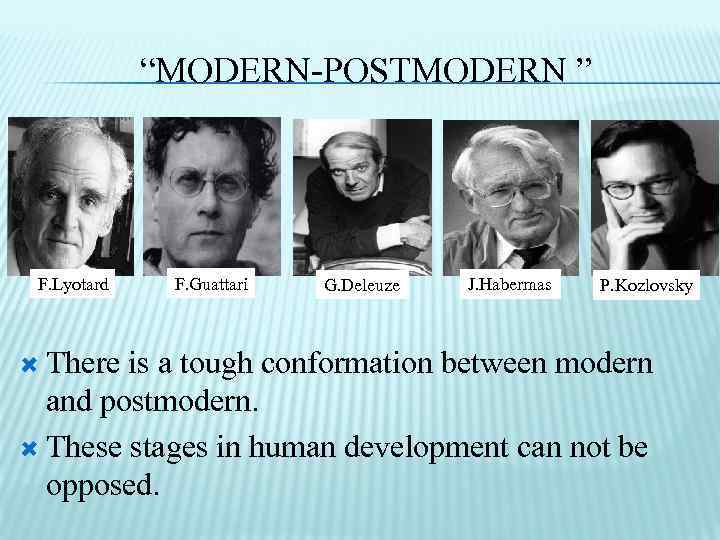 “MODERN-POSTMODERN ” F. Lyotard F. Guattari G. Deleuze J. Habermas P. Kozlovsky There is a tough conformation between modern and postmodern. These stages in human development can not be opposed.
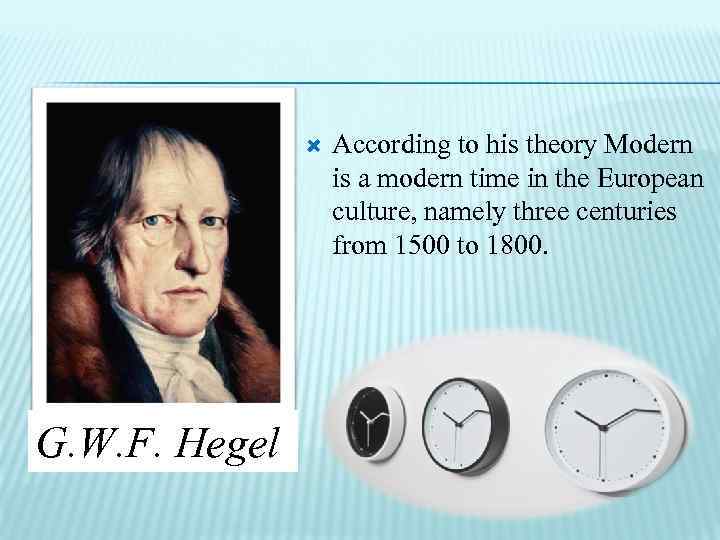 G. W. F. Hegel According to his theory Modern is a modern time in the European culture, namely three centuries from 1500 to 1800.
 MODERNITY Modernity is related to the modern era and denotes “a post-traditional, post-medieval historical period”, marked by progress from agrarianism via the rise of industrialism, capitalism, secularization, the nation-state, and its constituent institutions and form of surveillance.
 MODERNITY IS ASSOCIATED WITH: A certain set of attitudes towards the world, the idea of the world as open to transformation by human intervention; A complex of economic institutions, especially industrial production and a market economy; A certain range of political institutions, including the nation-state and mass democracy.
 BASIC ATTRIBUTES OF THE MODERN CULTURE • • • Rationalism that confronts to irrationalism; Overwhelming development of natural sciences; Dominant development of technique aimed at mastering over nature.
 POSTMODERNITY Postmodernity is generally used to describe the economic and cultural state or condition of society which is said to exist after modernity. Postmodernity - is a part of contemporary history. Postmodernity is a condition or a state of being associated with changes to institutions and conditions (Giddens, 1990) and with social and political results and innovations, globally, but especially in the West since the 1960 s.
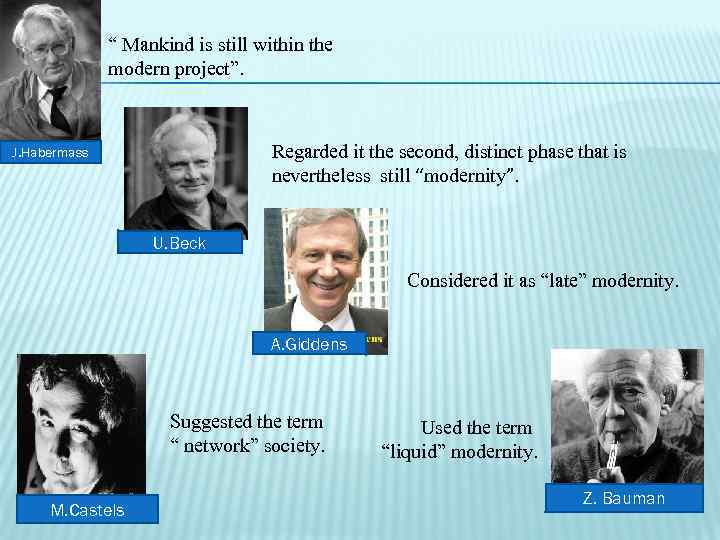 “ Mankind is still within the modern project”. Regarded it the second, distinct phase that is nevertheless still “modernity”. J. Habermass U. Beck Considered it as “late” modernity. A. Giddens Suggested the term “ network” society. M. Castels Used the term “liquid” modernity. Z. Bauman
 Postmodernity the nature of contemporary society In philosophy and critical theory postmodernity refers to the state of society which is said to exist after modernity, a historical condition that marks the reasons for the end of modernity. This usage is ascribed to the philosopher J. -F. Lyotard and J. Baudrillard. the nature of the critique of contemporary society Debates over universalism and relativism, where modernism is seen to represent the former and postmodernism the latter.
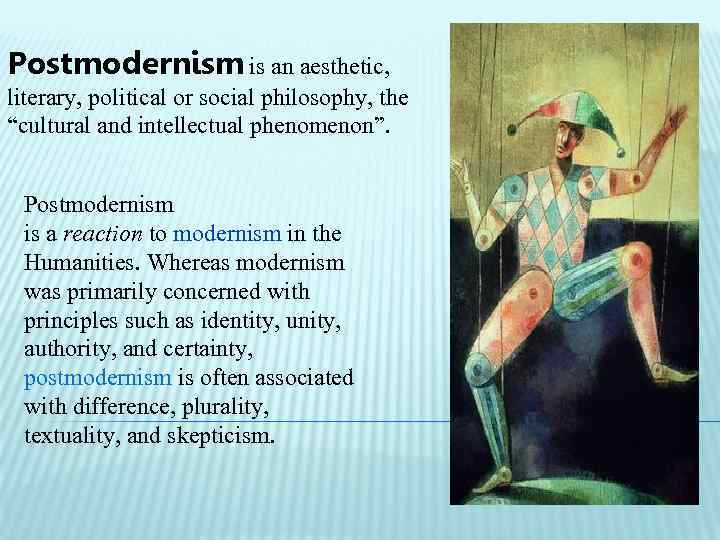 Postmodernism is an aesthetic, literary, political or social philosophy, the “cultural and intellectual phenomenon”. Postmodernism is a reaction to modernism in the Humanities. Whereas modernism was primarily concerned with principles such as identity, unity, authority, and certainty, postmodernism is often associated with difference, plurality, textuality, and skepticism.
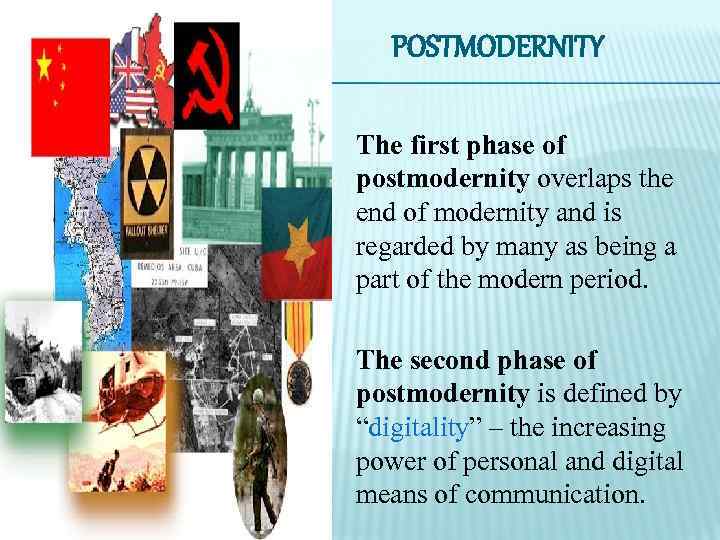 POSTMODERNITY The first phase of postmodernity overlaps the end of modernity and is regarded by many as being a part of the modern period. The second phase of postmodernity is defined by “digitality” – the increasing power of personal and digital means of communication.
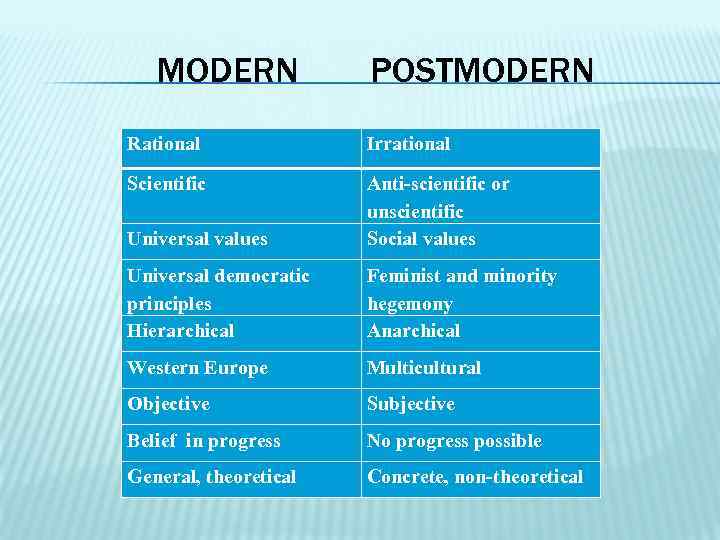 MODERN POSTMODERN Rational Irrational Scientific Universal values Anti-scientific or unscientific Social values Universal democratic principles Hierarchical Feminist and minority hegemony Anarchical Western Europe Multicultural Objective Subjective Belief in progress No progress possible General, theoretical Concrete, non-theoretical
 THE STATUS OF KNOWLEDGE The main feature of scientific knowledge in the culture of postmodernism is its ability to be sold, to acquire value in a new product that is to be transformed into a commodity. University education does not end with young people’s graduation from it. Society is constantly requires specialists to improve their competence through learning new scientific information, which "will allow them to expand the horizon of their professional life and combine their technical and moral experience" (J. -F. Lyotard).
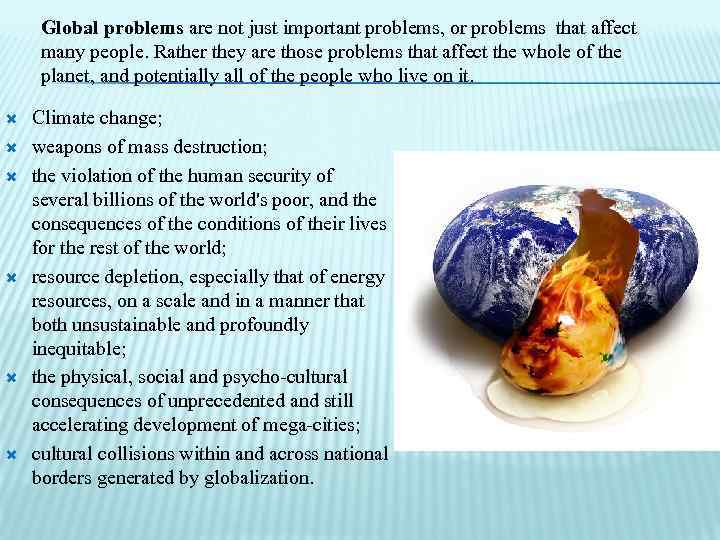 Global problems are not just important problems, or problems that affect many people. Rather they are those problems that affect the whole of the planet, and potentially all of the people who live on it. Climate change; weapons of mass destruction; the violation of the human security of several billions of the world's poor, and the consequences of the conditions of their lives for the rest of the world; resource depletion, especially that of energy resources, on a scale and in a manner that both unsustainable and profoundly inequitable; the physical, social and psycho-cultural consequences of unprecedented and still accelerating development of mega-cities; cultural collisions within and across national borders generated by globalization.
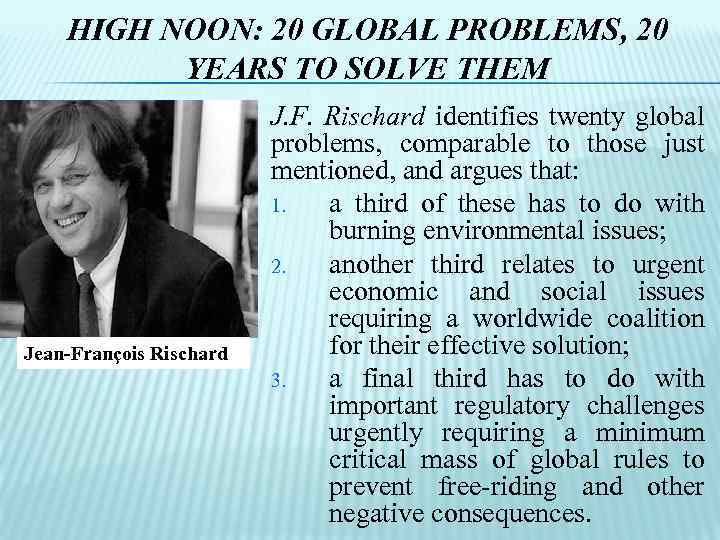 HIGH NOON: 20 GLOBAL PROBLEMS, 20 YEARS TO SOLVE THEM Jean-François Rischard J. F. Rischard identifies twenty global problems, comparable to those just mentioned, and argues that: 1. a third of these has to do with burning environmental issues; 2. another third relates to urgent economic and social issues requiring a worldwide coalition for their effective solution; 3. a final third has to do with important regulatory challenges urgently requiring a minimum critical mass of global rules to prevent free-riding and other negative consequences.
 “What is the single most important environmental problem facing the world today? ” A flip answer would be: “The single most important problem is our misguided focus on identifying the single most important problem!”
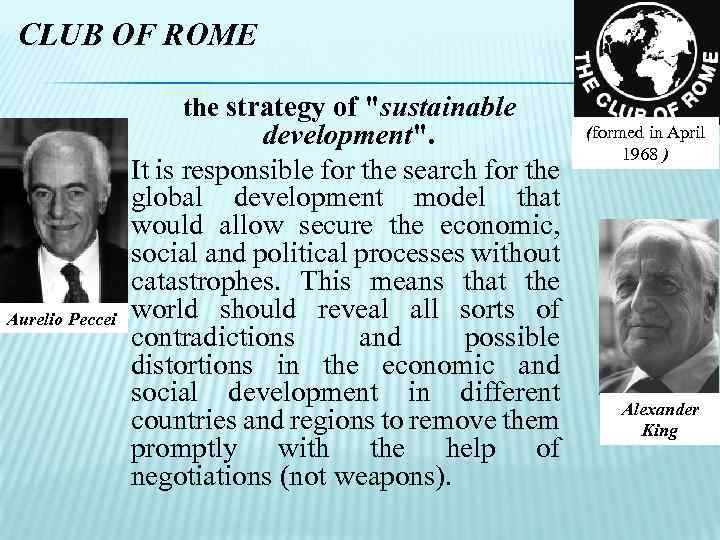 CLUB OF ROME the strategy of "sustainable Aurelio Peccei development". It is responsible for the search for the global development model that would allow secure the economic, social and political processes without catastrophes. This means that the world should reveal all sorts of contradictions and possible distortions in the economic and social development in different countries and regions to remove them promptly with the help of negotiations (not weapons). (formed in April 1968 ) Alexander King
 “SUSTAINABLE DEVELOPMENT“ v the world is unique and at the same time diverse. v the idea of mankind’s developing of global consciousness v the idea of creating a global model of the world development.
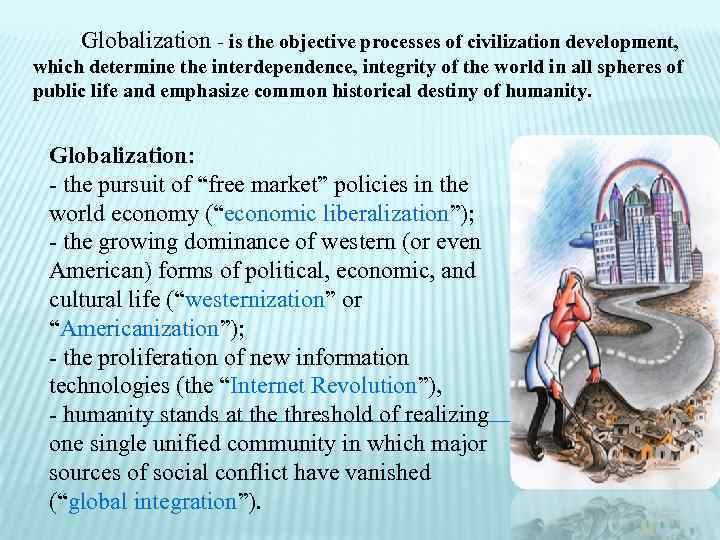 Globalization - is the objective processes of civilization development, - which determine the interdependence, integrity of the world in all spheres of public life and emphasize common historical destiny of humanity. Globalization: - the pursuit of “free market” policies in the world economy (“economic liberalization”); - the growing dominance of western (or even American) forms of political, economic, and cultural life (“westernization” or “Americanization”); - the proliferation of new information technologies (the “Internet Revolution”), - humanity stands at the threshold of realizing one single unified community in which major sources of social conflict have vanished (“global integration”).
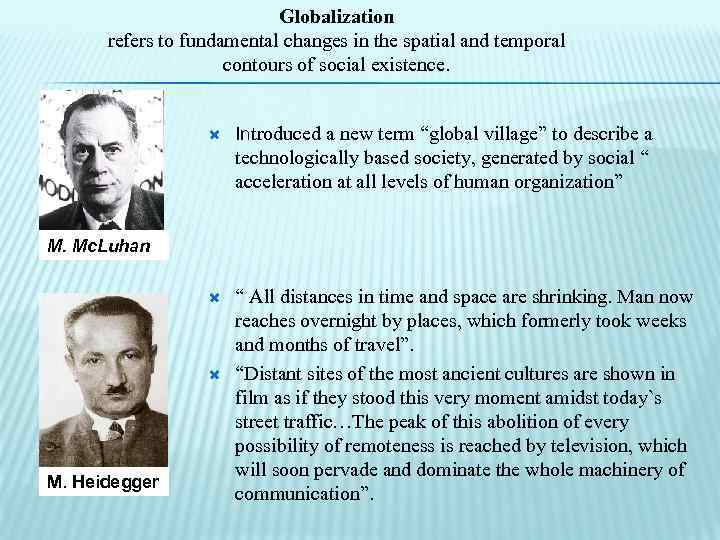 Globalization refers to fundamental changes in the spatial and temporal contours of social existence. Introduced a new term “global village” to describe a technologically based society, generated by social “ acceleration at all levels of human organization” “ All distances in time and space are shrinking. Man now reaches overnight by places, which formerly took weeks and months of travel”. “Distant sites of the most ancient cultures are shown in film as if they stood this very moment amidst today`s street traffic…The peak of this abolition of every possibility of remoteness is reached by television, which will soon pervade and dominate the whole machinery of communication”. M. Mc. Luhan M. Heidegger
 The basic characteristics of globalization: - deterritorialization, according to which a growing variety of social activities takes place irrespectively of the geographical location of participants. - the growth of social interconnectedness across existing geographical and political boundaries. - reference to the speed or velocity of social activity. - it should be conceived as a relatively longterm process. - it should be understood as a multi- pronged process, since deterritorialization, social interconnectedness, and acceleration manifest themselves in many different areas of social activity.
 Thus, globalization is changing the split world with autonomous and atomized peoples and cultures, leading to the unity of economic relations, political and social processes and historical fate of different countries. It leads to dialogue of cultures, to the harmonious unification of mankind in the face of common threats and global challenges.
 Negative consequences of globalization: - the expansion of American standards into most regions of the world, announced by the U. S. A. to be the zone of national interests. - demolishing of the ethnic and national values of different nations and countries under pressure of standardization, homogenization of material and spiritual culture. -” Westernization” of spiritual culture threatens with the destruction of national art, cinema, theatre, language and literature.
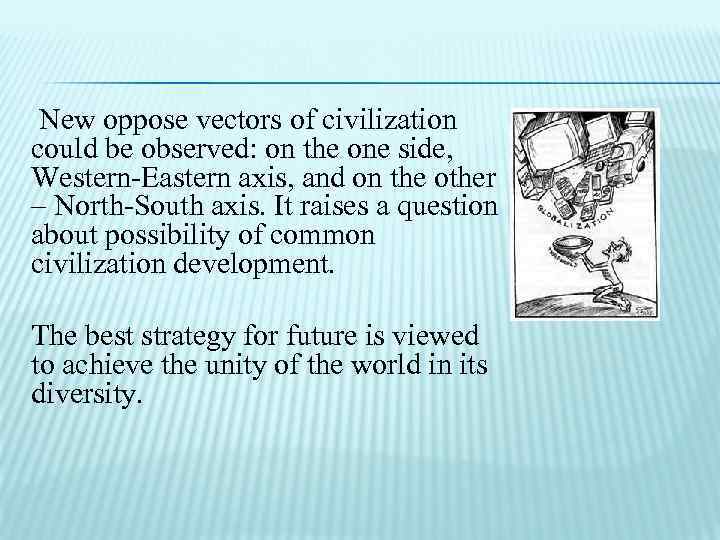 New oppose vectors of civilization could be observed: on the one side, Western-Eastern axis, and on the other – North-South axis. It raises a question about possibility of common civilization development. The best strategy for future is viewed to achieve the unity of the world in its diversity.
 QUESTIONS FOR EXPRESS-CONTROL 1. What caused the development of the Postmodern civilization stage? 2. A general, perspective plan of certain actions is called: 3. The objective process of civilization development, which determine the interdependence, integrity of the world in all spheres of public life and emphasize common historical destiny is called: 4. What modes of solving the global problems does the Rome Club offer? 5. The main sphere of production in the Age of Postmodernism is: