


 Скачать презентацию Strategy Formulation Strategies for Growth and Diversification
c79c9c39eccdebfa23c8ce80fa1e3249.ppt
- Количество слайдов: 41
 Strategy Formulation Strategies for Growth and Diversification
 Identifying Growth Strategies Define the industry Analyze options for growth
 What Is Our Industry? Defining the industry in new ways can present new opportunities. Examples: Disney n IBM n
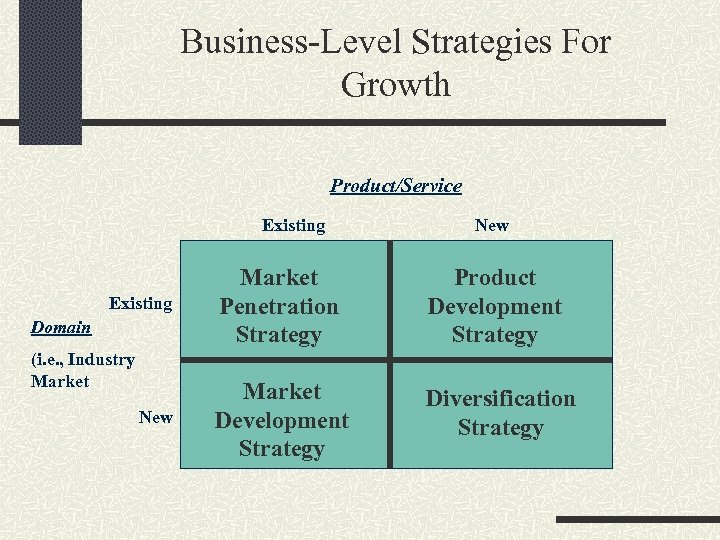 Business-Level Strategies For Growth Product/Service Existing Domain (i. e. , Industry Market New Market Penetration Strategy Product Development Strategy Market Development Strategy Diversification Strategy
 Product/Market Expansion: Scale Strategies Market Penetration Goal: increase market share Low risk/marginal returns Every business does this Market Development Goal: find new markets Marketing expertise Mature products/services
 Product/Market Expansion: Scope Strategies Product Development Goal: develop & introduce new products/services Technical expertise Growth of products/services (Could Entail Related Diversification) Diversification Goal: develop & introduce products/services to new or emerging markets (Most likely Unrelated Diversification)
 When Does Diversification Make Sense? Single business strategies have a number of advantages … …but also a number of risks -- all one’s eggs in one basket The logic: to spread corporate risk across multiple industries to enhance shareholder value: SYNERGY (i. e. , 2 + 2 = 5)
 Diversification -- Motives The risks of single business strategies are more severe for management than for shareholders of publicly traded firms. Diversification may be motivated by management’s desire to reduce risk. Diversification only makes sense when it enhances shareholder value!
 Tests For Judging Diversification Attractiveness Better-off Cost of entry
 Attractiveness Test Is the target industry attractive? (Use 5 forces model to assess industry attractiveness) Does the diversification move fit with the grand strategy of the firm?
 Better-off test Does the diversification move produce opportunities for synergies? Will the company be better off after the diversification than it was before? How and why?
 Cost of Entry Test Is the cost of the diversification worth it? Will the diversified firm create enough additional value to justify the cost?
 Methods for Diversification Acquisition of an existing business Creation of a new business from within, e. g. a start-up Joint venture with another firm or firms
 Acquisition Most popular approach to diversification Quick market entry Avoids entry barriers: Technology Access to suppliers Efficiency / economies of scale Promotion Distribution channels
 Major Acquisition Issue Acquire a successful company at a high price or Acquire a struggling company at a bargain price
 Start-Up Appropriate when: You have time to launch Market moves slowly Internal entry costs lower than acquisition costs You already possess necessary skills Target industry is fragmented
 Joint Ventures Pooling resources to spread risk Achieving synergy from respective capabilities Leveraging one another’s experience Complicated; potential for conflicts if responsibilities, liabilities, & rewards not clearly delineated
 Related Diversification Businesses are distinct … …but their value chains possess strategic “fit” in operations, marketing, management, R&D. distribution, labor, etc. Therefore, they tend to exploit economies of scope Tend to (historically) outperform unrelated diversifications
 Unrelated Diversification No common linkage or element of strategic fit among SBUs -- i. e. , no meaningful value chain interrelationships Strategic approach: venture opportunistically into attractive industries that have solid potential for financial returns “Conglomerates” Dominant logic: spreads businesses risk over multiple industries, stabilizing corporate profitability (in theory)
 Attractive Acquisition Targets for Unrelated Diversification Companies whose assets are undervalued (buy’em & sell’em to realize capital gains) Companies that are financially distressed (purchase at bargain price & turn’em around through injections of financial resources & managerial expertise) Companies with bright prospects, but limited capital Dominant logic: any company that can be acquired on good financial terms & offers good prospects for profitability is a good business for diversification
 Drawbacks of Unrelated Diversification Places enormous demands on corporate management -shifting resources & making moves into unknown areas, etc. Cannot capture synergies -- no strategic fit between SBUs Few businesses have offsetting up-down cycles, so salesprofit stability is more mythical than real (& when EVERYTHING IS in a downturn, assets spread thin are sometimes consumed …)
 Strategic Analysis of Diversified Companies “The essence of strategic management is to allocate resources to those areas that possess the greatest potential for future success”
 Corporate Strategy for Diversified Firms -Key Strategic Issues (1) How attractive are our current businesses? (2) With these businesses, what is our performance outlook for “X” years in the future? (3) If answers to (1) & (2) above aren’t satisfactory, what should we do to get out of some businesses, strengthen those remaining, & get into new businesses to boost our prospects for better performance?
 BCG Growth-Share Matrix Dimensions: Industry growth rate Relative market share position of the businesses SBUs plotted as circles with area proportional to their contribution to overall corporate sales
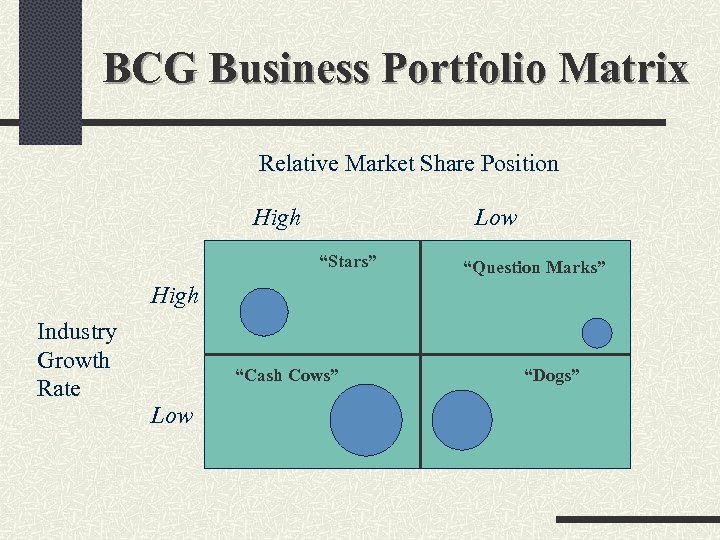 BCG Business Portfolio Matrix Relative Market Share Position High Low “Stars” “Question Marks” High Industry Growth Rate “Cash Cows” Low “Dogs”
 BCG Matrix -- Strengths Encourages strategists to view a diversified firm as a collection of cash flows & cash requirements (** its major strategic implication **) Explains why priorities for corporate resource allocation differ from SBU to SBU Demonstrates the progression of an SBU -from Q-mark ===>Star ===>Cash Cow
 BCG Matrix -- Weaknesses Over-simplifies market growth & market share issues 4 simple categories are neat, but trends are more valuable Doesn’t directly identify which SBUs offer the best investment opportunities Considers only 2 variables
 G. E. 9 -Cell Matrix Dimensions: Long-term industry attractiveness Business strength/Competitive position SBUs plotted as circles with area proportional to the size of the industry, & a sector within each circle representing the SBUs market share in its industry
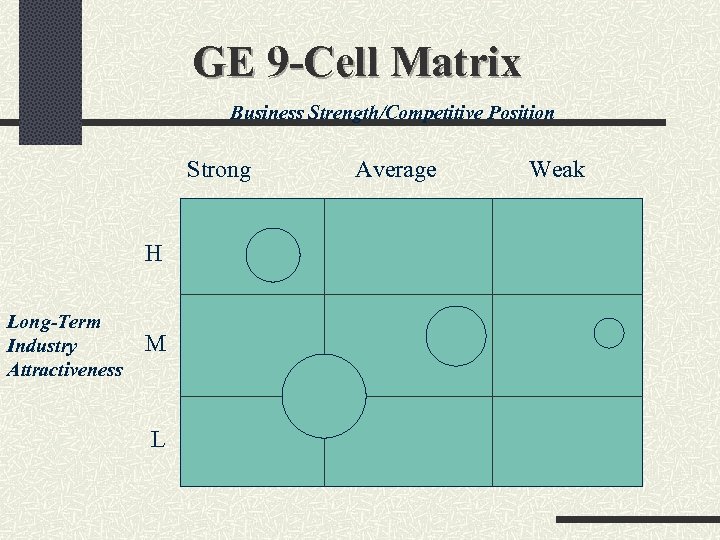 GE 9 -Cell Matrix Business Strength/Competitive Position Strong H Long-Term Industry Attractiveness M L Average Weak
 Strategic Implications of the G. E. 9 -Cell Matrix SBUs in 3 upper left cells get top investment priority SBUs in 3 middle diagonal cells merit steady investment to maintain & protect their industry positions SBUs in 3 lower right cells are candidates for harvesting or divestiture
 Advantages of G. E. 9 -Cell Matrix Allows for intermediate rankings between high & low and between strong & weak Incorporates a wider variety of strategically relevant variables than the BCG matrix Stresses the channeling of corporate resources to SBUs with the greatest potential for competitive advantage & superior performance
 Weaknesses of G. E. 9 -Cell Matrix Provides no guidance on specifics of SBU strategy Only suggests general strategic posture -- aggressive expansion, fortify-&-defend, or harvest/divest Doesn’t address the issue of strategic coordination across related SBUs Tends to obscure SBUs about to “take off” or “crash & burn” - static, not dynamic
 Life-Cycle Portfolio Matrix Dimensions: Industry stage in the life cycle SBU’s competitive position Area of each SBU circle is proportional to size of the industry; sectors denote SBU’s market share in its industry This matrix displays the distribution of the firm’s businesses across the various stages of industry evolution
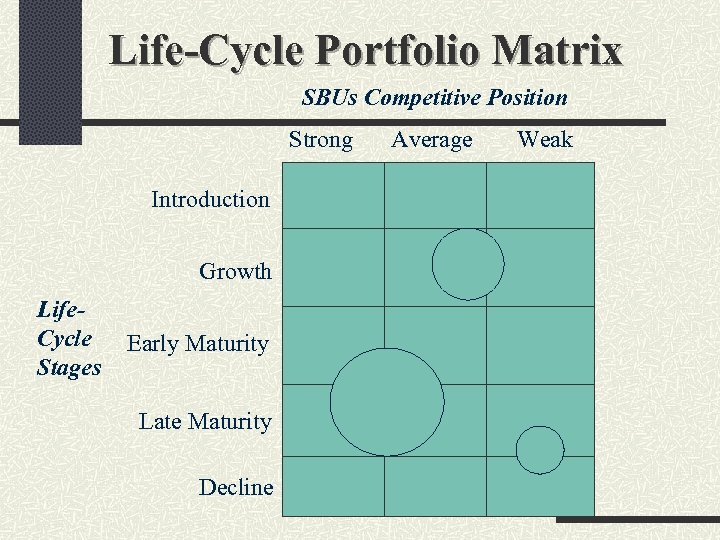 Life-Cycle Portfolio Matrix SBUs Competitive Position Strong Introduction Growth Life. Cycle Stages Early Maturity Late Maturity Decline Average Weak
 Common Problems Associated With Diversified Firms: Overemphasis on ROI Under-emphasis on future earnings streams Short-term focus “Growth” more valued than quality & value Over-decentralized; top managers become isolated & out-of-touch Avoidance of manageable (strategic) risk for the sake of short-run profit
 Performance: Effectiveness & Efficiency Effectiveness: “external” criteria Efficiency: “internal” criteria Not mutually exclusive Both important
 Effectiveness “Doing the right thing”; goal attainment Determine by the market Establishes what price you can command Measures: sales, market share, etc.
 Efficiency “Doing the thing right” Ratio of output to input Determines price you must charge Measures: operating profit, unit cost structure, etc.
 Market Criteria Future projection Reflects anticipated results Indicates investor confidence Measures: trend in stock price or cash value
 Operational Criteria Past & present Reflects actual results Indicates managerial competence Measures: ROE, ROI, ROA, market share, revenue, operating margin (profit), time-tomarket, inventory turns, quality, etc.
 Performance: The Bottom Line No simple “bottom line” No single criterion of performance is inherently most important Multidimensional Situational -- different measures are more appropriate at different times Difficult to be successful on all measures at the same time