 Скачать презентацию STRATEGY for a New DIRECTION SKILLED LABOUR EXPORT
8f6d99547db2774316cafd351f9a0672.ppt
- Количество слайдов: 128



STRATEGY for a New DIRECTION: “SKILLED LABOUR EXPORT STRATEGY” VABIS Hong Lam International Vocational College “Center of Vocational Education & Training” - Vietnam – Canada & Australia - Mr. Nguyen Ngoc My Chairman of VABIS Group October 2010
Introduction (1 of 3) If we look at the current state of the world we can see that all economies are hurting. However, with the economic turmoil and cyclical downturns, one thing has remained consistent: a demand for Skilled Labour. Most developed nations like Canada and Australia have been in dire need of Skilled Workers for over the past 2 decades. The demand has now become desperate and critical in many areas of industry. Canada, in particular, has responded to their need for Skilled Labour by reaching out to a few nations (Vietnam, Philippines and Ukraine) for help. Vietnam is one of these important nations. The problem of the past in Vietnam has been a lack of reputable institutions to step up to meet these needs. “Skilled Labour Export Initiative” Media Release Event, October 2010
Introduction (2 of 3) VABIS Hong Lam International Vocational College (VHLIVC) is now VABIS Hong Lam International Vocational College VHLIVC truly the first and leading Vietnam Vocational Education and Training Institution to have a marketable plan that makes sense-a program based on quality that is committed to meeting International Standards. By focusing on the Skilled Trades that are in greatest demand, Domestic and Overseas, VHLIVC will go through a “ 2 -Tiered” Program approach VHLIVC recruit, educate, train, and prepare Skilled Tradespeople to work and live overseas (Canada & Australia). The secret is to make this a seamless process and readily available for supplying to the much needed demand. The “First Tier” is a 2 -Year comprehensive International Acclaimed Vocational and Training Program which takes a student through a cooperative training process with outside companies (Domestic and Overseas) to enable students to receive valuable on-the-job training and get the real-life experience to prepare them for their future workplaces. “Skilled Labour Export Initiative” Media Release Event, October 2010
Introduction (3 of 3) These newly recruits will also receive Native English Lessons and Canadian/Australian Culture Training to acclimatize them to their future overseas home and new working environment. The importance of this cannot be emphasized enough. The “Second Tier” is 6 -Month comprehensive and rigorous International Acclaimed Vocational and Training Program which is a retraining and acclimatization program with focuses on recruiting well experienced workers that are seasoned professionals in their respective trades. The primary focus here will be to upgrade their existing skills to meet International Standards, while teaching them to communicate effectively in their future workplace and acclimatizing them to culture of their new future overseas homes (Canada and Australia). “Skilled Labour Export Initiative” Media Release Event, October 2010
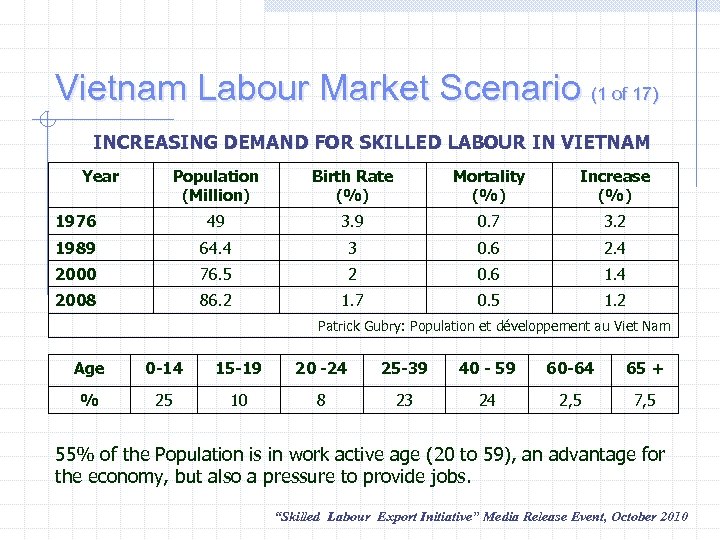
Vietnam Labour Market Scenario (1 of 17) INCREASING DEMAND FOR SKILLED LABOUR IN VIETNAM Year Population (Million) Birth Rate (%) Mortality (%) Increase (%) 1976 49 3. 9 0. 7 3. 2 1989 64. 4 3 0. 6 2. 4 2000 76. 5 2 0. 6 1. 4 2008 86. 2 1. 7 0. 5 1. 2 Patrick Gubry: Population et développement au Viet Nam Age 0 -14 15 -19 20 -24 25 -39 40 - 59 60 -64 65 + % 25 10 8 23 24 2, 5 7, 5 55% of the Population is in work active age (20 to 59), an advantage for the economy, but also a pressure to provide jobs. “Skilled Labour Export Initiative” Media Release Event, October 2010
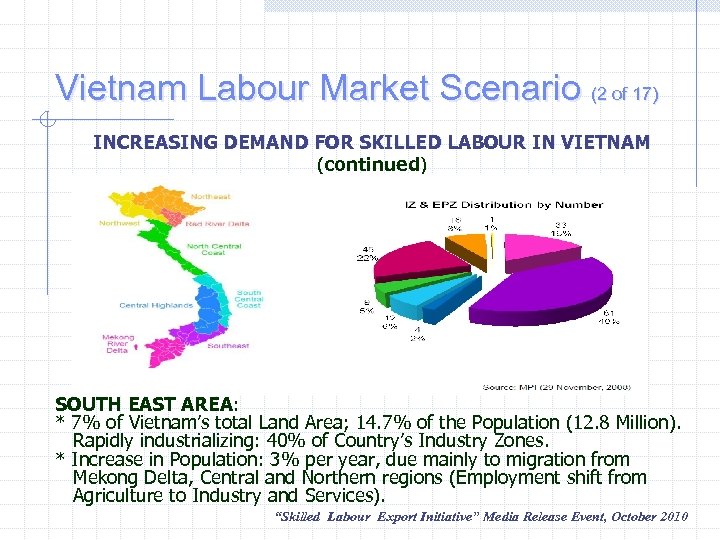
Vietnam Labour Market Scenario (2 of 17) INCREASING DEMAND FOR SKILLED LABOUR IN VIETNAM (continued) SOUTH EAST AREA: * 7% of Vietnam’s total Land Area; 14. 7% of the Population (12. 8 Million). Rapidly industrializing: 40% of Country’s Industry Zones. * Increase in Population: 3% per year, due mainly to migration from Mekong Delta, Central and Northern regions (Employment shift from Agriculture to Industry and Services). “Skilled Labour Export Initiative” Media Release Event, October 2010
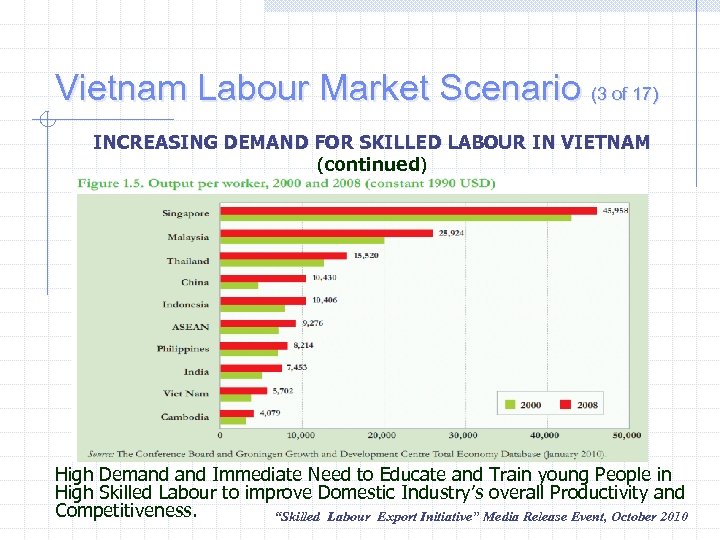
Vietnam Labour Market Scenario (3 of 17) INCREASING DEMAND FOR SKILLED LABOUR IN VIETNAM (continued) High Demand Immediate Need to Educate and Train young People in High Skilled Labour to improve Domestic Industry’s overall Productivity and Competitiveness. “Skilled Labour Export Initiative” Media Release Event, October 2010
Vietnam Labour Market Scenario (4 of 17) VOCATIONAL EDUCATION & TRAINING (VET) IN VIETNAM q Law on Vocational Education and Training (VET)-#76/2006/QH-11: v Enterprises have rights to establish their own VET Institutions to meet their own Labour Needs and those of society. v Enterprises have rights to cooperate with VET Institutions to organize Training, Research, Transfer of Technology. v Certain Corporate taxable Income Tax Preferences. “Skilled Labour Export Initiative” Media Release Event, October 2010
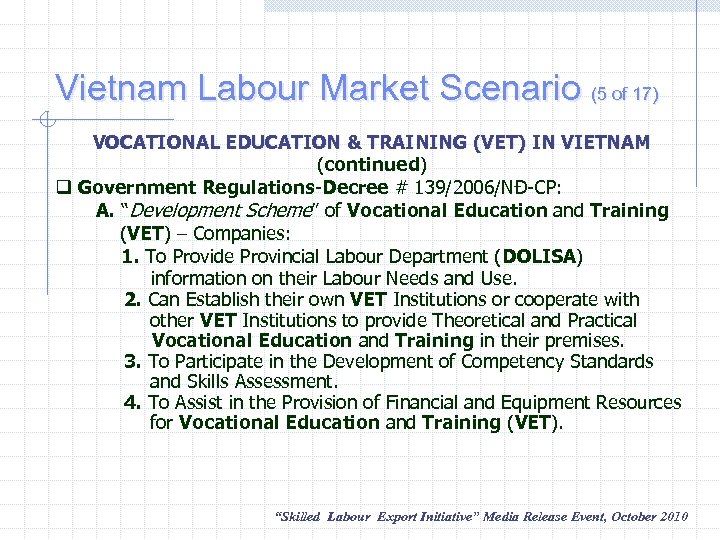
Vietnam Labour Market Scenario (5 of 17) VOCATIONAL EDUCATION & TRAINING (VET) IN VIETNAM (continued) q Government Regulations-Decree # 139/2006/NĐ-CP: A. “Development Scheme” of Vocational Education and Training (VET) – Companies: 1. To Provide Provincial Labour Department (DOLISA) information on their Labour Needs and Use. 2. Can Establish their own VET Institutions or cooperate with other VET Institutions to provide Theoretical and Practical Vocational Education and Training in their premises. 3. To Participate in the Development of Competency Standards and Skills Assessment. 4. To Assist in the Provision of Financial and Equipment Resources for Vocational Education and Training (VET). “Skilled Labour Export Initiative” Media Release Event, October 2010
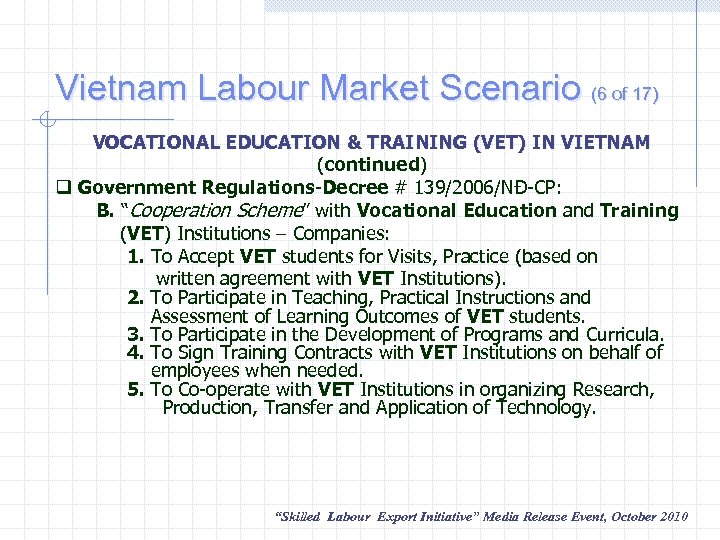
Vietnam Labour Market Scenario (6 of 17) VOCATIONAL EDUCATION & TRAINING (VET) IN VIETNAM (continued) q Government Regulations-Decree # 139/2006/NĐ-CP: B. “Cooperation Scheme” with Vocational Education and Training (VET) Institutions – Companies: 1. To Accept VET students for Visits, Practice (based on written agreement with VET Institutions). 2. To Participate in Teaching, Practical Instructions and Assessment of Learning Outcomes of VET students. 3. To Participate in the Development of Programs and Curricula. 4. To Sign Training Contracts with VET Institutions on behalf of employees when needed. 5. To Co-operate with VET Institutions in organizing Research, Production, Transfer and Application of Technology. “Skilled Labour Export Initiative” Media Release Event, October 2010
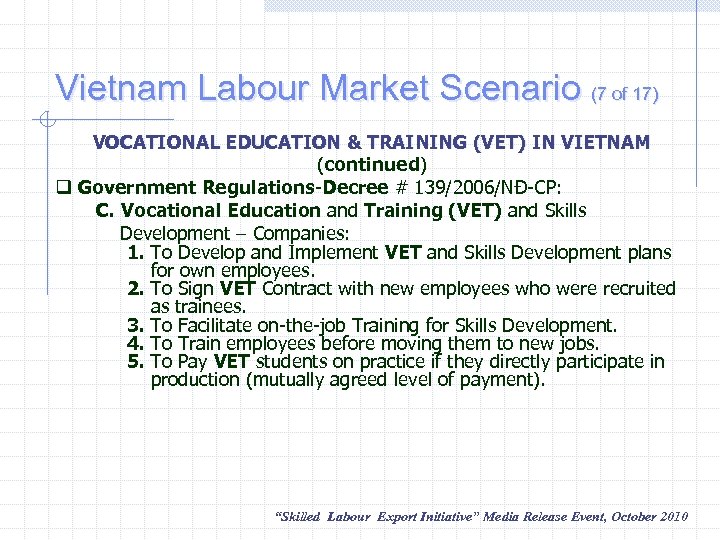
Vietnam Labour Market Scenario (7 of 17) VOCATIONAL EDUCATION & TRAINING (VET) IN VIETNAM (continued) q Government Regulations-Decree # 139/2006/NĐ-CP: C. Vocational Education and Training (VET) and Skills Development – Companies: 1. To Develop and Implement VET and Skills Development plans for own employees. 2. To Sign VET Contract with new employees who were recruited as trainees. 3. To Facilitate on-the-job Training for Skills Development. 4. To Train employees before moving them to new jobs. 5. To Pay VET students on practice if they directly participate in production (mutually agreed level of payment). “Skilled Labour Export Initiative” Media Release Event, October 2010
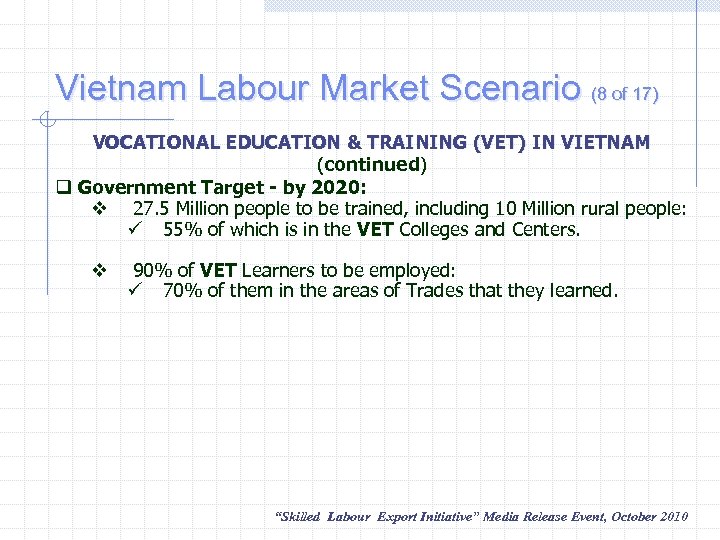
Vietnam Labour Market Scenario (8 of 17) VOCATIONAL EDUCATION & TRAINING (VET) IN VIETNAM (continued) q Government Target - by 2020: v 27. 5 Million people to be trained, including 10 Million rural people: ü 55% of which is in the VET Colleges and Centers. v 90% of VET Learners to be employed: ü 70% of them in the areas of Trades that they learned. “Skilled Labour Export Initiative” Media Release Event, October 2010
Vietnam Labour Market Scenario (9 of 17) VOCATIONAL EDUCATION & TRAINING (VET) IN VIETNAM (continued) q Government Policy - VET Network by 2020: v 230 Senior VET Colleges. v 310 Junior (Secondary) VET Colleges. v 1050 VET Centers. v Development of Competency Standards and Curricula on international Level. Encouragement of using Foreign Curricula (from developed countries). v All VET Institutions to be accredited. v National Skills Testing and Certification for 8 Million People. v 60% of training capacity covered by non-public (private) VET Institutions. “Skilled Labour Export Initiative” Media Release Event, October 2010
Vietnam Labour Market Scenario (10 of 17) VOCATIONAL EDUCATION & TRAINING (VET) IN VIETNAM (continued) q Government Policy - Some Orientations by 2020: v To Develop Mechanism and Policies facilitating the key Role of Industry in Vocational Education and Training (VET). ü Establishment of own VET Institutions. ü Association with VET Institutions in Training and Employment. ü Provision of Work Placement (Practice) for VET students. ü Encouragement of on-the-job VET. ü Direct Involvement of Industry Representatives (Professional Societies) in Development of Policies, Strategies, Plans and Implementation of Vocational Education and Training (VET). ü Enterprises to involve directly in VET Activities: Setting Objectives, Content and Methodology of VET participation in Skills Assessment… “Skilled Labour Export Initiative” Media Release Event, October 2010
Vietnam Labour Market Scenario (11 of 17) VOCATIONAL EDUCATION & TRAINING (VET) IN VIETNAM (continued) q Vocational Education and Training (VET) Vietnam in General: v Tuition is low because of Government Subsidy to all public VET Colleges and Centers. v Tuition in Non-public VET Colleges is Market Driven. v Nearly all other Non-public VET Colleges and Centers focus exclusively on White Collar Trades (Accounting, IT, Graphic Design, Secretarial and Office Occupations), with Low Investment and High Return. v VABIS Hong Lam International Vocational College’s VABIS Hong Lam International Vocational College (VHLIVC) VET Model focuses mainly on Heavy Industry VHLIVC related Skills Trades: … ü VHLIVC is an Exception among Private VET Colleges VHLIVC and Centers. ü A real Challenge to its Investor in terms of Financial Resources. “Skilled Labour Export Initiative” Media Release Event, October 2010
Vietnam Labour Market Scenario (12 of 17) VOCATIONAL EDUCATION & TRAINING (VET) IN VIETNAM (continued) q Vocational Education and Training (VET) Vietnam in General: … v VABIS Hong Lam International Vocational College’s VABIS Hong Lam International Vocational College (VHLIVC) VET Model focuses mainly on Heavy Industry VHLIVC related Skills Trades: … ü Capital Expenditure (Cap. Ex): Substantial Amount of Investment-Purchase of associated advanced Equipment based on International (Canada & Australian) Standards for VET. ü Operational Expenditure (Op. Ex): High Cost of Operations- § Campus Lease from Government (Public VET Colleges and Centers: FREE). § Cost of International VET Programs (Course Wares-Box Hill TAFE). “Skilled Labour Export Initiative” Media Release Event, October 2010
Vietnam Labour Market Scenario (13 of 17) VOCATIONAL EDUCATION & TRAINING (VET) IN VIETNAM (continued) q Cooperation with Industry: v Current Environment for the Cooperation: ü Human Resource Practice of Companies: § Low Investment in Skilled Labour (High Cost). o Recruitment from Labour Market. o Additional In-house Training of new workers due to unsatisfactory Performance/Skills. o Apprenticeship nearly non existent (Too Long, Too Expensive, Low Loyalty). § Many Companies want to see VET Colleges and Centers as Manpower supplying Enterprises (to save costs). ü No Tax Preference Scheme by Government to Enforce and Encourage Cooperation with VET Colleges and Centers. “Skilled Labour Export Initiative” Media Release Event, October 2010
Vietnam Labour Market Scenario (14 of 17) VOCATIONAL EDUCATION & TRAINING (VET) IN VIETNAM (continued) q Cooperation with Industry: … v Reasons for Cooperation with Industry: ü Educational: § Most VET Colleges and Centers can only arrange maximum 2 months of Industry Practice and the end of two or three (3) year programs. § VHLIVC’s Model is an adaptation of Canadian VHLIVC and Australian Apprenticeship to local conditions whereas fee paying students practice 50% of time in companies and 25% on campus in their two (2) year program (of 2000 hrs). “Skilled Labour Export Initiative” Media Release Event, October 2010
Vietnam Labour Market Scenario (15 of 17) VOCATIONAL EDUCATION & TRAINING (VET) IN VIETNAM (continued) q Cooperation with Industry: … v Reasons for Cooperation with Industry… ü Enrolment Number: § As Tuition gradually increased to reflect costs, number of our enrolments decreased (current crisis in tertiary sector of education also plays a significant role). § We expect Students to be paid while on company practice. This is to reinforce Students self-confidence and relieve part of the burden of tuition to Parents. § Our preference for Student Practice: Foreign. Invested Companies or International Industry Projects of Vietnamese Companies (Good Work Practice, Strict Safety Compliance). § Greater attractiveness lead to higher enrolment. “Skilled Labour Export Initiative” Media Release Event, October 2010
Vietnam Labour Market Scenario (16 of 17) VOCATIONAL EDUCATION & TRAINING (VET) IN VIETNAM (continued) q Cooperation with Industry: … v College Income Sources: ü Subsidy from the Investor (Hong Lam Tan Thanh Co. , Ltd. ) ü Tuition from Day Students. ü Contract Training for Employees of Companies. ü Other Incomes. v Subsidy will Diminish with Time. v Tuition from regular Day Students will be Main Source of Income. v Contract Training will also be a Significant Source of Income. “Skilled Labour Export Initiative” Media Release Event, October 2010
Vietnam Labour Market Scenario (17 of 17) VOCATIONAL EDUCATION & TRAINING (VET) IN VIETNAM (continued) q Cooperation with Industry: … v With High Tuition, the only Way out is to closely Cooperate with Companies to: ü Jointly Develop VET Models where: § Students are paid on Practice at Companies to offset part of their Tuition Cost, gain Real Work Experience to reinforce their Skills, Work Attitude. § Companies utilize Skills, save Costs in using practicing Students and recruit the best before their Graduation. ü Win Contracts in Training their existing/new Employees. ü Past and Current Projects and Partners: “Skilled Labour Export Initiative” Media Release Event, October 2010
Executive Summary (1 of 3) SKILLED MIGRATION TO CANADA & AUSTRALIA q Economic Migration: Canada and Australia are global exemplars of nation-building through government planned and administered economic, family and Humanitarian Migration Programs. By 2005, Australia included the world’s highest percentage of foreign-born residents (24. 6% of the population, with over 240 nationalities) followed by Canada at 19. 2% and the US at 11. 7% (Miller 2005). Within the past decade, Canada and Australia have also placed extraordinary emphasis on the recruitment of migrants with skills. In 2004, Canada selected 133, 746 people in the economic category, in particular substantial numbers of points-tested Principal Applicants qualified in the professions. “Skilled Labour Export Initiative” Media Release Event, October 2010
Executive Summary (2 of 3) SKILLED MIGRATION TO CANADA & AUSTRALIA q Economic Migration: (continued) Economic Migration: Skilled Migrants constituted 59. 6% of Canada’s total planned intake at this time (224, 346 people), far exceeding the targets set for family (51, 50056, 800) and refugee/humanitarian (30, 800 -33, 800) entrants. The proportion of economic migrants selected by Australia in 2004 -2005 was virtually identical to Canadian levels (58%), based on 77, 800 applicants out of a permanent migrant/humanitarian intake of 133, 000 people, with the 2005 -2006 target since set substantially higher (97, 500) (Birrell, Hawthorne & Richardson 2006). All these figures are increasing on an annual basis. “Skilled Labour Export Initiative” Media Release Event, October 2010
Executive Summary (3 of 3) SKILLED MIGRATION TO CANADA & AUSTRALIA q Economic Migration: (continued) Economic Migration: Despite numerical similarity in terms of Skilled Migration Programs, primary sources for Economic Migrants now vary markedly between Canada and Australia. Canada has placed unprecedented reliance in the recent period on migration from developing countries, most notably China (18%), India (11%), Philippines (7%), Pakistan (4%) and Romania (4%). While China and India feature strongly in Australia’s Skilled Migration Program, it has continued to maintain strong UK/Ireland South African flows – the top 5 source countries for 2004 -2005 being the UK/Ireland (25%), India (13%), China (11%), South Africa (5%) and Malaysia (5%). “Skilled Labour Export Initiative” Media Release Event, October 2010
Overview - VET Industry (1 of 12) VOCATIONAL EDUCATION & TRAINING (VET) VOCATIONAL EDUCATION & TRAINING VET Vocational Education and Training (VET), synonymous with Career and Technical Education (CTE), prepares individuals for the world of work through the acquisition of knowledge, skills (hard, soft, people, life) and competencies in an occupational field. The term "VET" or "CTE" continues to evolve and is known to take on other names, alternatives include Technical Vocational Education and Training, Workforce Education, Technical Education, Apprenticeship Training, and others. CTE is used in some economies to reflect an emphasis on careers and lifelong learning, while others refer to VET, a name that was adopted by the UNESCO-UNEVCO International Center. “Skilled Labour Export Initiative” Media Release Event, October 2010
Overview - VET Industry (2 of 12) VOCATIONAL EDUCATION & TRAINING (VET) (continued) VOCATIONAL EDUCATION & TRAINING VET/CTE programs are generally organized by educational or workforce development agencies at the secondary level to provide students with a sequence of course work that builds foundational career knowledge and specific technical skills and can lead to an occupational degree or certification specialty. Vocational Education and Training (VET) around an occupation may include those activities that are more traditionally "hands on" in nature, such as Construction Workers, Welders, Electricians, Machinists and Plumbers to Health or Service sector jobs like Nurses and Business Sales Executives. VET/CTE in some economies encompasses certain Engineering and Technology fields as well. “Skilled Labour Export Initiative” Media Release Event, October 2010
Overview - VET Industry (3 of 12) VOCATIONAL EDUCATION & TRAINING (VET) (continued) VOCATIONAL EDUCATION & TRAINING VET The VET/CTE pathway often requires enrolment in and mastery of academic subjects as a condition for graduation. However, in some economies the VET/CTE program may be more narrowly defined, mainly focuses on developing individual's technical skills. Policymakers’ interest is high in identifying Strategies and Implementation for strengthening VET/CTE models. Many current VET/CTE systems suffer from: * Low-Quality and out-of-date Instruction. * Fragmented Instruction that fails to provide Lifelong Learning Opportunities for Career Development and Training. * Lack of Modern Technology incorporated into Students’ Education and Training. “Skilled Labour Export Initiative” Media Release Event, October 2010
Overview - VET Industry (4 of 12) VOCATIONAL EDUCATION & TRAINING (VET) (continued) VOCATIONAL EDUCATION & TRAINING VET APEC economies are increasingly looking for Models, Strategies and Implementation as well as VET/CTE promising Practices for improving their Vocational Education and Training (VET) Systems to address both their current and long-term needs for well-trained Workforces. But stellar examples exist along the Pacific Rim of high-quality career preparation and technical Vocational Education and Training (VET) systems that could be models for others of ways to strengthen VET/CTE for effectively equipping students with the skills required for meeting the demands of a 21 st Century Workforce (New Contexts, New Job Skills, Global Citizenship): In many occupations, the nature of work in the 21 st century will be quite different from work in prior century. “Skilled Labour Export Initiative” Media Release Event, October 2010
Overview - VET Industry (5 of 12) VOCATIONAL EDUCATION & TRAINING (VET) (continued) VOCATIONAL EDUCATION & TRAINING VET But stellar examples exist…demands of a 21 st Century Workforce (New Contexts, New Job Skills, Global Citizenship): (continued) This realization is moving all APEC Economies to provide high- quality VET Systems to prepare today's Students for the Workforce of tomorrow. Three (3) trends signal the increasing demand rewards for those who bring special technical and workplace skills to the labour force as well as the reduced rewards for those who lack higher-level skills and are only able to perform routine work: Advances in Information Technologies (IT) enable the substitution of computers for routine work-- “Skilled Labour Export Initiative” Media Release Event, October 2010
Overview - VET Industry (6 of 12) VOCATIONAL EDUCATION & TRAINING (VET) (continued) VOCATIONAL EDUCATION & TRAINING VET Three (3) trends signal… are only able to perform routine work: … work--such as grocery product readers, voice recognition answering machines, and robotics on assembly lines. Aided by computers, Skilled Workers can experience productivity benefits that turn into higher earnings. Globalization increases the importance of trade in the world economy which raises world productivity and earnings overall, but also creates world markets for labour in which those economies with the most productive workers gain competitive advantage over economies and workers who are less productive. “Skilled Labour Export Initiative” Media Release Event, October 2010
Overview - VET Industry (7 of 12) VOCATIONAL EDUCATION & TRAINING (VET) (continued) VOCATIONAL EDUCATION & TRAINING VET Three (3) trends signal… are only able to perform routine work: Workers with adaptable skills benefit as the days of one-industry employment for a lifetime are diminishing and the norm is for a person to have 8 to 12 jobs in different sectors over their life span. Workers today need solid Academic and Technical Skills, and those in demand will ideally have proficiency in 21 st Century Competencies, including the ability to Think Critically, Problem Solve, and Communicate. “Skilled Labour Export Initiative” Media Release Event, October 2010
Overview - VET Industry (8 of 12) VET/CTE BY TYPE OF PROVIDER 21 st Century Economies characterized by rapid technological change challenge providers to offer VET/CTE that is up-to-date, relevant and yet sufficiently broad to enable learners to have career adaptability. Three (3) important providers of VET/CTE are: A. “Secondary Schools” which may start career awareness in the lower Secondary grades (7 -9) and provide more specific occupational skills at the upper secondary level (grades 10 -12). Balancing Academic and Technical Skills is a particular Secondary School challenge, as is creating a positive image for career and Technical Secondary Education and Schools. Singapore's Institute for Technical Education (ITE) is a Singapore Quality Harvard Innovation award-winning technical education… “Skilled Labour Export Initiative” Media Release Event, October 2010
Overview - VET Industry (9 of 12) VET/CTE BY TYPE OF PROVIDER (continued) VET/CTE BY TYPE OF PROVIDER A. “Secondary Schools” …provider at the upper Secondary and beyond level serving the lowest 25% of achievers operating within a World-class Academic Education System. ITE has maintained a high 90% satisfaction rate from employers with the graduate employment rate for a 5 -Month job search period also consistently at 90%. B. 2 -year “Postsecondary Education Institutions” serve as a bridge to work or more advanced Postsecondary Academic Training. The U. S. Community Colleges are an excellent example of low-cost providers that integrate Academic and Technical Training geared towards local labour market conditions. “Skilled Labour Export Initiative” Media Release Event, October 2010
Overview - VET Industry (10 of 12) VET/CTE BY TYPE OF PROVIDER (continued) VET/CTE BY TYPE OF PROVIDER B. Two-year “Postsecondary Education Institutions”. . . They are also well-known for allowing more able attendees to continue on to a 4 -year Collegiate Education. C. “Industry-Based Training” is carried out by a particular industry or company. Industry training may cover general competencies in personal areas such as Leadership or Teamwork or Academic competencies (for example, Computer Skills or Data Analyses). Specific skills are commonly covered relating to particular jobs, such as Welding, Construction or Invoice Preparation. “Skilled Labour Export Initiative” Media Release Event, October 2010
Overview - VET Industry (11 of 12) VET/CTE BY TYPE OF PROVIDER (continued) VET/CTE BY TYPE OF PROVIDER C. “Industry-Based Training”… Apprenticeship Programs are one historically common form of industry training where entry-level learners are trained and mentored on the job. Japan is an Economy that is a leader in Industry-Based Training of all types, relying on enterprises rather than the formal education sector for a considerable amount of occupationally-specific training. VABIS Hong Lam International Vocational College (VHLIVC) is an excellent combination of all three (3) of these VHLIVC VET Type Provider. “Skilled Labour Export Initiative” Media Release Event, October 2010
Overview - VET Industry (12 of 12) FUTURE VISIONS OF VET/CTE q Recognition and Emphasis on Informal Learning. q Networking of Institutions and also with Local and Regional Stakeholders. q International Perspectives in Training. q Use of IT/ICT and Digital Networks. q Need for Learner Autonomy and Self-directed Learning. q Competence Requirements for Pedagogical, Networking and Communications Skills for Trainers. q Organizational Competence Development. “Skilled Labour Export Initiative” Media Release Event, October 2010
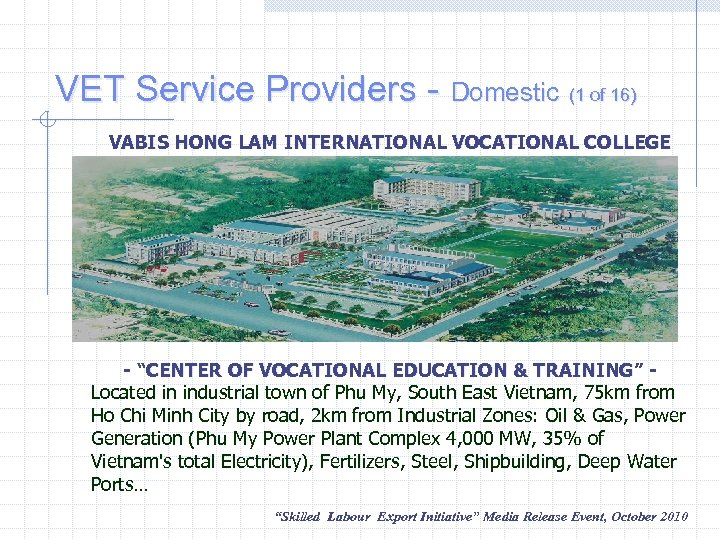
VET Service Providers - Domestic (1 of 16) VABIS HONG LAM INTERNATIONAL VOCATIONAL COLLEGE - “CENTER OF VOCATIONAL EDUCATION & TRAINING” CENTER OF VOCATIONAL EDUCATION & TRAINING Located in industrial town of Phu My, South East Vietnam, 75 km from Ho Chi Minh City by road, 2 km from Industrial Zones: Oil & Gas, Power Generation (Phu My Power Plant Complex 4, 000 MW, 35% of Vietnam's total Electricity), Fertilizers, Steel, Shipbuilding, Deep Water Ports… “Skilled Labour Export Initiative” Media Release Event, October 2010
VET Service Providers - Domestic (2 of 16) VABIS HONG LAM INTERNATIONAL VOCATIONAL COLLEGE (continued) VABIS Hong Lam International Vocational College (VHLIVC) VABIS Hong Lam International Vocational College VHLIVC was established on 15 th May, 2007 under the business name of Hong Lam Tan Thanh Co. , Ltd. ; operating as Hong Lam Vocational College (HLVC)-a company of VABIS Group and a privately owned institution. VABIS Group Inaugurated on 25 October, 2007, HLVC has been under operation for about 3 years. Later it was renamed from Hong Lam Vocational College (HLVC) to Hong Lam International Vocational College (HLIVC) by provincial government decision in September 2009. “Skilled Labour Export Initiative” Media Release Event, October 2010
VET Service Providers - Domestic (3 of 16) VABIS HONG LAM INTERNATIONAL VOCATIONAL COLLEGE (continued) Vision: “To Become a International-Class of the Highest of Standard Vocational College Serving the Immediate Needs of Local and Domestic Industries as well as near Future Demand of Overseas Markets for Highly Skilled Labour”. “To Contribute to Vietnam’s Industrialization Initiatives in particular and Globalization Initiatives in general via Vocational Education and Training, Research and Development as well as Internship and Cooperative Activities”. “Skilled Labour Export Initiative” Media Release Event, October 2010
VET Service Providers - Domestic (4 of 16) VABIS HONG LAM INTERNATIONAL VOCATIONAL COLLEGE (continued) Mission Statement: “To Provide a Flexible, Multi-Disciplinary Environment for High Quality Vocational Education and Training (VET) using the latest Technologies and Expertise”. “To Achieve Excellence in Vocational Education and Training (VET) Services within the College, Country and International Communities”. “Skilled Labour Export Initiative” Media Release Event, October 2010
VET Service Providers - Domestic (5 of 16) VABIS HONG LAM INTERNATIONAL VOCATIONAL COLLEGE (continued) The Value Proposition: “Setting the Bar for the Best-Value Vocational Education and Training (VET) and Building a Successful Business based on Creating Brand Value around bringing great Vocation Education and Training (VET) to Vietnam”. Core Values: “Academic Freedom and Integrity, Credibility, High Quality and Ethical Vocational Education and Training (VET) ”. “Skilled Labour Export Initiative” Media Release Event, October 2010
VET Service Providers - Domestic (6 of 16) VABIS HONG LAM INTERNATIONAL VOCATIONAL COLLEGE (continued) The main role of VABIS Hong Lam International Vocational College (VHLIVC) is to provide Vocational Education and College VHLIVC Training (VET) opportunities for the Technical Workforce of Vietnam as well as Canada and Australia markets through upgrading professional skills in a workplace and providing VET through Apprenticeship Schemes, Training Programs and intensive CONSTRUCTION Industry 2 -Year and 6 -Month Short Course Training. VET, to be effective, should serve as a bridge between Employers’ needs and those of work seekers and this can only be achieved through effective partnerships between the VHLIVC and Industry VHLIVC Stakeholders. “Skilled Labour Export Initiative” Media Release Event, October 2010
VET Service Providers - Domestic (7 of 16) VABIS HONG LAM INTERNATIONAL VOCATIONAL COLLEGE (continued) It is through this partnership approach that VET can add real value to development efforts within the CONSTRUCTION Industry. The delivery of CONSTRUCTION Industry Training has a number of unique features and the training environment for these CONSTRUCTION Programs must attempt to match as closely as possible the “real work environment” that students will face when entering the industry. This can only be achieved through this partnership approach. “Skilled Labour Export Initiative” Media Release Event, October 2010
VET Service Providers - Domestic (8 of 16) VABIS HONG LAM INTERNATIONAL VOCATIONAL COLLEGE (continued) Consequently, VABIS Hong Lam International Vocational College (VHLIVC) has been in tight collaboration with Box Hill College VHLIVC Institute of Australia for the past three (3) years and is currently working towards developing a close partnership with NMIT Institute of Australia as well as Saskatchewan Institute Of Applied Science & Technology (SIAST) of Canada to create a structure to further develop the VHLIVC’s VET Centers. A comprehensive VHLIVC assessment of the VHLIVC existing center was conducted to assess VHLIVC their capital, operation, human, and academic needs. “Skilled Labour Export Initiative” Media Release Event, October 2010
VET Service Providers - Domestic (9 of 16) VABIS HONG LAM INTERNATIONAL VOCATIONAL COLLEGE (continued) A “Master Strategic Planning” document was prepared for the VHLIVC. Research undertaken as part of the development of this VHLIVC strategic plan has indicated that there is a distinct lack of partnership between the key stakeholders in terms of how VET for the industry is planned, managed and delivered. As a consequence, VET of the CONSTRUCTION Industry in Vietnam is not currently producing the quantity or quality of outputs to meet the needs and demands of this fast growing industry. “Skilled Labour Export Initiative” Media Release Event, October 2010
VET Service Providers - Domestic (10 of 16) VABIS HONG LAM INTERNATIONAL VOCATIONAL COLLEGE (continued) In order to move forward in a structured manner, VHLIVC existing VHLIVC facility at the Tan Thanh-Phu My location is being restructured and enhanced to be a “Model VET Center”, which in turn would enable the specific measures in relation to the VHLIVC to be fully VHLIVC implemented into one center of international standard. This approach will lead to the development of a center of excellence for Vocational Education and Training (VET) in the CONSTRUCTION industry, which serves as a template for replication in an additional future two (2) centers: Vung Tau and Ho Chi Minh City. “Skilled Labour Export Initiative” Media Release Event, October 2010
VET Service Providers - Domestic (11 of 16) DOMESTIC VET PARTNERS * Hanoi University of Technology. * Pertro Vietnam Manpower Training College (PVMTC). * Dong An Polytechnic. * Ba Ria Vung Tau Vocational College. * LILAMA Technical & Technology College 2 (LILAMA 2). “Skilled Labour Export Initiative” Media Release Event, October 2010
VET Service Providers - Domestic (12 of 16) DOMESTIC VET PARTNERS * The British Council (Vietnam) * Senior Experten Service (Germany) * Lattitude Global Volunteering (UK) * Anniesland College (Glasgow, UK) “Skilled Labour Export Initiative” Media Release Event, October 2010
VET Service Providers - Overseas (13 of 16) INTERNATIONAL VET PARTNERS 1. BOX HILL TAFE (Australia) 1. BOX HILL TAFE * Provision of the four (4) Australian Accredited Trade Programs to VHLIVC * Training of Teaching Staff to the Qualification of Certificate IV Training & Assessment. * On-going Moderation of Quality of Program Delivery. * Issue of Trade Certificate III to Graduates of International Employment Type. “Skilled Labour Export Initiative” Media Release Event, October 2010
VET Service Providers - Overseas (14 of 16) INTERNATIONAL VET PARTNERS (continued) INTERNATIONAL VET PARTNERS 2. NMIT TAFE (Australia) 2. NMIT TAFE * Northern Melbourne Institute of TAFE (NMIT) is a TAFE institute located in the northern suburbs of Melbourne, Victoria, Australia. It has six (6) city campuses located at Preston, Collingwood, Epping, Fairfield, Greensborough, Heidelberg, a country campus at Ararat, and country training facilities at Eden Park, Yan Yean and Kyneton. A wide selection of study options in vocational education are offered from short courses, pre-apprenticeships, apprenticeships and traineeships through to certificate, diploma, advanced diploma, and bachelor degrees under the Australian Qualifications Framework. In 2009 there were 1, 103 teaching staff and 628 support staff employed by NMIT who delivered over 500 courses. “Skilled Labour Export Initiative” Media Release Event, October 2010
VET Service Providers - Overseas (15 of 16) INTERNATIONAL VET PARTNERS (continued) INTERNATIONAL VET PARTNERS 2. NMIT TAFE (Australia) (continued) 2. NMIT TAFE * There were 48, 000 students in Australia and a further 26, 000 off shore students at 26 partner institutions. NMIT claims it is the largest provider of primary industry training in Victoria and one of the largest in Australia offering a diverse range of courses from practical short-courses to Bachelor degrees in Agriculture and Land Management, Aquaculture, Equine Studies, and Viticulture and Winemaking. “Skilled Labour Export Initiative” Media Release Event, October 2010
VET Service Providers - Overseas (16 of 16) INTERNATIONAL VET PARTNERS (continued) INTERNATIONAL VET PARTNERS 3. SIAST (Canada) 3. SIAST * Provision Saskatchewan Institute of Applied Science and Technology (SIAST) is a diploma granting College that has four (4) campuses across Saskatchewan. SIAST is a nationally recognized, pre-eminent provider of Skills and Technical Training. More than 12, 000 students are enrolled in its programs and has approximately 29, 000 additional individual registrations. “Skilled Labour Export Initiative” Media Release Event, October 2010
VET Headline News (1 of 15) ADB TO HELP VIET NAM IMPROVE TECHNICAL TRAINING TO MEET SKILL SHORTAGES Manila, Philippines - Viet Nam’s drive to improve Vocational Education and Training (VET)to address a worsening shortage of skilled workers in key areas of its economy is getting support from the Asian Development Bank (ADB) – The Advertiser, July 2008. ADB is providing $70 million in Loans from its concessional Asian Development Bank for the Viet Nam Skills Enhancement Project, which will offer quality training programs in priority industries, in partnership with the private sector. Around 24, 000 students are expected to benefit from the program, with about 25% of them women and members of ethnic minority groups. “Skilled Labour Export Initiative” Media Release Event, October 2010
VET Headline News (2 of 15) ADB TO HELP VIET NAM IMPROVE TECHNICAL TRAINING TO MEET SKILL SHORTAGES (continued) Manila, Philippines - Viet Nam’s drive to improve Vocational Education and Training…from the Asian Development Bank (ADB). Viet Nam has posted impressive gains in growth and poverty reduction over the past 20 years, but with it aiming to target as an industrialized country, it is struggling to meet the demand for qualified specialized technical workers. Just 13% of the employable workforce has vocational qualifications. “Viet Nam’s long-term prosperity and development depends on its increasing competitiveness in regional and global markets, and if it is to expand as an industrialized country, it must develop highly skilled industrial workers, ” said Wendy Duncan, Principal Education Specialist, in ADB’s Southeast Asia Department. “Skilled Labour Export Initiative” Media Release Event, October 2010
VET Headline News (3 of 15) ADB TO HELP VIET NAM IMPROVE TECHNICAL TRAINING TO MEET SKILL SHORTAGES (continued) Manila, Philippines - Viet Nam’s drive to improve Vocational Education and Training…from the Asian Development Bank (ADB). The project will fund training programs in public and private vocational colleges in the automotive technology, electrical and mechanical manufacturing, hospitality and tourism, information and communication technology (ICT), and navigation and shipping industries – all of which currently lack sufficient skilled workers. It will provide management and instructor training to upgrade skills and improve planning and allocation of resources, and will also help develop new curricula and training materials, with support from the industries. “Skilled Labour Export Initiative” Media Release Event, October 2010
VET Headline News (4 of 15) ADB TO HELP VIET NAM IMPROVE TECHNICAL TRAINING TO MEET SKILL SHORTAGES (continued) Manila, Philippines - Viet Nam’s drive to improve Vocational Education and Training…from the Asian Development Bank (ADB). Credit will be also made available to approved private colleges to upgrade their equipment and facilities, with institutions expected to borrow up to $3 million to $4 million each. Women in Viet Nam, who make up nearly half the labor force, are underrepresented in skilled occupations, with vocational training largely targeted at males in the industrial trades. The project aims to address gender inequity by including programs in ICT and hospitality and tourism where females are well represented. “Skilled Labour Export Initiative” Media Release Event, October 2010
VET Headline News (5 of 15) ADB TO HELP VIET NAM IMPROVE TECHNICAL TRAINING TO MEET SKILL SHORTAGES (continued) Manila, Philippines - Viet Nam’s drive to improve Vocational Education and Training…from the Asian Development Bank (ADB). It is also carrying out a social marketing campaign for vocational training targeted at poor rural students, women and ethnic minorities, along with school pilot programs designed to attract more females into male-dominated industries such as electronics. ADB’s assistance includes a regular ADF loan of $50 million equivalent with a 32 -year term and grace period of 8 years, with annual interest of 1% per annum during the grace period, and 1. 5% for the balance of the term. “Skilled Labour Export Initiative” Media Release Event, October 2010
VET Headline News (6 of 15) ADB TO HELP VIET NAM IMPROVE TECHNICAL TRAINING TO MEET SKILL SHORTAGES (continued) Manila, Philippines - Viet Nam’s drive to improve Vocational Education and Training…from the Asian Development Bank (ADB). A second 32 -year loan of $20 million will be made available for onlending to private vocational colleges, with an annual interest charge of 2. 22% per annum. The government will contribute $8 million for a total project cost of $78 million. The Ministry of Labor, Invalids and Social Affairs will be the executing agency for the project which is expected to be completed by August 2015. “Skilled Labour Export Initiative” Media Release Event, October 2010
VET Headline News (7 of 15) IMMIGRATION AGREEMENT: SOUTH AUSTRALIA & PHILIPPINES Adelaidenow Scoop - An Immigration Agreement with the Philippines will deliver up to 50, 000 skilled workers to South Australia (SA) over the next decade – The Advertiser, July 2008. Deputy Premier Kevin Foley, who is on a nine-day trade mission to Malaysia and the Philippines, told The Advertiser yesterday a memorandum of understanding between the two (2) governments would help streamline the immigration process. A special program will be introduced by the Philippines, under its Labour and Employment Secretary Arturo Brion, for South Australia (SA) companies to employ "highly trained" Filipino workers. “Skilled Labour Export Initiative” Media Release Event, October 2010

VET Headline News (8 of 15) IMMIGRATION AGREEMENT: SOUTH AUSTRALIA & PHILIPPINES (continued) Adelaidenow Scoop - An Immigration Agreement with the Philippines… South Australia (SA) over the next decade – The Advertiser, July 2008. About nine million Filipinos work overseas, sending back "remittances" of about $15 billion a year that is vital to the economy of the Philippines. Despite criticism of the personal and social cost of having 10% of the population registered as Overseas Filipino Workers, the Philippines Government accepts the practice as a reality of life and has a policy of regulation. Mr. Foley said the South Australia (SA) agreement was modeled on a similar one signed in February between the Philippines and the Canadian province of Manitoba. “Skilled Labour Export Initiative” Media Release Event, October 2010
VET Headline News (9 of 15) IMMIGRATION AGREEMENT: SOUTH AUSTRALIA & PHILIPPINES (continued) Adelaidenow Scoop - An Immigration Agreement with the Philippines… South Australia (SA) over the next decade – The Advertiser, July 2008. Under the agreement, yet to be formally signed, registered employers are connected with licensed immigration agencies in the Philippines that will pre-screen and prepare skilled workers to move to South Australia (SA). '"We will work with industry and business to identify the skill gaps and the needs, " Mr Foley said. "We would be the first Australian Government to enter into a formal relationship with the Philippines Government to bring in skilled Filipino labour”. “Skilled Labour Export Initiative” Media Release Event, October 2010
VET Headline News (10 of 15) IMMIGRATION AGREEMENT: SOUTH AUSTRALIA & PHILIPPINES (continued) Adelaidenow Scoop - An Immigration Agreement with the Philippines… South Australia (SA) over the next decade – The Advertiser, July 2008. "There is no reason why as early as next year we should not be seeing a flow of workers into South Australia, provided businesses themselves join us in wanting to make this work”. "The Government can only do so much. “ Mr. Foley predicted about 50, 000 skilled Filipino workers would come to South Australia (SA) in the next five to 10 years, with most expected to become permanent residents. "That is what has happened in Manitoba, Canada, and they have a similar population to us, " he said. “Skilled Labour Export Initiative” Media Release Event, October 2010
VET Headline News (11 of 15) IMMIGRATION AGREEMENT: SOUTH AUSTRALIA & PHILIPPINES (continued) Adelaidenow Scoop - An Immigration Agreement with the Philippines… South Australia (SA) over the next decade – The Advertiser, July 2008. "The mining boom and the defence projects alone will require us to find at least an extra 300, 000 workers in the next 10 years. There are simply not enough workers in Australia”. "Filipino workers are attractive because they speak excellent English, and they are very dedicated, disciplined and productive workers, and highly skilled”. Filipino workers are expected to come to South Australia (SA) for employment in Manufacturing, Steel Fabrication, Mining, Nursing, Hospitality, Electronics and Advanced Manufacturing Sectors. “Skilled Labour Export Initiative” Media Release Event, October 2010
VET Headline News (12 of 15) IMMIGRATION AGREEMENT: SOUTH AUSTRALIA & PHILIPPINES (continued) Adelaidenow Scoop - An Immigration Agreement with the Philippines… South Australia (SA) over the next decade – The Advertiser, July 2008. One South Australia (SA) company, which had representatives travelling with Mr. Foley, employs about 400 Welders, Steel Fabricators and Boilermakers. Half of its workforce already has been sourced from the Philippines. Mr. Foley said a number of South Australia (SA) companies had already "beaten a path to the Philippines to look for workers". The visa process and required Federal Government policies were in place, he said. “Skilled Labour Export Initiative” Media Release Event, October 2010
VET Headline News (13 of 15) IMMIGRATION AGREEMENT: SOUTH AUSTRALIA & PHILIPPINES (continued) Adelaidenow Scoop - An Immigration Agreement with the Philippines… South Australia (SA) over the next decade – The Advertiser, July 2008. Most Filipino workers were expected to travel to South Australia (SA) on a 457 visa. That will allow them to stay for between six (6) months and four (4) years for work. Mr. Foley said the biggest hurdle was ensuring the skills obtained in the Philippines by workers were recognized in Australia. "That will require some form of presence in the Philippines and we may need to sponsor a training institution in the Philippines to ensure workers coming to Australia are properly accredited, " he said. “Skilled Labour Export Initiative” Media Release Event, October 2010
VET Headline News (14 of 15) IMMIGRATION AGREEMENT: SOUTH AUSTRALIA & PHILIPPINES (continued) Adelaidenow Scoop - An Immigration Agreement with the Philippines… South Australia (SA) over the next decade – The Advertiser, July 2008. "That is the biggest challenge but I think we can jump that hurdle relatively easily. “ The State Government already is helping to set up one private training centre in the Philippines to ensure local tradesmen and workers can meet Australian standards and be accredited to work in South Australia (SA). "We can do better than an ad hoc approach where South Australia (SA) companies come up here on their own, and the Philippines Government also would like to have a co-ordinated approach, " Mr. Foley said. “Skilled Labour Export Initiative” Media Release Event, October 2010
VET Headline News (15 of 15) IMMIGRATION AGREEMENT: SOUTH AUSTRALIA & PHILIPPINES (continued) Adelaidenow Scoop - An Immigration Agreement with the Philippines… South Australia (SA) over the next decade – The Advertiser, July 2008. "This won't solve our skills crisis, but this initiative alone has the potential to help address a looming skills shortage in South Australia (SA). “ Earlier this week in Malaysia, Mr. Foley said he had a "very productive" meeting with the chief executive of Malaysia Airlines to seek more direct flights to Adelaide. "We are confident they will increase the number of flights into Adelaide, " he said. The State Government Trade Delegation returns to Adelaide in the very near future to tie up loose ends. “Skilled Labour Export Initiative” Media Release Event, October 2010
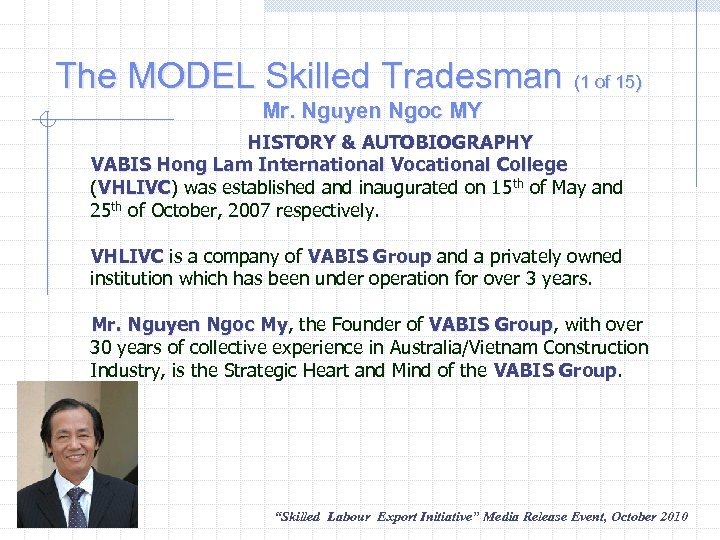
The MODEL Skilled Tradesman (1 of 15) Mr. Nguyen Ngoc MY HISTORY & AUTOBIOGRAPHY VABIS Hong Lam International Vocational College (VHLIVC) was established and inaugurated on 15 th of May and VHLIVC 25 th of October, 2007 respectively. VHLIVC is a company of VABIS Group and a privately owned VHLIVC VABIS Group institution which has been under operation for over 3 years. Mr. Nguyen Ngoc My, the Founder of VABIS Group, with over Mr. Nguyen Ngoc My VABIS Group 30 years of collective experience in Australia/Vietnam Construction Industry, is the Strategic Heart and Mind of the VABIS Group “Skilled Labour Export Initiative” Media Release Event, October 2010
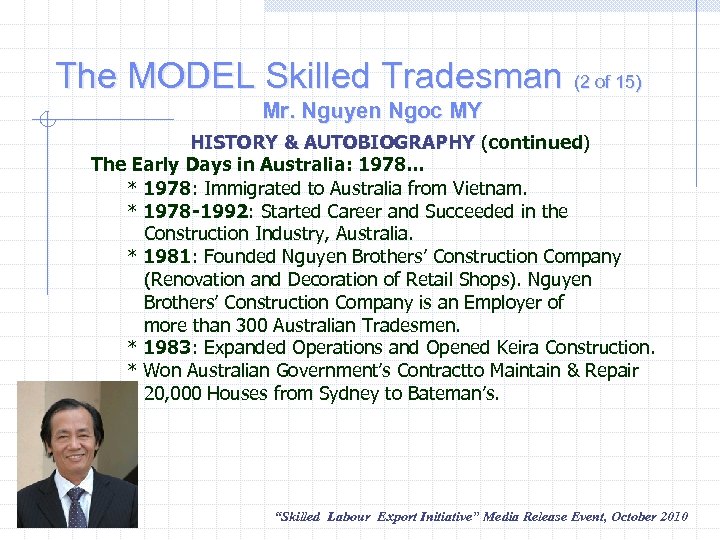
The MODEL Skilled Tradesman (2 of 15) Mr. Nguyen Ngoc MY HISTORY & AUTOBIOGRAPHY (continued) HISTORY & AUTOBIOGRAPHY The Early Days in Australia: 1978… * 1978: Immigrated to Australia from Vietnam. * 1978 -1992: Started Career and Succeeded in the Construction Industry, Australia. * 1981: Founded Nguyen Brothers’ Construction Company (Renovation and Decoration of Retail Shops). Nguyen Brothers’ Construction Company is an Employer of more than 300 Australian Tradesmen. * 1983: Expanded Operations and Opened Keira Construction. * Won Australian Government’s Contractto Maintain & Repair 20, 000 Houses from Sydney to Bateman’s. “Skilled Labour Export Initiative” Media Release Event, October 2010
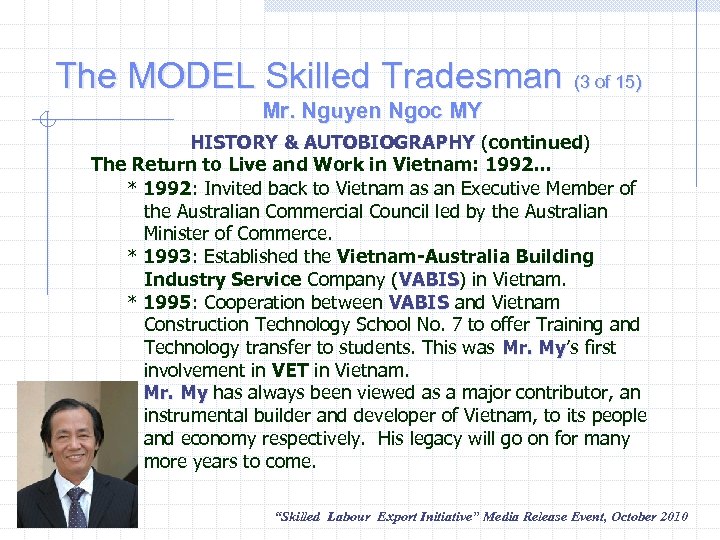
The MODEL Skilled Tradesman (3 of 15) Mr. Nguyen Ngoc MY HISTORY & AUTOBIOGRAPHY (continued) HISTORY & AUTOBIOGRAPHY The Return to Live and Work in Vietnam: 1992… * 1992: Invited back to Vietnam as an Executive Member of the Australian Commercial Council led by the Australian Minister of Commerce. * 1993: Established the Vietnam-Australia Building Industry Service Company (VABIS) in Vietnam. VABIS * 1995: Cooperation between VABIS and Vietnam VABIS Construction Technology School No. 7 to offer Training and Technology transfer to students. This was Mr. My’s first Mr. My involvement in VET in Vietnam. * Mr. My has always been viewed as a major contributor, an Mr. My instrumental builder and developer of Vietnam, to its people and economy respectively. His legacy will go on for many more years to come. “Skilled Labour Export Initiative” Media Release Event, October 2010
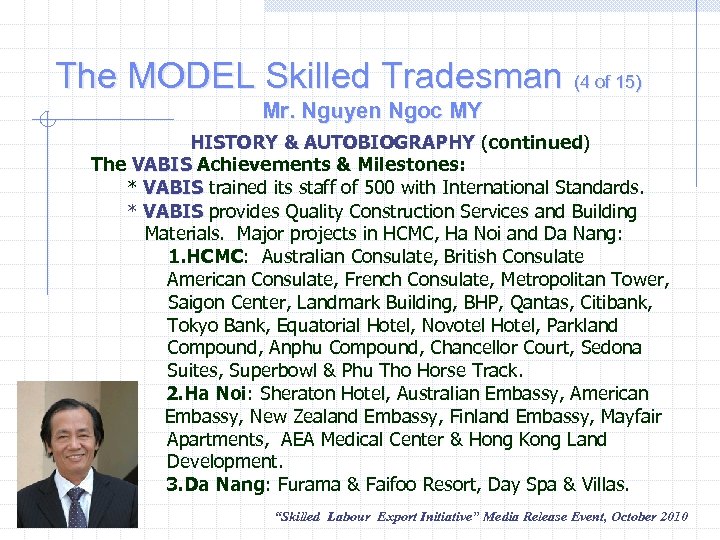
The MODEL Skilled Tradesman (4 of 15) Mr. Nguyen Ngoc MY HISTORY & AUTOBIOGRAPHY (continued) HISTORY & AUTOBIOGRAPHY The VABIS Achievements & Milestones: VABIS * VABIS trained its staff of 500 with International Standards. VABIS * VABIS provides Quality Construction Services and Building VABIS Materials. Major projects in HCMC, Ha Noi and Da Nang: 1. HCMC: Australian Consulate, British Consulate American Consulate, French Consulate, Metropolitan Tower, Saigon Center, Landmark Building, BHP, Qantas, Citibank, Tokyo Bank, Equatorial Hotel, Novotel Hotel, Parkland Compound, Anphu Compound, Chancellor Court, Sedona Suites, Superbowl & Phu Tho Horse Track. 2. Ha Noi: Sheraton Hotel, Australian Embassy, American Embassy, New Zealand Embassy, Finland Embassy, Mayfair Apartments, AEA Medical Center & Hong Kong Land Development. 3. Da Nang: Furama & Faifoo Resort, Day Spa & Villas. “Skilled Labour Export Initiative” Media Release Event, October 2010
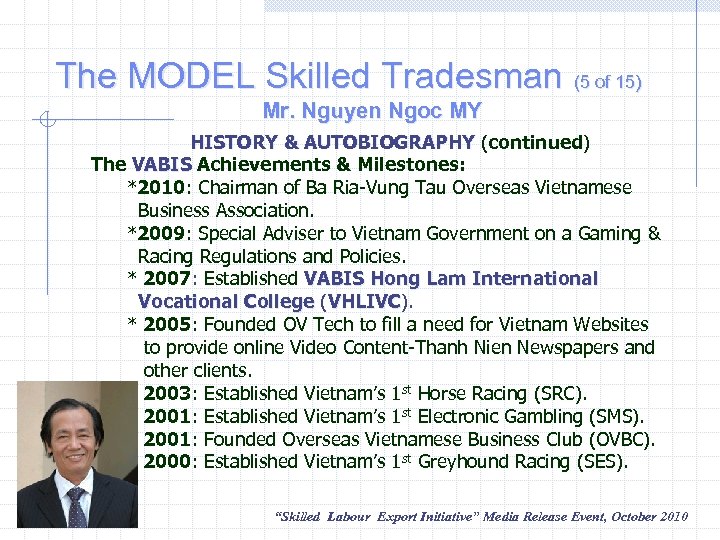
The MODEL Skilled Tradesman (5 of 15) Mr. Nguyen Ngoc MY HISTORY & AUTOBIOGRAPHY (continued) HISTORY & AUTOBIOGRAPHY The VABIS Achievements & Milestones: VABIS *2010: Chairman of Ba Ria-Vung Tau Overseas Vietnamese Business Association. *2009: Special Adviser to Vietnam Government on a Gaming & Racing Regulations and Policies. * 2007: Established VABIS Hong Lam International Vocational College (VHLIVC). Vocational College VHLIVC * 2005: Founded OV Tech to fill a need for Vietnam Websites to provide online Video Content-Thanh Nien Newspapers and other clients. * 2003: Established Vietnam’s 1 st Horse Racing (SRC). * 2001: Established Vietnam’s 1 st Electronic Gambling (SMS). * 2001: Founded Overseas Vietnamese Business Club (OVBC). * 2000: Established Vietnam’s 1 st Greyhound Racing (SES). “Skilled Labour Export Initiative” Media Release Event, October 2010
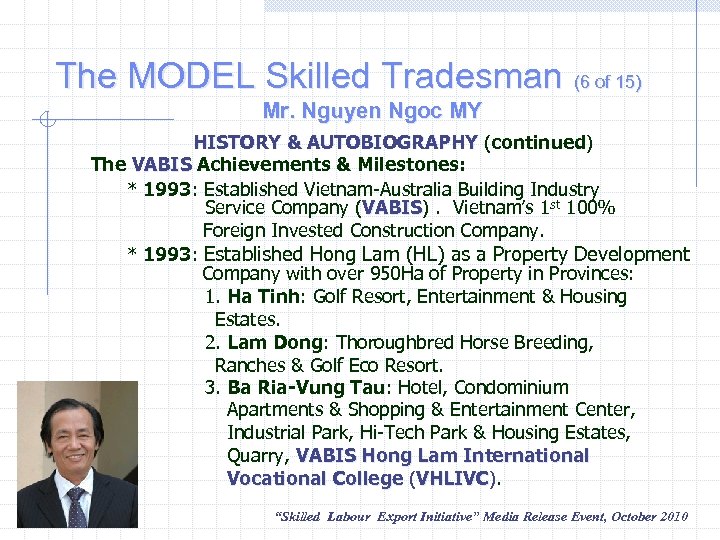
The MODEL Skilled Tradesman (6 of 15) Mr. Nguyen Ngoc MY HISTORY & AUTOBIOGRAPHY (continued) HISTORY & AUTOBIOGRAPHY The VABIS Achievements & Milestones: VABIS * 1993: Established Vietnam-Australia Building Industry Service Company (VABIS). Vietnam’s 1 st 100% VABIS Foreign Invested Construction Company. * 1993: Established Hong Lam (HL) as a Property Development Company with over 950 Ha of Property in Provinces: 1. Ha Tinh: Golf Resort, Entertainment & Housing Estates. 2. Lam Dong: Thoroughbred Horse Breeding, Ranches & Golf Eco Resort. 3. Ba Ria-Vung Tau: Hotel, Condominium Apartments & Shopping & Entertainment Center, Industrial Park, Hi-Tech Park & Housing Estates, Quarry, VABIS Hong Lam International Vocational College (VHLIVC). Vocational College VHLIVC “Skilled Labour Export Initiative” Media Release Event, October 2010
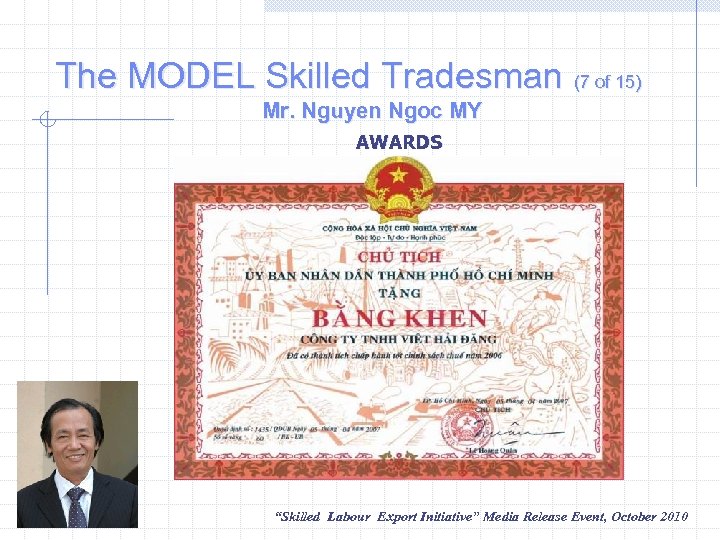
The MODEL Skilled Tradesman (7 of 15) Mr. Nguyen Ngoc MY AWARDS “Skilled Labour Export Initiative” Media Release Event, October 2010
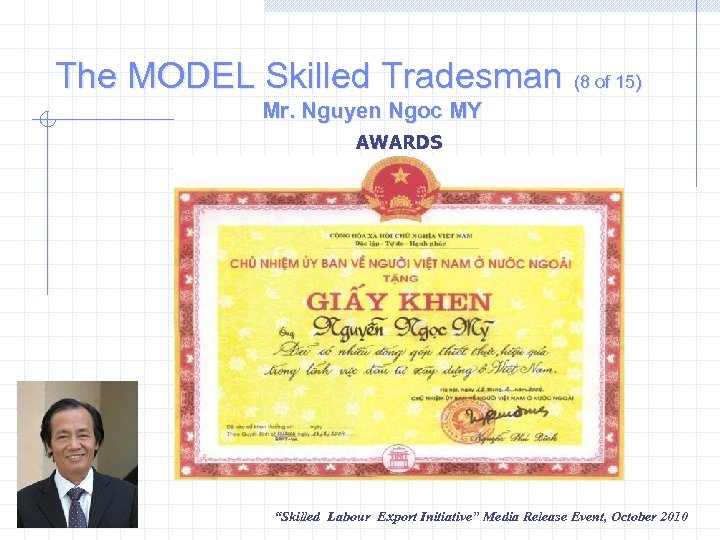
The MODEL Skilled Tradesman (8 of 15) Mr. Nguyen Ngoc MY AWARDS “Skilled Labour Export Initiative” Media Release Event, October 2010
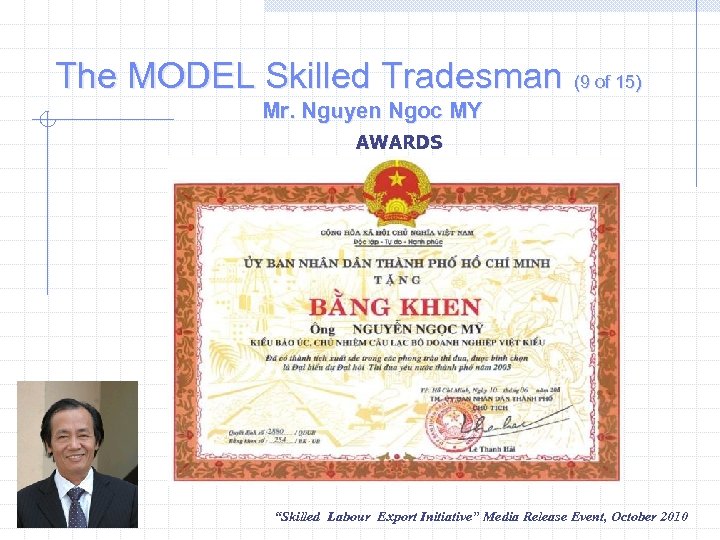
The MODEL Skilled Tradesman (9 of 15) Mr. Nguyen Ngoc MY AWARDS “Skilled Labour Export Initiative” Media Release Event, October 2010
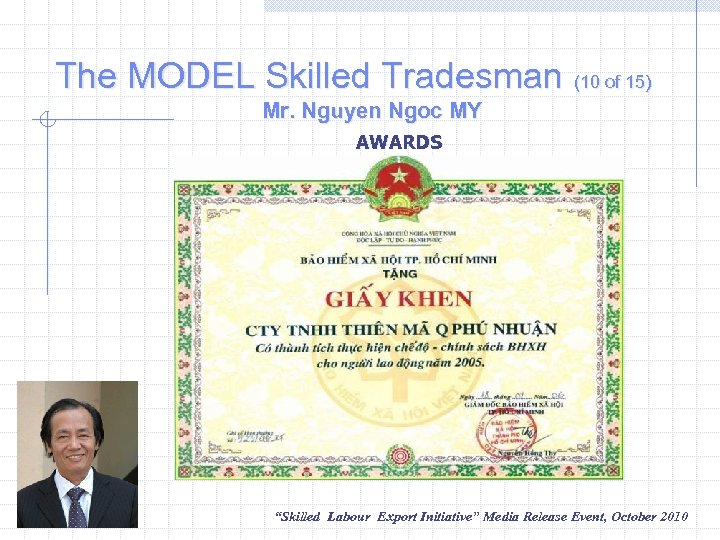
The MODEL Skilled Tradesman (10 of 15) Mr. Nguyen Ngoc MY AWARDS “Skilled Labour Export Initiative” Media Release Event, October 2010
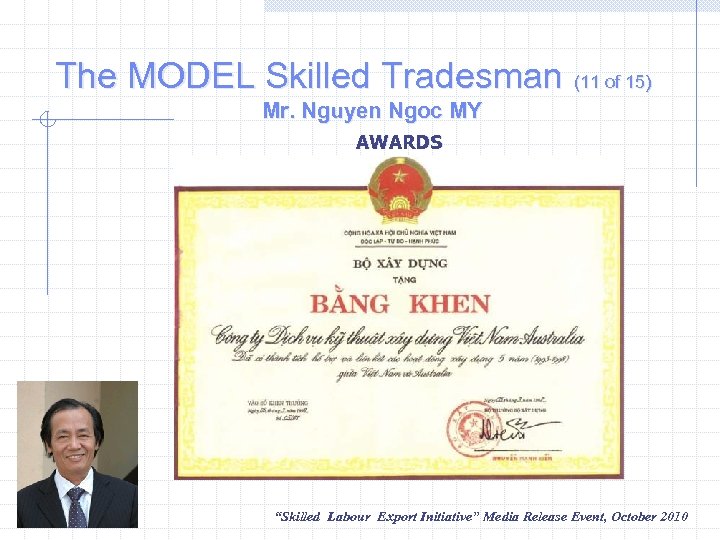
The MODEL Skilled Tradesman (11 of 15) Mr. Nguyen Ngoc MY AWARDS “Skilled Labour Export Initiative” Media Release Event, October 2010
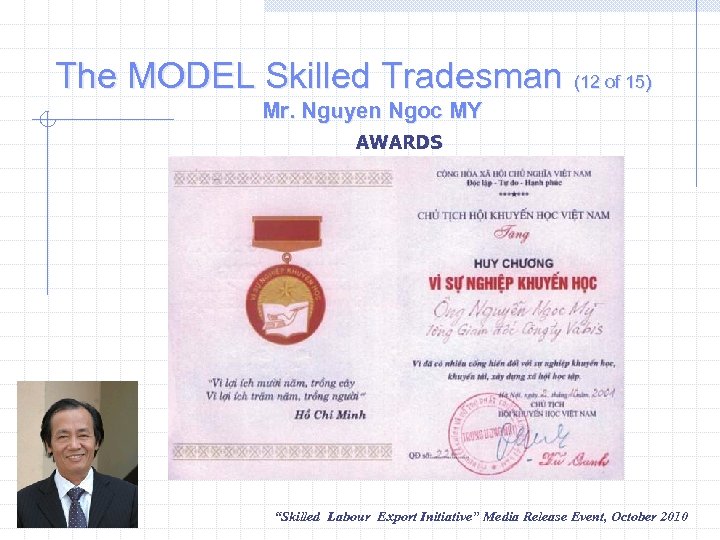
The MODEL Skilled Tradesman (12 of 15) Mr. Nguyen Ngoc MY AWARDS “Skilled Labour Export Initiative” Media Release Event, October 2010
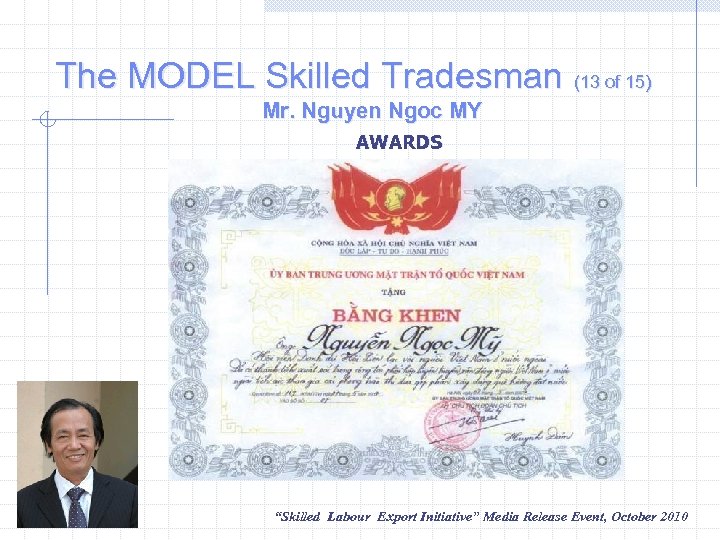
The MODEL Skilled Tradesman (13 of 15) Mr. Nguyen Ngoc MY AWARDS “Skilled Labour Export Initiative” Media Release Event, October 2010
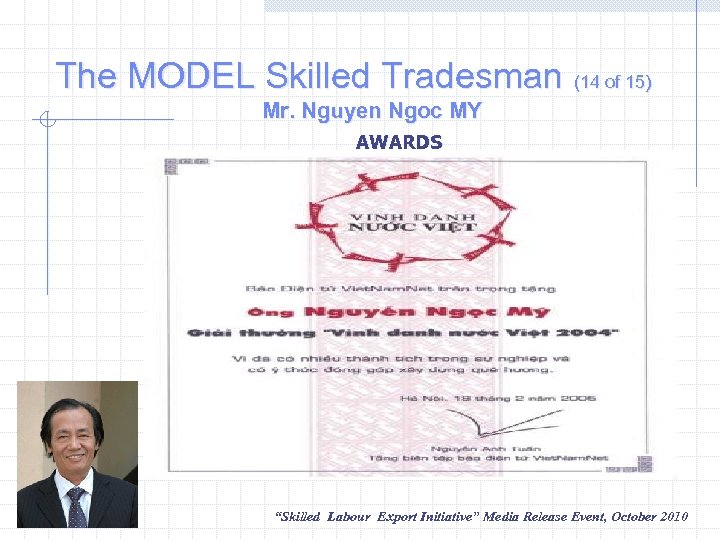
The MODEL Skilled Tradesman (14 of 15) Mr. Nguyen Ngoc MY AWARDS “Skilled Labour Export Initiative” Media Release Event, October 2010
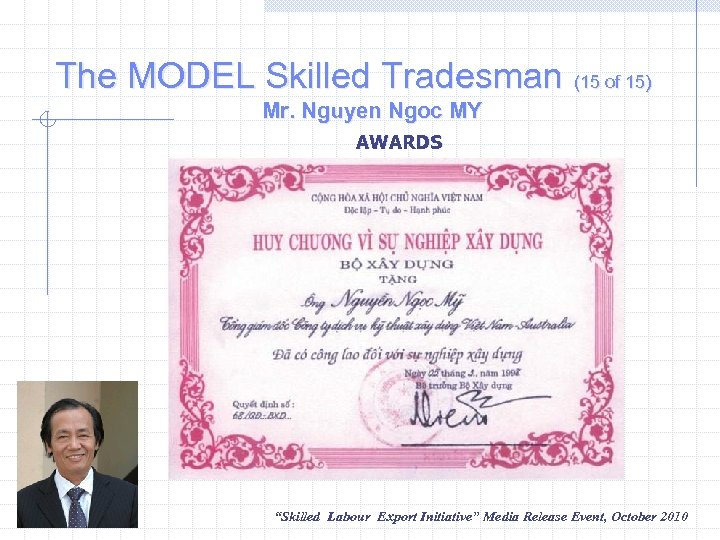
The MODEL Skilled Tradesman (15 of 15) Mr. Nguyen Ngoc MY AWARDS “Skilled Labour Export Initiative” Media Release Event, October 2010
The Skilled Trades Profession (1 of 7) ENHANCING THE IMAGE OF THE SKILLED TRADES The Skilled Trades play an important role in Canada and Australia's economy and offer a variety of dynamic and fulfilling career choices for today's youth. While many of us are aware that great opportunities exist within the Skilled Trades, the sector is currently facing a number of challenges. With an aging population and a wave of retirement approaching, Canada and Australia are poised to feel the effects of a shortage of Skilled Workers. According to the Conference Board of Canada, by 2020, Canada could be short a million workers. Perhaps the biggest threat, however, is society's negative attitudes and perceptions surrounding careers in the Skilled Trades. “Skilled Labour Export Initiative” Media Release Event, October 2010
The Skilled Trades Profession (2 of 7) ENHANCING THE IMAGE OF THE SKILLED TRADES (continued) In past studies conducted for the Canadian Apprenticeship Forum and Skills Canada, 60% of youth reported that their parents have not encouraged them to consider a career in trades. Many Canadian parents encourage their children to choose an Academic path and become lawyers and doctors. They want the best for their children and often do not associate a successful career with Skilled Trades. Furthermore, 71% of respondents said that guidance councilors have not encouraged them to consider Skilled Trades professions. The majority of teachers and guidance councilors are likely recommending University or College as the only Post-secondary options for their students. “Skilled Labour Export Initiative” Media Release Event, October 2010
The Skilled Trades Profession (3 of 7) ENHANCING THE IMAGE OF THE SKILLED TRADES (continued) These attitudes are thriving on a widespread misunderstanding of the benefits of careers in the Skilled Trades and are literally turning off Canadian youth to the possibility of a rewarding and successful career in the trades. If these negative perceptions persist, the availability of a Skilled Workforce - an essential component to the success of Canadian businesses – will greatly diminish. Case in point, Timothy Flood, President of John Flood and Sons, the oldest Construction Company in Canada, knows what it takes to run a successful business. He attributes the continued success of his family business to the ability to pass on knowledge from one generation to the next. “Skilled Labour Export Initiative” Media Release Event, October 2010
The Skilled Trades Profession (4 of 7) ENHANCING THE IMAGE OF THE SKILLED TRADES (continued) Ensuring a sustainable workforce requires employers to play an active role, Mr. Flood encourages them to participate in Apprentice Training Programs as a guaranteed way to transfer knowledge. “Apprentices are the Future of the Skilled Trades , ” he says. “Without Apprentices there will be no Skilled Trades Workforce. ” Making sure a pool of qualified workers exist now and future, is one of the many benefits that Apprenticeship has to offer. Training Apprentices makes good business sense and gives employers the opportunity to develop staff that understands the needs of the business and how to fulfill those needs. However, if youth are not even considering careers in the Skilled Trades, finding Apprentices to train will become yet another challenge for businesses to overcome. “Skilled Labour Export Initiative” Media Release Event, October 2010
The Skilled Trades Profession (5 of 7) ENHANCING THE IMAGE OF THE SKILLED TRADES (continued) Changing the attitudes of young Canadians and their key influencers about the benefits and opportunities available within the Skilled Trades is a crucial factor in ensuring the success of industry across the country. To counteract these negative attitudes, Human Resources and Skills Development Canada (HRSDC) announced $12 million for a 4 -year campaign to develop and promote Skilled Trades as a first-choice career option. The campaign, entitled “Skilled Trades: A Career You Can Build On” is a joint project between the Canada’s CAF-FCA and S/CC. The campaign has 2 primary objectives: 1. To make Skilled Trades a number one career choice of Canadian youth; and, 2. To encourage employers to hire and retain more Apprentices (September 2004 -December 2006). “Skilled Labour Export Initiative” Media Release Event, October 2010
The Skilled Trades Profession (6 of 7) ENHANCING THE IMAGE OF THE SKILLED TRADES (continued) “We are very excited about this campaign as we recognize the urgency of making young people, and their parents, more aware of the benefits of choosing a career in the trades, ” says Keith Lancastle, Executive Director of CAF-FCA. “We are proud to be one of the contributing partners in this important national initiative. ” The campaign is off to a running start, featuring English and French television, radio, cinema, and print ads targeted at youth, parents and educators. Specifically, the youth-focused commercial has made its way into popular culture with its catch phrase, “opening my toolbox beats opening a briefcase, any day. ” “Skilled Labour Export Initiative” Media Release Event, October 2010
The Skilled Trades Profession (7 of 7) ENHANCING THE IMAGE OF THE SKILLED TRADES (continued) “We are very excited about this campaign as we recognize the urgency of making young people, and their parents, more aware of the benefits of choosing a career in the trades, ” says Keith Lancastle, Executive Director of CAF-FCA. “We are proud to be one of the contributing partners in this important national initiative. ” The campaign is off to a running start, featuring English and French television, radio, cinema, and print ads targeted at youth, parents and educators. Specifically, the youth-focused commercial has made its way into popular culture with its catch phrase, “opening my toolbox beats opening a briefcase, any day. ” “Skilled Labour Export Initiative” Media Release Event, October 2010
Myths & Realities (1 of 23) Formal research and anecdotal evidence suggests that negative perceptions and attitudes about skilled trades exist among many youth, parents, and educators throughout countries like Australia, Canada and even Vietnam. Unfortunately, over the last generation, these negative attitudes have led to the creation of many myths within our society that if left uncontested, may further compound the impending skills shortage within Australia and Canada. Let’s expose some of these myths, and reveal the true realities. You may be in for a big surprise! “Skilled Labour Export Initiative” Media Release Event, October 2010
Myths & Realities (2 of 23) Myth 1: University is for smart students, while Skilled Trades are for students who do not do well academically. Reality 1: This is probably one of the most common myths about Skilled Trades, and is simply not true. The reality is that skilled trades require individuals with a strong academic foundation of literacy, mathematical and analytical skills, not to mention creativity, problem solving, coordination, and most importantly, a passion for their trade. These skills and characteristics are needed to perform complex tasks, such as: deciphering intricate blueprints while building an office tower; analyzing various elements (such as weather conditions, weight and distance) while operating a crane situated on a 10 story building; … “Skilled Labour Export Initiative” Media Release Event, October 2010
Myths & Realities (3 of 23) Reality 1: This is probably one of the most common myths about Skilled Trades, and is simply not true. (continued) … or identifying the potential volume of water and it resulting pressure when installing a sewage system for a hospital. These are but a few examples of the multifaceted tasks that skilled tradespeople regularly perform. As an apprentice, a student learns the most recent techniques and uses the latest high technology equipment required to be competent in all aspects of their trade. These students must learn theory of their trade in a classroom and then apply their knowledge and academic foundation to master the technical skills on the job. “Skilled Labour Export Initiative” Media Release Event, October 2010
Myths & Realities (4 of 23) Reality 1: This is probably one of the most common myths about Skilled Trades, and is simply not true. (continued) In short, selecting a skilled trade and entering into an apprenticeship is a first-choice post-secondary option. Similar to other options, successfully completing an apprenticeship takes intelligence, dedication, focus, and hard work. Students who enter these programs prefer careers that are ‘hands-on’, and enjoy applying their knowledge and skills to produce visible results at the end of the day. They are passionate about their work and take pride in their accomplishments. “Skilled Labour Export Initiative” Media Release Event, October 2010
Myths & Realities (5 of 23) Myth 2: A university degree is the only post-secondary education that provides a good future. Reality 2: Achieving a Certificate of Qualification for a skilled trade is also a ticket to a good future, given the high demand, good pay, ability to travel across the country, and lower rates of unemployment. * Opportunity-With the eminent skills shortage caused by lower birth rates and an ageing population, tradespeople will be in high demand. By 2020, it is estimated that Canada will be short 1 million workers. In the manufacturing sector alone, 400, 000 workers will be required in the next 15 years due to retirement. By 2007, more than one-third of jobs created in Canada will require trade certification or a college diploma. “Skilled Labour Export Initiative” Media Release Event, October 2010
Myths & Realities (6 of 23) Reality 2: Achieving a Certificate of Qualification for a Skilled Trades… and lower rates of unemployment… (continued) * Opportunity-…As just one example, some business leaders are predicting that by 2010, plumbers will be in high demand similar to the demand for individuals with IT skills in the 1990’s. These statistics really “hit-home” when we have to wait several months to obtain services from skilled tradespeople such as plumbers, electricians or carpenters, to carry out home repairs! * Good Pay-Apart from professionals such as doctors, dentists or lawyers, university degree earnings may not be as high as one might think. Skilled trades careers provide income levels which are above the national average for employed Canadians. “Skilled Labour Export Initiative” Media Release Event, October 2010
Myths & Realities (7 of 23) Reality 2: Achieving a Certificate of Qualification for a Skilled Trades… and lower rates of unemployment… (continued) * Good Pay-…In fact, according to the 2001 Statistics Canada census, trades people generally earn a salary approximately 3. 1% above the national average of all Canadian careers combined. * Travel-There are currently 45 trades that are designated as “Red Seal” trades. This means that there is an agreed national occupational analysis and cross-country standards specific to each of those trades that allows people with Red Seal endorsements to work anywhere in the country. More than 80% of the skilled trades journeypersons are certified in one of these “Red Seal” trades. “Skilled Labour Export Initiative” Media Release Event, October 2010
Myths & Realities (8 of 23) Reality 2: Achieving a Certificate of Qualification for a Skilled Trades… and lower rates of unemployment… (continued) * Travel-…So, for example, a Red Seal certified Tradesperson from the Atlantic coast will be able to work in his/her trade on the west coast when the opportunity arises. Skilled Trades careers provide flexibility, choice and freedom to choose that “perfect location. ” * Lower Rates of Unemployment-It is also interesting to note that in general, the unemployment rate for those with college or trades training is lower than the average unemployment rate in Canada, which includes university graduates. “Skilled Labour Export Initiative” Media Release Event, October 2010
Myths & Realities (9 of 23) Myth 3: There are limited choices within Skilled Trades. Reality 3: When we think of Skilled Trades careers, we might think of the traditional trades such as Carpenters, Plumbers, Electricians, or Mechanics. The reality is that there are over 200 trades to choose from (see www. ellischart. ca). Generally, these trades fall within four (4) main categories: 1. Construction: electricians, carpenters, plumbers, pipefitters, welders, heavy equipment operators, painters. 2. Transportation: automotive service technicians, aircraft structural technicians, heavy duty equipment technicians, automotive painters, fuel/electrical systems technicians. “Skilled Labour Export Initiative” Media Release Event, October 2010
Myths & Realities (10 of 23) Reality 3: When we think of Skilled Trades careers, we might think of the traditional trades such as Carpenters, Plumbers, Electricians, or Mechanics… Generally, these trades fall within four (4) main categories: (continued) 3. Manufacturing: Tool & Die Makers, Industrial Mechanics (Millwrights), Precision Metal Fabricators. 4. Service: Horticulturalists, Chefs, Florists. Myth 4: Skilled Trades don’t pay well. Reality 4: You can earn a very good income in Skilled Trades careers! “Skilled Labour Export Initiative” Media Release Event, October 2010
Myths & Realities (11 of 23) Reality 4: You can earn a very good income in Skilled Trades careers! (continued) Although wages within trades and regions vary, many different trades provide earnings above the national average. Tradespeople can earn from $12 to $35 an hour plus benefits, with additional opportunities available to earn even more, depending on the trade, position, location, and opportunities for overtime. For example, an instrument technician working in Alberta, who installs, maintains, and repairs the control and metering systems used in commercial and industrial processing, can earn up to $40 an hour. In the Windsor area, it is not uncommon for skilled tool and die makers -- with overtime included -- to easily average $100, 000 annually. “Skilled Labour Export Initiative” Media Release Event, October 2010
Myths & Realities (12 of 23) Reality 4: You can earn a very good income in Skilled Trades careers! (continued) Not only do Tradespeople earn above average incomes, they also complete their studies without being overwhelmed by debt. By taking an apprenticeship and learning a trade, you can ‘earn while you learn’, decreasing the amount of debt that you may incur during your postsecondary training (a bachelor graduate in the year 2000 often left university students with an average debt of $19, 500). Selecting a Skilled Trade’s career and taking an apprenticeship makes good financial sense! “Skilled Labour Export Initiative” Media Release Event, October 2010
Myths & Realities (13 of 23) Myth 5: Skilled Trades are dirty and noisy. Reality 5: There is no doubt that many trades require “hands-on” work. However, it is important to remember that technology and new techniques have greatly changed the nature of many trades. Today, an increasing amount of mechanical equipment is operated with the aid of computer software. Therefore, more and more trade workers work inside, using sophisticated computer equipment and technology. Legislated health and safety requirements enforce strict regulations on levels of noise and exposure to any hazardous materials on a job site. Furthermore, labour and business work together to ensure their workers’ safety by implementing and enforcing additional workplace safety standards. “Skilled Labour Export Initiative” Media Release Event, October 2010
Myths & Realities (14 of 23) Myth 6: Jobs in the Skilled Trades are the first to be negatively affected when the economy begins to decline. Reality 6: Economic growth affects all professions and industries. However, one of the key benefits of a Skilled Trades career is that it is one of the most transferable careers in today’s global economy. When you learn a trade, you will gain an essential skill that will always be needed in society. Ensuring that Canada has skilled Tradespeople is vital to Canada’s future prosperity and essential to Canada’s ability to have a strong economy within a global market. Economic trends are favouring countries and production facilities with a large pool of skilled workers. In other words, “qualified/skilled labour = a strong economy = high rates of employment for everyone. ” “Skilled Labour Export Initiative” Media Release Event, October 2010
Myths & Realities (15 of 23) Myth 7: Skilled Trades are only seasonal jobs. Reality 7: Although it used to be that outdoor infrastructure projects were put on hold until the frost left the ground, now, it is quite common to see skilled workers building roads and skyscrapers during the winter months. Although there is no denying that Canada’s outdoor temperature makes it more challenging to be a skilled worker, with today’s technology, it is possible to work in all types of adverse temperatures. “Skilled Labour Export Initiative” Media Release Event, October 2010
Myths & Realities (16 of 23) Reality 7: Although it used to be that outdoor infrastructure projects… during the winter months (continued). For example, new technology enables Tradespeople to work all year in the construction trades, while advanced masonry and concrete technology makes it possible to pour and cure even in below freezing temperatures. Simply adding propane heating and insulated tarps for example, creates a feasible work environment. Specialty clothing has also been designed to ensure workers comfort during the cold winter months. Some extreme conditions will require temporary slow downs or complete stop of work for a period, but as soon as they pass, everyone is back to work. “Skilled Labour Export Initiative” Media Release Event, October 2010
Myths & Realities (17 of 23) Myth 8: Jobs in the Skilled Trades are dead-end jobs. Reality 8: Skilled Trades offer not just jobs, but careers! There are many chances for advancement within a trade from supervisory positions, to management positions, to the possibility of owning your own business. The level of advancement is up to the capability and desire of the tradesperson. “Skilled Labour Export Initiative” Media Release Event, October 2010
Myths & Realities (18 of 23) Myth 9: Skilled Trades are too physically demanding. Reality 9: There is certainly a physical aspect to many of the trades. Ironically, the nature of these ‘hands-on’ careers is why skilled tradespeople have entered into these positions in the first place! For many people, this type of work is more attractive to them than a career that requires a lot of time in an office. However, it is important to clarify that there a diversity of tasks in many Skilled Trades careers, from designing concepts and blueprints, to planning and project management, to administrative functions. Technology has also changed the nature of many of the trades. People interested in working in the skilled trades need to learn how to operate the increasing amount of computer software and mechanical equipment that is incorporated into their jobs. “Skilled Labour Export Initiative” Media Release Event, October 2010
Myths & Realities (19 of 23) Reality 9: There is certainly a physical aspect to many of the trades… from designing concepts and blueprints, to planning and project management, to administrative functions. (continued) … For example, an automotive service technician is required to use a computer system to diagnose the problem with a vehicle. Today, the line between white-collar and blue-collar work is becoming blurred. Skilled Trades of today require greater “brains than brawn. ” “Skilled Labour Export Initiative” Media Release Event, October 2010
Myths & Realities (20 of 23) Myth 10: Women do not have the physical strength to perform Skilled Trades. Reality 10: Physical work does not solely imply strength. In fact, Skilled Trades require dexterity, stamina, good hand-eye coordination and balance - all attributes that women equally possess along with men. Myth 11: Apprenticeship program involves on-the-job training only. Reality 11: An apprenticeship program actually combines 80% on-the-job training with 20% in-school instruction. This approach is very effective and provides students with the opportunity to apply their textbook theories to real life situations under the guidance of a highly skilled journeyperson. “Skilled Labour Export Initiative” Media Release Event, October 2010
Myths & Realities (21 of 23) Reality 11: An apprenticeship program actually combines 80% on-thejob training with 20% in-school instruction. (continued) Apprenticeship develops well-rounded workers who are very skilled and comfortable in their role, making them highly productive workers. Myth 12: Skilled Trades are for students who don’t have the financial ability to go to university: University is for higher income families. Reality 12: There is interesting evidence to shed some light on this myth! According to Statistics Canada, in 2001, about 24% of youth from families with annual incomes from $25, 000 to $50, 000 attended university and only 1% more attended university from families with annual incomes from $50, 000 to $75, 000. “Skilled Labour Export Initiative” Media Release Event, October 2010
Myths & Realities (22 of 23) Reality 12: There is interesting evidence to shed some light on this myth! (continued) … In the same period, of youth who did not attend university, only 40% of youth within low-income families participated in college compared to 60% of youth from high-income families. This study also identified that university participation rates are more strongly associated to parents’ level of education than their annual income. In 2001, only 17% of youths whose parents had a high school education or less attended university, 28% of youth whose parents had a college education attended university and 50% of youth whose parents had a university education attended university. “Skilled Labour Export Initiative” Media Release Event, October 2010

Myths & Realities (23 of 23) Reality 12: There is interesting evidence to shed some light on this myth! (continued) Youth ages 18 to 24 were no less likely in 2001 than they were in 1993 to attend university and the gap in university participation between high income, modest ($25, 000 -$75, 000 annually) and low-income families (below $25, 000 annually) did not increase for the same period (Statistics Canada). “Skilled Labour Export Initiative” Media Release Event, October 2010
Background (1 of 10) CANADA (Saskatchewan) & AUSTRALIA (Alice Springs) 1. Saskatchewan, CANADA: The Premise: “A New Agreement: Saskatchewan & Vietnam” In January 2010, Saskatchewan's Ministry of Advanced Education, Employment and Labour, and the province's Minister responsible for Immigration Rob Norris, signed a Memorandum of Understanding (MOU) with the Government of Vietnam, Nguyen Duc Hung – Ambassador Extraordinary and Plenipotentiary Embassy of the Socialist Republic of Vietnam in Canada, that will formalize collaborative relations between Saskatchewan and Vietnam. The memorandum is focused on immigration, education and entrepreneurship. "This agreement will help to create more jobs in our province while building more diverse, dynamic and cosmopolitan communities right across Saskatchewan" Minister Norris said. “Skilled Labour Export Initiative” Media Release Event, October 2010
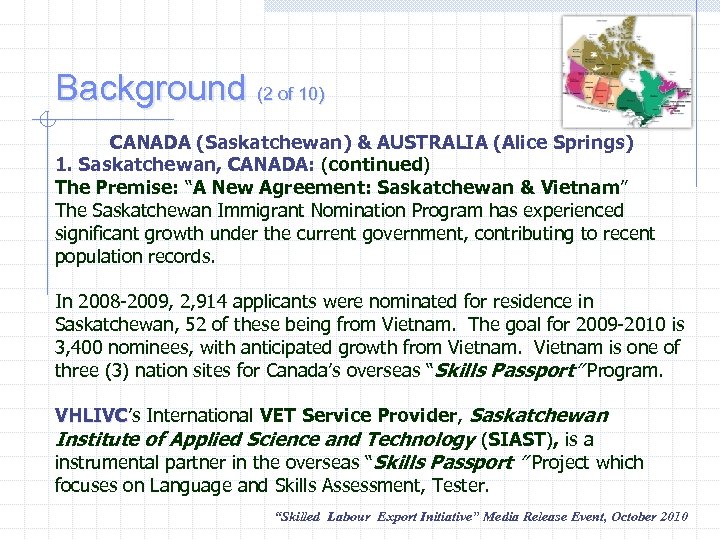
Background (2 of 10) CANADA (Saskatchewan) & AUSTRALIA (Alice Springs) 1. Saskatchewan, CANADA: (continued) The Premise: “A New Agreement: Saskatchewan & Vietnam” The Saskatchewan Immigrant Nomination Program has experienced significant growth under the current government, contributing to recent population records. In 2008 -2009, 2, 914 applicants were nominated for residence in Saskatchewan, 52 of these being from Vietnam. The goal for 2009 -2010 is 3, 400 nominees, with anticipated growth from Vietnam is one of three (3) nation sites for Canada’s overseas “Skills Passport” Program. VHLIVC’s International VET Service Provider, Saskatchewan VHLIVC Institute of Applied Science and Technology (SIAST), is a instrumental partner in the overseas “Skills Passport ” Project which focuses on Language and Skills Assessment, Tester. “Skilled Labour Export Initiative” Media Release Event, October 2010
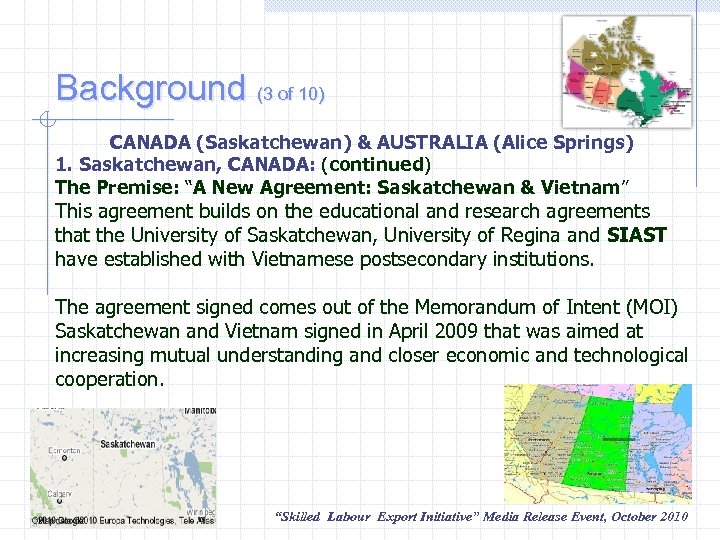
Background (3 of 10) CANADA (Saskatchewan) & AUSTRALIA (Alice Springs) 1. Saskatchewan, CANADA: (continued) The Premise: “A New Agreement: Saskatchewan & Vietnam” This agreement builds on the educational and research agreements that the University of Saskatchewan, University of Regina and SIAST have established with Vietnamese postsecondary institutions. The agreement signed comes out of the Memorandum of Intent (MOI) Saskatchewan and Vietnam signed in April 2009 that was aimed at increasing mutual understanding and closer economic and technological cooperation. “Skilled Labour Export Initiative” Media Release Event, October 2010
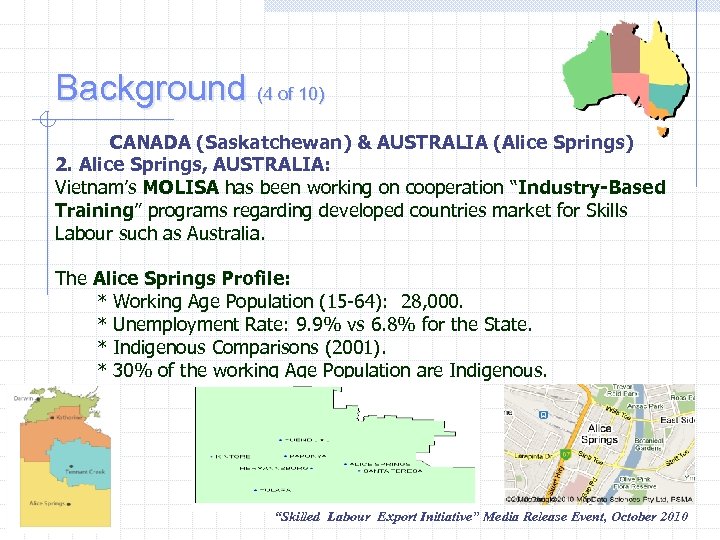
Background (4 of 10) CANADA (Saskatchewan) & AUSTRALIA (Alice Springs) 2. Alice Springs, AUSTRALIA: Vietnam’s MOLISA has been working on cooperation “Industry-Based Training” programs regarding developed countries market for Skills Labour such as Australia. The Alice Springs Profile: * Working Age Population (15 -64): 28, 000. * Unemployment Rate: 9. 9% vs 6. 8% for the State. * Indigenous Comparisons (2001). * 30% of the working Age Population are Indigenous. “Skilled Labour Export Initiative” Media Release Event, October 2010
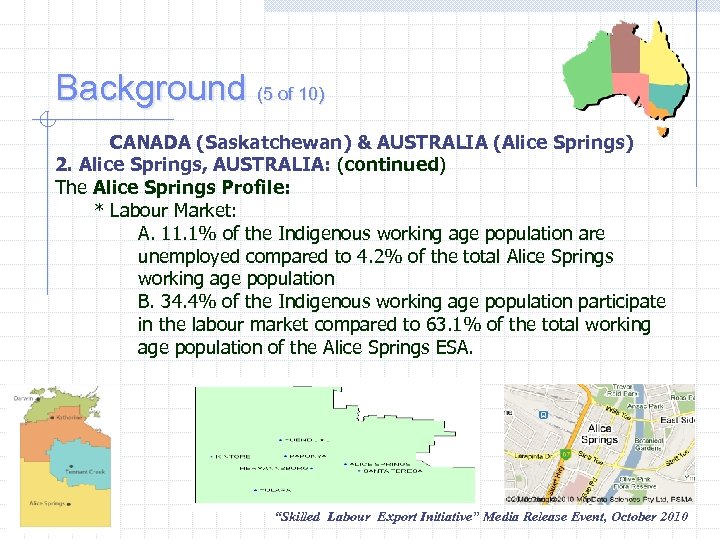
Background (5 of 10) CANADA (Saskatchewan) & AUSTRALIA (Alice Springs) 2. Alice Springs, AUSTRALIA: (continued) The Alice Springs Profile: * Labour Market: A. 11. 1% of the Indigenous working age population are unemployed compared to 4. 2% of the total Alice Springs working age population B. 34. 4% of the Indigenous working age population participate in the labour market compared to 63. 1% of the total working age population of the Alice Springs ESA. “Skilled Labour Export Initiative” Media Release Event, October 2010
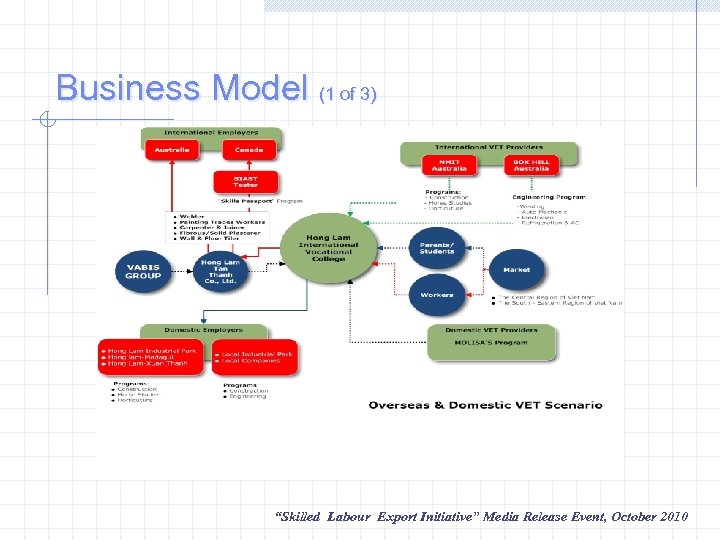
Business Model (1 of 3) “Skilled Labour Export Initiative” Media Release Event, October 2010
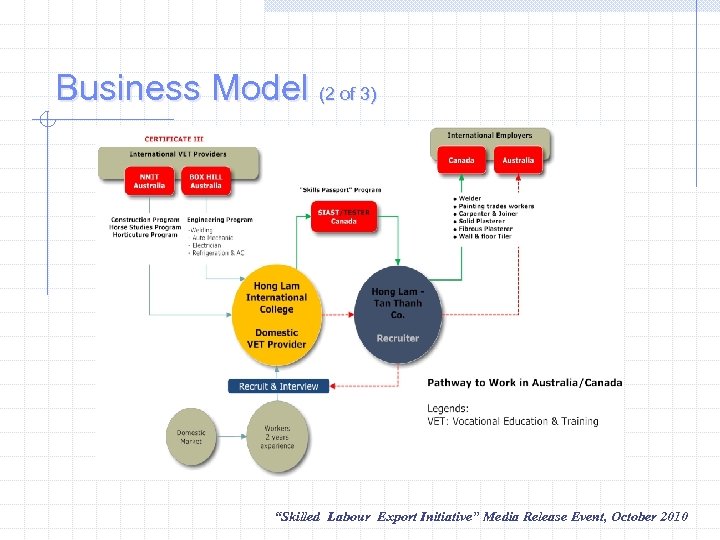
Business Model (2 of 3) “Skilled Labour Export Initiative” Media Release Event, October 2010
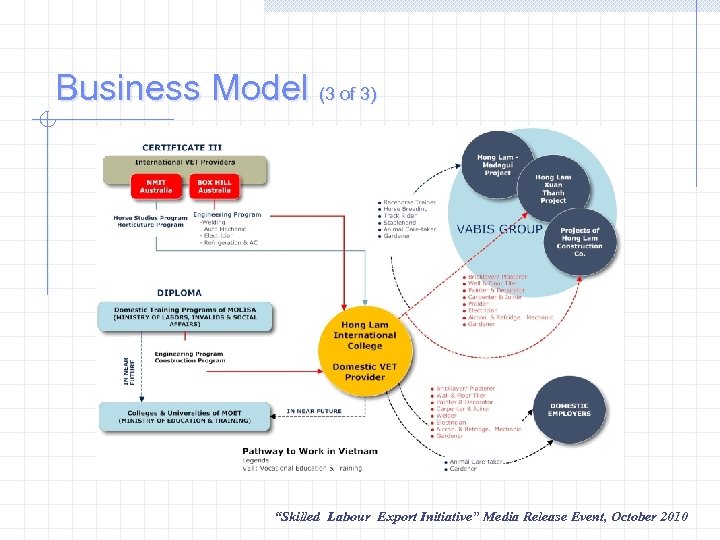
Business Model (3 of 3) “Skilled Labour Export Initiative” Media Release Event, October 2010
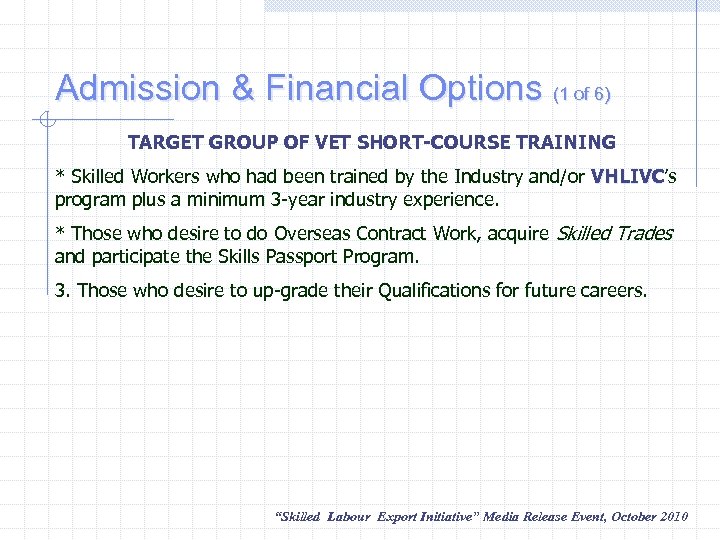
Admission & Financial Options (1 of 6) TARGET GROUP OF VET SHORT-COURSE TRAINING * Skilled Workers who had been trained by the Industry and/or VHLIVC’s VHLIVC program plus a minimum 3 -year industry experience. * Those who desire to do Overseas Contract Work, acquire Skilled Trades and participate the Skills Passport Program. 3. Those who desire to up-grade their Qualifications for future careers. “Skilled Labour Export Initiative” Media Release Event, October 2010
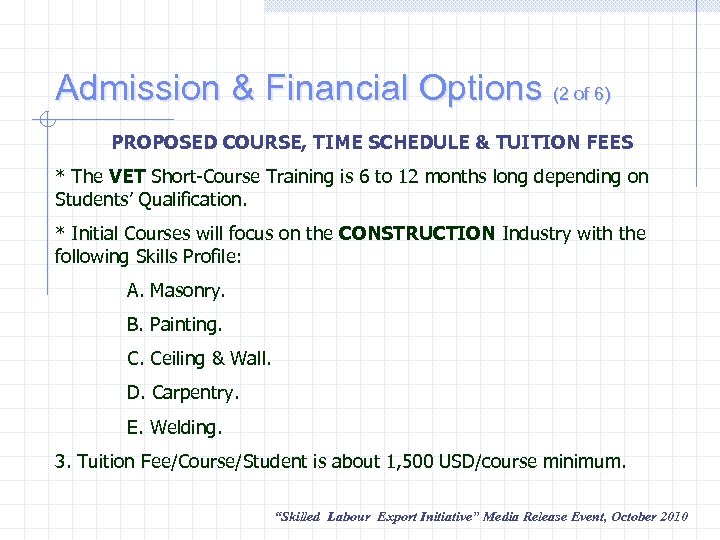
Admission & Financial Options (2 of 6) PROPOSED COURSE, TIME SCHEDULE & TUITION FEES * The VET Short-Course Training is 6 to 12 months long depending on Students’ Qualification. * Initial Courses will focus on the CONSTRUCTION Industry with the following Skills Profile: A. Masonry. B. Painting. C. Ceiling & Wall. D. Carpentry. E. Welding. 3. Tuition Fee/Course/Student is about 1, 500 USD/course minimum. “Skilled Labour Export Initiative” Media Release Event, October 2010
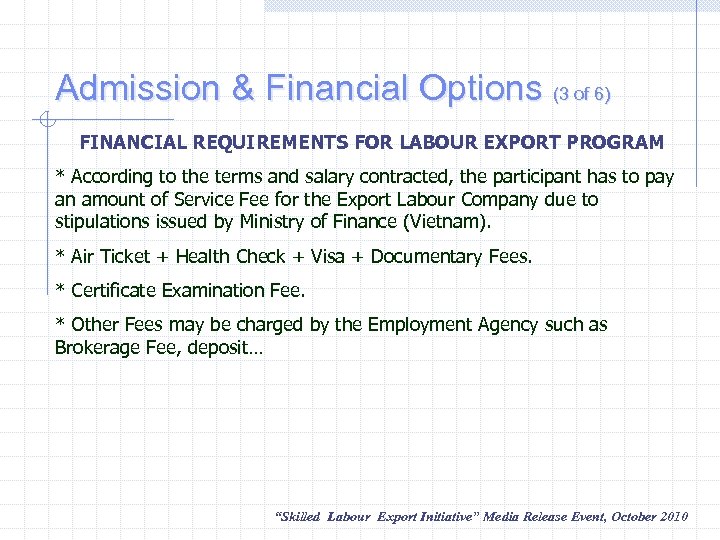
Admission & Financial Options (3 of 6) FINANCIAL REQUIREMENTS FOR LABOUR EXPORT PROGRAM * According to the terms and salary contracted, the participant has to pay an amount of Service Fee for the Export Labour Company due to stipulations issued by Ministry of Finance (Vietnam). * Air Ticket + Health Check + Visa + Documentary Fees. * Certificate Examination Fee. * Other Fees may be charged by the Employment Agency such as Brokerage Fee, deposit… “Skilled Labour Export Initiative” Media Release Event, October 2010
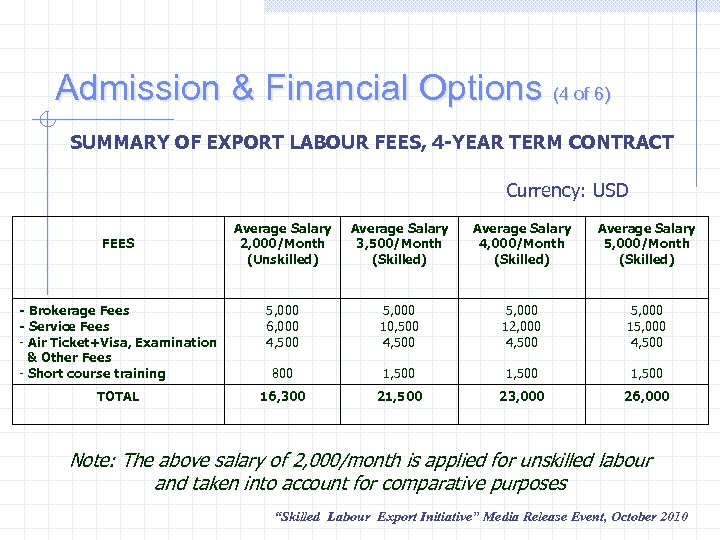
Admission & Financial Options (4 of 6) SUMMARY OF EXPORT LABOUR FEES, 4 -YEAR TERM CONTRACT Currency: USD Average Salary 2, 000/Month (Unskilled) Average Salary 3, 500/Month (Skilled) - Brokerage Fees - Service Fees - Air Ticket+Visa, Examination & Other Fees - Short course training 5, 000 6, 000 4, 500 5, 000 10, 500 4, 500 5, 000 12, 000 4, 500 5, 000 15, 000 4, 500 800 1, 500 TOTAL 16, 300 21, 500 23, 000 26, 000 FEES Average Salary 4, 000/Month (Skilled) Average Salary 5, 000/Month (Skilled) Note: The above salary of 2, 000/month is applied for unskilled labour and taken into account for comparative purposes “Skilled Labour Export Initiative” Media Release Event, October 2010
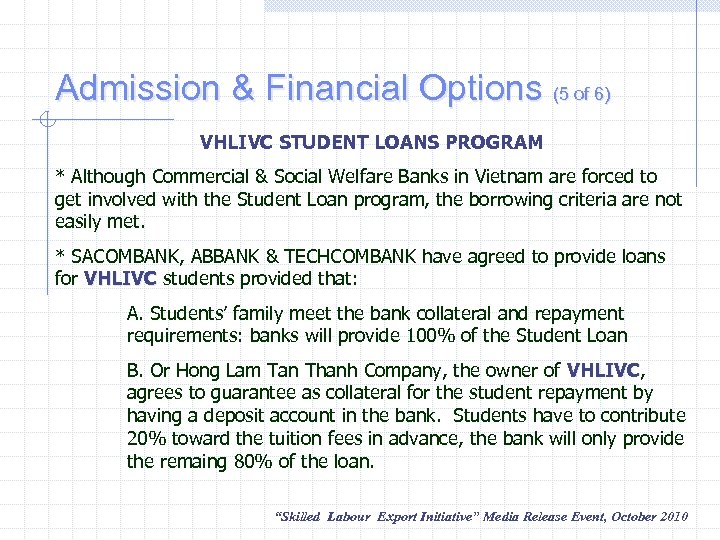
Admission & Financial Options (5 of 6) VHLIVC STUDENT LOANS PROGRAM * Although Commercial & Social Welfare Banks in Vietnam are forced to get involved with the Student Loan program, the borrowing criteria are not easily met. * SACOMBANK, ABBANK & TECHCOMBANK have agreed to provide loans for VHLIVC students provided that: VHLIVC A. Students’ family meet the bank collateral and repayment requirements: banks will provide 100% of the Student Loan B. Or Hong Lam Tan Thanh Company, the owner of VHLIVC, VHLIVC agrees to guarantee as collateral for the student repayment by having a deposit account in the bank. Students have to contribute 20% toward the tuition fees in advance, the bank will only provide the remaing 80% of the loan. “Skilled Labour Export Initiative” Media Release Event, October 2010
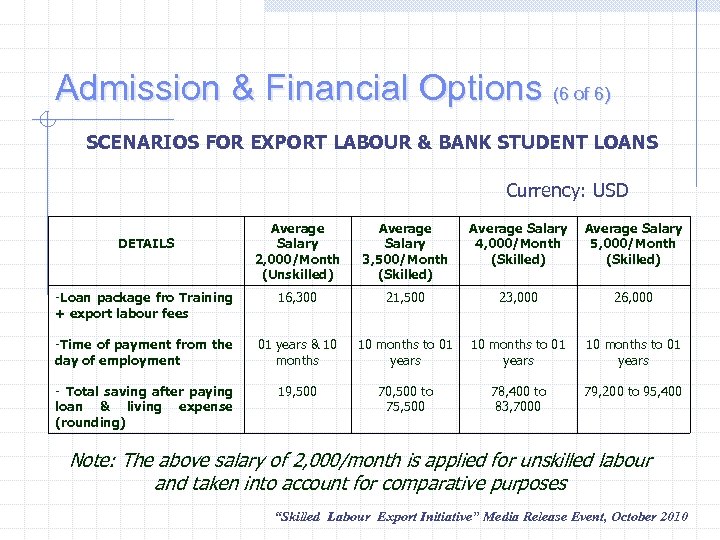
Admission & Financial Options (6 of 6) SCENARIOS FOR EXPORT LABOUR & BANK STUDENT LOANS Currency: USD Average Salary 2, 000/Month (Unskilled) Average Salary 3, 500/Month (Skilled) -Loan package fro Training + export labour fees 16, 300 21, 500 23, 000 26, 000 -Time of payment from the day of employment 01 years & 10 months to 01 years - Total saving after paying loan & living expense (rounding) 19, 500 70, 500 to 75, 500 78, 400 to 83, 7000 79, 200 to 95, 400 DETAILS Average Salary 4, 000/Month 5, 000/Month (Skilled) Note: The above salary of 2, 000/month is applied for unskilled labour and taken into account for comparative purposes “Skilled Labour Export Initiative” Media Release Event, October 2010
Summary & Conclusion (1 of 2) • As established by the Census data analysis, Canada and Australia represent highly comparable settlement sites for degree-qualified Migrants (all immigration categories). • Economic Migrants however perform indisputably better in Australia post-arrival — their immediate work outcomes strongly correlated to longer-term Labour Market integration rates (Birrell, Hawthorne & Richardson 2006). • Skilled Migrants able to make an immediate Contribution to the Economy through use of their Skills at an appropriate place in the Labour Market. • Since 1999, in consequence of the research findings, perceived ‘Employability’ has determined Principal Applicants’ Capacity to proceed with Skilled Migration to Canada and Australia. “Skilled Labour Export Initiative” Media Release Event, October 2010
Summary & Conclusion (2 of 2) • The stakes are high for both economic migrants and Canada. As established by a recent study, ‘If immigrants (escape) low income in their first year, the likelihood of entry in subsequent years (falls) dramatically to below 10%. “Skilled Labour Export Initiative” Media Release Event, October 2010
Скачать презентацию STRATEGY for a New DIRECTION SKILLED LABOUR EXPORT
8f6d99547db2774316cafd351f9a0672.ppt