 Скачать презентацию Strategy and training session IFI Labour Standards Sofia
603ce7588e244e0015420d35aaf468b9.ppt
- Количество слайдов: 44



Strategy and training session: IFI Labour Standards Sofia, Bulgaria 5 -6 May 2008 Molly Mc. Coy Global Unions Washington Office
I. The International Financial Institutions and their activities in the region
The IFIs in the Region • World Bank (WB) • International Finance Corporation (IFC) • International Monetary Fund (IFC) • European Bank for Reconstruction and Development (EBRD) • European Investment Bank (EIB)
World Bank • Lends to: municipal, regional, and national governments • Created in 1944 in the US to offer low-cost loans for the reconstruction of Europe after the second World War • In the 1950 -70’s, extended operations to “developing” countries outside of Europe, focusing mostly on infrastructure projects.
World Bank • 1980 -2000, began requiring indebted countries to follow structural adjustment programs • Today, mission is poverty eradication through loans in every field: health, education, public services, labour market reform, climate change, infrastructure, international trade, etc.
International Finance Corporation • Lends to: private sector companies and subnational governments • One of the five branches of the World Bank • Created in 1956 with the objective of stimulating private sector development through lending to private businesses in developing countries
International Monetary Fund • Lends to: Federal governments • Created in 1944 in the US with the objective of preserving international exchange rate stability and offering loans to countries with temporary balance of payments problems • 1980 -2000, required indebted countries to follow Structural Adjustment Programs • Today, its mission is to maintain macroeconomic stability includes interventions in its members’ labour markets, budget decisions, trade policies, and social programmes
European Bank for Reconstruction and Development • Lends to: private and state-owned companies (for privatization) • Founded in 1991 to promote private sector development following the fall of communism • Members are European-region countries, plus Japan and US (largest shareholder) • Largest single investor in the region
European Investment Bank (EIB) • Invests in public- and private sector projects worldwide, some lending to municipalities • Created in 1958 to be the investment bank of the European Union • Owned by European Union member states
The Washington-based IFIs Face Difficulties Worldwide • Rejected by the public – Massive protests against the IFIs in the late 1990 s and early 2000’s resulted in the cancellation of many IFIsponsored privatization programmes and the “softening” of some IFI conditionality • Threatened by new competition – In some regions, China is funding many of the large infrastructure projects once dominated by WB – Bilateral aid foundations and private donors have eclipsed WB spending on health care initiatives
The Washington-based IFIs Face Difficulties Worldwide • Criticized and rejected by some governements – IMF has lost its largest clients: Argentina, Brazil, and Indonesia, as well as several other countries – Governments in Latin America and Asia are developing their own alternatives to the IFIs – IFI influence remains strongest in the poorest countries
IFI Response to the Challenges • “Reduction” of conditionality • Cancellation of debts for the poorest countries • Emphasizing investment projects instead of policy reform • Increased technical assistance programmes, especially to strengthen the private sector • Renewed effort to develop infrastructure projects
2. The WB and IFC Labour Standards
• In May 2006, the IFC adopted new performance standards requiring all its clients to respect the Core Labour Standards (CLS) of the ILO • In 2007, the WB adopted similiar requirements for all its large-scale infrastructure projects • EBRD currently adopting similar standards • The CLS are: 1. 2. 3. 4. Prohibition of forced labour Prohibition of child labour Non-discrimination Right to organize and bargain collectively
Origins of the labour standards The standards are the result of more than 7 years of trade union campaigning at the World Bank: 1999 -2001: Responding to a trade union demand that it ensure its projects are consistent with the CLS, WB studies the implications of freedom of association on economic development 2001: WB donor countries insist that the Bank prepare a publication stating that the CLS do contibute to the Bank’s mission 2002: WB officially recognizes the value of the CLS, but does not accept to require CLS adherence from its clients
Orgins of the Standards (cont’d) 2003: In a meeting with union representatives, the president of the IFC says the IFC will require respect of CLS from its clients. Unions push the IFC to integrate the CLS into its contracts. 2004: A trade union specialist is assigned to the WB to help develop recommendations on CLS in construction projects 2004 – 06: The IFC begins a revision of its performance standards in consultation with the ICFTU May 2006: The IFC adopts new standards requiring its clients to observe the CLS 2007: WB adopts CLS standards for large infrastructure construction projects
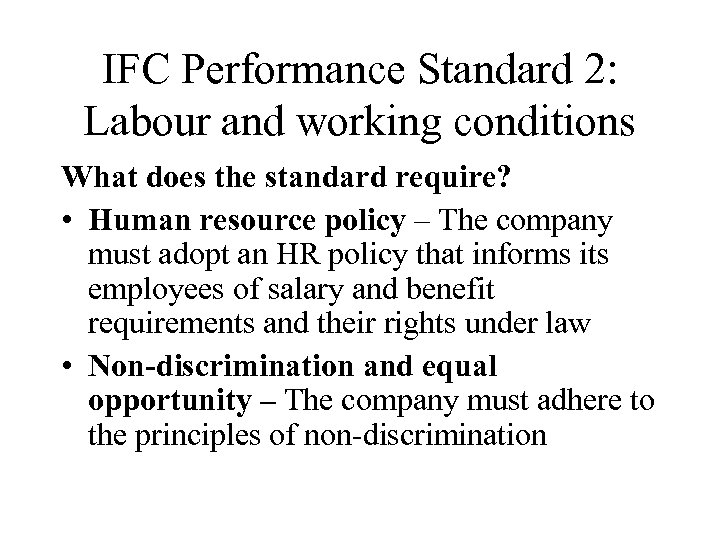
IFC Performance Standard 2: Labour and working conditions What does the standard require? • Human resource policy – The company must adopt an HR policy that informs its employees of salary and benefit requirements and their rights under law • Non-discrimination and equal opportunity – The company must adhere to the principles of non-discrimination
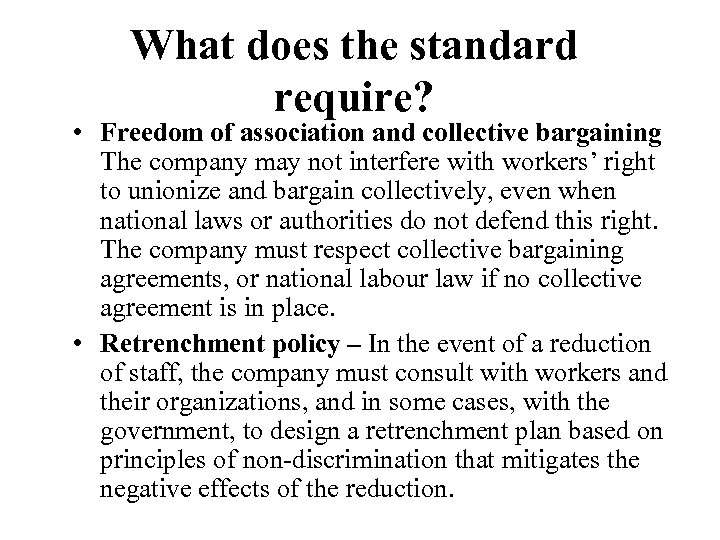
What does the standard require? • Freedom of association and collective bargaining The company may not interfere with workers’ right to unionize and bargain collectively, even when national laws or authorities do not defend this right. The company must respect collective bargaining agreements, or national labour law if no collective agreement is in place. • Retrenchment policy – In the event of a reduction of staff, the company must consult with workers and their organizations, and in some cases, with the government, to design a retrenchment plan based on principles of non-discrimination that mitigates the negative effects of the reduction.
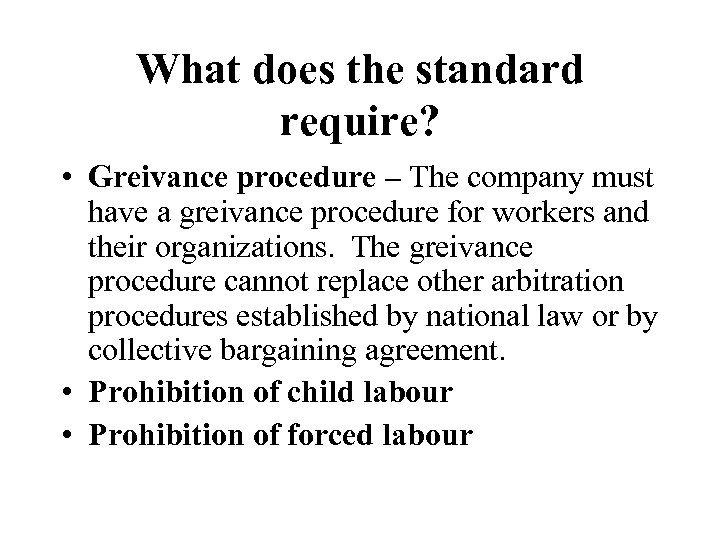
What does the standard require? • Greivance procedure – The company must have a greivance procedure for workers and their organizations. The greivance procedure cannot replace other arbitration procedures established by national law or by collective bargaining agreement. • Prohibition of child labour • Prohibition of forced labour
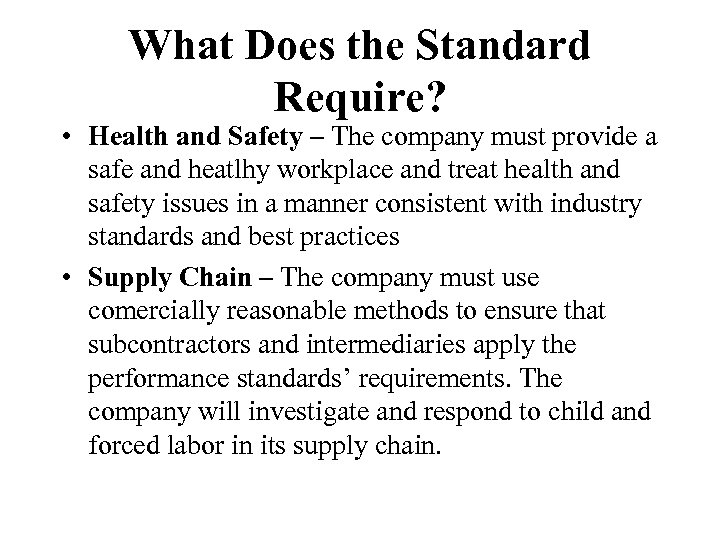
What Does the Standard Require? • Health and Safety – The company must provide a safe and heatlhy workplace and treat health and safety issues in a manner consistent with industry standards and best practices • Supply Chain – The company must use comercially reasonable methods to ensure that subcontractors and intermediaries apply the performance standards’ requirements. The company will investigate and respond to child and forced labor in its supply chain.
The WB Infrastructure Standards What do the standards require? • Child labour is prohibited (although the contract refers only to “harmful” child labour) • Forced labour is prohibited • Other health and safety requirements, including detailed requirements on the prevention of HIV transmission in the workplace • Similar requirements to those of the IFC, although they are directed at “contractors” rather than “clients”
When Are the Standards Applied? • The IFC performance standards apply to: – All new IFC loans, from May 2006 forward • The World Bank standards apply to: – Large-scale construction projects (generally $10 mn or more) • The WB has committed to sponsoring the harmonization of all multilateral development banks standards to include the CLS requirement in 2008. • WB moving towards “country systems” for procurement
3. Current IFC and World Bank Projects
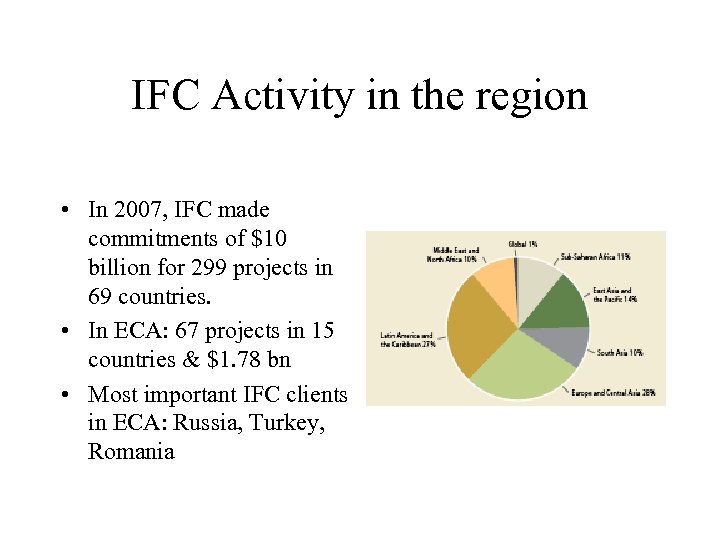
IFC Activity in the region • In 2007, IFC made commitments of $10 billion for 299 projects in 69 countries. • In ECA: 67 projects in 15 countries & $1. 78 bn • Most important IFC clients in ECA: Russia, Turkey, Romania
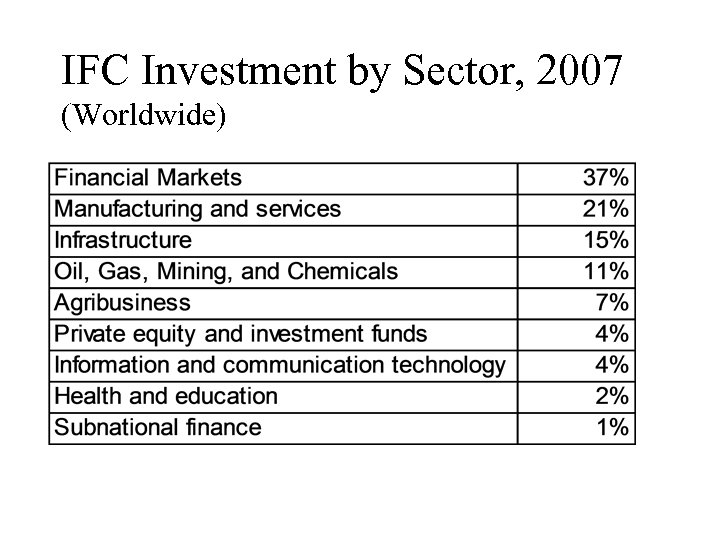
IFC Investment by Sector, 2007 (Worldwide)
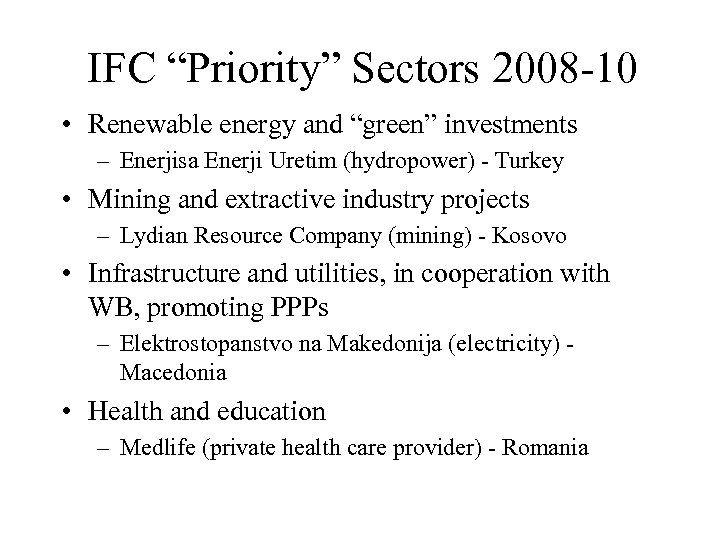
IFC “Priority” Sectors 2008 -10 • Renewable energy and “green” investments – Enerjisa Enerji Uretim (hydropower) - Turkey • Mining and extractive industry projects – Lydian Resource Company (mining) - Kosovo • Infrastructure and utilities, in cooperation with WB, promoting PPPs – Elektrostopanstvo na Makedonija (electricity) - Macedonia • Health and education – Medlife (private health care provider) - Romania
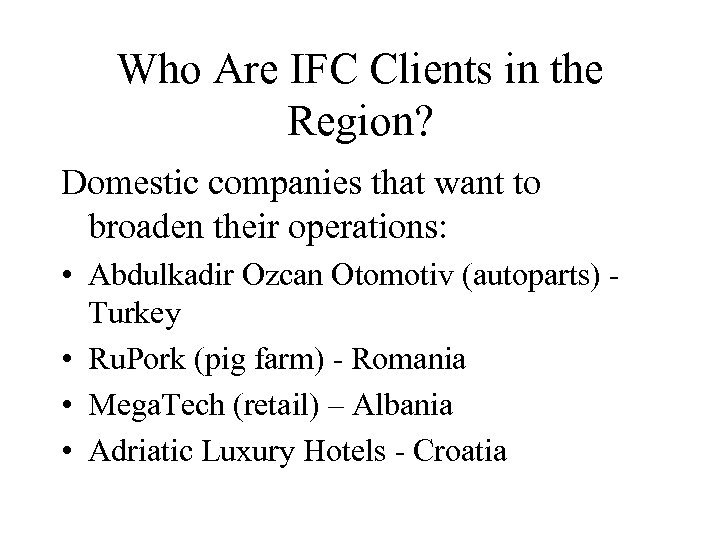
Who Are IFC Clients in the Region? Domestic companies that want to broaden their operations: • Abdulkadir Ozcan Otomotiv (autoparts) - Turkey • Ru. Pork (pig farm) - Romania • Mega. Tech (retail) – Albania • Adriatic Luxury Hotels - Croatia
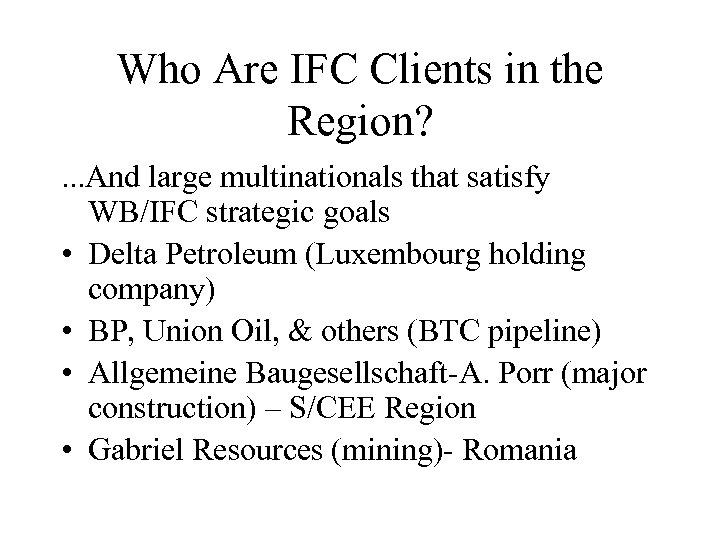
Who Are IFC Clients in the Region? . . . And large multinationals that satisfy WB/IFC strategic goals • Delta Petroleum (Luxembourg holding company) • BP, Union Oil, & others (BTC pipeline) • Allgemeine Baugesellschaft-A. Porr (major construction) – S/CEE Region • Gabriel Resources (mining)- Romania
Where to Look for Information on IFC Projects • WB Country Assistance Strategy (CAS) documents – Appendix detailing the IFC strategy for the country – Indentification of priority sectors • • IFC website: www. ifc. org/projects Local IFC offices Press and other sources Update bulletins from Global Unions Washington Office
WB Infrastructure Projects: • Increase in funding for infrastructure projects in the region – Only about 41% of WB total portfolio ($3. 8 bn) in ECA went towards infrastructure in 2007 – WB regional infrastructure strategy for ECA not yet available • Some recent projects – Road rehabilitation, Bulgaria, $125 million – Istanbul municipal infrastructure, $336. 3 million – Rijeka port modernization (Croatia), $48 million
Where to Find Information on WB Projects • WB CAS documents • WB project database • Monthly Operational Summary
4. Effective Use of the Standards
How Does the IFC Implement Its Standards • The IFC classifies projects according to risk – A – High-risk projects like pipelines or dams – B – Limited risk (the majority of projects, including most mining and construction projects) – C – Minimal risk (IT) – FI – Financial intermediary (a loan to a bank or other financial institution, rather than funding for a specific project) • Companies must submit a “Social and Environmental Assessment” and, if necessary, an “Action Plan” to mitigate risks. (Category “C” and “FI” projects are exempt. )
• The assessment and action plan must include consultation with “affected communities” and must be public • The IFC can set up inspection and monitoring of the project depending on the degree of risk
How Can Unions Use the Standards? 1. As an instrument to defend workers’ right to organize during a unionization campaign • The standards can provide support to a campaign if the local affiliate is ready to: – Organize workers – Be in communication with the national center or GUF – Work with allied organizations or other partners when necessary
2004 Test Case: Grupo M • While the IFC was revising its standards, it agreed to do a “test case” requiring a Domincan clothing manufacturer to respect the CLS, including freedom of association and collective bargaining • After signing the contract, the company tried to stifle a union organizing campaign in its Haiti factory by firing and beating union activists. • The Haitian union sought help from international partners: ITGLWF, ICFTU, the Solidarity Center and other unions and NGOs.
Grupo M Case (Cont’d) • At the behest of the unions, the IFC sent a mission to the factory to investigate the situation and concluded that the company had violated its contract. • Thanks to pressure from IFC, the company resolved the sitatuation. A few months later, the problems repeated. • The IFC threatened to cancel the loan, and the company finally complied with the CLS. • In 2005, the Haitian workers signed their first collective bargaining agreement.
Lessons From the Grupo M Case • The standards are one of many instruments unions can use in their campaigns. • Alone, the standards will not win a campaign. • Unions must be vigilant and push the IFC to enforce its standards. • International coordination and cooperation is essential to a strong campaign.
How Can Unions Use the Standards 2. As a greivance mechanism: • Unions can bring complaints against a company for violating the standards even after a loan has been approved (though we have more influence beforehand)
Examples of Recent Complaints • Child labour in the supply chain of Celtel Africa (as card vendors) • Discrimination and anti-union practices in a Brazilian airline • Widespread threats and violence against unions and trade unionists (Belarus) • Obstruction of the negotiation of a collective bargaining agreement (Pakistan) • Supression of trade union rights (Bangladesh)
Practical Information: How to present a complaint to the IFC • Written commplaints can be directed to the IFC Social and Environments Devt. Dept, and to local IFC offices. • Complaints can also be submitted to the Executive Directors of the World Bank, who approve the loans • So far, most complaints have been submitted to the IFC Social and Environments Devt. Dept • The Global Unions Washington Office has been responsible for submitting complaints to IFC
An effective complaint requires: • Specific information • Ongoing communication to clarify doubts and answer questions • Sufficient time • The Global Unions Washington Office can help – Coordinate information – Facilitate contacts between the local union and local IFC representatives – Organize meetings in Washington or in the country – Seek support of WB executive directors
5. Small Group Workshop: Practical Use of the IFC Standards For the case you have been given: • Draft a written complaint to submit to the IFC • Write a press release to distribute to national and international media outlets • Plan and present a campaign strategy to address the problem
Questions for Discussion • How to inform affiliates about use of the standards? • How to ensure that World Bank and IFC enforce the standards? • What will regional affiliates need to effectivly use the standards? • What are the next steps?
Скачать презентацию Strategy and training session IFI Labour Standards Sofia
603ce7588e244e0015420d35aaf468b9.ppt