 Скачать презентацию Strategies in Production and Operations Management David Bolton
5ee221bdb0889bf9bc145650b86652d3.ppt
- Количество слайдов: 44



Strategies in Production and Operations Management David Bolton, CFPIM, C. P. M. Materials Manager, Rotek, Inc. Past President, APICS Past Education Director, APICS
Semester Expectations ® Two tests ® mid-term, ® Two final projects ® Project 1…OM Mentoring ® Project 2…Advanced OM research ® Homework ® Participation ® APICS / Plant tours ® Final preparations for graduation
Changes in World Manufacturing ® Prior to 2000 ® enormous investment in software, hardware, ancillary systems ® much were in response to 2000 concerns ® this prompted elimination of many ‘homegrown’ systems ® Major ERP system companies responded ® SAP, Oracle, J. D. Edwards, People. Soft
Changes in World Manufacturing ® ERP system development ® based on MRP logic ® replaced older versions of MPC ® added MPC as a baseline to ERP systems ® Change ® need was required on factory floor to respond to world changes ® floor level teams, decentralized decisions ® floor level problem solving ® this required better information reporting
Changes in World Manufacturing ® Customer expectations remain the driving force in Manufacturing development ® more demands ® faster information ® faster product ® shortened product cycles
Changes in World Manufacturing ® Globalization ® even small enterprises have business interests in other countries ® could be manufacturing ® could be procurement ® increases the need for information reach ® This causes the need for greater integration and management of the supply chain

APICS: The Association for Operations Management
APICS Certification ® CPIM: Certified in Production and Inventory Management ® CFPIM: Certified Fellow in Production and Inventory Management ® CIRM: Certified in Integrated Resource Management ® Chapters 8, 11, 17 and 19
The CPIM Curriculum ® The APICS Dictionary ® Basics of Supply Chain Management ® Master Planning of Resources ® Detailed Scheduling and Planning ® Execution and Control of Operations ® Strategic Management of Resources
The CPIM Curriculum ® The APICS Dictionary ® important reference document for all five areas of certification ® good desk reference
The CPIM Curriculum ® Basics of Supply Chain Management ® Elements of supply chain ® Just-in-time (JIT) ® Total quality management (TQM) ® Manufacturing Resource Planning (MRPII) ® Demand planning ® Capacity planning
The CPIM Curriculum ® Master Planning of Resources ® Demand ® Sales Management and operations planning ® Master scheduling ® Measuring the business plan
The CPIM Curriculum ® Detailed Scheduling and Planning ® techniques and practices of inventory management ® mechanics of material planning process ® planning operations to support priority plan ® planning procurement and external sources of supply
The CPIM Curriculum ® Execution and Control of Operations ® prioritization ® executing and sequencing of work plans and implementing controls ® authorizing and reporting activities for push and pull systems ® evaluating performance and providing feedback
The CPIM Curriculum ® Strategic Management of Resources ® competitive ® choices market issues affecting facilities, supply chain, information technology, organizational design ® configuring and integrating internal design ® evaluating and managing projects

Student APICS ® Attend Akron APICS meetings on 2 nd Tuesday of the month ® Speakers ® Student paper competition ® Region III meetings ® Whatever you make it
Strategies in Production & Operations Management Chapter 1 Manufacturing Planning and Control
MPC provides information ® Efficient management of materials ® Effective utilization of people and equipment ® Coordination of internal activities with external suppliers ® Communication with the customer about market requirements
MPC Managerial Concerns ® The context for MPC ® The MPC system defined ® An MPC system framework ® Matching the MPC system with the needs of the firm ® Evolution of the MPC system
The Context for MPC ® Continual change in the competitive environment is key ® Three key areas influence this change: ® internationalization ® the role of the customer ® increasing use of information technology
Internationalization ® International reach of manufacturing companies ® Nike ® global supply chain network for ‘hollow corporation’ ® Some firms are manufacturing only ® Flextronics ® high levels of flexibility
The Role of the Customer ® Customer expectations: ® product flexibility ® process flexibility ® responsiveness ® lower transaction costs ® lower inventories ® MPC systems must be able to determine, transmit, revise and coordinate requirements globally. . .
Increasing Use of I. T. ® Global response, coordination, and communication require rapid deployment of Information Technology
The MPC System Defined ® The MPC system efficiently manages. . . ® the flow of material ® the utilization of people and equipment ® The MPC system responds to customers by… ® utilizing the capacity of our suppliers ® utilizing our internal capacity ® …to meet customer demands
Typical MPC Support Activities The activities are contained within 3 horizons: ® Long term ® Medium term ® Short term
Typical MPC Support Activities ® Long term ® provides information to make decisions regarding capacity ® equipment, buildings, suppliers, etc. ® important when the enterprise is responding to short-term demands ® is necessary to provide the right mix of human resources, technology and geographical locations to meet the firms future needs
Typical MPC Support Activities ® Medium term ® the fundamental issue is matching supply and demand volume must be considered ® mix must be considerted (GE Bearings) ® ® focus is the exact mix of production, capacity and material needs raw materials ® work in process ® finished goods ®
Typical MPC Support Activities ® Short term ® detailed scheduling required to meet the production requirements time ® people ® materials ® equipment ® facilities ® ® MPC system must track and report plan v. actuals
Costs and Benefits of MPC Systems ® Initial costs are substantial ® operational ® costs are significant imagine a small machine shop of your own ® achieving the benefits of the MPC system can be elusive ® they must be recognized to be competitive
Costs and Benefits of MPC Systems ® Symptoms of a poorly operating MPC system: ® poor customer service ® excessive inventory ® inappropriate assignment of materials, workers, and equipment ® large numbers of expediters!
Costs and Benefits of MPC Systems ® Symptoms can cause a firm… ® to go bankrupt ® miss opportunities
Costs and Benefits of MPC Systems ® Benefits of a properly operating system… ® Timken Bearing Division in N. C. ® controlled WIP ® smooth production flows ® short and consistent delivery lead times ® rapid response to new orders ® efficient production lot sizes ® labor productivity increases
Costs and Benefits of MPC Systems ® Benefits of a properly operating system… ® Nortel Networks streamlining of their supply chain ® reduction in manufacturing and distribution overhead ® reduced throughput times ® focus on core competencies
Costs and Benefits of MPC Systems ® Benefits of a properly operating system… ® Korean Heavy Industries ® reduction in lead time by 40 percent ® reduction in inventories by 50 percent ® direct labor productivity increase of 40 percent
An MPC System Framework ® Now typical to have an MPC system imbedded in our ERP systems ® More activities of these MPC systems have evolved with global need for change
MPC System Activities ® The general MPC system
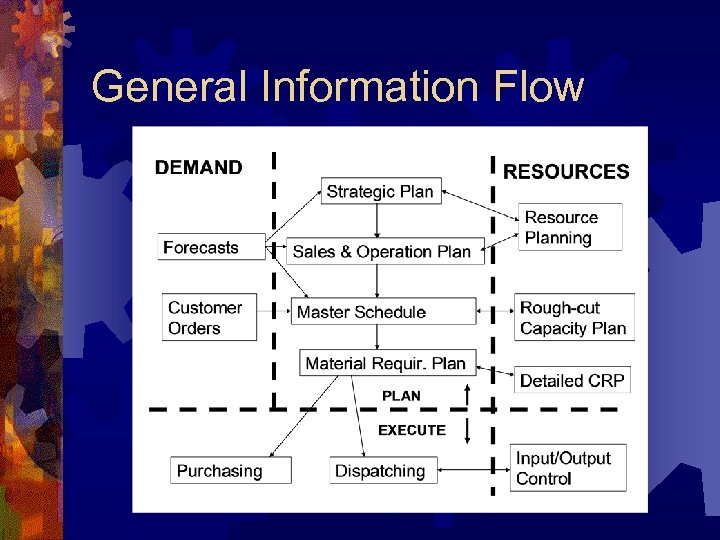
General Information Flow
Matching the MPC System with the Needs of the Firm ® The specific needs depend on the nature of the production process ® These needs cannot remain static ® competitive conditions ® customer expectations ® design changes ® supplier capabilities ® internal needs
Matching the MPC System with the Needs of the Firm ® MPC technology will also change with time ® changes to increased speed of computers will change the MPC planning cycles can be speeded up ® information can be analyzed real time ® inventories can be shared real time ® ® MPC system must reflect factory floor conditions
MPC Classification Schema ® Figure 1. 2
Evolution of the MPC System ® The key is keeping the MPC system matched to the company’s attributes at a particular point in time. ® This means the strategy of the firm must be reviewed and compared with the system from time to time
The Changing Competitive World ® Figure 1. 3 ® New technology, products, processes, systems, techniques permit new competitive initiatives ® Marketplace dictates drive revisions in company strategies ® All change our look at the MPC
Reacting to the Changes ® If the MPC system is not reviewed periodically to compare it with company needs, it may become ineffective. ® JIT moves items so quickly that floor schedules are not needed
Homework for Chapter 1 ® Discussion ® Short questions 1, 2, 3, 4, and 5 answers, typewritten for executive review ® Think about your answers, role-play a key production staff member
Скачать презентацию Strategies in Production and Operations Management David Bolton
5ee221bdb0889bf9bc145650b86652d3.ppt