 Скачать презентацию Strategies for Resource Management for better input use
e2ba743354e73fe344ec0ec6f193bd5f.ppt
- Количество слайдов: 36



Strategies for Resource Management for better input use efficiency Odisha State
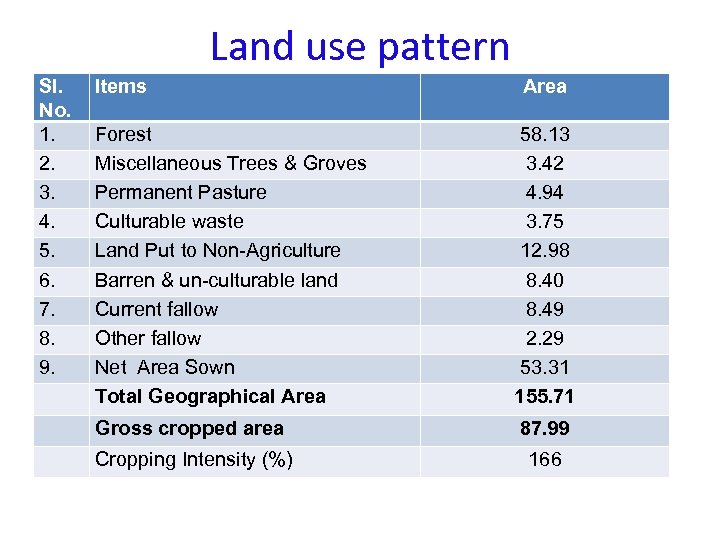
Land use pattern Sl. No. 1. 2. 3. 4. 5. 6. 7. 8. 9. Items Area Forest Miscellaneous Trees & Groves Permanent Pasture Culturable waste Land Put to Non-Agriculture Barren & un-culturable land Current fallow Other fallow Net Area Sown Total Geographical Area 58. 13 3. 42 4. 94 3. 75 12. 98 8. 40 8. 49 2. 29 53. 31 155. 71 Gross cropped area 87. 99 Cropping Intensity (%) 166
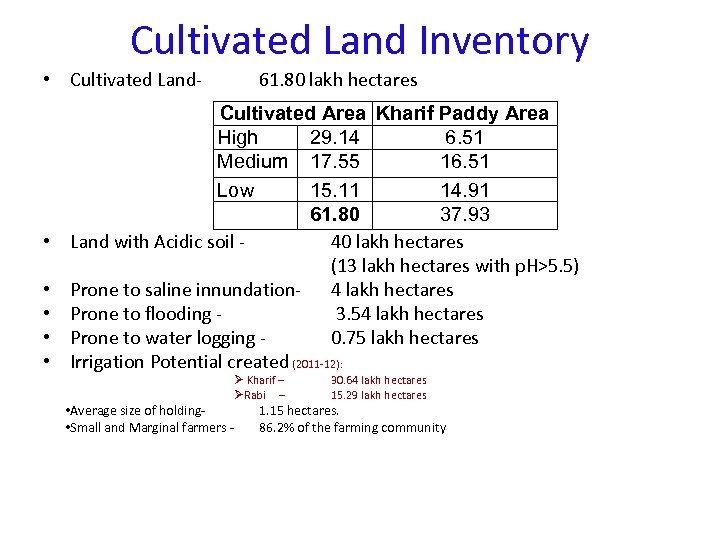
Cultivated Land Inventory • Cultivated Land- • • • 61. 80 lakh hectares Cultivated Area Kharif Paddy Area High 29. 14 6. 51 Medium 17. 55 16. 51 Low 15. 11 14. 91 61. 80 37. 93 Land with Acidic soil 40 lakh hectares (13 lakh hectares with p. H>5. 5) Prone to saline innundation- 4 lakh hectares Prone to flooding 3. 54 lakh hectares Prone to water logging 0. 75 lakh hectares Irrigation Potential created (2011 -12): • Average size of holding • Small and Marginal farmers - Ø Kharif – ØRabi – 30. 64 lakh hectares 15. 29 lakh hectares 1. 15 hectares. 86. 2% of the farming community
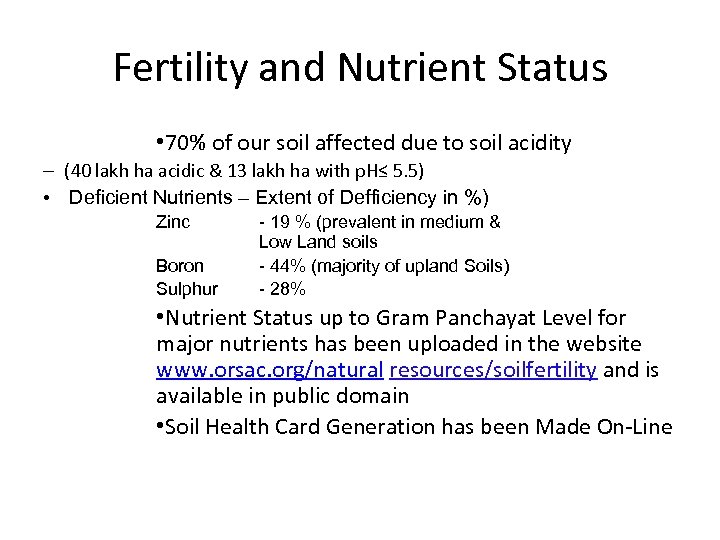
Fertility and Nutrient Status • 70% of our soil affected due to soil acidity – (40 lakh ha acidic & 13 lakh ha with p. H≤ 5. 5) • Deficient Nutrients – Extent of Defficiency in %) Zinc Boron Sulphur - 19 % (prevalent in medium & Low Land soils - 44% (majority of upland Soils) - 28% • Nutrient Status up to Gram Panchayat Level for major nutrients has been uploaded in the website www. orsac. org/natural resources/soilfertility and is available in public domain • Soil Health Card Generation has been Made On-Line
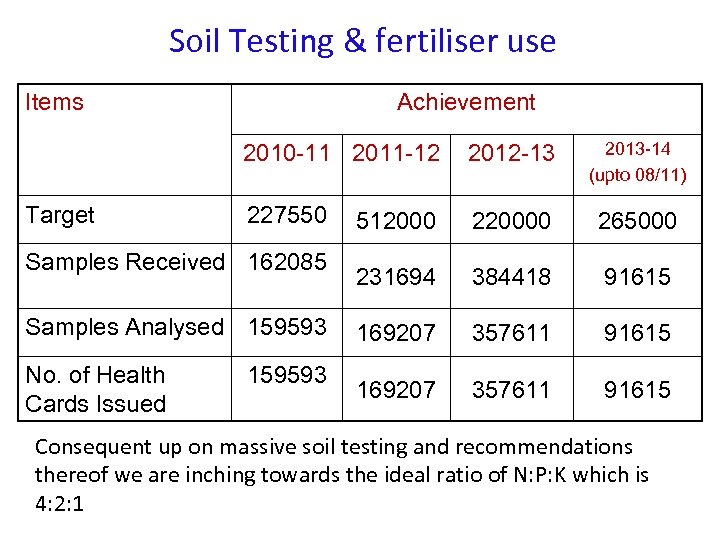
Soil Testing & fertiliser use Items Achievement 2010 -11 2011 -12 2012 -13 2013 -14 (upto 08/11) 227550 512000 220000 265000 231694 384418 91615 Samples Analysed 159593 169207 357611 91615 No. of Health Cards Issued 169207 357611 91615 Target Samples Received 162085 159593 Consequent up on massive soil testing and recommendations thereof we are inching towards the ideal ratio of N: P: K which is 4: 2: 1
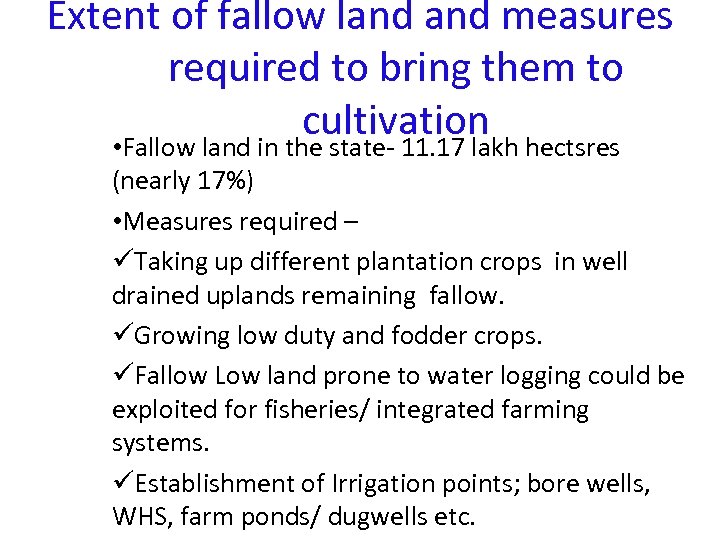
Extent of fallow land measures required to bring them to cultivation hectsres • Fallow land in the state- 11. 17 lakh (nearly 17%) • Measures required – üTaking up different plantation crops in well drained uplands remaining fallow. üGrowing low duty and fodder crops. üFallow Low land prone to water logging could be exploited for fisheries/ integrated farming systems. üEstablishment of Irrigation points; bore wells, WHS, farm ponds/ dugwells etc.
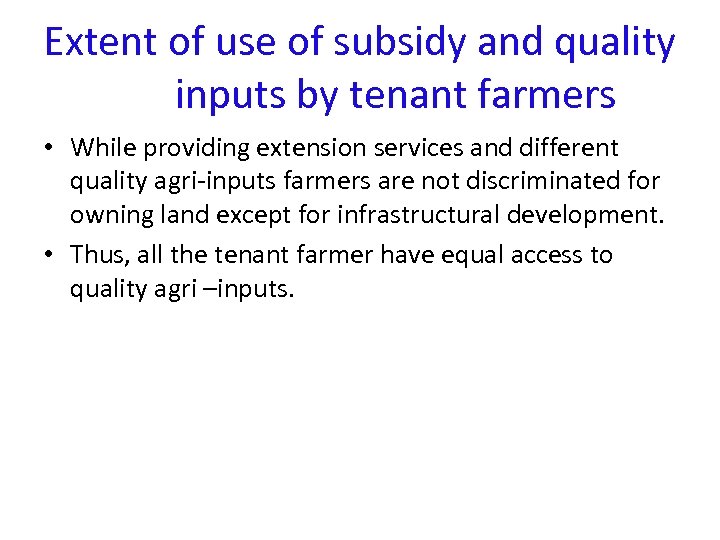
Extent of use of subsidy and quality inputs by tenant farmers • While providing extension services and different quality agri-inputs farmers are not discriminated for owning land except for infrastructural development. • Thus, all the tenant farmer have equal access to quality agri –inputs.
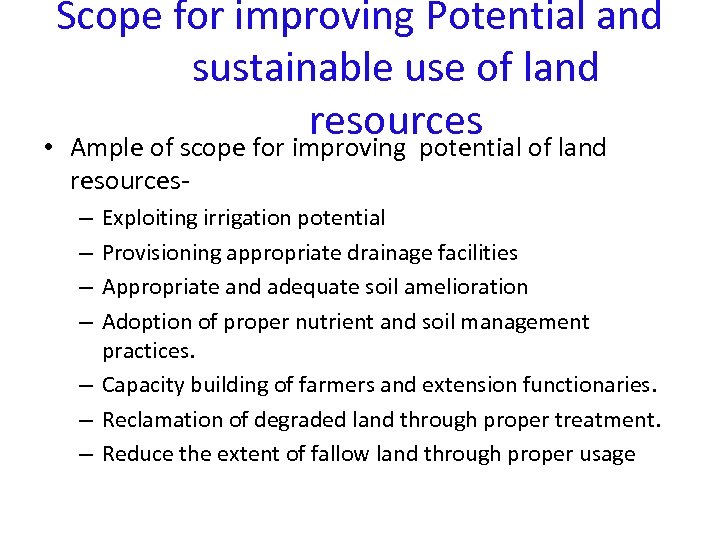
Scope for improving Potential and sustainable use of land resources of land • Ample of scope for improving potential resources- Exploiting irrigation potential Provisioning appropriate drainage facilities Appropriate and adequate soil amelioration Adoption of proper nutrient and soil management practices. – Capacity building of farmers and extension functionaries. – Reclamation of degraded land through proper treatment. – Reduce the extent of fallow land through proper usage – –
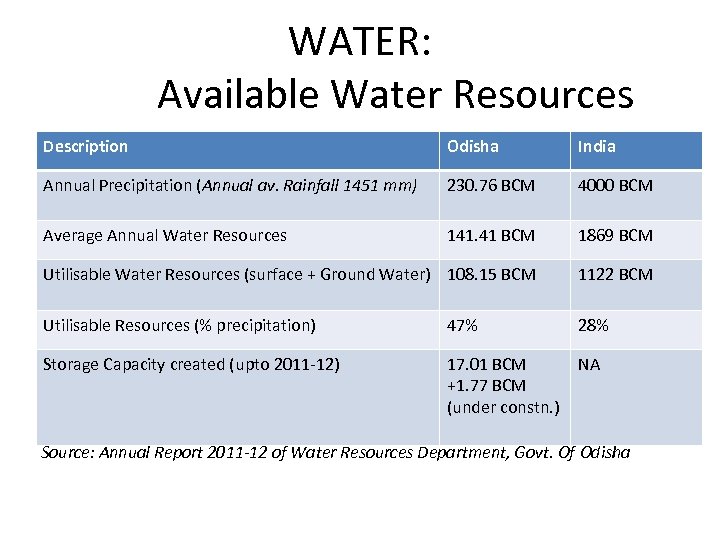
WATER: Available Water Resources Description Odisha India Annual Precipitation (Annual av. Rainfall 1451 mm) 230. 76 BCM 4000 BCM Average Annual Water Resources 141. 41 BCM 1869 BCM Utilisable Water Resources (surface + Ground Water) 108. 15 BCM 1122 BCM Utilisable Resources (% precipitation) 47% 28% Storage Capacity created (upto 2011 -12) 17. 01 BCM +1. 77 BCM (under constn. ) NA Source: Annual Report 2011 -12 of Water Resources Department, Govt. Of Odisha
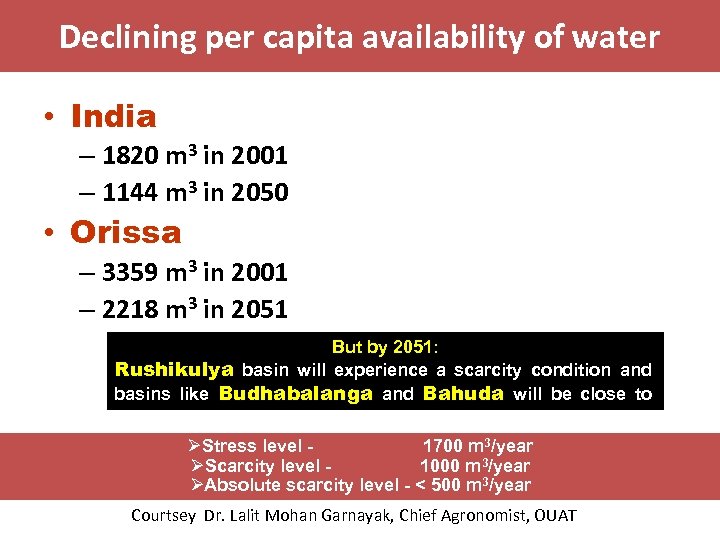
Declining per capita availability of water • India – 1820 m 3 in 2001 – 1144 m 3 in 2050 • Orissa – 3359 m 3 in 2001 – 2218 m 3 in 2051 But by 2051: Rushikulya basin will experience a scarcity condition and basins like Budhabalanga and Bahuda will be close to scarcity condition ØStress level 1700 m 3/year ØScarcity level 1000 m 3/year ØAbsolute scarcity level - < 500 m 3/year Courtsey Dr. Lalit Mohan Garnayak, Chief Agronomist, OUAT
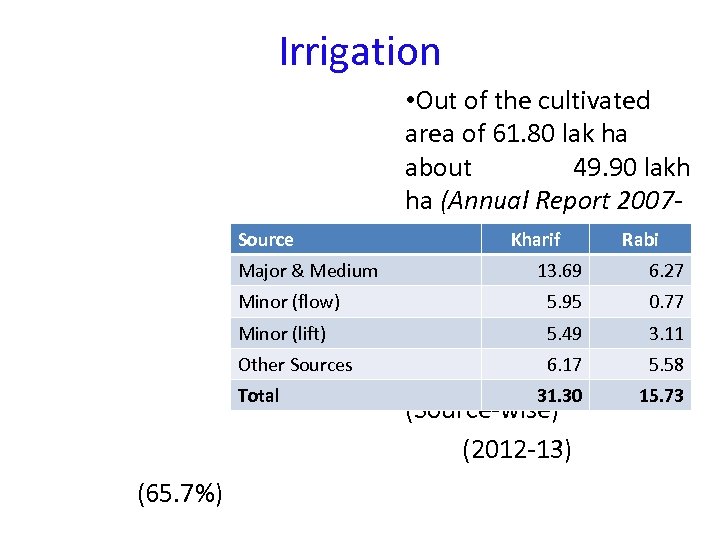
Irrigation Source Major & Medium Minor (flow) Minor (lift) Other Sources Total (65. 7%) • Out of the cultivated area of 61. 80 lak ha about 49. 90 lakh ha (Annual Report 200708 - water resources Kharif Rabi Deptt. ) can 13. 69 brought be 6. 27 5. 95 0. 77 under assured irrigation. 5. 49 • Irrigation potential 3. 11 6. 17 5. 58 created in lakh ha 31. 30 15. 73 (Source-wise) (2012 -13)
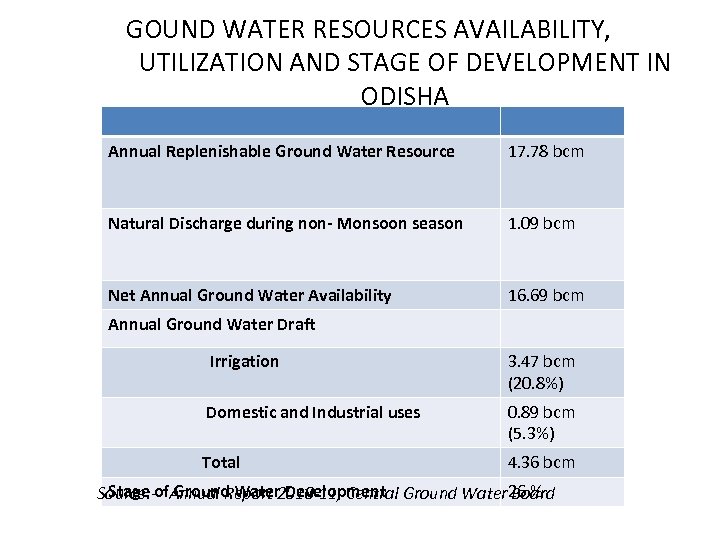
GOUND WATER RESOURCES AVAILABILITY, UTILIZATION AND STAGE OF DEVELOPMENT IN ODISHA Annual Replenishable Ground Water Resource 17. 78 bcm Natural Discharge during non- Monsoon season 1. 09 bcm Net Annual Ground Water Availability 16. 69 bcm Annual Ground Water Draft Irrigation 3. 47 bcm (20. 8%) Domestic and Industrial uses 0. 89 bcm (5. 3%) Total 4. 36 bcm Stage Ground Water Development Source: -of. Annual Report 2010 -11, Central Ground Water 26 % Board
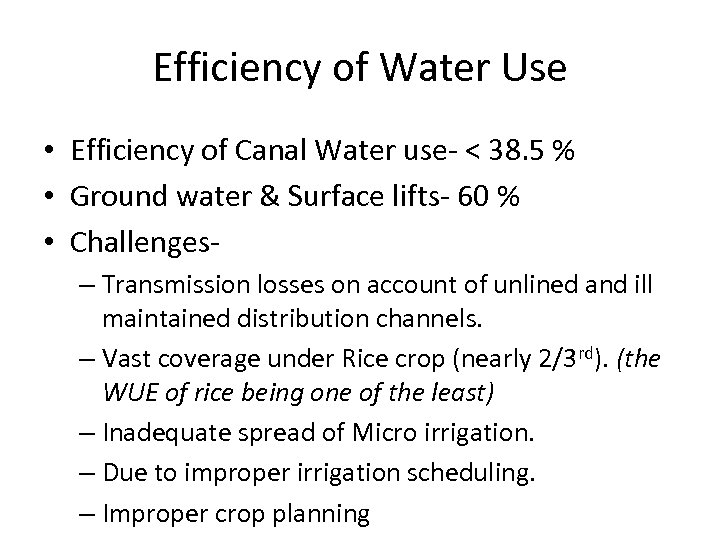
Efficiency of Water Use • Efficiency of Canal Water use- < 38. 5 % • Ground water & Surface lifts- 60 % • Challenges– Transmission losses on account of unlined and ill maintained distribution channels. – Vast coverage under Rice crop (nearly 2/3 rd). (the WUE of rice being one of the least) – Inadequate spread of Micro irrigation. – Due to improper irrigation scheduling. – Improper crop planning
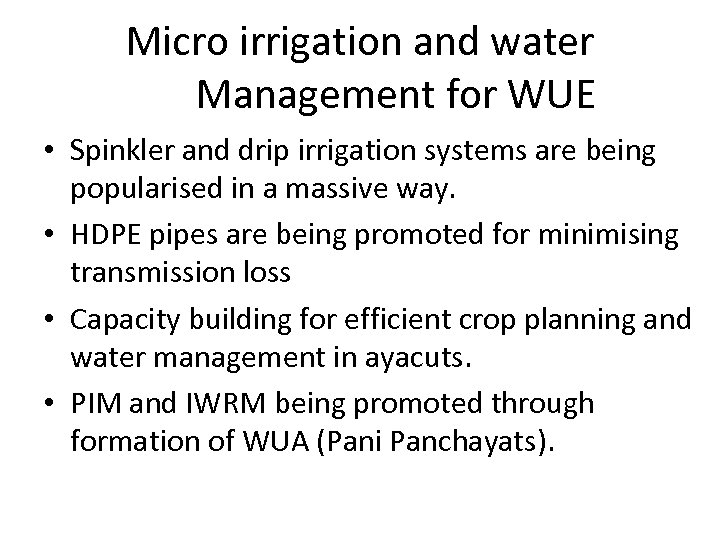
Micro irrigation and water Management for WUE • Spinkler and drip irrigation systems are being popularised in a massive way. • HDPE pipes are being promoted for minimising transmission loss • Capacity building for efficient crop planning and water management in ayacuts. • PIM and IWRM being promoted through formation of WUA (Pani Panchayats).
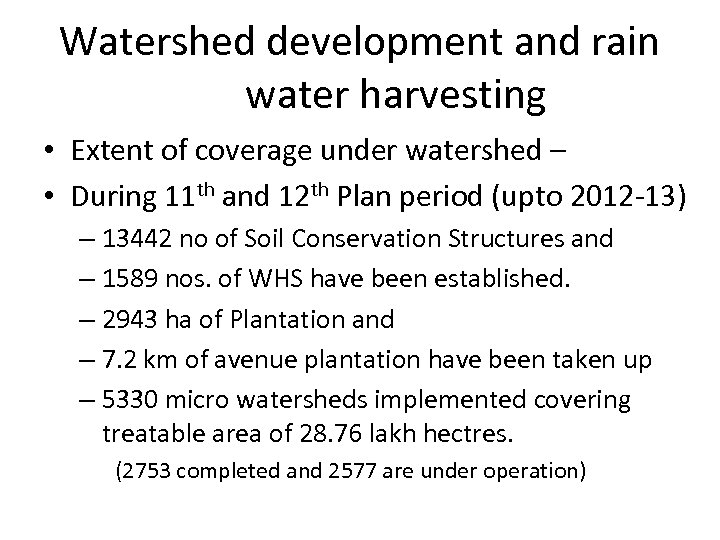
Watershed development and rain water harvesting • Extent of coverage under watershed – • During 11 th and 12 th Plan period (upto 2012 -13) – 13442 no of Soil Conservation Structures and – 1589 nos. of WHS have been established. – 2943 ha of Plantation and – 7. 2 km of avenue plantation have been taken up – 5330 micro watersheds implemented covering treatable area of 28. 76 lakh hectres. (2753 completed and 2577 are under operation)
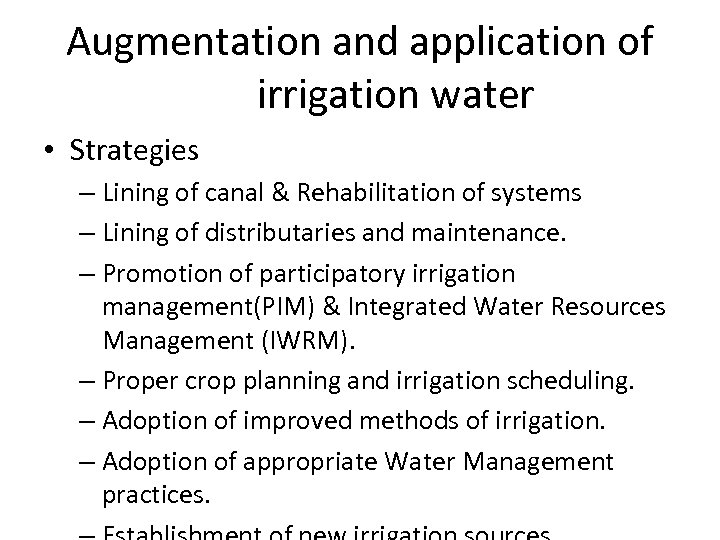
Augmentation and application of irrigation water • Strategies – Lining of canal & Rehabilitation of systems – Lining of distributaries and maintenance. – Promotion of participatory irrigation management(PIM) & Integrated Water Resources Management (IWRM). – Proper crop planning and irrigation scheduling. – Adoption of improved methods of irrigation. – Adoption of appropriate Water Management practices.
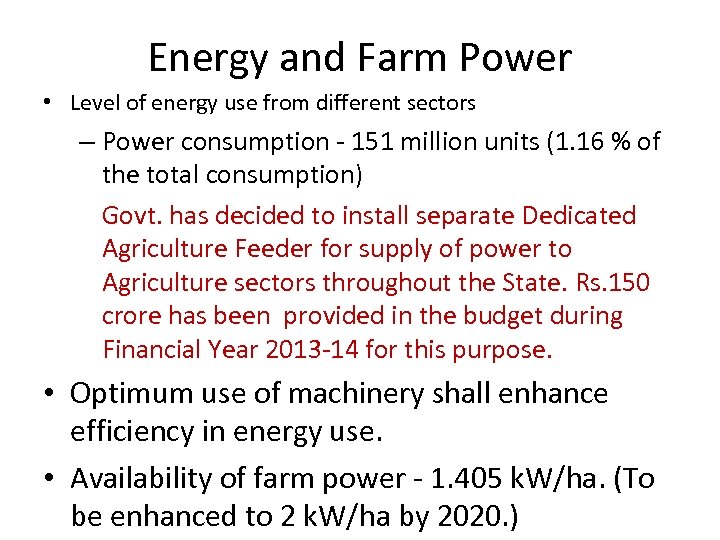
Energy and Farm Power • Level of energy use from different sectors – Power consumption - 151 million units (1. 16 % of the total consumption) Govt. has decided to install separate Dedicated Agriculture Feeder for supply of power to Agriculture sectors throughout the State. Rs. 150 crore has been provided in the budget during Financial Year 2013 -14 for this purpose. • Optimum use of machinery shall enhance efficiency in energy use. • Availability of farm power - 1. 405 k. W/ha. (To be enhanced to 2 k. W/ha by 2020. )
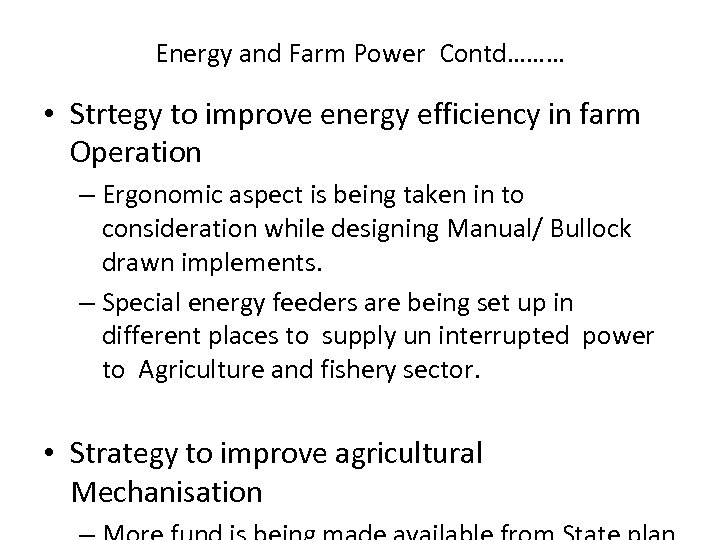
Energy and Farm Power Contd……… • Strtegy to improve energy efficiency in farm Operation – Ergonomic aspect is being taken in to consideration while designing Manual/ Bullock drawn implements. – Special energy feeders are being set up in different places to supply un interrupted power to Agriculture and fishery sector. • Strategy to improve agricultural Mechanisation
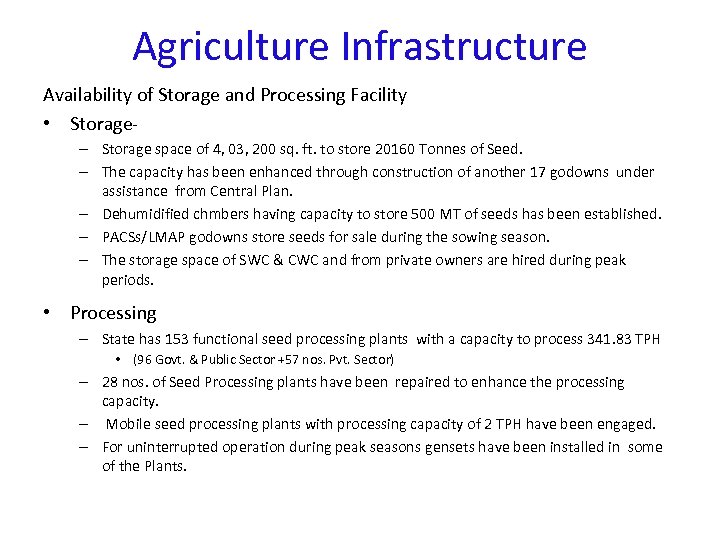
Agriculture Infrastructure Availability of Storage and Processing Facility • Storage– Storage space of 4, 03, 200 sq. ft. to store 20160 Tonnes of Seed. – The capacity has been enhanced through construction of another 17 godowns under assistance from Central Plan. – Dehumidified chmbers having capacity to store 500 MT of seeds has been established. – PACSs/LMAP godowns store seeds for sale during the sowing season. – The storage space of SWC & CWC and from private owners are hired during peak periods. • Processing – State has 153 functional seed processing plants with a capacity to process 341. 83 TPH • (96 Govt. & Public Sector +57 nos. Pvt. Sector) – 28 nos. of Seed Processing plants have been repaired to enhance the processing capacity. – Mobile seed processing plants with processing capacity of 2 TPH have been engaged. – For uninterrupted operation during peak seasons gensets have been installed in some of the Plants.
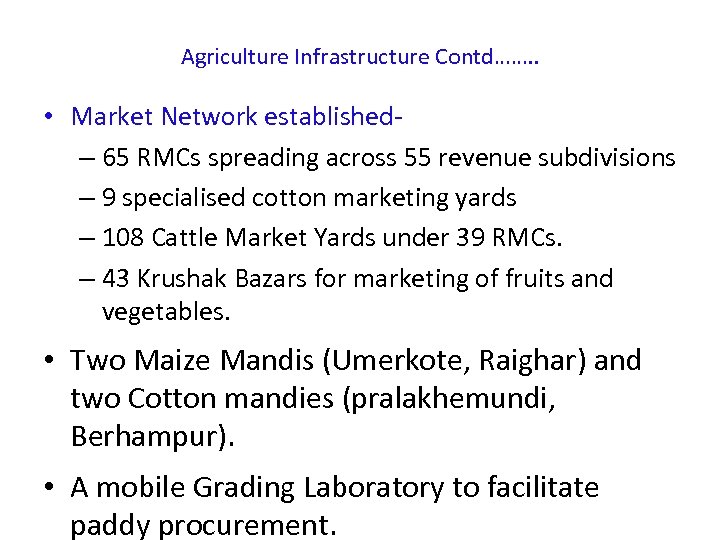
Agriculture Infrastructure Contd……. . • Market Network established– 65 RMCs spreading across 55 revenue subdivisions – 9 specialised cotton marketing yards – 108 Cattle Market Yards under 39 RMCs. – 43 Krushak Bazars for marketing of fruits and vegetables. • Two Maize Mandis (Umerkote, Raighar) and two Cotton mandies (pralakhemundi, Berhampur). • A mobile Grading Laboratory to facilitate paddy procurement.
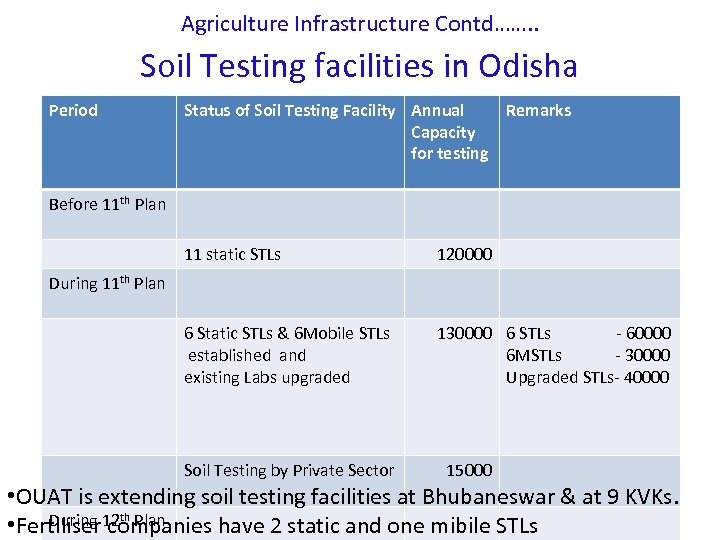
Agriculture Infrastructure Contd……. . Soil Testing facilities in Odisha Period Status of Soil Testing Facility Annual Remarks Capacity for testing Before 11 th Plan 11 static STLs 120000 6 Static STLs & 6 Mobile STLs established and existing Labs upgraded 130000 6 STLs - 60000 6 MSTLs - 30000 Upgraded STLs- 40000 During 11 th Plan Soil Testing by Private Sector 15000 • OUAT is extending soil testing facilities at Bhubaneswar & at 9 KVKs. During companies have 2 static and one mibile STLs • Fertiliser 12 th Plan
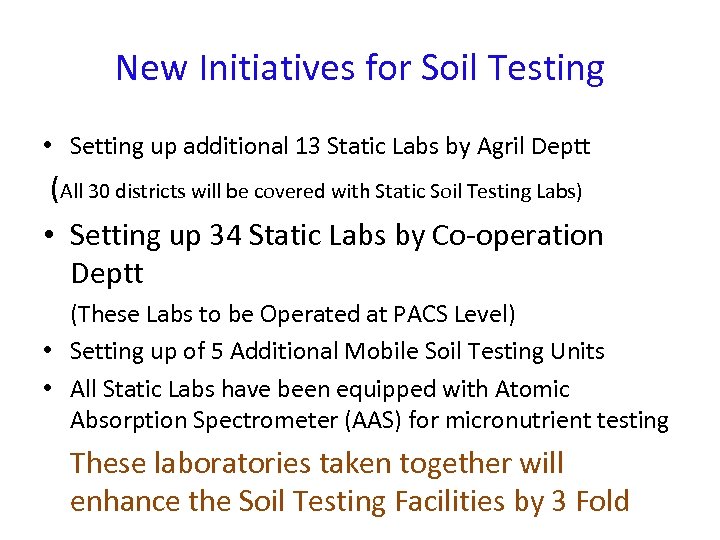
New Initiatives for Soil Testing • Setting up additional 13 Static Labs by Agril Deptt (All 30 districts will be covered with Static Soil Testing Labs) • Setting up 34 Static Labs by Co-operation Deptt (These Labs to be Operated at PACS Level) • Setting up of 5 Additional Mobile Soil Testing Units • All Static Labs have been equipped with Atomic Absorption Spectrometer (AAS) for micronutrient testing These laboratories taken together will enhance the Soil Testing Facilities by 3 Fold
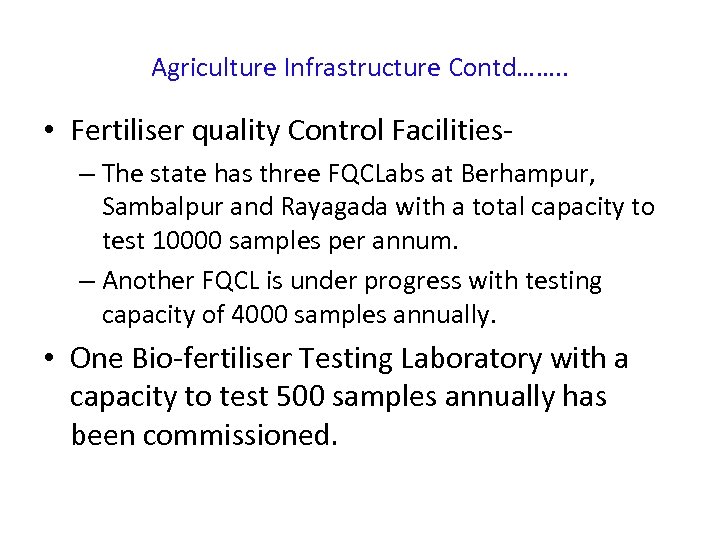
Agriculture Infrastructure Contd……. . • Fertiliser quality Control Facilities– The state has three FQCLabs at Berhampur, Sambalpur and Rayagada with a total capacity to test 10000 samples per annum. – Another FQCL is under progress with testing capacity of 4000 samples annually. • One Bio-fertiliser Testing Laboratory with a capacity to test 500 samples annually has been commissioned.
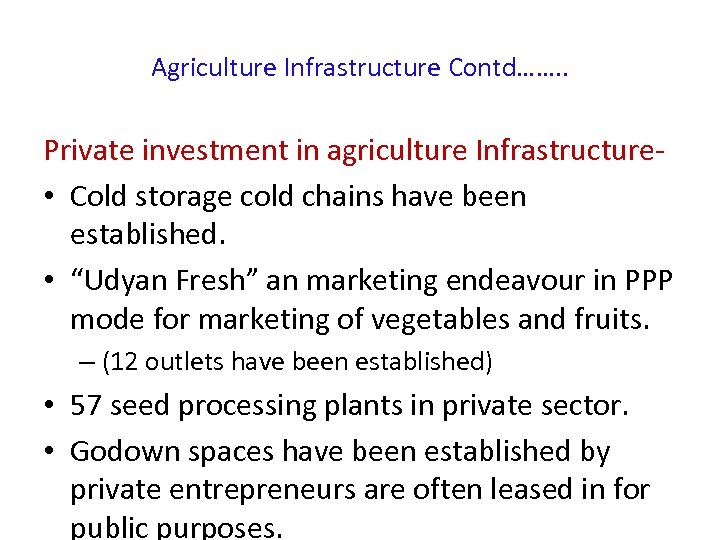
Agriculture Infrastructure Contd……. . Private investment in agriculture Infrastructure • Cold storage cold chains have been established. • “Udyan Fresh” an marketing endeavour in PPP mode for marketing of vegetables and fruits. – (12 outlets have been established) • 57 seed processing plants in private sector. • Godown spaces have been established by private entrepreneurs are often leased in for public purposes.
Agriculture Infrastructure Contd……. . • Facilities for providing inputs to farmers. • Inputs godowns are spread across the state up to block level for storing agri-inputs. – Seed Godowns, Godowns in the FIAC buildings • PACSs /LAMPs godowns are also utilised for storing agri-iputs
Agriculture Infrastructure Contd……. . Scope and opprtunities to improve • Godowns need to be established at GP level to house agri inputs to facilitate availability at the farmers’ door step. • More of assistance to be provided for establishment of dehumidified storages.
Agro advisory network • OUAT is the first SAU in the country to launch Agro-Met website since 2001. • Research and Development Organisations – OUAT (SAU), Bhubaneswar – CRRI (Central Rice Research Institute), Cuttack – CIFA (Central Institute for Freshwater Aquaculture), Bhubaneswar – CTCRI (Central Tuber Crop Research Institute), Bhubaneswar – Do. WM (Directorate of Water Management),
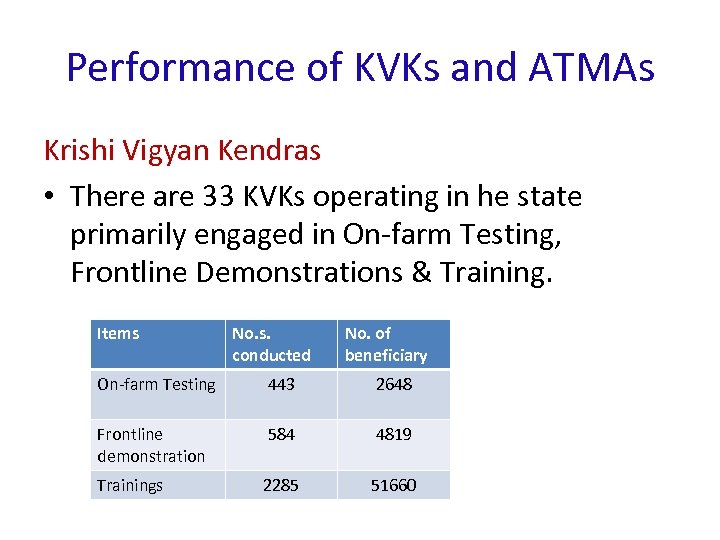
Performance of KVKs and ATMAs Krishi Vigyan Kendras • There are 33 KVKs operating in he state primarily engaged in On-farm Testing, Frontline Demonstrations & Training. Items No. s. conducted No. of beneficiary On-farm Testing 443 2648 Frontline demonstration 584 4819 Trainings 2285 51660
Performance of ATMA • In all the 314 blocks Block Technology Teams and Farmers’ Advisory Committee have been formed. • 314 Block Technology Manager (BTM) & 628 Block Level Technical Assistants (BLTA) have been engaged. • 12468 Farmer Friends @ 2/per GP have been identified. • During 2013 -14 – 10000 acres with proper marketing tie-up. – Promoting HYV scented rice (Kudrat & Pravat)
Extent of services of Research & extension agencies used in Agriculture Development • KVKs act as a member both in ATMA Governing Board & ATMA management Committee • One of the Subject Matter Specialists of KVK acts as DPD (technical) of ATMA. • KVKs also provides technical support to various flagship programmes being implemented. • Res. -Extension-Farmer linkage is being strengthened through various programmes.
Extent of information on improved input and technology shared to the farming community. • Disemination of such information is being done through – various mass media, – providing quality input and input assistance, – conducting demonstrations and trials, – organising Farmer Field schools, Farmers’ Training, Exposure visits and other capacity building programmes. – Incentivising technology adoptions and farmers’ recognition
Scope for improving information and technology disemination • A lot of technology having potential to improve the pace of development in agriculture still remains unexploited. • Development in agriculture has become very competitive in the post globalisation era. • Technology need to be constantly upgraded and transfered for results as continuous process. • Interactive portals/infromation kiosks need to be established.
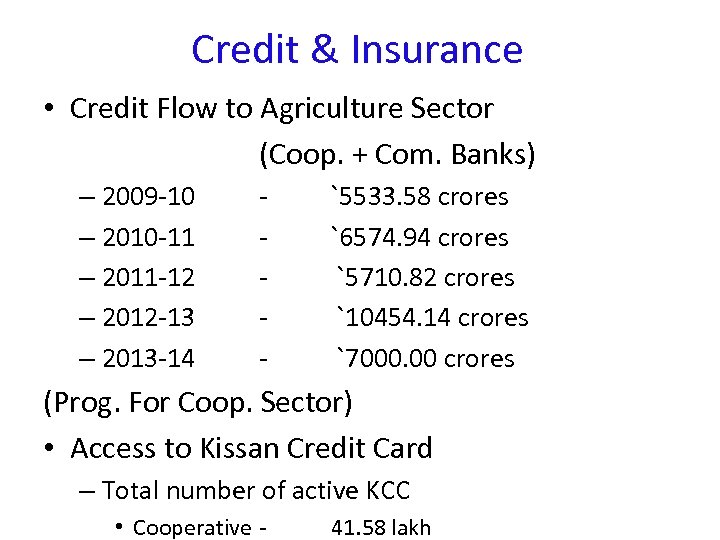
Credit & Insurance • Credit Flow to Agriculture Sector (Coop. + Com. Banks) – 2009 -10 – 2010 -11 – 2011 -12 – 2012 -13 – 2013 -14 - `5533. 58 crores `6574. 94 crores `5710. 82 crores `10454. 14 crores `7000. 00 crores (Prog. For Coop. Sector) • Access to Kissan Credit Card – Total number of active KCC • Cooperative - 41. 58 lakh
Scope and opportunities to improve credit flows to small and marginal farmers • The small and marginal farmers are being extended interest subvention. (3% subsidy on interest for timely repayment) • The scale of finance being revised suitably. • Self help groups of tennant farmers or oral lesees are being extended crop loans • Co-op. credit structure is being revamped. • Universal coverage by Kissan Credit Cards to ensure flexibility in lending norms.
Human Resource • Availability of human resource is adequate • The PRIs respond well and are well aquainted with Agriculture sector Programmes. • They are involved from planning level to implementation. • Training Institutes–Institute of Management on Extension (IMAGE) – 3 Regional Institute of Training on Extension – 3 Training Institutes of Horticulture –Minor Irrigation and Water use Training Institute –Water and Land Management Training Institute

Thank You
Скачать презентацию Strategies for Resource Management for better input use
e2ba743354e73fe344ec0ec6f193bd5f.ppt