 Скачать презентацию Strategies for Implementing Antimicrobial Stewardship Guidelines Ann Biehl
eab6debe531014b455267467f510c928.ppt
- Количество слайдов: 90



Strategies for Implementing Antimicrobial Stewardship Guidelines Ann Biehl, M. S. , Pharm. D. abiehl@mcleodhealth. org PGY 1 Pharmacy Resident Mc. Leod Regional Medical Center Florence, South Carolina Society of Health-System Pharmacists Spring Symposium 2008 Myrtle Beach, South Carolina
Objectives • Identify current antimicrobial practice guidelines • Discuss strategies for complying with practice standards
Antimicrobial Resistance: a growing problem • In 2004, approximately 2 million people experienced a hospital-acquired infection • 90, 000 of these infections were fatal • 1 death every six minutes Dellit TH. Clin Infect Dis 2007 Jan 15; 44(2): 159
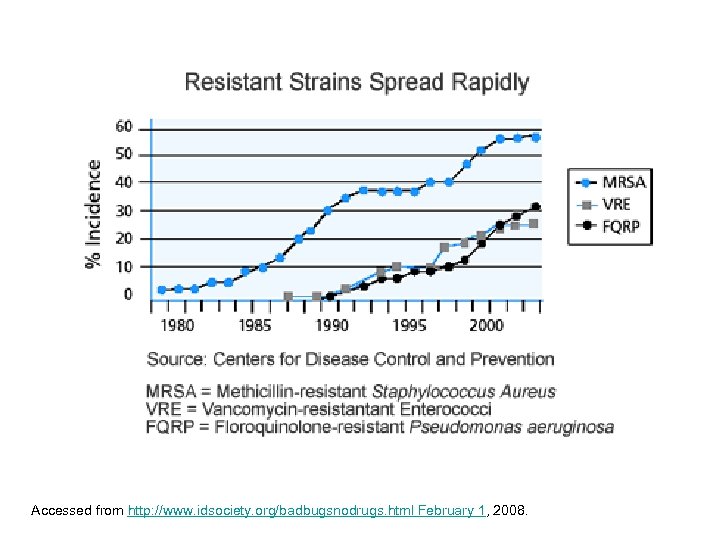
Accessed from http: //www. idsociety. org/badbugsnodrugs. html February 1, 2008.

Infectious Diseases Society of America Superbug Hit List • Methicillin-resistant Staphylococcus aureus • Vancomycin-resistant Enterococcus faecium (VRE) • Escherichia coli • Klebsiella species • Pseudomonas aeruginosa • Acinetobacter baumannii Accessed from http: //www. idsociety. org/badbugsnodrugs. html, February 20, 2008
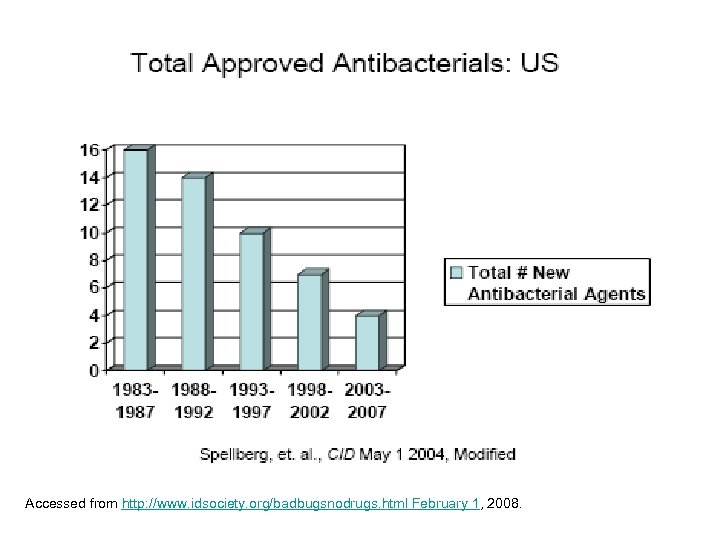
Accessed from http: //www. idsociety. org/badbugsnodrugs. html February 1, 2008.
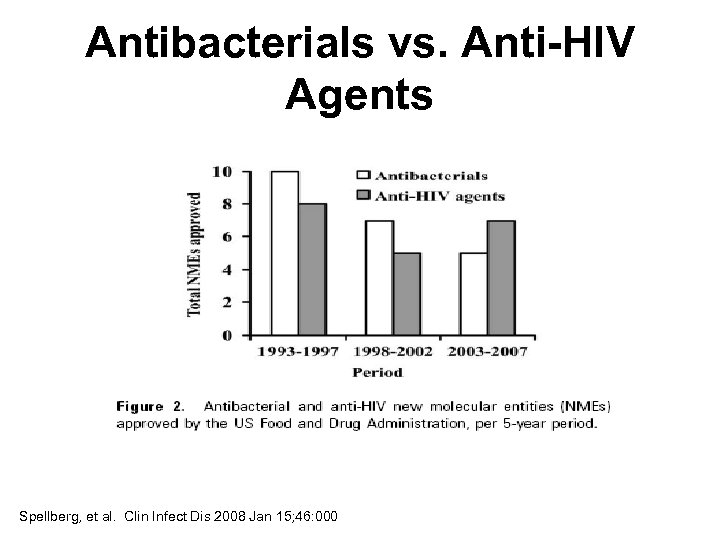
Antibacterials vs. Anti-HIV Agents Spellberg, et al. Clin Infect Dis 2008 Jan 15; 46: 000
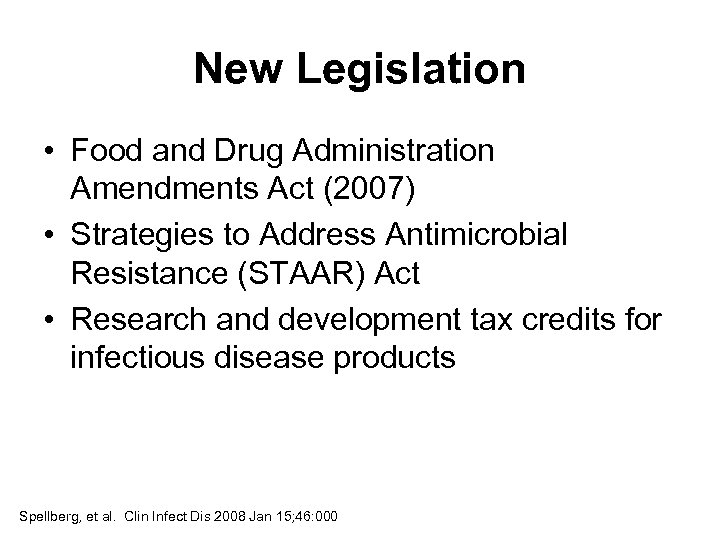
New Legislation • Food and Drug Administration Amendments Act (2007) • Strategies to Address Antimicrobial Resistance (STAAR) Act • Research and development tax credits for infectious disease products Spellberg, et al. Clin Infect Dis 2008 Jan 15; 46: 000

Health care professionals are already playing with antimicrobials
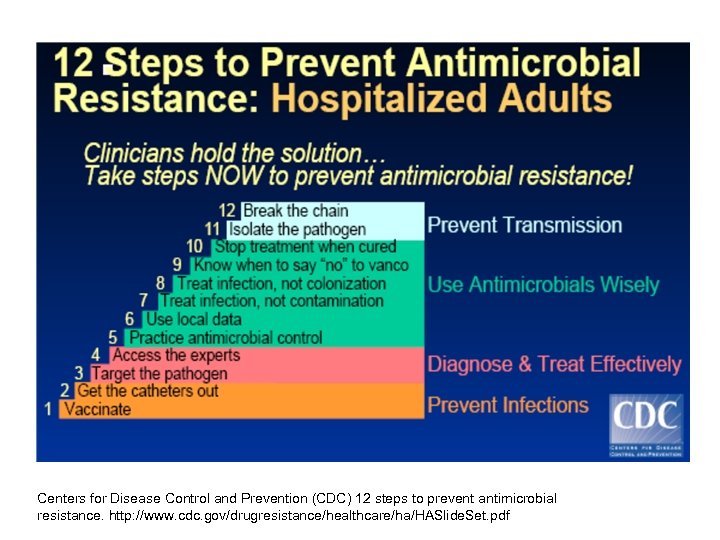
Centers for Disease Control and Prevention (CDC) 12 steps to prevent antimicrobial resistance. http: //www. cdc. gov/drugresistance/healthcare/ha/HASlide. Set. pdf
The answer: This activity can result in the best clinical outcome for the treatment OR prevention of infection with minimal toxicity and minimal impact on subsequent resistance.

What is: Antimicrobial Stewardship
Antimicrobial Stewardship Defined: the optimal selection, dosage, route and duration of antimicrobial treatment. Dellit TH. Clin Infect Dis 2007 Jan 15; 44(2): 159
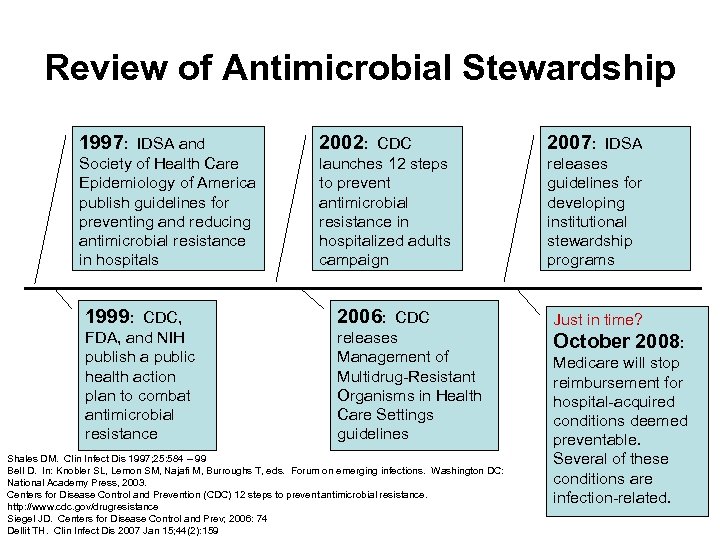
Review of Antimicrobial Stewardship 1997: IDSA and 2002: CDC 2007: IDSA Society of Health Care Epidemiology of America publish guidelines for preventing and reducing antimicrobial resistance in hospitals launches 12 steps to prevent antimicrobial resistance in hospitalized adults campaign releases guidelines for developing institutional stewardship programs 1999: CDC, 2006: CDC Just in time? FDA, and NIH publish a public health action plan to combat antimicrobial resistance releases Management of Multidrug-Resistant Organisms in Health Care Settings guidelines October 2008: Shales DM. Clin Infect Dis 1997; 25: 584 – 99 Bell D. In: Knobler SL, Lemon SM, Najafi M, Burroughs T, eds. Forum on emerging infections. Washington DC: National Academy Press, 2003. Centers for Disease Control and Prevention (CDC) 12 steps to prevent antimicrobial resistance. http: //www. cdc. gov/drugresistance Siegel JD. Centers for Disease Control and Prev; 2006: 74 Dellit TH. Clin Infect Dis 2007 Jan 15; 44(2): 159 Medicare will stop reimbursement for hospital-acquired conditions deemed preventable. Several of these conditions are infection-related.
Antimicrobial Stewardship • Primary Goal: to optimize clinical outcomes while minimizing unintended consequences of antimicrobial use – Consequences • Toxicity • Selection of pathogenic organisms • Emergence of resistant pathogens • Secondary goal: to reduce health care costs without adversely affecting the quality of care Dellit TH. Clin Infect Dis 2007 Jan 15; 44(2): 159

Aspects of antimicrobial stewardship applied… Vancomycin resistant E faecium. Downloaded from http: //www. buddycom. com/bacteria/gpc/Efa ecium. jpg December 17, 2007.
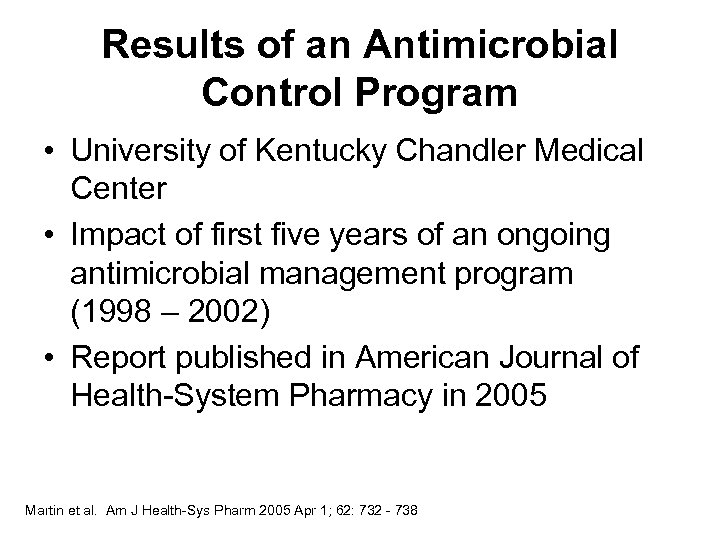
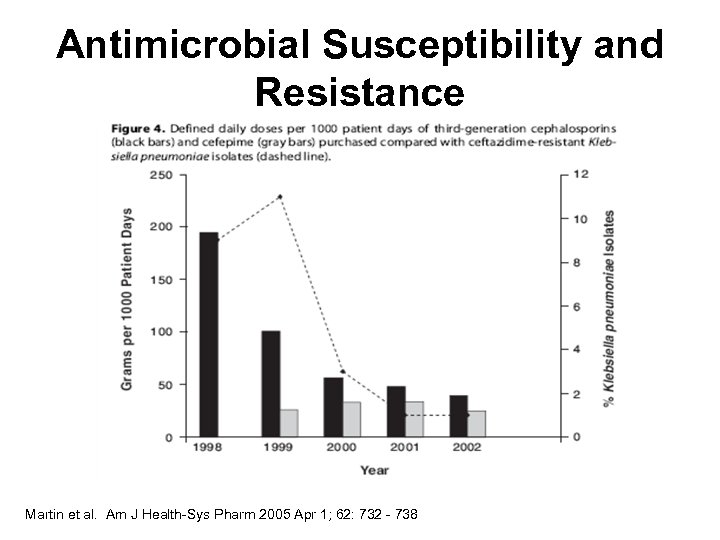
Results of an Antimicrobial Control Program • University of Kentucky Chandler Medical Center • Impact of first five years of an ongoing antimicrobial management program (1998 – 2002) • Report published in American Journal of Health-System Pharmacy in 2005 Martin et al. Am J Health-Sys Pharm 2005 Apr 1; 62: 732 - 738
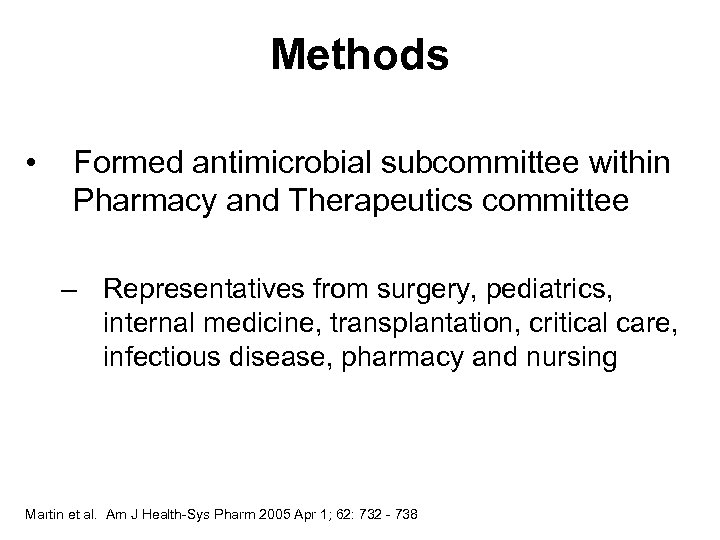
Methods • Formed antimicrobial subcommittee within Pharmacy and Therapeutics committee – Representatives from surgery, pediatrics, internal medicine, transplantation, critical care, infectious disease, pharmacy and nursing Martin et al. Am J Health-Sys Pharm 2005 Apr 1; 62: 732 - 738
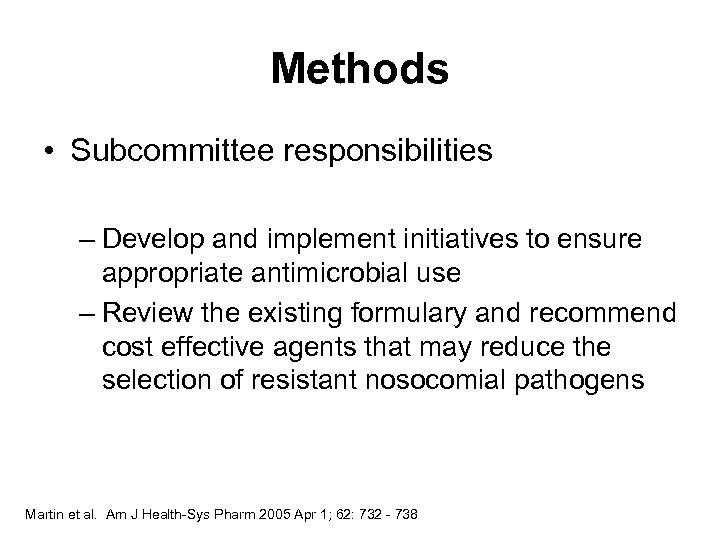
Methods • Subcommittee responsibilities – Develop and implement initiatives to ensure appropriate antimicrobial use – Review the existing formulary and recommend cost effective agents that may reduce the selection of resistant nosocomial pathogens Martin et al. Am J Health-Sys Pharm 2005 Apr 1; 62: 732 - 738
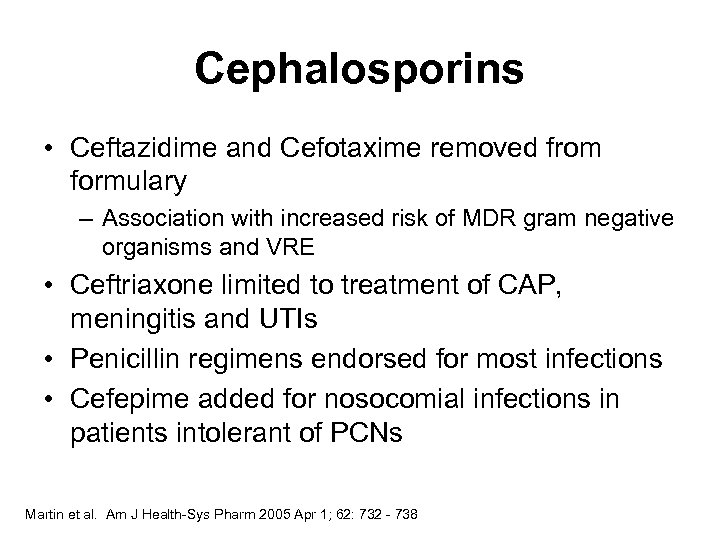
Cephalosporins • Ceftazidime and Cefotaxime removed from formulary – Association with increased risk of MDR gram negative organisms and VRE • Ceftriaxone limited to treatment of CAP, meningitis and UTIs • Penicillin regimens endorsed for most infections • Cefepime added for nosocomial infections in patients intolerant of PCNs Martin et al. Am J Health-Sys Pharm 2005 Apr 1; 62: 732 - 738
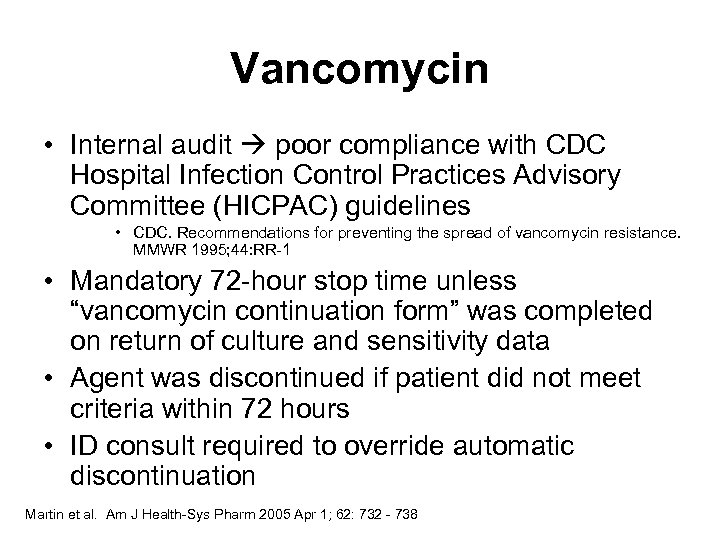
Vancomycin • Internal audit poor compliance with CDC Hospital Infection Control Practices Advisory Committee (HICPAC) guidelines • CDC. Recommendations for preventing the spread of vancomycin resistance. MMWR 1995; 44: RR-1 • Mandatory 72 -hour stop time unless “vancomycin continuation form” was completed on return of culture and sensitivity data • Agent was discontinued if patient did not meet criteria within 72 hours • ID consult required to override automatic discontinuation Martin et al. Am J Health-Sys Pharm 2005 Apr 1; 62: 732 - 738
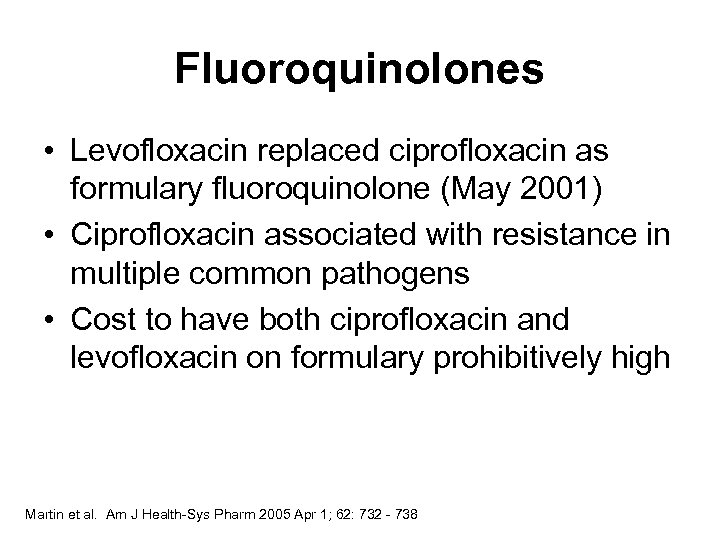
Fluoroquinolones • Levofloxacin replaced ciprofloxacin as formulary fluoroquinolone (May 2001) • Ciprofloxacin associated with resistance in multiple common pathogens • Cost to have both ciprofloxacin and levofloxacin on formulary prohibitively high Martin et al. Am J Health-Sys Pharm 2005 Apr 1; 62: 732 - 738
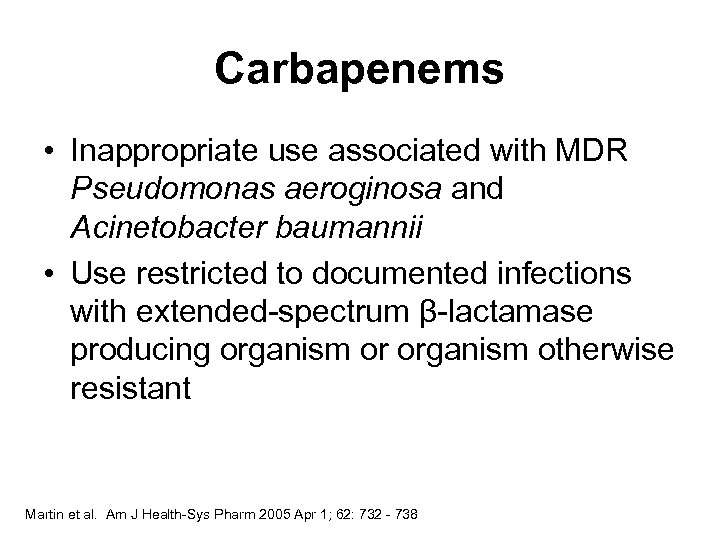
Carbapenems • Inappropriate use associated with MDR Pseudomonas aeroginosa and Acinetobacter baumannii • Use restricted to documented infections with extended-spectrum β-lactamase producing organism or organism otherwise resistant Martin et al. Am J Health-Sys Pharm 2005 Apr 1; 62: 732 - 738
Amphotericin B formulations • All lipid formulations restricted • ID approval required before use Martin et al. Am J Health-Sys Pharm 2005 Apr 1; 62: 732 - 738
Monitoring • Susceptibility rates of key pathogens reported on quarterly by clinical microbiology laboratory • Antimicrobial expenditures reported on quarterly by the pharmacy financial officer – Compared with baseline (1998) and adjusted for inflation of drug acquisition costs – Purchases also monitored by defined daily doses/1000 patient days Martin et al. Am J Health-Sys Pharm 2005 Apr 1; 62: 732 - 738
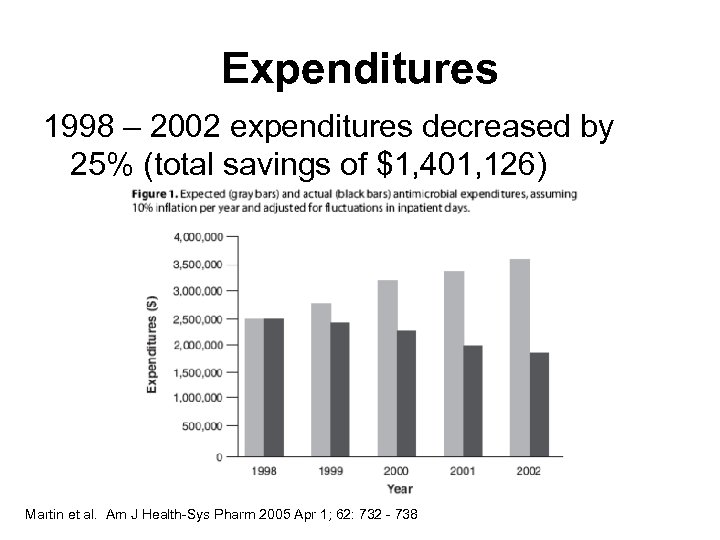
Expenditures 1998 – 2002 expenditures decreased by 25% (total savings of $1, 401, 126) Martin et al. Am J Health-Sys Pharm 2005 Apr 1; 62: 732 - 738
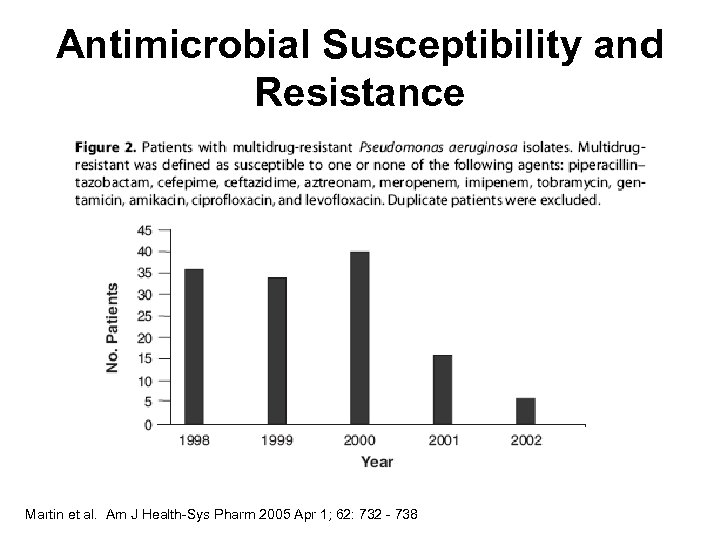
Antimicrobial Susceptibility and Resistance Martin et al. Am J Health-Sys Pharm 2005 Apr 1; 62: 732 - 738
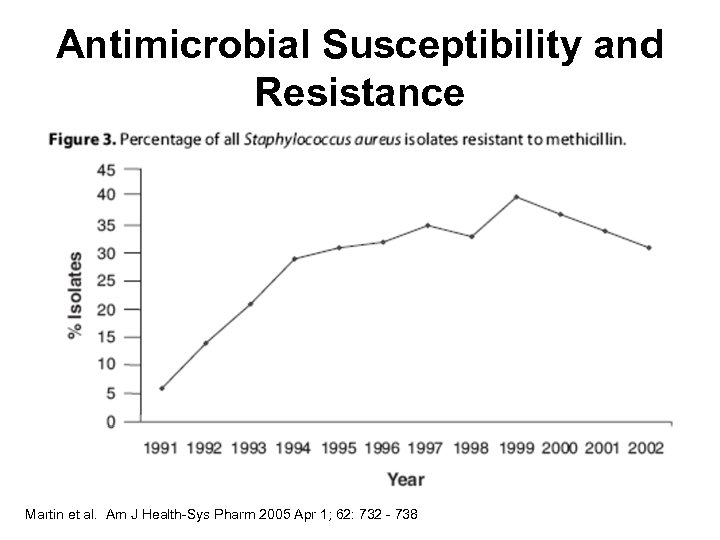
Antimicrobial Susceptibility and Resistance Martin et al. Am J Health-Sys Pharm 2005 Apr 1; 62: 732 - 738
Antimicrobial Susceptibility and Resistance Martin et al. Am J Health-Sys Pharm 2005 Apr 1; 62: 732 - 738
Tools for Success • Multidisciplinary team • Periodic feedback to physicians regarding program’s benefits • Focused goals Martin et al. Am J Health-Sys Pharm 2005 Apr 1; 62: 732 - 738
Centers for Disease Control Guidelines for Multidrug-Resistant Organisms in Healthcare Settings (2006). Siegel JD. Centers for Disease Control and Prev; 2006: 74 Infectious Disease Society of America Guidelines for Developing Institutional Programs to Enhance Antimicrobial Stewardship Dellit TH. Clin Infect Dis 2007 Jan 15; 44(2): 159
Centers for Disease Control Guidelines for Multidrug-Resistant Organisms in Healthcare Settings (2006) • Developed by experts in infection control in conjunction with CDC's Healthcare Infection Control Practices Advisory Committee (HICPAC) • Stresses the causal relationship between antibiotic use and resistance patterns Siegel JD. Centers for Disease Control and Prev; 2006: 74
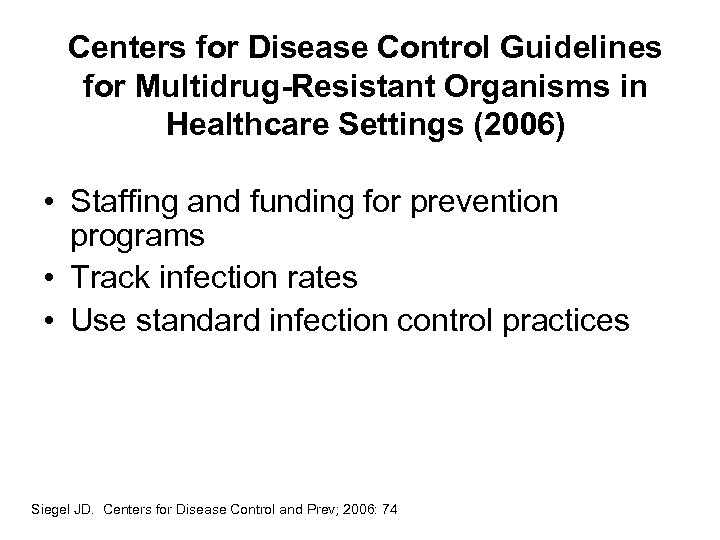
Centers for Disease Control Guidelines for Multidrug-Resistant Organisms in Healthcare Settings (2006) • Staffing and funding for prevention programs • Track infection rates • Use standard infection control practices Siegel JD. Centers for Disease Control and Prev; 2006: 74
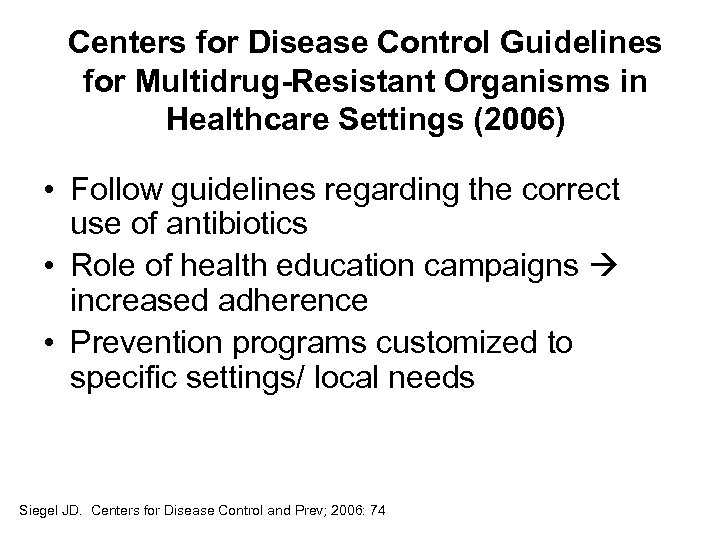
Centers for Disease Control Guidelines for Multidrug-Resistant Organisms in Healthcare Settings (2006) • Follow guidelines regarding the correct use of antibiotics • Role of health education campaigns increased adherence • Prevention programs customized to specific settings/ local needs Siegel JD. Centers for Disease Control and Prev; 2006: 74
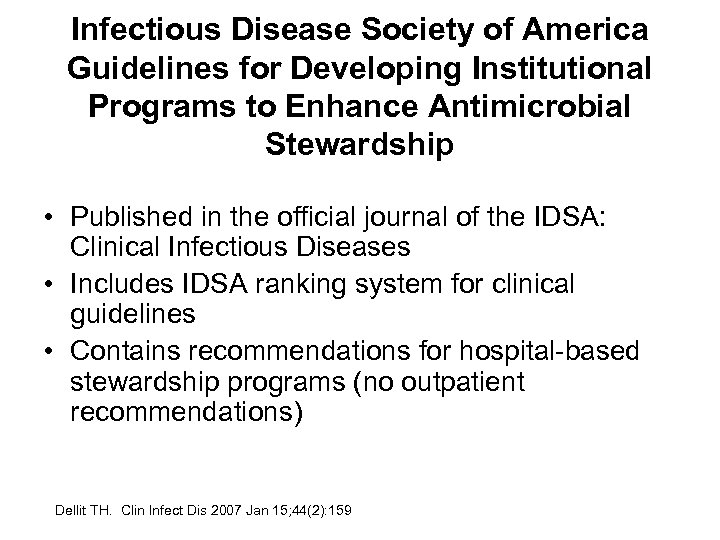
Infectious Disease Society of America Guidelines for Developing Institutional Programs to Enhance Antimicrobial Stewardship • Published in the official journal of the IDSA: Clinical Infectious Diseases • Includes IDSA ranking system for clinical guidelines • Contains recommendations for hospital-based stewardship programs (no outpatient recommendations) Dellit TH. Clin Infect Dis 2007 Jan 15; 44(2): 159
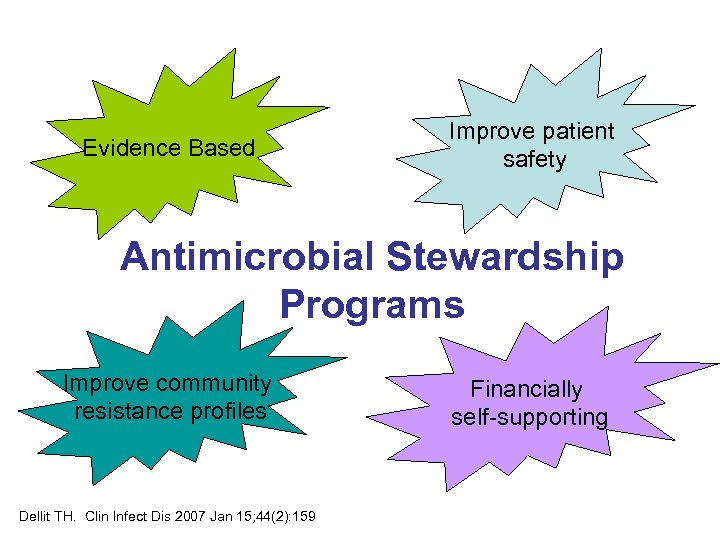
Evidence Based Improve patient safety Antimicrobial Stewardship Programs Improve community resistance profiles Dellit TH. Clin Infect Dis 2007 Jan 15; 44(2): 159 Financially self-supporting
IDSA Guidelines: Elements of a successful stewardship program • Comprehensive program – Active monitoring of resistance – Fostering of appropriate use • Often used as a surrogate marker for impact on resistance – Collaboration of effective infection control to minimize secondary spread of resistance Dellit TH. Clin Infect Dis 2007 Jan 15; 44(2): 159
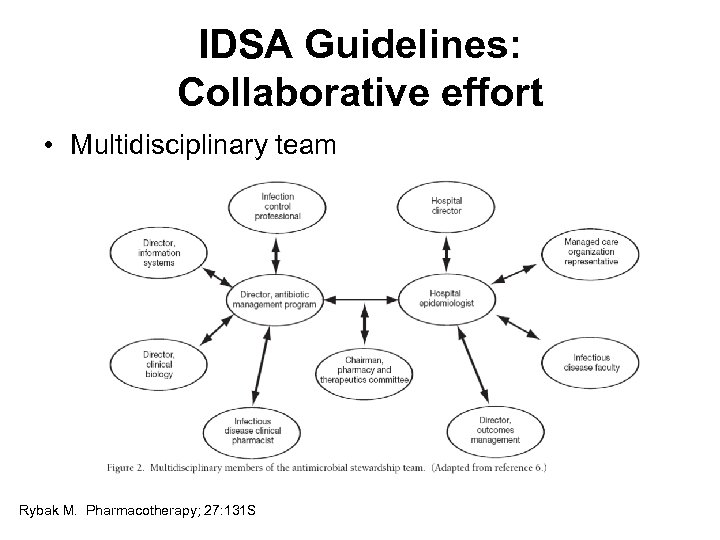
IDSA Guidelines: Collaborative effort • Multidisciplinary team Rybak M. Pharmacotherapy; 27: 131 S
Infectious Disease Pharmacist • Qualifications – Pharm. D. degree – PGY 1 Pharmacy Residency – Additional training in infectious diseases • ID specialty residency preferred – Maintain current knowledge base Dellit TH. Clin Infect Dis 2007 Jan 15; 44(2): 159 Rapp R. 41 st ASHP Midyear Clinical Meeting, 2006.
Infectious Disease Pharmacist • Duties – Provide interventional feedback for antimicrobial therapies – Collaborate with infectious disease physician – Follow clinical outcomes – Provide pharmacokinetic services Dellit TH. Clin Infect Dis 2007 Jan 15; 44(2): 159 Rapp R. 41 st ASHP Midyear Clinical Meeting, 2006
Infectious Disease Pharmacist • Duties, con’t – Educate hospital staff on appropriate antibiotic usage – Precept and mentor pharmacy students, pharmacy practice residents and infectious disease specialty residents – Review antibiogram regularly Dellit TH. Clin Infect Dis 2007 Jan 15; 44(2): 159 Rapp R. 41 st ASHP Midyear Clinical Meeting, 2006
IDSA Guidelines: Key Recommendations • Two proactive core strategies: – Prospective audit with intervention and feedback to prescriber – Formulary restriction and preauthorization Dellit TH. Clin Infect Dis 2007 Jan 15; 44(2): 159
Prospective Audit • ID pharmacist and physician work together • Select drugs and units • Review cases and make recommendations within certain time frame after drug is ordered – Appropriate drug • Bug-drug • Streamlining/de-escalation – Dose – Route Dellit TH. Clin Infect Dis 2007 Jan 15; 44(2): 159
Formulary Restriction and Preauthorization • Stewardship team works closely with Pharmacy and Therapeutics Committee to designate restricted drugs and evidence-based indications • Pager for authorization • Success depends on who is authorizing • Challenges: • May shift resistance to alternative agent • Must monitor trends Dellit TH. Clin Infect Dis 2007 Jan 15; 44(2): 159
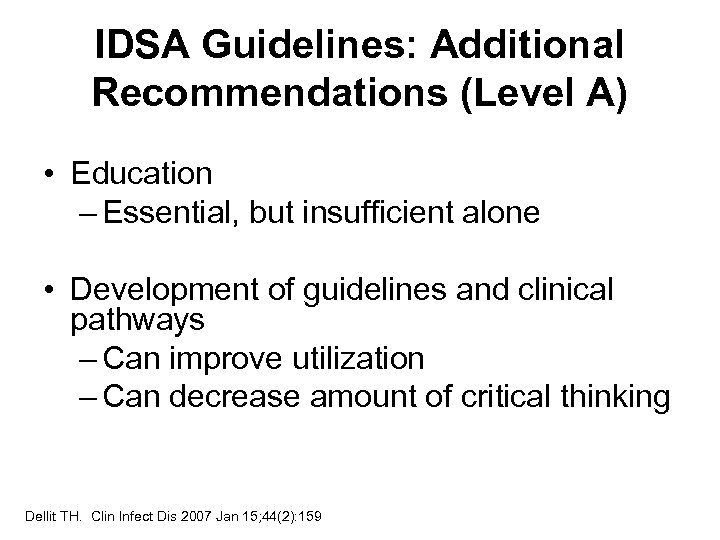
IDSA Guidelines: Additional Recommendations (Level A) • Education – Essential, but insufficient alone • Development of guidelines and clinical pathways – Can improve utilization – Can decrease amount of critical thinking Dellit TH. Clin Infect Dis 2007 Jan 15; 44(2): 159
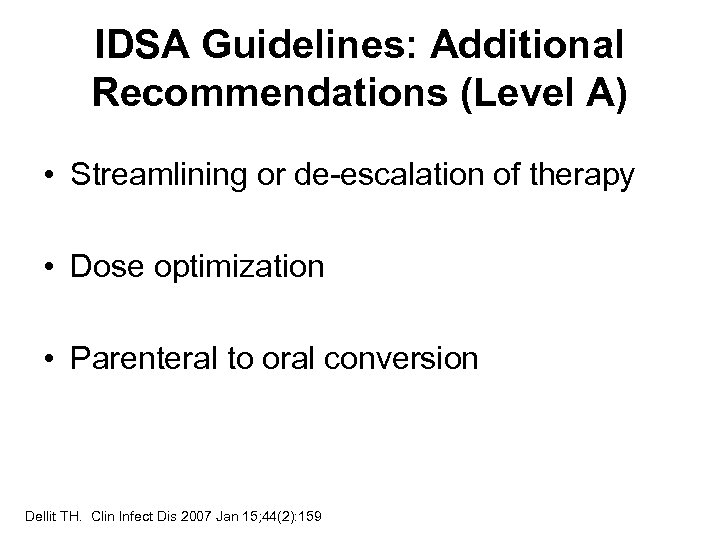
IDSA Guidelines: Additional Recommendations (Level A) • Streamlining or de-escalation of therapy • Dose optimization • Parenteral to oral conversion Dellit TH. Clin Infect Dis 2007 Jan 15; 44(2): 159
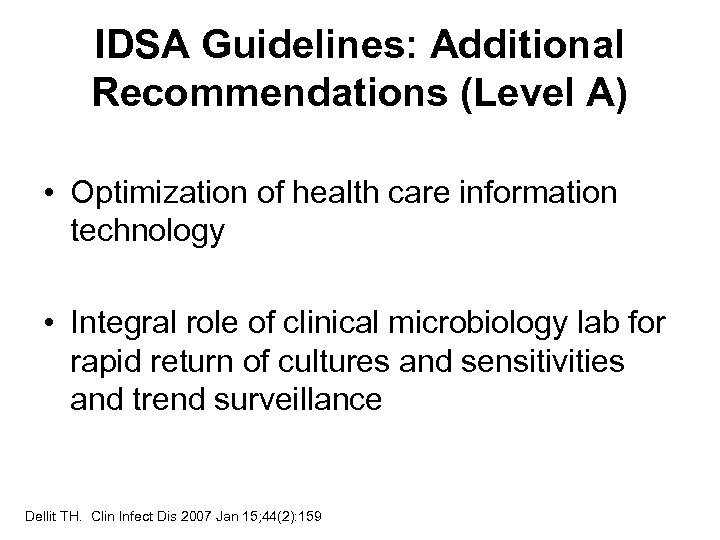
IDSA Guidelines: Additional Recommendations (Level A) • Optimization of health care information technology • Integral role of clinical microbiology lab for rapid return of cultures and sensitivities and trend surveillance Dellit TH. Clin Infect Dis 2007 Jan 15; 44(2): 159
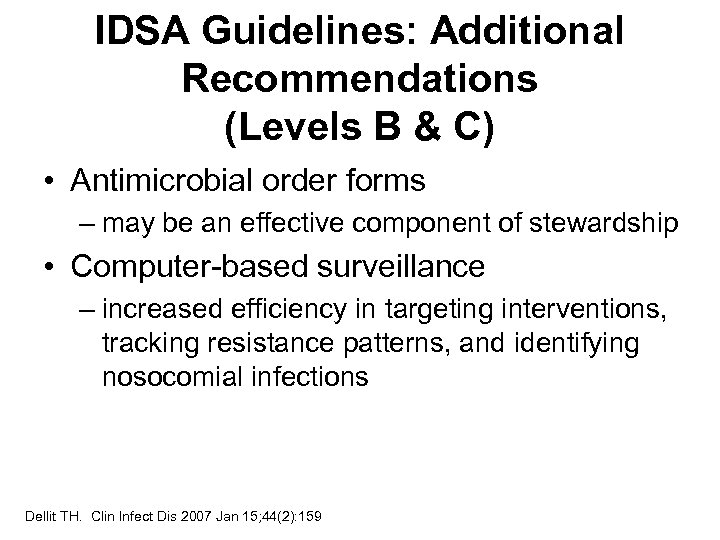
IDSA Guidelines: Additional Recommendations (Levels B & C) • Antimicrobial order forms – may be an effective component of stewardship • Computer-based surveillance – increased efficiency in targeting interventions, tracking resistance patterns, and identifying nosocomial infections Dellit TH. Clin Infect Dis 2007 Jan 15; 44(2): 159
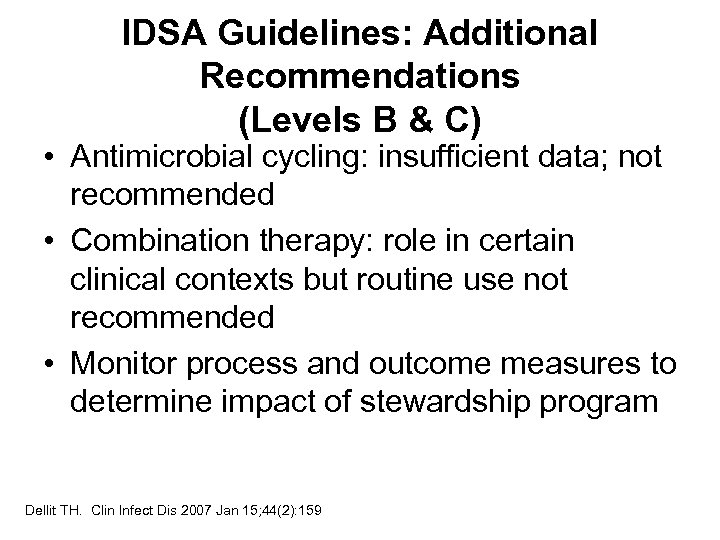
IDSA Guidelines: Additional Recommendations (Levels B & C) • Antimicrobial cycling: insufficient data; not recommended • Combination therapy: role in certain clinical contexts but routine use not recommended • Monitor process and outcome measures to determine impact of stewardship program Dellit TH. Clin Infect Dis 2007 Jan 15; 44(2): 159
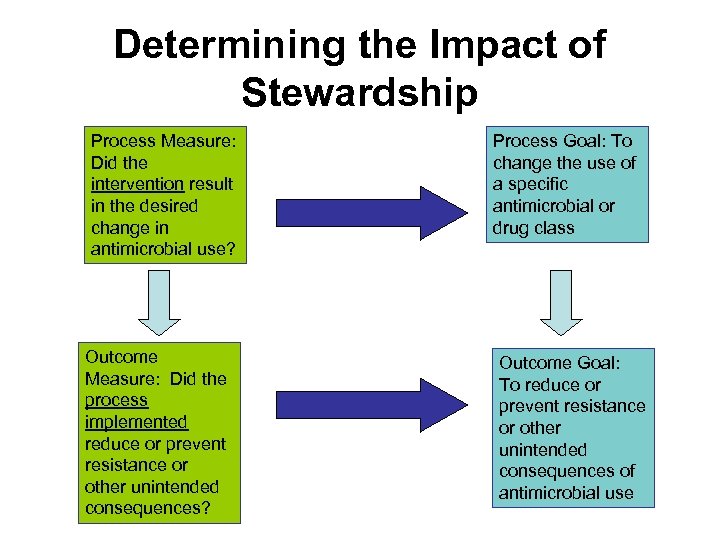
Determining the Impact of Stewardship Process Measure: Did the intervention result in the desired change in antimicrobial use? Outcome Measure: Did the process implemented reduce or prevent resistance or other unintended consequences? Process Goal: To change the use of a specific antimicrobial or drug class Outcome Goal: To reduce or prevent resistance or other unintended consequences of antimicrobial use
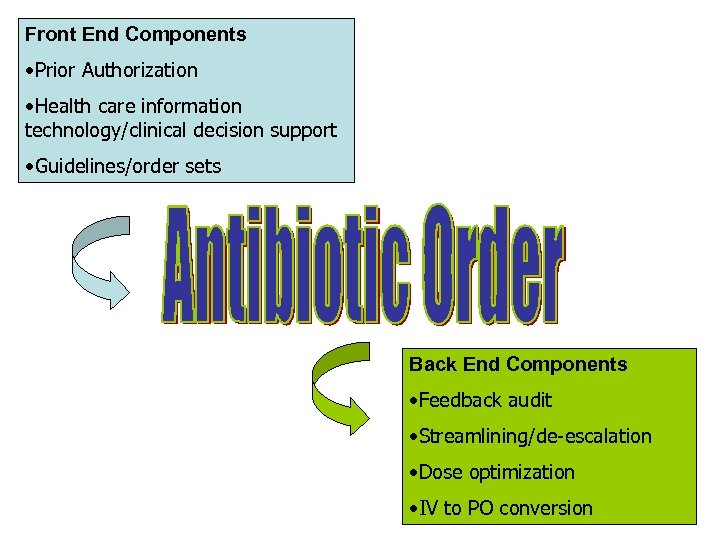
Front End Components • Prior Authorization • Health care information technology/clinical decision support • Guidelines/order sets Back End Components • Feedback audit • Streamlining/de-escalation • Dose optimization • IV to PO conversion
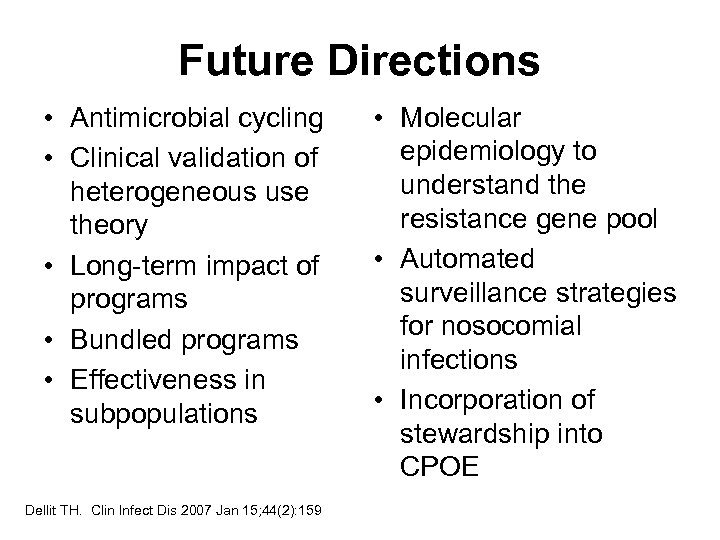
Future Directions • Antimicrobial cycling • Clinical validation of heterogeneous use theory • Long-term impact of programs • Bundled programs • Effectiveness in subpopulations Dellit TH. Clin Infect Dis 2007 Jan 15; 44(2): 159 • Molecular epidemiology to understand the resistance gene pool • Automated surveillance strategies for nosocomial infections • Incorporation of stewardship into CPOE
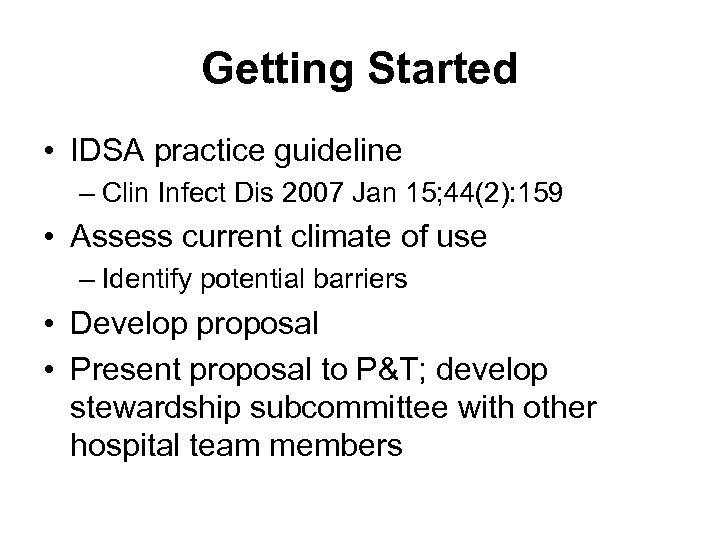
Getting Started • IDSA practice guideline – Clin Infect Dis 2007 Jan 15; 44(2): 159 • Assess current climate of use – Identify potential barriers • Develop proposal • Present proposal to P&T; develop stewardship subcommittee with other hospital team members
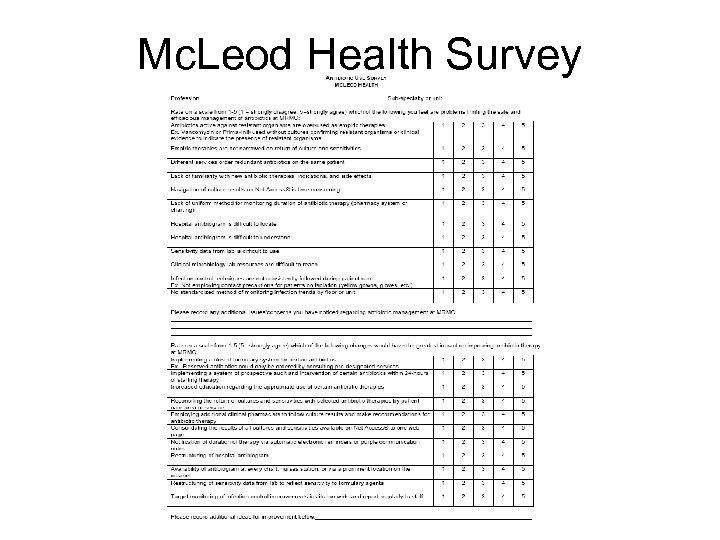
Mc. Leod Health Survey
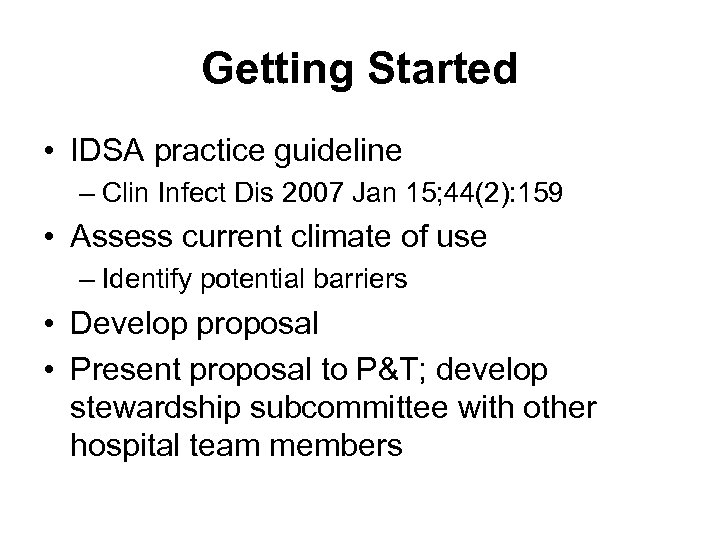
Getting Started • IDSA practice guideline – Clin Infect Dis 2007 Jan 15; 44(2): 159 • Assess current climate of use – Identify potential barriers • Develop proposal • Present proposal to P&T; develop stewardship subcommittee with other hospital team members
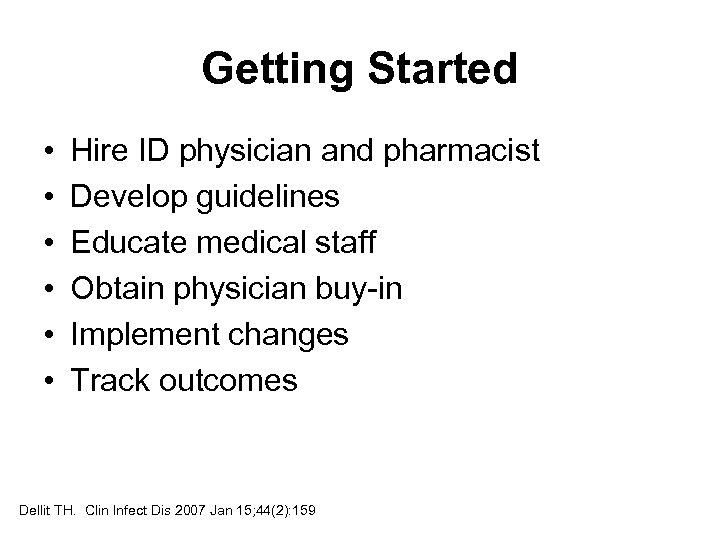
Getting Started • • • Hire ID physician and pharmacist Develop guidelines Educate medical staff Obtain physician buy-in Implement changes Track outcomes Dellit TH. Clin Infect Dis 2007 Jan 15; 44(2): 159
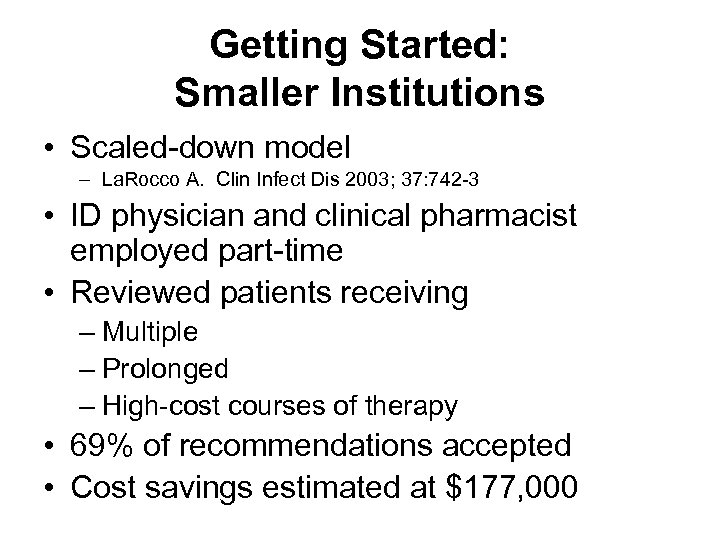
Getting Started: Smaller Institutions • Scaled-down model – La. Rocco A. Clin Infect Dis 2003; 37: 742 -3 • ID physician and clinical pharmacist employed part-time • Reviewed patients receiving – Multiple – Prolonged – High-cost courses of therapy • 69% of recommendations accepted • Cost savings estimated at $177, 000


$100
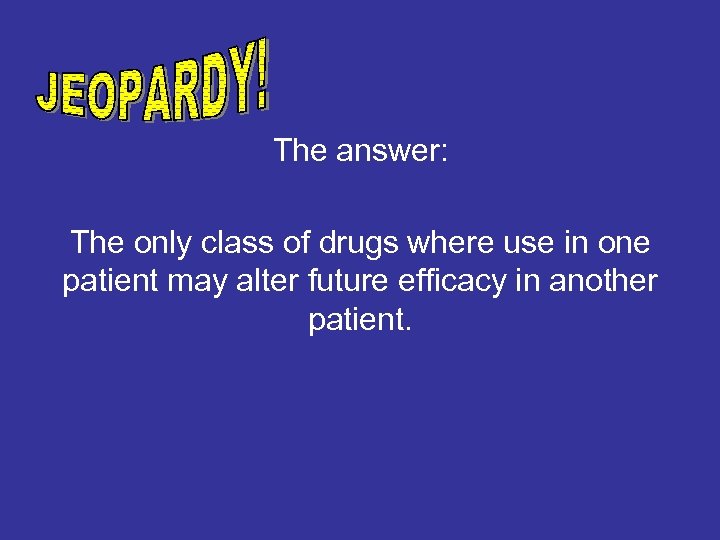
The answer: The only class of drugs where use in one patient may alter future efficacy in another patient.

What are antimicrobials?

$200
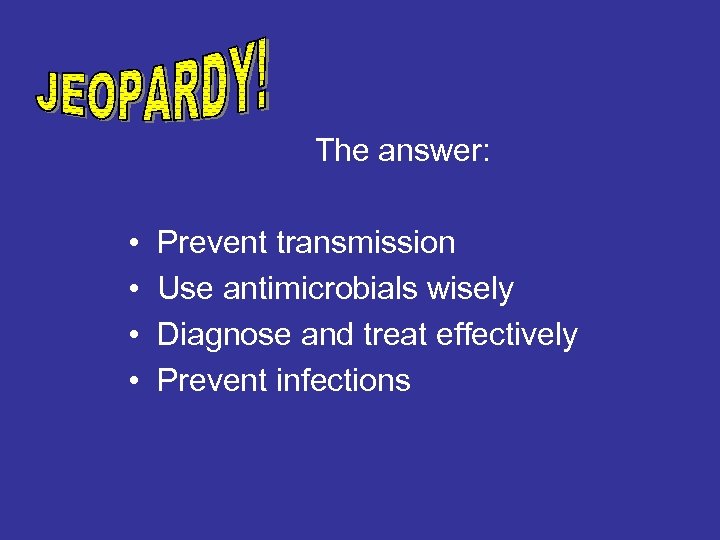
The answer: • Prevent transmission • Use antimicrobials wisely • Diagnose and treat effectively • Prevent infections

What are the major components to the CDC’s 12 steps to reduce antibiotic resistance?

$300
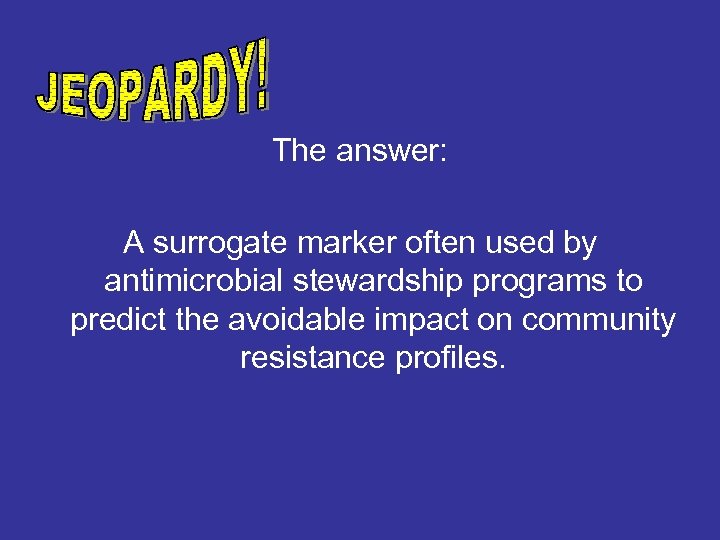
The answer: A surrogate marker often used by antimicrobial stewardship programs to predict the avoidable impact on community resistance profiles.

What is inappropriate antibiotic use?

$400
The answer: A core strategy of the IDSA guidelines that allows clinicians to order antibiotics without prior authorization but intervention can occur following treatment initiation.

What is prospective review and intervention?

$500

The answer: A significant benefit to antimicrobial stewardship programs that results in many programs being self-supporting.

What is cost-savings?

$600
The answer: This person contributes to the stewardship team by providing interventional feedback to physicians, working closely with the infectious disease physician, providing pharmacokinetic services, and educating hospital staff on appropriate antibiotic use.

Who is the infectious disease pharmacist?

$700

The answer: Narrowing therapy upon return of cultures and sensitivities to more targeted therapy to decrease antimicrobial exposure and contain cost.

What is streamlining or deescalation of therapy?

$800
The answer: Aspect of stewardship that can result in decreased length of stay, reduced hospital costs and fewer potential complications due to prolonged IV access.

What is IV to PO conversion?

$900
The answer: Amount of antibiotic given that accounts for: • individual patient characteristics (age, renal function, weight) • causative organism and site of infection (endocarditis, meningitis, osteomyelitis) • and pharmacokinetic/dynamic characteristics of the drug

What is dose-optimization?

$1000
The answer: • Prior Authorization • Health care information technology/ clinical decision support • Guidelines/order sets

What are front-end components of antimicrobial stewardship?
Conclusions • Antibiotic stewardship programs can result in increased patient safety, improved community resistance profiles, and significant cost savings. • Stewardship programs should be implemented in all health care facilities as per the 2007 IDSA guidelines.
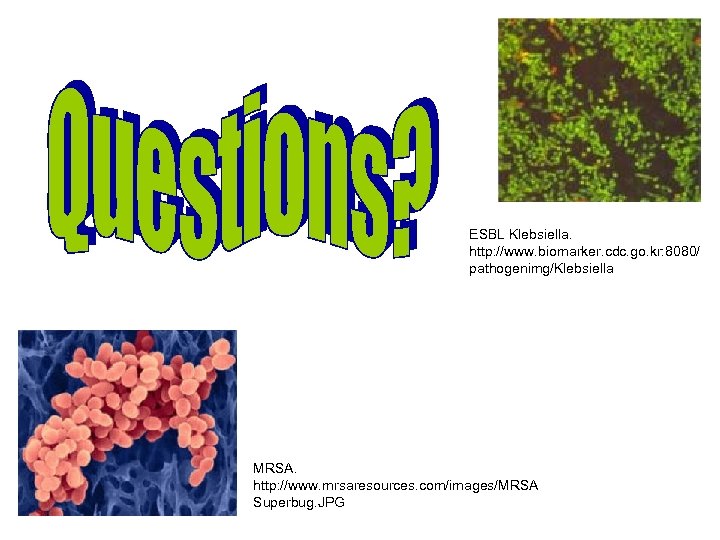
ESBL Klebsiella. http: //www. biomarker. cdc. go. kr: 8080/ pathogenimg/Klebsiella MRSA. http: //www. mrsaresources. com/images/MRSA Superbug. JPG
Скачать презентацию Strategies for Implementing Antimicrobial Stewardship Guidelines Ann Biehl
eab6debe531014b455267467f510c928.ppt