 Скачать презентацию Strategies for Future Acclerators Barry Barish Elba 23
d8e660b6485694479f5df27183aabbc4.ppt
- Количество слайдов: 33



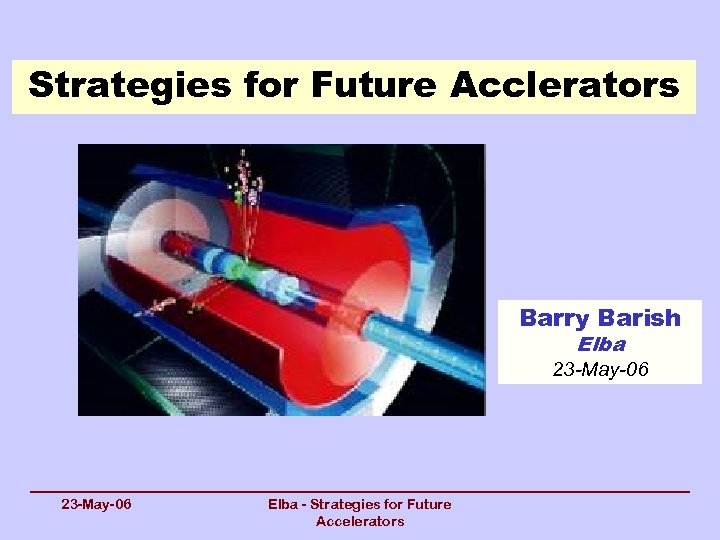
Strategies for Future Acclerators Barry Barish Elba 23 -May-06 Elba - Strategies for Future Accelerators
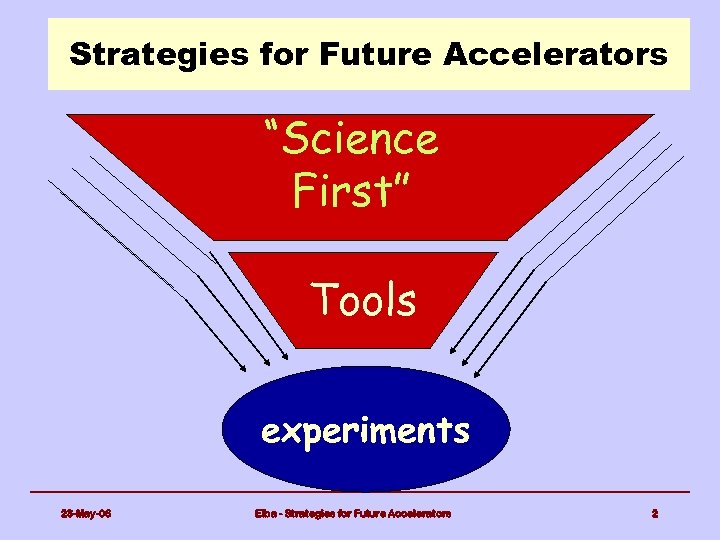
Strategies for Future Accelerators “Science First” Tools experiments 23 -May-06 Elba - Strategies for Future Accelerators 2
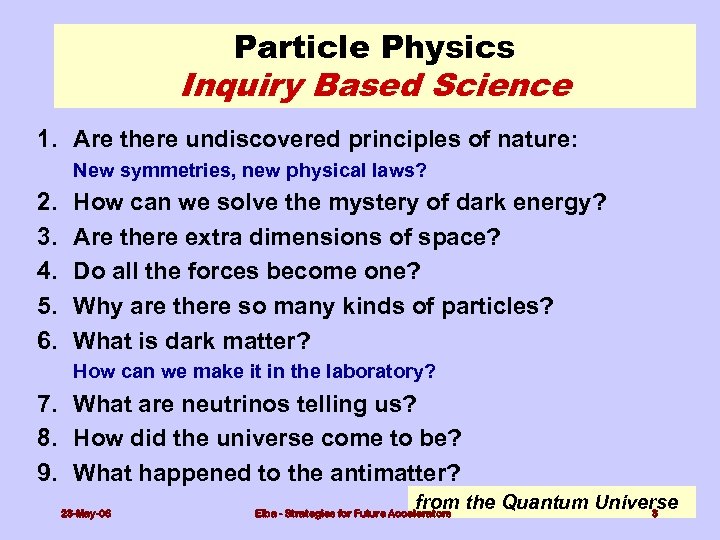
Particle Physics Inquiry Based Science 1. Are there undiscovered principles of nature: New symmetries, new physical laws? 2. 3. 4. 5. 6. How can we solve the mystery of dark energy? Are there extra dimensions of space? Do all the forces become one? Why are there so many kinds of particles? What is dark matter? How can we make it in the laboratory? 7. What are neutrinos telling us? 8. How did the universe come to be? 9. What happened to the antimatter? 23 -May-06 from the Quantum Universe 3 Elba - Strategies for Future Accelerators
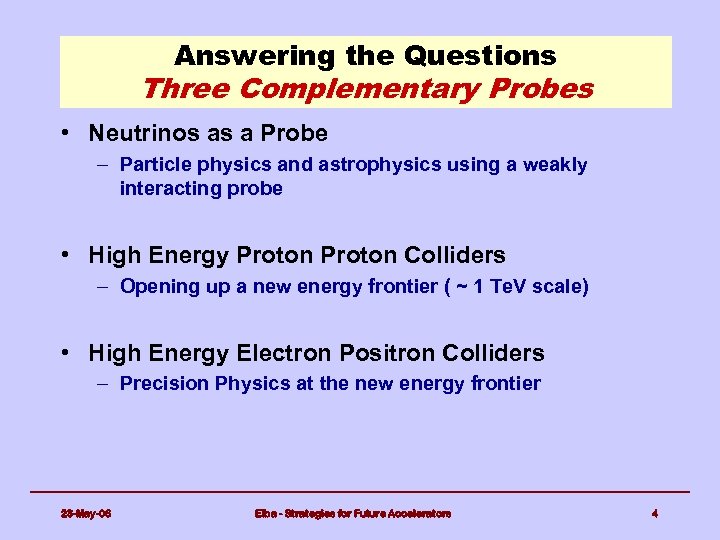
Answering the Questions Three Complementary Probes • Neutrinos as a Probe – Particle physics and astrophysics using a weakly interacting probe • High Energy Proton Colliders – Opening up a new energy frontier ( ~ 1 Te. V scale) • High Energy Electron Positron Colliders – Precision Physics at the new energy frontier 23 -May-06 Elba - Strategies for Future Accelerators 4
Why a Te. V Scale e+e- Accelerator? • Two parallel developments over the past few years (the science & the technology) – The precision information from LEP and other data have pointed to a low mass Higgs; Understanding electroweak symmetry breaking, whether supersymmetry or an alternative, will require precision measurements. – There are strong arguments for the complementarity between a ~0. 5 -1. 0 Te. V ILC and the LHC science. 23 -May-06 Elba - Strategies for Future Accelerators 5
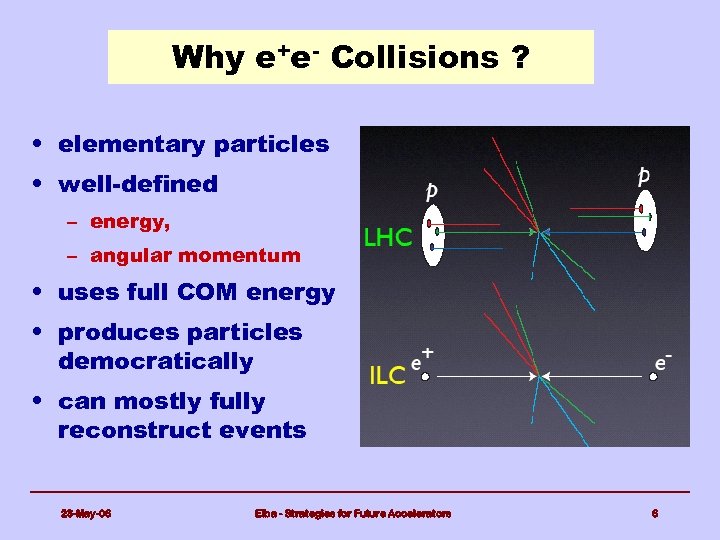
Why e+e- Collisions ? • elementary particles • well-defined – energy, – angular momentum • uses full COM energy • produces particles democratically • can mostly fully reconstruct events 23 -May-06 Elba - Strategies for Future Accelerators 6
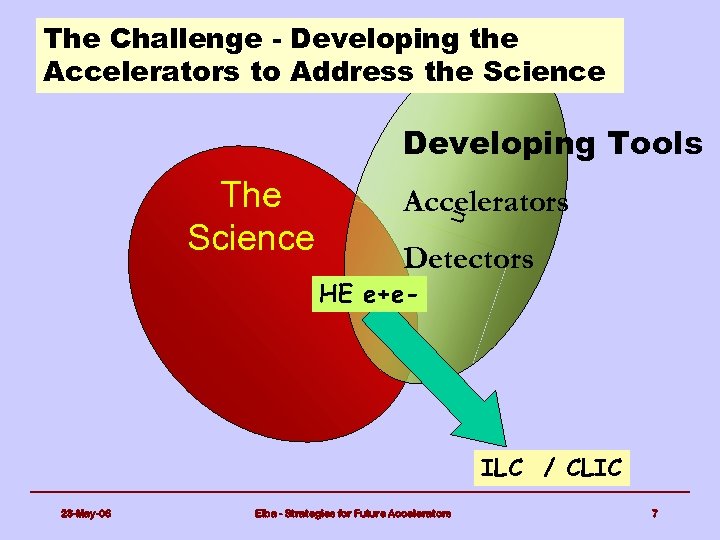
The Challenge - Developing the Accelerators to Address the Science Developing Tools Accelerators u The Science Detectors HE e+e- ILC / CLIC 23 -May-06 Elba - Strategies for Future Accelerators 7
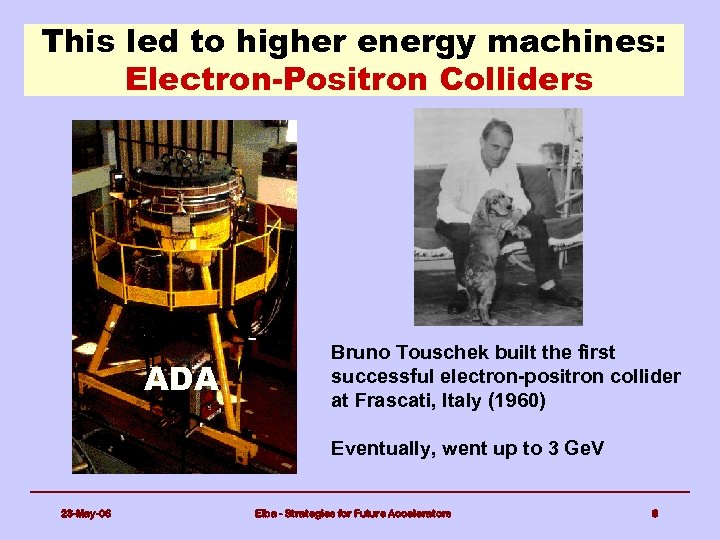
This led to higher energy machines: Electron-Positron Colliders ADA Bruno Touschek built the first successful electron-positron collider at Frascati, Italy (1960) Eventually, went up to 3 Ge. V 23 -May-06 Elba - Strategies for Future Accelerators 8
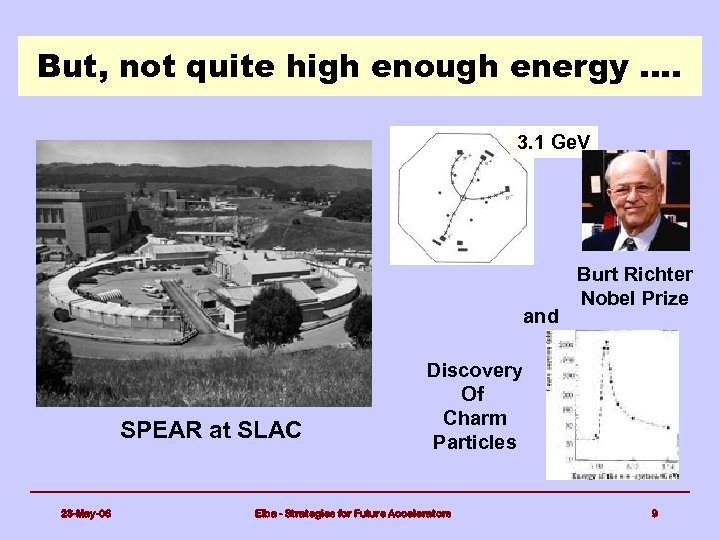
But, not quite high enough energy …. 3. 1 Ge. V and SPEAR at SLAC 23 -May-06 Burt Richter Nobel Prize Discovery Of Charm Particles Elba - Strategies for Future Accelerators 9
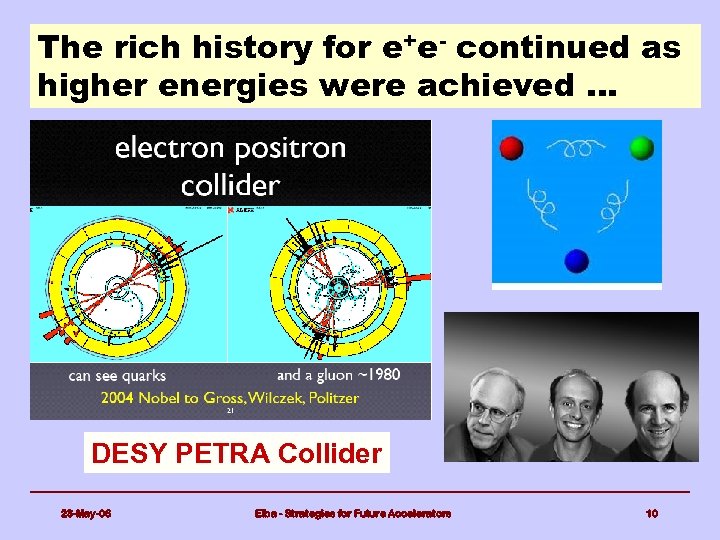
The rich history for e+e- continued as higher energies were achieved … DESY PETRA Collider 23 -May-06 Elba - Strategies for Future Accelerators 10
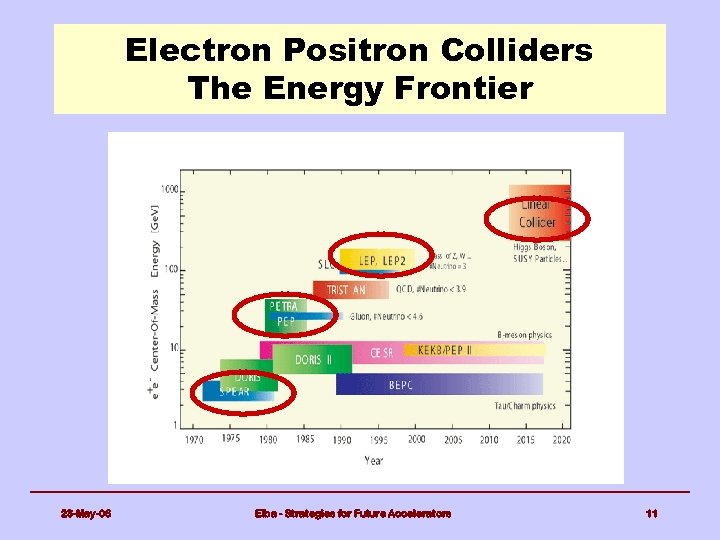
Electron Positron Colliders The Energy Frontier 23 -May-06 Elba - Strategies for Future Accelerators 11
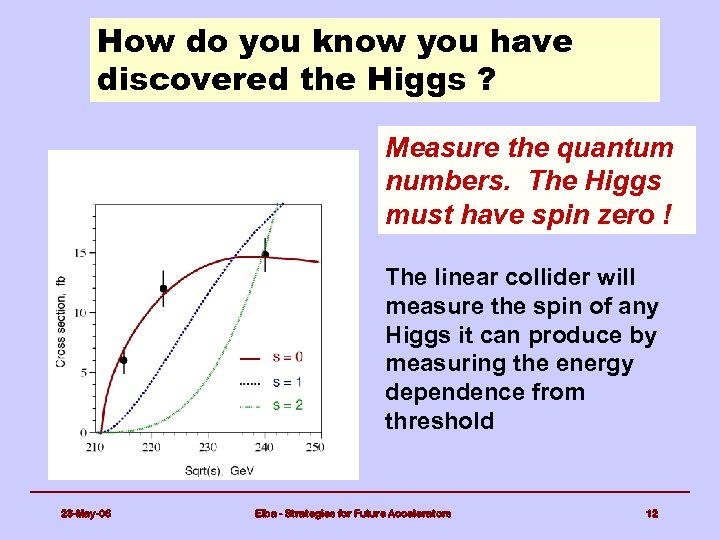
How do you know you have discovered the Higgs ? Measure the quantum numbers. The Higgs must have spin zero ! The linear collider will measure the spin of any Higgs it can produce by measuring the energy dependence from threshold 23 -May-06 Elba - Strategies for Future Accelerators 12
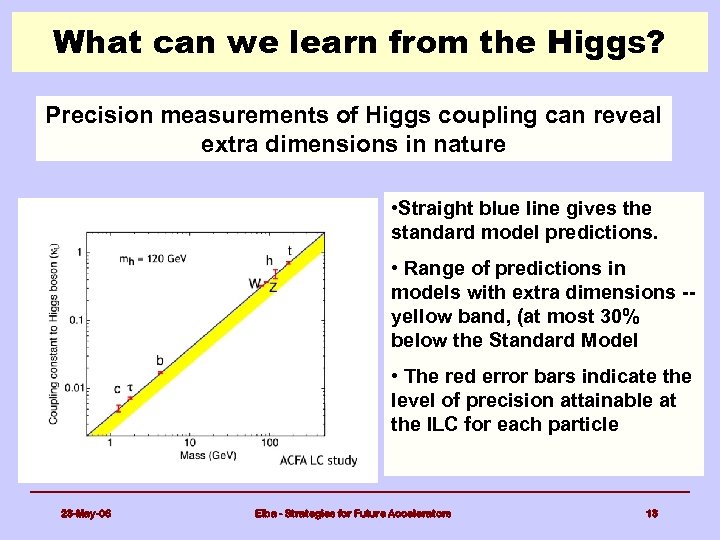
What can we learn from the Higgs? Precision measurements of Higgs coupling can reveal extra dimensions in nature • Straight blue line gives the standard model predictions. • Range of predictions in models with extra dimensions -yellow band, (at most 30% below the Standard Model • The red error bars indicate the level of precision attainable at the ILC for each particle 23 -May-06 Elba - Strategies for Future Accelerators 13
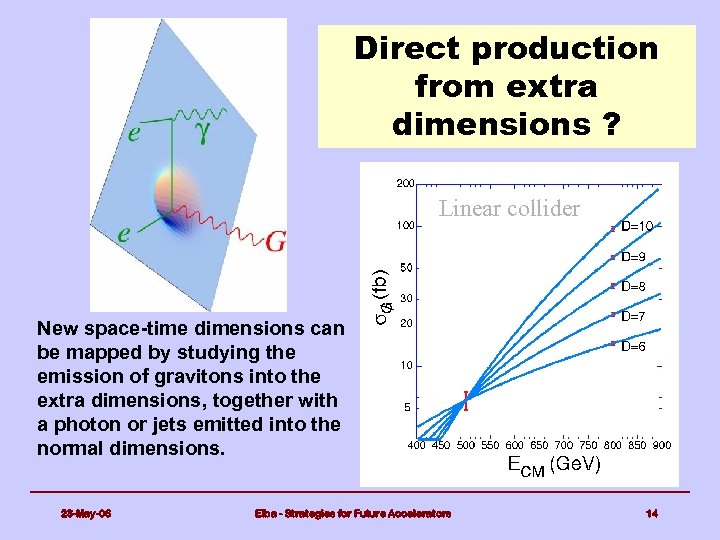
Direct production from extra dimensions ? Linear collider New space-time dimensions can be mapped by studying the emission of gravitons into the extra dimensions, together with a photon or jets emitted into the normal dimensions. 23 -May-06 Elba - Strategies for Future Accelerators 14
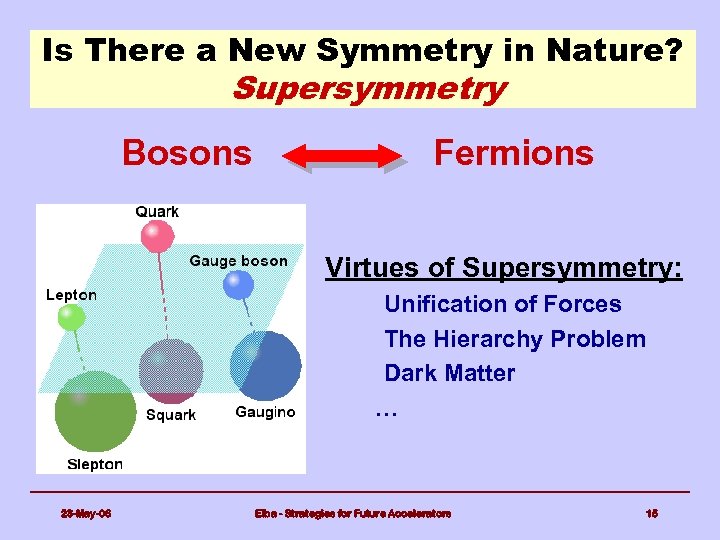
Is There a New Symmetry in Nature? Supersymmetry Bosons Fermions Virtues of Supersymmetry: – Unification of Forces – The Hierarchy Problem – Dark Matter … 23 -May-06 Elba - Strategies for Future Accelerators 15
Parameters for the ILC • Ecm adjustable from 200 – 500 Ge. V • Luminosity ∫Ldt = 500 fb-1 in 4 years • Ability to scan between 200 and 500 Ge. V • Energy stability and precision below 0. 1% • Electron polarization of at least 80% • The machine must be upgradeable to 1 Te. V 23 -May-06 Elba - Strategies for Future Accelerators 16
A Te. V Scale e+e- Accelerator? • Two parallel developments over the past few years (the science & the technology) – Two alternate designs -- “warm” and “cold” had come to the stage where the show stoppers had been eliminated and the concepts were well understood. – A major step toward a new international machine requires uniting behind one technology, and then make a unified global design based on the recommended technology. 23 -May-06 Elba - Strategies for Future Accelerators 17
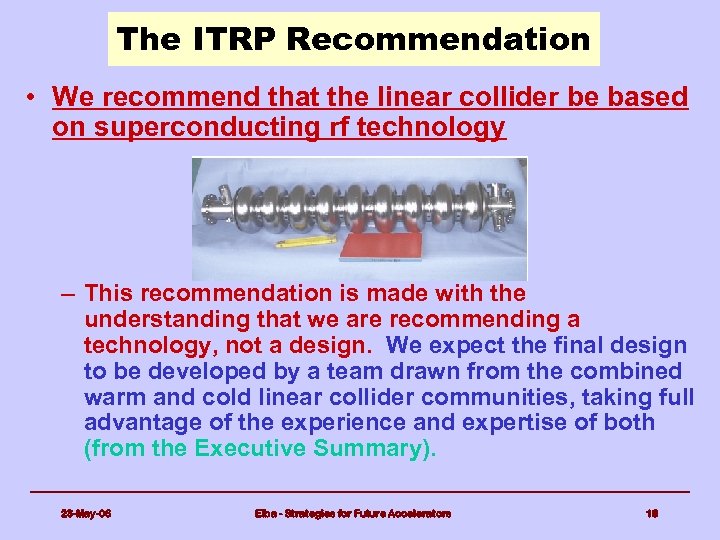
The ITRP Recommendation • We recommend that the linear collider be based on superconducting rf technology – This recommendation is made with the understanding that we are recommending a technology, not a design. We expect the final design to be developed by a team drawn from the combined warm and cold linear collider communities, taking full advantage of the experience and expertise of both (from the Executive Summary). 23 -May-06 Elba - Strategies for Future Accelerators 18
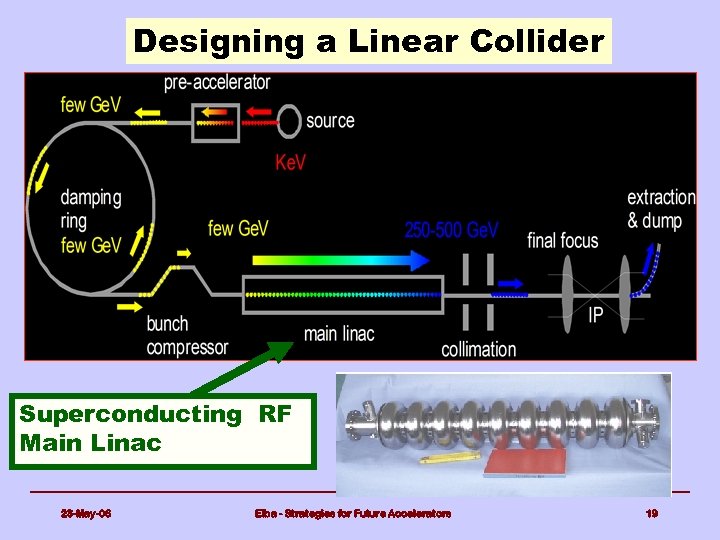
Designing a Linear Collider Superconducting RF Main Linac 23 -May-06 Elba - Strategies for Future Accelerators 19
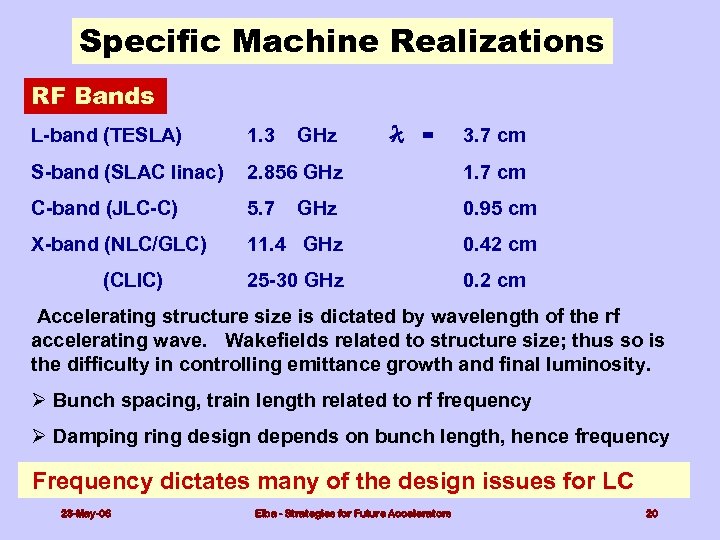
Specific Machine Realizations rf bands: RF Bands 1. 3 S-band (SLAC linac) 2. 856 GHz 1. 7 cm C-band (JLC-C) 5. 7 GHz 0. 95 cm X-band (NLC/GLC) 11. 4 GHz 0. 42 cm 25 -30 GHz 0. 2 cm (CLIC) GHz l = L-band (TESLA) 3. 7 cm Accelerating structure size is dictated by wavelength of the rf accelerating wave. Wakefields related to structure size; thus so is the difficulty in controlling emittance growth and final luminosity. Ø Bunch spacing, train length related to rf frequency Ø Damping ring design depends on bunch length, hence frequency Frequency dictates many of the design issues for LC 23 -May-06 Elba - Strategies for Future Accelerators 20
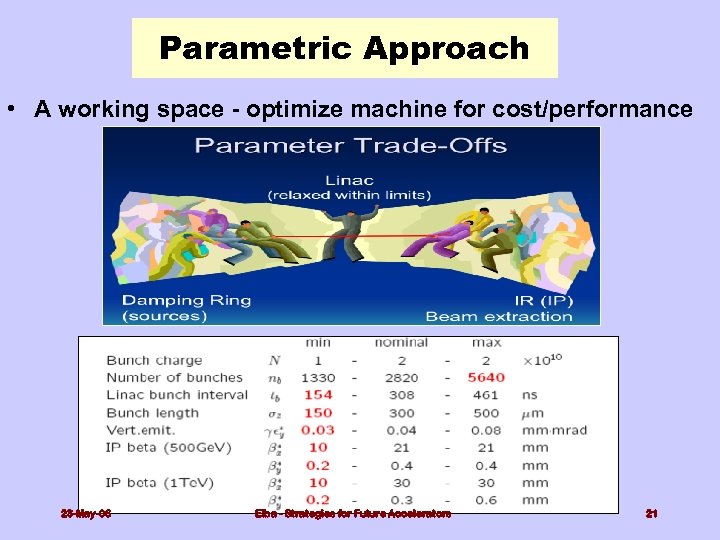
Parametric Approach • A working space - optimize machine for cost/performance 23 -May-06 Elba - Strategies for Future Accelerators 21
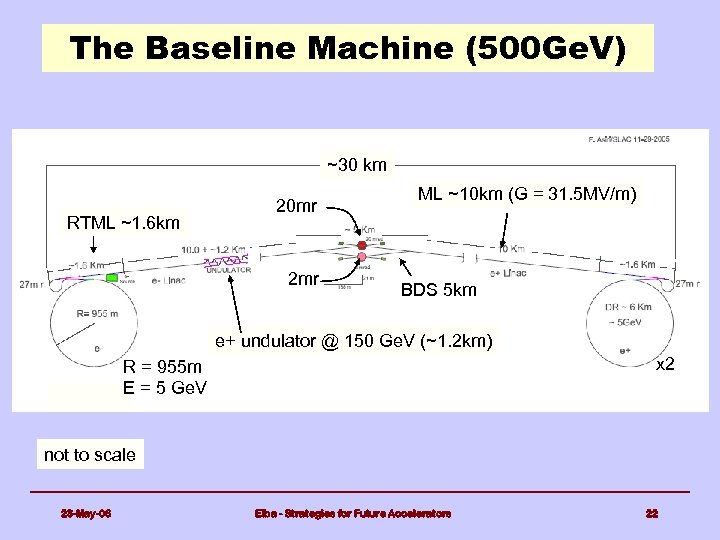
The Baseline Machine (500 Ge. V) ~30 km RTML ~1. 6 km 20 mr 2 mr ML ~10 km (G = 31. 5 MV/m) BDS 5 km e+ undulator @ 150 Ge. V (~1. 2 km) x 2 R = 955 m E = 5 Ge. V not to scale 23 -May-06 Elba - Strategies for Future Accelerators 22
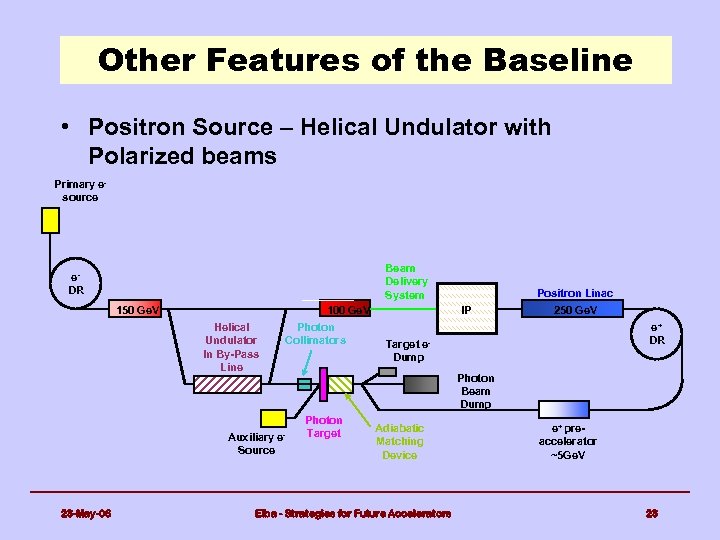
Other Features of the Baseline • Positron Source – Helical Undulator with Polarized beams Primary esource Beam Delivery System e. DR 150 Ge. V 100 Ge. V Helical Undulator In By-Pass Line Photon Collimators Auxiliary e. Source 23 -May-06 Positron Linac IP 250 Ge. V e+ DR Target e. Dump Photon Beam Dump Photon Target Adiabatic Matching Device Elba - Strategies for Future Accelerators e+ preaccelerator ~5 Ge. V 23
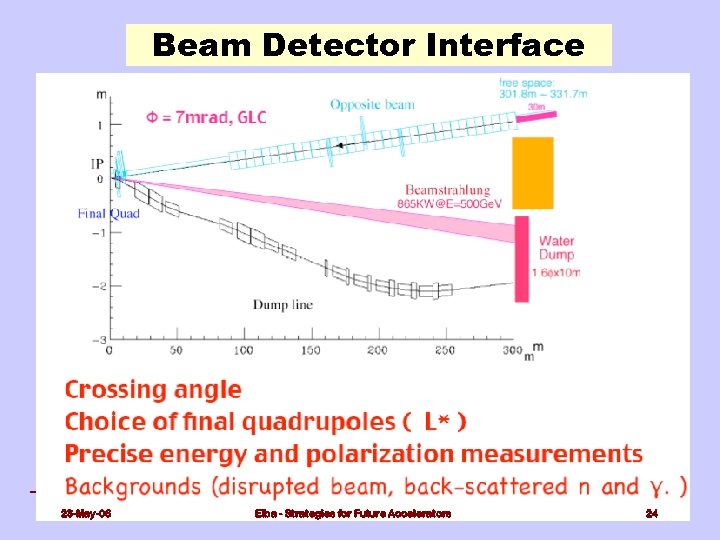
Beam Detector Interface 23 -May-06 Elba - Strategies for Future Accelerators 24
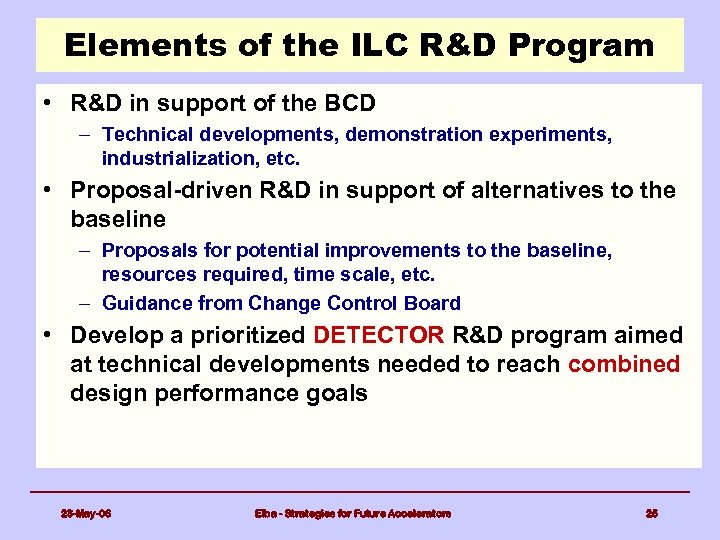
Elements of the ILC R&D Program • R&D in support of the BCD – Technical developments, demonstration experiments, industrialization, etc. • Proposal-driven R&D in support of alternatives to the baseline – Proposals for potential improvements to the baseline, resources required, time scale, etc. – Guidance from Change Control Board • Develop a prioritized DETECTOR R&D program aimed at technical developments needed to reach combined design performance goals 23 -May-06 Elba - Strategies for Future Accelerators 25
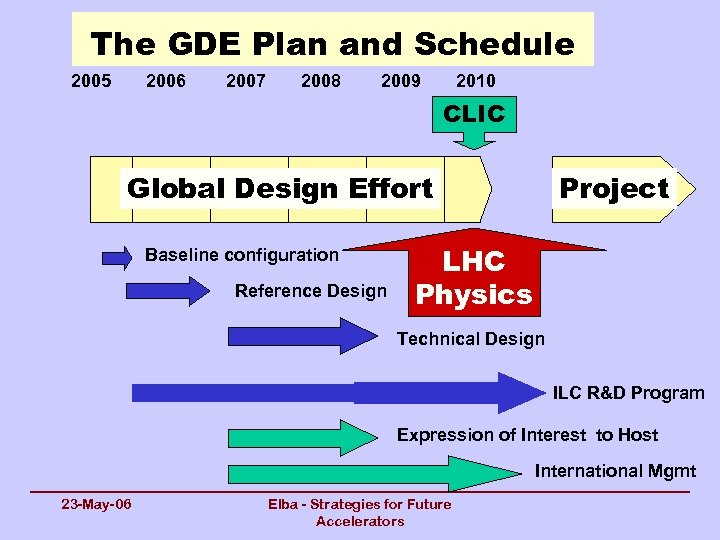
The GDE Plan and Schedule 2005 2006 2007 2008 2009 2010 CLIC Global Design Effort Baseline configuration Reference Design Project LHC Physics Technical Design ILC R&D Program Expression of Interest to Host International Mgmt 23 -May-06 Elba - Strategies for Future Accelerators
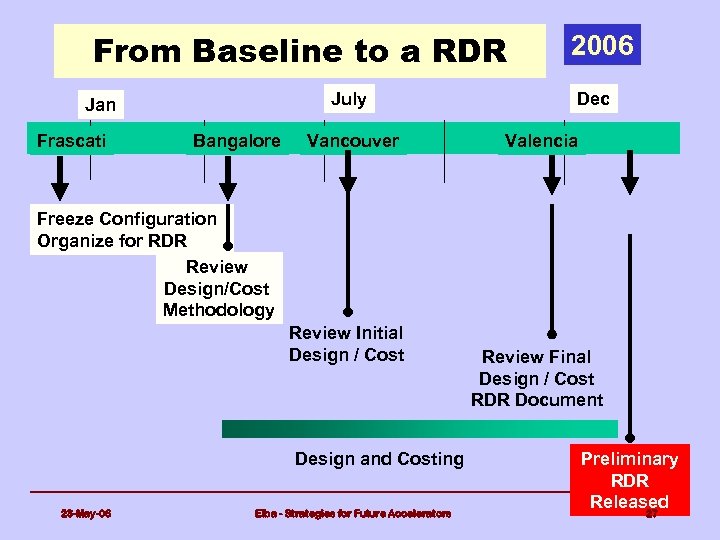
From Baseline to a RDR July Jan Frascati Bangalore Vancouver 2006 Dec Valencia Freeze Configuration Organize for RDR Review Design/Cost Methodology Review Initial Design / Cost Design and Costing 23 -May-06 Elba - Strategies for Future Accelerators Review Final Design / Cost RDR Document Preliminary RDR Released 27
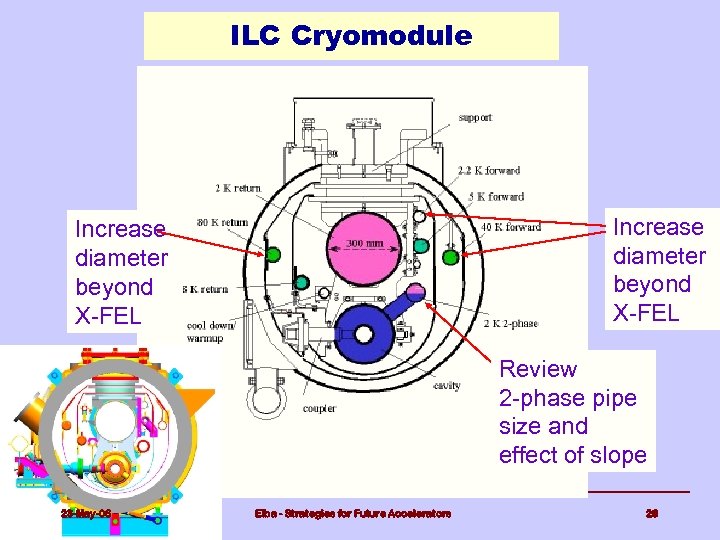
ILC Cryomodule Increase diameter beyond X-FEL Review 2 -phase pipe size and effect of slope 23 -May-06 Elba - Strategies for Future Accelerators 28
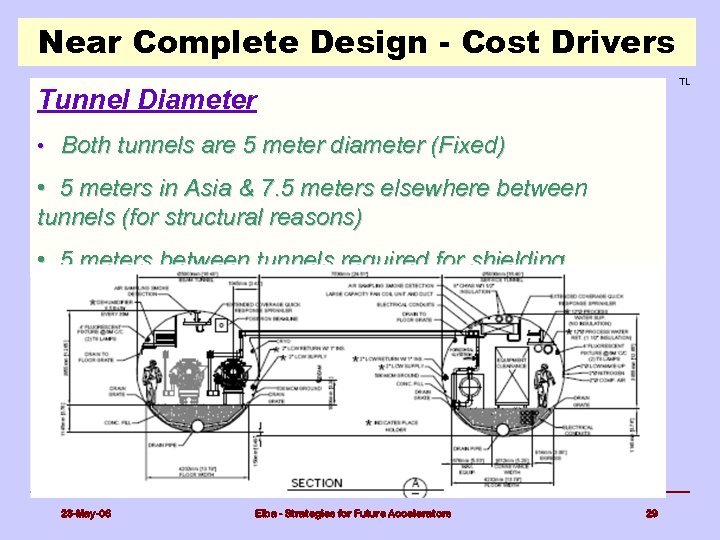
Near Complete Design - Cost Drivers TL Tunnel Diameter • Both tunnels are 5 meter diameter (Fixed) • 5 meters in Asia & 7. 5 meters elsewhere between tunnels (for structural reasons) • 5 meters between tunnels required for shielding 23 -May-06 Elba - Strategies for Future Accelerators 29
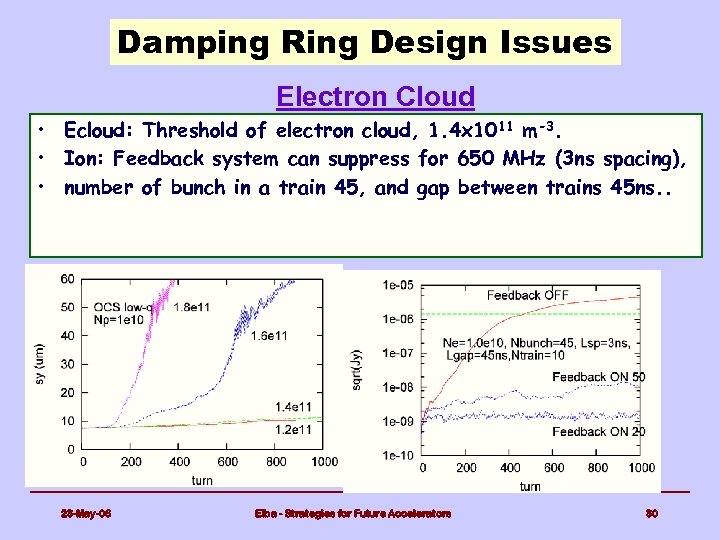
Damping Ring Design Issues Electron Cloud • Ecloud: Threshold of electron cloud, 1. 4 x 10¹¹ m-3. • Ion: Feedback system can suppress for 650 MHz (3 ns spacing), • number of bunch in a train 45, and gap between trains 45 ns. . 23 -May-06 Elba - Strategies for Future Accelerators 30
Accelerator Physics Challenges • Develop High Gradient Superconducting RF systems – Requires efficient RF systems, capable of accelerating high power beams (~MW) with small beam spots(~nm). • Achieving nm scale beam spots – Requires generating high intensity beams of electrons and positrons – Damping the beams to ultra-low emittance in damping rings – Transporting the beams to the collision point without significant emittance growth or uncontrolled beam jitter – Cleanly dumping the used beams. • Reaching Luminosity Requirements – Designs satisfy the luminosity goals in simulations – A number of challenging problems in accelerator physics and technology must be solved, however. 23 -May-06 Elba - Strategies for Future Accelerators 31
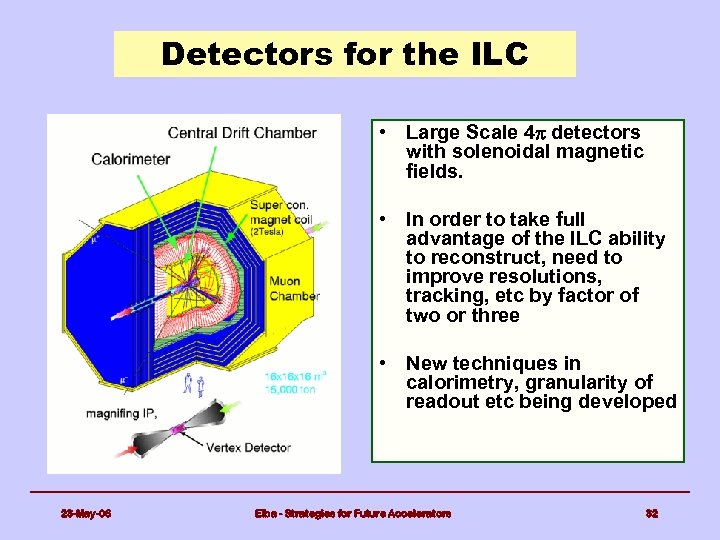
Detectors for the ILC • Large Scale 4 p detectors with solenoidal magnetic fields. • In order to take full advantage of the ILC ability to reconstruct, need to improve resolutions, tracking, etc by factor of two or three • New techniques in calorimetry, granularity of readout etc being developed 23 -May-06 Elba - Strategies for Future Accelerators 32
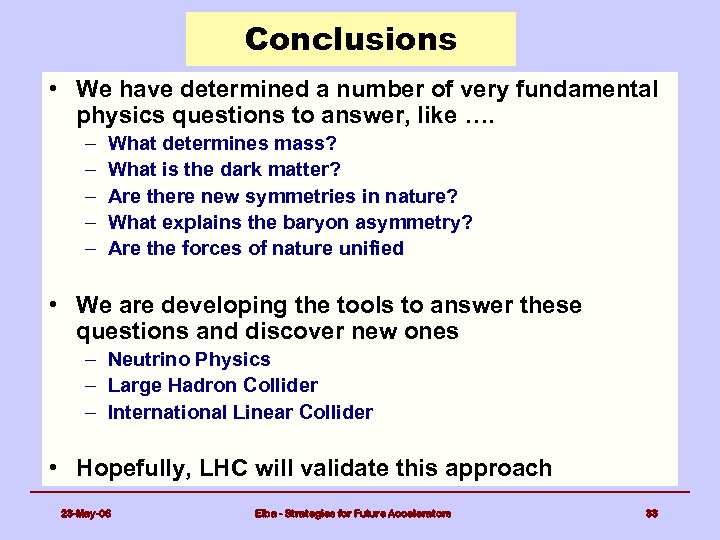
Conclusions • We have determined a number of very fundamental physics questions to answer, like …. – – – What determines mass? What is the dark matter? Are there new symmetries in nature? What explains the baryon asymmetry? Are the forces of nature unified • We are developing the tools to answer these questions and discover new ones – Neutrino Physics – Large Hadron Collider – International Linear Collider • Hopefully, LHC will validate this approach 23 -May-06 Elba - Strategies for Future Accelerators 33
Скачать презентацию Strategies for Future Acclerators Barry Barish Elba 23
d8e660b6485694479f5df27183aabbc4.ppt