 Скачать презентацию Strategies for Collecting and Including Data From Disabled
89eedea72907a4183e18d23a2eab13d7.ppt
- Количество слайдов: 44



Strategies for Collecting and Including Data From Disabled Populations Alison Reuter, Phoenix Shanti Group Brian M. Smith, State of Vermont Dan Blankenberger, Thresholds September 13 -14, 2005 St. Louis, Missouri Sponsored by the U. S. Department of Housing and Urban Development
Strategies for Collecting and Including Data From Disabled Populations: HIV Alison Reuter, MA, MEd Housing Director Phoenix Shanti Group September 13 -14, 2005 St. Louis, Missouri Sponsored by the U. S. Department of Housing and Urban Development
Overview • Phoenix Shanti Group: Agency Overview • Special Concerns working with HIV+ homeless clients • Involvement in the development process • Operationalizing and implementing HMIS at the agency level • Future considerations September 13 -14, 2005 St. Louis, Missouri Sponsored by the U. S. Department of Housing and Urban Development 3
Phoenix Shanti Group • Incorporated in 1987, Phoenix Shanti Group’s mission is to provide housing, education and direct client services to individuals, families and loved ones infected with and affected by HIV/AIDS • PSG’s programs are interrelated to best meet clients’ needs September 13 -14, 2005 St. Louis, Missouri Sponsored by the U. S. Department of Housing and Urban Development 4
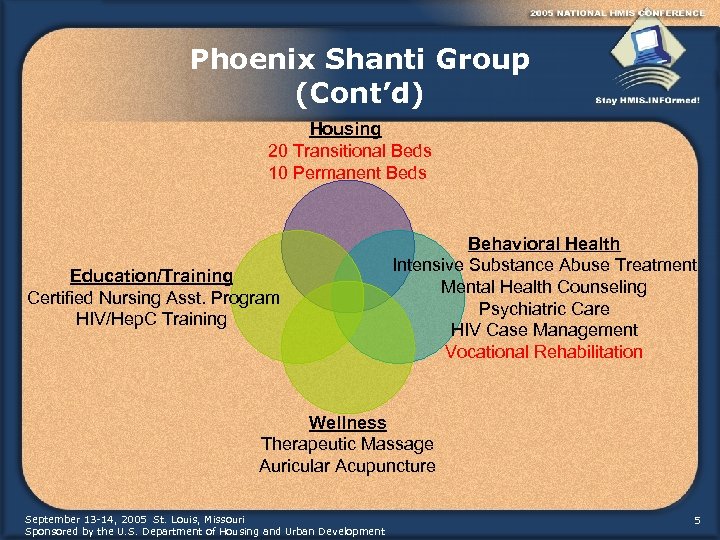
Phoenix Shanti Group (Cont’d) Housing 20 Transitional Beds 10 Permanent Beds Education/Training Certified Nursing Asst. Program HIV/Hep. C Training Behavioral Health Intensive Substance Abuse Treatment Mental Health Counseling Psychiatric Care HIV Case Management Vocational Rehabilitation Wellness Therapeutic Massage Auricular Acupuncture September 13 -14, 2005 St. Louis, Missouri Sponsored by the U. S. Department of Housing and Urban Development 5
Special Considerations for Working With HIV+ Homeless Clients • CONFIDENTIALITY! • Special laws regarding the protection of HIVrelated information exist, and all data collection and sharing in HMIS must comply with these laws. For example, Arizona Revised Statute 36 -664 provides guidelines for releasing information about communicable diseases, including HIV September 13 -14, 2005 St. Louis, Missouri Sponsored by the U. S. Department of Housing and Urban Development 6
ARS 36 -664 F • “A general authorization for the release of medical or other information, including communicable disease related information, is not an authorization for the release of HIVrelated information unless the authorization specifically indicates its purpose as an authorization for the release of confidential HIV-related information and complies with the requirements of this section. ” • Because Shanti provides housing only to HIV+ individuals and their families, releasing information stating that a client resides at PSG is, in essence, stating that they are HIV+ September 13 -14, 2005 St. Louis, Missouri Sponsored by the U. S. Department of Housing and Urban Development 7
ARS 36 -664 H • “If a disclosure of communicable disease related information is made pursuant to an authorization under subsection F of this section, the disclosure shall be accompanied by a statement in writing that warns that the information is from confidential records protected by state law and that prohibits further disclosure of the information without the specific written authorization of the person to whom it pertains or as otherwise permitted by law. ” • If information is shared with another provider, that provider must also obtain specific written authorization if they are to share information as well September 13 -14, 2005 St. Louis, Missouri Sponsored by the U. S. Department of Housing and Urban Development 8
Involvement in the Development Process • Beginning in 2002, PSG staff became involved in HMIS planning for our region • HMIS User Group: made up of homeless providers; met twice monthly until 2005; now every six weeks • HMIS Advisory Board: made up of agency administrators and funders; meets bimonthly September 13 -14, 2005 St. Louis, Missouri Sponsored by the U. S. Department of Housing and Urban Development 9
Involvement in the Development Process • Involvement from the beginning allowed us to make sure that special needs of HIV+ homeless clients were considered; Our input helped shape all aspects of the system: • • Who should participate Codes of ethics User guidelines Implementation schedules Picklists Releases of Information Security September 13 -14, 2005 St. Louis, Missouri Sponsored by the U. S. Department of Housing and Urban Development 10
Operationalizing and Implementing HMIS at the Agency Level • Because of our involvement in the development of our HMIS system, we had practice with and knowledge of the system that increased ease and decreased fears about confidentiality issues • Our confidence in the system was communicated to our clients September 13 -14, 2005 St. Louis, Missouri Sponsored by the U. S. Department of Housing and Urban Development 11
Operationalizing and Implementing HMIS at the Agency Level • Explaining the purpose and benefits of HMIS to our clients is key to gaining their support • The security of the system is clearly communicated • Exactly what information will be shared is communicated verbally and in writing; It is imperative to communicate that “being in the system” will not connect them to PSG in any way • Clients are given options about the extent to which they wish to participate September 13 -14, 2005 St. Louis, Missouri Sponsored by the U. S. Department of Housing and Urban Development 12
Operationalizing and Implementing HMIS at the Agency Level • Early involvement allowed us to build flexibility into the system • Our system is defaulted to automatically close everything; only the basic profile is opened if the client consents • Even if another agency accesses a client’s basic profile, no information regarding who entered the information is accessed September 13 -14, 2005 St. Louis, Missouri Sponsored by the U. S. Department of Housing and Urban Development 13
SUCCESS! • In 2 ½ years of using the system, we have entered all 200+ clients served into Service. Point; All but two consented to open their basic profile; No one refused to consent or requested to be added anonymously • Several additional HIV Housing providers have begun implementation of Service. Point at their agencies September 13 -14, 2005 St. Louis, Missouri Sponsored by the U. S. Department of Housing and Urban Development 14
Future Considerations • To share or not to share? • How can we integrate our agency’s multiple data systems to better represent a comprehensive picture of the homeless population served and to enhance the referral system? September 13 -14, 2005 St. Louis, Missouri Sponsored by the U. S. Department of Housing and Urban Development 15
Strategies for Collecting and Including Data in HMIS From Disabled Populations: HHS / PATH Brian M. Smith Housing Program Administrator State of Vermont Department of Health Division of Mental Health September 13 -14, 2005 St. Louis, Missouri Sponsored by the U. S. Department of Housing and Urban Development
The Objective • To include non-HUD funded homeless providers information in a local or statewide HMIS September 13 -14, 2005 St. Louis, Missouri Sponsored by the U. S. Department of Housing and Urban Development 17
What’s Ahead • Background on the topic • Specific Goals and Objectives • Tasks for Continuums and Providers • Vermont’s Experience • Specific Barriers, Options, Tools, and Benefits September 13 -14, 2005 St. Louis, Missouri Sponsored by the U. S. Department of Housing and Urban Development 18
Background: Staging of Local HMIS Implementation • “HMIS is a difficult and time-consuming process and must necessarily be done in stages. ” • Progress toward October 2004 Goal and beyond • Co. C’s first priority (regardless of funding source) • Emergency Shelters • Transitional Housing Programs • Outreach Programs September 13 -14, 2005 St. Louis, Missouri Sponsored by the U. S. Department of Housing and Urban Development 19
Tasks for Continua and Providers - Best Practices • To produce more comprehensive local, community, or regional HMIS reports • To produce a more broad based inclusive representation of the homeless in a community • To provide more standardized data on local and statewide homeless trends for analysis September 13 -14, 2005 St. Louis, Missouri Sponsored by the U. S. Department of Housing and Urban Development 20
Objectives for Those Initiating the Process • Planned outreach to non-HUD funded providers who are part of the Continuum of Care (or who may not be included) • Building additional community support for HMIS through education, training, and funding • Development of a more complete community data set • Development of improved reporting capacity for Co. C and individual providers • Increased value for HMIS participants due to more accurate and timely reporting capacity for a variety of funding sources • Better outcomes for individuals and families served September 13 -14, 2005 St. Louis, Missouri Sponsored by the U. S. Department of Housing and Urban Development 21
Questions to Ask • Who to include? • How to outreach and who to contact? • What is the best approach for you either local or statewide? September 13 -14, 2005 St. Louis, Missouri Sponsored by the U. S. Department of Housing and Urban Development 22
Steps to Build Community Support • Share knowledge, capacity, and funds • Be conscious of non-HUD reporting requirements and multiple program reporting needs of agencies • Determine where various agency efficiencies can be created by joining HMIS • Work with agencies (HUD funded and non-HUD funded) to customize and develop individual agency program reports September 13 -14, 2005 St. Louis, Missouri Sponsored by the U. S. Department of Housing and Urban Development 23
Building Support & Capacity (continued) • Develop individual agency standards and data definitions that meet HUD requirements and the agency individual programs • AIRS taxonomy September 13 -14, 2005 St. Louis, Missouri Sponsored by the U. S. Department of Housing and Urban Development 24
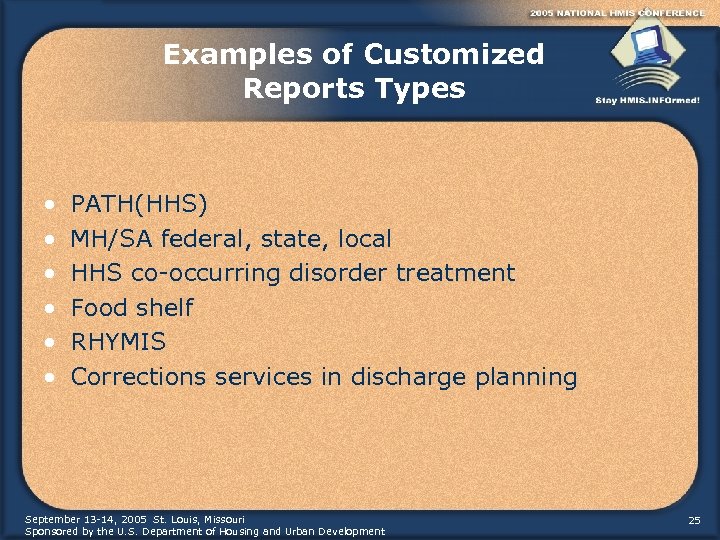
Examples of Customized Reports Types • • • PATH(HHS) MH/SA federal, state, local HHS co-occurring disorder treatment Food shelf RHYMIS Corrections services in discharge planning September 13 -14, 2005 St. Louis, Missouri Sponsored by the U. S. Department of Housing and Urban Development 25
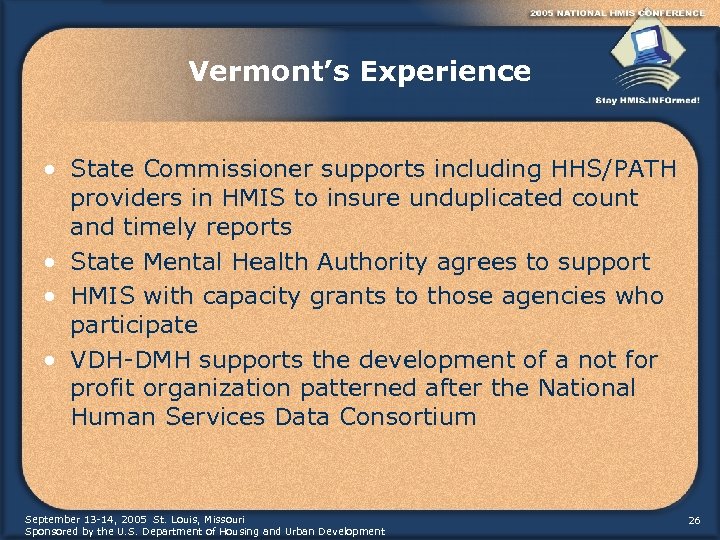
Vermont’s Experience • State Commissioner supports including HHS/PATH providers in HMIS to insure unduplicated count and timely reports • State Mental Health Authority agrees to support • HMIS with capacity grants to those agencies who participate • VDH-DMH supports the development of a not for profit organization patterned after the National Human Services Data Consortium September 13 -14, 2005 St. Louis, Missouri Sponsored by the U. S. Department of Housing and Urban Development 26
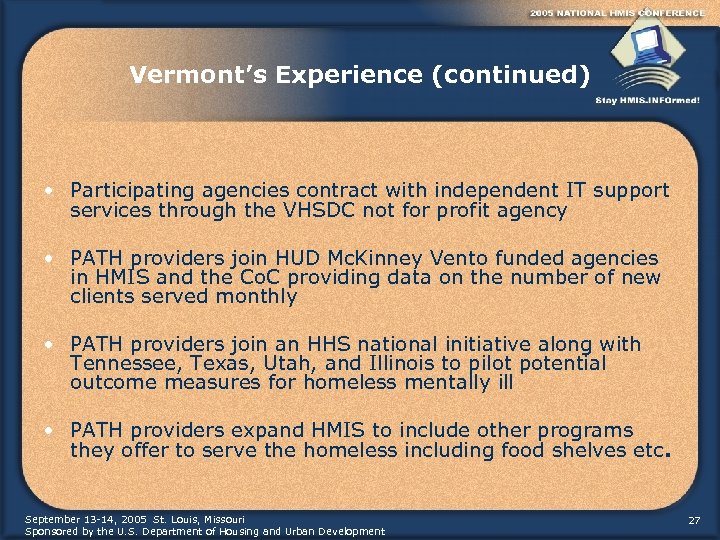
Vermont’s Experience (continued) • Participating agencies contract with independent IT support services through the VHSDC not for profit agency • PATH providers join HUD Mc. Kinney Vento funded agencies in HMIS and the Co. C providing data on the number of new clients served monthly • PATH providers join an HHS national initiative along with Tennessee, Texas, Utah, and Illinois to pilot potential outcome measures for homeless mentally ill • PATH providers expand HMIS to include other programs they offer to serve the homeless including food shelves etc. September 13 -14, 2005 St. Louis, Missouri Sponsored by the U. S. Department of Housing and Urban Development 27
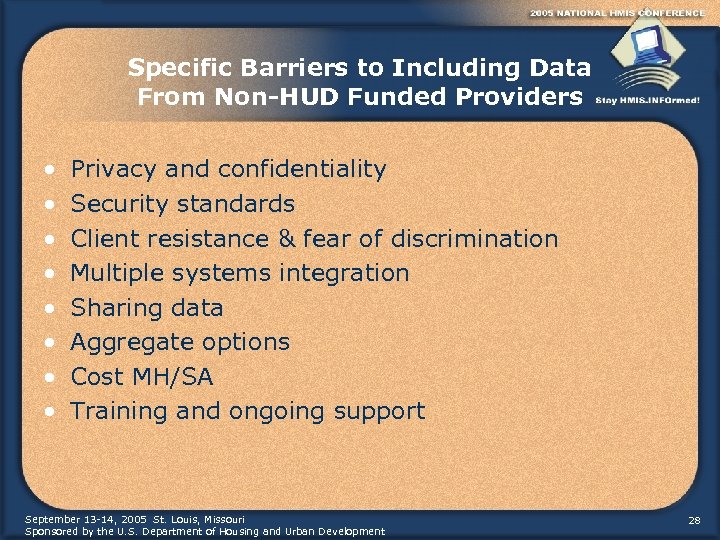
Specific Barriers to Including Data From Non-HUD Funded Providers • • Privacy and confidentiality Security standards Client resistance & fear of discrimination Multiple systems integration Sharing data Aggregate options Cost MH/SA Training and ongoing support September 13 -14, 2005 St. Louis, Missouri Sponsored by the U. S. Department of Housing and Urban Development 28
Options and Tools to Reduce Barriers and Concerns • Unique identifier and confidentiality trainings • Contractual agreements from funders with incentives • Building participating agency considerations into the system • Consumer participation in HMIS groups particularly education & training • Use of systems administration across providers, with financial incentives and flexibility • Insure that participating agencies will have multiple report/funder capacity September 13 -14, 2005 St. Louis, Missouri Sponsored by the U. S. Department of Housing and Urban Development 29
Options and Tools (continued) • Identification of key contacts who support the initiative or who would work as a demonstration project • Identification of specific time and cost savings for participating agencies • Development of connections to 10 year planning groups September 13 -14, 2005 St. Louis, Missouri Sponsored by the U. S. Department of Housing and Urban Development 30
Benefits • From a Client Perspective: • Increased trust and greater consumer participation • A sense of privacy and security & control over information • Increased self determination • From a Participating Agency: • • Better program management Accurate timely reporting capacity Increased funding potential Recognition for an improved profile of community needs, gaps, and priorities September 13 -14, 2005 St. Louis, Missouri Sponsored by the U. S. Department of Housing and Urban Development 31
Benefits (continued) • From Funding Sources: • • A sense of better utilization of funds & administration; Information for policy directions Support of community need The PATH Program in particular continues to recognize the value of local agency participation in these efforts September 13 -14, 2005 St. Louis, Missouri Sponsored by the U. S. Department of Housing and Urban Development 32
In Summary • Include non-HUD providers in your HMIS for a better picture of homelessness in your community; For example, PATH providers R&HY, DV Faith Based Organizations and others • This will develop a more comprehensive system that recognizes the strengths and capacities within a community; It can lead to better serving individuals with very high service utilization patterns and have subsequent benefits for all homeless programs in a community • In conclusion, taking this on will bring additional providers together to identify challenges, and needs together, and assist in creating more effective programs and efficiencies over time September 13 -14, 2005 St. Louis, Missouri Sponsored by the U. S. Department of Housing and Urban Development 33
Strategies for Collecting and Including Data from Disabled Populations Dan Blankenberger Software Development Specialist Thresholds Chicago, Illinois September 13 -14, 2005 St. Louis, Missouri Sponsored by the U. S. Department of Housing and Urban Development
Thresholds • • • Mental Health Agency Multiple Funding Sources Medicaid Billing 850 staff 5, 500 clients served last Fiscal Year • Wide variety of services • Over 100 programs September 13 -14, 2005 St. Louis, Missouri Sponsored by the U. S. Department of Housing and Urban Development 35
Thresholds’ Electronic Case Management and Billing System • In use since 1998 • Comprehensive shared client records • Integrated billing, service reporting and clinical record keeping system • “Forms” based construction • Centralized server based management with remote WAN access • Currently developing a web based application to replace this system September 13 -14, 2005 St. Louis, Missouri Sponsored by the U. S. Department of Housing and Urban Development 36
Benefits • Better integration/coordinated treatment • Reduced duplication of efforts/documentation • Programming Logic • Better informed users • Automated auditing • Reduced administrative involvement • Forces clean up at the primary/only data collection area • Data, data September 13 -14, 2005 St. Louis, Missouri Sponsored by the U. S. Department of Housing and Urban Development 37
HMIS Involvement • • Early involvement SOPs define architecture Local vs. Global Education: learning and teaching September 13 -14, 2005 St. Louis, Missouri Sponsored by the U. S. Department of Housing and Urban Development 38
Pitfalls and Solutions • Resistance • Language • Communication • • Lack of direction Single mindedness Tabling core issues Fear September 13 -14, 2005 St. Louis, Missouri Sponsored by the U. S. Department of Housing and Urban Development 39
Communication: The Language of Data Bases • Audience acknowledgment • Abstract notions • Practical application • Examples September 13 -14, 2005 St. Louis, Missouri Sponsored by the U. S. Department of Housing and Urban Development 40
Security: Definitions • Define types • External • Internal • Confidentiality • Don’t mix them up September 13 -14, 2005 St. Louis, Missouri Sponsored by the U. S. Department of Housing and Urban Development 41
HMIS Risk Assessment • What risks do agencies already carry • External • Internal • Confidentiality • Some risks that are unique to an HMIS system • External • Internal • Confidentiality • Minimizing risks September 13 -14, 2005 St. Louis, Missouri Sponsored by the U. S. Department of Housing and Urban Development 42
Minimizing Risks • External • Internal • Confidentiality • Database design September 13 -14, 2005 St. Louis, Missouri Sponsored by the U. S. Department of Housing and Urban Development 43
Approaches for HMIS Participation • • Bare bones System replacement System add on Data interfacing • A successful implementation may require all approaches • Education and information needs to be involved for agencies to best plan September 13 -14, 2005 St. Louis, Missouri Sponsored by the U. S. Department of Housing and Urban Development 44
Скачать презентацию Strategies for Collecting and Including Data From Disabled
89eedea72907a4183e18d23a2eab13d7.ppt