


 Скачать презентацию Strategies for Accelerating Student Success Findings Recommendations
c39ccf922be451c1ec76eb4b88a1dc40.ppt
- Количество слайдов: 25
 Strategies for Accelerating Student Success: Findings & Recommendations from the Assessment of the Evidence Series Thomas Bailey Community College Research Center Teachers College/Columbia University RP Group Conference April 14, 2011
 Assessment of Evidence Series • Focused on: – Developmental education (assessment & placement, acceleration programs, contextualization of basic skills instruction, innovative math pedagogy) – Non-academic supports – Program & institutional structures – Online learning – Organizational improvement • Impacts: Best-quality quantitative research • Implications: Qualitative research, theoretical literature, practitioner input
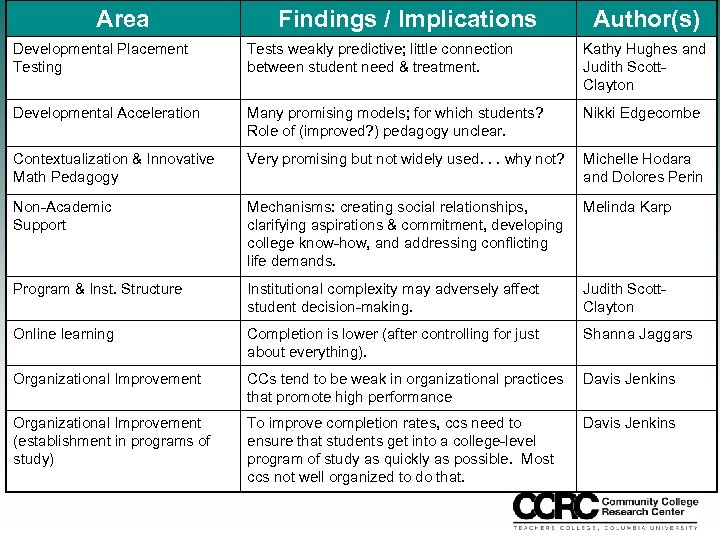 Area Findings / Implications Findings & Implications Author(s) Developmental Placement Testing Tests weakly predictive; little connection between student need & treatment. Kathy Hughes and Judith Scott. Clayton Developmental Acceleration Many promising models; for which students? Role of (improved? ) pedagogy unclear. Nikki Edgecombe Contextualization & Innovative Math Pedagogy Very promising but not widely used. . . why not? Michelle Hodara and Dolores Perin Non-Academic Support Mechanisms: creating social relationships, clarifying aspirations & commitment, developing college know-how, and addressing conflicting life demands. Melinda Karp Program & Inst. Structure Institutional complexity may adversely affect student decision-making. Judith Scott. Clayton Online learning Completion is lower (after controlling for just about everything). Shanna Jaggars Organizational Improvement CCs tend to be weak in organizational practices that promote high performance Davis Jenkins Organizational Improvement (establishment in programs of study) To improve completion rates, ccs need to ensure that students get into a college-level program of study as quickly as possible. Most ccs not well organized to do that. Davis Jenkins
 An overarching theme • Organizational improvement was a stand-alone topic. • Over time, realized it was integral to all the topics • To substantially improve: – developmental education – online & face-to-face pedagogy – support provision • . . . the whole institution needs to be engaged and focused on improving student outcomes.
 Four Broad Findings & Recommendations • • #1: Complexity & Structure #2: Faculty Engagement #3: Academic Alignment & Assessment #4: Continuous Improvement
 Complexity & Structure • All humans make bad choices in unduly complex environments. • College can seem complex and confusing to students, due to: – – A bewildering array of options Lack of information integration Unnecessary bureaucracy Tools convenient / inexpensive to the college
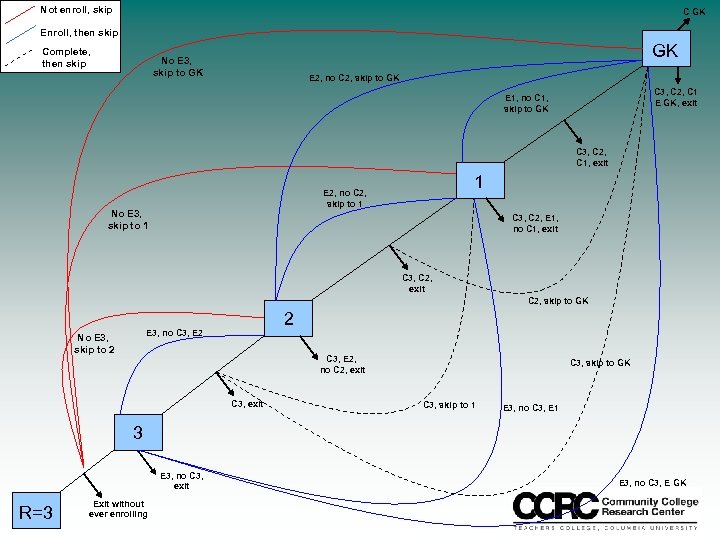 Not enroll, skip C GK Enroll, then skip Complete, then skip GK No E 3, skip to GK E 2, no C 2, skip to GK C 3, C 2, C 1 E GK, exit E 1, no C 1, skip to GK C 3, C 2, C 1, exit 1 E 2, no C 2, skip to 1 No E 3, skip to 1 C 3, C 2, E 1, no C 1, exit C 3, C 2, exit C 2, skip to GK 2 E 3, no C 3, E 2 No E 3, skip to 2 C 3, E 2, no C 2, exit C 3, skip to GK C 3, skip to 1 E 3, no C 3, E 1 3 E 3, no C 3, exit R=3 Exit without ever enrolling E 3, no C 3, E GK
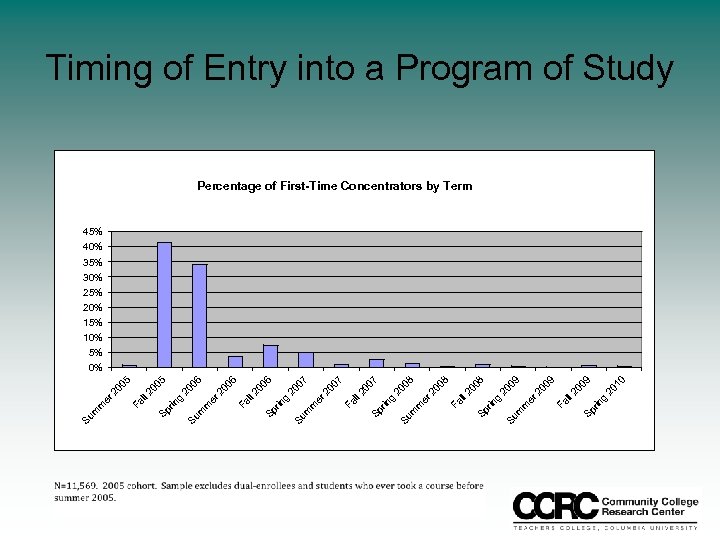 g g g ll Fa rin Sp g 0 20 1 9 20 0 9 9 20 0 8 er 20 0 m m Su Sp rin ll Fa 8 20 0 7 er 20 0 m m Su Sp rin ll Fa 7 20 0 6 er 20 0 m m Su Sp rin ll Fa 6 20 0 5 er 20 0 m m Su g rin Sp ll Fa er 20 0 m m Su Timing of Entry into a Program of Study Percentage of First-Time Concentrators by Term 45% 40% 35% 30% 25% 20% 15% 10% 5% 0%
 Complexity & Structure • Recommendation: Simplify the structures and bureaucracies that students must navigate.
 Complexity & Structure • Recommendation: Simplify the structures and bureaucracies that students must navigate. – Does not require restricting choice
 Complexity & Structure • Recommendation: Simplify the structures and bureaucracies that students must navigate. – Does not require restricting choice – Re-examine policies, practices, programs, services: • Why are they in place? • Are they serving their intended function? • Are they aligned with the goal of student success?
 Complexity & Structure • Re-examine policies, practices, services. . . – Form cross-functional teams of faculty, student services, staff administrators – Map out student’s experience from first contact; where & why are students encountering frustration and confusion? – Develop protocols of recommended practice to support student success at each stage of their experience in college
 Faculty Engagement • Substantial organizational improvement requires strong employee involvement. • In CCs, student success goals can be hampered by: – lack of faculty/staff engagement – large part-time workforce – organizational silos
 Faculty Engagement • Organizations with strong employee involvement in reform: – Ensure employees have deep understanding of goals and methods of reform – Empower employees as part of reform – Encourage staff to work in cross-functional teams – Create challenging yet meaningful goals – Present evidence of successes
 Faculty Engagement • Student supports: – Resources are limited – Yet students underutilize • Potential solution: integration of supports • Would require deep and broad faculty & staff support
 Faculty Engagement • Previous attempts to broadly engage faculty have not always been successful • Perhaps because reforms: – Often focus on student retention / completion (institutional effectiveness) – Not on student learning (instructional effectiveness)
 Faculty Engagement • Recommendation: Empower faculty to set challenging and meaningful student learning goals – Include not just content knowledge/skills – Create recommended protocols for challenging areas
 Academic Alignment & Assessment • In K-12, schools effective with disadvantaged students have “instructional program coherence: ” – Well-coordinated, “rationalized” curriculum – Common instructional framework – Clearly defined learning outcomes – Integrated assessments & academic supports • Colleges do not put strong emphasis on these.
 Academic Alignment & Assessment • Recommendation: Faculty work together to craft learning outcomes. Process would: – Help faculty from different disciplines communicate and align expectations for reading, writing, & math – Help part-time instructors understand course goals – Help students understand program goals & requirements – Help high schools understand expectations
 Continuous Improvement • Practices of high-performance organizations: – Strong leadership – Customer focus – Functional alignment – Process improvement – Use of measurement for improvement – Employee involvement – Training and professional development – External linkages
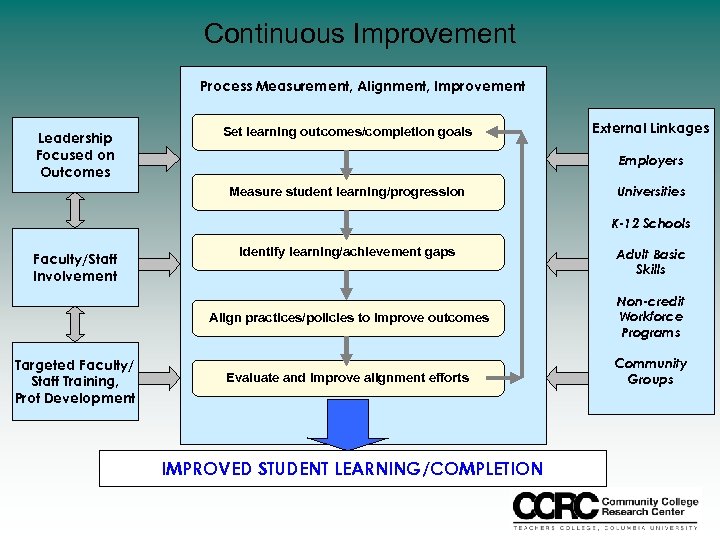 Continuous Improvement Process Measurement, Alignment, Improvement Leadership Focused on Outcomes Set learning outcomes/completion goals External Linkages Employers Set learning outcomes/completion goals Measure student learning/progression Universities K-12 Schools Faculty/Staff Involvement Identify learning/achievement gaps Align practices/policies to improve outcomes Targeted Faculty/ Staff Training, Prof Development Evaluate and improve alignment efforts IMPROVED STUDENT LEARNING/COMPLETION Adult Basic Skills Non-credit Workforce Programs Community Groups
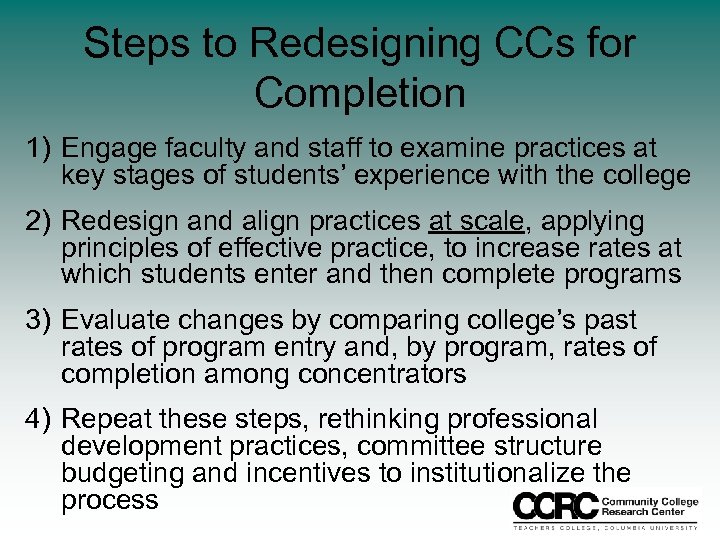 Steps to Redesigning CCs for Completion 1) Engage faculty and staff to examine practices at key stages of students’ experience with the college 2) Redesign and align practices at scale, applying principles of effective practice, to increase rates at which students enter and then complete programs 3) Evaluate changes by comparing college’s past rates of program entry and, by program, rates of completion among concentrators 4) Repeat these steps, rethinking professional development practices, committee structure budgeting and incentives to institutionalize the process
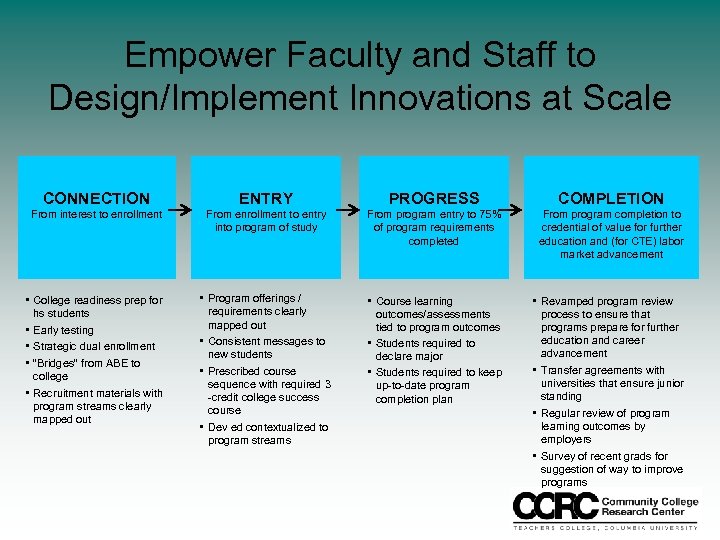 Empower Faculty and Staff to Design/Implement Innovations at Scale CONNECTION ENTRY PROGRESS COMPLETION From interest to enrollment From enrollment to entry into program of study From program entry to 75% of program requirements completed From program completion to credential of value for further education and (for CTE) labor market advancement • College readiness prep for hs students • Early testing • Strategic dual enrollment • “Bridges” from ABE to college • Recruitment materials with program streams clearly mapped out • Program offerings / requirements clearly mapped out • Consistent messages to new students • Prescribed course sequence with required 3 -credit college success course • Dev ed contextualized to program streams • Course learning outcomes/assessments tied to program outcomes • Students required to declare major • Students required to keep up-to-date program completion plan • Revamped program review process to ensure that programs prepare for further education and career advancement • Transfer agreements with universities that ensure junior standing • Regular review of program learning outcomes by employers • Survey of recent grads for suggestion of way to improve programs
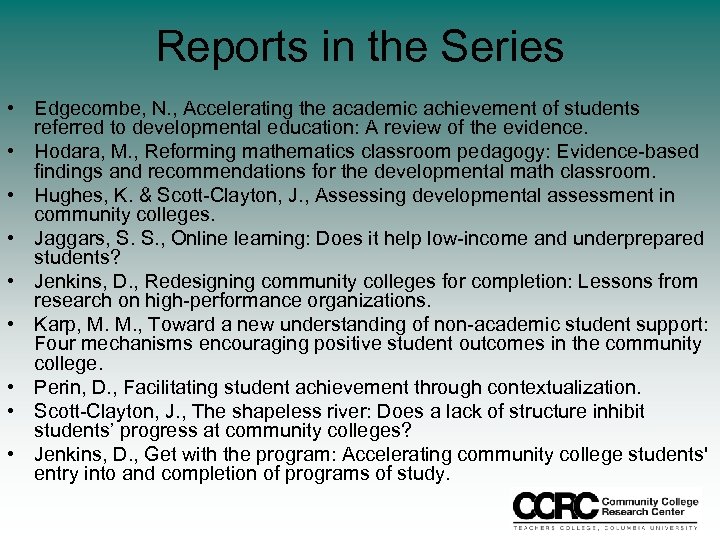 Reports in the Series • Edgecombe, N. , Accelerating the academic achievement of students referred to developmental education: A review of the evidence. • Hodara, M. , Reforming mathematics classroom pedagogy: Evidence-based findings and recommendations for the developmental math classroom. • Hughes, K. & Scott-Clayton, J. , Assessing developmental assessment in community colleges. • Jaggars, S. S. , Online learning: Does it help low-income and underprepared students? • Jenkins, D. , Redesigning community colleges for completion: Lessons from research on high-performance organizations. • Karp, M. M. , Toward a new understanding of non-academic student support: Four mechanisms encouraging positive student outcomes in the community college. • Perin, D. , Facilitating student achievement through contextualization. • Scott-Clayton, J. , The shapeless river: Does a lack of structure inhibit students’ progress at community colleges? • Jenkins, D. , Get with the program: Accelerating community college students' entry into and completion of programs of study.
 For more information: Please visit us on the web at http: //ccrc. tc. columbia. edu, where you can download presentations, reports, CCRC Briefs, and sign-up for news announcements. Community College Research Center Institute on Education and the Economy, Teachers College, Columbia University 525 West 120 th Street, Box 174, New York, NY 10027 E-mail: ccrc@columbia. edu Telephone: 212. 678. 3091 CCRC is funded in part by: Alfred P. Sloan foundation, Bill & Melinda Gates Foundation, Kresge Foundation, Lumina Foundation for Education, The Ford Foundation, National Science Foundation (NSF), Institute of Education Sciences of the U. S. Department of Education