


 Скачать презентацию Strategies and policies to promote inclusive green economy
e82287fcd05f8349c43ed1407391468d.ppt
- Количество слайдов: 9
 Strategies and policies to promote inclusive green economy learning Exemple of France with the case project “Houses of employment and sustainable development” FIRST GLOBAL FORUM ON GREEN ECONOMY LEARNING Paris Thursday, 17 th of december 2015 Thomas GAUDIN – Service Economie et Prospective- ADEME Henri Le Marois – Consultant- ALLIANCE VILLES EMPLOI
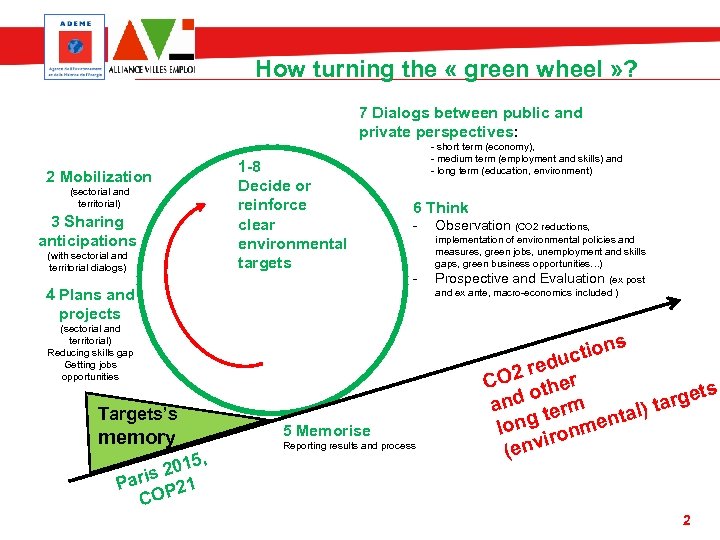 How turning the « green wheel » ? 7 Dialogs between public and private perspectives: 1 -8 Decide or reinforce clear environmental targets 2 Mobilization (sectorial and territorial) 3 Sharing anticipations (with sectorial and territorial dialogs) 4 Plans and projects - short term (economy), - medium term (employment and skills) and - long term (education, environment) 6 Think - implementation of environmental policies and measures, green jobs, unemployment and skills gaps, green business opportunities…) - Prospective and Evaluation (ex post and ex ante, macro-economics included ) (sectorial and territorial) Reducing skills gap Getting jobs opportunities Targets’s memory Observation (CO 2 reductions, 5 Memorise 15, 20 aris 21 P COP Reporting results and process s tion c redu CO 2 ther ts o arge and term ) t g ntal lon ronme i (env 2
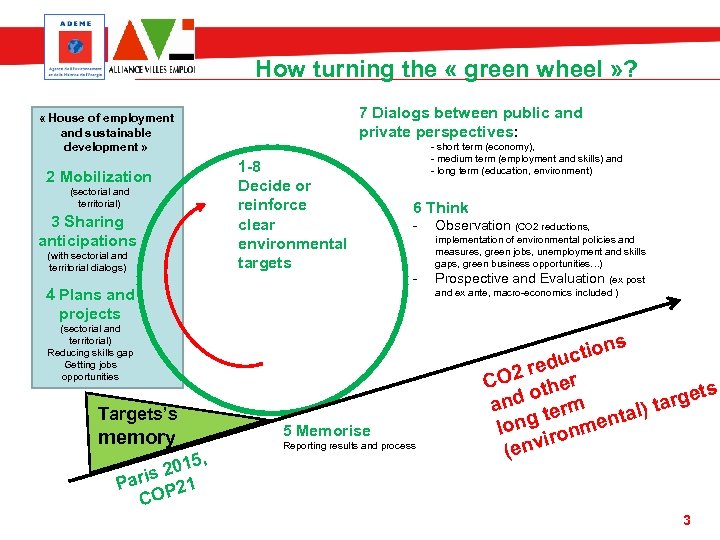 How turning the « green wheel » ? 7 Dialogs between public and private perspectives: « House of employment and sustainable development » 1 -8 Decide or reinforce clear environmental targets 2 Mobilization (sectorial and territorial) 3 Sharing anticipations (with sectorial and territorial dialogs) 4 Plans and projects - short term (economy), - medium term (employment and skills) and - long term (education, environment) 6 Think - implementation of environmental policies and measures, green jobs, unemployment and skills gaps, green business opportunities…) - Prospective and Evaluation (ex post and ex ante, macro-economics included ) (sectorial and territorial) Reducing skills gap Getting jobs opportunities Targets’s memory Observation (CO 2 reductions, 5 Memorise 15, 20 aris 21 P COP Reporting results and process s tion c redu CO 2 ther ts o arge and term ) t g ntal lon ronme i (env 3
 Action « build up skills in the construction sector» Challenge • Build up skills in the construction sector in order to meet the qualitative and quantitative goals of the energy transition Principle of action • Act at local level with all the stakeholders • Share clear environmental objectives 4
 Action « build up skills in the construction sector» Methodology • Phase 1 - Mobilization of all the stakeholders (local authorities, building owners, enterprises, trainers …. ) • Phase 2 - Sharing diagnosis and anticipations • Phase 3 - Building a joint action plan • Phase 4 - Implementation of the action plan Organisation • Co-organisers • National – Alliance Villes Emploi and ADEME • Local - Employment Houses and ADEME regional offices • The Employment Houses : Local organisations chaired by a local politician (Mayor, chair person of local authorities), and which has for members local authorities, the State, the Employment agency, and local actors. Act as « catalyst » , and « animator » . • Alliance Villes Emploi is the national organisation of the Employment Houses. 5
 Action « build up skills in the construction sector» : impact • 43 territories • 1. 300 stakeholders mobilized • 500 Ø Ø actions implemented in the main following fields : Access to employment Information Training Organization of the market (demand offer) • Shared « culture » and understanding of the challenges of the energy transition • Development of a « work together » spirit 6
 Action « build up skills in the construction sector» : lessons learned • The objectives of the energy transition will not be reached if the skills of the labour force are not improved. • Local territories is a very good place to anticipate jobs and skills needs • It is necessary to have a local « animator » who mobilize and organize the stakeholders. This « animator » must have the competencies and the legitimacy to fill his role. • A shared prospective diagnosis, done with all the stakeholders prior to the action plan, is a must. • Responsibilities and tasks have to be clearly shared between the stakeholders. 7
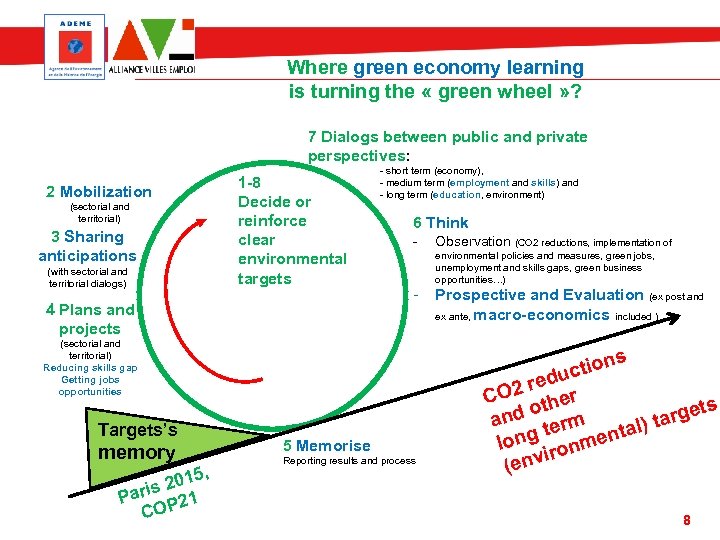 Where green economy learning is turning the « green wheel » ? 7 Dialogs between public and private perspectives: 2 Mobilization (sectorial and territorial) 3 Sharing anticipations (with sectorial and territorial dialogs) 1 -8 Decide or reinforce clear environmental targets 4 Plans and projects - short term (economy), - medium term (employment and skills) and - long term (education, environment) 6 Think - environmental policies and measures, green jobs, unemployment and skills gaps, green business opportunities…) - (sectorial and territorial) Reducing skills gap Getting jobs opportunities Targets’s memory 5, 201 s Pari P 21 CO Observation (CO 2 reductions, implementation of 5 Memorise Reporting results and process Prospective and Evaluation (ex post and ex ante, macro-economics included ) s tion c redu CO 2 ther s d o m rget an ta ter ental) long ronm i (env 8
 Thank you Thomas Gaudin – ADEME Henri Le Marois – Alliance Villes Emploi