


 Скачать презентацию Strategic Planning Retreat Key Measures of Success April
829748ba1c73cdb2a16984f039f9f037.ppt
- Количество слайдов: 27
 Strategic Planning Retreat Key Measures of Success April 17, 2008 Lawrenceburg Campus
 MISSION STATEMENT With students at the heart of our mission, the Bluegrass Community and Technical College provides open access to excellence in teaching and learning. Through comprehensive and responsive programs and services, we sustain a strong partnership with the community to improve economic vitality and quality of life in the region. In pursuit of our mission, the Bluegrass Community and Technical College provides the following: • Certificate, diploma, associate degree, and transfer programs • Remedial/developmental education programs • Adult education programs • Workforce and business & industry customized training programs • Continuing education and community outreach • State-of-the-art technology • Student and customer-centered support Bluegrass Community and Technical College was formed in 2005 following the consolidation of Central Kentucky Technical College and Lexington Community College. Bluegrass Community and Technical College is a member of the Kentucky Community and Technical College System and is a public two-year degree granting institution serving the Bluegrass Region of Kentucky. 2 STRATEGIC PLANNING RETREAT
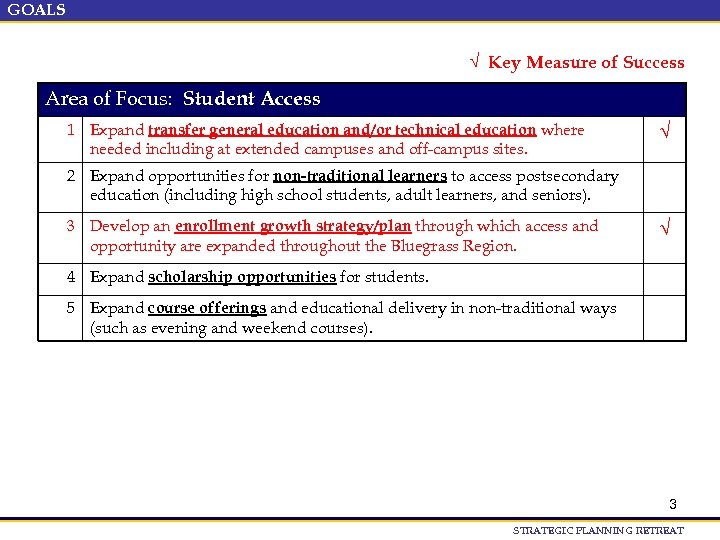 GOALS √ Key Measure of Success Area of Focus: Student Access 1 Expand transfer general education and/or technical education where needed including at extended campuses and off-campus sites. √ 2 Expand opportunities for non-traditional learners to access postsecondary education (including high school students, adult learners, and seniors). 3 Develop an enrollment growth strategy/plan through which access and opportunity are expanded throughout the Bluegrass Region. √ 4 Expand scholarship opportunities for students. 5 Expand course offerings and educational delivery in non-traditional ways (such as evening and weekend courses). 3 STRATEGIC PLANNING RETREAT
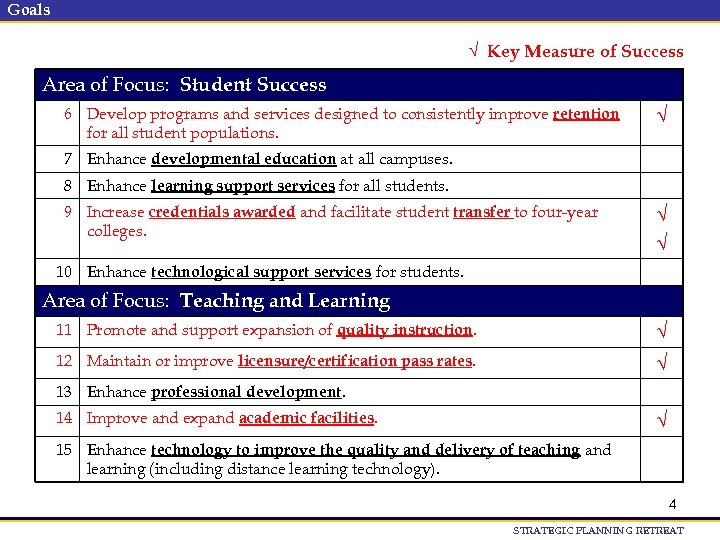 Goals √ Key Measure of Success Area of Focus: Student Success 6 Develop programs and services designed to consistently improve retention for all student populations. √ 7 Enhance developmental education at all campuses. 8 Enhance learning support services for all students. 9 Increase credentials awarded and facilitate student transfer to four-year colleges. √ √ 10 Enhance technological support services for students. Area of Focus: Teaching and Learning 11 Promote and support expansion of quality instruction. √ 12 Maintain or improve licensure/certification pass rates. √ 13 Enhance professional development. √ 14 Improve and expand academic facilities. 15 Enhance technology to improve the quality and delivery of teaching and learning (including distance learning technology). 4 STRATEGIC PLANNING RETREAT
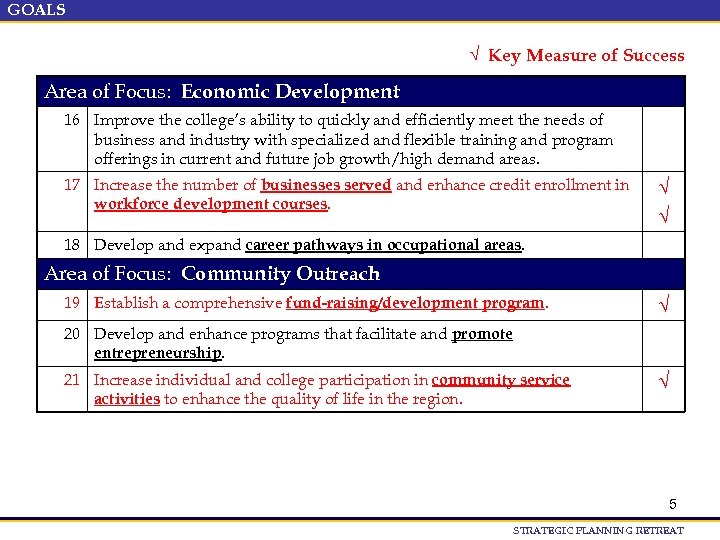 GOALS √ Key Measure of Success Area of Focus: Economic Development 16 Improve the college’s ability to quickly and efficiently meet the needs of business and industry with specialized and flexible training and program offerings in current and future job growth/high demand areas. 17 Increase the number of businesses served and enhance credit enrollment in workforce development courses. √ √ 18 Develop and expand career pathways in occupational areas. Area of Focus: Community Outreach 19 Establish a comprehensive fund-raising/development program. √ 20 Develop and enhance programs that facilitate and promote entrepreneurship. 21 Increase individual and college participation in community service activities to enhance the quality of life in the region. √ 5 STRATEGIC PLANNING RETREAT
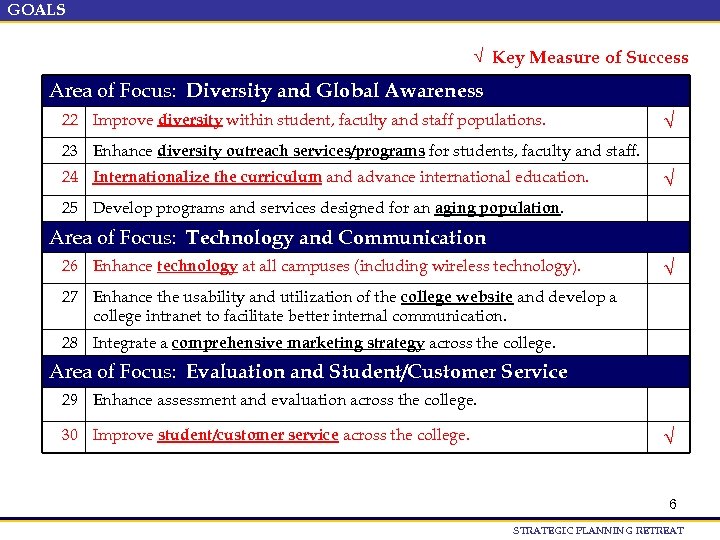 GOALS √ Key Measure of Success Area of Focus: Diversity and Global Awareness 22 Improve diversity within student, faculty and staff populations. √ 23 Enhance diversity outreach services/programs for students, faculty and staff. 24 Internationalize the curriculum and advance international education. √ 25 Develop programs and services designed for an aging population. Area of Focus: Technology and Communication 26 Enhance technology at all campuses (including wireless technology). √ 27 Enhance the usability and utilization of the college website and develop a college intranet to facilitate better internal communication. 28 Integrate a comprehensive marketing strategy across the college. Area of Focus: Evaluation and Student/Customer Service 29 Enhance assessment and evaluation across the college. 30 Improve student/customer service across the college. √ 6 STRATEGIC PLANNING RETREAT
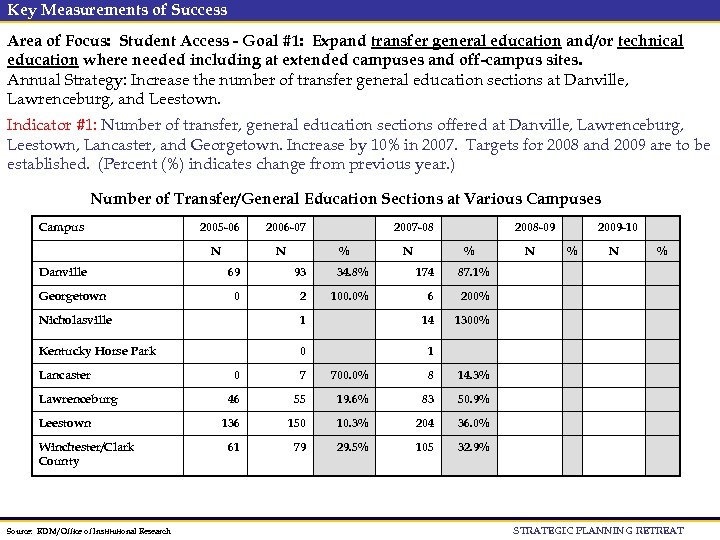 Key Measurements of Success Area of Focus: Student Access - Goal #1: Expand transfer general education and/or technical education where needed including at extended campuses and off-campus sites. Annual Strategy: Increase the number of transfer general education sections at Danville, Lawrenceburg, and Leestown. Indicator #1: Number of transfer, general education sections offered at Danville, Lawrenceburg, Leestown, Lancaster, and Georgetown. Increase by 10% in 2007. Targets for 2008 and 2009 are to be established. (Percent (%) indicates change from previous year. ) Number of Transfer/General Education Sections at Various Campuses Campus 2005 -06 N Danville Georgetown 2006 -07 N 2007 -08 % N 2008 -09 % 69 93 34. 8% 174 2 100. 0% 6 % N % 87. 1% 0 N 2009 -10 200% 1300% Nicholasville 1 14 Kentucky Horse Park 0 1 Lancaster Lawrenceburg Leestown Winchester/Clark County Source: RDM/Office of Institutional Research 0 7 700. 0% 8 14. 3% 46 55 19. 6% 83 50. 9% 136 150 10. 3% 204 36. 0% 61 79 29. 5% 105 32. 9% STRATEGIC PLANNING RETREAT
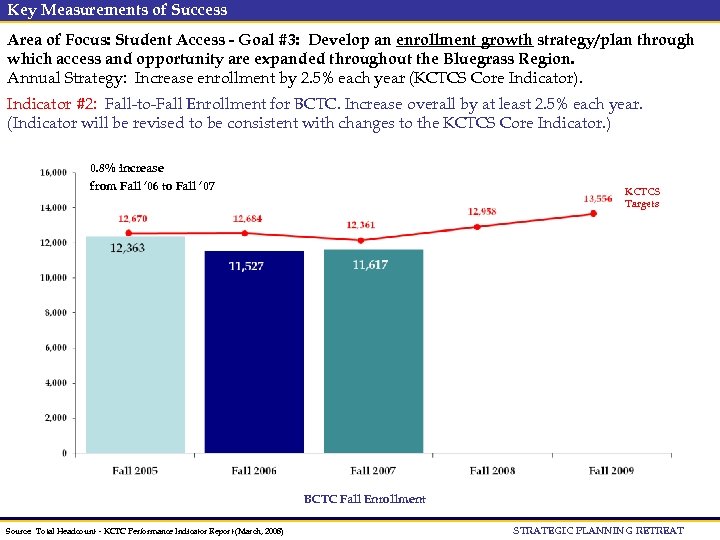 Key Measurements of Success Area of Focus: Student Access - Goal #3: Develop an enrollment growth strategy/plan through which access and opportunity are expanded throughout the Bluegrass Region. Annual Strategy: Increase enrollment by 2. 5% each year (KCTCS Core Indicator). Indicator #2: Fall-to-Fall Enrollment for BCTC. Increase overall by at least 2. 5% each year. (Indicator will be revised to be consistent with changes to the KCTCS Core Indicator. ) 0. 8% increase from Fall ’ 06 to Fall ’ 07 KCTCS Targets BCTC Fall Enrollment Source: Total Headcount – KCTC Performance Indicator Report (March, 2008) STRATEGIC PLANNING RETREAT
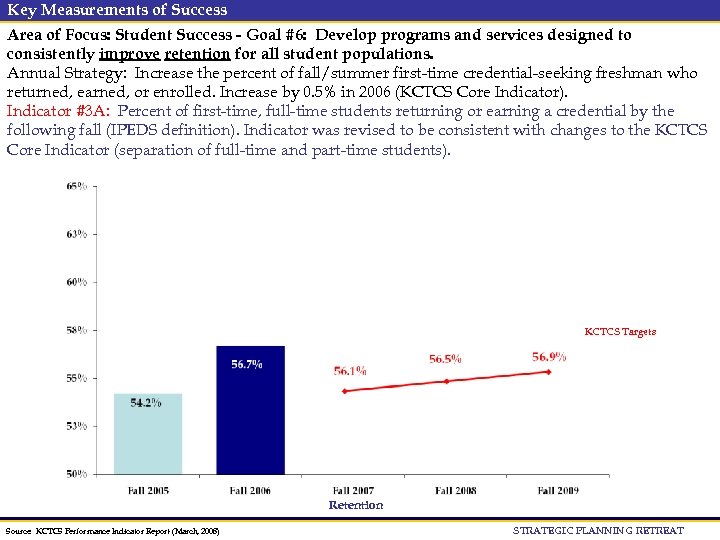 Key Measurements of Success Area of Focus: Student Success - Goal #6: Develop programs and services designed to consistently improve retention for all student populations. Annual Strategy: Increase the percent of fall/summer first-time credential-seeking freshman who returned, earned, or enrolled. Increase by 0. 5% in 2006 (KCTCS Core Indicator). Indicator #3 A: Percent of first-time, full-time students returning or earning a credential by the following fall (IPEDS definition). Indicator was revised to be consistent with changes to the KCTCS Core Indicator (separation of full-time and part-time students). KCTCS Targets Retention Source: KCTCS Performance Indicator Report (March, 2008) STRATEGIC PLANNING RETREAT
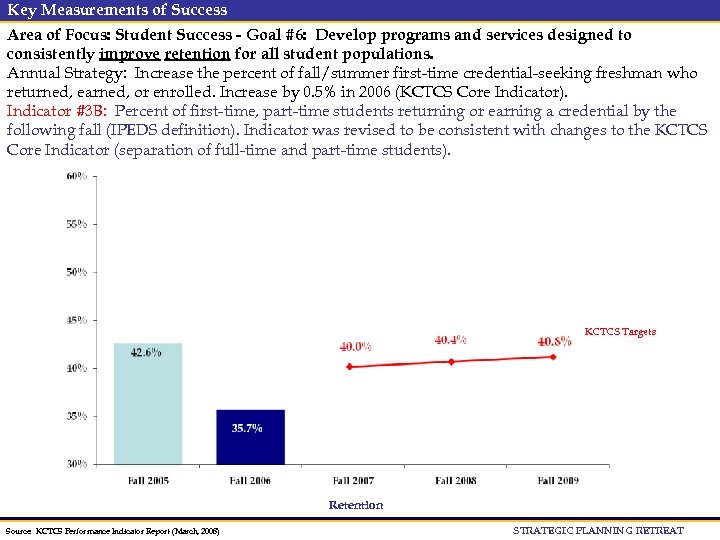 Key Measurements of Success Area of Focus: Student Success - Goal #6: Develop programs and services designed to consistently improve retention for all student populations. Annual Strategy: Increase the percent of fall/summer first-time credential-seeking freshman who returned, earned, or enrolled. Increase by 0. 5% in 2006 (KCTCS Core Indicator). Indicator #3 B: Percent of first-time, part-time students returning or earning a credential by the following fall (IPEDS definition). Indicator was revised to be consistent with changes to the KCTCS Core Indicator (separation of full-time and part-time students). KCTCS Targets Retention Source: KCTCS Performance Indicator Report (March, 2008) STRATEGIC PLANNING RETREAT
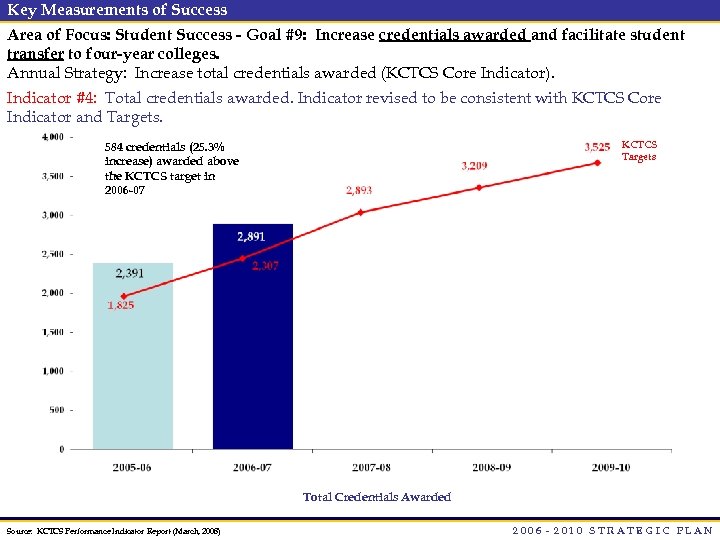 Key Measurements of Success Area of Focus: Student Success - Goal #9: Increase credentials awarded and facilitate student transfer to four-year colleges. Annual Strategy: Increase total credentials awarded (KCTCS Core Indicator). Indicator #4: Total credentials awarded. Indicator revised to be consistent with KCTCS Core Indicator and Targets. KCTCS Targets 584 credentials (25. 3% increase) awarded above the KCTCS target in 2006 -07 Total Credentials Awarded Source: KCTCS Performance Indicator Report (March, 2008) 2006 - 2010 STRATEGIC PLAN
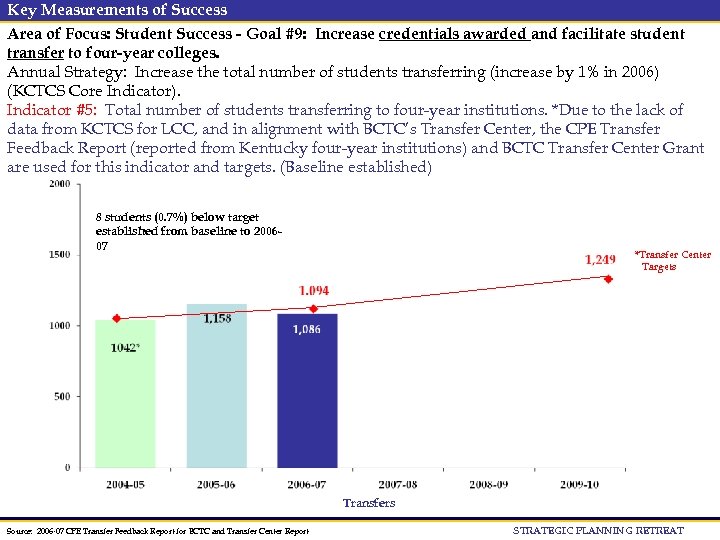 Key Measurements of Success Area of Focus: Student Success - Goal #9: Increase credentials awarded and facilitate student transfer to four-year colleges. Annual Strategy: Increase the total number of students transferring (increase by 1% in 2006) (KCTCS Core Indicator). Indicator #5: Total number of students transferring to four-year institutions. *Due to the lack of data from KCTCS for LCC, and in alignment with BCTC’s Transfer Center, the CPE Transfer Feedback Report (reported from Kentucky four-year institutions) and BCTC Transfer Center Grant are used for this indicator and targets. (Baseline established) 8 students (0. 7%) below target established from baseline to 200607 Target 3887 *Transfer Center Targets Transfers Source: 2006 -07 CPE Transfer Feedback Report for BCTC and Transfer Center Report STRATEGIC PLANNING RETREAT
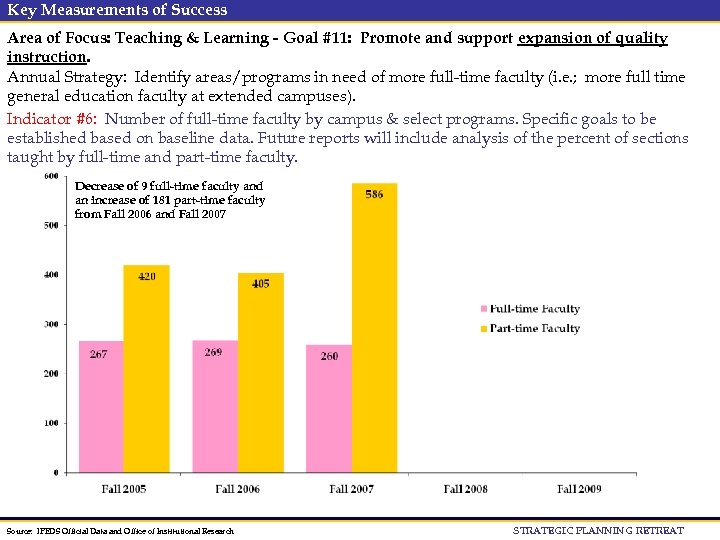 Key Measurements of Success Area of Focus: Teaching & Learning - Goal #11: Promote and support expansion of quality instruction. Annual Strategy: Identify areas/programs in need of more full-time faculty (i. e. ; more full time general education faculty at extended campuses). Indicator #6: Number of full-time faculty by campus & select programs. Specific goals to be established based on baseline data. Future reports will include analysis of the percent of sections taught by full-time and part-time faculty. Decrease of 9 full-time faculty and an increase of 181 part-time faculty from Fall 2006 and Fall 2007 Source: IPEDS Official Data and Office of Institutional Research STRATEGIC PLANNING RETREAT
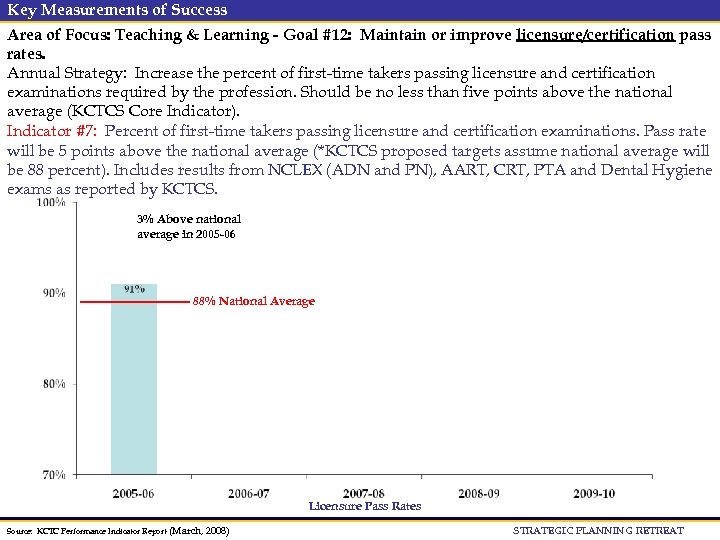 Key Measurements of Success Area of Focus: Teaching & Learning - Goal #12: Maintain or improve licensure/certification pass rates. Annual Strategy: Increase the percent of first-time takers passing licensure and certification examinations required by the profession. Should be no less than five points above the national average (KCTCS Core Indicator). Indicator #7: Percent of first-time takers passing licensure and certification examinations. Pass rate will be 5 points above the national average (*KCTCS proposed targets assume national average will be 88 percent). Includes results from NCLEX (ADN and PN), AART, CRT, PTA and Dental Hygiene exams as reported by KCTCS. 3% Above national average in 2005 -06 88% National Average Licensure Pass Rates Source: KCTC Performance Indicator Report (March, 2008) STRATEGIC PLANNING RETREAT
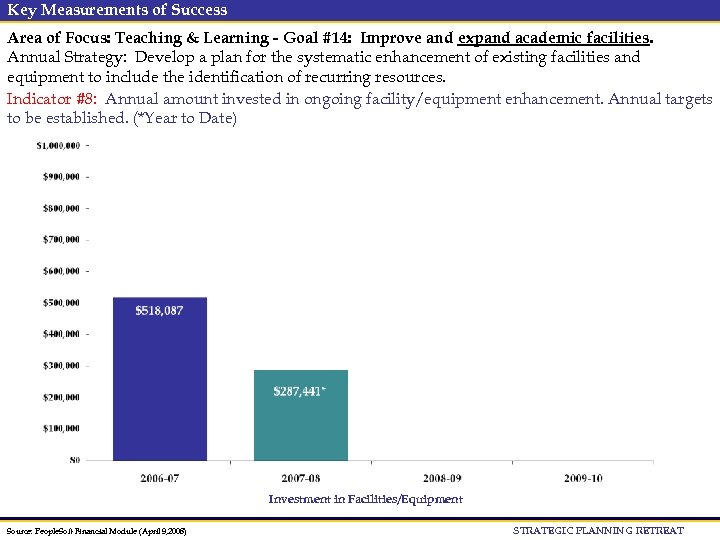 Key Measurements of Success Area of Focus: Teaching & Learning - Goal #14: Improve and expand academic facilities. Annual Strategy: Develop a plan for the systematic enhancement of existing facilities and equipment to include the identification of recurring resources. Indicator #8: Annual amount invested in ongoing facility/equipment enhancement. Annual targets to be established. (*Year to Date) Investment in Facilities/Equipment Source: People. Soft Financial Module (April 9, 2008) STRATEGIC PLANNING RETREAT
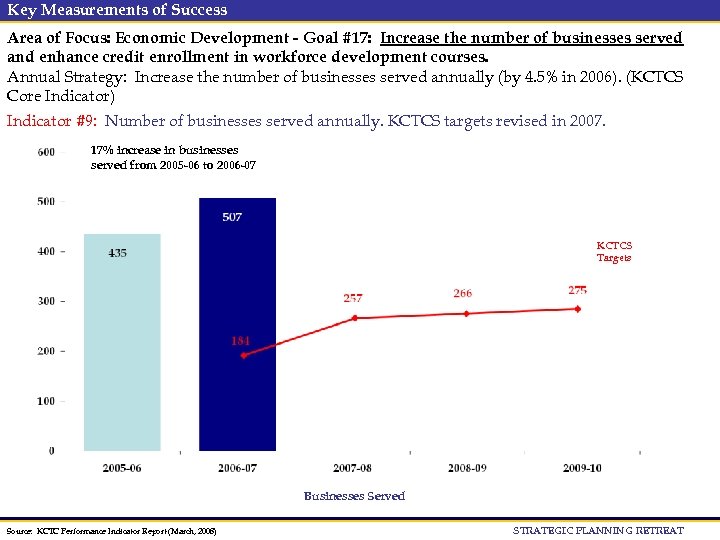 Key Measurements of Success Area of Focus: Economic Development - Goal #17: Increase the number of businesses served and enhance credit enrollment in workforce development courses. Annual Strategy: Increase the number of businesses served annually (by 4. 5% in 2006). (KCTCS Core Indicator) Indicator #9: Number of businesses served annually. KCTCS targets revised in 2007. 17% increase in businesses served from 2005 -06 to 2006 -07 KCTCS Targets Businesses Served Source: KCTC Performance Indicator Report (March, 2008) STRATEGIC PLANNING RETREAT
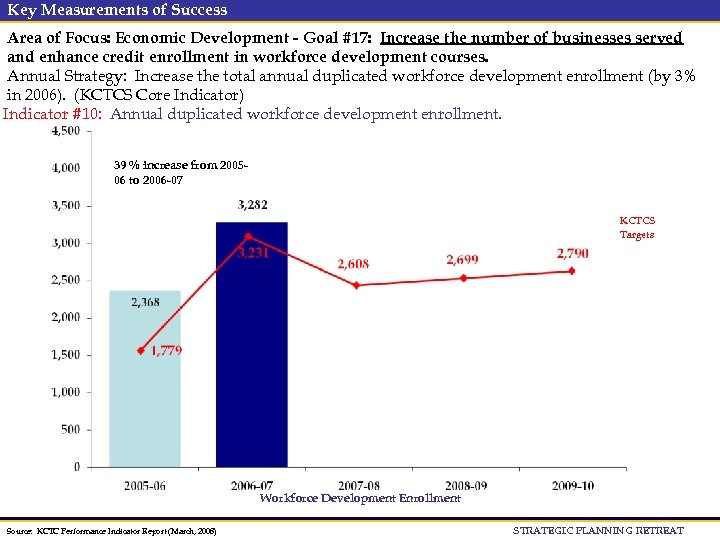 Key Measurements of Success Area of Focus: Economic Development - Goal #17: Increase the number of businesses served and enhance credit enrollment in workforce development courses. Annual Strategy: Increase the total annual duplicated workforce development enrollment (by 3% in 2006). (KCTCS Core Indicator) Indicator #10: Annual duplicated workforce development enrollment. 39 % increase from 200506 to 2006 -07 KCTCS Targets Workforce Development Enrollment Source: KCTC Performance Indicator Report (March, 2008) STRATEGIC PLANNING RETREAT
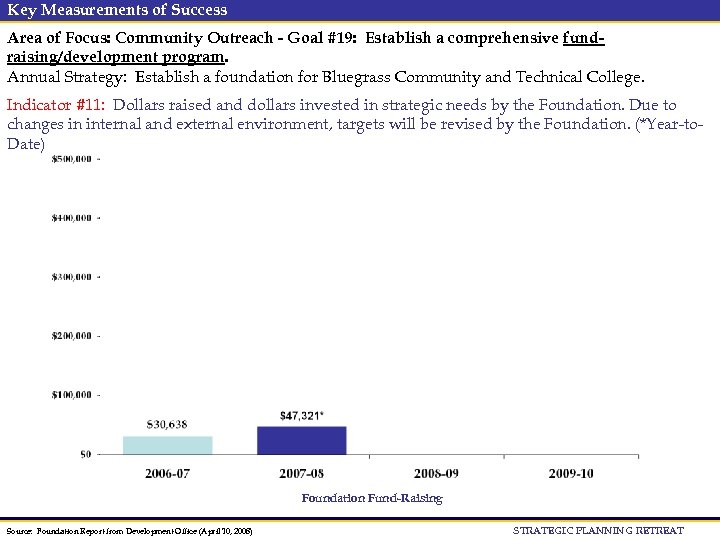 Key Measurements of Success Area of Focus: Community Outreach - Goal #19: Establish a comprehensive fundraising/development program. Annual Strategy: Establish a foundation for Bluegrass Community and Technical College. Indicator #11: Dollars raised and dollars invested in strategic needs by the Foundation. Due to changes in internal and external environment, targets will be revised by the Foundation. (*Year-to. Date) Foundation Fund-Raising Source: Foundation Report from Development Office (April 10, 2008) STRATEGIC PLANNING RETREAT
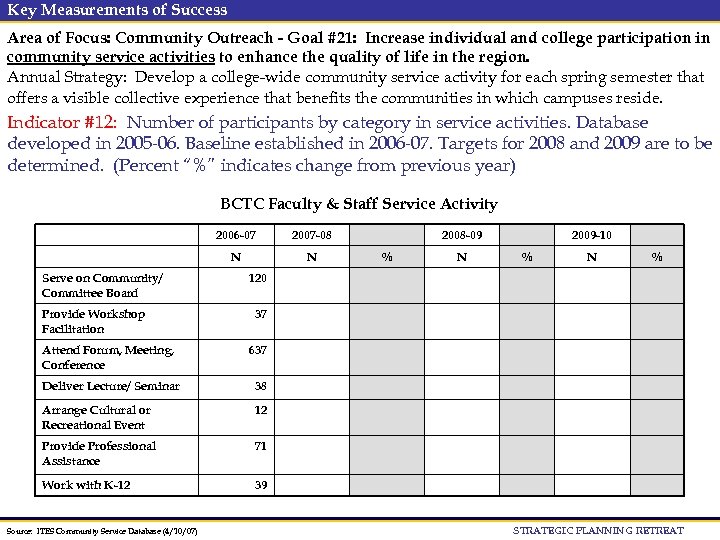 Key Measurements of Success Area of Focus: Community Outreach - Goal #21: Increase individual and college participation in community service activities to enhance the quality of life in the region. Annual Strategy: Develop a college-wide community service activity for each spring semester that offers a visible collective experience that benefits the communities in which campuses reside. Indicator #12: Number of participants by category in service activities. Database developed in 2005 -06. Baseline established in 2006 -07. Targets for 2008 and 2009 are to be determined. (Percent “%” indicates change from previous year) BCTC Faculty & Staff Service Activity 2006 -07 N Serve on Community/ Committee Board Provide Workshop Facilitation 2007 -08 N 2008 -09 % N 2009 -10 % N % 120 37 Attend Forum, Meeting, Conference 637 Deliver Lecture/ Seminar 38 Arrange Cultural or Recreational Event 12 Provide Professional Assistance 71 Work with K-12 39 Source: ITES Community Service Database (4/10/07) STRATEGIC PLANNING RETREAT
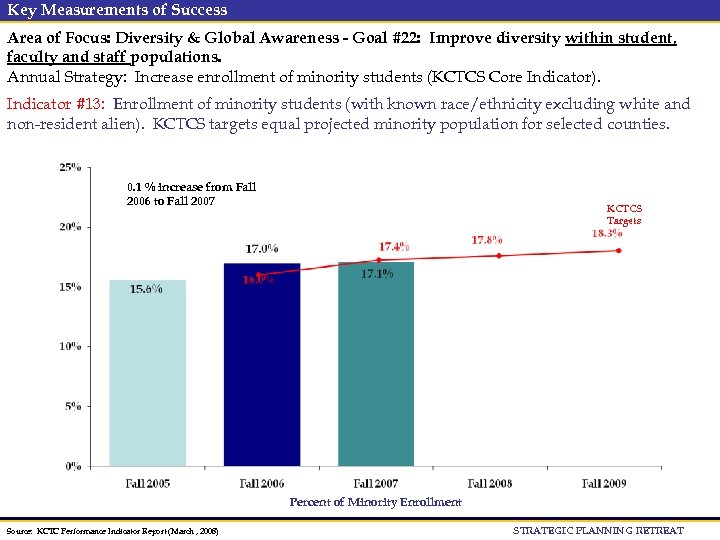 Key Measurements of Success Area of Focus: Diversity & Global Awareness - Goal #22: Improve diversity within student, faculty and staff populations. Annual Strategy: Increase enrollment of minority students (KCTCS Core Indicator). Indicator #13: Enrollment of minority students (with known race/ethnicity excluding white and non-resident alien). KCTCS targets equal projected minority population for selected counties. 0. 1 % increase from Fall 2006 to Fall 2007 KCTCS Targets Percent of Minority Enrollment Source: KCTC Performance Indicator Report (March , 2008) STRATEGIC PLANNING RETREAT
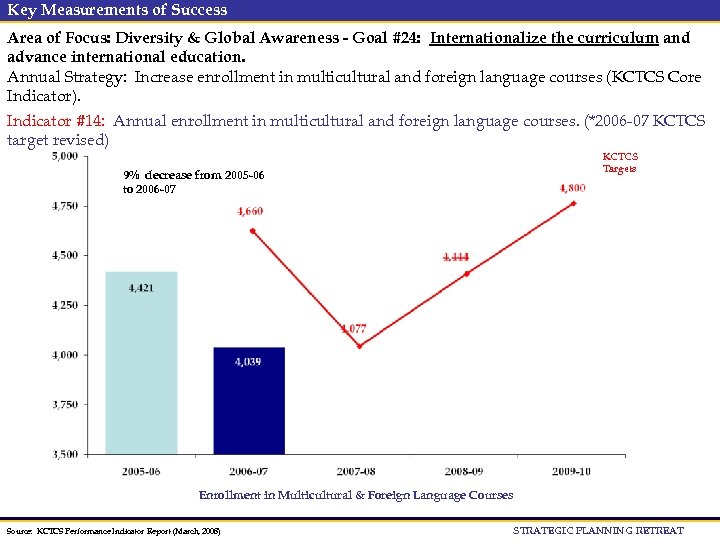 Key Measurements of Success Area of Focus: Diversity & Global Awareness - Goal #24: Internationalize the curriculum and advance international education. Annual Strategy: Increase enrollment in multicultural and foreign language courses (KCTCS Core Indicator). Indicator #14: Annual enrollment in multicultural and foreign language courses. (*2006 -07 KCTCS target revised) 9% decrease from 2005 -06 to 2006 -07 KCTCS Targets Enrollment in Multicultural & Foreign Language Courses Source: KCTCS Performance Indicator Report (March, 2008) STRATEGIC PLANNING RETREAT
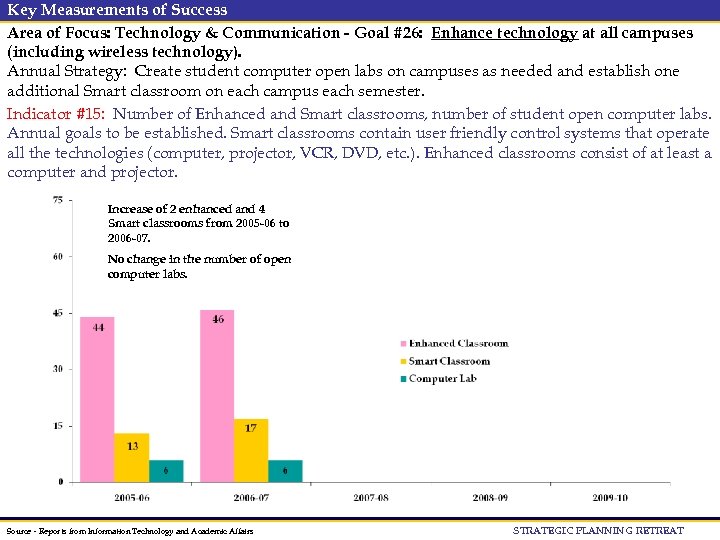 Key Measurements of Success Area of Focus: Technology & Communication - Goal #26: Enhance technology at all campuses (including wireless technology). Annual Strategy: Create student computer open labs on campuses as needed and establish one additional Smart classroom on each campus each semester. Indicator #15: Number of Enhanced and Smart classrooms, number of student open computer labs. Annual goals to be established. Smart classrooms contain user friendly control systems that operate all the technologies (computer, projector, VCR, DVD, etc. ). Enhanced classrooms consist of at least a computer and projector. Increase of 2 enhanced and 4 Smart classrooms from 2005 -06 to 2006 -07. No change in the number of open computer labs. Source – Reports from Information Technology and Academic Affairs STRATEGIC PLANNING RETREAT
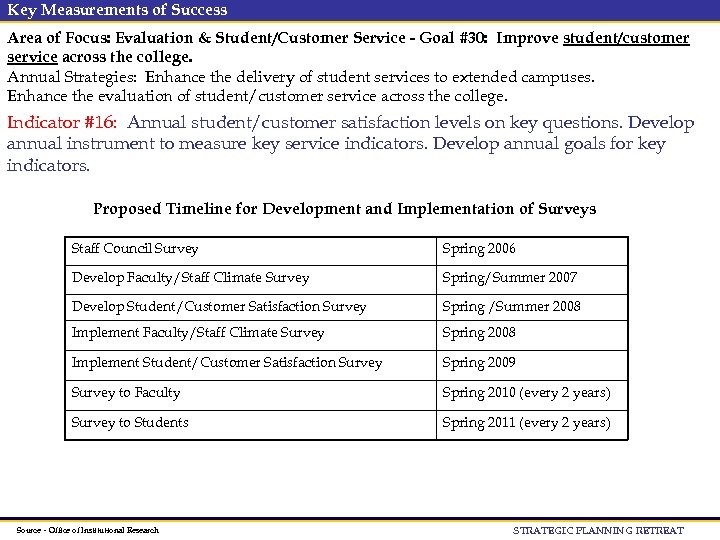 Key Measurements of Success Area of Focus: Evaluation & Student/Customer Service - Goal #30: Improve student/customer service across the college. Annual Strategies: Enhance the delivery of student services to extended campuses. Enhance the evaluation of student/customer service across the college. Indicator #16: Annual student/customer satisfaction levels on key questions. Develop annual instrument to measure key service indicators. Develop annual goals for key indicators. Proposed Timeline for Development and Implementation of Surveys Staff Council Survey Spring 2006 Develop Faculty/Staff Climate Survey Spring/Summer 2007 Develop Student/Customer Satisfaction Survey Spring /Summer 2008 Implement Faculty/Staff Climate Survey Spring 2008 Implement Student/Customer Satisfaction Survey Spring 2009 Survey to Faculty Spring 2010 (every 2 years) Survey to Students Spring 2011 (every 2 years) Source – Office of Institutional Research STRATEGIC PLANNING RETREAT
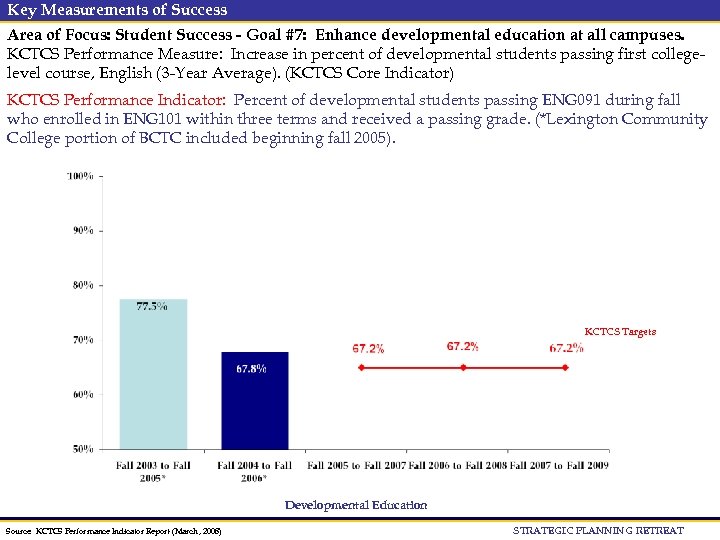 Key Measurements of Success Area of Focus: Student Success - Goal #7: Enhance developmental education at all campuses. KCTCS Performance Measure: Increase in percent of developmental students passing first collegelevel course, English (3 -Year Average). (KCTCS Core Indicator) KCTCS Performance Indicator: Percent of developmental students passing ENG 091 during fall who enrolled in ENG 101 within three terms and received a passing grade. (*Lexington Community College portion of BCTC included beginning fall 2005). KCTCS Targets Developmental Education Source: KCTCS Performance Indicator Report (March , 2008) STRATEGIC PLANNING RETREAT
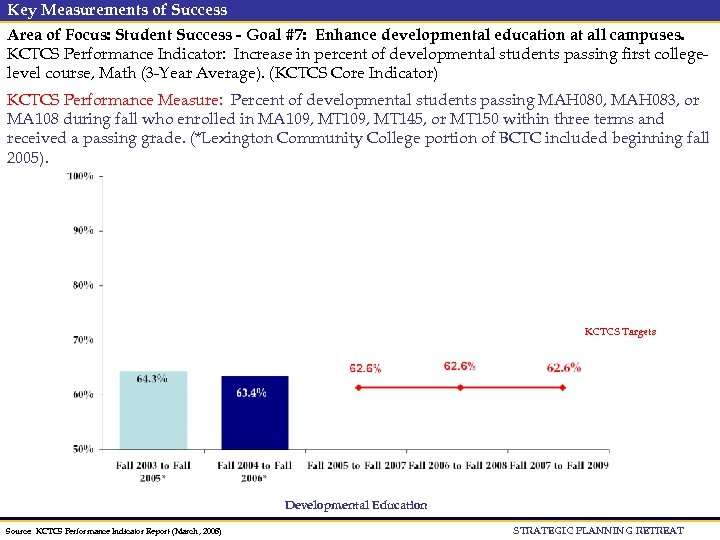 Key Measurements of Success Area of Focus: Student Success - Goal #7: Enhance developmental education at all campuses. KCTCS Performance Indicator: Increase in percent of developmental students passing first collegelevel course, Math (3 -Year Average). (KCTCS Core Indicator) KCTCS Performance Measure: Percent of developmental students passing MAH 080, MAH 083, or MA 108 during fall who enrolled in MA 109, MT 145, or MT 150 within three terms and received a passing grade. (*Lexington Community College portion of BCTC included beginning fall 2005). KCTCS Targets Developmental Education Source: KCTCS Performance Indicator Report (March , 2008) STRATEGIC PLANNING RETREAT
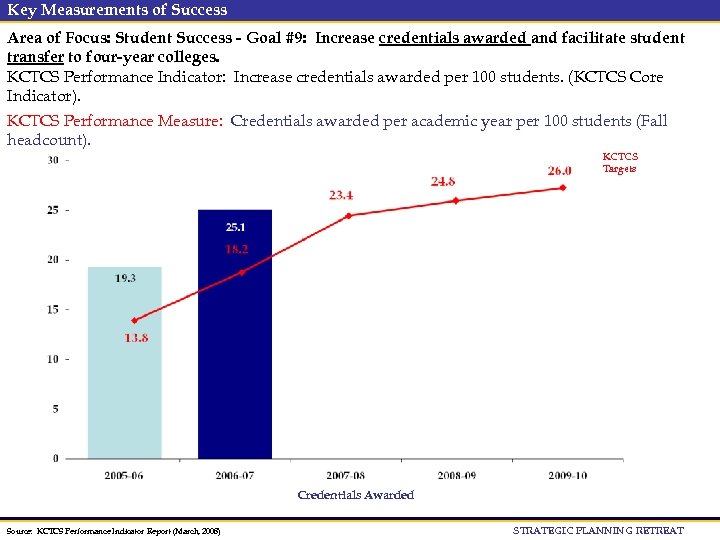 Key Measurements of Success Area of Focus: Student Success - Goal #9: Increase credentials awarded and facilitate student transfer to four-year colleges. KCTCS Performance Indicator: Increase credentials awarded per 100 students. (KCTCS Core Indicator). KCTCS Performance Measure: Credentials awarded per academic year per 100 students (Fall headcount). KCTCS Targets Credentials Awarded Source: KCTCS Performance Indicator Report (March, 2008) STRATEGIC PLANNING RETREAT
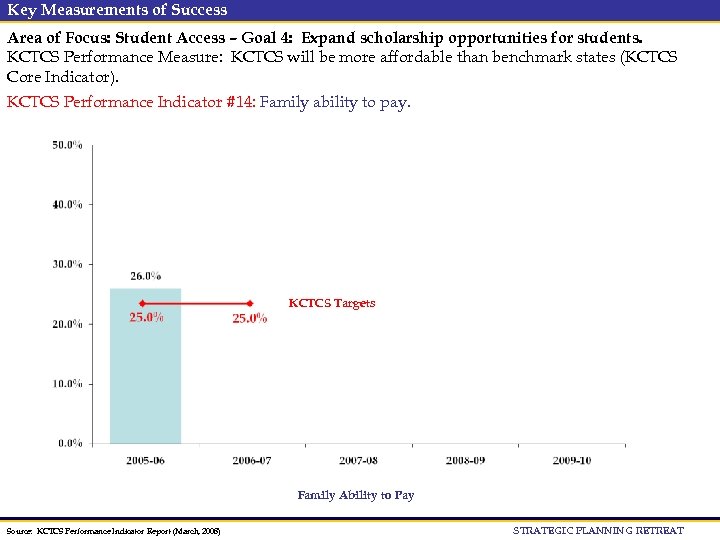 Key Measurements of Success Area of Focus: Student Access – Goal 4: Expand scholarship opportunities for students. KCTCS Performance Measure: KCTCS will be more affordable than benchmark states (KCTCS Core Indicator). KCTCS Performance Indicator #14: Family ability to pay. KCTCS Targets Family Ability to Pay Source: KCTCS Performance Indicator Report (March, 2008) STRATEGIC PLANNING RETREAT