


 Скачать презентацию Strategic Plan 2015 16 2019 20 AND Annual Performance
434bdc5a54362395555ea878bb853d04.ppt
- Количество слайдов: 68
 Strategic Plan 2015/16 – 2019/20 AND Annual Performance Plan 2015/16 1 1
 Presentation Outline • Introduction • Strategic Overview – Vision, Mission, Values – Constitutional, Legislative and Policy Mandates – Planned Policy Initiatives • Situational Analysis – Performance and Organisational Environment – Do. T Strategic Planning Process • • Do. T Strategic Outcome-Oriented Goals & Objectives Planned Initiatives over the MTSF and MTEF Resource Considerations Risk Management Links to Long Term Infrastructure and Other Plans Conditional Grants Public Entities Public-Private Partnerships 2
 Introduction • Do. T Strategic Plan 2015/16 – 2019/20 and Annual Performance Plan 2015/16 was guided by the National Development Plan (NDP) 2030, the New Growth Path (NGP) Framework, the Industrial Policy Action Plan (IPAP) and the National Infrastructure Plan (NIP) • African Union Agenda 2063 vision of “an integrated, prosperous and peaceful Africa, driven by its own citizens and representing a dynamic force in the global arena” will also drive the Do. T efforts of enhancing regional and continental integration • Do. T will also support the Back-to-Basics call made by Minister of Co. GTA to strengthen and enhance performance of local government 3
 STRATEGIC OVERVIEW 4
 Do. T Vision & Mission VISION “Transport, the Heartbeat of Economic Growth and Social Development” MISSION To lead the development of efficient integrated transport systems by creating a framework of sustainable policies and regulations; and implementable models to support government strategies for socio-economic development. 5
 Do. T Values • Maintain fairness and equity in all our operations; • Strive for quality and affordable transport for all; • Stimulate innovation in the transport sector; transparency, accountability monitoring of all operations; and • Ensure sustainability, financial affordability, accessibility as well as upholding of the Batho Pele principles. 6
 Constitutional Mandate • Constitution identifies legislative responsibilities for three spheres of government with regard to airports, roads, traffic management and public transport. • Transport function legislated and executed at all three levels of government. • Implementation at national level done through entities and overseen by the Do. T. • Do. T responsible for conducting research; formulating legislation and policies; assigning responsibilities to entities and other spheres; regulating through setting norms and standards; and monitoring and evaluation. 7
 Legislative Mandate The entire legislative mandate of the Department of Transport is derived from its constitutional mandate. The Do. T is thus primarily responsible for Acts related to: • • • Railways and Harbours; Shipping; Roads, Motor Vehicles; and Civil Aviation. 8
 Policy Mandate • National White Paper on Transport Policy, 1996 • White paper on National Policy on Airports and Airspace Management, 1997 • National Commercial Ports Policy, 2002 • Taxi Recapitalisation Policy, 2009 9
 Policy Initiatives over the MTSF • Review of the White Paper on the National Transport Policy • Finalisation of the White Paper on the National Railway Policy • Development of the White Paper on the Roads Policy • Finalisation of the National Civil Aviation Policy • Finalisation of the White Paper on the National Maritime Policy • Development of the Cabotage Policy for Coastal, Regional and Continental Waters • Finalisation of the National Learner Transport Policy 10
 SITUATIONAL ANALYSIS 11
 Performance Environment Background • Do. T exist to ensure provision of safe, reliable, effective, efficient, affordable and integrated transport services that best meet needs of passenger and freight users • Major challenges facing transport sector in meeting its mandate – infrastructure development, – maintenance and – strategic expansion of its network • Common problem – rate of deterioration of existing infrastructure and – inadequate capital investment to meet required maintenance and expansion 12
 Performance Environment Background • NDP 2030 – Radical Economic Transformation as a catalyst for accelerated economic growth and job creation – Stimulate productivity – Improve efficiencies – Accelerate elimination of inequality • NDP growth target – 5% by 2019. This will be achieved through: – Private sector partnerships to unlock obstacles for investment • Government investment (MTSF 2014 – 2019) – R 847 billion on infrastructure (manufacture of busses); R 50 billion – Transnet locomotive contract and PRASA passenger rail projects 13
 Performance Environment • MTSF 2014 – 2019 approved July 2014 as comprehensive implementation plan of NDP and ruling party manifesto • Minister’s delivery agreement to implement transport related issues in the MTSF – Outcome 4: Decent Employment Through inclusive Growth – Outcome 6: An Efficient, Competitive and Responsive Economic Infrastructure – Outcome 7: Comprehensive Rural Development and Land Reform – Outcome 10: Protect and Enhance Our Environmental Assets and natural Resources 14
 Performance Environment Outcome 4 – Decent employment through inclusive economic growth Sub-Outcome 1: Productive investment is effectively crowded in through the infrastructure build programme • Ensure monitoring of off-takes by end users on the infrastructure programme 15
 Performance Environment Outcome 6 – An efficient, competitive and responsive economic infrastructure Sub-Outcome 1: Regulation, funding and investment improved • Establish a Single Transport Economic Regulator (STER) by December 2016 • Develop a Private Sector Participation Framework for ports and freight rail, removing barriers to entry for private investment and operations within the context of Cabinet-approved policy and with an analysis of the implication of tariffs 16
 Performance Environment Outcome 6 – An efficient, competitive and responsive economic infrastructure Sub-Outcome 3: Maintenance, strategic expansion, operational efficiency, capacity and competitiveness of our logistics and transport infrastructure ensured. • Improve and preserve national, provincial and local road infrastructure; • Strengthen road traffic management; • Improve public transport • Strengthen institutional arrangements for public transport 17
 Performance Environment Outcome 6 – An efficient, competitive and responsive economic infrastructure Sub-Outcome 3: Maintenance, strategic expansion, operational efficiency, capacity and competitiveness of our logistics and transport infrastructure ensured. • Improve national transport planning to develop long-term plans for transport that synchronize with spatial planning and align infrastructure investment activities of provincial and local government and clearly communicate the state’s transport vision to the private sector • Ensure development and approval of the Integrated Transport Plan by June 2016 • Develop and implement approved plan and improve market share of containers on rail vs road, to ensure that we move road freight to rail 18
 Performance Environment Outcome 6 – An efficient, competitive and responsive economic infrastructure Sub-Outcome 6: Coordination, planning, integration and monitoring implementation of strategic integrated projects in the National Infrastructure Plan • SIP 1: Unlocking the Northern Mineral Belt – N 11 Ermelo to Hendrina Full Rehabilitation Project – SANRAL – Moloto Rail Corridor – PRASA • SIP 2: Durban-Free State-Gauteng Logistics and Industrial Corridor projects – N 2 De Beers Pass (Harrismith Hub) 19
 Performance Environment Outcome 6 – An efficient, competitive and responsive economic infrastructure Sub-Outcome 6: Coordination, planning, integration and monitoring implementation of strategic integrated projects in the National Infrastructure Plan • SIP 3: South Eastern Node and Corridor Development – N 2 Wildcoast – SANRAL – Mthatha Airport: upgrade of airport, landing aids, fencing and roads • SIP 4: Unlocking economic opportunities in the North West Province 20
 Performance Environment Outcome 6 – An efficient, competitive and responsive economic infrastructure Sub-Outcome 6: Coordination, planning, integration and monitoring implementation of strategic integrated projects in the National Infrastructure Plan • SIP 7: Integrated Urban Space and Public Transport Programme – Integrated Public Transport Networks in 13 cities (Cape Town, Tshwane, Johannesburg, e. Thekwini, Rustenburg, Nelson Mandela Bay, Ekurhuleni, Polokwane, Msunduzi, Mangaung, Mbombela, Buffalo City) 21
 Performance Environment Outcome 7 – Comprehensive Land Reform Rural Development and Sub-Outcome 5: Increased access to quality infrastructure and functional services, particularly in education, healthcare and public transport in rural areas • Improve transport infrastructure and public transport in rural areas • Access Road Development Plan for improving rural road infrastructure implemented • % of district municipalities implementing the Integrated Public Transport Network Strategy 22
 Performance Environment Outcome 10 – Protect and enhance our environmental assets and natural resources Sub-Outcome 2: An effective climate change mitigation and adaptation response • Develop strategic policy and regulatory frameworks and programmes to promote a low carbon economy; • Green Transport Strategy and Implementation Plan formulated and completed by March 2018 23
 Performance Environment Key Areas of Service Delivery over the MTSF: 1. Efficient and integrated Infrastructure Network and Operations • Private Sector Participation Framework • National Transport Master Plan (NATMAP 2050) • Single Transport Economic Regulator • Transport Infrastructure Build Interventions – – Integrated Transport Networks Provincial Road Maintenance Programme (PRMG) PRASA Capital Expenditure Programme Harrismith Hub 24
 Performance Environment Key Areas of Service Delivery over the MTSF: 2. A Transport Sector that is Safe and Secure • Reduction of road fatalities by half based on 2010 figures – UN Decade of Action for Road Safety Resolution 64/255 • Adjudication of Administrative Road Traffic Offences Amendment Act • National Railway Safety Regulator Amendment Act • National Railway Safety Strategy • Civil Aviation Amendment Act and Regulations • Merchant Shipping Act • Inland Waterway Strategy 25
 Performance Environment Key Areas of Service Delivery over the MTSF: 3. Improved Rural Access, Infrastructure and Mobility • Access Road Development Plans to improve rural road infrastructure • Integrated Public Transport Network plans in rural municipalities • Review of the Rural Transport Strategy to enhance access and mobility in rural space • National Learner Transport Policy to provide norms and standards; and operational guidelines for learner transportation especially in rural areas 26
 Performance Environment Key Areas of Service Delivery over the MTSF: 4. Improved Public Transport Services • Planning and construction of Bus Rapid Transit (BRT) systems in identified local and metropolitan municipalities • Review of the Public Transport Strategy • Review of the Taxi Recapitalisation Programme • Integrated Public Transport Turnaround Plan to optimise public transport service offerings in rural and urban spaces • Amendment of the National Land Transport Act and development of regulations to enhance public transport regulation 27
 Performance Environment Key Areas of Service Delivery over the MTSF: 5. Contribution to Job Creation • Off-takes of the Provincial Road Maintenance Programme – 60% employment and empowerment in road infrastructure – 40% of the grant allocated to pothole patching (Operation Tselantle) – 6 000 work opportunities to be created – women, youth and people with disabilities • Off-takes of the Rolling Stock Renewal Programme – 8 088 direct and 33 000 indirect jobs to be created over 10 years duration of contract to revamp ailing rail infrastructure • Implementation of the African Maritime Charter • Skill development and youth job readiness – 5 163 graduates currently in internship programmes in the transport sector. 28
 Performance Environment Key Areas of Service Delivery over the MTSF: 6. Contribution to Environmental Protection • Green Transport Strategy to reduce sector GHG emissions • Regulations to phase out the Chapter 2 Aircraft to assist in reducing aviation noise • Ratification and implementation of relevant maritime conventions to minimise pollution at sea 29
 Organisational Environment • Internal challenges of structural alignment and allocation of resources (human, financial, facilities and equipment) will be continually optimised to ensure economic, efficient and effective performance and improvement of service delivery • Reduction of vacancy rate and strengthening of knowledge and information systems will be priorities for the medium term • Simplified organisation structure of the Do. T puts emphasis on modes of transport and complementing this modal emphasis are two cross-cutting programmes that seek to provide strategic administrative and technical support – Administration and Integrated Transport Planning. 30
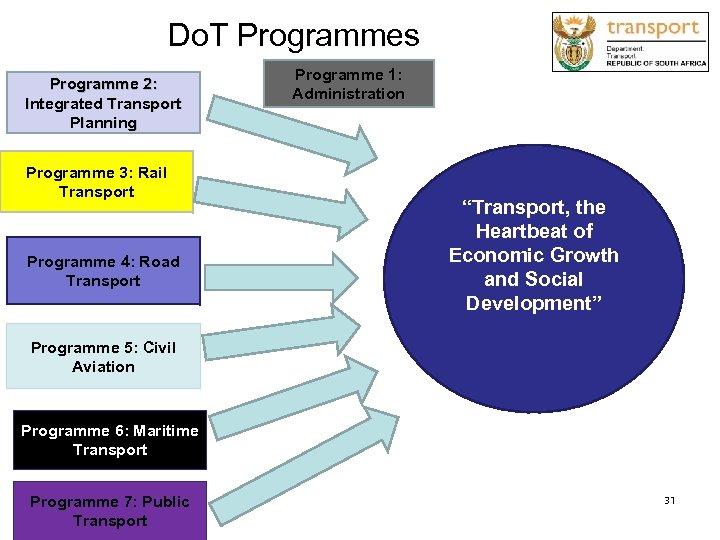 Do. T Programmes Programme 2: Integrated Transport Planning Programme 3: Rail Transport Programme 4: Road Transport Programme 1: Administration “Transport, the Heartbeat of Economic Growth and Social Development” Programme 5: Civil Aviation Programme 6: Maritime Transport Programme 7: Public Transport 31
 Do. T Strategic Planning Process • Relevance and appropriateness of Strategic Outcome-oriented Goals and Objectives re-assessed to ensure adequate interventions to identified sector challenges • Approach and Interventions re-prioritised in line with the new Radical Economic Transformation stance of the NDP and MTSF • Preliminary planning sessions conducted per programme, comprising of key modal stakeholders • First and Second Drafts of the Strategic Plan and Annual Performance Plan compiled and submitted to the DPME in August and November 2014 respectively. • Sector-wide strategic planning session hosted in January 2015 and final drafts of the SP and APP submitted to Internal Audit and the Auditor. General for pre-audit exercise, approved by Executive Authority and submitted to Parliament for tabling on the 11 th March 2015. 32
 STRATEGIC OUTCOMEORIENTED GOALS AND OBJECTIVES 33
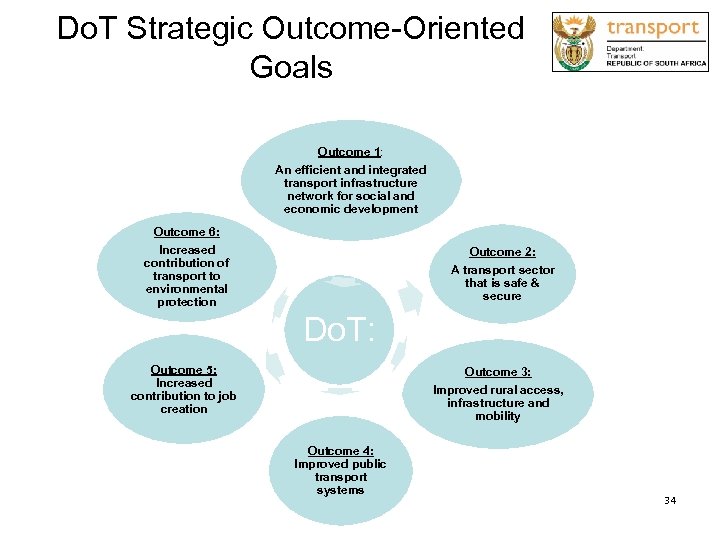 Do. T Strategic Outcome-Oriented Goals Outcome 1: An efficient and integrated transport infrastructure network for social and economic development Outcome 6: Increased contribution of transport to environmental protection Outcome 2: A transport sector that is safe & secure Do. T: Outcome 5: Increased contribution to job creation Outcome 3: Improved rural access, infrastructure and mobility Outcome 4: Improved public transport systems 34
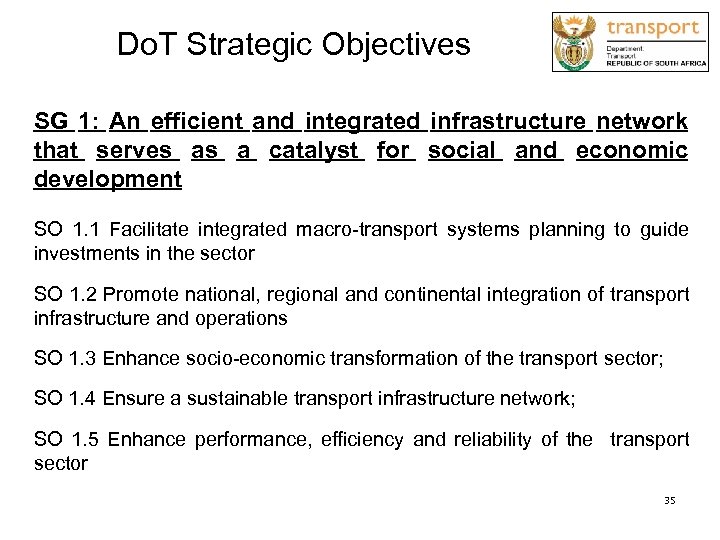 Do. T Strategic Objectives SG 1: An efficient and integrated infrastructure network that serves as a catalyst for social and economic development SO 1. 1 Facilitate integrated macro-transport systems planning to guide investments in the sector SO 1. 2 Promote national, regional and continental integration of transport infrastructure and operations SO 1. 3 Enhance socio-economic transformation of the transport sector; SO 1. 4 Ensure a sustainable transport infrastructure network; SO 1. 5 Enhance performance, efficiency and reliability of the transport sector 35
 Do. T Strategic Objectives SG 2: A transport sector that is safe and secure SO 2. 1 Regulate and enhance transport safety and security 36
 Do. T Strategic Objectives SG 3: Improved rural access, infrastructure and mobility SO 3. 1 Provide integrated rural transport infrastructure and services 37
 Do. T Strategic Objectives SG 4: Improved public transport services SO 4. 1 Promote sustainable public transport; SO 4. 2 Improve public transport access and reliability SO 4. 3 Regulate public transport 38
 Do. T Strategic Objectives SG 5: Increased contribution to job creation SO 5. 1 Monitor off-takes of the implementation of the provincial road maintenance programme SO 5. 2 Develop and implement relevant charters and legislation 39
 Do. T Strategic Objectives SG 6: Increased contribution environmental protection to transport to SO 6. 1 Reduce GHG emissions SO 6. 2 Minimise aviation noise SO 6. 3 Reduce level of pollution at sea 40
 Do. T Strategic Objectives SG 7: Effective and efficient management and support SO 7. 1 Provide strategic support and corporate services SO 7. 2 Ensure good governance and a sound control environment 41
 PLANNED INITIATIVES OVER THE MTSF AND MTEF 42
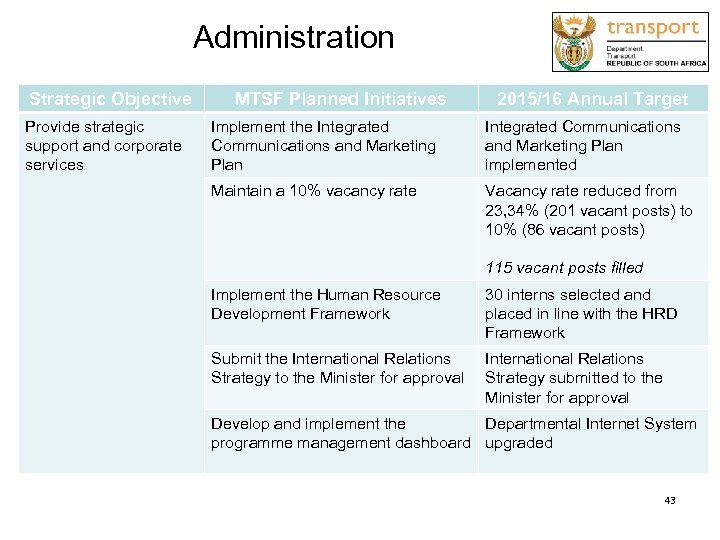 Administration Strategic Objective Provide strategic support and corporate services MTSF Planned Initiatives 2015/16 Annual Target Implement the Integrated Communications and Marketing Plan implemented Maintain a 10% vacancy rate Vacancy rate reduced from 23, 34% (201 vacant posts) to 10% (86 vacant posts) 115 vacant posts filled Implement the Human Resource Development Framework 30 interns selected and placed in line with the HRD Framework Submit the International Relations Strategy to the Minister for approval International Relations Strategy submitted to the Minister for approval Develop and implement the Departmental Internet System programme management dashboard upgraded 43
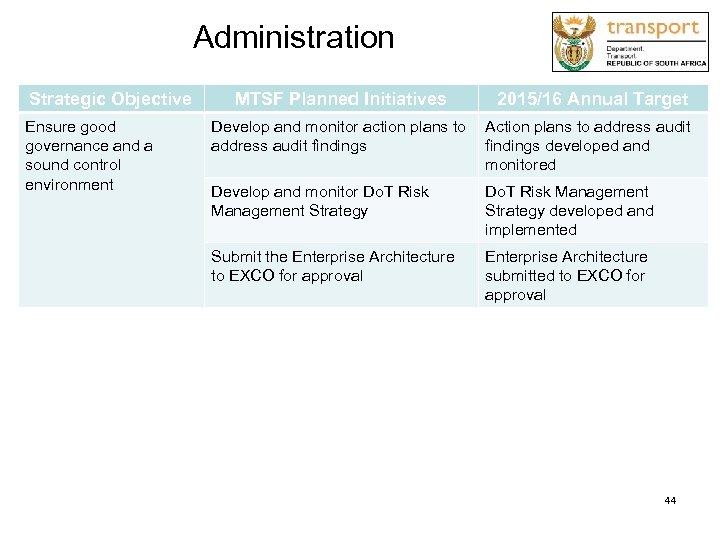 Administration Strategic Objective Ensure good governance and a sound control environment MTSF Planned Initiatives 2015/16 Annual Target Develop and monitor action plans to Action plans to address audit findings developed and monitored Develop and monitor Do. T Risk Management Strategy developed and implemented Submit the Enterprise Architecture to EXCO for approval Enterprise Architecture submitted to EXCO for approval 44
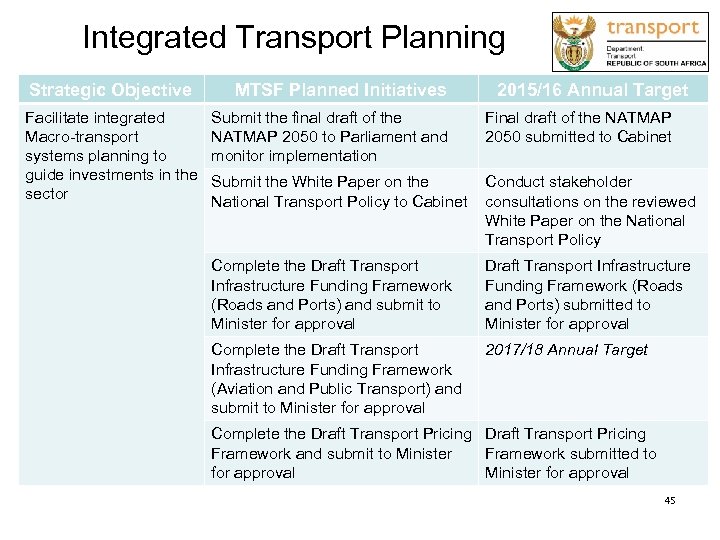 Integrated Transport Planning Strategic Objective Facilitate integrated Macro-transport systems planning to guide investments in the sector MTSF Planned Initiatives 2015/16 Annual Target Submit the final draft of the NATMAP 2050 to Parliament and monitor implementation Final draft of the NATMAP 2050 submitted to Cabinet Submit the White Paper on the National Transport Policy to Cabinet Conduct stakeholder consultations on the reviewed White Paper on the National Transport Policy Complete the Draft Transport Infrastructure Funding Framework (Roads and Ports) and submit to Minister for approval Draft Transport Infrastructure Funding Framework (Roads and Ports) submitted to Minister for approval Complete the Draft Transport Infrastructure Funding Framework (Aviation and Public Transport) and submit to Minister for approval 2017/18 Annual Target Complete the Draft Transport Pricing Framework and submit to Minister Framework submitted to for approval Minister for approval 45
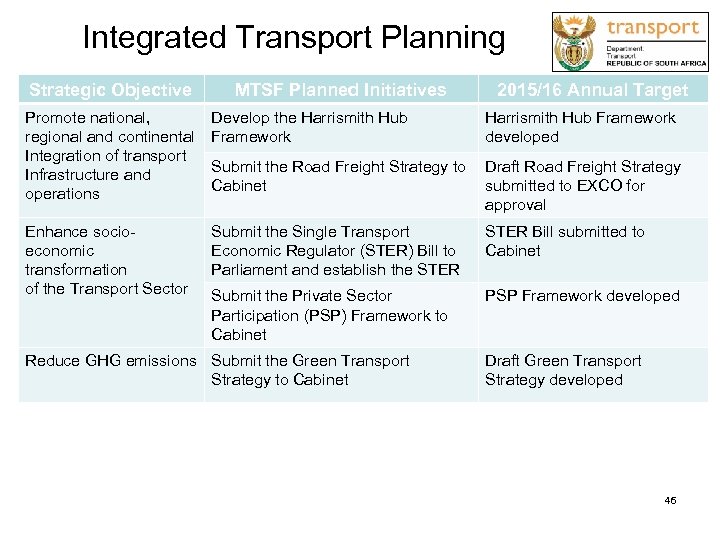 Integrated Transport Planning Strategic Objective MTSF Planned Initiatives 2015/16 Annual Target Promote national, regional and continental Integration of transport Infrastructure and operations Develop the Harrismith Hub Framework developed Submit the Road Freight Strategy to Cabinet Draft Road Freight Strategy submitted to EXCO for approval Enhance socio- economic transformation of the Transport Sector Submit the Single Transport Economic Regulator (STER) Bill to Parliament and establish the STER Bill submitted to Cabinet Submit the Private Sector Participation (PSP) Framework to Cabinet PSP Framework developed Reduce GHG emissions Submit the Green Transport Strategy to Cabinet Draft Green Transport Strategy developed 46
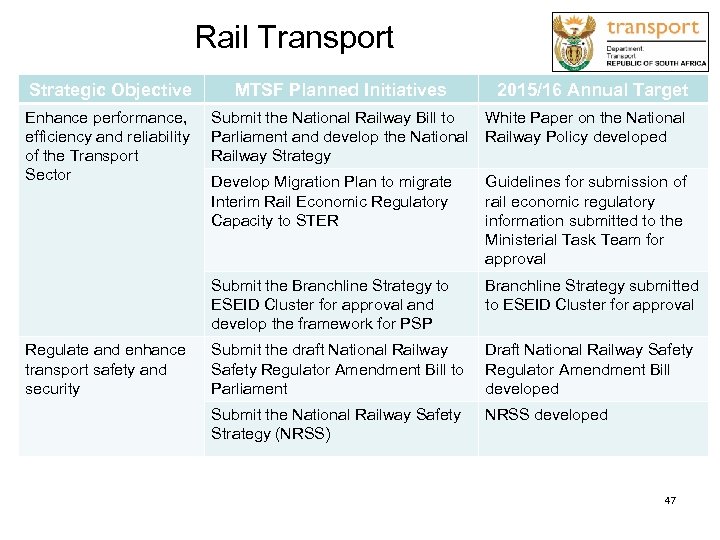 Rail Transport Strategic Objective Enhance performance, efficiency and reliability of the Transport Sector MTSF Planned Initiatives 2015/16 Annual Target Submit the National Railway Bill to White Paper on the National Parliament and develop the National Railway Policy developed Railway Strategy Guidelines for submission of rail economic regulatory information submitted to the Ministerial Task Team for approval Submit the Branchline Strategy to ESEID Cluster for approval and develop the framework for PSP Regulate and enhance transport safety and security Develop Migration Plan to migrate Interim Rail Economic Regulatory Capacity to STER Branchline Strategy submitted to ESEID Cluster for approval Submit the draft National Railway Safety Regulator Amendment Bill to Parliament Draft National Railway Safety Regulator Amendment Bill developed Submit the National Railway Safety Strategy (NRSS) NRSS developed 47
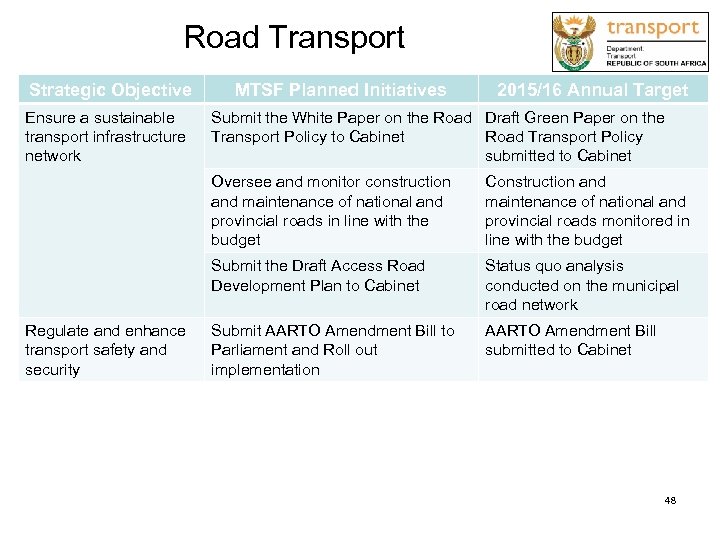 Road Transport Strategic Objective Ensure a sustainable transport infrastructure network MTSF Planned Initiatives 2015/16 Annual Target Submit the White Paper on the Road Draft Green Paper on the Transport Policy to Cabinet Road Transport Policy submitted to Cabinet Oversee and monitor construction and maintenance of national and provincial roads in line with the budget Submit the Draft Access Road Development Plan to Cabinet Regulate and enhance transport safety and security Construction and maintenance of national and provincial roads monitored in line with the budget Status quo analysis conducted on the municipal road network Submit AARTO Amendment Bill to Parliament and Roll out implementation AARTO Amendment Bill submitted to Cabinet 48
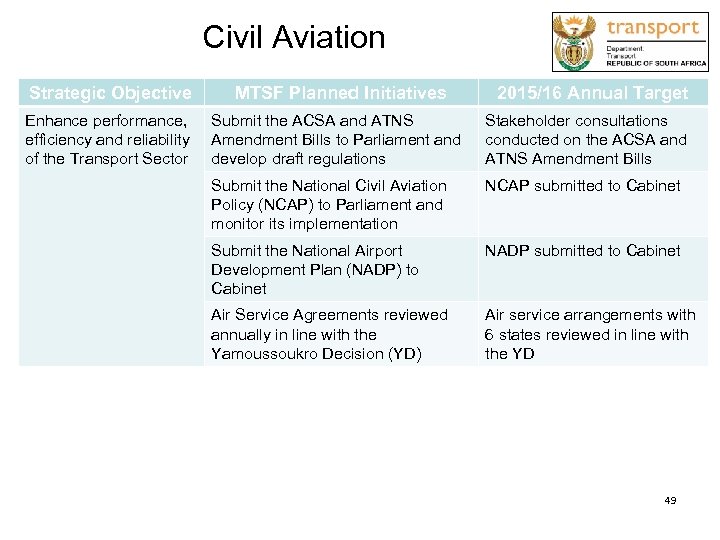 Civil Aviation Strategic Objective MTSF Planned Initiatives 2015/16 Annual Target Enhance performance, efficiency and reliability of the Transport Sector Submit the ACSA and ATNS Amendment Bills to Parliament and develop draft regulations Stakeholder consultations conducted on the ACSA and ATNS Amendment Bills Submit the National Civil Aviation Policy (NCAP) to Parliament and monitor its implementation NCAP submitted to Cabinet Submit the National Airport Development Plan (NADP) to Cabinet NADP submitted to Cabinet Air Service Agreements reviewed annually in line with the Yamoussoukro Decision (YD) Air service arrangements with 6 states reviewed in line with the YD 49
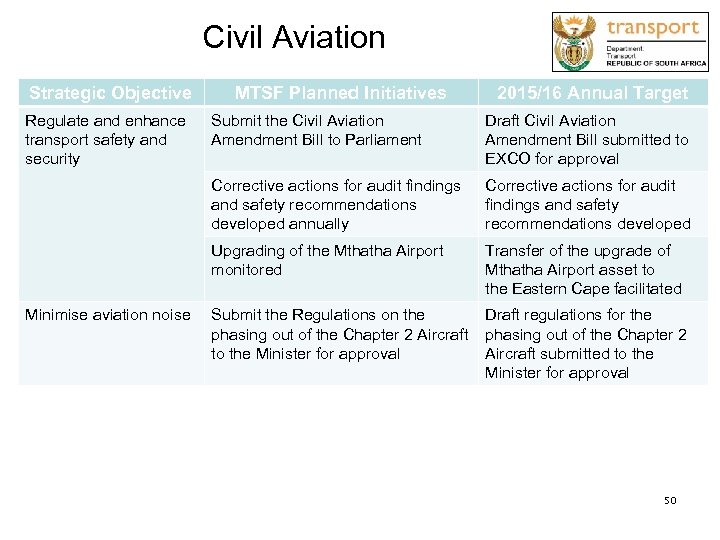 Civil Aviation Strategic Objective Regulate and enhance transport safety and security MTSF Planned Initiatives 2015/16 Annual Target Draft Civil Aviation Amendment Bill submitted to EXCO for approval Corrective actions for audit findings and safety recommendations developed annually Corrective actions for audit findings and safety recommendations developed Upgrading of the Mthatha Airport monitored Minimise aviation noise Submit the Civil Aviation Amendment Bill to Parliament Transfer of the upgrade of Mthatha Airport asset to the Eastern Cape facilitated Submit the Regulations on the Draft regulations for the phasing out of the Chapter 2 Aircraft phasing out of the Chapter 2 to the Minister for approval Aircraft submitted to the Minister for approval 50
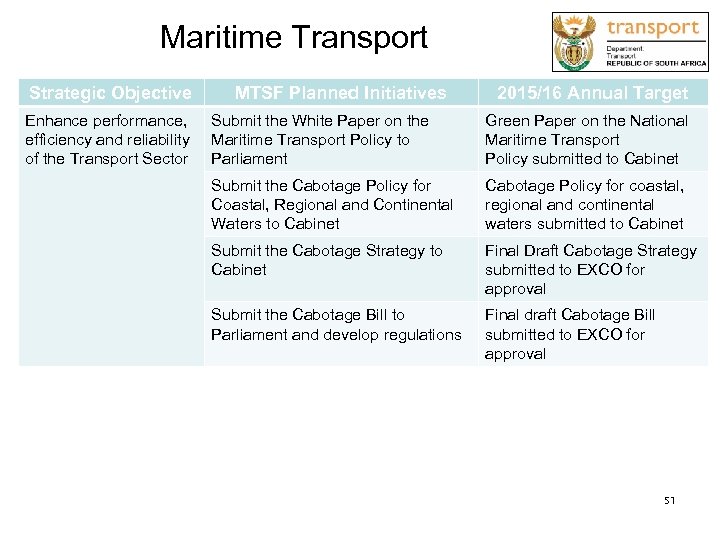 Maritime Transport Strategic Objective Enhance performance, efficiency and reliability of the Transport Sector MTSF Planned Initiatives 2015/16 Annual Target Submit the White Paper on the Maritime Transport Policy to Parliament Green Paper on the National Maritime Transport Policy submitted to Cabinet Submit the Cabotage Policy for Coastal, Regional and Continental Waters to Cabinet Cabotage Policy for coastal, regional and continental waters submitted to Cabinet Submit the Cabotage Strategy to Cabinet Final Draft Cabotage Strategy submitted to EXCO for approval Submit the Cabotage Bill to Parliament and develop regulations Final draft Cabotage Bill submitted to EXCO for approval 51
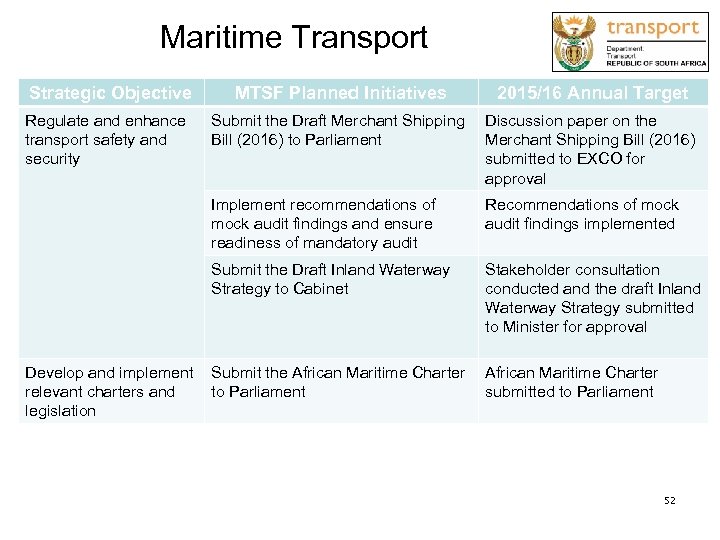 Maritime Transport Strategic Objective MTSF Planned Initiatives 2015/16 Annual Target Regulate and enhance transport safety and security Submit the Draft Merchant Shipping Bill (2016) to Parliament Discussion paper on the Merchant Shipping Bill (2016) submitted to EXCO for approval Implement recommendations of mock audit findings and ensure readiness of mandatory audit Recommendations of mock audit findings implemented Submit the Draft Inland Waterway Strategy to Cabinet Stakeholder consultation conducted and the draft Inland Waterway Strategy submitted to Minister for approval Develop and implement Submit the African Maritime Charter relevant charters and to Parliament submitted to Parliament legislation 52
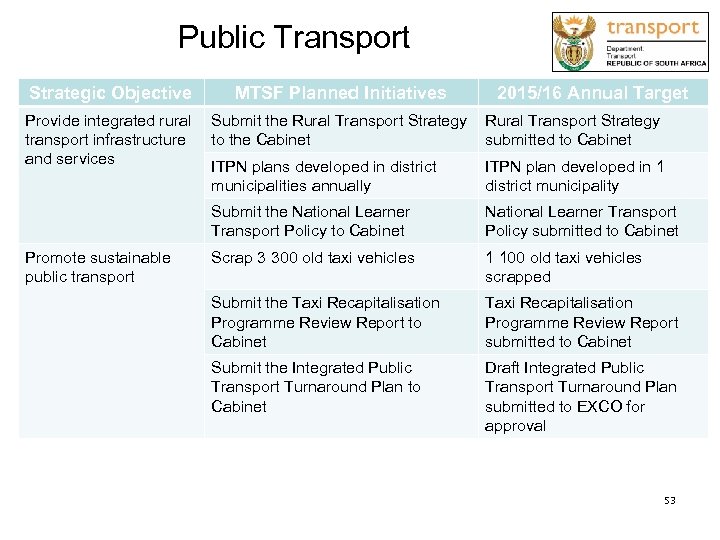 Public Transport Strategic Objective MTSF Planned Initiatives 2015/16 Annual Target Provide integrated rural Submit the Rural Transport Strategy transport infrastructure to the Cabinet submitted to Cabinet and services ITPN plans developed in district ITPN plan developed in 1 municipalities annually district municipality Submit the National Learner Transport Policy to Cabinet Promote sustainable public transport National Learner Transport Policy submitted to Cabinet Scrap 3 300 old taxi vehicles 1 100 old taxi vehicles scrapped Submit the Taxi Recapitalisation Programme Review Report to Cabinet Taxi Recapitalisation Programme Review Report submitted to Cabinet Submit the Integrated Public Transport Turnaround Plan to Cabinet Draft Integrated Public Transport Turnaround Plan submitted to EXCO for approval 53
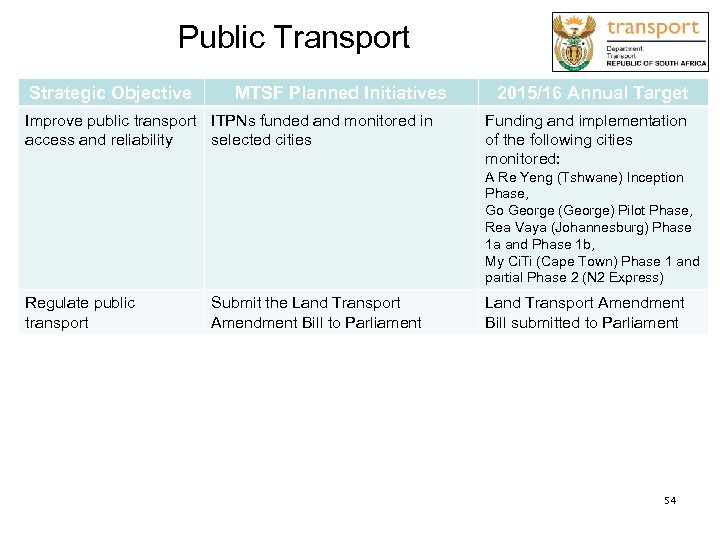 Public Transport Strategic Objective MTSF Planned Initiatives Improve public transport ITPNs funded and monitored in access and reliability selected cities 2015/16 Annual Target Funding and implementation of the following cities monitored: A Re Yeng (Tshwane) Inception Phase, Go George (George) Pilot Phase, Rea Vaya (Johannesburg) Phase 1 a and Phase 1 b, My Ci. Ti (Cape Town) Phase 1 and partial Phase 2 (N 2 Express) Regulate public transport Submit the Land Transport Amendment Bill to Parliament Land Transport Amendment Bill submitted to Parliament 54
 RESOURCES CONSIDERATIONS 55
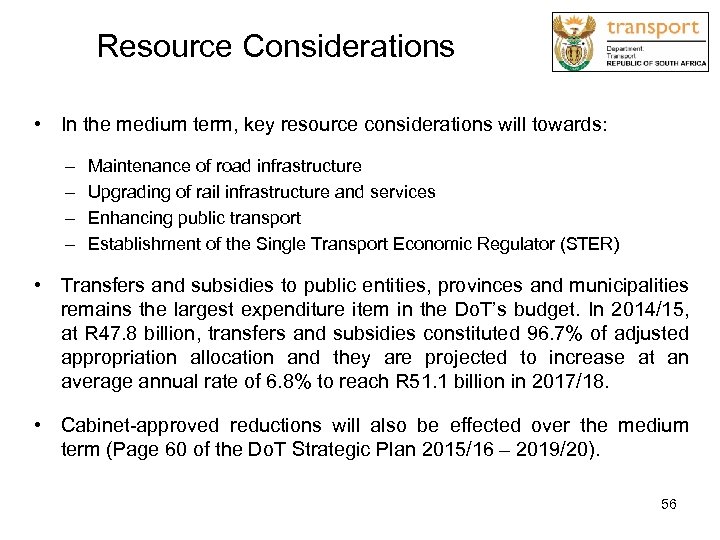 Resource Considerations • In the medium term, key resource considerations will towards: – – Maintenance of road infrastructure Upgrading of rail infrastructure and services Enhancing public transport Establishment of the Single Transport Economic Regulator (STER) • Transfers and subsidies to public entities, provinces and municipalities remains the largest expenditure item in the Do. T’s budget. In 2014/15, at R 47. 8 billion, transfers and subsidies constituted 96. 7% of adjusted appropriation allocation and they are projected to increase at an average annual rate of 6. 8% to reach R 51. 1 billion in 2017/18. • Cabinet-approved reductions will also be effected over the medium term (Page 60 of the Do. T Strategic Plan 2015/16 – 2019/20). 56
 RISK MANAGEMENT 57
 Do. T Risk Statement • Do. T commits to a risk management process that ensures that all strategic and operational risks to its business strategy are identified and assessed • Response plans will be developed and implemented for each risk; and monitored on a quarterly basis • The effectiveness of the risk management and control measures put in place will be reported to the Risk Management Committee, EXCO and the Audit Committee on a quarterly basis • Internal Audit will also conduct periodic independent assessment on the effectiveness of risk management 58
 LINKS TO LONG-TERM INFRASTRUCTURE AND OTHER PLANS 59
 Long-Term Infrastructure and Other Plans Moloto Rail Development Corridor Project Description: Rapid rail service between Mthambothini (Siyabuswa) in Mpumalanga and Tshwane with feeder services to and from stations. There also trafficinduced and safety-related road upgrades in rural villages along the R 573 Moloto Road Estimated Project Cost • R 18. 9 billion capital expenditure • R 1. 6 billion land acquisition 60
 Long-Term Infrastructure and Other Plans Durban Dug-Out Port Development Project Description: Expansion of the container-handling capacity at the Durban Port to enhance logistics of doing business in SA by improving rail and port connections. Project linked to SIP 2: Durban-Free State-Gauteng Logistics and Industrial Corridor Estimated Project Cost • R 75 – R 100 billion 61
 CONDITIONAL GRANTS 62
 Conditional Grants • Public Transport Operations Grant – R 4 939 448 000 • Public Transport Network Grant – R 5 953 090 000 • Provincial Road Maintenance Grant – R 9 850 655 000 • Rural Road Asset Management System – R 96 842 000 63
 PUBLIC ENTITIES 64
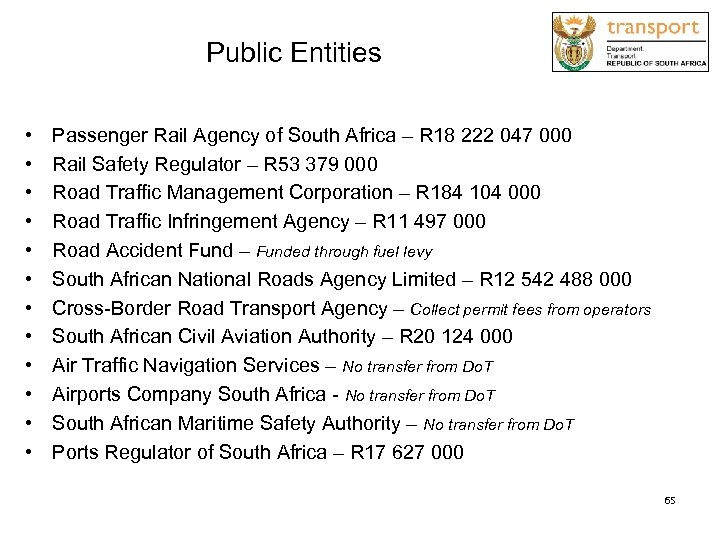 Public Entities • • • Passenger Rail Agency of South Africa – R 18 222 047 000 Rail Safety Regulator – R 53 379 000 Road Traffic Management Corporation – R 184 104 000 Road Traffic Infringement Agency – R 11 497 000 Road Accident Fund – Funded through fuel levy South African National Roads Agency Limited – R 12 542 488 000 Cross-Border Road Transport Agency – Collect permit fees from operators South African Civil Aviation Authority – R 20 124 000 Air Traffic Navigation Services – No transfer from Do. T Airports Company South Africa - No transfer from Do. T South African Maritime Safety Authority – No transfer from Do. T Ports Regulator of South Africa – R 17 627 000 65
 PUBLIC-PRIVATE PARTNERSHIPS 66
 Public-Private Partnerships Moloto Rail Development Corridor Purpose: Provide transport solution to problems experienced by commuters along the Moloto Corridor Outputs: Reduced travel times, improved safety, reduction of traffic congestions, road accidents, injuries and fatalities Value of Agreement: PPP registered and process currently at Phase 1 of Treasury Approval processes 67
 Thank You! 68