 Скачать презентацию Strategic partnership friendship and good neighborly relations between
китай казахстан.pptx
- Количество слайдов: 16




Strategic partnership friendship and good neighborly relations between Kazakhstan and China. Footer Text 2/8/2018 1
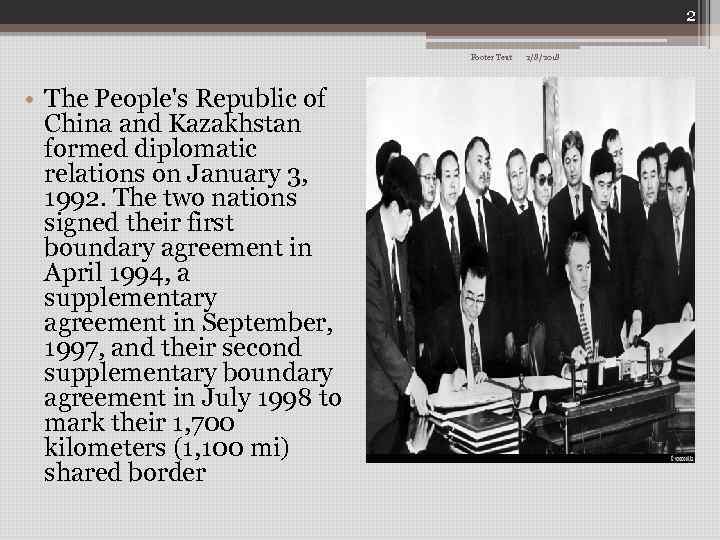
2 Footer Text • The People's Republic of China and Kazakhstan formed diplomatic relations on January 3, 1992. The two nations signed their first boundary agreement in April 1994, a supplementary agreement in September, 1997, and their second supplementary boundary agreement in July 1998 to mark their 1, 700 kilometers (1, 100 mi) shared border 2/8/2018
An outline of Kazakh. Chinese relations • Political relations between China and Kazakhstan are successful: since independence, the two countries have settled old disputes about their common border and established close political contacts. Chinese and Kazakh officials meet frequently to discuss bilateral issues and, for Kazakhstan, “developing good neighborly relations with China is a top priority”. Today, both share membership of the Shanghai Cooperation Organization and other regional groups committed to promote political cooperation and security. Footer Text 2/8/2018 3

Footer Text 2/8/2018 4
• Bilateral economic relations are equally positive and have been intensifying for many years. The main factor behind the continuous improvements in trade relations is China's unmatched willingness and ability to invest. Figures in this regard are impressive: at the beginning of 2011, for example, Beijing committed to loan $1. 7 billion to the Kazakh national welfare fund, $5 billion to the local petrochemical industry, and to buy Kazakh uranium for an estimated $8 billion. Increased Chinese influence is welcomed in Astana because it provides an opportunity to diversify the country's economy. Footer Text 2/8/2018 5
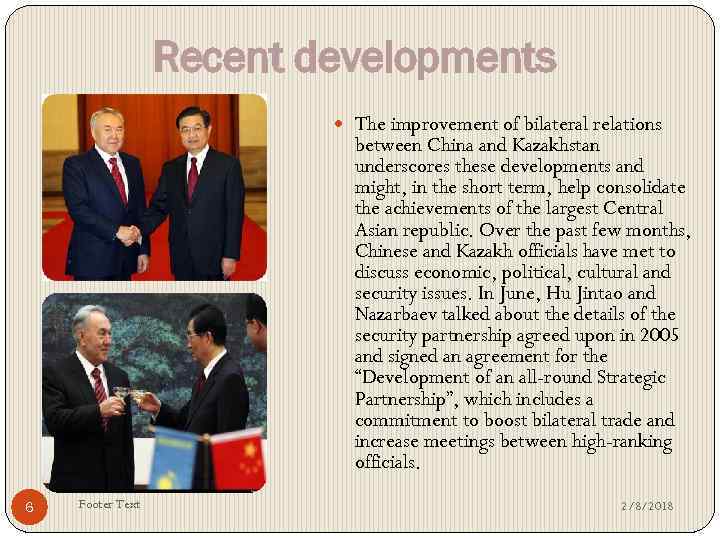
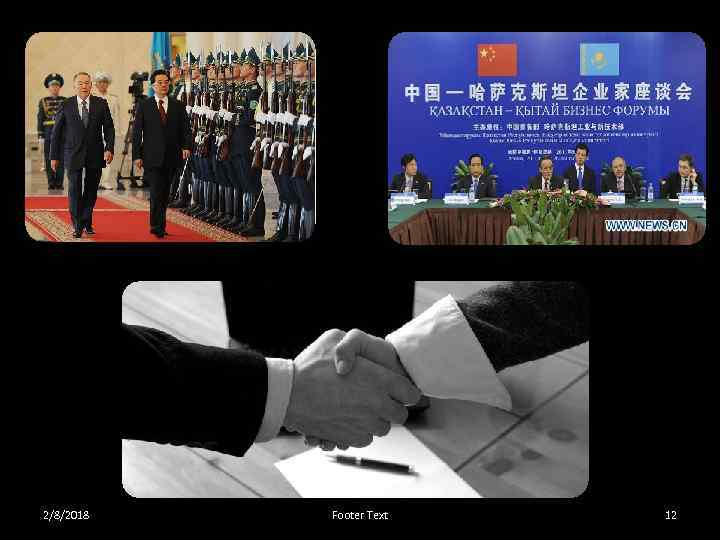
Recent developments The improvement of bilateral relations between China and Kazakhstan underscores these developments and might, in the short term, help consolidate the achievements of the largest Central Asian republic. Over the past few months, Chinese and Kazakh officials have met to discuss economic, political, cultural and security issues. In June, Hu Jintao and Nazarbaev talked about the details of the security partnership agreed upon in 2005 and signed an agreement for the “Development of an all-round Strategic Partnership”, which includes a commitment to boost bilateral trade and increase meetings between high-ranking officials. 6 Footer Text 2/8/2018
At the moment the situation of Kazakh-Chinese relations could not look better: Nazarbaev and Hu Jintao seem to have a deep mutual understanding and the current Kazakh temporary presidency of the SCO will provide additional opportunities for the two presidents to meet and discuss aspects of bilateral cooperation. Chinese officials have expressed satisfaction for the current situation of trade relations and have praised the recent creation of a trade and business center in Khorgos, at the border between Kazakhstan and China. 7 Footer Text 2/8/2018
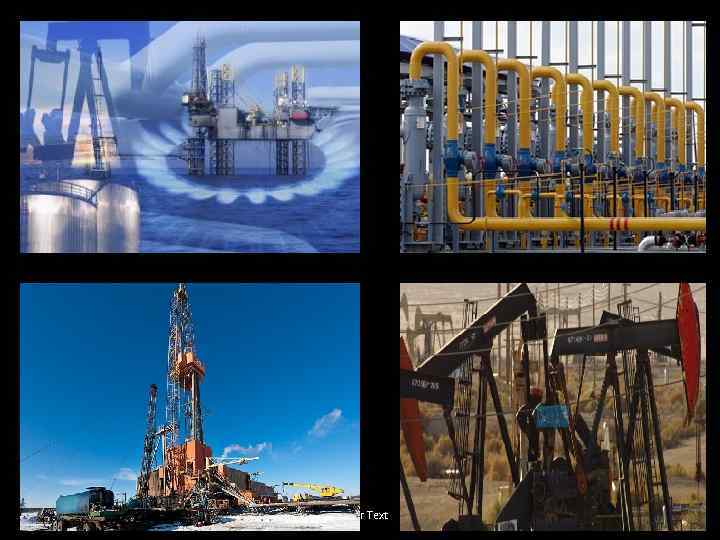
Energy cooperation At the moment, Kazakhstan is one of China's main energy providers (11 million tons of oil reached China in 2010 through the Kazakhstan-China oil pipeline), and Chinese officials visiting Central Asia have recently expressed their desire to strengthen energy cooperation with oil-rich Kazakhstan. The Central Asian country's oil exports are set to increase dramatically over the next years with Kazakh officials promising a 50% increase by 2020, and a large share of this will be used to meet China's growing demand: Kazakhstan's goal is to provide 22 million tons/year of oil to China by 2020, up from an estimated 12. 1 million tons in 2011. 2/8/2018 Footer Text 8
2/8/2018 Footer Text 9
To achieve this, Kazakhstan is working to increase the amount of oil delivered through the Kazakhstan. China pipeline, while constructing a parallel gas pipeline which should become operational in 2014. In addition to increasing Kazakhstan's gas exports, this new infrastructure would also fill a serious gap in Kazakhstan's pipelines network, enabling gas from the west of the country to be delivered to the industrial southern regions of Kazakhstan, consequently eliminating the reliance on Uzbek gas. 2/8/2018 Footer Text 10
SECURITY COOPERATION AND RISKS CONNECTED TO UNREST IN EAST TURKESTAN • For China, security is one of the main aspects of its Central Asian strategy. In his meeting with Nazarbaev in the summer of 2011, Hu Jintao stressed the importance of security outlining its three main threats in the Central Asian region: separatism, extremism and terrorism. This reflects Beijing preoccupations with the instability in Eastern Turkestan, or Xinjiang, the turbulent region affected by sporadic outbursts of violence by the local Muslim Uyghur majority, who suffers from alleged discrimination, colonization attempts and wholesale repression from Beijing. The most recent explosion of violence in July 2011 cast a shade of pessimism over the likelihood of achieving long-lasting stability in East Turkestan. 2/8/2018 Footer Text 11
2/8/2018 Footer Text 12
• As all of the strategic oil and gas pipelines connecting China to Central Asia pass through East Turkestan, violence in that region can adversely affect Chinese oil imports and jeopardize Beijing's energy security. This is why instability and religiouslymotivated terrorism are deeply feared by Chinese officials, as demonstrated by the commitment with which China tries to strengthen the role of the SCO as a means to ensure regional stability. 2/8/2018 Footer Text 13
The bleak sides of cooperation with China The main problem for Kazakhstan's economy is the low level of diversification and the dependence on oil and gas exports. Chinese investments in non-resource sectors may be just what the country needs to overcome the obstacles to its development and avoid the “middle income trap” and the consequences of hydrocarbon prices fluctuation. However, there are risks associated to close relations with China, as well. Footer Text 14 2/8/2018
Kazakhstan's economy is set to rely more and more on China's money, cooperation, investments and energy imports, which exposes the Central Asian country to the risk of dependence on one single partner, and on its economic fortunes or misfortunes. This would mean replacing the reliance on hydrocarbons exports with another form of dependence. Oddly enough, this danger may be avoided because of the notorious wariness of authoritarian regimes for cooperation: Kazakhstan's leadership is still to some extent cautious about China's intentions and is therefore unwilling to allow its powerful neighbor to unleash its full potential in Kazakhstan. Footer Text 15 2/8/2018
CONCLUSION Political and economic cooperation between China and Kazakhstan is, overall, an example of success. The two countries still cooperate mostly in the energy sphere, but both seem committed to encouraging Kazakhstan's economic diversification. However, Chinese investments may not be enough: a strong political will from the Kazakh side is required to successfully promote diversification, even though this may deprive the leadership of opportunities for kleptocracy. Moreover, the two countries might be close to reaching the limits of their cooperation: Kazakh officials' wariness of China's power, and the local population's fear of Chinese demographic expansion, may prove to be insurmountable obstacles to cooperation efforts. In any case, Kazakhstan's problems are unlikely to be solved exclusively by closer ties with China. Diversification, not just in the economic sphere, but also in the choice of political partners, will remain Kazakhstan's priority for the time being. 8 8/ 2/ 1 20 FOOTER TEXT 16
Скачать презентацию Strategic partnership friendship and good neighborly relations between
китай казахстан.pptx