


 Скачать презентацию STRATEGIC MANAGEMENT TODAY S CHALLENGES TOOLS FOR EFFECTIVE
страт менеджмент корнышкова (1).ppt
- Количество слайдов: 14
 STRATEGIC MANAGEMENT: TODAY’S CHALLENGES & TOOLS FOR EFFECTIVE MANAGEMENT IN INTERCULTURAL ENVIRONMENT Elena V. Kornyshkova, Associate Professor МВА (ISU, USA), Executive Education: Wharton Business School, & George Washington University, SPb. SU (Linguistics), LETI (Electro. Physics), 14 years of prof. experience in USA; GSOM SPb. SU (Master Programs) NET EXPAT (USA-Belgium): Consultant (cross-cultural adaptation in management & in career development) ekornyshkova@hse. ru OR ekornychkova@yandex. ru, +7 911 -151 8643
 STRATEGIC MANAGEMENT: TODAY’S CHALLENGES & TOOLS FOR EFFECTIVE MANAGEMENT IN INTERCULTURAL ENVIRONMENT • Course introduction & value for career & professional development. Cultural & traditional management models’ challenges • Required Reading – 5 -6 minute (4 -5 slides) presentations & Executive Summary, group work. • Guest Lecture Class & preparation • Tests • Grading: 50 -50. Rounding off: arithmetic rule – only for the Final grades. Rounding for Accumulated & Final Test grades – to units of the number. • Consultations & Access for Assistance. Feedback anytime. Quality Survey - in the end of the course • Skipping classes: only 1 lecture and 1 seminar allowed. 2/11/2018 2
 STRATEGIC MANAGEMENT: TODAY’S CHALLENGES & TOOLS FOR EFFECTIVE MANAGEMENT IN INTERCULTURAL ENVIRONMENT. Areas of Discussion during the Course • Trust & Strategic Management. Marketing, CRM, Leadership, HRM. Case(s) • Cultural Intelligence as Key Competence in Management • High-performance organizational communication. Internal, External Communication & Conversational Communication. • Customer Relations Management: instruments. • Search for leaders: best international practice in university relations development. • Corporate Social Responsibility: modern concept & cases. Guest Lecturer: Ms. Mari Stock. Dates: 15. 02, 22. 02, 1. 03, (8. 03), 20. 03, 22. 03 2/11/2018 3
 TRUST in Management, Product, Service, Customer Relations, HRM • Trust is essential for performance. Why? • Customer expectations? Impact of Technology? Of Globalization? Command- top-down-control systems? • Issue of Uncertainty between expectations & reality • Issue of Risk & Risk Analysis, Information Access & Gathering • Issue of Cynicism • Issue of Time & Efficiency • Issue of Codes & Rules & “Exceptions” 2/11/2018 4
 LEVELS OF TRUST Individual - Interpersonal Willingness of a party to be vulnerable to the actions of another party based on the expectation that the other will perform a particular action important to the thruster, irrespective of the ability to monitor or control that other party The extent to which a person is confident, and willing to act on the basis of the words, actions and decisions of another An individual’s belief about the integrity and dependability of another 2/11/2018 5
 LEVELS OF TRUST: Leader & Team • The degree of faith employees…. . have concerning management’s ability to steer the organization • An expectation or belief that the team can rely on the leader’s actions or words + that the leader has good intentions toward the team. • Employees’ expectations regarding the behavior of their workgroup peers, so that those who they trust will support processes helping them, and oppose processes harming them. • A confidence between the parties that they will not be harmed or put at risk by the actions of the other party, and that any party will NOT exploit the other’s vulnerability 2/11/2018 6
 WHY TRUST IS SO HARD TO ACHIEVE IN MANAGEMENT? TRUST DEFICIT Behavior • Actions inconsistent with the mission & the vision of the company • Emphasis on productivity, effectiveness & achievement at ALL COSTS • Excessive turnover & continuous change Communication & Behavior Leaders who use ambiguity & weasel words in their promises Unwritten promises Very big distance between leaders and “others” Lack of Consistency & Practice • !!! Management that does NOT observe sanctions when trust is violated • Plans & intentions are overtaken by circumstances beyond …. Control • Management does not follow the values, or rules set for others 2/11/2018 7
 EQUIVALENTS OF TRUST IN TRUST DEFICIT. How do we see them in Organization & Management? • Supernatural forces or Power, fortune (high uncertainty) • Paternalism – search of strong authority, “quasi father” who assures missing order, hierarchical harmony & predictability of the group’s life • Corruption • Pressure – to control the others’ actions • Isolation – separating certain groups in an unfavorable environment & with lack of tolerance from/for the others • Excessive assistance of legal institutions – a need formal means to secure the transaction. • Low context communication & looking for legal loops, inconsistency in law enforcement 2/11/2018 8
 RESEARCH & DISCUSSION “What to Do? ” Hiring, Recognition, Firing Decisions Selection of people who share and value behaviors that produce trust Laying off & crisis behavior by leadership Organizational Communication Inviting honest, collective, public conversations Importance of keeping employees informed as information (e. g. about change in organization) becomes available Organizational Internal Networking Trust is factor of relationships Minimizing of Repressive HR Management & Communication Empowerment & Mistake Management 2/11/2018 9
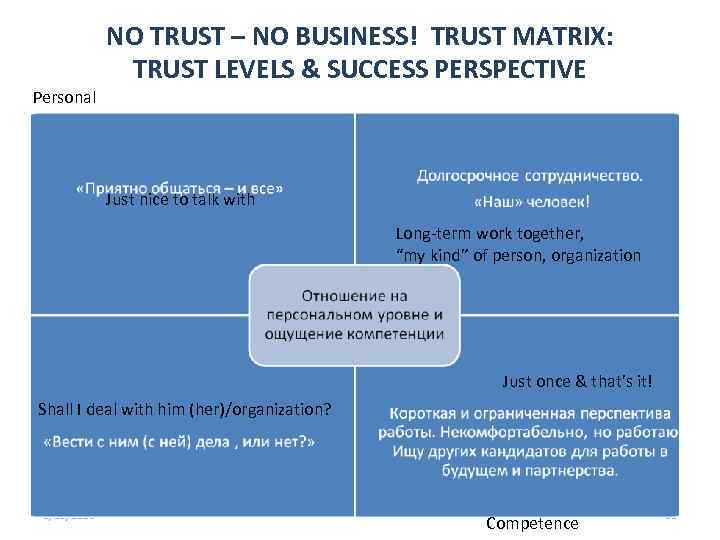 NO TRUST – NO BUSINESS! TRUST MATRIX: TRUST LEVELS & SUCCESS PERSPECTIVE Personal Just nice to talk with Long-term work together, “my kind” of person, organization Just once & that’s it! Shall I deal with him (her)/organization? 2/11/2018 Competence 10
 For the next time: Required Reading Executive Summary (1 -2 pp. ), 4 -5 min presentation (4 -5 slides) for 1 article/team. Material Exchange. 1. Pate J. , Morgan-Thomas A. , Beaumont Ph. Trust Restoration: an Examination of Senior Managers’ Attempt to Rebuild Employee Trust, Human Resource Management Journal, Vol. 22, Issue 2, 2012, pp. 148164 2. Lagrosen S. , Lagrosen Y. Trust and Quality Management: Perspectives from Marketing and Organizational Learning. Total Quality Management. Vol. 23, No. 4, Jan. 2012 pp. 13 -26 3. Heskett J. Why is Trust So Hard to Achieve in Management? Working Knowledge, Harvard Business School weekly newsletter http: //hbswk. hbs. edu/item/7034. html 4. Spreitzer G. , Mishra A. Giving Up Control Without Losing Control Trust & Its Substitutes’ Effects on Managers’ Involving Employees in Decision Making. Group & Organization Management, June 1999; Vol. 24, No. 2 (pp. 1 -10, 21 -22, 24 -25 - in Acrobat format) (Web. Knowledge, HSE Library, Full Text) 2/11/2018 11
 TRUST & STRATEGY: STARBUCKS. COM Case of Global Success by building Business Model based on Trust 17 (1987) – 12440 (2006) – 17 651 stores (2012) • RUSSIA – 2007 http: //starbuckscoffee. ru/en-US/ • $10 K in IPO (1992) = $650 K (2010) • OUR MISSION: to inspire and nurture the human spirit – one person, one cup and one neighborhood at a time. Here are the principles of how we live that every day: ……. 2/11/2018 12
 Mission Statement: To inspire and to nurture the human spirit – one person, one cup and one neighborhood at a time! State expectations in each category, select the priority ones, come up with statements to demonstrate dedication of Starbucks to achieve the expectations & even to go beyond them – to build trust in every area of the business – according to the Mission Statement. • Our Coffee: • Our Partners (All employees of the company): • Our Customer: • Our Stores: • Our Neighborhood: • Our Stakeholders: 2/11/2018 13
 Starbucks: Vulnerabilities, Threats & Actions in Russia to Protect/Develop Trust - questions to think about • Our Coffee • Our Partners • Our Customer • Our Stores • Our Neighborhood • Our Stakeholders 2/11/2018 14