


 Скачать презентацию Strategic Legal Persuasion Writing to Win Part 3
2731cfc7ef18e91085c11e39cf7a1bca.ppt
- Количество слайдов: 32
 Strategic Legal Persuasion: Writing to Win (Part 3) Michelle J. Ouellette, Q. C.
 “Often Thought, but Never so Well Expressed” “You will have written exceptionally well if, by skillful arrangement of your words, you have made an ordinary one seem original” - Horace, 65 -8 BC “What is written without effort is in general read without pleasure. ” - Samuel Johnson, 1709 -1784 “The difference between the right word and the almost right word is the difference between lightning and a lightning bug. ” - Mark Twain, 1835 -1910 “He who wants to persuade should put his trust not in the right argument but in the right words. ” - Joseph Conrad, 1857 -1924
 Principles of Legal Writing (According to D. Robert White, The Official Lawyer’s Handbook, Simon & Schuster, 1983) l l l Never use one word where ten will do Never use a small word where a big one will do suffice Never use a simple statement where one of substantially greater complexity will achieve comparable goals Never use English where Latin, mutatis mutandis, will do Qualify virtually everything Do not be embarrassed about repeating yourself. l l Worry about the difference between “which” and “that”[!] In pleadings and briefs, that which is defensible should be stated. That which is indefensible, but which you wish were true, should merely be suggested Never refer to your opponent’s “arguments”; he only makes “assertions”, and his assertions are always “bald” If a lay person can read a document from beginning to end without falling asleep, it needs work
 No person shall prune, cut, carry away, pull up, dig, fell, bore, chop, saw, chip, pick, move, sever, climb, molest, take, break, deface, destroy, set fire to, burn, scorch, carve, paint, mark, or in any manner interfere with, tamper, mutilate, misuse, disturb or damage any tree, shrub, plant, grass, flower, or part thereof, nor shall any person permit any chemical, whether solid, fluid, or gaseous, to seep, drip, drain, or be emptied, sprayed, dusted, or injected upon, about or into any tree, shrub, plant, grass, flower, or part thereof, except when specifically authorized by competent authority.
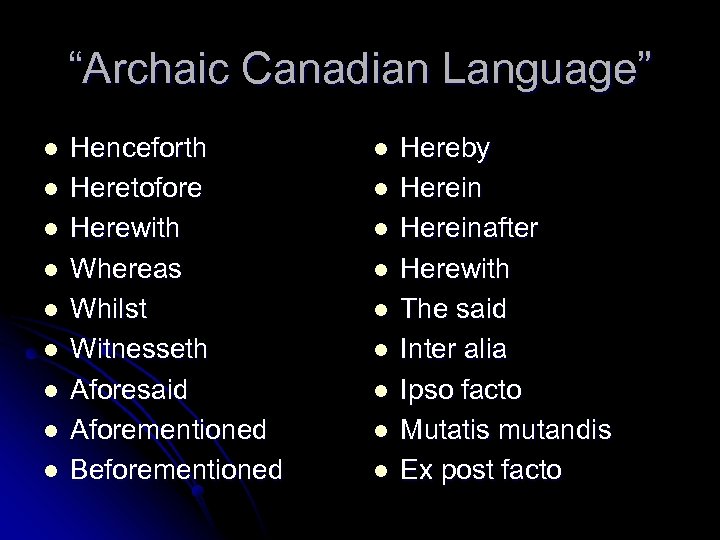 “Archaic Canadian Language” l l l l l Henceforth Heretofore Herewith Whereas Whilst Witnesseth Aforesaid Aforementioned Beforementioned l l l l l Hereby Hereinafter Herewith The said Inter alia Ipso facto Mutatis mutandis Ex post facto
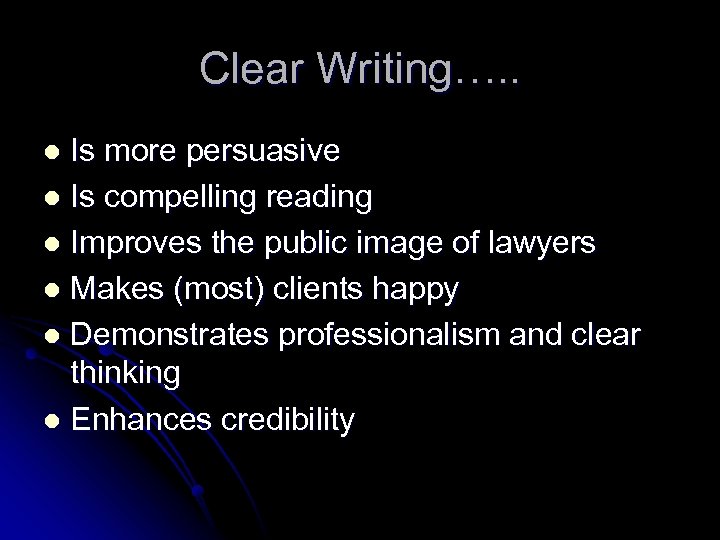 Clear Writing…. . Is more persuasive l Is compelling reading l Improves the public image of lawyers l Makes (most) clients happy l Demonstrates professionalism and clear thinking l Enhances credibility l
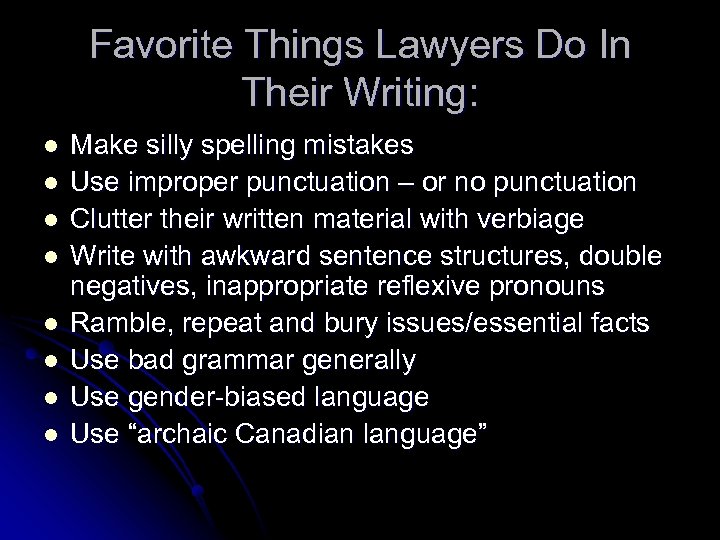 Favorite Things Lawyers Do In Their Writing: l l l l Make silly spelling mistakes Use improper punctuation – or no punctuation Clutter their written material with verbiage Write with awkward sentence structures, double negatives, inappropriate reflexive pronouns Ramble, repeat and bury issues/essential facts Use bad grammar generally Use gender-biased language Use “archaic Canadian language”
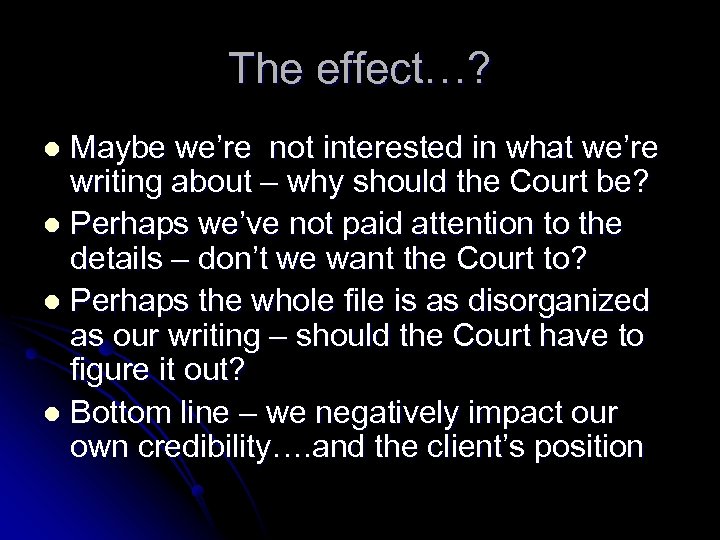 The effect…? Maybe we’re not interested in what we’re writing about – why should the Court be? l Perhaps we’ve not paid attention to the details – don’t we want the Court to? l Perhaps the whole file is as disorganized as our writing – should the Court have to figure it out? l Bottom line – we negatively impact our own credibility…. and the client’s position l
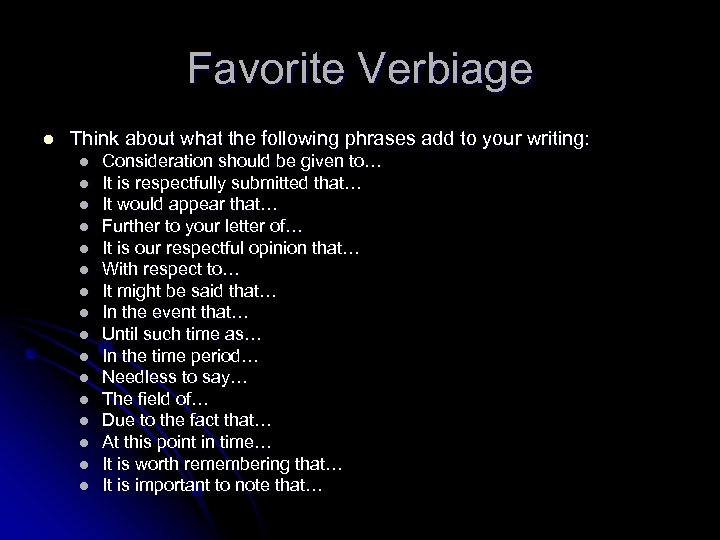 Favorite Verbiage l Think about what the following phrases add to your writing: l l l l Consideration should be given to… It is respectfully submitted that… It would appear that… Further to your letter of… It is our respectful opinion that… With respect to… It might be said that… In the event that… Until such time as… In the time period… Needless to say… The field of… Due to the fact that… At this point in time… It is worth remembering that… It is important to note that…
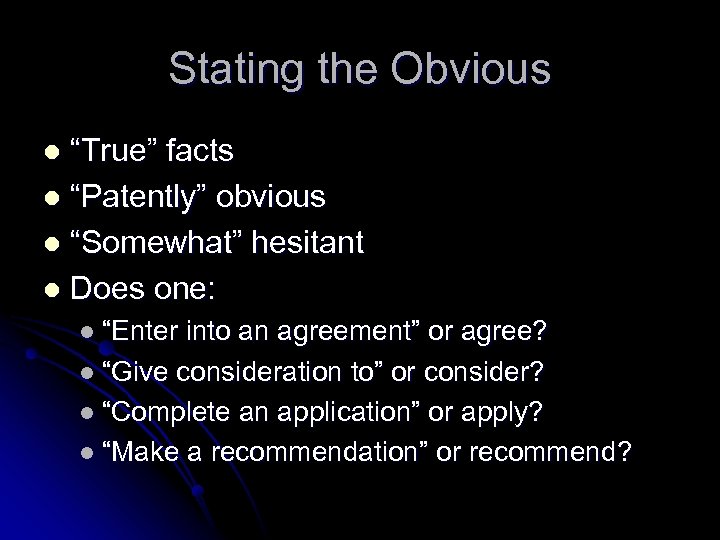 Stating the Obvious “True” facts l “Patently” obvious l “Somewhat” hesitant l Does one: l l “Enter into an agreement” or agree? l “Give consideration to” or consider? l “Complete an application” or apply? l “Make a recommendation” or recommend?
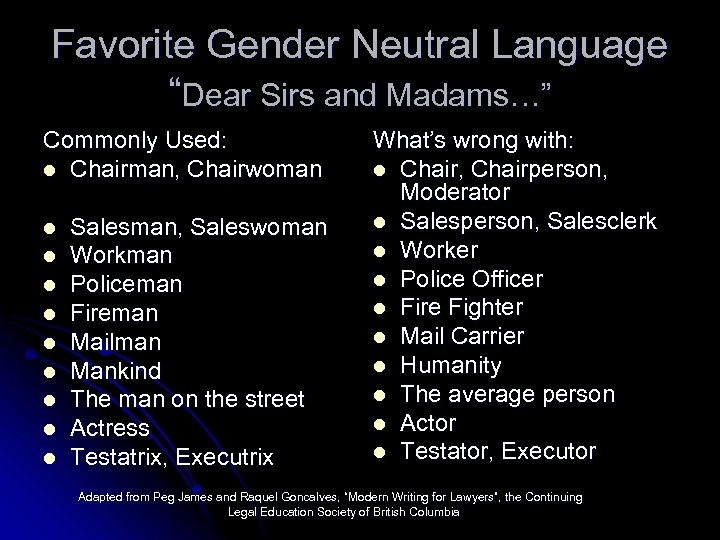 Favorite Gender Neutral Language “Dear Sirs and Madams…” Commonly Used: l Chairman, Chairwoman l l l l l Salesman, Saleswoman Workman Policeman Fireman Mailman Mankind The man on the street Actress Testatrix, Executrix What’s wrong with: l Chair, Chairperson, Moderator l Salesperson, Salesclerk l Worker l Police Officer l Fire Fighter l Mail Carrier l Humanity l The average person l Actor l Testator, Executor Adapted from Peg James and Raquel Goncalves, “Modern Writing for Lawyers”, the Continuing Goncalves, Legal Education Society of British Columbia
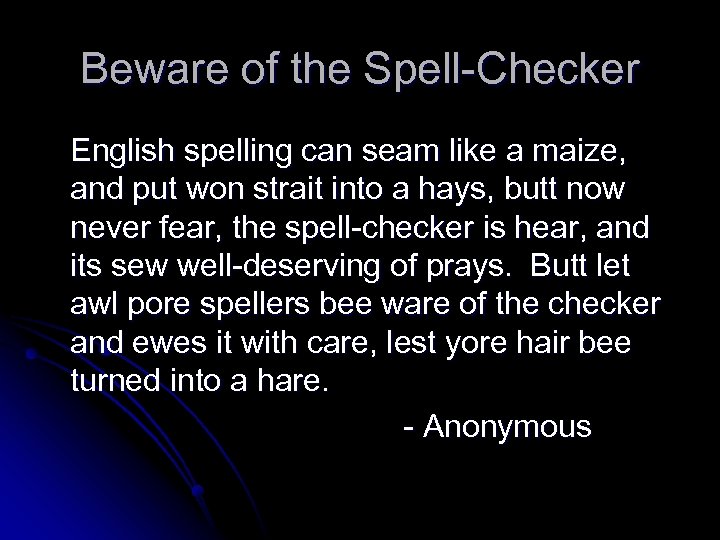 Beware of the Spell-Checker English spelling can seam like a maize, and put won strait into a hays, butt now never fear, the spell-checker is hear, and its sew well-deserving of prays. Butt let awl pore spellers bee ware of the checker and ewes it with care, lest yore hair bee turned into a hare. - Anonymous
 Favorite Ideas to Help with Spelling l Prefixes do not change the spelling of a word l l Knowing the meaning of the prefix helps l l l for (not or against) v. fore (before or in front); forbid v. foresee inter (between) v. intra (within); interstate v. intrastate Mnemonics, rhymes and rules l l “un-necessary”, “dis-satisfied” the “i before e” rhyme (don’t forget the “extras”) the “final consonant” rule (preference v. preferring, inference v. inferred) Emphasis on the last syllable – double the last consonant; otherwise, probably not. The “picnic” or hard “c” rule – add a “k” to use an “e”, “i” or “y” suffix Think about the root of the word and its meaning l l Log – “word, speak” – Logic, Eulogy String or Strict – “bind, draw tight” – stringent, stricture
 Favorite Confused Words l l l l l Jibe/Jive – to correspond or agree/a dance Compliment/Complement – expression of praise/that which completes Affect/Effect – to influence (as in feelings)/to bring about (v. ) or the result (n. ) Ingenious/Ingenuous – crafty/naive Allude/Elude – to refer to something indirectly/to escape or avoid Aural/Oral – pertaining to the ear/spoken Emigrate/Immigrate – leave one country/settle in another Biannually/Biennially – twice a year/every two years Eminent/Imminent – distinguished/impending Averse/Adverse –in opposition/unfavorable
 Confused words (continued) l l l l l Farther/Further – at a greater distance/to a greater extent Amoral/Immoral – outside morality/offside of morality Accept/Except – to receive/to exclude Incredulous/Incredible – skeptical/not believable Eulogy/Elegy – statement of praise/song mourning Flaunt/Flout –to show off/ to go against Uninterested/Disinterested – bored/impartial Principal/Principle – first in rank/law, code or basis for position Tack/Tact – a course or direction/intuitive perception Tortious/Torturous – wrongful/twisted or complicated/full of pain
 Good Use of Punctuation Can… Link or separate ideas l Make a statement in and of itself l Develop the rhythm of your paragraph or sentence l Provide emphasis l Lead the reader where you want him or her to go l
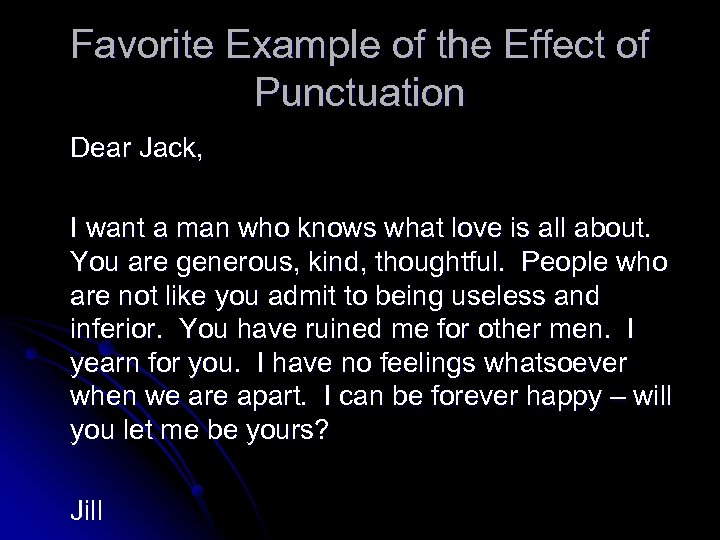 Favorite Example of the Effect of Punctuation Dear Jack, I want a man who knows what love is all about. You are generous, kind, thoughtful. People who are not like you admit to being useless and inferior. You have ruined me for other men. I yearn for you. I have no feelings whatsoever when we are apart. I can be forever happy – will you let me be yours? Jill
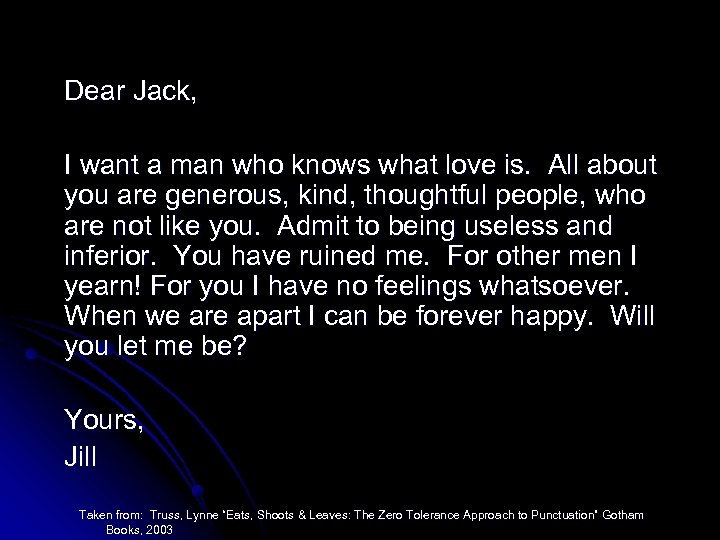 Dear Jack, I want a man who knows what love is. All about you are generous, kind, thoughtful people, who are not like you. Admit to being useless and inferior. You have ruined me. For other men I yearn! For you I have no feelings whatsoever. When we are apart I can be forever happy. Will you let me be? Yours, Jill Taken from: Truss, Lynne “Eats, Shoots & Leaves: The Zero Tolerance Approach to Punctuation” Gotham Books, 2003
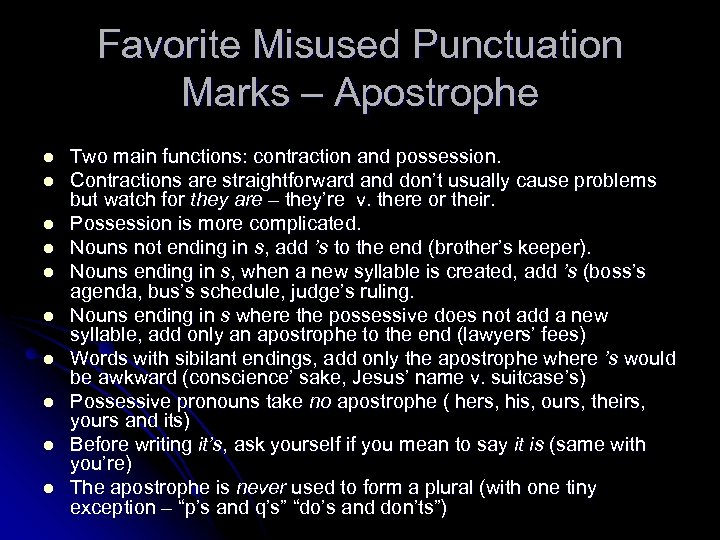 Favorite Misused Punctuation Marks – Apostrophe l l l l l Two main functions: contraction and possession. Contractions are straightforward and don’t usually cause problems but watch for they are – they’re v. there or their. Possession is more complicated. Nouns not ending in s, add ’s to the end (brother’s keeper). Nouns ending in s, when a new syllable is created, add ’s (boss’s agenda, bus’s schedule, judge’s ruling. Nouns ending in s where the possessive does not add a new syllable, add only an apostrophe to the end (lawyers’ fees) Words with sibilant endings, add only the apostrophe where ’s would be awkward (conscience’ sake, Jesus’ name v. suitcase’s) Possessive pronouns take no apostrophe ( hers, his, ours, theirs, yours and its) Before writing it’s, ask yourself if you mean to say it is (same with you’re) The apostrophe is never used to form a plural (with one tiny exception – “p’s and q’s” “do’s and don’ts”)
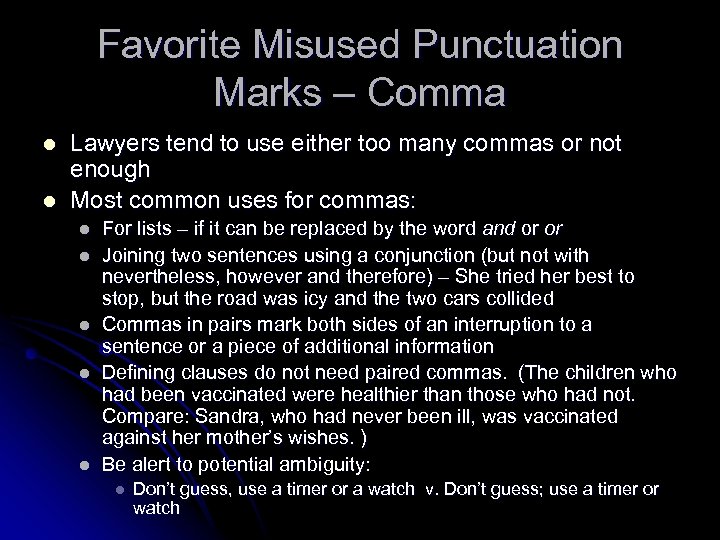 Favorite Misused Punctuation Marks – Comma l l Lawyers tend to use either too many commas or not enough Most common uses for commas: l l l For lists – if it can be replaced by the word and or or Joining two sentences using a conjunction (but not with nevertheless, however and therefore) – She tried her best to stop, but the road was icy and the two cars collided Commas in pairs mark both sides of an interruption to a sentence or a piece of additional information Defining clauses do not need paired commas. (The children who had been vaccinated were healthier than those who had not. Compare: Sandra, who had never been ill, was vaccinated against her mother’s wishes. ) Be alert to potential ambiguity: l Don’t guess, use a timer or a watch v. Don’t guess; use a timer or watch
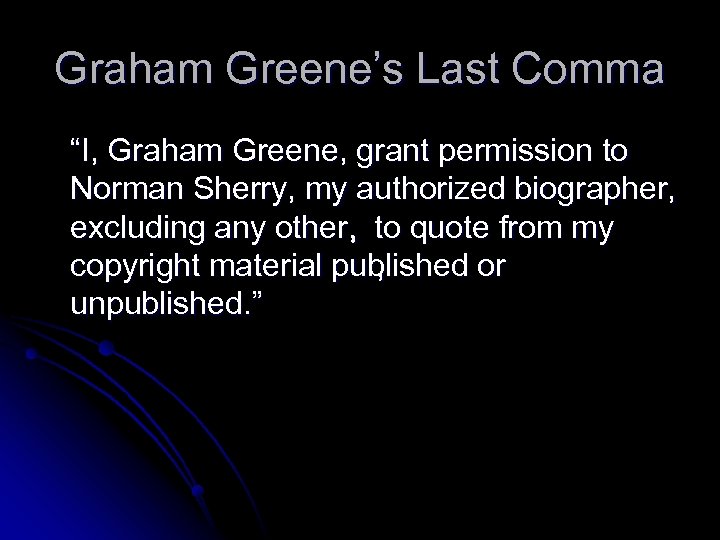 Graham Greene’s Last Comma “I, Graham Greene, grant permission to Norman Sherry, my authorized biographer, excluding any other, to quote from my , copyright material published or , unpublished. ”
 Favorite Misused Punctuation Marks – Colons introduce a second component of a sentence that exemplifies, restates, elaborates, undermines, explains or balances the first part. (This much is clear, Watson: it was the baying of an enormous hound. ) l Colons also introduce lists, subtitles, dialogue and long quotations. l
 Favorite Misused Punctuation Marks – Semi-Colon Joins two related sentences with no conjunction l A period is always an alternative l “Linking” words - however, nevertheless, consequently and hence - require a semicolon l
 Favorite Grammatical Challenges Pesky Pronouns l I or me – Mom was wrong about using “me” George and I/me drafted the brief. l Sam gave the brief to George and I/me. l Sam worked with George and I/me for years. What happens when you remove the other person? l l Who or Whom – If it sounds silly, it likely is That’s the man who/whom the police chased. l The people who/whom did this must be held responsible. l To who/whom will you issue the Subpoena? Restate using the “m” test: he/him or they/them (The police chased “him” – so “whom” works) l
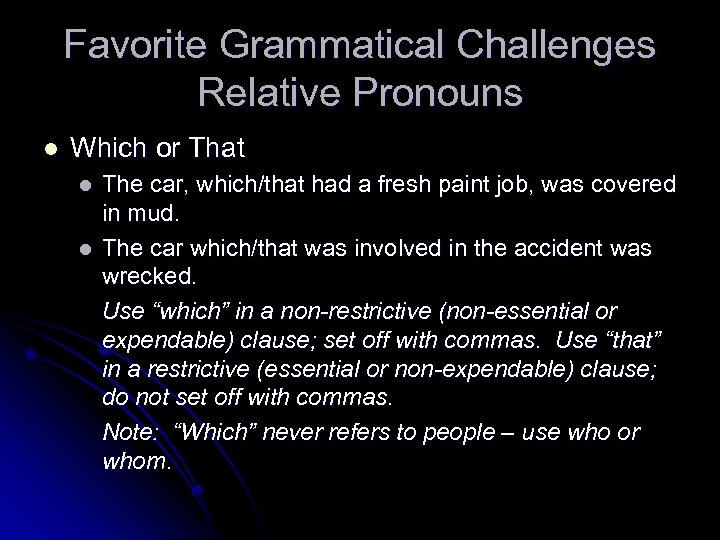 Favorite Grammatical Challenges Relative Pronouns l Which or That l l The car, which/that had a fresh paint job, was covered in mud. The car which/that was involved in the accident was wrecked. Use “which” in a non-restrictive (non-essential or expendable) clause; set off with commas. Use “that” in a restrictive (essential or non-expendable) clause; do not set off with commas. Note: “Which” never refers to people – use who or whom.
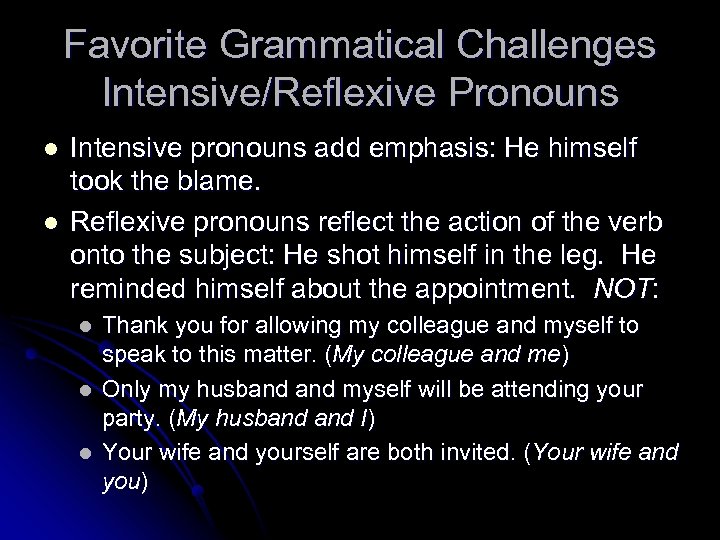 Favorite Grammatical Challenges Intensive/Reflexive Pronouns l l Intensive pronouns add emphasis: He himself took the blame. Reflexive pronouns reflect the action of the verb onto the subject: He shot himself in the leg. He reminded himself about the appointment. NOT: l l l Thank you for allowing my colleague and myself to speak to this matter. (My colleague and me) Only my husband myself will be attending your party. (My husband I) Your wife and yourself are both invited. (Your wife and you)
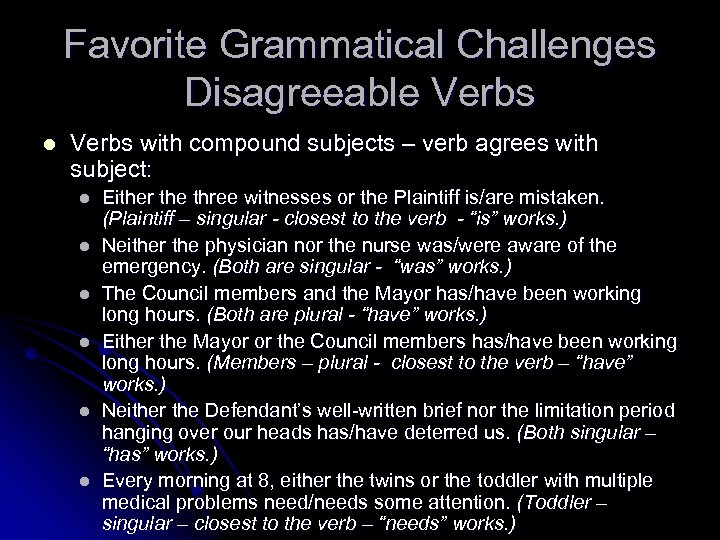 Favorite Grammatical Challenges Disagreeable Verbs l Verbs with compound subjects – verb agrees with subject: l l l Either the three witnesses or the Plaintiff is/are mistaken. (Plaintiff – singular - closest to the verb - “is” works. ) Neither the physician nor the nurse was/were aware of the emergency. (Both are singular - “was” works. ) The Council members and the Mayor has/have been working long hours. (Both are plural - “have” works. ) Either the Mayor or the Council members has/have been working long hours. (Members – plural - closest to the verb – “have” works. ) Neither the Defendant’s well-written brief nor the limitation period hanging over our heads has/have deterred us. (Both singular – “has” works. ) Every morning at 8, either the twins or the toddler with multiple medical problems need/needs some attention. (Toddler – singular – closest to the verb – “needs” works. )
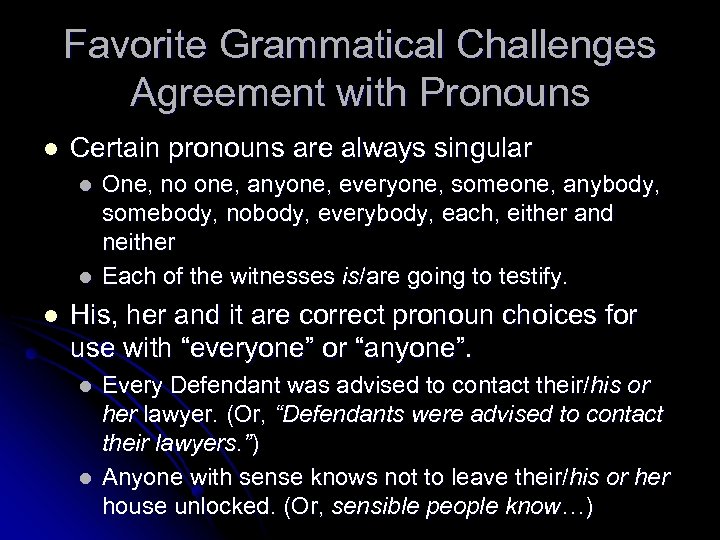 Favorite Grammatical Challenges Agreement with Pronouns l Certain pronouns are always singular l l l One, no one, anyone, everyone, someone, anybody, somebody, nobody, everybody, each, either and neither Each of the witnesses is/are going to testify. His, her and it are correct pronoun choices for use with “everyone” or “anyone”. l l Every Defendant was advised to contact their/his or her lawyer. (Or, “Defendants were advised to contact their lawyers. ”) Anyone with sense knows not to leave their/his or her house unlocked. (Or, sensible people know…)
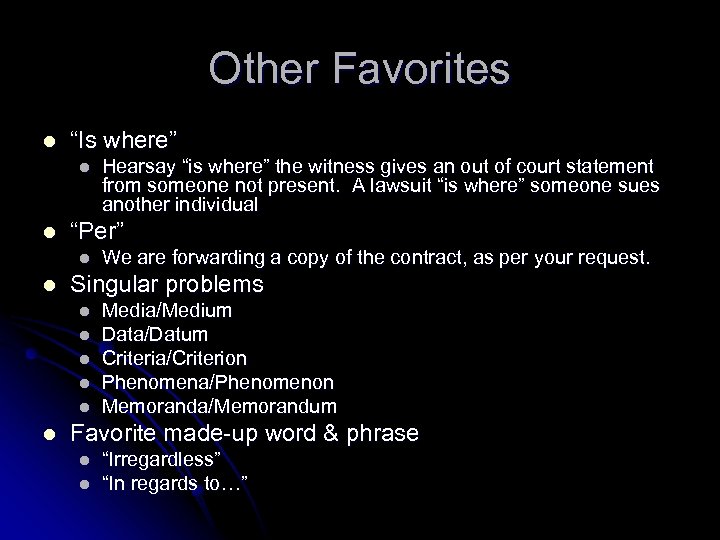 Other Favorites l “Is where” l l “Per” l l We are forwarding a copy of the contract, as per your request. Singular problems l l l Hearsay “is where” the witness gives an out of court statement from someone not present. A lawsuit “is where” someone sues another individual Media/Medium Data/Datum Criteria/Criterion Phenomena/Phenomenon Memoranda/Memorandum Favorite made-up word & phrase l l “Irregardless” “In regards to…”
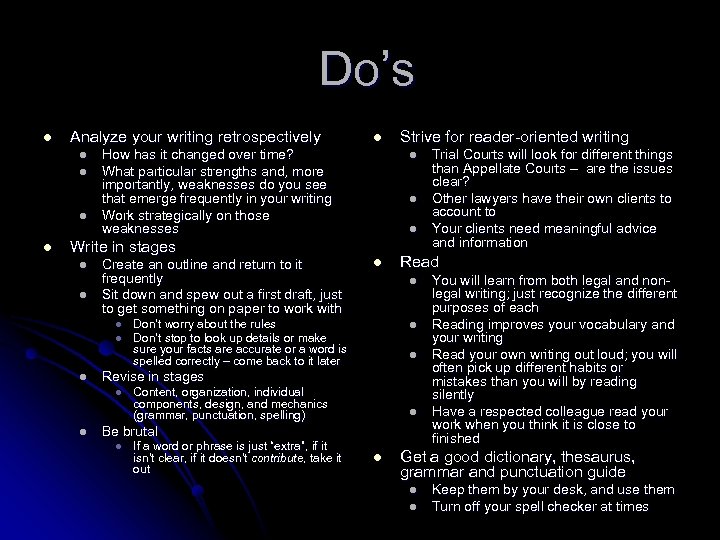 Do’s l Analyze your writing retrospectively l l l How has it changed over time? What particular strengths and, more importantly, weaknesses do you see that emerge frequently in your writing Work strategically on those weaknesses l l l Write in stages l l Create an outline and return to it frequently Sit down and spew out a first draft, just to get something on paper to work with l l l Don’t worry about the rules Don’t stop to look up details or make sure your facts are accurate or a word is spelled correctly – come back to it later l l Content, organization, individual components, design, and mechanics (grammar, punctuation, spelling) l Be brutal l If a word or phrase is just “extra”, if it isn’t clear, if it doesn't contribute, take it contribute, out l Trial Courts will look for different things than Appellate Courts – are the issues clear? Other lawyers have their own clients to account to Your clients need meaningful advice and information Read Revise in stages l l Strive for reader-oriented writing You will learn from both legal and nonlegal writing; just recognize the different purposes of each Reading improves your vocabulary and your writing Read your own writing out loud; you will often pick up different habits or mistakes than you will by reading silently Have a respected colleague read your work when you think it is close to finished Get a good dictionary, thesaurus, grammar and punctuation guide l l Keep them by your desk, and use them Turn off your spell checker at times
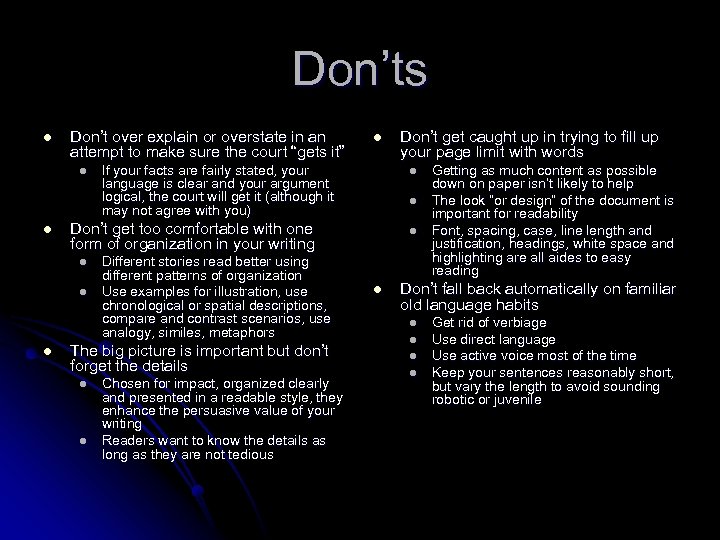 Don’ts l Don’t over explain or overstate in an attempt to make sure the court “gets it” l l If your facts are fairly stated, your language is clear and your argument logical, the court will get it (although it may not agree with you) l Different stories read better using different patterns of organization Use examples for illustration, use chronological or spatial descriptions, compare and contrast scenarios, use analogy, similes, metaphors The big picture is important but don’t forget the details l l Chosen for impact, organized clearly and presented in a readable style, they enhance the persuasive value of your writing Readers want to know the details as long as they are not tedious Don’t get caught up in trying to fill up your page limit with words l l Don’t get too comfortable with one form of organization in your writing l l l Getting as much content as possible down on paper isn’t likely to help The look “or design” of the document is important for readability Font, spacing, case, line length and justification, headings, white space and highlighting are all aides to easy reading Don’t fall back automatically on familiar old language habits l l Get rid of verbiage Use direct language Use active voice most of the time Keep your sentences reasonably short, but vary the length to avoid sounding robotic or juvenile
 Bibliography Batko, Ann When Bad Grammar Happens to Good People (Castle Books, 2005) Hacker, Diana A Canadian Writer’s Reference (Nelson Canada, 1989) James, Peg Clear Writing – A Contemporary Approach (Saskatchewan Legal Education Society, 1998) James, Peg Winning Ways – The Art of Persuasive Legal Writing (Saskatchewan Legal Education Society, 1999) James, Peg & Goncalves, Raquel Modern Writing for Lawyers (The Continuing Legal Education Society of British Columbia, 1994) Truss, Lynne Eats, Shoots & Leaves: The Zero Tolerance Approach to Punctuation (Gotham Books, 2003) Vos Savant, Marilyn The Art of Spelling: The Madness and the Method (W. W. Norton & Company, 2000) Many of the examples in this presentation are borrowed gratefully from the foregoing titles.