


 Скачать презентацию Strategic Leadership Workshop Col Martyn Forgrave Head
4b0bc84d6720eabc6cdfa00996c8e9c7.ppt
- Количество слайдов: 45
 Strategic Leadership Workshop Col Martyn Forgrave | Head International Section, Defence Academy Dr Laura Cleary I Head of Centre for International Security and Resilience Dr Roger Darby I Centre for Defence Management and Leadership International Section | Leadership & Management Division | College of Management and Technology
 Agenda • Understanding the Minister’s intent in the wider context. Light Lunch • Communicating the Minister’s intent. • Translating the Minister’s intent into actions. Break (Tea/Coffee) • Understanding leadership approaches. • Leading and Managing in the Security Sector. • Leading and managing Change Programmes. Centre for Defence Leadership & Management | College of Management & Technology | UK Defence Academy
 Output • Improved understanding of: - translating a leader’s vision into action. - communicating the intent. • Exposure to ideas on: - underpinning strategic leadership performance. - leading and managing change Centre for Defence Leadership & Management | College of Management & Technology | UK Defence Academy
 Understanding ‘If I had an hour to solve a problem and my life depended on the answer, I would spend the first 55 minutes figuring out the proper question to ask, for if I knew the proper question, I could solve the problem in five minutes’. Albert Einsten Centre for Defence Leadership & Management | College of Management & Technology | UK Defence Academy
 Understanding • Acquisition & development of knowledge to such a level that it enables: – Insight (knowing why something has happened). – Foresight (being able to identify & anticipate what may happen). • Make better decisions when based on most accurate depiction of situation. Centre for Defence Leadership & Management | College of Management & Technology | UK Defence Academy
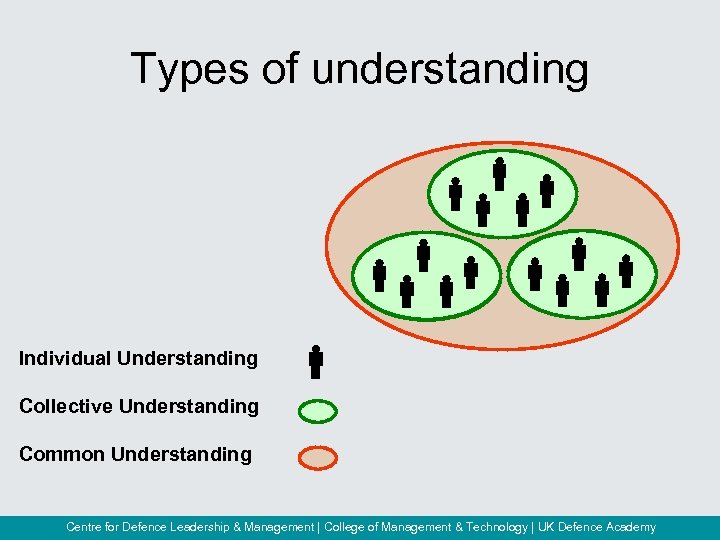 Types of understanding Individual Understanding Collective Understanding Common Understanding Centre for Defence Leadership & Management | College of Management & Technology | UK Defence Academy
 Intent – ‘Mission Command’ • 5 Key Elements: – A commander ensures subordinates understand his intentions, their own missions and the strategic, operational and tactical context – Subordinates are told what effect they are to achieve and the reasons why – Subordinates are allocated sufficient recourses – A commander uses a minimum of control so as not to limit a subordinate’s freedom of action – Subordinates decide for themselves how best to achieve their tasks Centre for Defence Leadership & Management | College of Management & Technology | UK Defence Academy
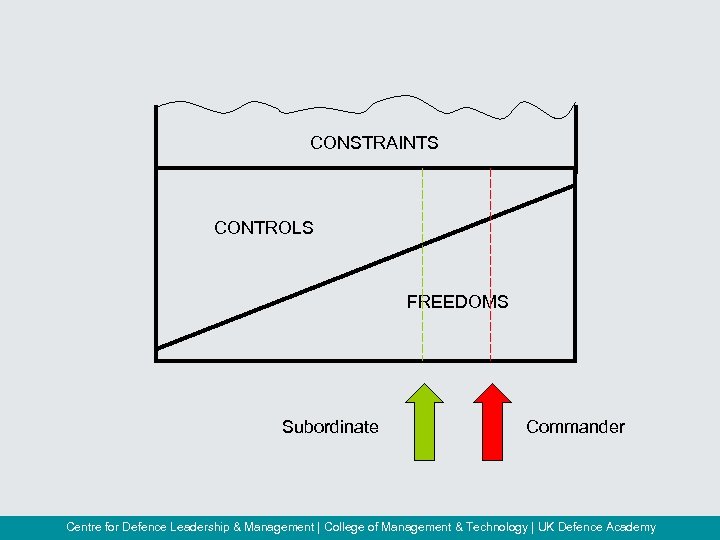 CONSTRAINTS CONTROLS FREEDOMS Subordinate Commander Centre for Defence Leadership & Management | College of Management & Technology | UK Defence Academy
 Integrated Approach: What is it? “Denotes public service agencies working across portfolio boundaries to achieve a shared goal and integrated government response to particular issues. Approaches can be formal and informal. They can focus on policy development, programme management and service delivery. ” (State Government of Victoria State, Joined Up Government: a review of national and international experiences, Working Paper No. 1, 2007) Centre for Defence Leadership & Management | College of Management & Technology | UK Defence Academy
 What is policy? • A choice leading to a course of action proposed or adopted by a government. A statement of intent, or a commitment to act. • Strategy is not policy, but the means of effecting it. • “Policy without strategy is, to a degree, flying blind”. Professor Lord Hennessy of Nympsfield Centre for Defence Leadership & Management | College of Management & Technology | UK Defence Academy
 What is Strategy? • Strategy is not simply the articulation of a desired outcome. • Strategy within Government is about finding plausible ways to deliver long-term policy objectives over time, using the resources available (i. e. balancing ‘ends, ways and means’). • But what are the hallmarks of good strategy…? . Centre for Defence Leadership & Management | College of Management & Technology | UK Defence Academy
 Strategy should be…. • • Context-specific Realistic Competitive Insightful Resourced Organised Flexible Centre for Defence Leadership & Management | College of Management & Technology | UK Defence Academy
 Strategy might include…. • • • Introduction Context Assumptions Vision and objectives Priorities Pathway to the future Stakeholders Cost Delivery challenges ………. etc, etc Centre for Defence Leadership & Management | College of Management & Technology | UK Defence Academy
 Plan might include…. • • Delivery of objectives (outputs & standards) Resource envelope Risk statement/management Dependencies – how to work within the corporate framework • Assurance (performance management) – how driving increased efficiency • ………. etc, etc Centre for Defence Leadership & Management | College of Management & Technology | UK Defence Academy
 Generic Departmental Design Principles • List key attributes (max 10) that you would like to see operating in your department. • Write down 5 design principles for this new operating model. • Prepare to discuss them Centre for Defence Leadership & Management | College of Management & Technology | UK Defence Academy
 Risk • Risk: Uncertain event or set of circumstance that should it occur, will have an effect on achievement of objectives. • Risk Management: Systematic process of identifying, analysing and responding to risk. - Initiate - Identify - Assess - Plan Responses (transfer, avoid, accept, reduce) - Implement Centre for Defence Leadership & Management | College of Management & Technology | UK Defence Academy
 Leadership Approaches Centre for Defence Leadership & Management | College of Management & Technology | UK Defence Academy
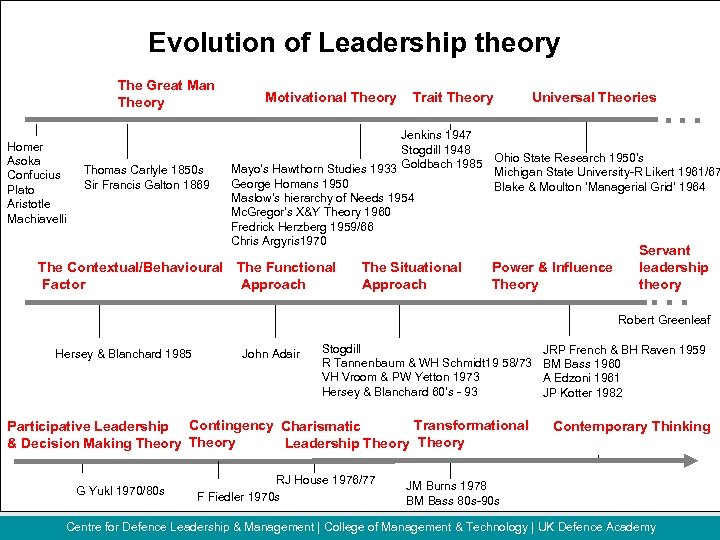 Evolution of Leadership theory The Great Man Theory Homer Asoka Confucius Plato Aristotle Machiavelli Thomas Carlyle 1850 s Sir Francis Galton 1869 Motivational Theory Trait Theory Jenkins 1947 Stogdill 1948 Mayo’s Hawthorn Studies 1933 Goldbach 1985 George Homans 1950 Maslow’s hierarchy of Needs 1954 Mc. Gregor’s X&Y Theory 1960 Fredrick Herzberg 1959/66 Chris Argyris 1970 The Contextual/Behavioural The Functional Factor Approach The Situational Approach Universal Theories . . . Ohio State Research 1950’s Michigan State University-R Likert 1961/67 Blake & Moulton ‘Managerial Grid’ 1964 Power & Influence Theory Servant leadership theory . . . Robert Greenleaf Hersey & Blanchard 1985 John Adair Stogdill R Tannenbaum & WH Schmidt 19 58/73 VH Vroom & PW Yetton 1973 Hersey & Blanchard 60’s - 93 Transformational Participative Leadership Contingency Charismatic & Decision Making Theory Leadership Theory G Yukl 1970/80 s RJ House 1976/77 F Fiedler 1970 s JRP French & BH Raven 1959 BM Bass 1960 A Edzoni 1961 JP Kotter 1982 Contemporary Thinking JM Burns 1978 BM Bass 80 s-90 s Centre for Defence Leadership & Management | College of Management & Technology | UK Defence Academy
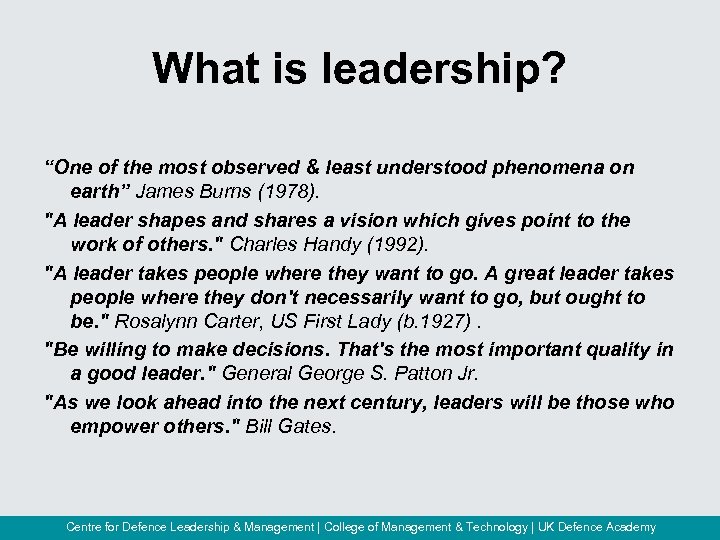 What is leadership? “One of the most observed & least understood phenomena on earth” James Burns (1978). "A leader shapes and shares a vision which gives point to the work of others. " Charles Handy (1992). "A leader takes people where they want to go. A great leader takes people where they don't necessarily want to go, but ought to be. " Rosalynn Carter, US First Lady (b. 1927). "Be willing to make decisions. That's the most important quality in a good leader. " General George S. Patton Jr. "As we look ahead into the next century, leaders will be those who empower others. " Bill Gates. Centre for Defence Leadership & Management | College of Management & Technology | UK Defence Academy
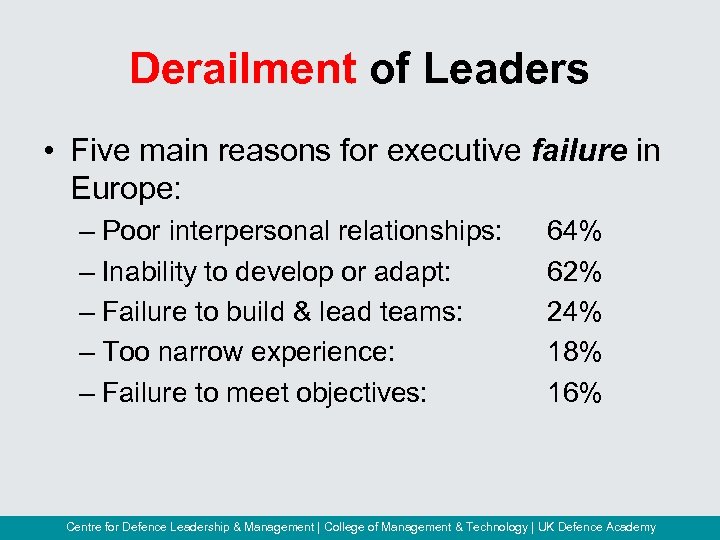 Derailment of Leaders • Five main reasons for executive failure in Europe: – Poor interpersonal relationships: – Inability to develop or adapt: – Failure to build & lead teams: – Too narrow experience: – Failure to meet objectives: 64% 62% 24% 18% 16% Centre for Defence Leadership & Management | College of Management & Technology | UK Defence Academy
 Command is a position of authority and responsibility to which military men and women are legally appointed. Leadership and management are the key components to the successful exercise of Command. Successful management is readily measured against objective criteria but commanders are not leaders until their position has been ratified in the hearts and minds of those they command. © DLC Centre for Defence Leadership & Management | College of Management & Technology | UK Defence Academy
 Leadership is visionary; it is the projection of personality and character to inspire the team to achieve the desired outcome. There is no prescription for leadership and no prescribed style of leader. Leadership is a combination of example, persuasion and compulsion dependent on the situation. It should aim to transform and be underpinned by individual skills and an enabling ethos. The successful leader is an individual who understands him/herself, the organisation, the environment in which they operate and the people that they are privileged to lead. © DLC Centre for Defence Leadership & Management | College of Management & Technology | UK Defence Academy
 Management is a facet of Command. It is about the allocation and control of resources (human, materiel and financial) to achieve objectives. Management requires the capability to deploy a range of techniques and skills to enhance and facilitate the planning, organisation and execution of the business of defence. A successful Manager combines these skills with those of leadership. A Manager with the style of management most suited to the circumstances is the most successful. (A Leader/Manager) © DLC Centre for Defence Leadership & Management | College of Management & Technology | UK Defence Academy
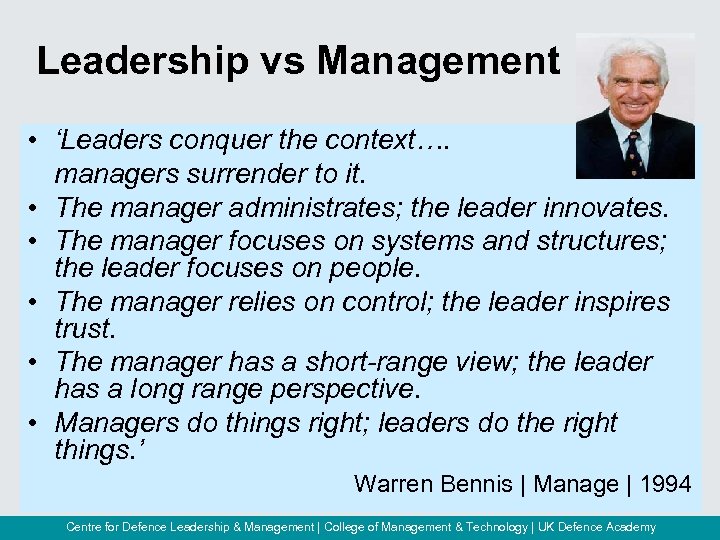 Leadership vs Management • ‘Leaders conquer the context…. managers surrender to it. • The manager administrates; the leader innovates. • The manager focuses on systems and structures; the leader focuses on people. • The manager relies on control; the leader inspires trust. • The manager has a short-range view; the leader has a long range perspective. • Managers do things right; leaders do the right things. ’ Warren Bennis | Manage | 1994 Centre for Defence Leadership & Management | College of Management & Technology | UK Defence Academy
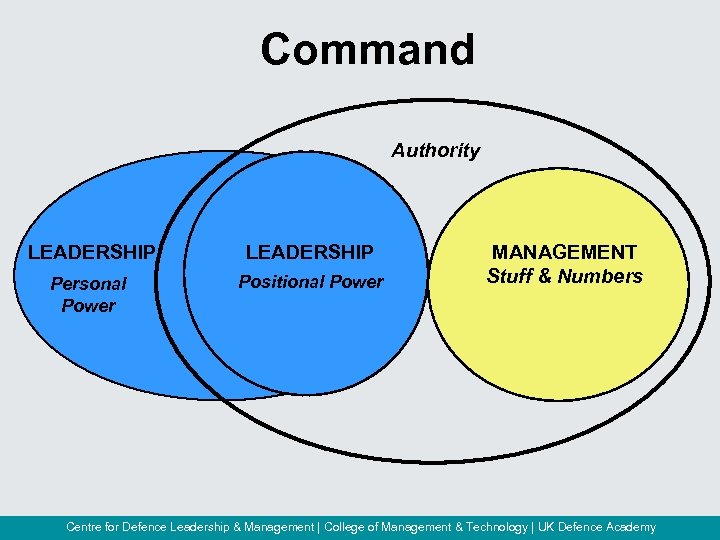 Command Authority LEADERSHIP Personal Power Positional Power MANAGEMENT Stuff & Numbers Centre for Defence Leadership & Management | College of Management & Technology | UK Defence Academy
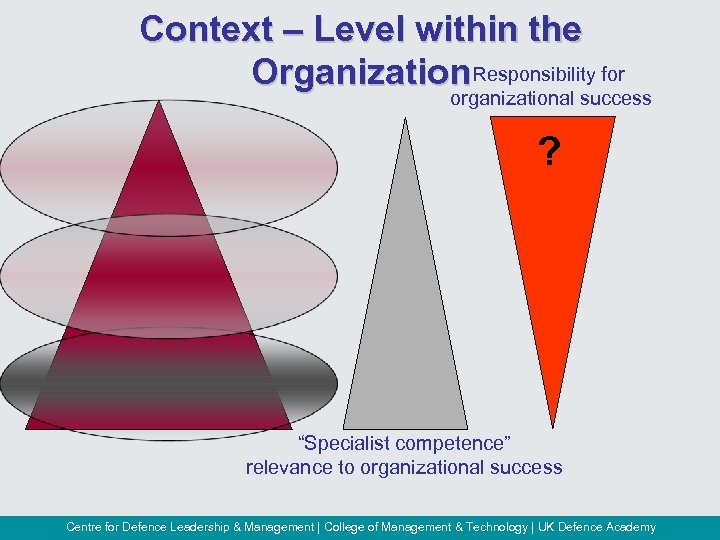 Context – Level within the Organization Responsibility for organizational success ? “Specialist competence” relevance to organizational success Centre for Defence Leadership & Management | College of Management & Technology | UK Defence Academy
 What Changes? “Strategic leaders do not need to know all the answers – they do need to ask the right questions” Communication – from inward “reinforcing the team” to upward and outward – “shaping the environment”, “cross-silo” Uncertainty – increasing ambiguity, complexity and volatility Risks – in Defence context - physical to organisational Decision-making – increasing proportion of “ethical decisions” …. . Etc! Centre for Defence Leadership & Management | College of Management & Technology | UK Defence Academy
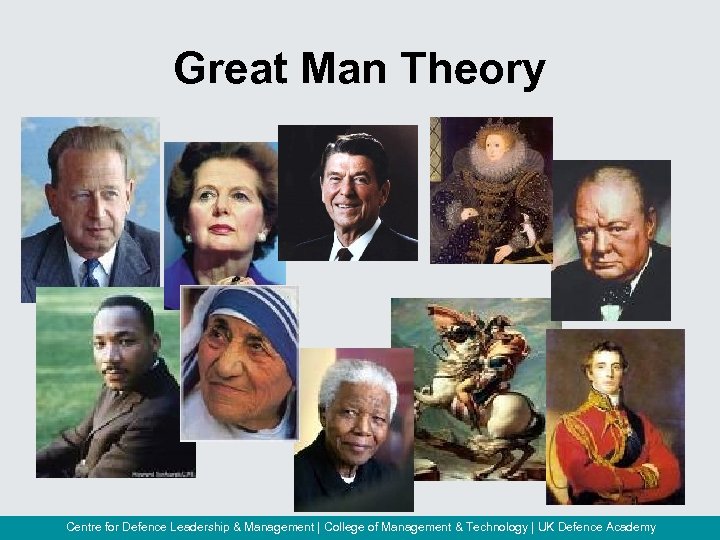 Great Man Theory Centre for Defence Leadership & Management | College of Management & Technology | UK Defence Academy
 TRAIT THEORY HOW TO PREDICT WHO WILL BE A GOOD LEADER Centre for Defence Leadership & Management | College of Management & Technology | UK Defence Academy
 TRAIT THEORY • List 5 traits of a GOOD LEADER in priority order • List 5 traits of a BAD LEADER in priority order Centre for Defence Leadership & Management | College of Management & Technology | UK Defence Academy
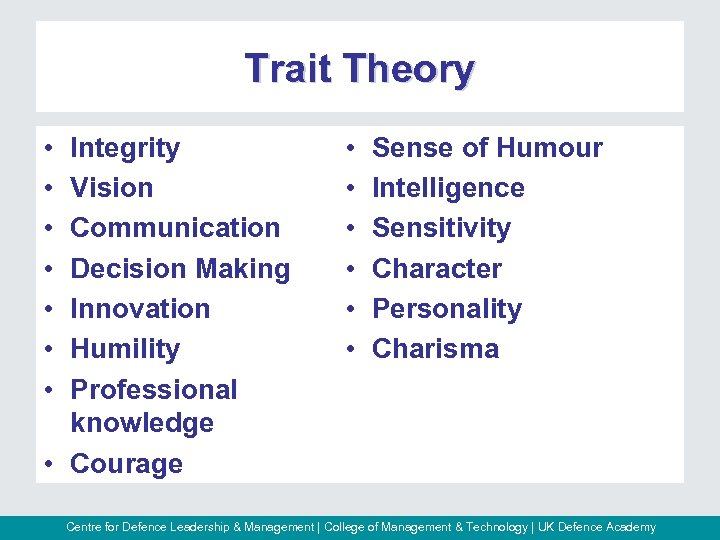 Trait Theory • • Integrity Vision Communication Decision Making Innovation Humility Professional knowledge • Courage • • • Sense of Humour Intelligence Sensitivity Character Personality Charisma Centre for Defence Leadership & Management | College of Management & Technology | UK Defence Academy
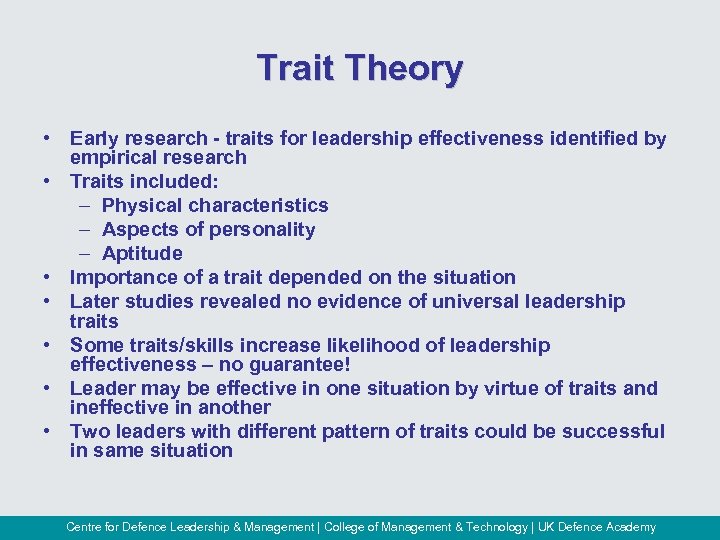 Trait Theory • Early research - traits for leadership effectiveness identified by empirical research • Traits included: – Physical characteristics – Aspects of personality – Aptitude • Importance of a trait depended on the situation • Later studies revealed no evidence of universal leadership traits • Some traits/skills increase likelihood of leadership effectiveness – no guarantee! • Leader may be effective in one situation by virtue of traits and ineffective in another • Two leaders with different pattern of traits could be successful in same situation Centre for Defence Leadership & Management | College of Management & Technology | UK Defence Academy
 Can managers use different leadership styles depending on the situation? Centre for Defence Leadership & Management | College of Management & Technology | UK Defence Academy
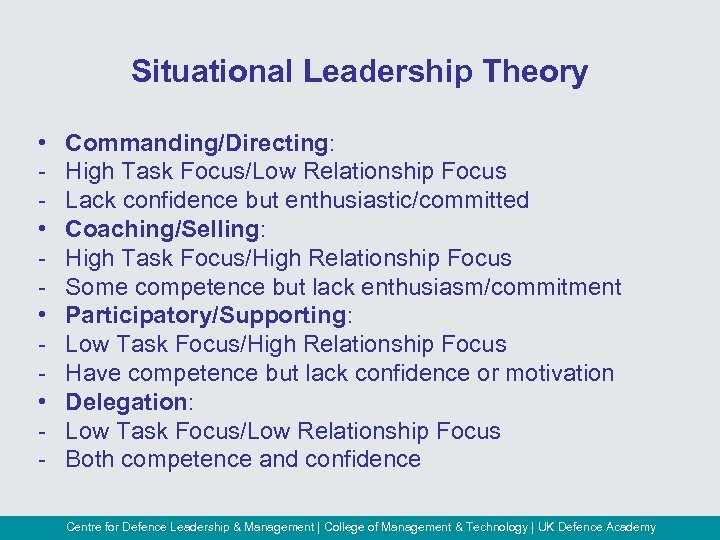 Situational Leadership Theory • • - Commanding/Directing: High Task Focus/Low Relationship Focus Lack confidence but enthusiastic/committed Coaching/Selling: High Task Focus/High Relationship Focus Some competence but lack enthusiasm/commitment Participatory/Supporting: Low Task Focus/High Relationship Focus Have competence but lack confidence or motivation Delegation: Low Task Focus/Low Relationship Focus Both competence and confidence Centre for Defence Leadership & Management | College of Management & Technology | UK Defence Academy
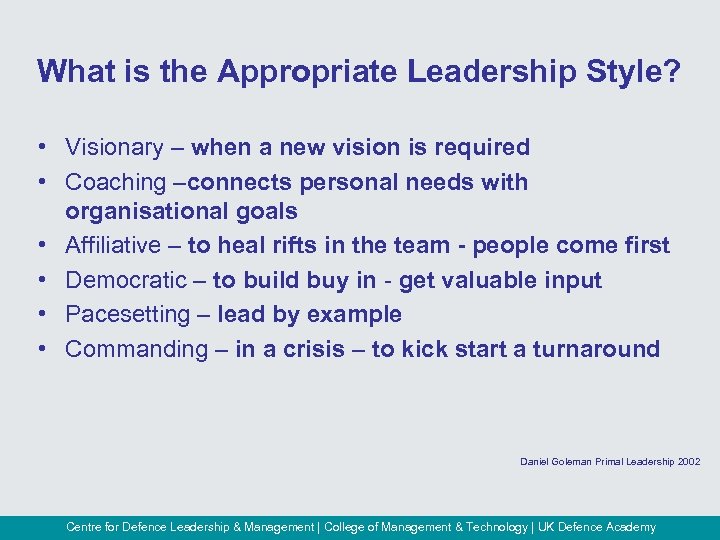 What is the Appropriate Leadership Style? • Visionary – when a new vision is required • Coaching –connects personal needs with organisational goals • Affiliative – to heal rifts in the team - people come first • Democratic – to build buy in - get valuable input • Pacesetting – lead by example • Commanding – in a crisis – to kick start a turnaround Daniel Goleman Primal Leadership 2002 Centre for Defence Leadership & Management | College of Management & Technology | UK Defence Academy
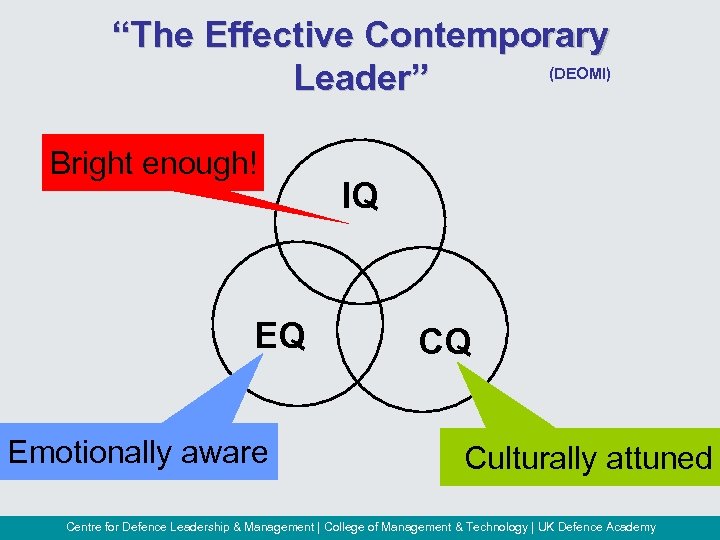 “The Effective Contemporary (DEOMI) Leader” Bright enough! EQ Emotionally aware IQ CQ Culturally attuned Centre for Defence Leadership & Management | College of Management & Technology | UK Defence Academy
 Emotional Intelligence D Goleman 1996 Psychologist Harvard ‘The capacity for recognising our own feelings and those of others, for motivating ourselves and for managing emotions well in ourselves and in our relationships. Abilities distinct from but complementary to academic intelligence, the purely cognitive capacity measured by IQ. ’ Centre for Defence Leadership & Management | College of Management & Technology | UK Defence Academy
 EQ – 5 Elements • Self awareness - understand yourself and your effect on others • Self Regulation - suspend judgement, think before acting • Motivation – passion beyond reward • Empathy – understand the emotional makeup of other people and treat them accordingly • Social Skill – managing relationships, building networks Centre for Defence Leadership & Management | College of Management & Technology | UK Defence Academy
 Toxic Leadership “Destructive leaders are focused on short-term mission accomplishment. They provide superiors with impressive articulate presentations and enthusiastic responses to missions. But they are unconcerned about, or oblivious to, staff or troop morale and/or climate. They are seen as self serving” US Army War College Class of 2003 Centre for Defence Leadership & Management | College of Management & Technology | UK Defence Academy
 Toxic Leadership • Bright, energetic individuals with a reputation for ‘getting the job done’. • Strategic issue ‘not normally addressed until there is a public spectacle’ • EQ attributes: – Arrogant – self centred – ultimately dysfunctional – Insensitivity – Uncontrolled ambition (for self not organisation) Centre for Defence Leadership & Management | College of Management & Technology | UK Defence Academy
 Followership What makes you follow a leader? Are you a good Follower? Centre for Defence Leadership & Management | College of Management & Technology | UK Defence Academy
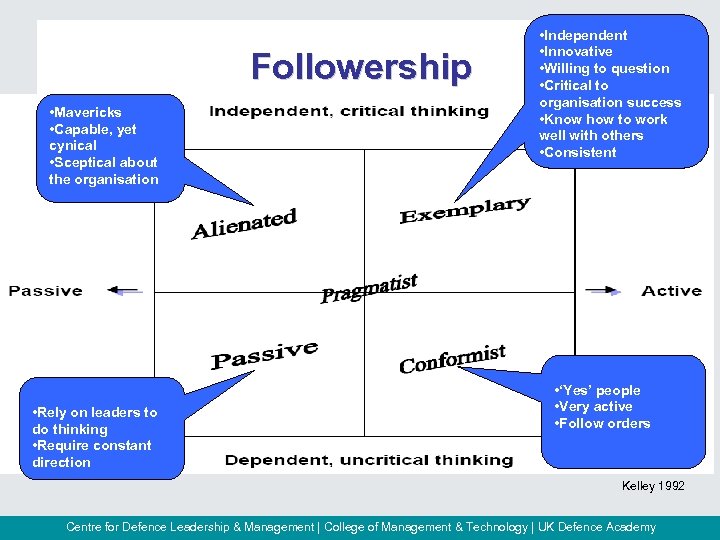 Followership • Mavericks • Capable, yet cynical • Sceptical about the organisation • Rely on leaders to do thinking • Require constant direction • Independent • Innovative • Willing to question • Critical to organisation success • Know how to work well with others • Consistent • ‘Yes’ people • Very active • Follow orders Kelley 1992 Centre for Defence Leadership & Management | College of Management & Technology | UK Defence Academy
 What sort of leader do you want to be? • One that: – – – – Is comfortable with uncertainty & complexity. Can work with ambiguity & risk. Treats change as opportunity rather than threat. Is forward looking & can visualise the future. Looks up & outward. Is comfortable with information extremes. Is aware of their own strengths & weaknesses. Can build working teams and accept constructive dissent. Centre for Defence Leadership & Management | College of Management & Technology | UK Defence Academy
 Leadership Thinking • Great Man Tradition: – Entertaining but unscientific. • Academic Tradition: – Scientific but often difficult to understand or see the immediate relevance. – Considerable differences between the disciplines. Centre for Defence Leadership & Management | College of Management & Technology | UK Defence Academy
 Questions International Section | Leadership & Management Division | College of Management and Technology