 Скачать презентацию Story about Cosmic Ray historical review a
Вводная лекция.ppt
- Количество слайдов: 84



Story about Cosmic Ray (historical review + a toy model of cosmic ray origin) 2/17/2018 ФИАН, Теоротдел 1
April, 28, 1911 Heike Kamerlingh-Onnes, the discovery of superconductivity at temperatures of liquid Helium, Centenary of Superconductivity August, 7, 1912 Centenary of Cosmic Ray Discovery 2/17/2018 ФИАН, Теоротдел 2
INTRODUCTION 2/17/2018 ФИАН, Теоротдел 3
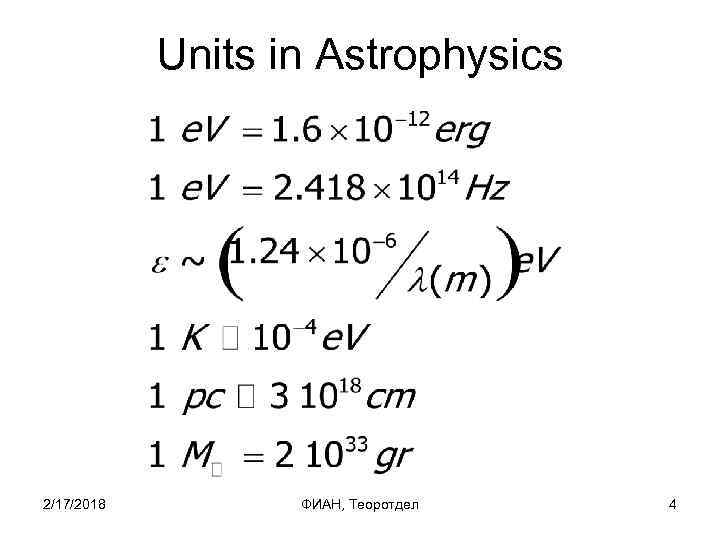
Units in Astrophysics 2/17/2018 ФИАН, Теоротдел 4
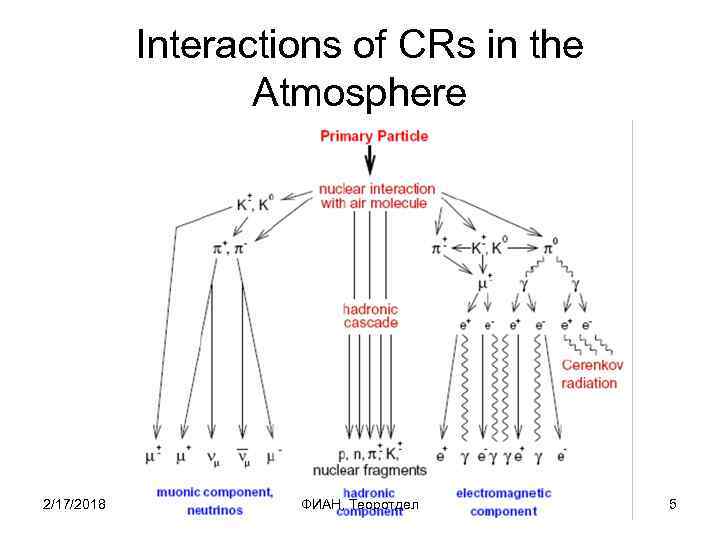
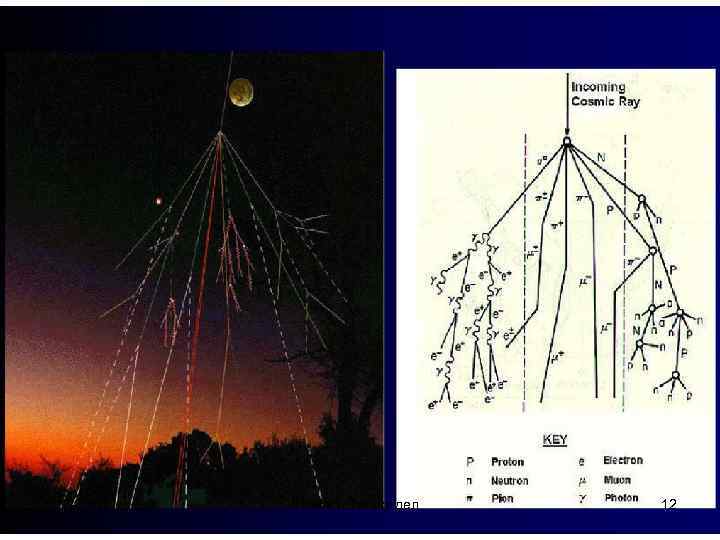
Interactions of CRs in the Atmosphere 2/17/2018 ФИАН, Теоротдел 5
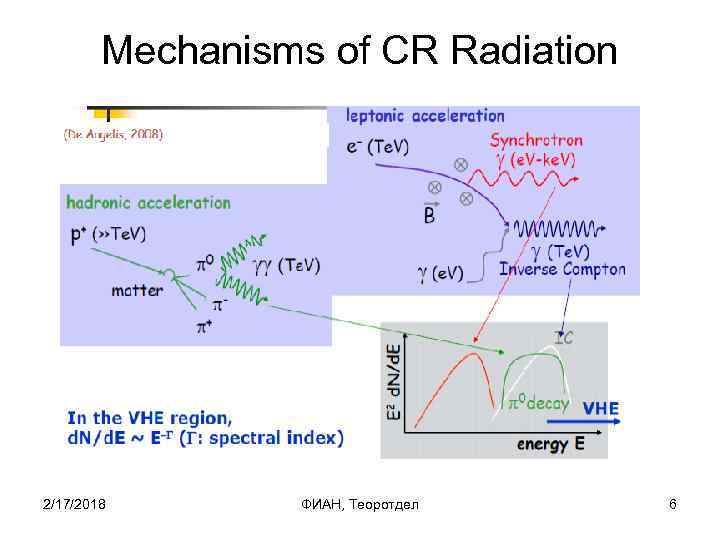
Mechanisms of CR Radiation 2/17/2018 ФИАН, Теоротдел 6
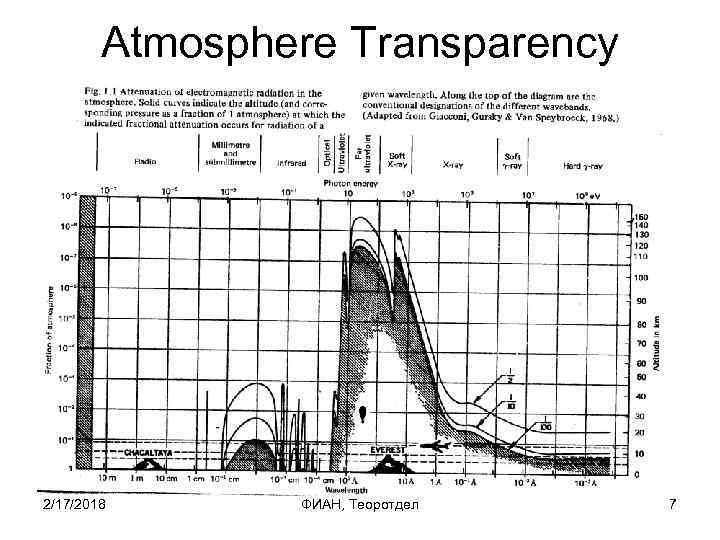
Atmosphere Transparency 2/17/2018 ФИАН, Теоротдел 7
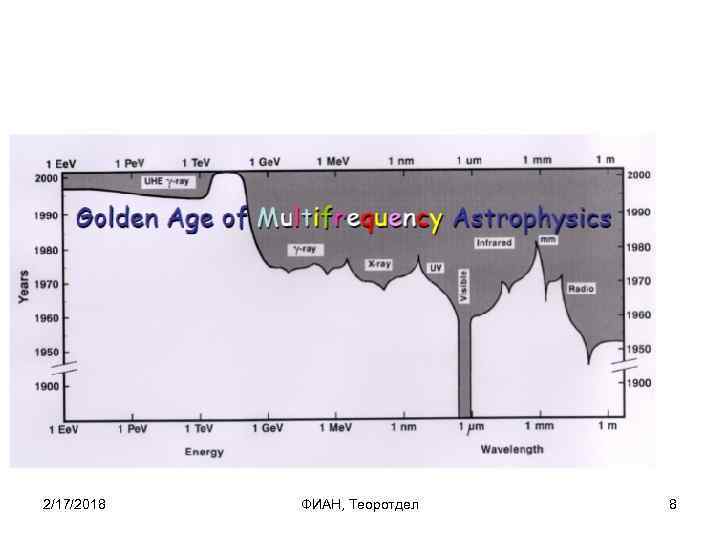
2/17/2018 ФИАН, Теоротдел 8
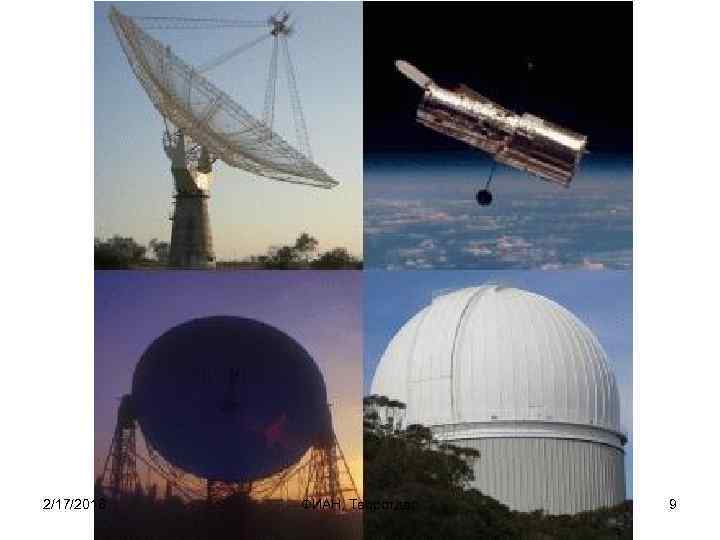
2/17/2018 ФИАН, Теоротдел 9
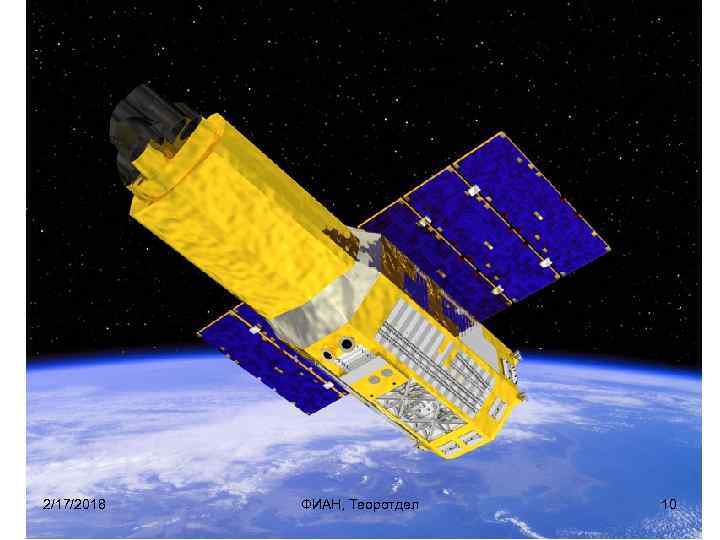
Origin of Cosmic Rays 2/17/2018 ФИАН, Теоротдел 10
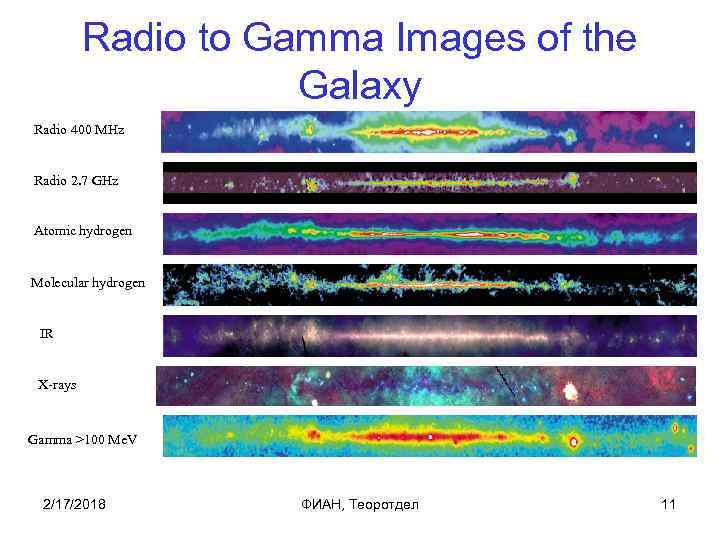
Radio to Gamma Images of the Galaxy Radio 400 MHz Radio 2. 7 GHz Atomic hydrogen Molecular hydrogen IR X-rays Gamma >100 Me. V 2/17/2018 ФИАН, Теоротдел 11
2/17/2018 ФИАН, Теоротдел 12
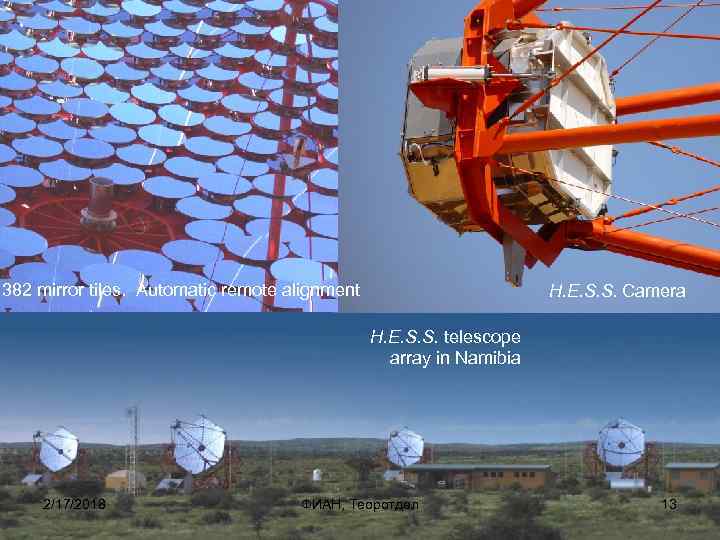
382 mirror tiles. Automatic remote alignment H. E. S. S. Camera H. E. S. S. telescope array in Namibia 2/17/2018 ФИАН, Теоротдел 13
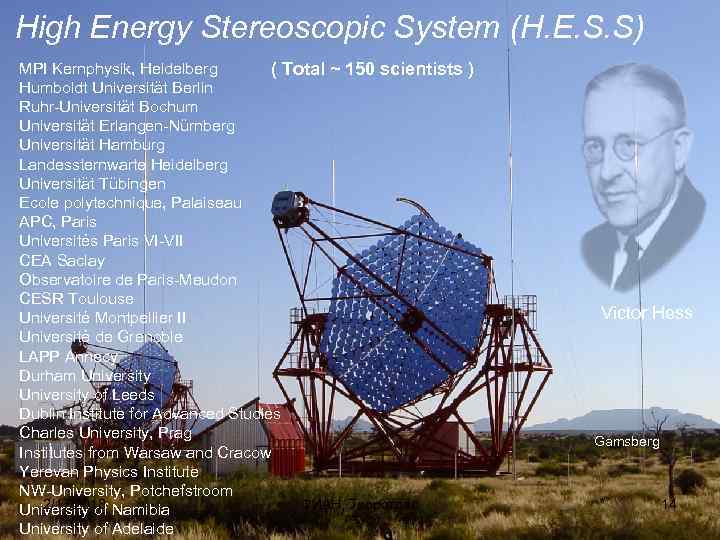
High Energy Stereoscopic System (H. E. S. S) MPI Kernphysik, Heidelberg ( Total ~ 150 scientists ) Humboldt Universität Berlin PSR 1253 Ruhr-Universität Bochum Universität Erlangen-Nürnberg Universität Hamburg Landessternwarte Heidelberg Universität Tübingen Ecole polytechnique, Palaiseau APC, Paris Universités Paris VI-VII CEA Saclay Observatoire de Paris-Meudon CESR Toulouse Université Montpellier II Université de Grenoble LAPP Annecy Durham University of Leeds Dublin Institute for Advanced Studies Charles University, Prag Institutes from Warsaw and Cracow Yerevan Physics Institute NW-University, Potchefstroom 2/17/2018 ФИАН, Теоротдел University of Namibia University of Adelaide Victor Hess Gamsberg 14
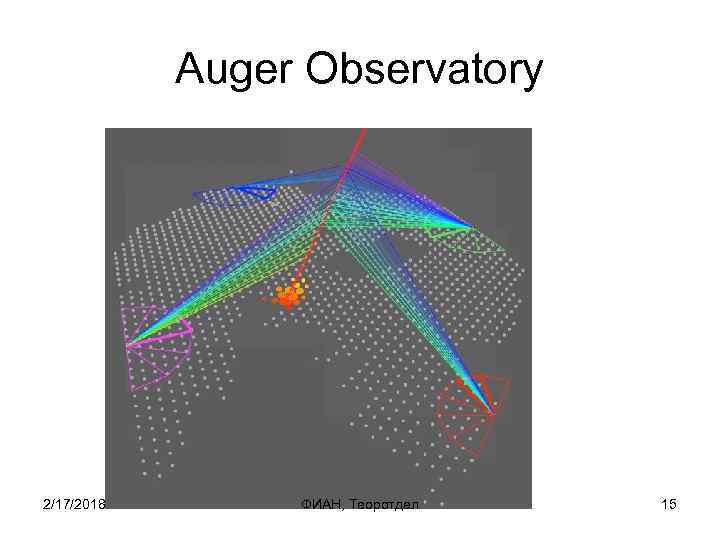
Auger Observatory 2/17/2018 ФИАН, Теоротдел 15
STORY of the DISCOVERY 2/17/2018 ФИАН, Теоротдел 16
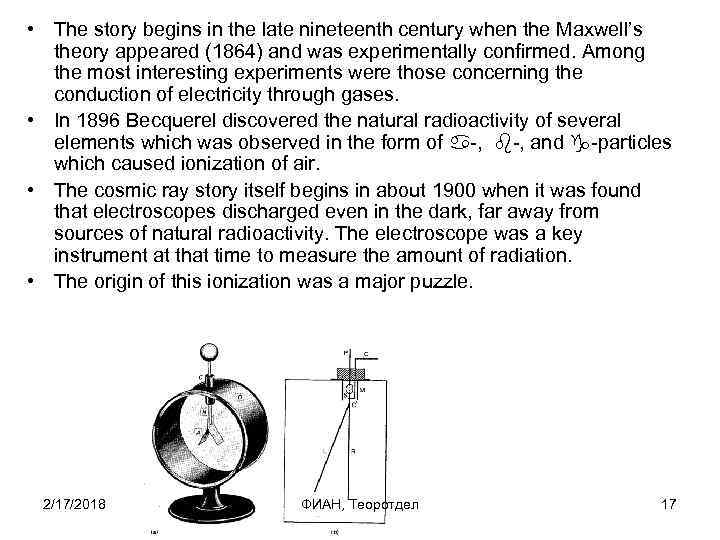
• The story begins in the late nineteenth century when the Maxwell’s theory appeared (1864) and was experimentally confirmed. Among the most interesting experiments were those concerning the conduction of electricity through gases. • In 1896 Becquerel discovered the natural radioactivity of several elements which was observed in the form of -, and -particles which caused ionization of air. • The cosmic ray story itself begins in about 1900 when it was found that electroscopes discharged even in the dark, far away from sources of natural radioactivity. The electroscope was a key instrument at that time to measure the amount of radiation. • The origin of this ionization was a major puzzle. 2/17/2018 ФИАН, Теоротдел 17
• Rutherford showed that the most of the ionization was due to radioactive elements in rocks. • To protect from the natural ionization from the Earth surface Wulf suggested to put an electroscope on the top of Eiffel Tower, whose height was 330 m. 2/17/2018 ФИАН, Теоротдел 18
• In 1910 Wulf found that ionization fell indeed, from 6 x 10⁶ ions/m 3 to 3. 5 x 10⁶ ions/m 3. • However, absorption in air of the most penetrating -rays was known. The intensity of ionization should have halved in only 80 m height and would have negligible at the top of the Tower. 2/17/2018 ФИАН, Теоротдел 19
• 1912. The big breakthrough came in 1912 and 1913 when Hess and then Kohlhoerster made balloon flights in order to elucidate the role of the Earth in which they measured the ionization of atmosphere. • In 1912 Hess had flown to 5 km, and Kohlhoerster in 1914 had made ascent to 9 km. • Especially successful was the flight of August, 7, 1912. The birthday of cosmic rays discovered by V. Hess when he reached an altitude 5 km. • At high latitude the ionization rate was several times higher than observed at the sea level. Radioactive elements in the upper atmosphere? 2/17/2018 ФИАН, Теоротдел 20
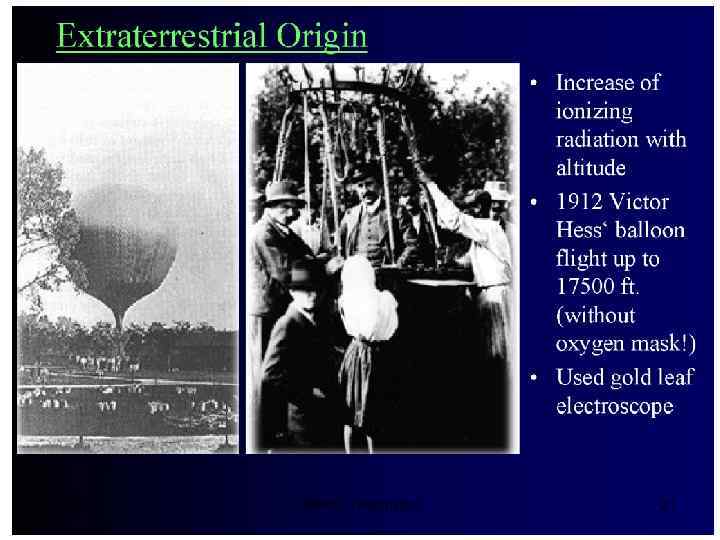
2/17/2018 ФИАН, Теоротдел 21
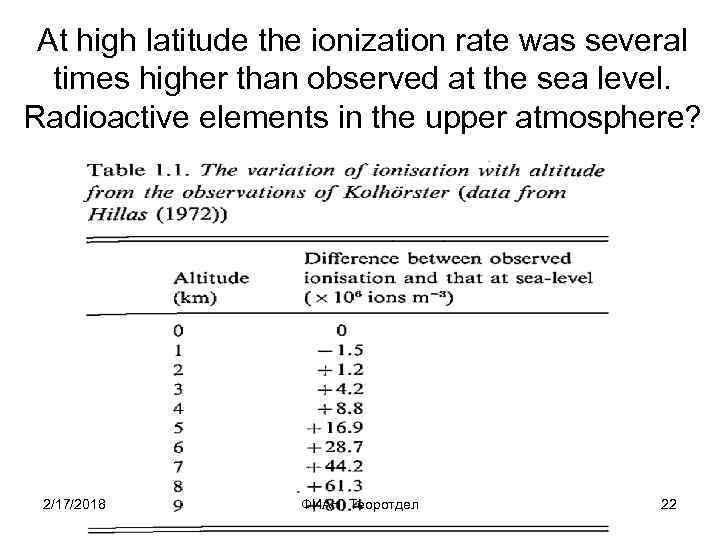
At high latitude the ionization rate was several times higher than observed at the sea level. Radioactive elements in the upper atmosphere? 2/17/2018 ФИАН, Теоротдел 22
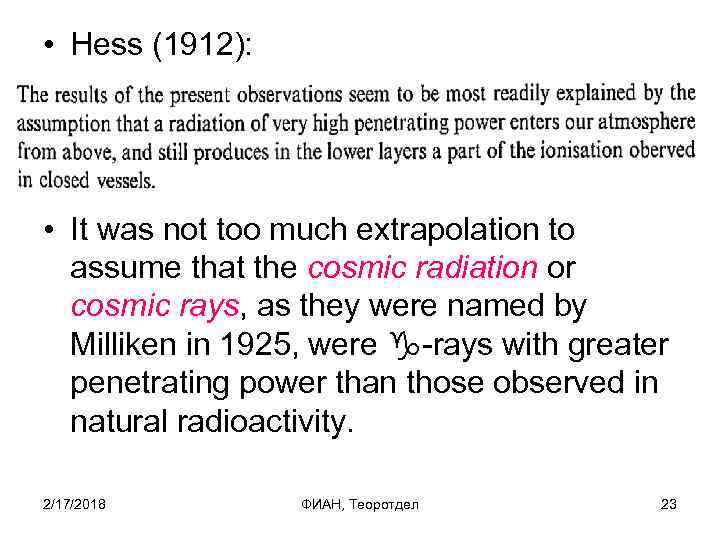
• Hess (1912): • It was not too much extrapolation to assume that the cosmic radiation or cosmic rays, as they were named by Milliken in 1925, were -rays with greater penetrating power than those observed in natural radioactivity. 2/17/2018 ФИАН, Теоротдел 23
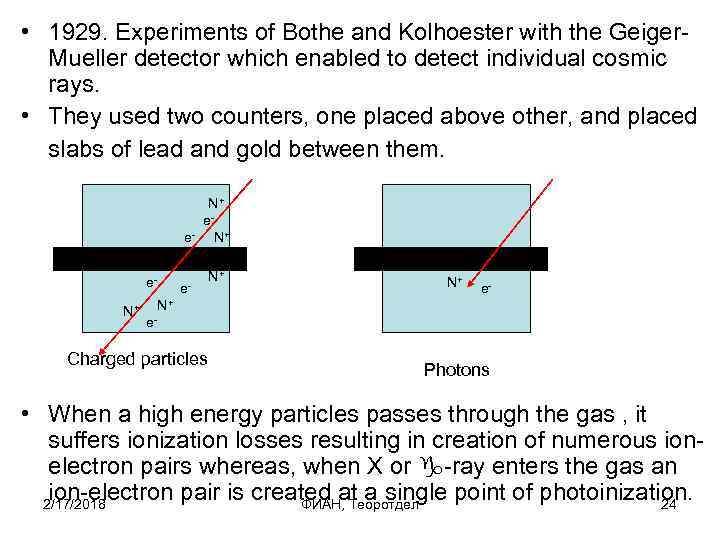
• 1929. Experiments of Bothe and Kolhoester with the Geiger. Mueller detector which enabled to detect individual cosmic rays. • They used two counters, one placed above other, and placed slabs of lead and gold between them. N+ ee- N+ ee. N+ e- Charged particles Photons • When a high energy particles passes through the gas , it suffers ionization losses resulting in creation of numerous ionelectron pairs whereas, when X or -ray enters the gas an ion-electron pair is created at a single point of photoinization. 2/17/2018 ФИАН, Теоротдел 24
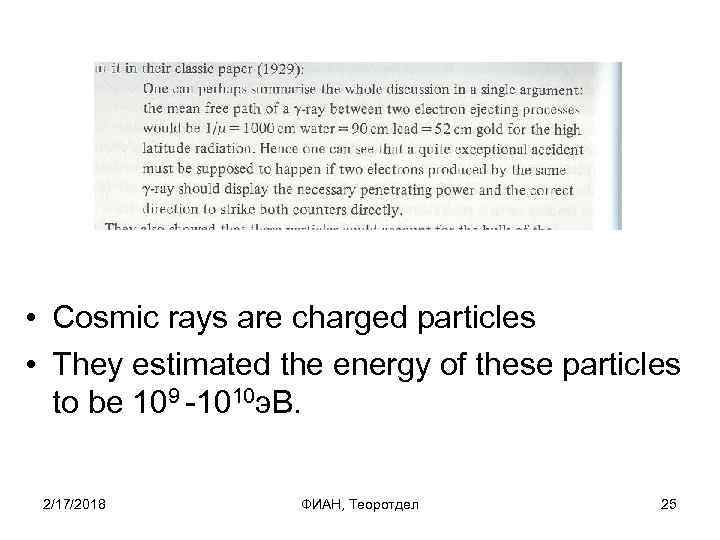
• Cosmic rays are charged particles • They estimated the energy of these particles to be 109 -1010 э. В. 2/17/2018 ФИАН, Теоротдел 25
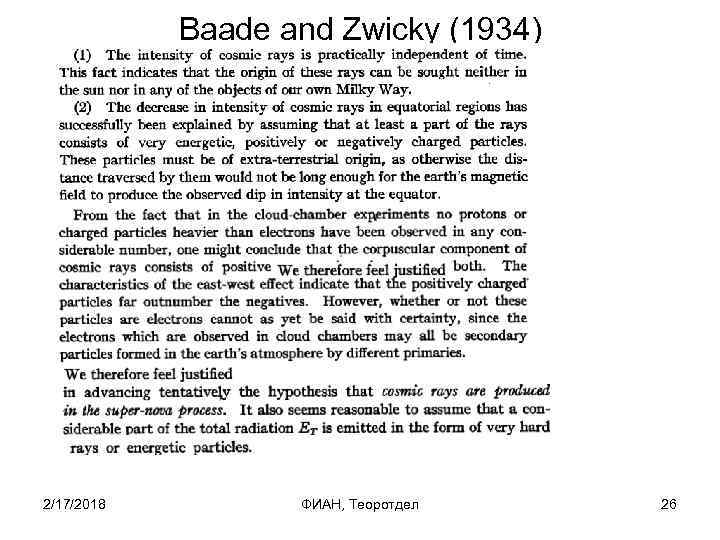
Baade and Zwicky (1934) 2/17/2018 ФИАН, Теоротдел 26
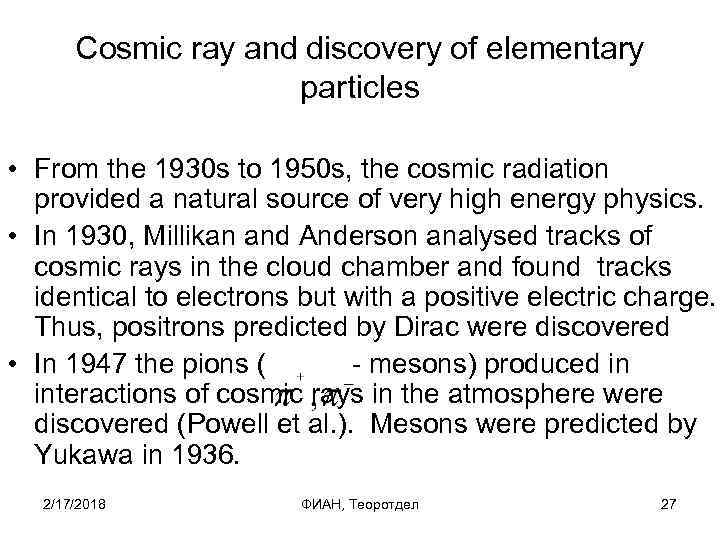
Cosmic ray and discovery of elementary particles • From the 1930 s to 1950 s, the cosmic radiation provided a natural source of very high energy physics. • In 1930, Millikan and Anderson analysed tracks of cosmic rays in the cloud chamber and found tracks identical to electrons but with a positive electric charge. Thus, positrons predicted by Dirac were discovered • In 1947 the pions ( - mesons) produced in interactions of cosmic rays in the atmosphere were discovered (Powell et al. ). Mesons were predicted by Yukawa in 1936. 2/17/2018 ФИАН, Теоротдел 27
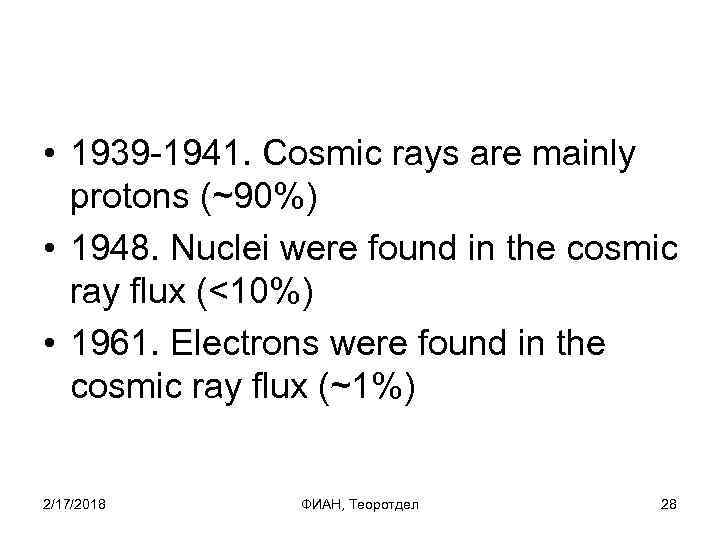
• 1939 -1941. Cosmic rays are mainly protons (~90%) • 1948. Nuclei were found in the cosmic ray flux (<10%) • 1961. Electrons were found in the cosmic ray flux (~1%) 2/17/2018 ФИАН, Теоротдел 28
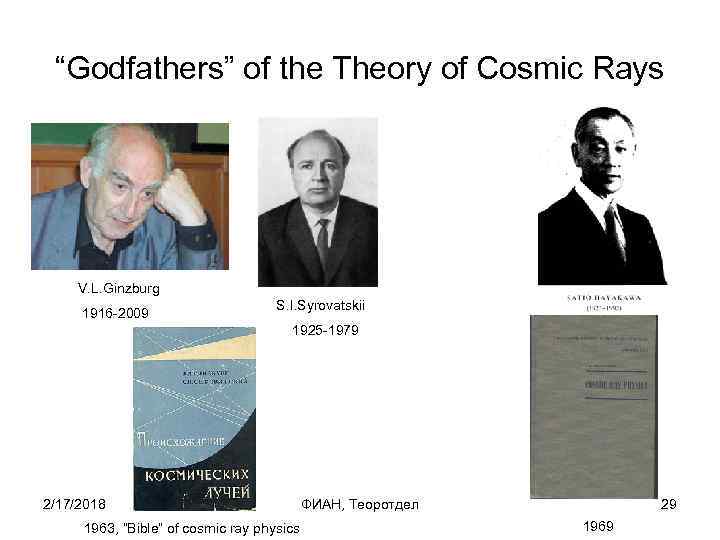
“Godfathers” of the Theory of Cosmic Rays V. L. Ginzburg 1916 -2009 S. I. Syrovatskii 1925 -1979 2/17/2018 1963, “Bible” of cosmic ray physics ФИАН, Теоротдел 29 1969
THEORY of COSMIC RAY ORIGIN 2/17/2018 ФИАН, Теоротдел 30
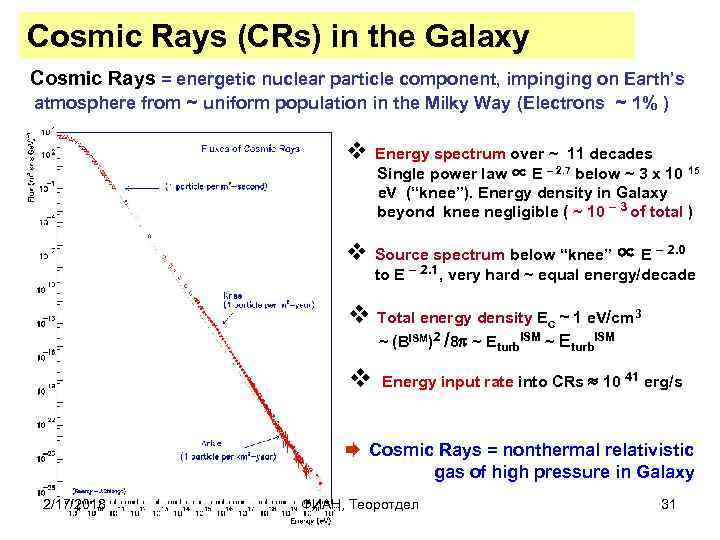
Cosmic Rays (CRs) in the Galaxy Cosmic Rays = energetic nuclear particle component, impinging on Earth’s atmosphere from ~ uniform population in the Milky Way (Electrons ~ 1% ) v Energy spectrum over ~ 11 decades Single power law ∝ E – 2. 7 below ~ 3 x 10 15 e. V (“knee”). Energy density in Galaxy beyond knee negligible ( ~ 10 – 3 of total ) v Source spectrum below “knee” ∝ E – 2. 0 to E – 2. 1, very hard ~ equal energy/decade v Total energy density Ec ~ 1 e. V/cm 3 ~ (BISM)2 /8 ~ Eturb. ISM v Energy input rate into CRs 10 41 erg/s Cosmic Rays = nonthermal relativistic gas of high pressure in Galaxy 2/17/2018 ФИАН, Теоротдел 31
Models of Cosmic Ray Origin • Solar (Alfven) • Extragalactic (Burbidge) • Galactic (Ginzburg) 2/17/2018 ФИАН, Теоротдел 32
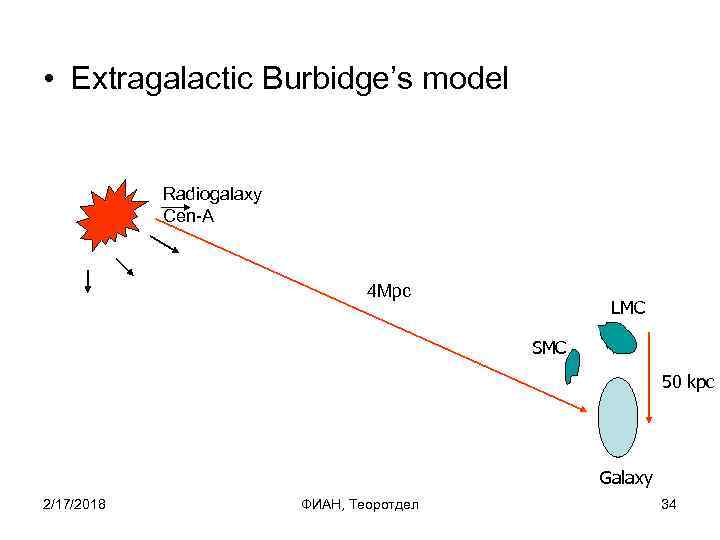
• Extragalactic Burbidge’s model Radiogalaxy Cen-A 4 Mpc LMC SMC 50 kpc Galaxy 2/17/2018 ФИАН, Теоротдел 34
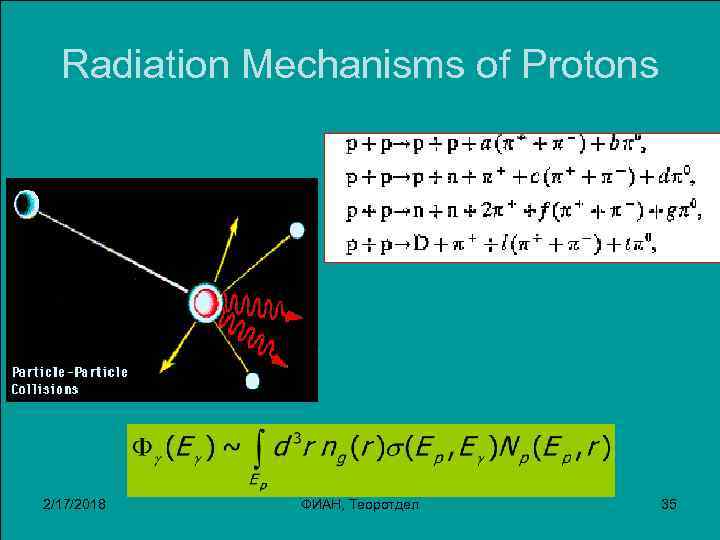
Radiation Mechanisms of Protons 2/17/2018 ФИАН, Теоротдел 35
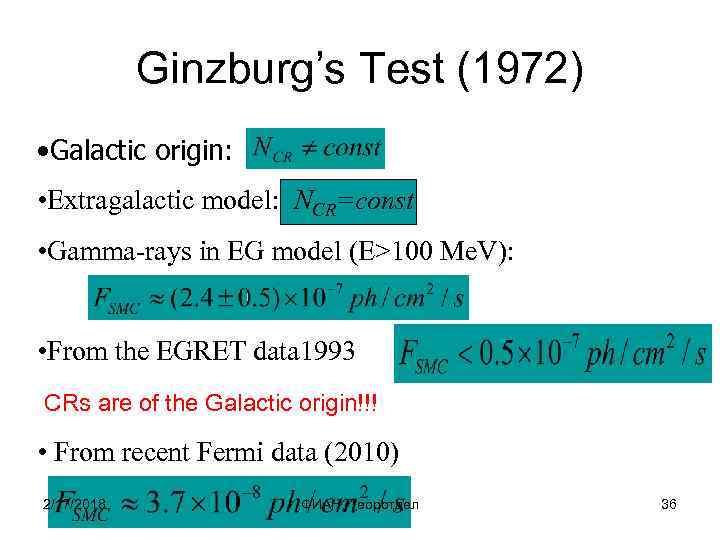
Ginzburg’s Test (1972) • Galactic origin: • Extragalactic model: NCR=const • Gamma-rays in EG model (E>100 Me. V): • From the EGRET data 1993 CRs are of the Galactic origin!!! • From recent Fermi data (2010) 2/17/2018 ФИАН, Теоротдел 36

2/17/2018 ФИАН, Теоротдел 38
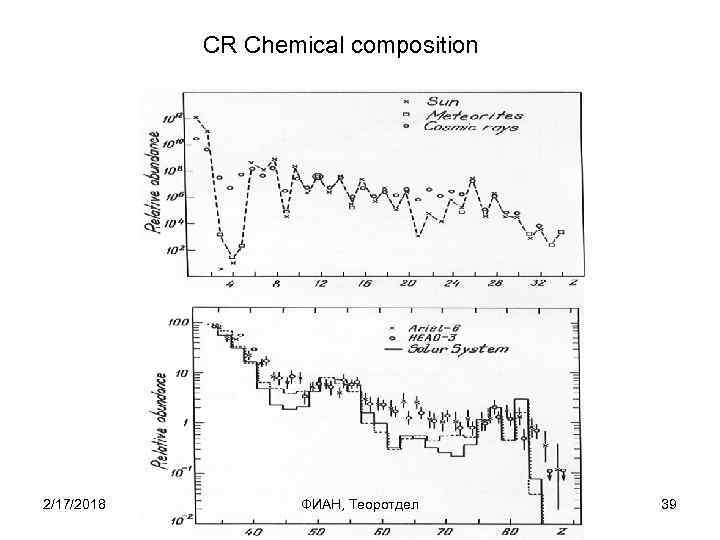
CR Chemical composition 2/17/2018 ФИАН, Теоротдел 39
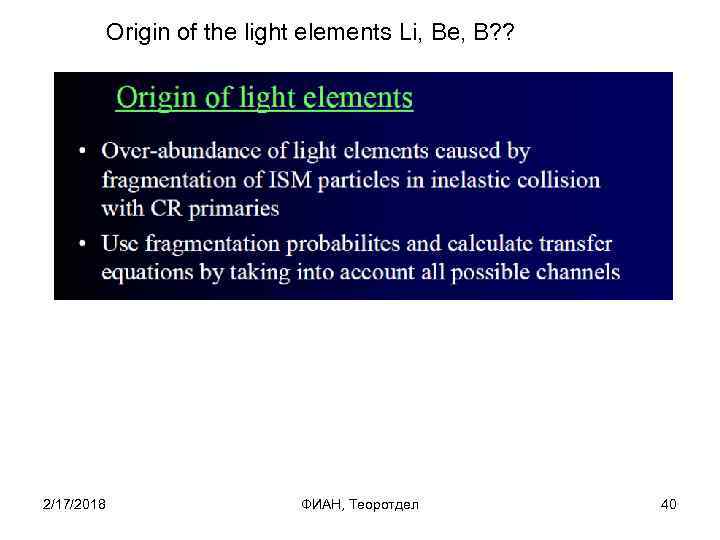
Origin of the light elements Li, Be, B? ? 2/17/2018 ФИАН, Теоротдел 40
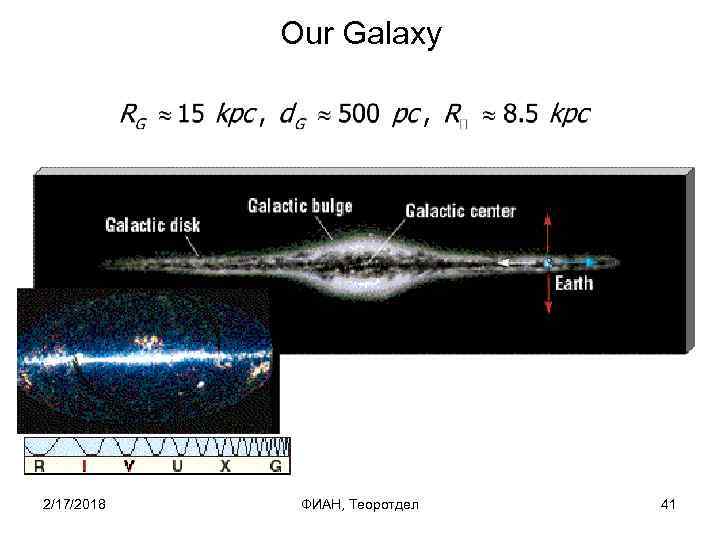
Our Galaxy 2/17/2018 ФИАН, Теоротдел 41
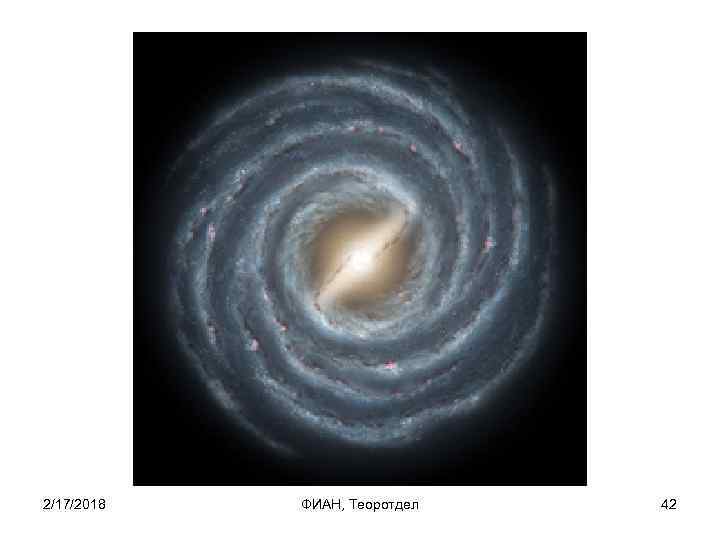
2/17/2018 ФИАН, Теоротдел 42
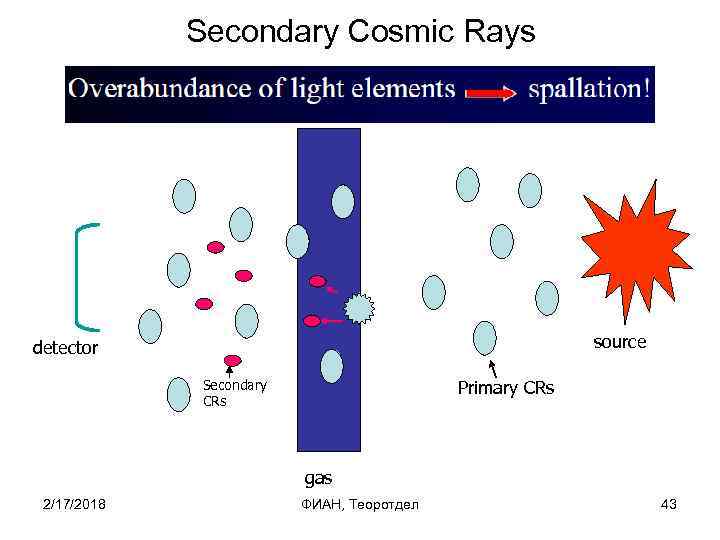
Secondary Cosmic Rays source detector Primary CRs Secondary CRs gas 2/17/2018 ФИАН, Теоротдел 43
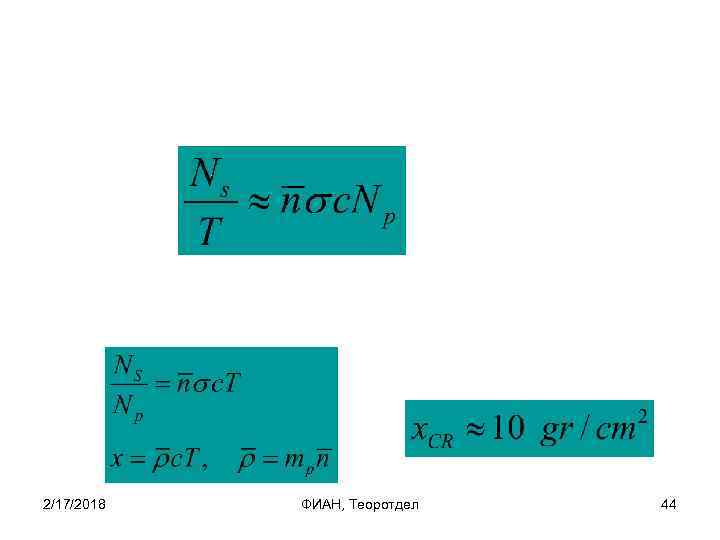
2/17/2018 ФИАН, Теоротдел 44
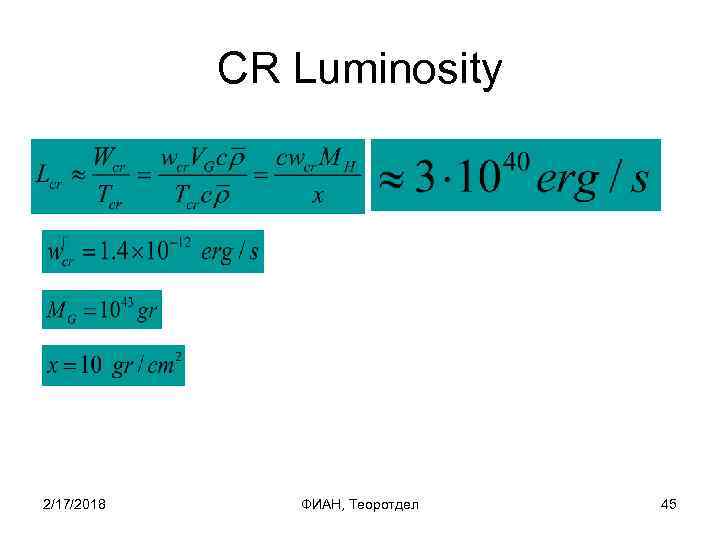
CR Luminosity 2/17/2018 ФИАН, Теоротдел 45
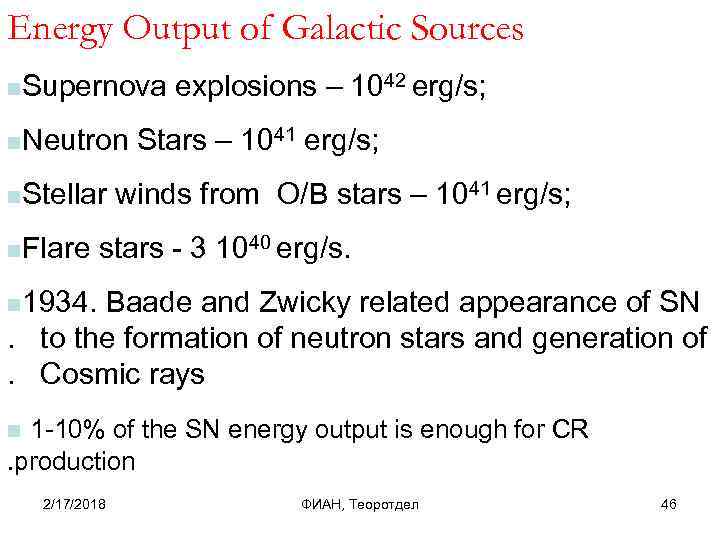
Energy Output of Galactic Sources n. Supernova explosions – 1042 erg/s; n. Neutron Stars – 1041 erg/s; n. Stellar winds from O/B stars – 1041 erg/s; n. Flare stars - 3 1040 erg/s. n 1934. Baade and Zwicky related appearance of SN . to the formation of neutron stars and generation of . Cosmic rays n 1 -10% of the SN energy output is enough for CR . production 2/17/2018 ФИАН, Теоротдел 46
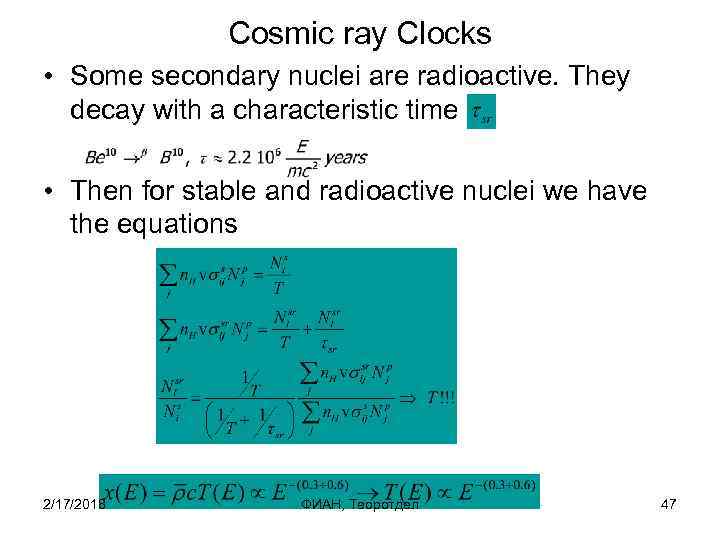
Cosmic ray Clocks • Some secondary nuclei are radioactive. They decay with a characteristic time • Then for stable and radioactive nuclei we have the equations 2/17/2018 ФИАН, Теоротдел 47
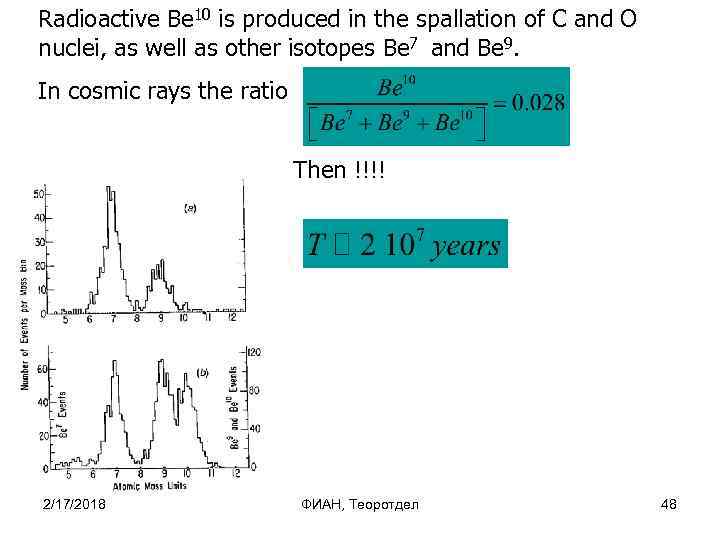
Radioactive Be 10 is produced in the spallation of C and O nuclei, as well as other isotopes Be 7 and Be 9. In cosmic rays the ratio Then !!!! 2/17/2018 ФИАН, Теоротдел 48
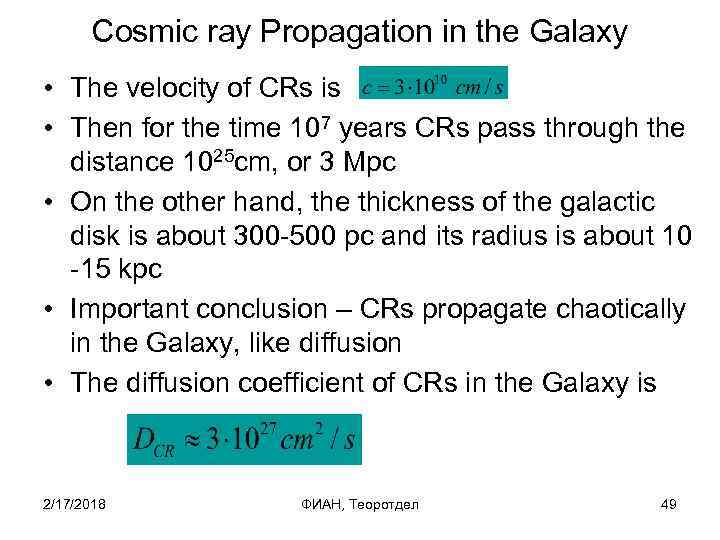
Cosmic ray Propagation in the Galaxy • The velocity of CRs is • Then for the time 107 years CRs pass through the distance 1025 cm, or 3 Mpc • On the other hand, the thickness of the galactic disk is about 300 -500 pc and its radius is about 10 -15 kpc • Important conclusion – CRs propagate chaotically in the Galaxy, like diffusion • The diffusion coefficient of CRs in the Galaxy is 2/17/2018 ФИАН, Теоротдел 49
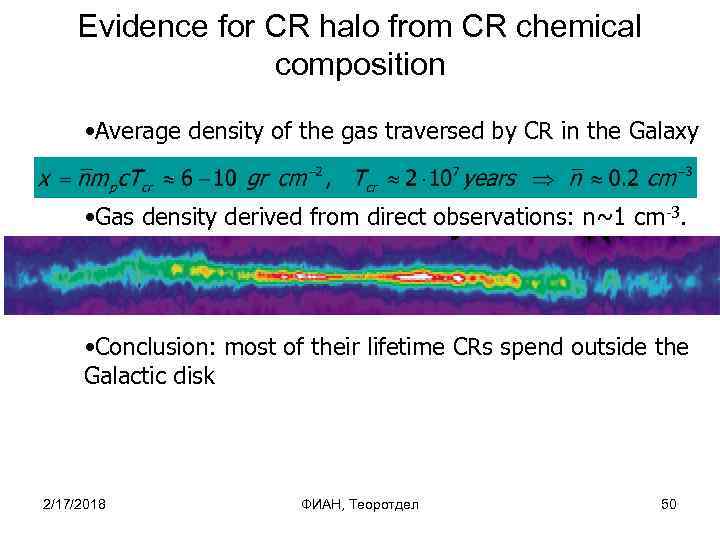
Evidence for CR halo from CR chemical composition • Average density of the gas traversed by CR in the Galaxy • Gas density derived from direct observations: n~1 cm-3. • Conclusion: most of their lifetime CRs spend outside the Galactic disk 2/17/2018 ФИАН, Теоротдел 50
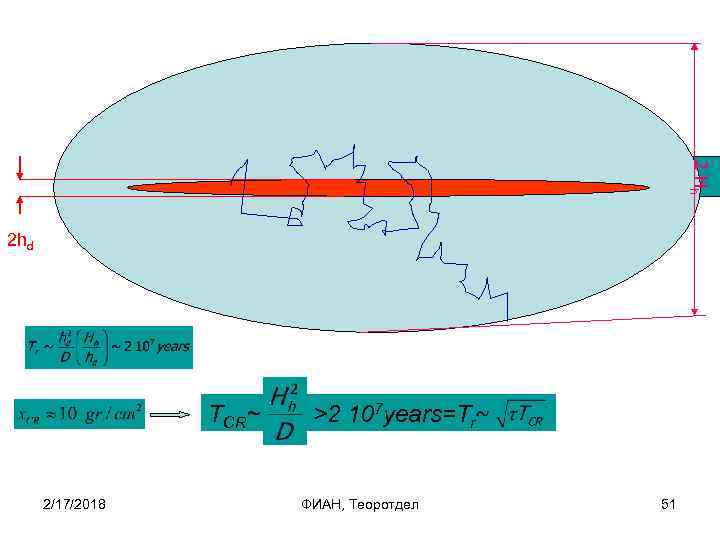
2 Hh 2 hd TCR~ 2/17/2018 >2 107 years=Тr ФИАН, Теоротдел 51
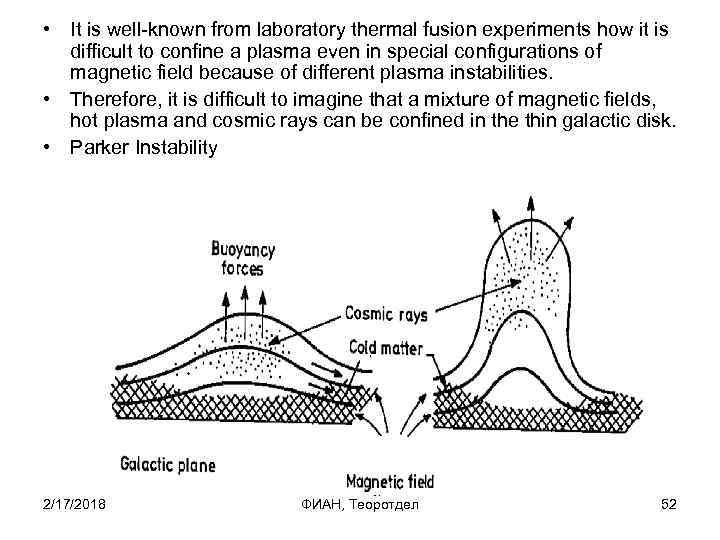
• It is well-known from laboratory thermal fusion experiments how it is difficult to confine a plasma even in special configurations of magnetic field because of different plasma instabilities. • Therefore, it is difficult to imagine that a mixture of magnetic fields, hot plasma and cosmic rays can be confined in the thin galactic disk. • Parker Instability 2/17/2018 ФИАН, Теоротдел 52
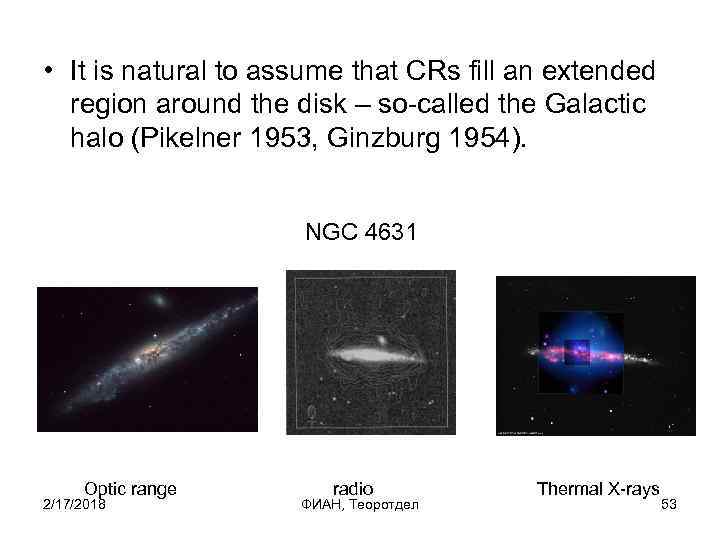
• It is natural to assume that CRs fill an extended region around the disk – so-called the Galactic halo (Pikelner 1953, Ginzburg 1954). NGC 4631 Optic range 2/17/2018 radio ФИАН, Теоротдел Thermal X-rays 53
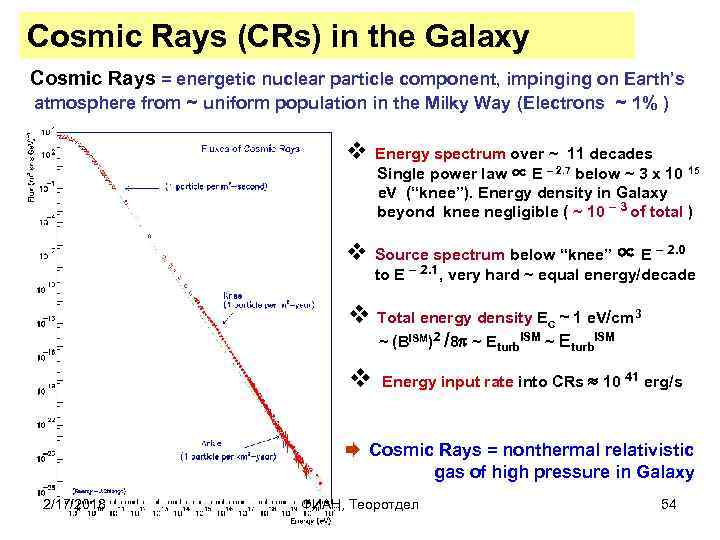
Cosmic Rays (CRs) in the Galaxy Cosmic Rays = energetic nuclear particle component, impinging on Earth’s atmosphere from ~ uniform population in the Milky Way (Electrons ~ 1% ) v Energy spectrum over ~ 11 decades Single power law ∝ E – 2. 7 below ~ 3 x 10 15 e. V (“knee”). Energy density in Galaxy beyond knee negligible ( ~ 10 – 3 of total ) v Source spectrum below “knee” ∝ E – 2. 0 to E – 2. 1, very hard ~ equal energy/decade v Total energy density Ec ~ 1 e. V/cm 3 ~ (BISM)2 /8 ~ Eturb. ISM v Energy input rate into CRs 10 41 erg/s Cosmic Rays = nonthermal relativistic gas of high pressure in Galaxy 2/17/2018 ФИАН, Теоротдел 54
General remarks • Requirements for mechanisms of CR acceleration 1. A power law spectrum for particles of all types; 2. The spectral index is about 2. 5 -2. 7 which is constant over the energy range of almost six orders of a magnitude; 3. The acceleration should generate particles with energies from ~109 e. V to 1017~1019 e. V; 4. The acceleration mechanism should reproduce the CR chemical abundance 2/17/2018 ФИАН, Теоротдел 55
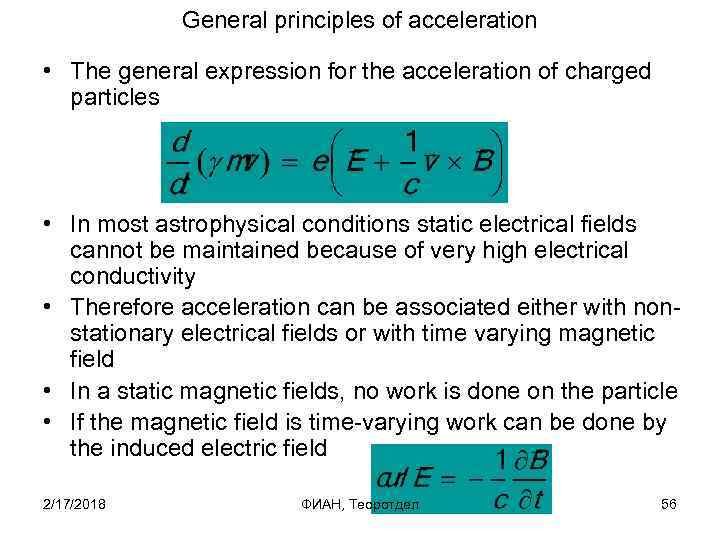
General principles of acceleration • The general expression for the acceleration of charged particles • In most astrophysical conditions static electrical fields cannot be maintained because of very high electrical conductivity • Therefore acceleration can be associated either with nonstationary electrical fields or with time varying magnetic field • In a static magnetic fields, no work is done on the particle • If the magnetic field is time-varying work can be done by the induced electric field 2/17/2018 ФИАН, Теоротдел 56
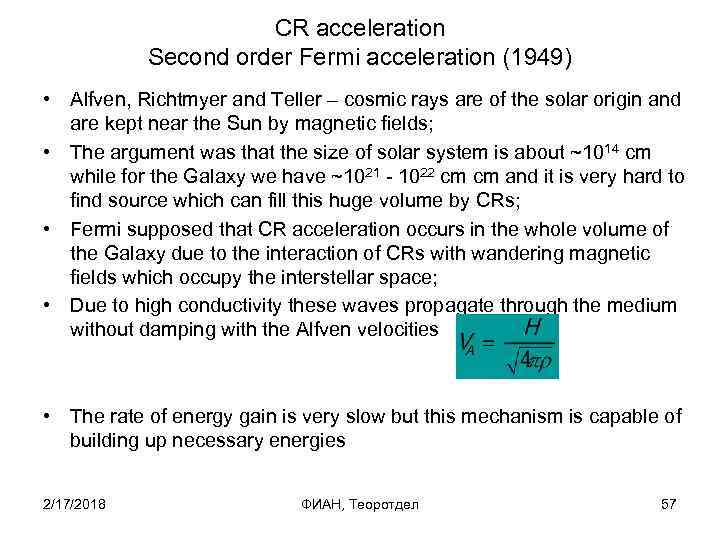
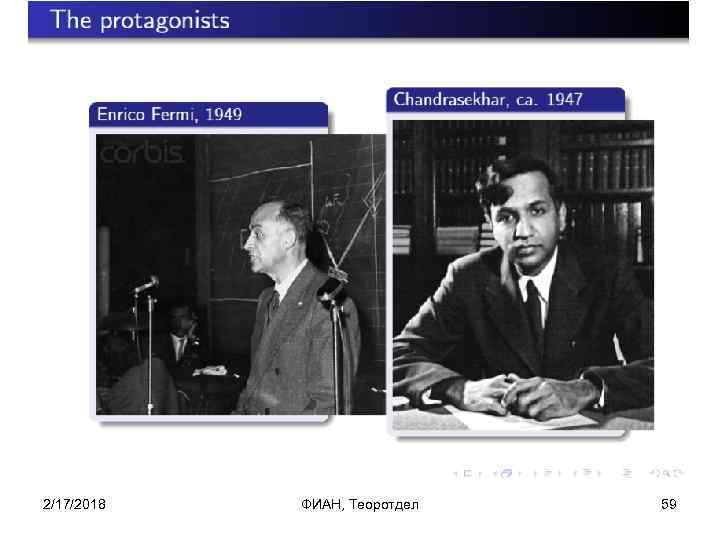
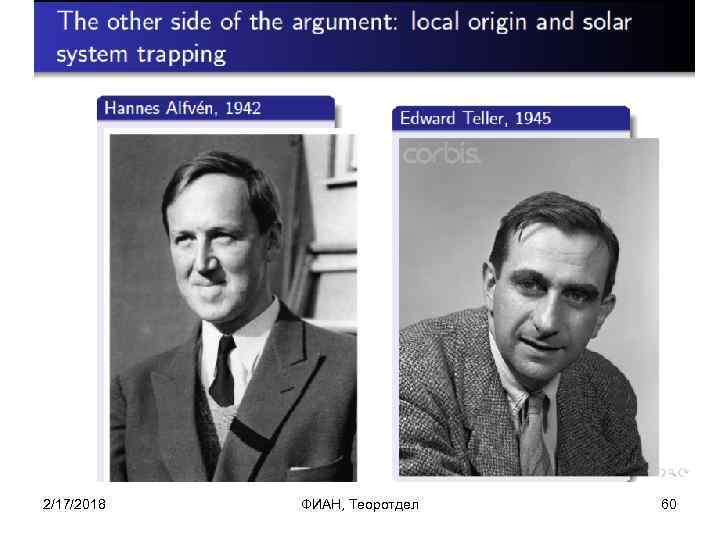
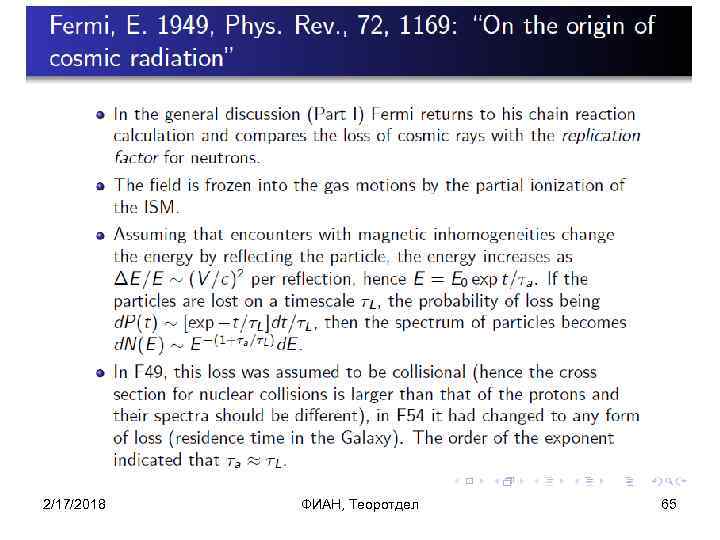
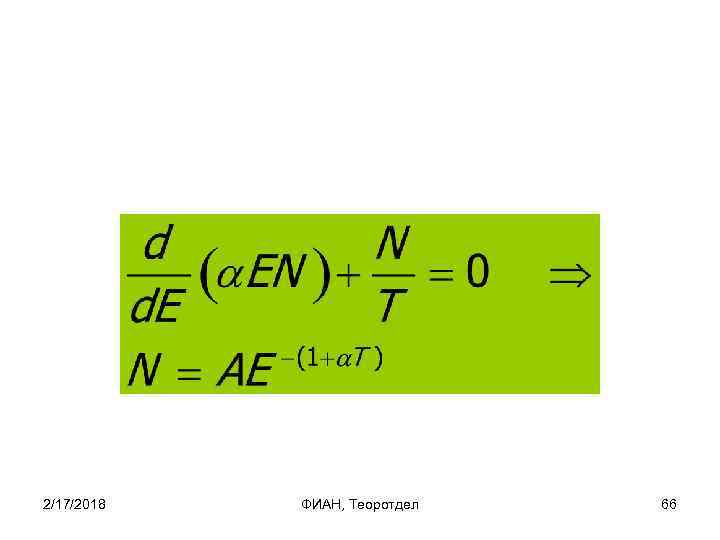
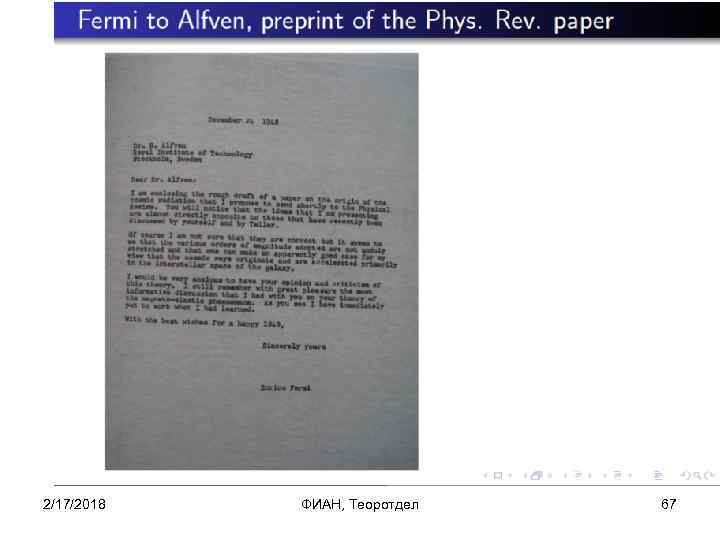
CR acceleration Second order Fermi acceleration (1949) • Alfven, Richtmyer and Teller – cosmic rays are of the solar origin and are kept near the Sun by magnetic fields; • The argument was that the size of solar system is about ~1014 cm while for the Galaxy we have ~1021 - 1022 cm cm and it is very hard to find source which can fill this huge volume by CRs; • Fermi supposed that CR acceleration occurs in the whole volume of the Galaxy due to the interaction of CRs with wandering magnetic fields which occupy the interstellar space; • Due to high conductivity these waves propagate through the medium without damping with the Alfven velocities • The rate of energy gain is very slow but this mechanism is capable of building up necessary energies 2/17/2018 ФИАН, Теоротдел 57
2/17/2018 ФИАН, Теоротдел 58
2/17/2018 ФИАН, Теоротдел 59
2/17/2018 ФИАН, Теоротдел 60
2/17/2018 ФИАН, Теоротдел 61
2/17/2018 ФИАН, Теоротдел 62
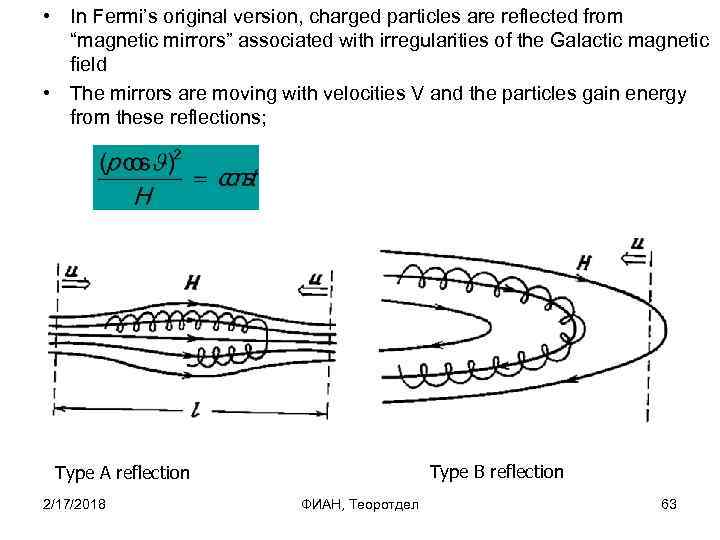
• In Fermi’s original version, charged particles are reflected from “magnetic mirrors” associated with irregularities of the Galactic magnetic field • The mirrors are moving with velocities V and the particles gain energy from these reflections; Type B reflection Type A reflection 2/17/2018 ФИАН, Теоротдел 63
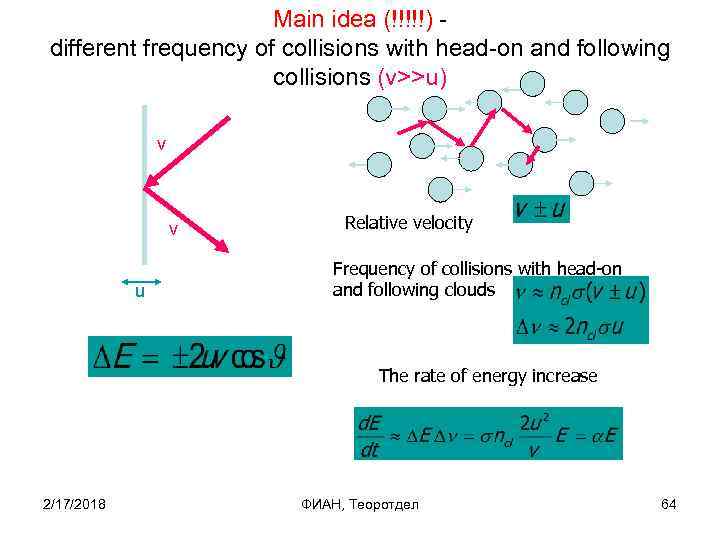
Main idea (!!!!!) - different frequency of collisions with head-on and following collisions (v>>u) v v u Relative velocity Frequency of collisions with head-on and following clouds The rate of energy increase 2/17/2018 ФИАН, Теоротдел 64
2/17/2018 ФИАН, Теоротдел 65
2/17/2018 ФИАН, Теоротдел 66
2/17/2018 ФИАН, Теоротдел 67
2/17/2018 ФИАН, Теоротдел 68
2/17/2018 ФИАН, Теоротдел 69
2/17/2018 ФИАН, Теоротдел 70
2/17/2018 ФИАН, Теоротдел 71
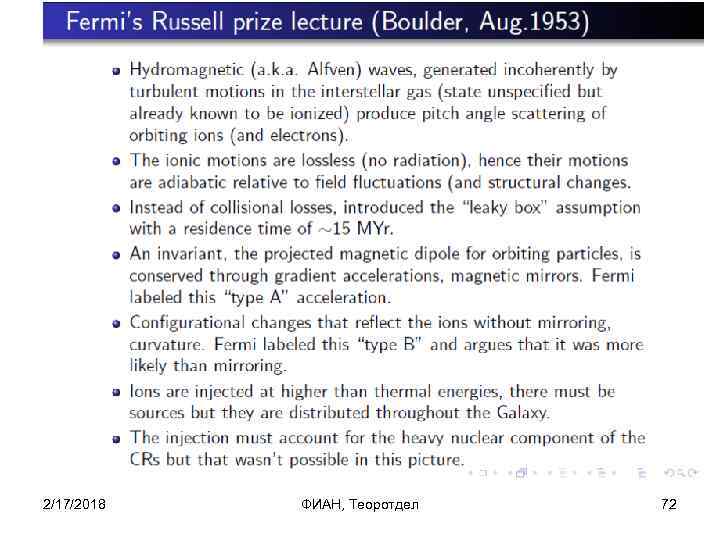
2/17/2018 ФИАН, Теоротдел 72
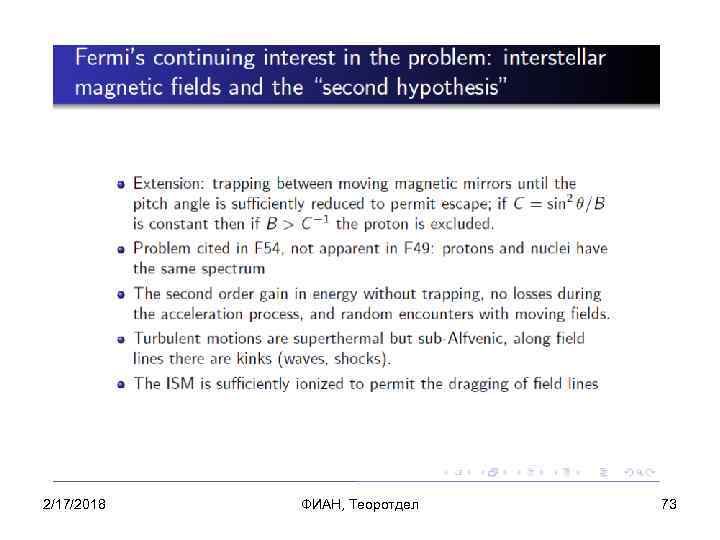
2/17/2018 ФИАН, Теоротдел 73
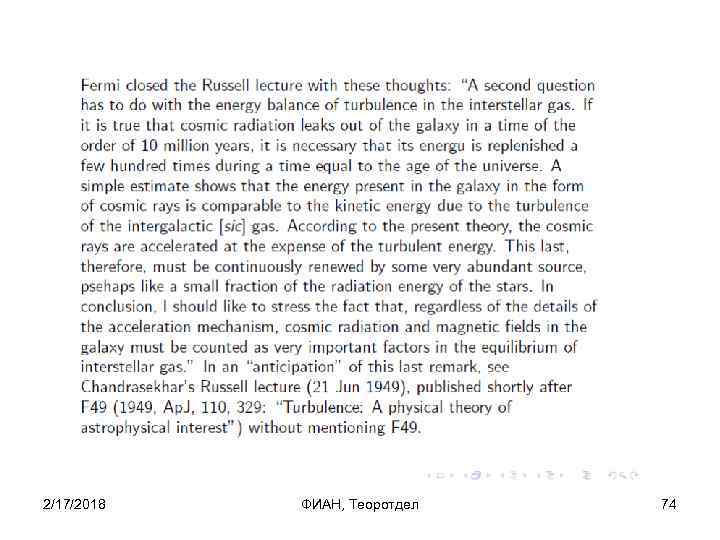
2/17/2018 ФИАН, Теоротдел 74
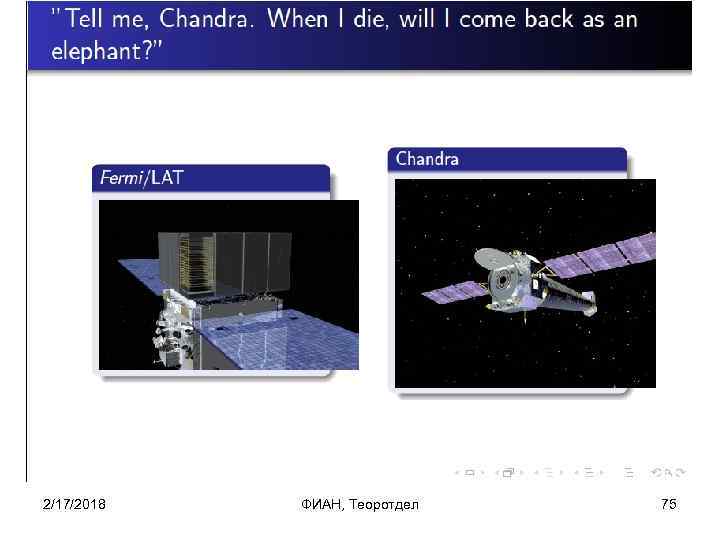
2/17/2018 ФИАН, Теоротдел 75
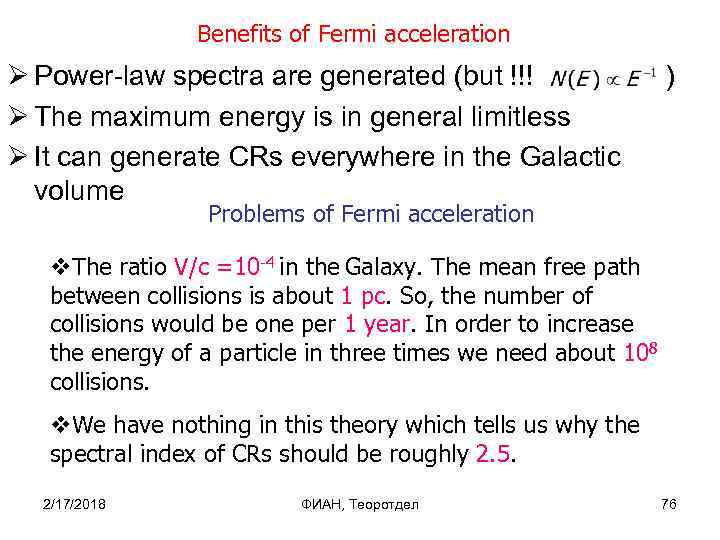
Benefits of Fermi acceleration Ø Power-law spectra are generated (but !!! ) Ø The maximum energy is in general limitless Ø It can generate CRs everywhere in the Galactic volume Problems of Fermi acceleration v. The ratio V/c =10 -4 in the Galaxy. The mean free path between collisions is about 1 pc. So, the number of collisions would be one per 1 year. In order to increase the energy of a particle in three times we need about 108 collisions. v. We have nothing in this theory which tells us why the spectral index of CRs should be roughly 2. 5. 2/17/2018 ФИАН, Теоротдел 76
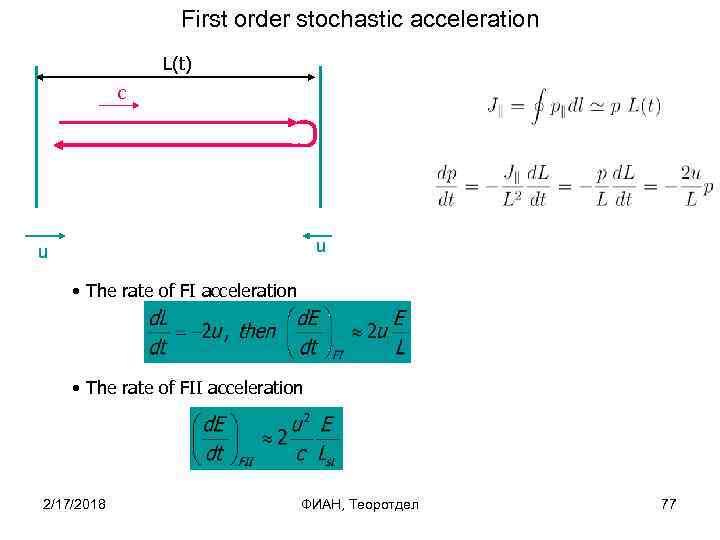
First order stochastic acceleration L(t) c u u • The rate of FI acceleration • The rate of FII acceleration 2/17/2018 ФИАН, Теоротдел 77
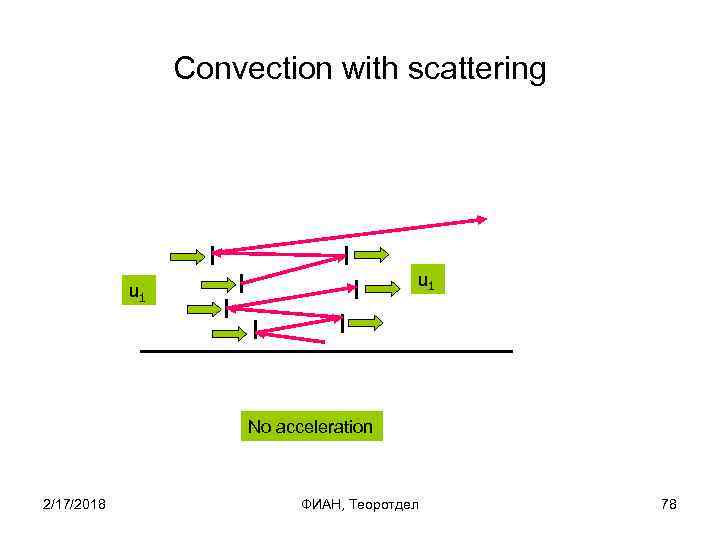
Convection with scattering u 1 No acceleration 2/17/2018 ФИАН, Теоротдел 78
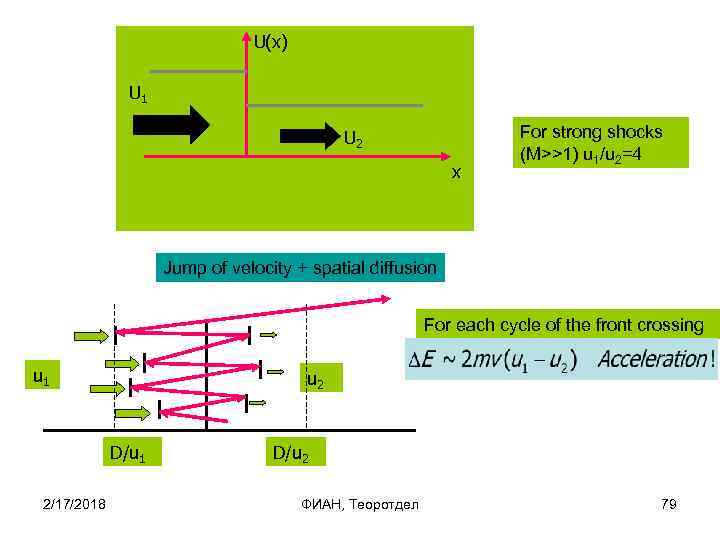
U(x) U 1 U 2 x For strong shocks (M>>1) u 1/u 2=4 Jump of velocity + spatial diffusion For each cycle of the front crossing u 1 u 2 D/u 1 2/17/2018 D/u 2 ФИАН, Теоротдел 79
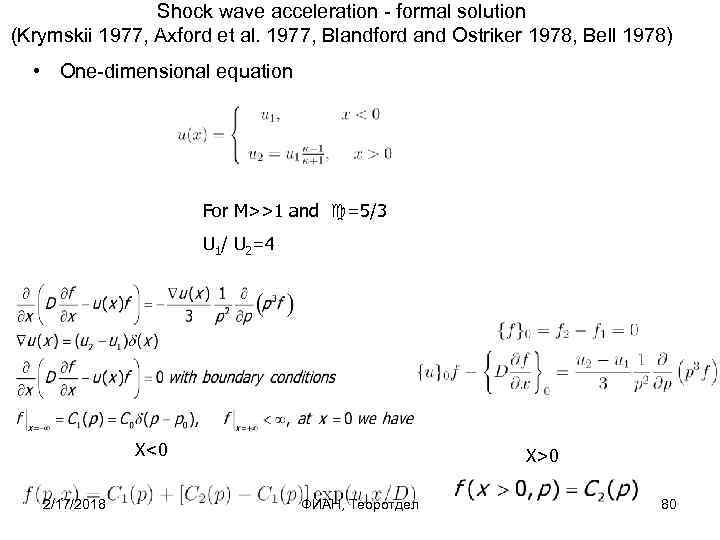
Shock wave acceleration - formal solution (Krymskii 1977, Axford et al. 1977, Blandford and Ostriker 1978, Bell 1978) • One-dimensional equation For M>>1 and =5/3 U 1/ U 2=4 X<0 2/17/2018 X>0 ФИАН, Теоротдел 80
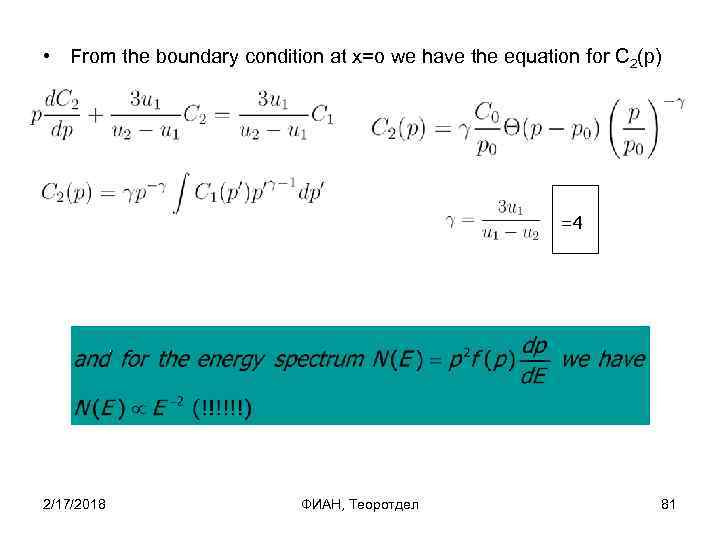
• From the boundary condition at x=o we have the equation for C 2(p) =4 2/17/2018 ФИАН, Теоротдел 81
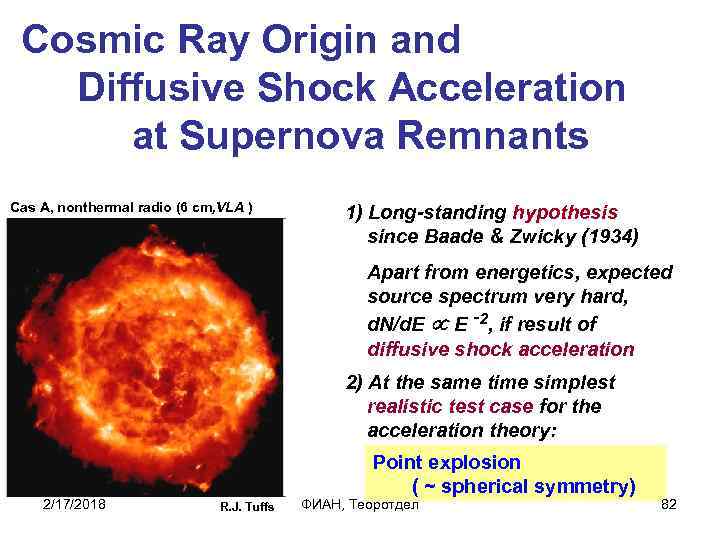
Cosmic Ray Origin and Diffusive Shock Acceleration at Supernova Remnants Cas A, nonthermal radio (6 cm, VLA ) 1) Long-standing hypothesis since Baade & Zwicky (1934) Apart from energetics, expected source spectrum very hard, d. N/d. E E -2, if result of diffusive shock acceleration 2) At the same time simplest realistic test case for the acceleration theory: 2/17/2018 Point explosion ( ~ spherical symmetry) R. J. Tuffs ФИАН, Теоротдел 82
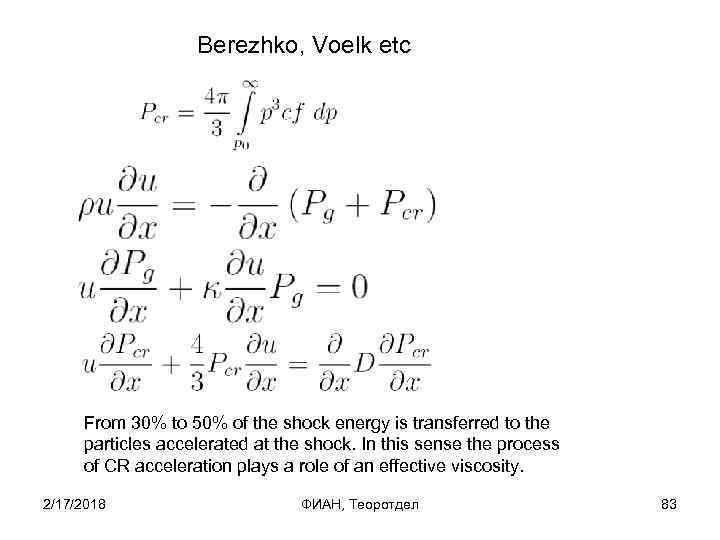
Berezhko, Voelk etc From 30% to 50% of the shock energy is transferred to the particles accelerated at the shock. In this sense the process of CR acceleration plays a role of an effective viscosity. 2/17/2018 ФИАН, Теоротдел 83
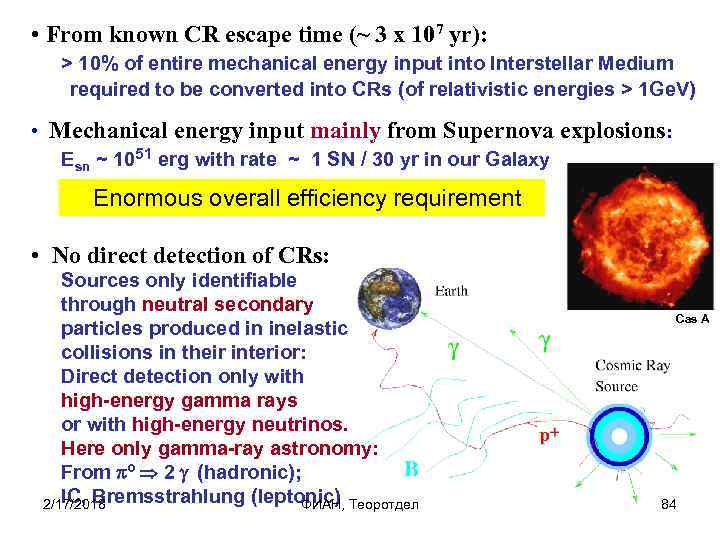
• From known CR escape time (~ 3 x 10⁷ yr): > 10% of entire mechanical energy input into Interstellar Medium required to be converted into CRs (of relativistic energies > 1 Ge. V) • Mechanical energy input mainly from Supernova explosions: Esn ~ 1051 erg with rate ~ 1 SN / 30 yr in our Galaxy Enormous overall efficiency requirement • No direct detection of CRs: Sources only identifiable through neutral secondary particles produced in inelastic collisions in their interior: Direct detection only with high-energy gamma rays or with high-energy neutrinos. Here only gamma-ray astronomy: From º 2 (hadronic); IC, Bremsstrahlung (leptonic) 2/17/2018 ФИАН, Теоротдел Cas A 84
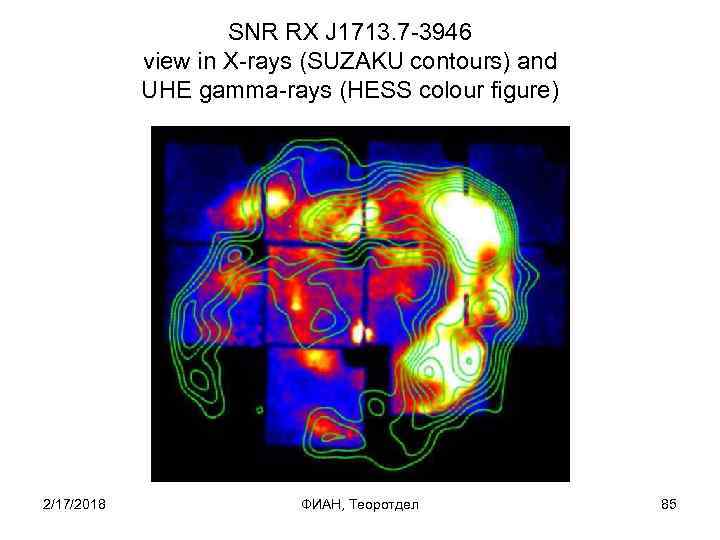
SNR RX J 1713. 7 -3946 view in X-rays (SUZAKU contours) and UHE gamma-rays (HESS colour figure) 2/17/2018 ФИАН, Теоротдел 85
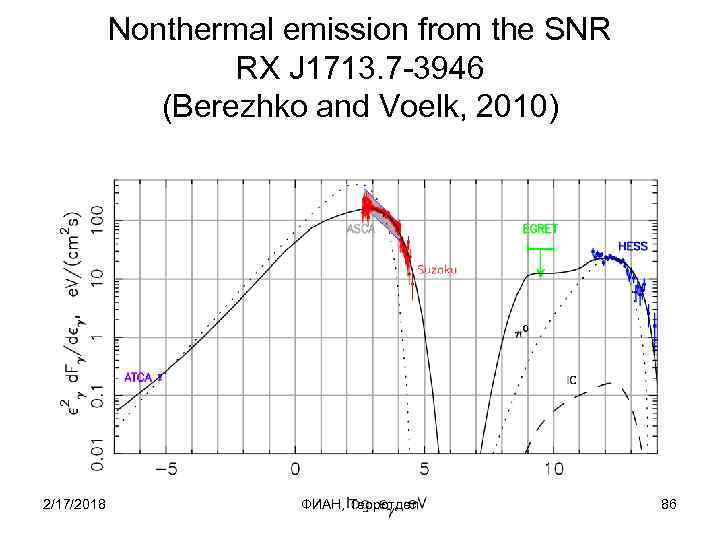
Nonthermal emission from the SNR RX J 1713. 7 -3946 (Berezhko and Voelk, 2010) 2/17/2018 ФИАН, Теоротдел 86
Скачать презентацию Story about Cosmic Ray historical review a
Вводная лекция.ppt