


 Скачать презентацию Storage Rings Characteristics Instrumentation m apollonio
c9819f3fa5545f49a9cab87daa3e6fc1.ppt
- Количество слайдов: 53
 Storage Rings Characteristics & Instrumentation m. apollonio – Imperial College (London) 22 -25/09/2010 IDS-NF meeting - RAL 1
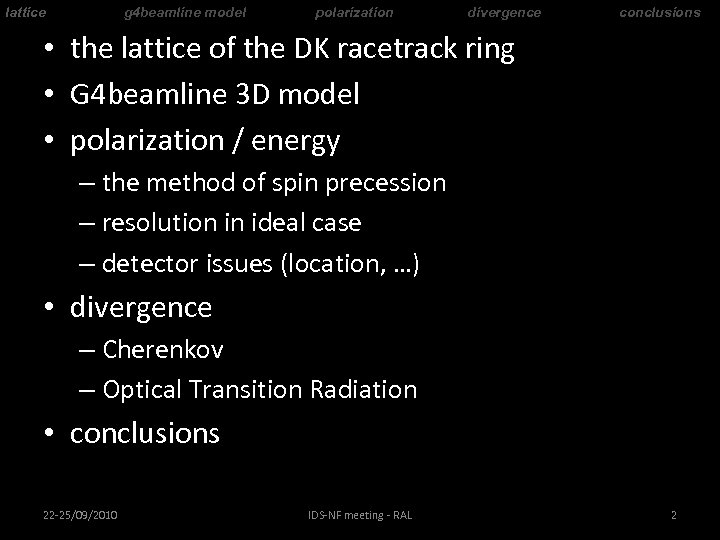 lattice g 4 beamline model polarization divergence conclusions • the lattice of the DK racetrack ring • G 4 beamline 3 D model • polarization / energy – the method of spin precession – resolution in ideal case – detector issues (location, …) • divergence – Cherenkov – Optical Transition Radiation • conclusions 22 -25/09/2010 IDS-NF meeting - RAL 2
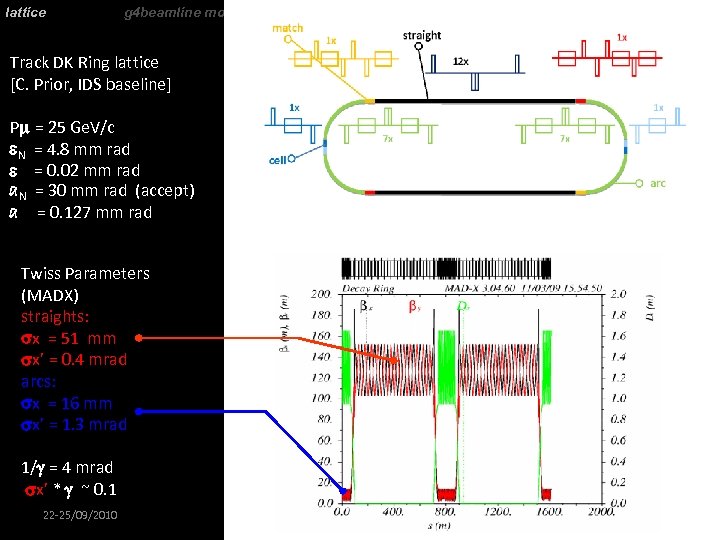 lattice g 4 beamline model polarization divergence conclusions Track DK Ring lattice [C. Prior, IDS baseline] Pm = 25 Ge. V/c e. N = 4. 8 mm rad e = 0. 02 mm rad a. N = 30 mm rad (accept) a = 0. 127 mm rad Twiss Parameters (MADX) straights: sx = 51 mm sx’ = 0. 4 mrad arcs: sx = 16 mm sx’ = 1. 3 mrad 1/g = 4 mrad sx’ * g ~ 0. 1 22 -25/09/2010 IDS-NF meeting - RAL 3
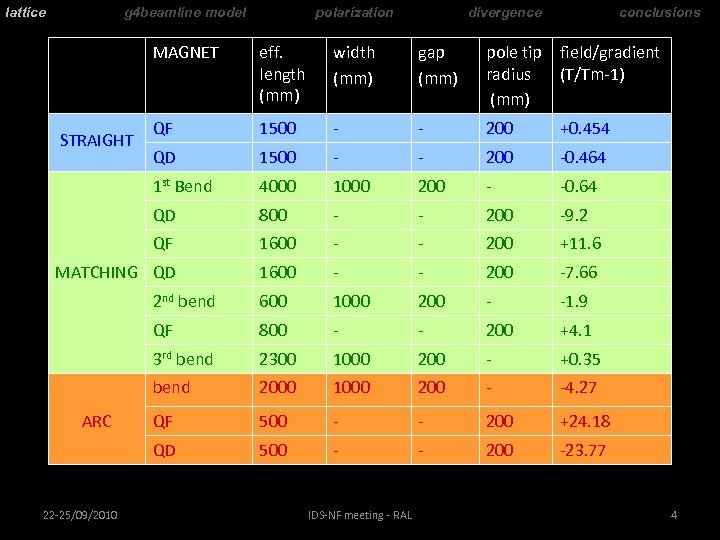 lattice g 4 beamline model polarization divergence conclusions MAGNET eff. length (mm) width (mm) gap (mm) pole tip radius (mm) field/gradient (T/Tm-1) QF 1500 - - 200 +0. 454 QD 1500 - - 200 -0. 464 1 st Bend 4000 1000 200 - -0. 64 QD 800 - - 200 -9. 2 QF 1600 - - 200 +11. 6 MATCHING QD 1600 - - 200 -7. 66 2 nd bend 600 1000 200 - -1. 9 QF 800 - - 200 +4. 1 3 rd bend 2300 1000 200 - +0. 35 bend 2000 1000 200 - -4. 27 QF 500 - - 200 +24. 18 QD 500 - - 200 -23. 77 STRAIGHT ARC 22 -25/09/2010 IDS-NF meeting - RAL 4
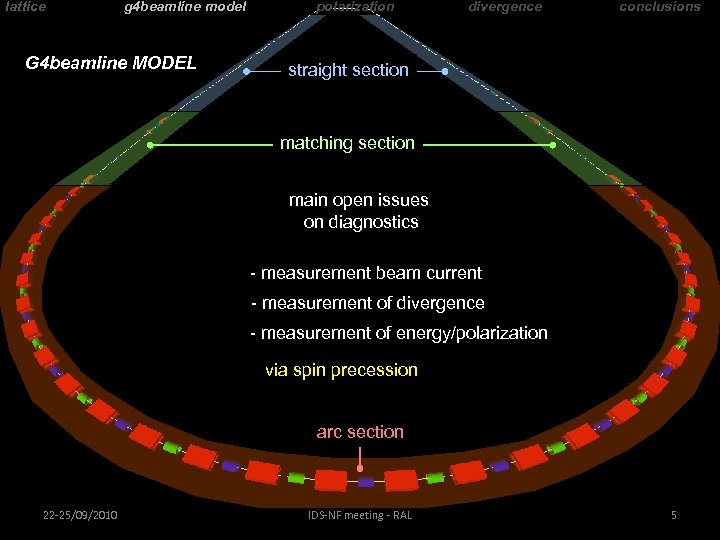 lattice g 4 beamline model G 4 beamline MODEL polarization divergence conclusions straight section matching section main open issues on diagnostics - measurement beam current - measurement of divergence - measurement of energy/polarization via spin precession arc section 22 -25/09/2010 IDS-NF meeting - RAL 5
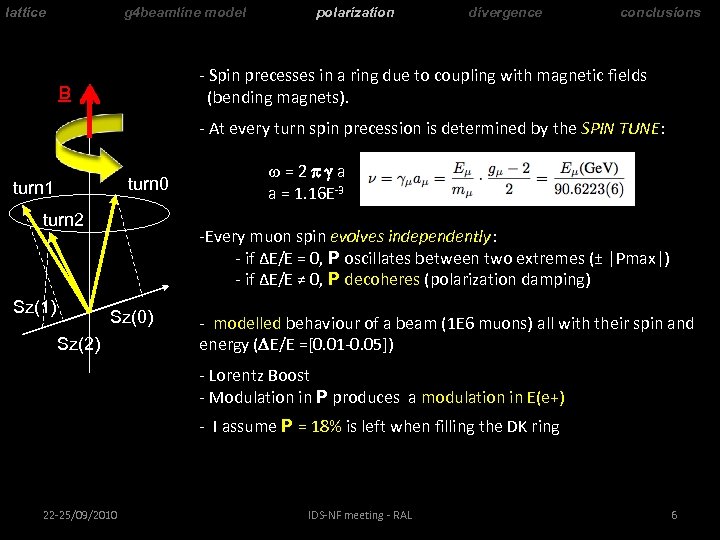 lattice g 4 beamline model polarization divergence conclusions - Spin precesses in a ring due to coupling with magnetic fields (bending magnets). B - At every turn spin precession is determined by the SPIN TUNE: turn 0 turn 1 turn 2 Sz(1) w=2 pga a = 1. 16 E-3 -Every muon spin evolves independently: - if ∆E/E = 0, P oscillates between two extremes (± |Pmax|) - if ΔE/E ≠ 0, P decoheres (polarization damping) Sz(0) Sz(2) - modelled behaviour of a beam (1 E 6 muons) all with their spin and energy (DE/E =[0. 01 -0. 05]) - Lorentz Boost - Modulation in P produces a modulation in E(e+) - I assume P = 18% is left when filling the DK ring 22 -25/09/2010 IDS-NF meeting - RAL 6
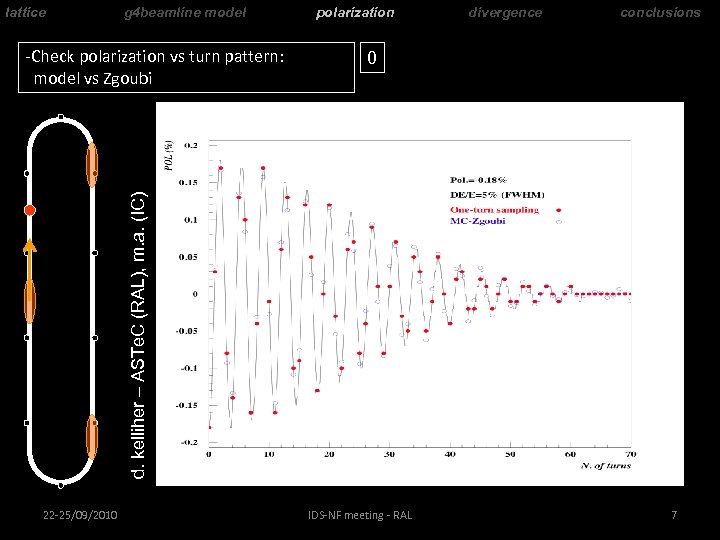 lattice g 4 beamline model divergence conclusions 0 d. kelliher – ASTe. C (RAL), m. a. (IC) -Check polarization vs turn pattern: model vs Zgoubi polarization 22 -25/09/2010 IDS-NF meeting - RAL 7
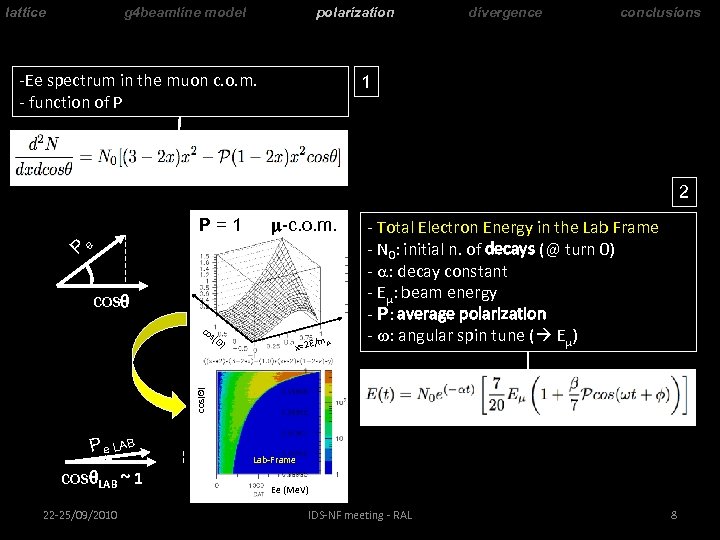 lattice g 4 beamline model polarization -Ee spectrum in the muon c. o. m. - function of P divergence conclusions 1 2 P=1 m-c. o. m. Pe cosq co mm x=2 E/ cos(Θ) s(Θ ) - Total Electron Energy in the Lab Frame - N 0: initial n. of decays (@ turn 0) - a: decay constant - Em: beam energy - P: average polarization - w: angular spin tune ( Em) P e LAB cosq. LAB ~ 1 22 -25/09/2010 Lab-Frame Ee (Me. V) IDS-NF meeting - RAL 8
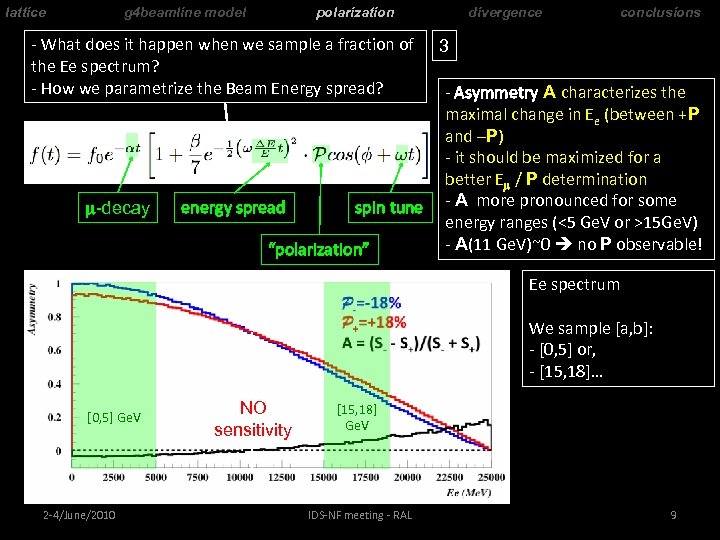 lattice g 4 beamline model polarization - What does it happen when we sample a fraction of the Ee spectrum? - How we parametrize the Beam Energy spread? m-decay energy spread spin tune “polarization” divergence conclusions 3 - Asymmetry A characterizes the maximal change in Ee (between +P and –P) - it should be maximized for a better Em / P determination - A more pronounced for some energy ranges (<5 Ge. V or >15 Ge. V) - A(11 Ge. V)~0 no P observable! Ee spectrum We sample [a, b]: - [0, 5] or, - [15, 18]… [0, 5] Ge. V 22 -25/09/2010 2 -4/June/2010 NO sensitivity [15, 18] Ge. V IDS-NF meeting - RAL 9
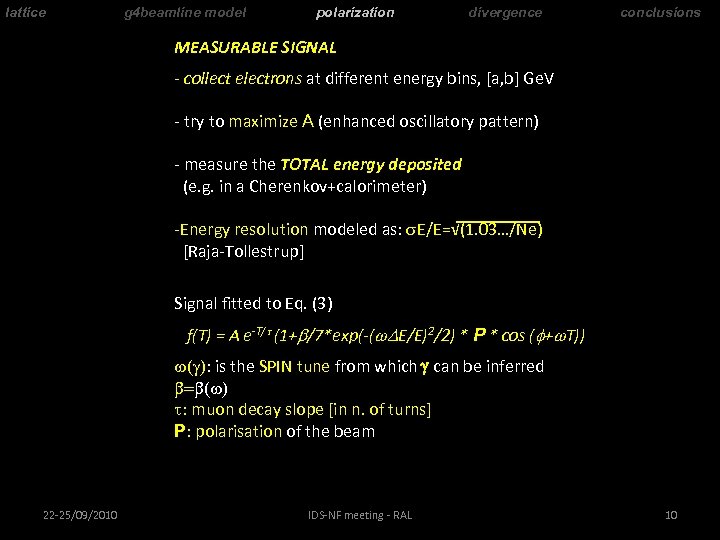 lattice g 4 beamline model polarization divergence conclusions MEASURABLE SIGNAL - collect electrons at different energy bins, [a, b] Ge. V - try to maximize A (enhanced oscillatory pattern) - measure the TOTAL energy deposited (e. g. in a Cherenkov+calorimeter) -Energy resolution modeled as: s. E/E=√(1. 03…/Ne) [Raja-Tollestrup] Signal fitted to Eq. (3) f(T) = A e-T/t (1+b/7*exp(-(w. DE/E)2/2) * P * cos (f+w. T)) w(g): is the SPIN tune from which g can be inferred b=b(w) t: muon decay slope [in n. of turns] P: polarisation of the beam 22 -25/09/2010 IDS-NF meeting - RAL 10
![lattice g 4 beamline model polarization [0, 5] Ge. V/c N 0=30% (1 E](https://present5.com/presentation/c9819f3fa5545f49a9cab87daa3e6fc1/image-11.jpg "lattice g 4 beamline model polarization [0, 5] Ge. V/c N 0=30% (1 E") lattice g 4 beamline model polarization [0, 5] Ge. V/c N 0=30% (1 E 6) divergence conclusions -18% P 0 DE/E=2. 5% (hw) fit (80 turns) E = 24999 ± 40 Me. V DE/E = 2. 6 ± 0. 1 % tm = 97. 5 ± 0. 15 P [0, 5] Ge. V = (22. ± 0. 7)% [15, 18] Ge. V/c N 0=30% (1 E 6) fit (80 turns) E = 25040 ± 38 Me. V [15, 18] Ge. V DE/E = 2. 57 ± 0. 15 % tm derive actual P from MAX-min excursions 22 -25/09/2010 IDS-NF meeting - RAL = 97. 6 ± 0. 16 P = (10. 8 ± 0. 7)% 11
lattice g 4 beamline model polarization [0, 5] Ge. V/c N 0=30% (1 E 6) divergence conclusions -18% P 0 DE/E=2. 5% (hw) fit (80 turns) E = 24999 ± 40 Me. V DE/E = 2. 6 ± 0. 1 % tm = 97. 5 ± 0. 15 P [0, 5] Ge. V = (22. ± 0. 7)% [15, 18] Ge. V/c N 0=30% (1 E 6) fit (80 turns) E = 25040 ± 38 Me. V [15, 18] Ge. V DE/E = 2. 57 ± 0. 15 % tm derive actual P from MAX-min excursions 22 -25/09/2010 IDS-NF meeting - RAL = 97. 6 ± 0. 16 P = (10. 8 ± 0. 7)% 11
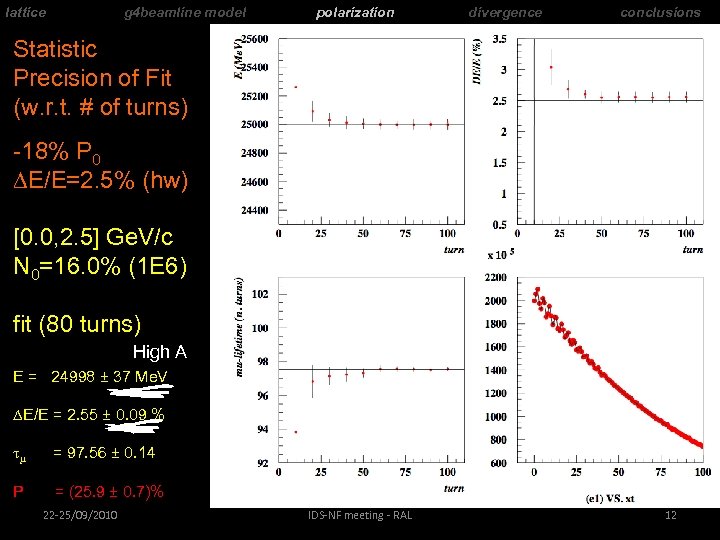 lattice g 4 beamline model polarization divergence conclusions Statistic Precision of Fit (w. r. t. # of turns) -18% P 0 DE/E=2. 5% (hw) [0. 0, 2. 5] Ge. V/c N 0=16. 0% (1 E 6) fit (80 turns) High A E = 24998 ± 37 Me. V DE/E = 2. 55 ± 0. 09 % tm = 97. 56 ± 0. 14 P = (25. 9 ± 0. 7)% 22 -25/09/2010 IDS-NF meeting - RAL 12
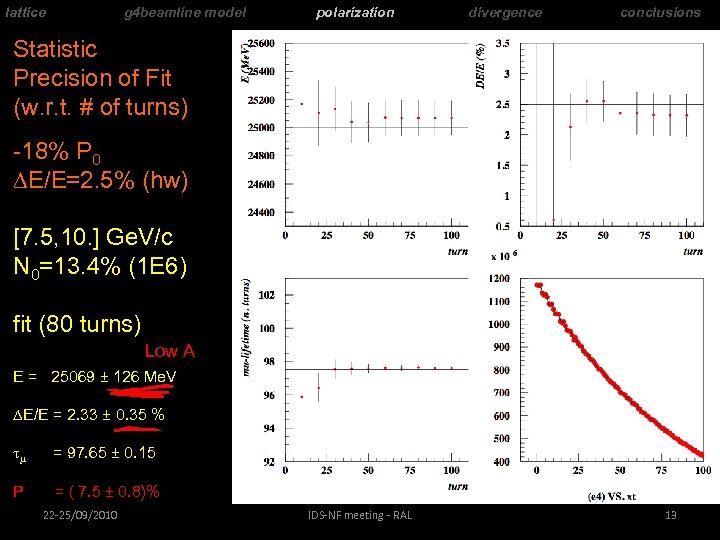 lattice g 4 beamline model polarization divergence conclusions Statistic Precision of Fit (w. r. t. # of turns) -18% P 0 DE/E=2. 5% (hw) [7. 5, 10. ] Ge. V/c N 0=13. 4% (1 E 6) fit (80 turns) Low A E = 25069 ± 126 Me. V DE/E = 2. 33 ± 0. 35 % tm = 97. 65 ± 0. 15 P = ( 7. 5 ± 0. 8)% 22 -25/09/2010 IDS-NF meeting - RAL 13
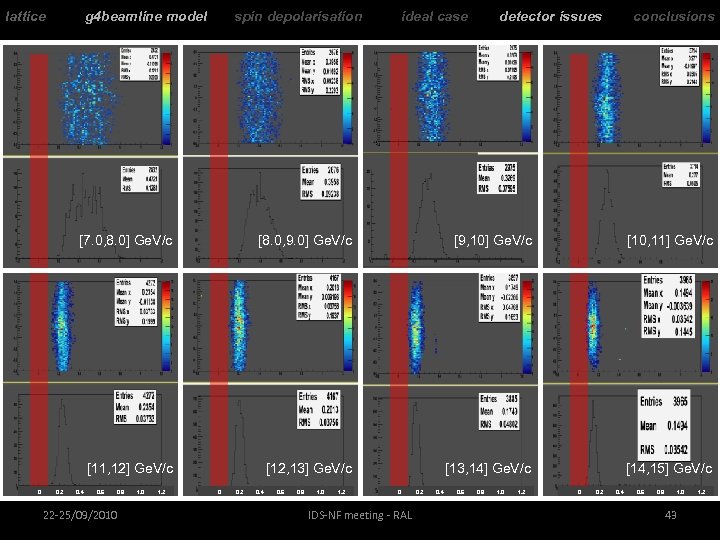
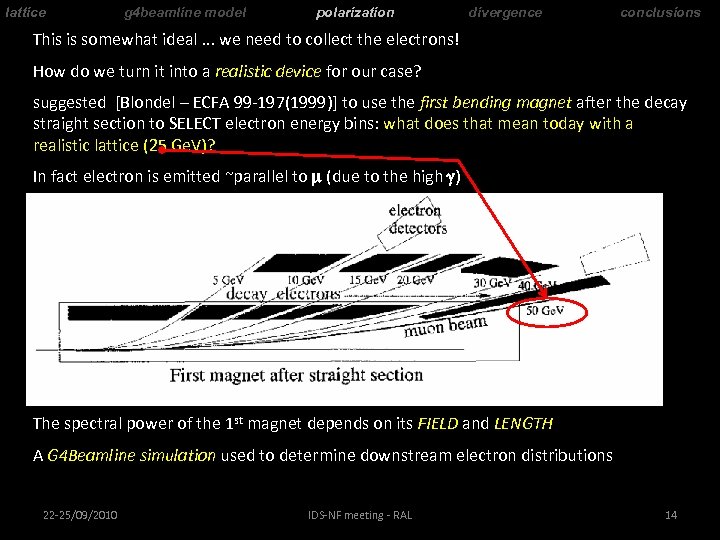 lattice g 4 beamline model polarization divergence conclusions This is somewhat ideal. . . we need to collect the electrons! How do we turn it into a realistic device for our case? suggested [Blondel – ECFA 99 -197(1999)] to use the first bending magnet after the decay straight section to SELECT electron energy bins: what does that mean today with a realistic lattice (25 Ge. V)? In fact electron is emitted ~parallel to m (due to the high g) The spectral power of the 1 st magnet depends on its FIELD and LENGTH A G 4 Beamline simulation used to determine downstream electron distributions 22 -25/09/2010 IDS-NF meeting - RAL 14
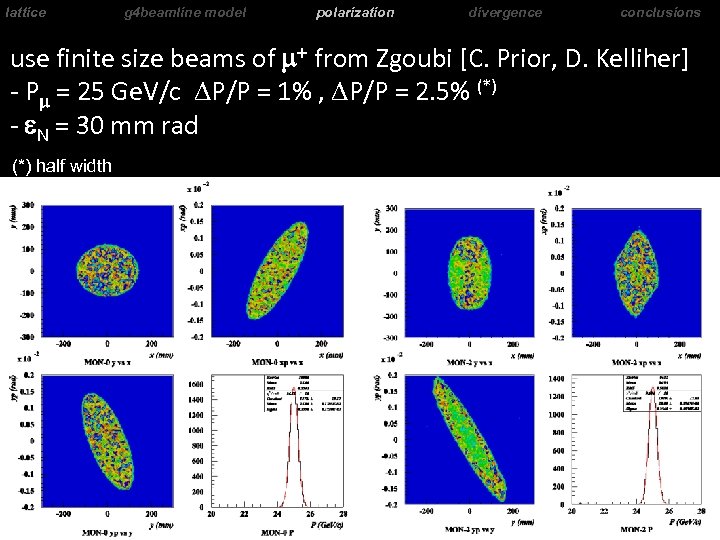 lattice g 4 beamline model polarization divergence conclusions use finite size beams of m+ from Zgoubi [C. Prior, D. Kelliher] - Pm = 25 Ge. V/c DP/P = 1% , DP/P = 2. 5% (*) - e. N = 30 mm rad (*) half width 22 -25/09/2010 m at mid - straight IDS-NF meeting - RAL m at end of straight 15
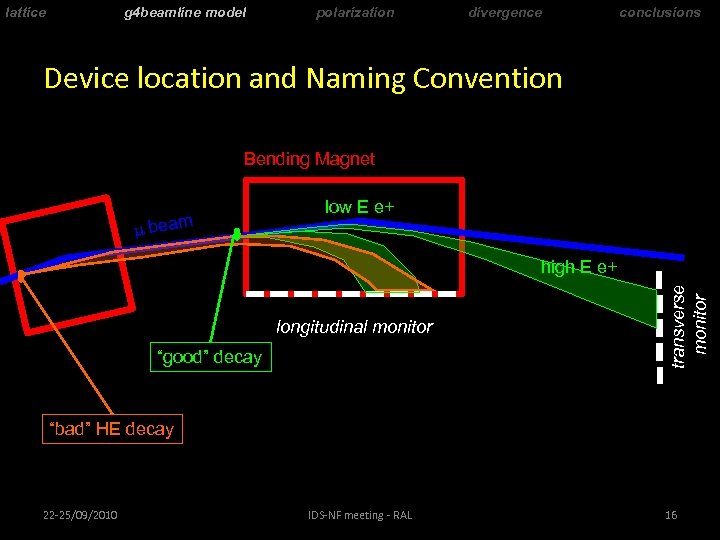 lattice g 4 beamline model polarization divergence conclusions Device location and Naming Convention Bending Magnet m beam low E e+ longitudinal monitor “good” decay transverse monitor high E e+ “bad” HE decay 22 -25/09/2010 IDS-NF meeting - RAL 16
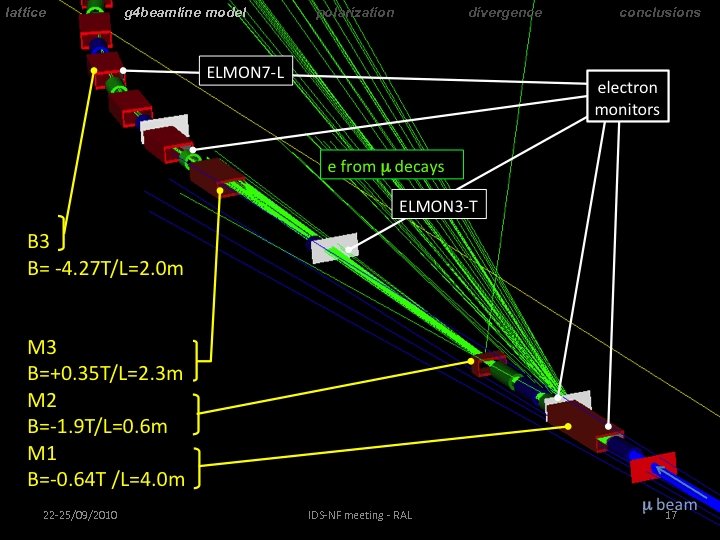 lattice 22 -25/09/2010 g 4 beamline model polarization IDS-NF meeting - RAL divergence conclusions 17
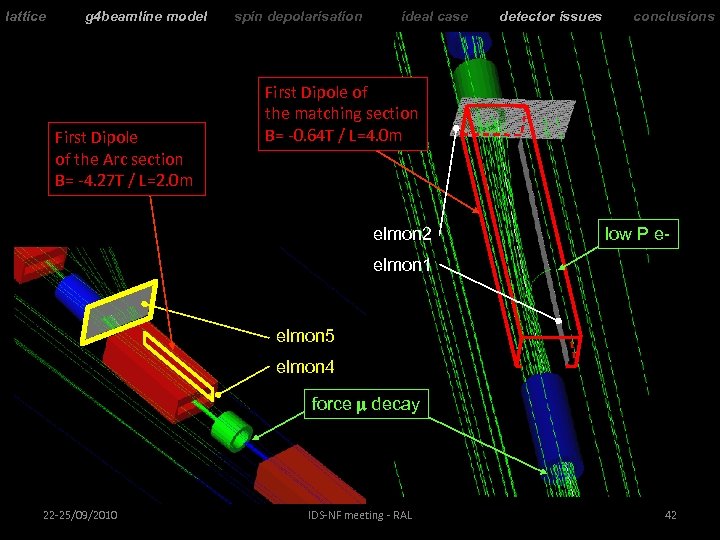
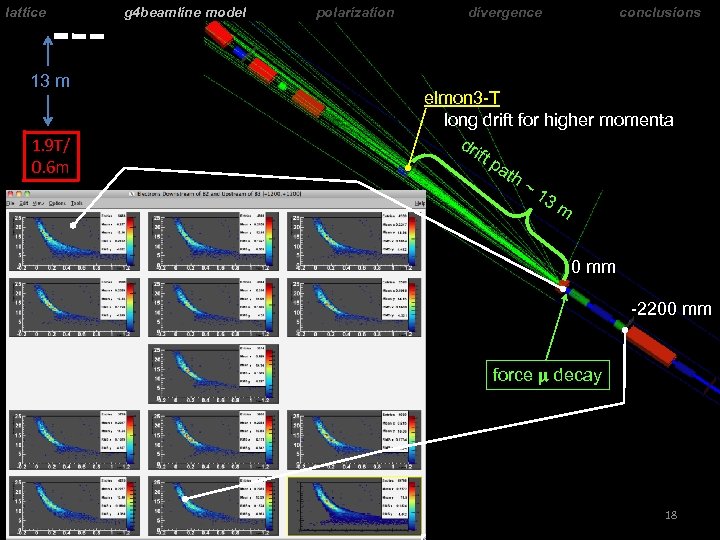 lattice g 4 beamline model polarization 13 m divergence conclusions elmon 3 -T long drift for higher momenta dri ft p ath ~1 3 m 1. 9 T/ 0. 6 m 0 mm -2200 mm force m decay 22 -25/09/2010 IDS-NF meeting - RAL 18
RMS-x RMS-P beam size e=30 mmrad dispersion 22 -25/09/2010 beam direction [15, 18] Ge. V IDS-NF meeting - RAL 19 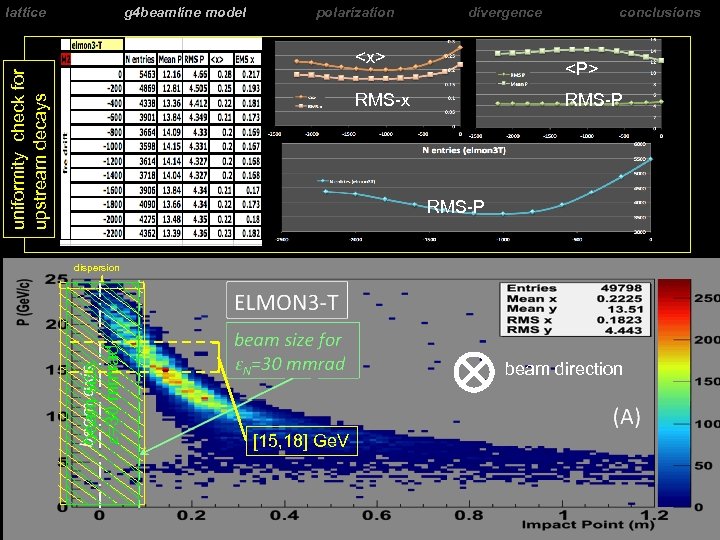 lattice g 4 beamline model polarization divergence uniformity check for upstream decays
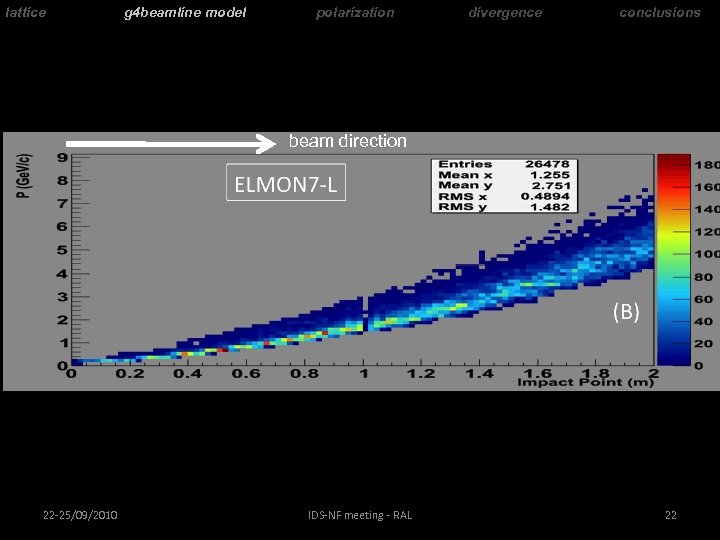
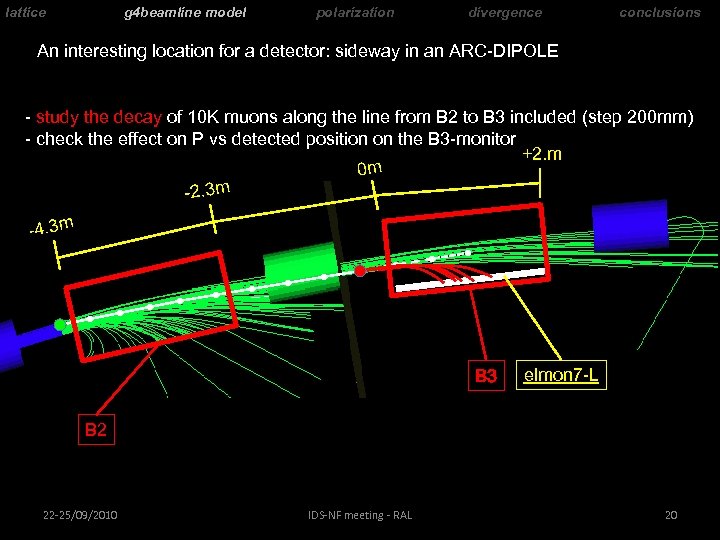 lattice g 4 beamline model polarization divergence conclusions An interesting location for a detector: sideway in an ARC-DIPOLE - study the decay of 10 K muons along the line from B 2 to B 3 included (step 200 mm) - check the effect on P vs detected position on the B 3 -monitor +2. m 0 m -2. 3 m -4. 3 m B 3 elmon 7 -L B 2 22 -25/09/2010 IDS-NF meeting - RAL 20
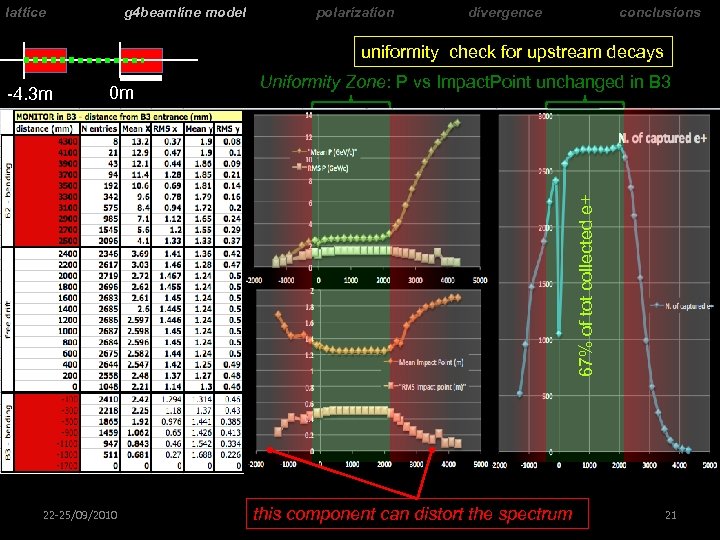 lattice g 4 beamline model polarization divergence conclusions uniformity check for upstream decays 0 m Uniformity Zone: P vs Impact. Point unchanged in B 3 67% of tot collected e+ -4. 3 m 22 -25/09/2010 IDS-NF meeting - RAL this component can distort the spectrum 21
 lattice g 4 beamline model polarization divergence conclusions beam direction 22 -25/09/2010 IDS-NF meeting - RAL 22
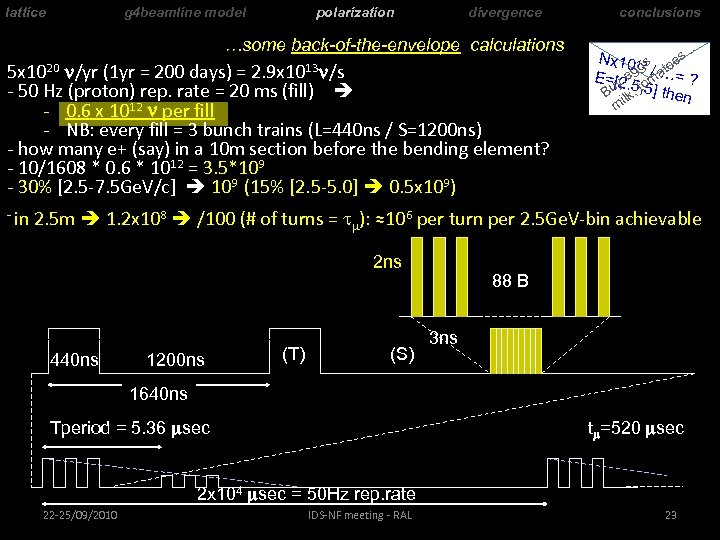 lattice g 4 beamline model polarization divergence …some back-of-the-envelope calculations 5 x 10²⁰ n/yr (1 yr = 200 days) = 2. 9 x 10¹³ n/s - 50 Hz (proton) rep. rate = 20 ms (fill) - 0. 6 x 10¹² n per fill - NB: every fill = 3 bunch trains (L=440 ns / S=1200 ns) - how many e+ (say) in a 10 m section before the bending element? - 10/1608 * 0. 6 * 1012 = 3. 5*109 - 30% [2. 5 -7. 5 Ge. V/c] 109 (15% [2. 5 -5. 0] 0. 5 x 10⁹) - in conclusions. . Nx 10 12 s oes g t e ma E=[2. g o/ …= ? y 5 Bu ilk, , t 5] then m 2. 5 m 1. 2 x 10⁸ /100 (# of turns = tm): ≈106 per turn per 2. 5 Ge. V-bin achievable 2 ns 440 ns 1200 ns (T) (S) 88 B 3 ns 1640 ns Tperiod = 5. 36 msec tm=520 msec 2 x 10⁴ msec = 50 Hz rep. rate 22 -25/09/2010 IDS-NF meeting - RAL 23
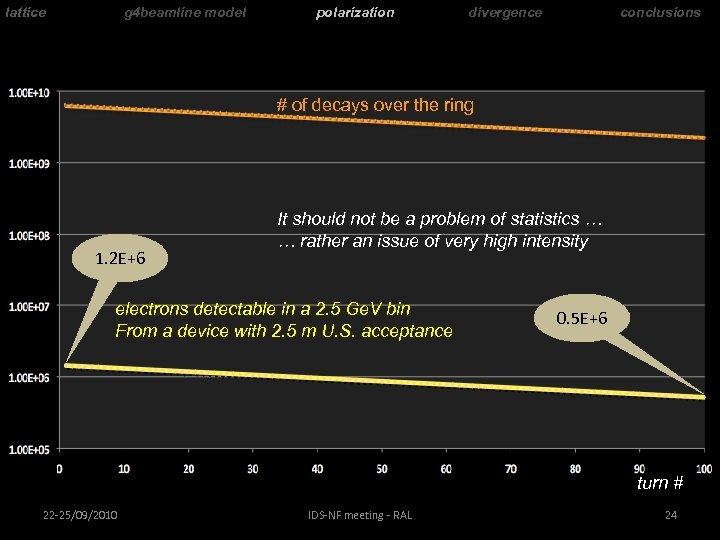 lattice g 4 beamline model polarization divergence conclusions # of decays over the ring 1. 2 E+6 It should not be a problem of statistics … … rather an issue of very high intensity electrons detectable in a 2. 5 Ge. V bin From a device with 2. 5 m U. S. acceptance 0. 5 E+6 turn # 22 -25/09/2010 IDS-NF meeting - RAL 24
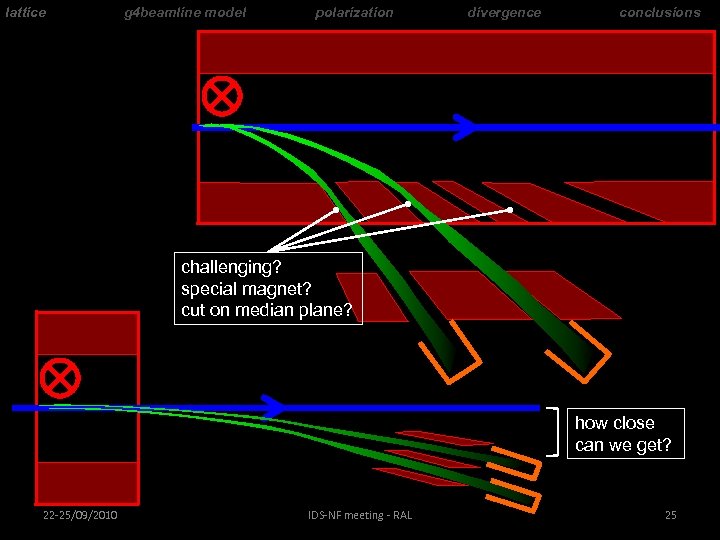 lattice g 4 beamline model polarization divergence conclusions challenging? special magnet? cut on median plane? how close can we get? 22 -25/09/2010 IDS-NF meeting - RAL 25
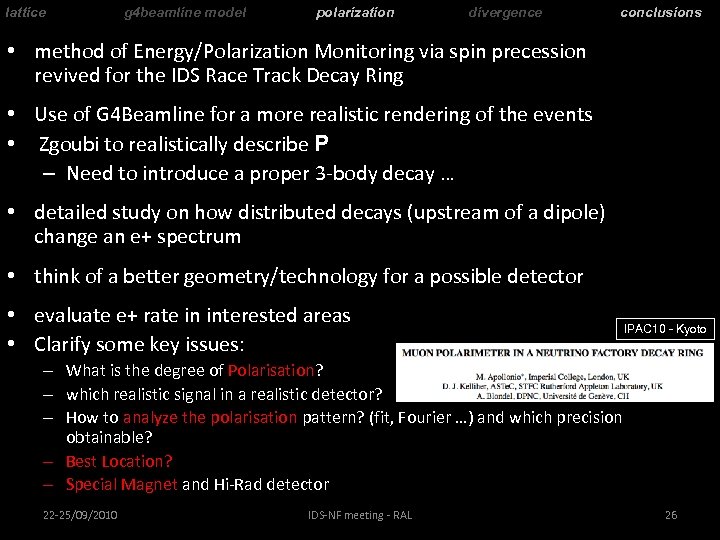 lattice g 4 beamline model polarization divergence conclusions • method of Energy/Polarization Monitoring via spin precession revived for the IDS Race Track Decay Ring • Use of G 4 Beamline for a more realistic rendering of the events • Zgoubi to realistically describe P – Need to introduce a proper 3 -body decay … • detailed study on how distributed decays (upstream of a dipole) change an e+ spectrum • think of a better geometry/technology for a possible detector • evaluate e+ rate in interested areas • Clarify some key issues: IPAC 10 - Kyoto – What is the degree of Polarisation? – which realistic signal in a realistic detector? – How to analyze the polarisation pattern? (fit, Fourier …) and which precision obtainable? – Best Location? – Special Magnet and Hi-Rad detector 22 -25/09/2010 IDS-NF meeting - RAL 26
 lattice g 4 beamline model polarization divergence conclusions Divergence Measurement Reminder:
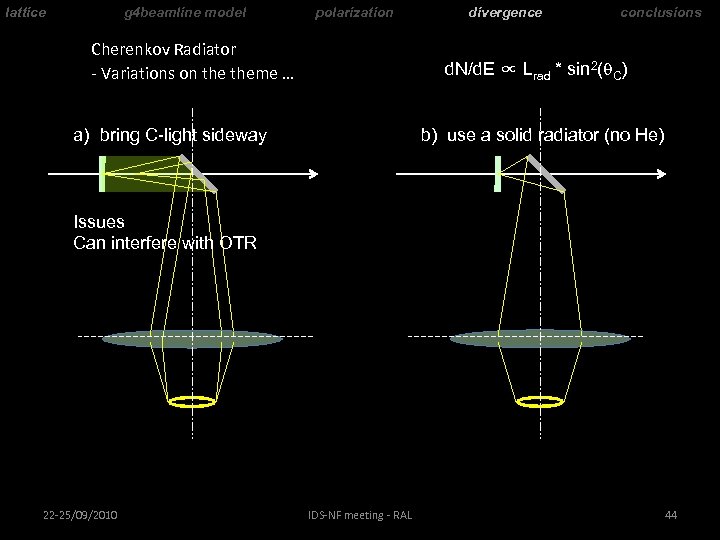
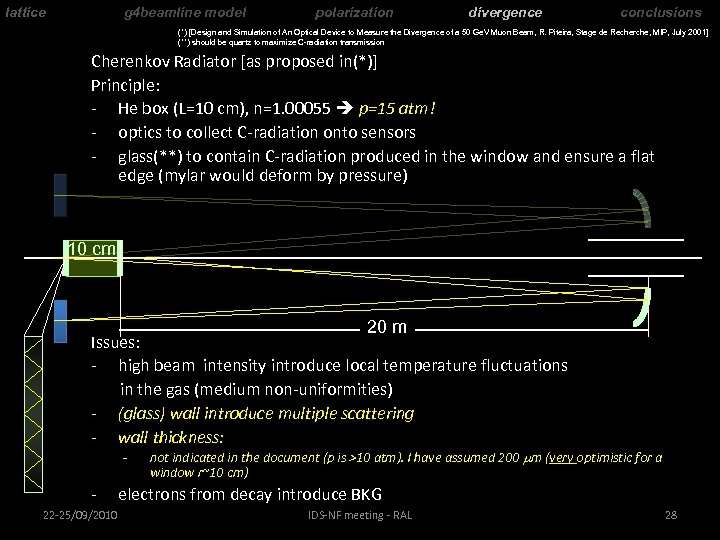 lattice g 4 beamline model polarization divergence conclusions (*) [Design and Simulation of An Optical Device to Measure the Divergence of a 50 Ge. V Muon Beam, R. Piteira, Stage de Recherche, MIP, July 2001] (**) should be quartz to maximize C-radiation transmission Cherenkov Radiator [as proposed in(*)] Principle: - He box (L=10 cm), n=1. 00055 p=15 atm! - optics to collect C-radiation onto sensors - glass(**) to contain C-radiation produced in the window and ensure a flat edge (mylar would deform by pressure) 10 cm 20 m Issues: - high beam intensity introduce local temperature fluctuations in the gas (medium non-uniformities) - (glass) wall introduce multiple scattering - wall thickness: - 22 -25/09/2010 not indicated in the document (p is >10 atm). I have assumed 200 mm (very optimistic for a window r~10 cm) electrons from decay introduce BKG IDS-NF meeting - RAL 28
 lattice g 4 beamline model polarization divergence conclusions Q. : - Why n=1. 00055 (natm=1. 000036) ? - q. C=33 mrad (q. C=8. 5 mrad) - This would require an optical system 4 x longer - mirrors must be out of the beam - keep same resolving power - distance(QF – QD) ~ 30 m - The Low Pressure solution is not an option with this geometry 22 -25/09/2010 IDS-NF meeting - RAL 29
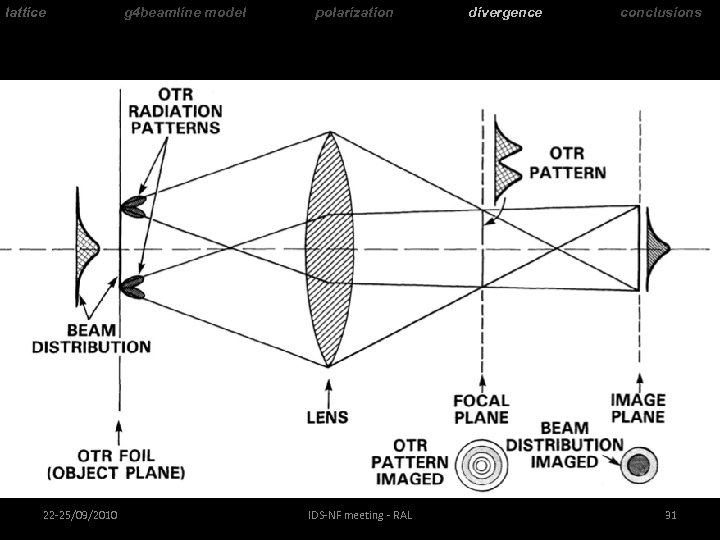
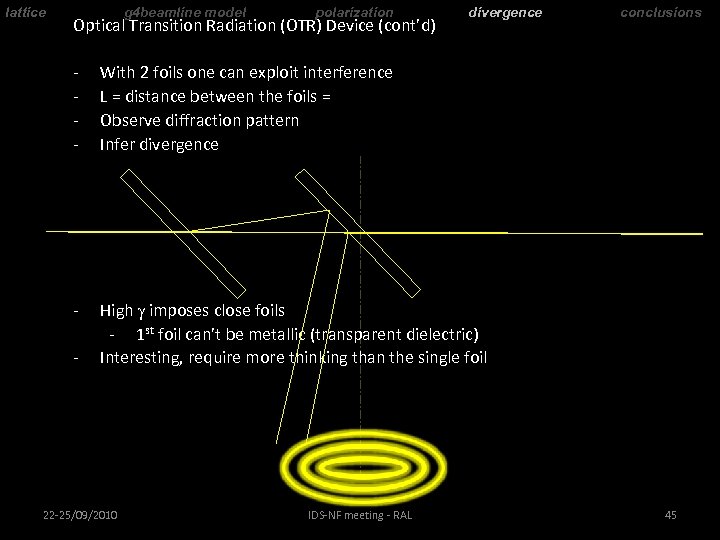
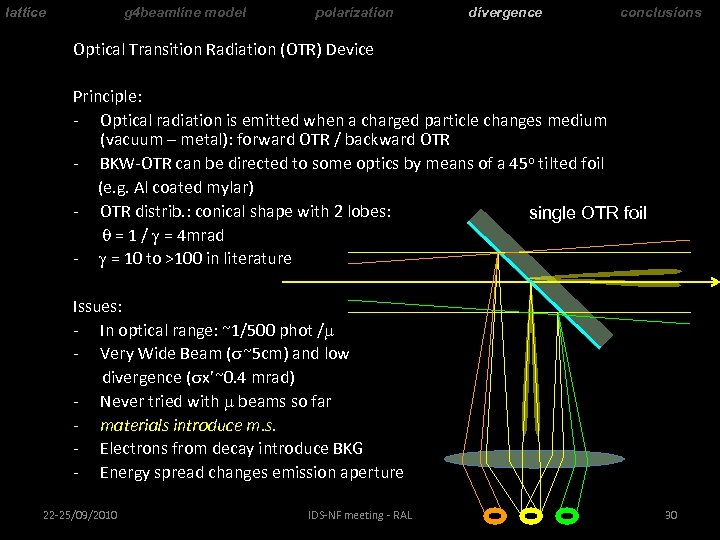 lattice g 4 beamline model polarization divergence conclusions Optical Transition Radiation (OTR) Device Principle: - Optical radiation is emitted when a charged particle changes medium (vacuum – metal): forward OTR / backward OTR - BKW-OTR can be directed to some optics by means of a 45 o tilted foil (e. g. Al coated mylar) - OTR distrib. : conical shape with 2 lobes: single OTR foil q = 1 / g = 4 mrad - g = 10 to >100 in literature Issues: - In optical range: ~1/500 phot /m - Very Wide Beam (s~5 cm) and low divergence (sx’~0. 4 mrad) - Never tried with m beams so far - materials introduce m. s. - Electrons from decay introduce BKG - Energy spread changes emission aperture 22 -25/09/2010 IDS-NF meeting - RAL 30
 lattice 22 -25/09/2010 g 4 beamline model polarization IDS-NF meeting - RAL divergence conclusions 31
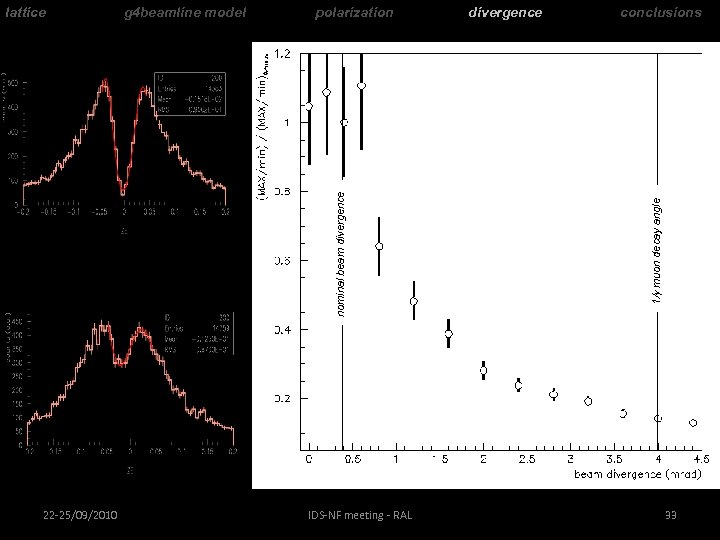
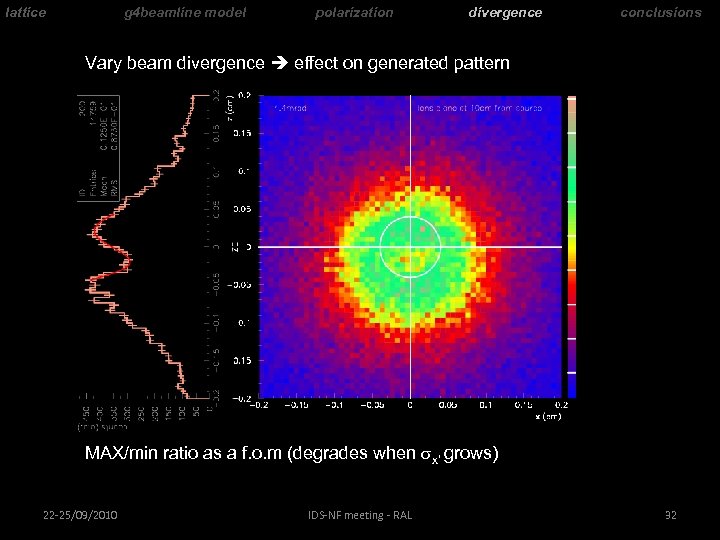 lattice g 4 beamline model polarization divergence conclusions Vary beam divergence effect on generated pattern MAX/min ratio as a f. o. m (degrades when sx’ grows) 22 -25/09/2010 IDS-NF meeting - RAL 32
 polarization 22 -25/09/2010 IDS-NF meeting - RAL divergence conclusions 1/g muon decay angle g 4 beamline model nominal beam divergence lattice 33
 lattice g 4 beamline model polarization divergence conclusions 0. 6 1012 n per fill m per fill 2 1011 / 88 = 2. 3 109 m per bunch 2300/500 x 106 = 4. 6 x 10⁶ photons in opt. range (per bunch) On a matrix of 3600 pixel 1000 phot / pixel Need to find a suitable sensor 22 -25/09/2010 IDS-NF meeting - RAL 34
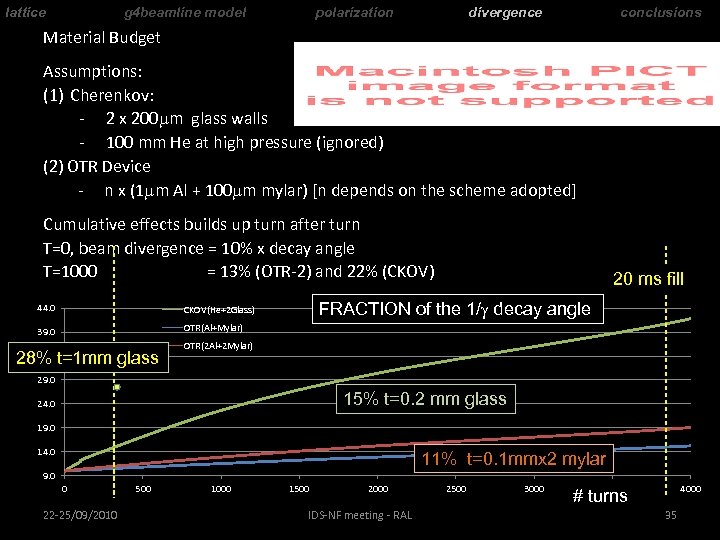 lattice g 4 beamline model polarization divergence conclusions Material Budget Assumptions: (1) Cherenkov: - 2 x 200 mm glass walls - 100 mm He at high pressure (ignored) (2) OTR Device - n x (1 mm Al + 100 mm mylar) [n depends on the scheme adopted] Cumulative effects builds up turn after turn T=0, beam divergence = 10% x decay angle T=1000 = 13% (OTR-2) and 22% (CKOV) 44. 0 FRACTION of the 1/g decay angle CKOV(He+2 Glass) 39. 0 20 ms fill OTR(Al+Mylar) 28% t=1 mm glass 34. 0 OTR(2 Al+2 Mylar) 29. 0 15% t=0. 2 mm glass 24. 0 19. 0 14. 0 11% t=0. 1 mmx 2 mylar 9. 0 0 22 -25/09/2010 500 1000 1500 2000 IDS-NF meeting - RAL 2500 3000 3500 4000 # turns 35
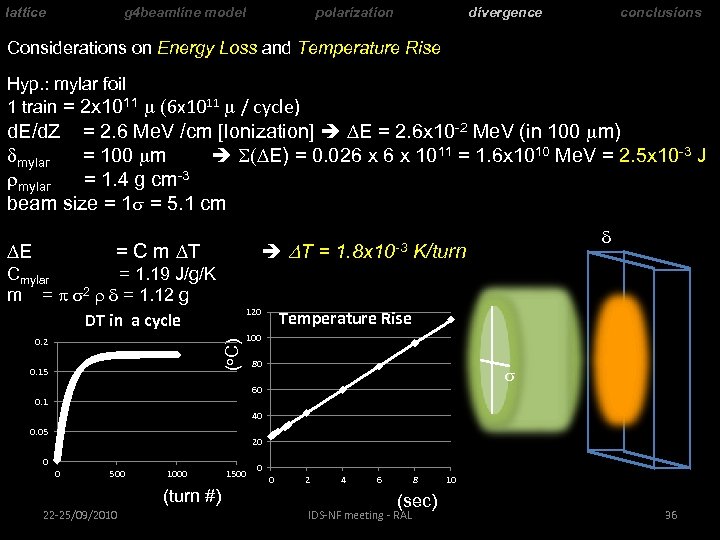 lattice g 4 beamline model polarization divergence conclusions Considerations on Energy Loss and Temperature Rise Hyp. : mylar foil 1 train = 2 x 10¹¹ m (6 x 10¹¹ m / cycle) d. E/d. Z = 2. 6 Me. V /cm [Ionization] DE = 2. 6 x 10 -2 Me. V (in 100 mm) dmylar = 100 mm S(DE) = 0. 026 x 1011 = 1. 6 x 10¹⁰ Me. V = 2. 5 x 10 -3 J rmylar = 1. 4 g cm-3 beam size = 1 s = 5. 1 cm DE DT = = C m DT Cmylar = 1. 19 J/g/K m = p s 2 r d = 1. 12 g DT in a cycle (o. C) 0. 2 120 0. 15 1. 8 x 10 -3 d K/turn Temperature Rise 100 80 s 60 0. 1 40 0. 05 20 0 0 500 1000 (turn #) 22 -25/09/2010 1500 0 0 2 4 6 8 (sec) IDS-NF meeting - RAL 10 36
 lattice g 4 beamline model polarization divergence conclusions Summary of resolutions for beam divergence measurement sy’ = 0. 4 mrad Cherenkov Radiator - smeas 2 = smir 2 + sdiff 2 + stemp 2 smeas = 0. 04 mrad So, divergence should be measurable at a 10% level OTR single foil (*) [Kiu, Wang & Ben-Zvi] / (**)[Rule, Fiorito] - smeas 2 = 12. 5(*) ÷ 15(**)% x 1/g ~ 0. 4 ÷ 0. 5 mrad 100% level - may gain something from optics / sensors used 22 -25/09/2010 IDS-NF meeting - RAL 37
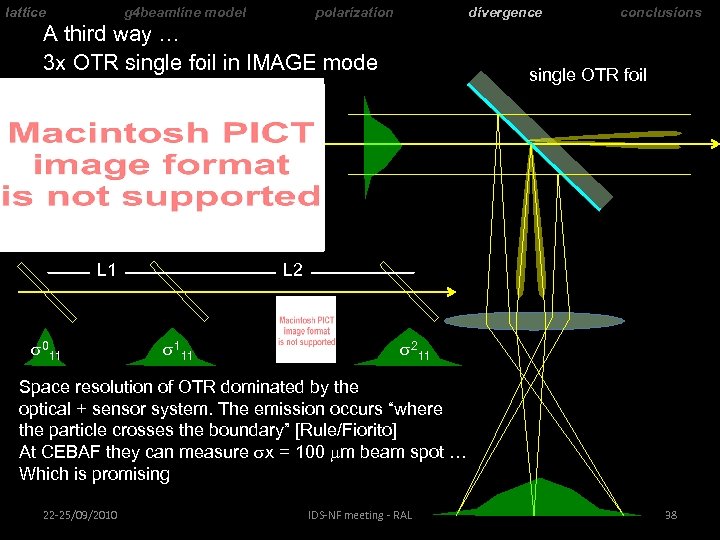 lattice g 4 beamline model polarization divergence A third way … 3 x OTR single foil in IMAGE mode L 1 s 011 conclusions single OTR foil L 2 s 111 s 211 Space resolution of OTR dominated by the optical + sensor system. The emission occurs “where the particle crosses the boundary” [Rule/Fiorito] At CEBAF they can measure sx = 100 mm beam spot … Which is promising 22 -25/09/2010 IDS-NF meeting - RAL 38
 lattice g 4 beamline model SUMMARY polarization divergence conclusions - Measurement on beam divergence reviewed (3 techniques considered) a) CHERENKOV radiator b. 1) OTR focal plane b. 2) OTR imaging (a) - promising resolution - some effects (e. g. thick glass walls) neglected - the proposed system looks very impractical. (b. 1) - direct measurement of divergence - resolution probably < needs of Physics - thin windows reduce m. s. - cooling over time needed. (b. 2) - beam spots reconstructed - divergence (emittance) reconstructed by means of standard techniques. - requires at least 3 stations. - resolution to be assessed. - cooling needed. 22 -25/09/2010 IDS-NF meeting - RAL 39
 lattice g 4 beamline model polarization divergence conclusions observation on costing … - after C. Bontoiu’s talk (need for a technical design) - Real Magnet design - missing (important!) - e. g. effect of e- decay in the SC bending elements ! - Polarimeter - at a conceptual stage - real magnets design missing - detector design missing - Divergence Monitor - conceptual stage - need decision on a baseline choice - detector design missing - Current meter - not yet assessed - assumed “easier” - NOTE: a) Cost of a monitor should be a “small” fraction of the ring’s b) However decision on magnet design to accommodate a detector could drive some costs 22 -25/09/2010 IDS-NF meeting - RAL 40
 End / Spares 22 -25/09/2010 IDS-NF meeting - RAL 41
 lattice g 4 beamline model First Dipole of the Arc section B= -4. 27 T / L=2. 0 m spin depolarisation ideal case detector issues conclusions First Dipole of the matching section B= -0. 64 T / L=4. 0 m elmon 2 low P e- elmon 1 elmon 5 elmon 4 force m decay 22 -25/09/2010 IDS-NF meeting - RAL 42
 lattice g 4 beamline model spin depolarisation ideal case detector issues conclusions [7. 0, 8. 0] Ge. V/c 0. 2 [9, 10] Ge. V/c [10, 11] Ge. V/c [11, 12] Ge. V/c 0 [8. 0, 9. 0] Ge. V/c [12, 13] Ge. V/c [13, 14] Ge. V/c [14, 15] Ge. V/c 0. 4 0. 6 0. 8 22 -25/09/2010 1. 2 0 0. 2 0. 4 0. 6 0. 8 1. 0 1. 2 0 IDS-NF meeting - RAL 0. 2 0. 4 0. 6 0. 8 1. 0 1. 2 0 0. 2 0. 4 0. 6 0. 8 1. 0 43 1. 2
 lattice g 4 beamline model polarization Cherenkov Radiator - Variations on theme … divergence conclusions d. N/d. E ∝ Lrad * sin 2(q. C) a) bring C-light sideway b) use a solid radiator (no He) Issues Can interfere with OTR 22 -25/09/2010 IDS-NF meeting - RAL 44
 lattice g 4 beamline model polarization Optical Transition Radiation (OTR) Device (cont’d) divergence - With 2 foils one can exploit interference L = distance between the foils = Observe diffraction pattern Infer divergence - conclusions High g imposes close foils - 1 st foil can’t be metallic (transparent dielectric) Interesting, require more thinking than the single foil - 22 -25/09/2010 IDS-NF meeting - RAL 45
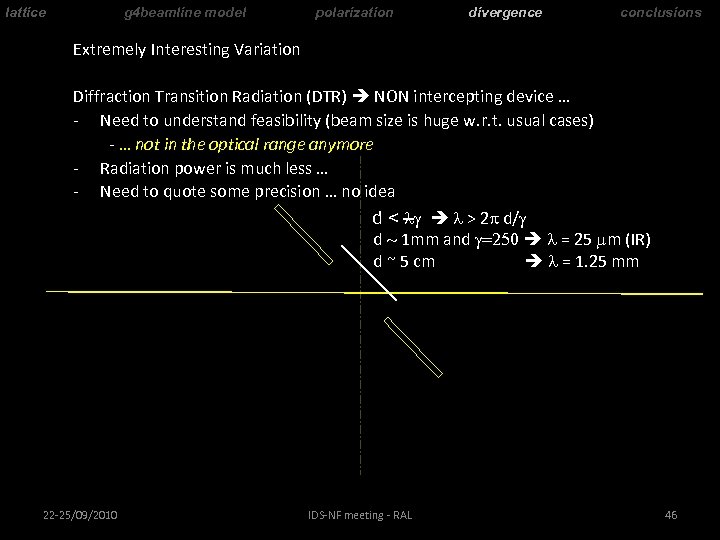 lattice g 4 beamline model polarization divergence conclusions Extremely Interesting Variation Diffraction Transition Radiation (DTR) NON intercepting device … - Need to understand feasibility (beam size is huge w. r. t. usual cases) - … not in the optical range anymore - Radiation power is much less … - Need to quote some precision … no idea d < lg l > 2 p d/g d ~ 1 mm and g=250 l = 25 mm (IR) d ~ 5 cm l = 1. 25 mm 22 -25/09/2010 IDS-NF meeting - RAL 46
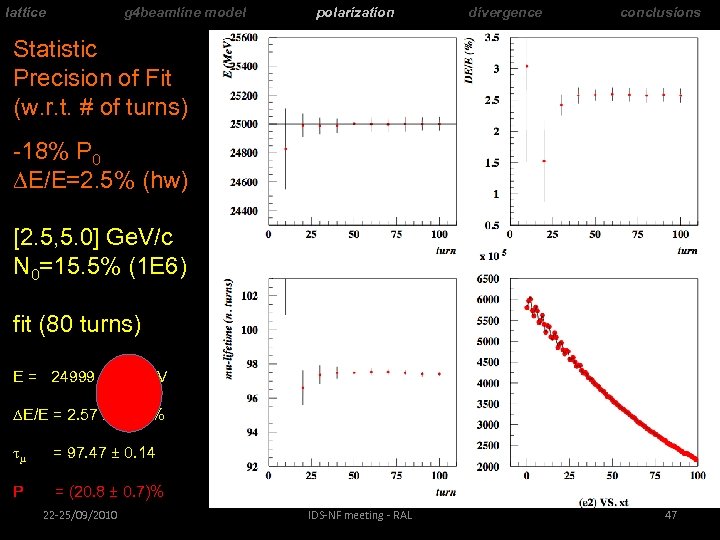 lattice g 4 beamline model polarization divergence conclusions Statistic Precision of Fit (w. r. t. # of turns) -18% P 0 DE/E=2. 5% (hw) [2. 5, 5. 0] Ge. V/c N 0=15. 5% (1 E 6) fit (80 turns) E = 24999 ± 49 Me. V DE/E = 2. 57 ± 0. 12 % tm = 97. 47 ± 0. 14 P = (20. 8 ± 0. 7)% 22 -25/09/2010 IDS-NF meeting - RAL 47
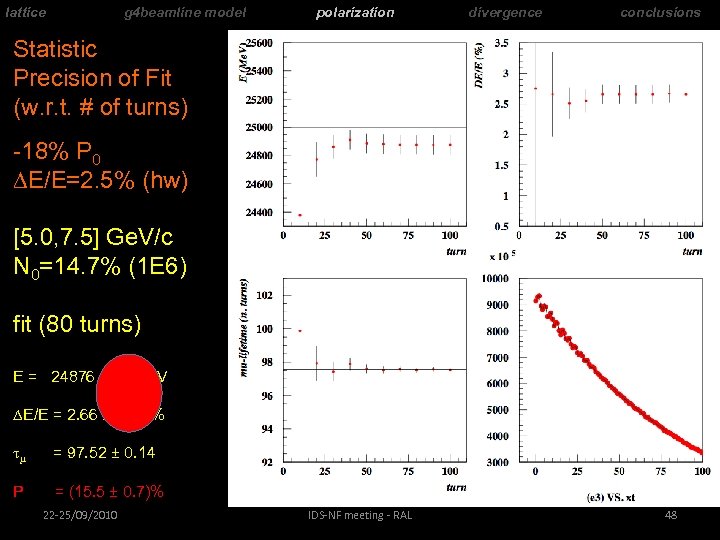 lattice g 4 beamline model polarization divergence conclusions Statistic Precision of Fit (w. r. t. # of turns) -18% P 0 DE/E=2. 5% (hw) [5. 0, 7. 5] Ge. V/c N 0=14. 7% (1 E 6) fit (80 turns) E = 24876 ± 68 Me. V DE/E = 2. 66 ± 0. 15 % tm = 97. 52 ± 0. 14 P = (15. 5 ± 0. 7)% 22 -25/09/2010 IDS-NF meeting - RAL 48
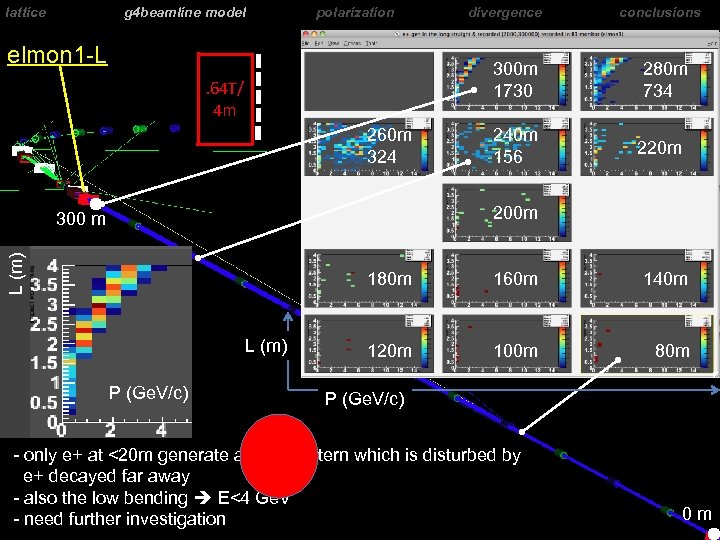 lattice g 4 beamline model polarization elmon 1 -L divergence 300 m 1730 . 64 T/ 4 m 260 m 324 240 m 156 conclusions 280 m 734 220 m 200 m L (m) 300 m 180 m L (m) P (Ge. V/c) 160 m 140 m 120 m 100 m 80 m P (Ge. V/c) - only e+ at <20 m generate a clear pattern which is disturbed by e+ decayed far away - also the low bending E<4 Ge. V 22 -25/09/2010 IDS-NF meeting - RAL - need further investigation 49 0 m
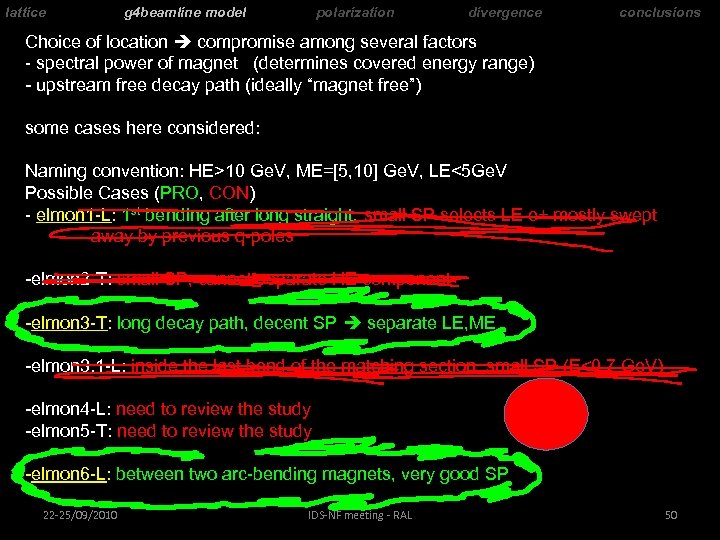 lattice g 4 beamline model polarization divergence conclusions Choice of location compromise among several factors - spectral power of magnet (determines covered energy range) - upstream free decay path (ideally “magnet free”) some cases here considered: Naming convention: HE>10 Ge. V, ME=[5, 10] Ge. V, LE<5 Ge. V Possible Cases (PRO, CON) - elmon 1 -L: 1 st bending after long straight, small SP selects LE e+ mostly swept away by previous q-poles -elmon 2 -T: small SP, cannot separate HE component -elmon 3 -T: long decay path, decent SP separate LE, ME -elmon 3. 1 -L: inside the last bend of the matching section, small SP (E<0. 7 Ge. V) -elmon 4 -L: need to review the study -elmon 5 -T: need to review the study -elmon 6 -L: between two arc-bending magnets, very good SP 22 -25/09/2010 IDS-NF meeting - RAL 50
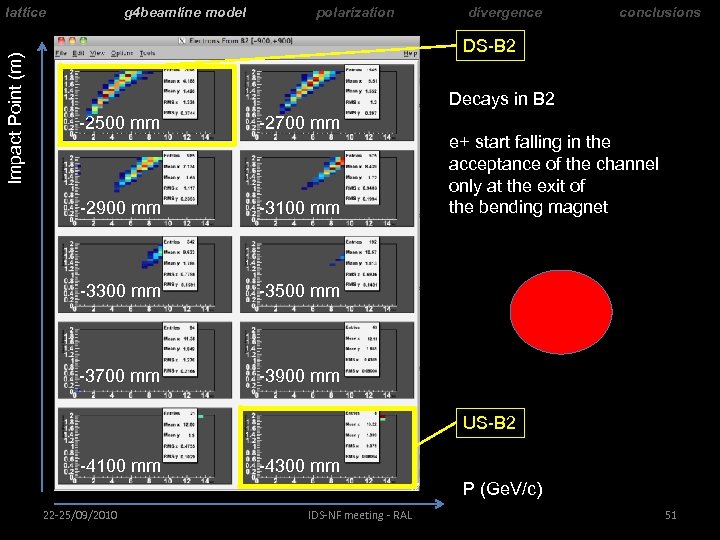 Impact Point (m) lattice g 4 beamline model polarization divergence conclusions DS-B 2 Decays in B 2 -2500 mm -2700 mm -2900 mm -3100 mm -3300 mm -3500 mm -3700 mm -3900 mm e+ start falling in the acceptance of the channel only at the exit of the bending magnet US-B 2 -4100 mm -4300 mm P (Ge. V/c) 22 -25/09/2010 IDS-NF meeting - RAL 51
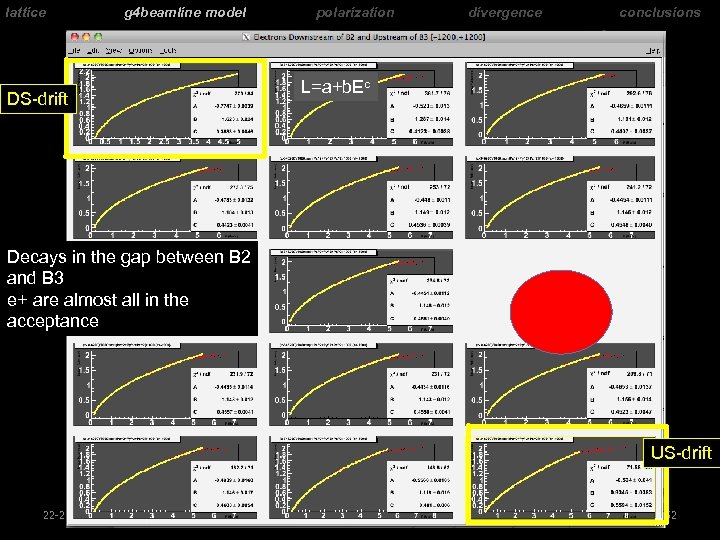 lattice g 4 beamline model polarization divergence conclusions L=a+b. Ec DS-drift 0 mm Decays in the gap between B 2 and B 3 e+ are almost all in the acceptance US-drift -2400 mm 22 -25/09/2010 IDS-NF meeting - RAL 52
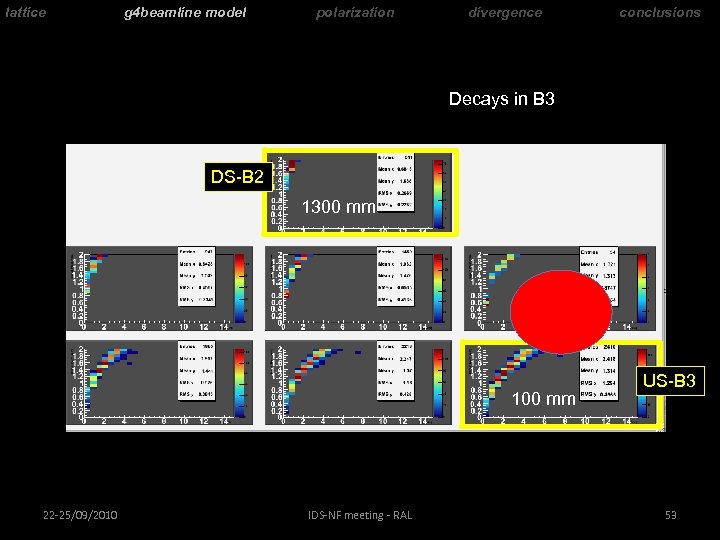 lattice g 4 beamline model polarization divergence conclusions Decays in B 3 DS-B 2 1300 mm 100 mm 22 -25/09/2010 IDS-NF meeting - RAL US-B 3 53