


 Скачать презентацию Storage of Semantic Information Connectionist approach Collins
6dbd2b4f98c3621e9741cc938de73d35.ppt
- Количество слайдов: 11
 Storage of Semantic Information • Connectionist approach (Collins & Quillian, 1969) -operational version of Bower’s (1967) Multiple Trace Theory emphasising a network of associations Storage of Episodic Information • Schema Theory (Shank, 1975) - embodies Bartlett’s (1932) notion of effort after meaning and emphasises the role of past experience and expectation. examples
 Schema Theory What is a Schema? “A mental model or representation built up through experience about a person, an object, a situation, or an event. ” (Head, 1920) “Organised structures that capture knowledge and expectations of some aspect of the world. ” (Bartlett, 1932)
 Excerpt from ‘War of the Ghosts’ (Bartlett, 1932) • … and the young man went ashore to his house and made a fire. • And he told everybody and said, “Behold, I accompanied the ghosts, and we went to a fight. • Many of our fellows were killed, • And many of those who attacked us were killed. • And they said I was hit • And I did not feel sick. ” • He told it all, • And they be became quiet. • When the sun rose, he fell down. • Something black came out of his mouth. • His face became contorted. • The people jumped up and cried. • He was dead.
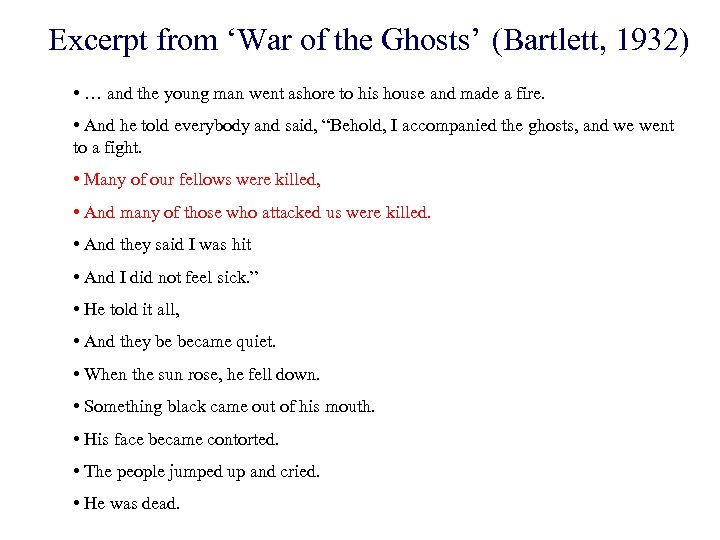 Excerpt from ‘War of the Ghosts’ (Bartlett, 1932) • … and the young man went ashore to his house and made a fire. • And he told everybody and said, “Behold, I accompanied the ghosts, and we went to a fight. • Many of our fellows were killed, • And many of those who attacked us were killed. • And they said I was hit • And I did not feel sick. ” • He told it all, • And they be became quiet. • When the sun rose, he fell down. • Something black came out of his mouth. • His face became contorted. • The people jumped up and cried. • He was dead.
 Excerpt from ‘War of the Ghosts’ (Bartlett, 1932) • … and the young man went ashore to his house and made a fire. • And he told everybody and said, “Behold, I accompanied the ghosts, and we went to a fight. • Many of our fellows were killed, • And many of those who attacked us were killed. • And they said I was hit • And I did not feel sick. ” • He told it all, • And they be became quiet. • When the sun rose, he fell down. • Something black came out of his mouth. • His face became contorted. • The people jumped up and cried. • He was dead.
 Excerpt from ‘War of the Ghosts’ (Bartlett, 1932) • … and the young man went ashore to his house and made a fire. • And he told everybody and said, “Behold, I accompanied the ghosts, and we went to a fight. • Many of our fellows were killed, • And many of those who attacked us were killed. • And they said I was hit • And I did not feel sick. ” • He told it all, • And they be became quiet. • When the sun rose, he fell down. • Something black came out of his mouth. • His face became contorted. • The people jumped up and cried. • He was dead.
 Excerpt from ‘War of the Ghosts’ (Bartlett, 1932) • … and the young man went ashore to his house and made a fire. • And he told everybody and said, “Behold, I accompanied the ghosts, and we went to a fight. • Many of our fellows were killed, • And many of those who attacked us were killed. • And they said I was hit • And I did not feel sick. ” • He told it all, • And they be became quiet. • When the sun rose, he fell down. • Something black came out of his mouth. • His face became contorted. • The people jumped up and cried. • He was dead.
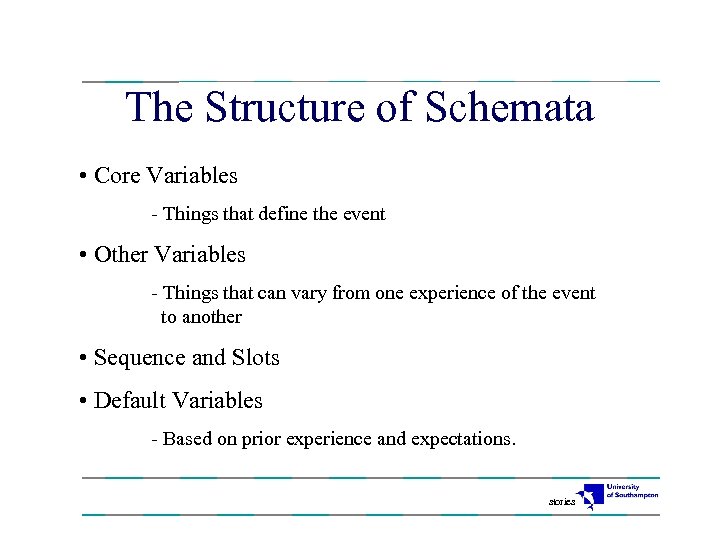 The Structure of Schemata • Core Variables - Things that define the event • Other Variables - Things that can vary from one experience of the event to another • Sequence and Slots • Default Variables - Based on prior experience and expectations. stories
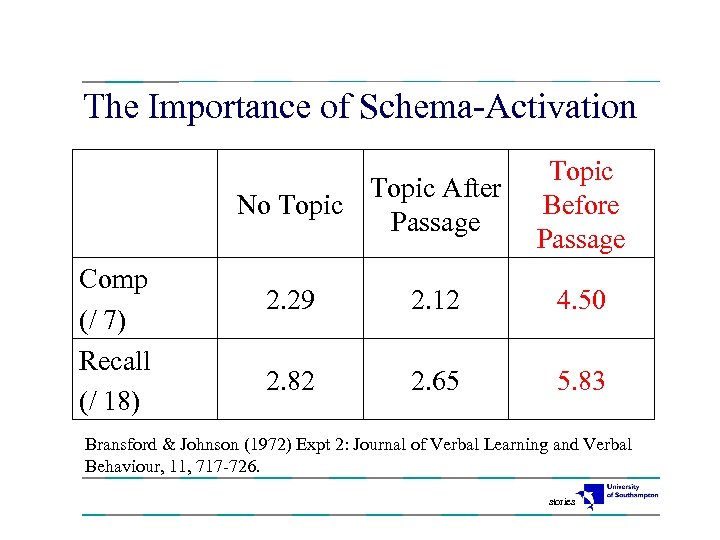 The Importance of Schema-Activation Topic After No Topic Passage Comp (/ 7) Recall (/ 18) Topic Before Passage 2. 29 2. 12 4. 50 2. 82 2. 65 5. 83 Bransford & Johnson (1972) Expt 2: Journal of Verbal Learning and Verbal Behaviour, 11, 717 -726. stories
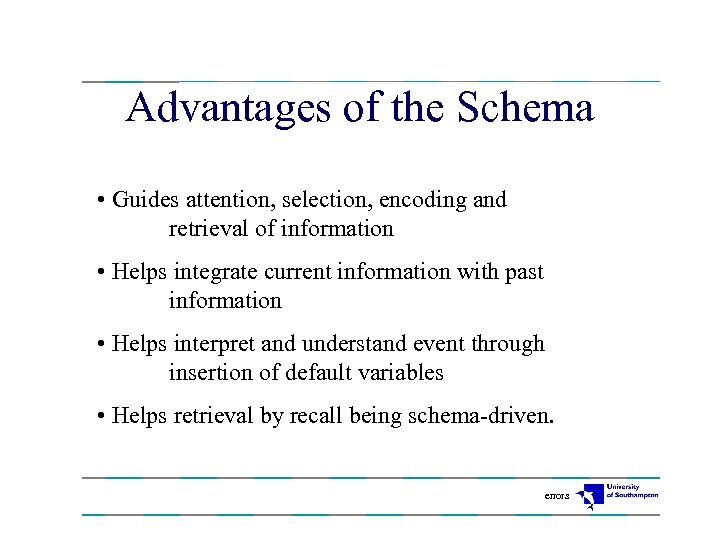 Advantages of the Schema • Guides attention, selection, encoding and retrieval of information • Helps integrate current information with past information • Helps interpret and understand event through insertion of default variables • Helps retrieval by recall being schema-driven. errors
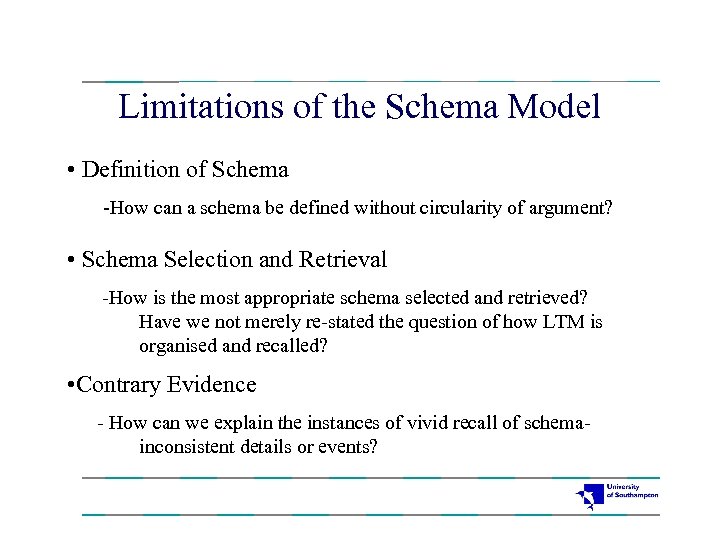 Limitations of the Schema Model • Definition of Schema -How can a schema be defined without circularity of argument? • Schema Selection and Retrieval -How is the most appropriate schema selected and retrieved? Have we not merely re-stated the question of how LTM is organised and recalled? • Contrary Evidence - How can we explain the instances of vivid recall of schemainconsistent details or events?