


 Скачать презентацию STORAGE MANAGEMENT GETTING STARTED Storage Management 101 Everything
c9d1378249a2ced0d3492a7cef43b0d0.ppt
- Количество слайдов: 25
 STORAGE MANAGEMENT/ GETTING STARTED: Storage Management 101 Everything you always wanted to know about Storage Management (but were afraid to ask) Stephen Foskett Practice Manager Glass. House Technologies
 Agenda l The utility model l Building a storage management team l Break l Storage management processes l Storage management tools
 The basics l IT is made up of people, process and technology l Mature processes enable strategic IT: • • • Leverage “utility” concepts • Select tools to enable consistency and streamline processes Build an effective storage management group Use “maturity” concept to drive process improvements
 The utility model l Utilities offer fixed centralized services to consumers l Benefits of the utility model: • • Reduced costs through resource sharing • Alignment of service and requirements through SLAs Improved service through specialization and standardization
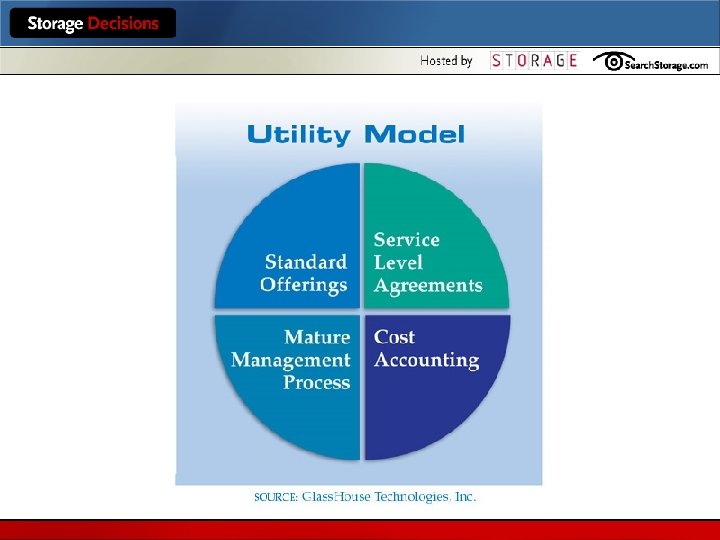 Systems Administrators Hardware Policies Software Policies Configuration Processes Business Analysts Policies Requirements Analysis Service Level Agreements Operations Standard Procedures Monitoring Escalation IT Management Metrics Cost Modeling Chargeback
 Getting started 1. Create a centralized storage group 2. Develop strategic policies and standard architecture 3. Say no to ad-hoc purchases 4. Migrate and consolidate what you have 5. Proactively develop SLAs and begin reporting
 Building a storage management group l Requirements: • • • Dedicated focused resources Ownership of infrastructure Empowerment to control purchases l Start with the people and architecture already in place
 Align resources with requirements l Most storage groups are under-staffed l Risks abound: • • • Lack of technology coverage (vacations, nights) Lack of focus (storage, backup, operations) Failure to align technology with business l Define roles/responsibilities and boundaries
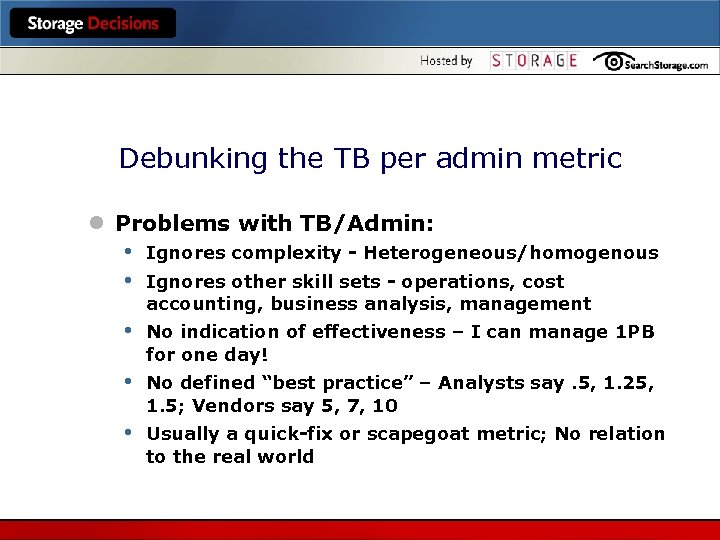 Debunking the TB per admin metric l Problems with TB/Admin: • • Ignores complexity - Heterogeneous/homogenous • No indication of effectiveness – I can manage 1 PB for one day! • No defined “best practice” – Analysts say. 5, 1. 25, 1. 5; Vendors say 5, 7, 10 • Usually a quick-fix or scapegoat metric; No relation to the real world Ignores other skill sets - operations, cost accounting, business analysis, management
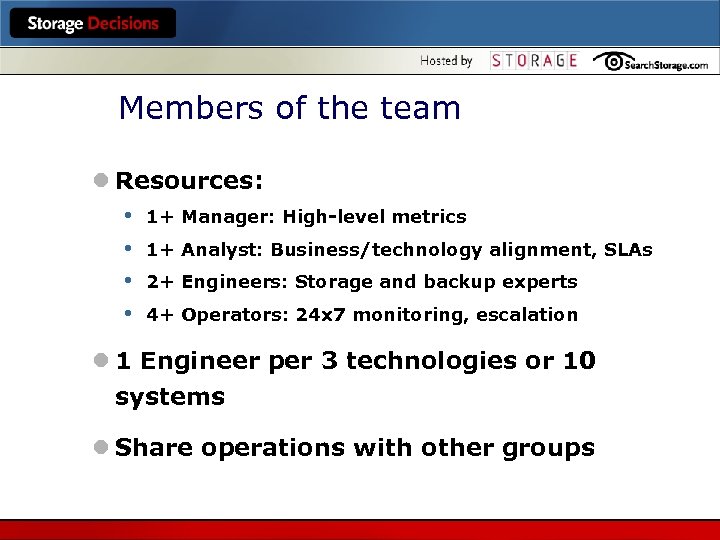 Members of the team l Resources: • 1+ Manager: High-level metrics • 1+ Analyst: Business/technology alignment, SLAs • 2+ Engineers: Storage and backup experts • 4+ Operators: 24 x 7 monitoring, escalation l 1 Engineer per 3 technologies or 10 systems l Share operations with other groups
 Thank you. Questions on part 1?
 Please rate the content of Stephen Foskett’s talk, “Storage Management 101, part 1. ” 1. 2. 3. 4. 5. 0/0 Poor Fair Good Very Good Excellent
 Please rate Stephen Foskett’s presentation as a speaker. 1. 2. 3. 4. 5. 0/0 Poor Fair Good Very Good Excellent
 STORAGE MANAGEMENT/ GETTING STARTED: Storage Management 101, part 2 Everything you always wanted to know about Storage Management (but were afraid to ask) Stephen Foskett Practice Manager Glass. House Technologies
 Understanding process and procedure l Mature management processes is one “leg” of the utility model l Ad hoc process becomes Standard Operating Procedure (SOP) through maturity l ITIL and Glass. House SMLSM are frameworks for understanding processes
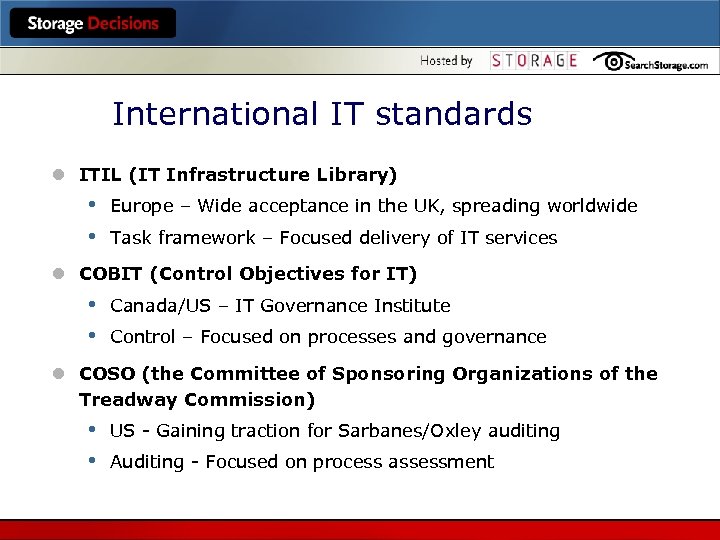 International IT standards l ITIL (IT Infrastructure Library) • • Europe – Wide acceptance in the UK, spreading worldwide Task framework – Focused delivery of IT services l COBIT (Control Objectives for IT) • • Canada/US – IT Governance Institute Control – Focused on processes and governance l COSO (the Committee of Sponsoring Organizations of the Treadway Commission) • • US - Gaining traction for Sarbanes/Oxley auditing Auditing - Focused on process assessment
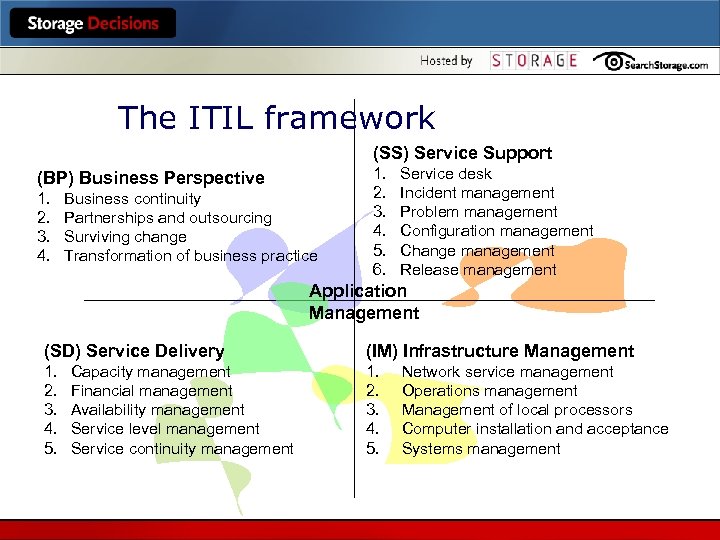 The ITIL framework (SS) Service Support (BP) Business Perspective 1. 2. 3. 4. Business continuity Partnerships and outsourcing Surviving change Transformation of business practice 1. 2. 3. 4. 5. 6. Service desk Incident management Problem management Configuration management Change management Release management Application Management (SD) Service Delivery (IM) Infrastructure Management 1. 2. 3. 4. 5. Capacity management Financial management Availability management Service level management Service continuity management Network service management Operations management Management of local processors Computer installation and acceptance Systems management
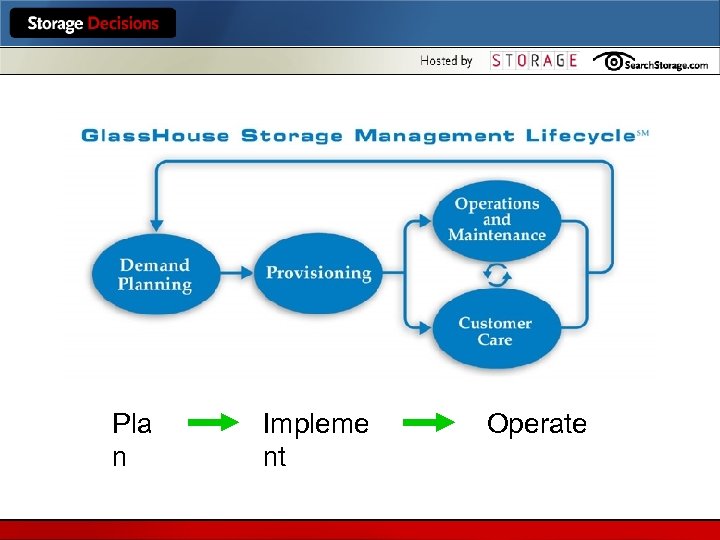 Pla n Impleme nt Operate
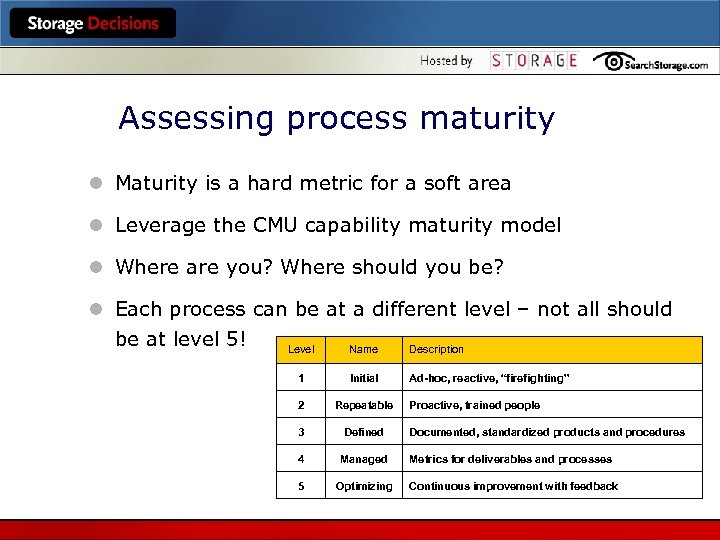 Assessing process maturity l Maturity is a hard metric for a soft area l Leverage the CMU capability maturity model l Where are you? Where should you be? l Each process can be at a different level – not all should be at level 5! Level Name Description 1 Initial Ad-hoc, reactive, “firefighting” 2 Repeatable 3 Defined 4 Managed Metrics for deliverables and processes 5 Optimizing Continuous improvement with feedback Proactive, trained people Documented, standardized products and procedures
 Processes and tools l Outline your management processes – leverage ITIL or Glass. House SML l Understand what you need to do – which processes need automation? l Buy tools to support critical processes
 Tool confusion l There are no standard category names: • Storage Resource Management (SRM) usually analyzes host storage contents (number, type, attributes of files) but not always • Different storage management suites have different functions l Suites are lacking: • Many “suites” do not offer SRM or device management functionality • Hardware vendors dominate management suite business
 Package-based approach l Software packages are purchased arbitrarily: • • • Hardware vendor’s suggestion Giveaways Media coverage/Advertising l Hit or miss coverage of business needs
 Selecting storage management software l Look for software offering just what you need l Minimize number of tools: • • Lack of integration options Complexity = Confusion l Look beyond “suites”
 Commonly needed management tools l Enterprise backup – Essential l Backup reporting – Success rate, failures, needs customization l Utilization reporting – Who is using what resources, needs customization l Architecture visualization – Enables engineers to understand environment l SNMP framework – Send traps to operations
 Rarely used management tools l Traditional SRM – One-shot wonder l Automated provisioning – Requires mature processes, saves little time l Automated cost accounting – Needs massive customization l Process/Policy automation – Are you ready?